Market Snapshot
- Market Size (2026): USD 2.6 Bn
- Forecast Value (2035): USD 10.3 Bn
- CAGR (2026-2035): 16.5%
- Leading Messaging Channel (2026): SMS, around 48%
- Leading Application (2026): OTP & Authentication, close to 38%
- Key Players: Gupshup, Route Mobile, Tanla Platforms and others
What is India A2P Messaging Market and its Market Size?
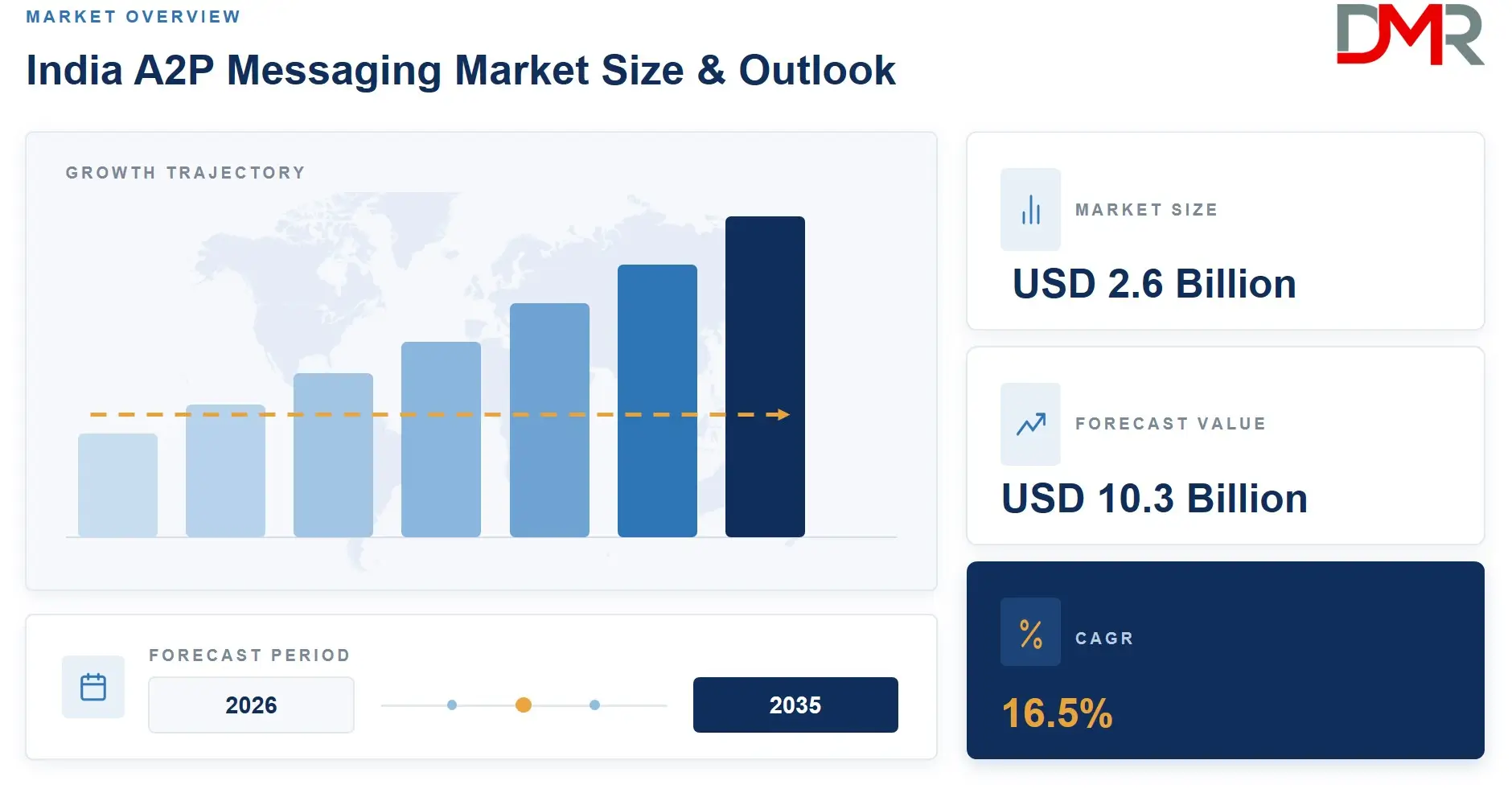
The India A2P Messaging Market size is estimated to reach USD 2.6 Bn in 2026 and is further anticipated to reach USD 10.3 Bn by 2035, at a CAGR of 16.5%.
ℹ
To learn more about this report –
Download Your Free Sample Report Here
Application-to-person messaging covers automated communication that enterprise systems push to individual mobile subscribers across SMS, WhatsApp Business API and other OTT chat rails, RCS business messaging and voice-triggered alerts, distinct from person-to-person traffic carried on the same networks. In India, every commercial sender must scrub its message templates and headers against the Telecom Regulatory Authority of India's Distributed Ledger Technology platform before an operator or licensed aggregator will deliver a single message, which makes registration status the practical gate on market entry. The figures in this report cover messaging volume and platform revenue billed for delivery inside India; they exclude the worldwide revenue that India-headquartered aggregators such as Gupshup or Route Mobile earn from clients based outside the country.
Banks, non-banking financial companies and UPI-linked payment apps are the largest buyers because every transaction carries a mandatory one-time password, and e-commerce, food delivery and ride-hailing platforms follow closely for order and dispatch updates. Government departments, utilities and hospital networks add a steady base of bill, tax and appointment notifications, while smaller retailers and local service businesses increasingly reach customers through templated WhatsApp Business API messages rather than bulk SMS blasts. Purchasing typically runs through a CPaaS aggregator rather than a direct telecom contract, since the aggregator absorbs the compliance burden of sender ID registration and multi-operator routing.
Two shifts are reshaping the market at once. Enterprises are migrating a growing share of non-transactional traffic away from plain SMS toward rich, two-way channels, WhatsApp Business API foremost and RCS Business Messaging close behind as Reliance Jio and Bharti Airtel extend carrier support nationally. At the same time, repeated tightening of the DLT scrubbing mandate since 2023 has pushed volume away from unregistered direct-to-telco routes and toward compliance-managed aggregator platforms, consolidating spend among a smaller set of vendors that can guarantee delivery.
Use Cases
- BFSI OTP Delivery: Banks and UPI-linked payment apps trigger DLT-scrubbed one-time passwords for every login and transaction, relying on multi-operator SMS routing to guarantee delivery within seconds even during peak settlement windows.
- E-commerce Order Updates: Online retailers and quick-commerce platforms use WhatsApp Business API templates to confirm orders, share live courier tracking links and collect delivery feedback, replacing separate SMS and app-push workflows with one conversational thread.
- Hospital Appointment Reminders: Multi-city hospital chains combine SMS and voice-based messaging to confirm bookings, remind patients ahead of procedures and share lab result availability, cutting missed-appointment rates across outpatient departments.
- Government Bill and Tax Notices: State utilities and municipal bodies route recurring bill, subsidy and tax-due alerts through aggregator platforms on the SMS channel, which stays the default choice for reaching feature-phone users in low-connectivity districts.
Key Takeaways
- Market Size & Share: The market is valued at approximately USD 2.6 Bn in 2026 and is set to reach USD 10.3 Bn by 2035.
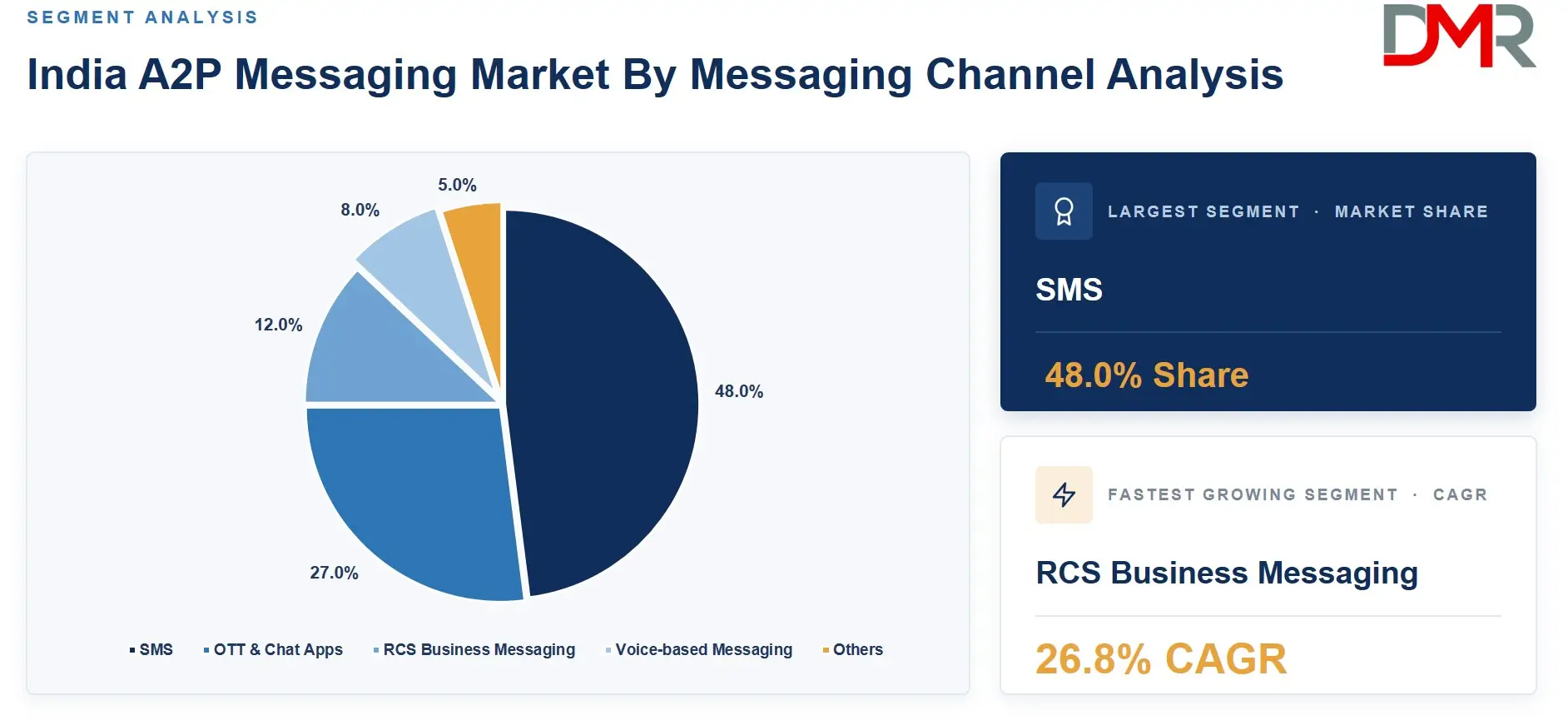
- Messaging Channel Analysis: SMS is expected to hold around 48% share in 2026, while RCS Business Messaging is projected to expand at 26.8% CAGR through 2035.
- Demand Concentration: BFSI and e-commerce enterprises together generate close to 60% of enterprise messaging spend, concentrated among metro-headquartered senders.
- Regulatory Compliance: Nearly all commercial senders now route traffic through DLT-registered aggregators, a shift that has reshaped vendor selection since 2023.
- Application-Layer Shift: OTP & Authentication is estimated to account for approximately 38% of application-wise volume in 2026, anchored by UPI transaction growth.
- Distribution Fragmentation: CPaaS platforms and aggregators are projected to capture just over 52% of distribution channel volume in 2026, ahead of direct operator connectivity.
How AI/Gen AI is Transforming the India A2P Messaging Market?
Generative and conversational AI are moving deepest into the parts of the value chain that used to require live agents. Large language model powered chatbots now sit behind WhatsApp Business API and RCS Business Messaging threads, handling account queries, order tracking and basic dispute resolution in regional languages without escalating to a call centre, which is reshaping cost structures for high-volume BFSI and e-commerce senders.
Machine learning is also doing quieter, operational work across compliance and delivery. Classifiers trained on historic complaint data flag likely spam or phishing templates before they reach the DLT scrubbing layer, cutting manual review time for aggregators processing millions of daily submissions, while send-time optimisation models learn each subscriber's engagement pattern to schedule promotional messages when open rates are highest rather than blasting a fixed time slot to an entire base.
- Conversational Support Automation: LLM-based agents resolve routine banking and order queries inside WhatsApp and RCS threads.
- Fraud and Spam Classification: Machine learning models pre-screen templates and sender behaviour ahead of DLT scrubbing.
- Send-Time and Channel Optimisation: Predictive models select the channel and time most likely to reach each subscriber.
- Regional-Language Generation: Generative models draft and localise message templates across multiple Indian languages at scale.
Key Drivers in the India A2P Messaging Market
Demand rests on two forces that pull in different directions: regulatory compliance that makes core transactional volume near-mandatory, and a voluntary shift toward richer engagement channels.
- Mandatory Authentication Volume: Every UPI transaction, banking login and e-commerce checkout in India requires a fresh one-time password, and Reserve Bank of India guidance around two-factor authentication keeps this traffic effectively compulsory for regulated senders. With UPI transaction counts still climbing year over year, the base layer of OTP messaging grows almost mechanically alongside digital payment adoption, giving aggregators a predictable, high-volume floor of demand that does not depend on marketing budgets. This structural stickiness is why SMS, despite losing share to richer channels, still anchors close to half of channel volume in 2026.
- Conversational Commerce Adoption: Brands are shifting post-purchase communication, order tracking, delivery updates and customer support, onto WhatsApp Business API and RCS threads because a single verified conversation resolves queries that once needed a call centre agent. E-commerce and quick-commerce platforms report faster resolution and lower cost per interaction once support moves into the same thread that delivered the original notification, which is pulling enterprise messaging budgets toward two-way, richer formats that can also carry payment links and product catalogues.
Restraints in the India A2P Messaging Market
Two forces temper otherwise rapid growth, one commercial and one structural.
- Operator Termination Cost Pressure: Telecom operators periodically revise SMS termination charges billed to aggregators, and each increase compresses margins for platforms competing on per-message pricing for high-volume, low-value transactional traffic. Aggregators absorbing these increases without passing them fully to enterprise clients, in order to retain price-sensitive BFSI and government accounts, face thinner unit economics even as overall message volume keeps growing, a mismatch that is pushing consolidation among smaller regional players unable to sustain the pressure alone.
- DLT Re-registration Burden: Periodic tightening of the Distributed Ledger Technology scrubbing mandate requires every sender, template and header to be re-verified, and smaller enterprises without dedicated compliance teams often experience onboarding delays that push them toward informal or unregistered routes with unreliable delivery. This friction slows the addressable market's formal growth even as it reinforces the position of aggregators experienced enough to manage compliance on a client's behalf.
Growth Opportunities in the India A2P Messaging Market
The clearest white space sits away from India's already-saturated metro enterprise base.
- Tier 2 and Tier 3 Digital Commerce: Smartphone and UPI penetration in smaller Indian cities is climbing faster than in metro markets that are close to saturation, and regional-language e-commerce, financial services and healthcare providers expanding into these cities need localised messaging support that most legacy SMS-only vendors do not offer. Aggregators building genuine multi-language WhatsApp and SMS template libraries stand to capture a disproportionate share of this next wave of enterprise sign-ups before larger competitors localise their own offerings.
- RCS-Enabled BFSI Cross-Sell: Carrier-verified RCS Business Messaging lets banks and NBFCs embed product carousels, application links and video explainers directly inside an authenticated thread, turning what was once a plain OTP message into a cross-sell surface. Early adopters among private banks are already testing loan and card upsell flows through RCS, and the opportunity scales quickly once Jio and Airtel finish extending enterprise-grade support beyond flagship handsets to the broader Android base.
Trends in the India A2P Messaging Market
Two shifts are visible in how the market is structured today, distinct from the drivers pulling volume toward it.
- Aggregator Consolidation: Listed CPaaS players have been acquiring smaller regional aggregators and specialist channel vendors to broaden their operator relationships and vertical expertise in one move, rather than building each capability organically, a pattern that is thinning the long tail of small, single-channel providers that dominated the market a decade ago. Clients increasingly prefer a single vendor across SMS, RCS and WhatsApp rather than managing separate contracts per channel.
- Shift to Two-Way Engagement: Enterprises are redesigning messaging programmes around two-way conversation rather than one-way broadcast, embedding reply options, quick-reply buttons and in-thread payment links so a single notification can also resolve a query or close a sale. Success is increasingly measured by engagement and conversion rates rather than delivery rate alone, pushing template design skills, not just routing infrastructure, into the core of what aggregators sell.
Research Scope and Analysis
Segment performance is examined across five axes: messaging channel, application, end use industry, sender ID type and distribution channel. Each axis identifies which sub-segment carries the largest share of 2026 revenue and which one is expanding fastest through 2035, along with the commercial reason behind each position.
ℹ
To learn more about this report –
Download Your Free Sample Report Here
By Messaging Channel
SMS is projected to hold the largest share of messaging channel revenue in 2026, accounting for around 48%, since every DLT-registered sender defaults to it for time-critical OTP and transactional alerts that must reach even basic feature phones without a data connection. Banks and payment apps in particular keep SMS as the fallback channel behind richer formats, which anchors its base volume. Growth, however, is concentrated in RCS Business Messaging, expanding at a CAGR of 26.8% between 2026 and 2035 as Reliance Jio and Bharti Airtel extend carrier-verified RCS support to enterprise brand accounts nationwide. The richer card and carousel formats let senders combine authentication with promotional content in a single verified thread, pulling budget away from plain-text SMS campaigns and toward carrier-billed RCS traffic.
By Application
OTP & Authentication is expected to remain the leading application in 2026, accounting for close to 38% of volume, driven by the sheer scale of UPI transactions, banking logins and e-commerce checkouts that each require a fresh one-time code. Regulatory expectations around two-factor authentication for financial transactions keep this application near-mandatory rather than discretionary. The steeper trajectory sits with customer engagement and support messaging, projected to grow at a CAGR of 25.4% through 2035 as brands shift post-purchase service, order tracking and query resolution onto WhatsApp Business API and RCS threads instead of call centres, a move that lowers per-interaction cost while improving response speed for high-volume consumer brands.
By End Use Industry
BFSI is set to account for the largest share of end use industry demand in 2026, at approximately 34%, reflecting the volume of OTP, statement and fraud-alert messaging generated by banks, NBFCs and UPI-linked apps operating under strict authentication norms. Growth, however, is fastest in healthcare, which is projected to expand at a CAGR of 24.7% between 2026 and 2035 as multi-city hospital chains and diagnostic networks digitise appointment booking, lab result delivery and post-discharge follow-up. Rising smartphone penetration among tier 2 and tier 3 patients is widening the addressable base for this vertical faster than for any other end-use category tracked in the segmentation.
By Sender ID Type
Alphanumeric sender IDs are estimated to hold the largest share of sender ID type revenue in 2026, at around 44%, because brand-recognisable prefixes are effectively mandatory for promotional and many transactional templates under current DLT header rules. Toll-free and virtual numbers represent the fastest-growing category, forecast to expand at a CAGR of 23.6% through 2035, pulled by rising demand for two-way, call-back-enabled conversational commerce where a consumer can reply or call directly from the same thread that delivered the notification. Aggregators are provisioning these numbers in bulk for retail and BFSI clients running loyalty and collections campaigns.
By Distribution Channel
CPaaS platforms and aggregators are projected to account for just over 52% of distribution channel revenue in 2026, since most enterprises prefer to outsource multi-operator routing, DLT compliance and channel orchestration rather than negotiate directly with telecom operators. The fastest-growing channel is in-house enterprise platforms, expanding at a CAGR of 22.3% between 2026 and 2035 as the largest banks and e-commerce groups build proprietary messaging gateways to cut per-message aggregator margins once their volumes justify the integration cost, a path only available to senders large enough to absorb the upfront engineering spend.
The India A2P Messaging Market Report is Segmented Based on the Following
By Messaging Channel
- SMS
- OTT & Chat Apps
- RCS Business Messaging
- Voice-based Messaging
- Others
By Application
- OTP & Authentication
- Transactional Notifications
- Promotional Marketing
- Customer Engagement & Support
- Others
By End Use Industry
- BFSI
- E-commerce & Retail
- IT & Telecom
- Healthcare
- Travel & Hospitality
- Others
By Sender ID Type
- Alphanumeric Sender ID
- Short Code
- Numeric Long Code
- Toll-Free/Virtual Number
- Others
By Distribution Channel
- CPaaS Platforms & Aggregators
- Direct Operator/Telco Connectivity
- In-house Enterprise Platforms
- System Integrators & Consultants
- Others
Regulatory Landscape
India's Distributed Ledger Technology platform, operated jointly by telecom operators under Telecom Regulatory Authority of India oversight, now scrubs nearly every commercial template and sender header before delivery, and periodic tightening since 2023 has pushed unregistered direct-to-telco traffic toward compliance-managed aggregators. What is shifting now is the extension of similar registration discipline to RCS and WhatsApp Business Platform traffic, closing a gap that previously let some rich-media senders bypass SMS-era scrubbing. The commercial opening sits with aggregators able to offer a single compliance layer across every channel, reducing the operational burden on enterprise compliance teams. The risk is a slower onboarding cycle for smaller senders, which favours vendors already carrying deep DLT integration and keeps enterprise pricing power concentrated among a handful of platforms.
Technology Analysis
Enterprise messaging stacks in India are consolidating around omnichannel CPaaS orchestration that routes a single campaign across SMS, WhatsApp Business API and RCS from one interface, replacing the channel-by-channel integrations most senders ran through 2023. What is shifting now is the rapid carrier rollout of RCS Business Messaging by Reliance Jio and Bharti Airtel, which finally gives brands a verified, rich-media channel at national scale rather than a pilot confined to select handsets. The commercial opening sits in agentic, AI-driven conversational commerce, where a single RCS or WhatsApp thread can carry authentication, product discovery and payment. The risk is deepening dependence on a small set of platform gatekeepers, chiefly Meta and the two leading carriers, whose API pricing changes flow straight through to enterprise messaging cost.
Competitive Landscape
Competition in the India A2P messaging market sits across two layers: a duopoly-anchored base of network operators, led by Reliance Jio and Bharti Airtel, that controls terminating access, and a fragmented tier of CPaaS aggregators and platform specialists that compete for enterprise contracts on top of that access. The basis of competition has shifted from raw per-message pricing toward compliance depth, channel breadth across SMS, RCS and WhatsApp, and vertical specialisation in BFSI, healthcare or e-commerce workflows. Consolidation is the dominant strategy among mid-sized aggregators, evident in repeated acquisitions by listed players expanding their regional and channel footprint, while platform-level partnerships with Meta and Google secure preferential API access for WhatsApp Business Platform and RCS Business Messaging respectively. Smaller vendors increasingly compete by layering conversational AI and regional-language support onto standard messaging infrastructure rather than on price alone.
Some of the Prominent Players in the India A2P Messaging Market are:
- Sinch
- Twilio
- Infobip
- Vonage
- Bandwidth Inc
- Bird (MessageBird)
- Syniverse
- Mavenir
- Cisco (Webex Connect)
- Genesys
- Gupshup
- Route Mobile
- Tanla Platforms
- Netcore Cloud
- Valuefirst Digital Media
- MSG91
- Interakt
- AiSensy
- Exotel
- Ozonetel
- Knowlarity Communications
- Reverie Language Technologies
- Airtel IQ
- Jio Haptik
- WATI
- SMSCountry
- Yellow.ai
- Dotgo
- Tata Communications
- Bharti Airtel
- Reliance Jio
- Vodafone Idea
- Tata Consultancy Services
- Wipro
- Infosys
- Persistent Systems
- HCLTech
- Tech Mahindra
- Ericsson India
- Nokia
- Other Key Players
Recent Developments
- In April 2026, Tanla Platforms expanded its DLT-compliant scrubbing infrastructure to cover RCS traffic, giving enterprises a single blacklist and whitelist layer across SMS and rich messaging channels.
- In February 2026, Reliance Jio extended commercial RCS Business Messaging to enterprise brand accounts nationwide following its earlier consumer rollout, opening a carrier-grade rich-media channel for large BFSI and e-commerce senders.
- In November 2025, Gupshup broadened its WhatsApp Business Platform integration with regional-language conversational AI agents aimed at BFSI collection and support use cases.
- In July 2025, Route Mobile added a dedicated toll-free voice-and-messaging bundle for healthcare appointment reminders following demand from hospital chains.
- In March 2025, Bharti Airtel's Airtel IQ platform launched a unified CPaaS dashboard combining SMS, RCS and voice OTP delivery with real-time DLT compliance checks.
- In September 2024, the Telecom Regulatory Authority of India tightened its DLT re-verification mandate for commercial senders, pushing enterprises toward aggregator-managed compliance rather than direct telecom connectivity.
Report Details
| Report Characteristics |
| Market Size (2026) |
USD 2.6 Bn |
| Forecast Value (2035) |
USD 10.3 Bn |
| CAGR (2026-2035) |
16.5% |
| Historical Data |
2021 - 2025 |
| Forecast Data |
2026 - 2035 |
| Base Year |
2025 |
| Segments Covered |
By Messaging Channel, By Application, By End Use Industry, By Sender ID Type, and By Distribution Channel |
| Regional Coverage |
India |
Frequently Asked Questions
How big is the India A2P Messaging Market?
▾ The India A2P Messaging Market size is estimated at USD 2.6 Bn in 2026 and is projected to reach USD 10.3 Bn by 2035, expanding at a CAGR of 16.5% over the forecast period, driven by mandatory OTP volumes and the shift toward richer, two-way messaging channels across banking, e-commerce and healthcare.
What is the growth rate of the India A2P Messaging Market?
▾ The market is projected to grow at a CAGR of 16.5% between 2026 and 2035, rising from USD 2.6 Bn to USD 10.3 Bn, as enterprises migrate spend from plain SMS toward RCS Business Messaging and WhatsApp Business API, both of which carry richer formats and stronger engagement than legacy text alerts.
What is driving demand in the India A2P Messaging Market?
▾ Demand is anchored by mandatory one-time password traffic tied to UPI transactions, banking logins and e-commerce checkouts, which keeps SMS and RCS volumes near-compulsory for regulated senders. Rising WhatsApp Business API adoption for order updates and customer service is adding a second, faster-growing layer of demand on top of this compliance-driven base.
Who are the key players in the India A2P Messaging Market?
▾ Leading participants include Gupshup, Route Mobile, Tanla Platforms, Netcore Cloud, Airtel IQ and Jio Haptik, alongside global CPaaS providers such as Sinch, Twilio and Infobip that serve Indian enterprise clients through local operator partnerships and DLT-compliant routing infrastructure.
Which messaging channel holds the largest share in the India A2P Messaging Market?
▾ SMS is expected to hold the largest share of the India A2P Messaging Market in 2026, accounting for around 48% of channel volume, reflecting its role as the default channel for time-critical OTP and transactional alerts that must reach feature phones without a data connection.
What role does WhatsApp Business API play in the India A2P Messaging Market?
▾ WhatsApp Business API has become the primary rich-media channel for order updates, delivery tracking and customer support, letting enterprises combine notifications with two-way conversation. Its adoption is a core driver of the OTT & Chat Apps segment and is pushing spend away from one-way promotional SMS toward conversational engagement.
How is RCS Business Messaging expected to grow in the India A2P Messaging Market?
▾ RCS Business Messaging is projected to expand at a CAGR of 26.8% in the India A2P Messaging Market between 2026 and 2035, the fastest of any messaging channel tracked, as Reliance Jio and Bharti Airtel extend carrier-verified support to enterprise brand accounts nationwide, enabling card and carousel formats that blend authentication with promotional content.