India CAT CAM CBCT Market Snapshot
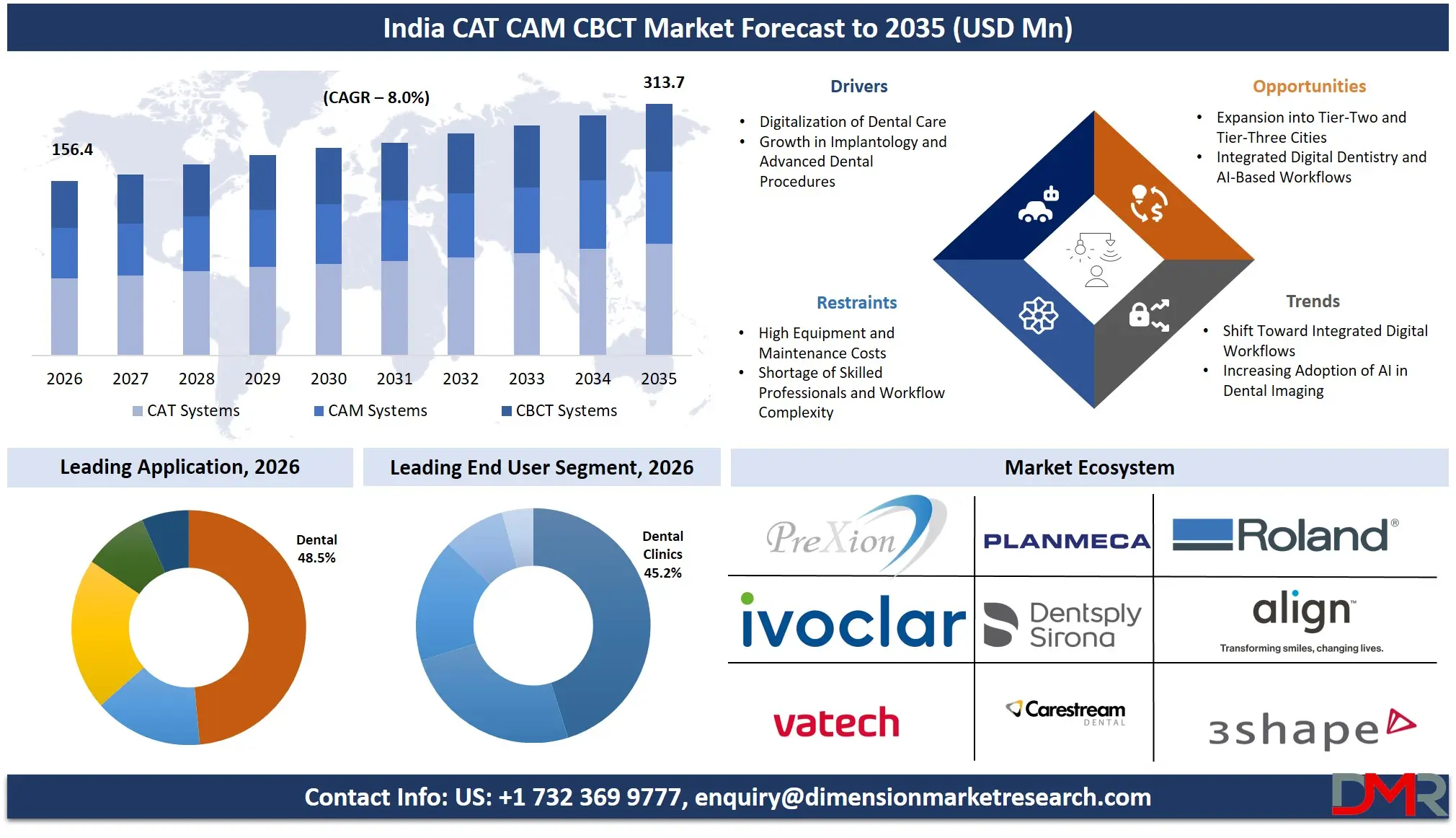
- Market Size in 2026: USD 156.4 Million
- Market Size in 2035: USD 313.7 Million
- CAGR, 2026-2035: 8.0%
- Leading Product Segment in 2026: CAM Systems, 47.8%
- Leading Application Segment in 2026: Dental, 48.5%
- Leading End-User Segment in 2026: Dental Clinics, 45.2%
- Fastest-Growing Product Segment: CBCT Systems, 10.8% CAGR
What is the India CAT CAM CBCT Market and its Market Size?
The India CAT CAM CBCT market is estimated at USD 156.4 million in 2026 and is projected to reach approximately USD 313.7 million by 2035, representing an 8.0% CAGR.
ℹ
To learn more about this report –
Download Your Free Sample Report Here
The India CAT CAM CBCT market encompasses advanced digital technologies used to capture, process, visualize, design and manufacture dental and maxillofacial solutions. CAT/CT systems provide cross-sectional anatomical imaging; CBCT provides three-dimensional, relatively high-resolution imaging of dental and maxillofacial structures; and CAM systems translate digital CAD designs into physical restorations, prostheses, models and surgical devices. Together, these technologies form an increasingly connected digital-dentistry workflow spanning diagnosis, treatment planning, restorative dentistry, implantology, orthodontics, oral surgery and laboratory manufacturing. Their principal value proposition is improved diagnostic detail, workflow efficiency, customization, repeatability and shorter treatment or production cycles.
Use Cases
- Dental Implant Planning: Three-dimensional imaging and digital workflows support implant positioning, bone assessment and surgical-guide preparation.
- Orthodontic Treatment Planning: Digital imaging and scanning improve assessment of tooth position, skeletal relationships and treatment progression.
- Restorative Dentistry: CAD/CAM enables rapid design and production of crowns, bridges, veneers, inlays and onlays.
- Maxillofacial Surgery: Three-dimensional anatomical visualization assists surgical planning for complex craniofacial procedures.
- Endodontics: High-resolution three-dimensional imaging helps clinicians evaluate root morphology, canals and complex anatomical structures.
- Digital Dental Laboratories: CAM equipment enables automated, repeatable production of customized prosthetic and orthodontic components.
Key Takeaways
- Market Size and Growth: The modeled market is estimated at USD 156.4 million in 2026 and USD 313.7 million in 2035, implying an 8.0% CAGR.
- Growth Drivers: Digitalization of dental practices, expanding organized clinic networks, dental tourism, aesthetic dentistry and increasing availability of lower-cost digital systems support adoption.
- Segment Dominance: CAM systems represent the largest modeled product segment because they serve both dental laboratories and increasingly digitized clinics.
- CBCT Momentum: CBCT is projected to be the fastest-growing product segment as implantology, orthodontics, endodontics and maxillofacial applications increasingly require three-dimensional imaging.
- Geographic Pattern: Adoption remains concentrated in metropolitan and major tier-2 markets, although lower-cost systems and service-center expansion are broadening access.
How AI, Cloud and 3D Digital Workflows are Transforming the Market?
AI, cloud connectivity and integrated 3D workflows are changing CAT, CAM and CBCT from standalone machines into connected digital ecosystems. AI-assisted image analysis can support segmentation, anatomical visualization and treatment planning, while cloud platforms allow scans and CAD files to move between clinics, laboratories and specialists. Dentsply Sirona's Primescan 2, for example, combines intraoral scanning with cloud-native DS Core functionality, while Carestream Dental has introduced AI-powered software for implant planning and case sharing.
The principal benefits are faster workflows, reduced manual data entry, improved reproducibility, easier remote collaboration and greater utilization of expensive equipment. CAM automation can reduce manufacturing time, while modern CBCT platforms increasingly combine imaging with planning software. AI also creates opportunities for decision-support features without requiring every practice to employ highly specialized imaging personnel.
Key Drivers in the India CAT CAM CBCT Market
Digitalization of Dental Care
The growing adoption of digital dentistry is a major driver for the India CAT CAM CBCT Market. Dental clinics and laboratories are increasingly replacing conventional impressions, manual design and traditional imaging with digital scanning, three-dimensional imaging, CAD/CAM design and computer-assisted manufacturing. Organized dental chains and premium private clinics are investing in integrated digital workflows to improve accuracy, reduce turnaround times and increase treatment capacity. The growing use of digital technologies in restorative dentistry, orthodontics, implantology and prosthodontics is creating sustained demand for CAM and CBCT systems. Increasing awareness among dentists regarding workflow efficiency and customized treatment is further supporting equipment adoption.
Growth in Implantology and Advanced Dental Procedures
Increasing demand for dental implants, orthodontic treatment, cosmetic dentistry and complex oral procedures is supporting the India CAT CAM CBCT Market. CBCT systems provide three-dimensional visualization that can assist implant planning, bone assessment, root-canal evaluation and maxillofacial procedures. At the same time, CAM systems enable the production of customized crowns, bridges, veneers, aligners and other dental restorations. Expansion of organized dental clinics, rising disposable incomes in urban markets and growing patient awareness are encouraging providers to invest in advanced diagnostic and manufacturing technologies.
Restraints in the India CAT CAM CBCT Market
High Equipment and Maintenance Costs
High initial investment remains a major restraint for the India CAT CAM CBCT Market. Advanced CBCT, CAT and CAM systems require substantial capital expenditure, while software licenses, maintenance contracts, calibration, upgrades and staff training increase the overall cost of ownership. Smaller independent dental clinics may find it difficult to justify purchasing expensive equipment when patient volumes are limited. Adoption is therefore concentrated in metropolitan areas, larger dental clinics, hospitals, laboratories and diagnostic centers. Financing, leasing and shared-service models can reduce this barrier, but affordability remains an important consideration when selecting advanced digital equipment.
Shortage of Skilled Professionals and Workflow Complexity
The effective use of CAT, CAM and CBCT technologies requires trained dentists, radiology professionals, dental technicians and CAD/CAM operators. Limited availability of skilled personnel can reduce equipment utilization and increase dependence on manufacturers or external service providers. Clinics also face challenges integrating equipment from different manufacturers because software compatibility, file formats and workflow interoperability can vary. Training requirements become particularly important as systems incorporate artificial intelligence, automated treatment planning and cloud-based platforms. These factors can slow adoption among smaller practices and increase the operational costs associated with implementing advanced digital workflows.
Growth Opportunities in the India CAT CAM CBCT Market
Expansion into Tier-Two and Tier-Three Cities
Expansion beyond major metropolitan markets represents a significant opportunity for the India CAT CAM CBCT Market. Dental infrastructure is developing in smaller cities, while patients increasingly seek advanced implantology, orthodontic, restorative and cosmetic treatments closer to home. Manufacturers can target these markets through affordable equipment, compact CBCT systems, financing programs, distributor networks and localized technical support. Diagnostic imaging centers can also provide shared CBCT services to multiple dental practices, allowing clinics to access three-dimensional imaging without purchasing their own equipment. This model can improve equipment utilization while lowering the capital barrier for smaller providers.
Integrated Digital Dentistry and AI-Based Workflows
Integration of CBCT, intraoral scanning, CAD software, CAM equipment and artificial intelligence creates substantial growth potential. Connected workflows can allow patient data to move from diagnosis through treatment planning, digital design and manufacturing with fewer manual steps. AI-assisted imaging can support anatomical segmentation, implant planning and case visualization, while cloud platforms enable collaboration between dentists and laboratories. Vendors that combine hardware, software, analytics and service capabilities can develop broader customer relationships and recurring revenue opportunities. Increasing demand for customized restorations and faster treatment workflows is expected to further encourage adoption of integrated digital dentistry solutions.
Trends in the India CAT CAM CBCT Market
Shift Toward Integrated Digital Workflows
The India CAT CAM CBCT Market is moving from standalone equipment toward connected digital ecosystems. Dental providers increasingly seek systems that can communicate with scanners, imaging platforms, CAD software, CAM equipment and laboratory systems. Interoperability, workflow automation and cloud connectivity are therefore becoming important purchasing considerations. This shift is encouraging manufacturers to compete not only on hardware specifications but also on software functionality, ease of integration, service support and overall workflow efficiency.
Increasing Adoption of AI in Dental Imaging
Artificial intelligence is becoming increasingly important across dental imaging and treatment-planning applications. AI can assist with image interpretation, anatomical segmentation, implant planning, treatment visualization and workflow automation. As these capabilities become integrated directly into CBCT and digital dentistry platforms, providers can potentially reduce manual tasks and improve consistency. The increasing availability of AI-enabled imaging and planning software is expected to strengthen demand for connected CAT, CAM and CBCT ecosystems across India's dental and healthcare markets.
Research Scope and Analysis
The market is segmented by Product Type, Application, and End User. Product segmentation covers CAT, CAM and CBCT systems; application segmentation covers dental, orthopedic, maxillofacial surgery, ENT and other applications; end-user segmentation covers hospitals, dental clinics, diagnostic imaging centers, academic institutions and other users.
By Product Type Analysis
CAM Systems are estimated to represent the dominant product segment in 2026, with approximately 47.8% share, supported by demand from dental laboratories, organized clinics and restorative workflows. CAD/CAM enables digitally designed restorations to be manufactured through milling or printing, creating value through customization, repeatability and reduced turnaround time. CBCT systems are estimated at approximately 29% of the combined market in 2026 and represent the fastest-growing product category at about 10.8% CAGR, driven by implantology, orthodontics, endodontics and oral/maxillofacial surgery. CAT/CT systems account for the remaining approximately 23.2%, supported mainly by hospitals, larger diagnostic centers and complex maxillofacial applications. The product mix is expected to shift gradually toward CBCT and integrated digital systems as dedicated dental three-dimensional imaging becomes more accessible.
By Application Analysis
Dental applications represent the largest application category, with an estimated 48.5% share in 2026, reflecting the broad use of digital imaging and CAD/CAM across restorative, implant, orthodontic and general dental procedures. Maxillofacial surgery represents the second-largest application at approximately 21%, benefiting from three-dimensional anatomical visualization and surgical planning. Orthopedic applications account for roughly 15%, primarily where CT/CAT-related imaging and specialized digital planning overlap with the defined market scope. ENT applications contribute approximately 9%, with the balance represented by other applications. The fastest-growing application is estimated to be orthodontics, at approximately 11.2% CAGR, reflecting increasing adoption of digital scanning, three-dimensional assessment and digitally planned treatment.
By End User Analysis
Dental clinics are estimated to command the largest end-user share at approximately 45.2% in 2026, supported by the expansion of organized chains, premium private practices, dental tourism and chairside digital workflows. Hospitals represent approximately 25%, benefiting from greater capital availability and the ability to use imaging systems across multiple specialties. Diagnostic imaging centers account for about 17%, particularly where CBCT services are provided to external dental practices. Academic and research institutions represent around 8%, while other end users account for approximately 4%. Diagnostic imaging centers are estimated to be the fastest-growing end-user category at roughly 10.3% CAGR, because shared-service models can lower the capital barrier for independent dentists.
The India CAT CAM CBCT Market Report is segmented on the basis of the following:
By Product Type
- CAT Systems
- CAM Systems
- CBCT Systems
By Application
- Dental
- Orthopedic
- Maxillofacial Surgery
- ENT
- Other Applications
By End User
- Hospitals
- Dental Clinics
- Diagnostic Imaging Centers
- Academic & Research Institutions
- Other End Users
Regional Analysis
The India CAT CAM CBCT Market is geographically diverse, with adoption influenced by healthcare infrastructure, dental clinic density, availability of skilled professionals, organized dental chains and investment in digital dentistry. West India represents a well-developed market, supported by strong private healthcare infrastructure, established dental laboratories and major centers such as Mumbai, Pune and Ahmedabad. South India has high adoption of advanced dental technologies, driven by established dental institutions, specialist clinics, laboratories and technology-oriented healthcare providers across Bengaluru, Chennai and Hyderabad. North India is experiencing expanding adoption, particularly across Delhi-NCR, Uttar Pradesh, Punjab, Haryana and Rajasthan, supported by growing private healthcare infrastructure and increasing demand for implantology, orthodontics and cosmetic dentistry. East India remains a developing market, with West Bengal, Odisha, Bihar and Jharkhand representing important areas of opportunity as dental infrastructure, specialist services and awareness of digital imaging and CAD/CAM technologies continue to improve.
By Region
India
Regulatory Landscape
India's CAT/CBCT component is strongly influenced by radiation-safety regulation. AERB requires manufacturers, suppliers and users of diagnostic X-ray equipment to obtain the relevant regulatory permissions, and operation of diagnostic X-ray equipment requires a licence. Dental CBCT is specifically included within the applicable diagnostic-radiology framework. Equipment procurement, type approval, room shielding, quality assurance and radiation-professional requirements therefore influence installation timelines and total ownership costs. CDSCO also regulates medical devices under India's medical-device framework, with the regulatory system continuing to evolve. The regulatory environment creates compliance costs but also raises the importance of authorized suppliers, service capability and documented product quality.
Investment and White Space Analysis
The largest investment opportunity is the integration layer connecting CBCT, scanning, CAD, CAM, AI and cloud software. Standalone hardware remains important, but recurring software, workflow subscriptions, service contracts and data interoperability can increase lifetime customer value. Tier-2 cities offer additional whitespace because smaller clinics can access advanced imaging through shared diagnostic centers or leasing models. Low-dose CBCT, compact systems, AI-assisted planning and affordable milling/printing solutions can address price-sensitive customers. Dental laboratory digitization is another opportunity because CAD/CAM can centralize production and support higher volumes. Risks include foreign-exchange exposure, high upfront costs, rapid technology obsolescence, distributor dependence and shortage of trained technicians.
Competitive Landscape
The India CAT CAM CBCT market is moderately fragmented, combining multinational dental-technology companies, specialized imaging manufacturers, CAD/CAM suppliers, domestic distributors and increasingly capable regional players. Competition is based on imaging quality, radiation dose, workflow integration, software capability, interoperability, equipment price, financing, service coverage and training. Major international participants include Dentsply Sirona, Planmeca, Carestream Dental, Vatech, Align Technology, Ivoclar, 3Shape and other specialized manufacturers. Companies increasingly compete through connected ecosystems rather than isolated equipment. Product launches, software upgrades, partnerships, distributor expansion and integration with third-party digital platforms are major competitive strategies.
Some of the prominent players in the India CAT CAM CBCT Market are:
- Dentsply Sirona
- Planmeca
- Carestream Dental
- Vatech
- Align Technology
- 3Shape
- Ivoclar
- Amann Girrbach
- vhf camfacture
- Roland DG
- J. Morita
- NewTom (Cefla)
- ACTEON Group
- PreXion
- Genoray
- RAY Co.
- Owandy Radiology
- Asahi Roentgen
- DÜRR Dental
- Shining 3D
- Up3D
- Medit
- exocad
- Zirkonzahn
- Straumann
- KaVo Dental
- 3DCAD/CAM
- DOF
- DGSHAPE
- Formlabs
- SprintRay
- Carbon
- 3D Systems
- Stratasys
- EOS
- Renishaw
- Sirona Dental Systems
- Henry Schein
- GC Corporation
- Kuraray Noritake Dental
- Other Key Players
Recent Developments
- October 2025, Carestream Dental: Carestream Dental launched CS 3D Imaging Premium, an AI-powered software solution intended to support implant planning, case acceptance and case sharing.
- October 2025, Ivoclar/vhf: Ivoclar and vhf expanded their partnership by validating additional vhf milling machines for IPS e.max CAD processing, increasing interoperability across coordinated CAD/CAM workflows.
- August 2025, Vatech: Vatech launched its Clever One AI dental platform in the U.S., integrating panoramic, CBCT, intraoral, facial and STL data into a unified viewing environment.
- July 2025, Carestream Dental: Carestream Dental announced Digital Dentistry Society certification for its CS 9600 and CS 8200 3D CBCT families, strengthening positioning around clinical validation and digital imaging.
- March 2025, Planmeca: Planmeca introduced new products across extraoral and intraoral imaging, CAD/CAM and software at IDS 2025, reinforcing its strategy around integrated digital-dentistry workflows.
- March 2025, Align Technology: Align introduced restorative capabilities for its next-generation iTero Lumina scanner and the iTero Lumina Pro dental imaging system, including NIRI technology and broader restorative workflows.
Report Details
| Report Characteristics |
| Market Size (2026) |
USD 156.4 Mn |
| Forecast Value (2035) |
USD 313.7 Mn |
| Historical Data |
2021 – 2025 |
| Forecast Data |
2026 – 2035 |
| Base Year |
2025 |
| Segments Covered |
By Product Type, By Application, By End User |
| Country Coverage |
India (East, West, North, and South) |
Frequently Asked Questions
What is the size of the India CAT CAM CBCT Market in 2026?
▾ The India CAT CAM CBCT Market is estimated at USD 156.4 million in 2026, covering CAT, CAM and CBCT systems across major applications and end users.
What will the India CAT CAM CBCT Market be worth in 2035?
▾ The India CAT CAM CBCT Market is projected to reach approximately USD 313.7 million by 2035, supported by continued digitalization of dental and imaging workflows.
What is the CAGR of the India CAT CAM CBCT Market from 2026 to 2035?
▾ The India CAT CAM CBCT Market is estimated to expand at an approximately 8.0% CAGR between 2026 and 2035.
What are the key drivers of the India CAT CAM CBCT Market?
▾ The India CAT CAM CBCT Market is driven by digital dentistry adoption, implantology, aesthetic dentistry, organized dental clinics, dental tourism and increasing demand for three-dimensional imaging.
Which product segment leads the India CAT CAM CBCT Market?
▾ CAM Systems lead the India CAT CAM CBCT Market, accounting for an estimated 47.8% share in 2026 because of expanding digital restorative and laboratory workflows.
Which is the fastest-growing segment in the India CAT CAM CBCT Market?
▾ CBCT Systems are expected to be the fastest-growing product segment in the India CAT CAM CBCT Market, with an estimated CAGR of 10.8% during 2026-2035.
Who are the major players in the India CAT CAM CBCT Market?
▾ Major participants in the India CAT CAM CBCT Market include Dentsply Sirona, Planmeca, Carestream Dental, Vatech, Align Technology, Ivoclar and 3Shape.