India Contact Lenses Manufacturers Market Snapshot
- Market Size, 2026: USD 769.7 million
- Market Size, 2035: USD 1,180 million
- CAGR, 2026–2035: 4.8%
- Leading Product Type: Soft Contact Lenses, 78%
- Leading Design: Spherical, 57%
- Leading Replacement Schedule: Monthly, 46%
- Leading Application: Vision Correction, 76%
- Leading Distribution Channel: Optical Stores, 52%
- Fastest-Growing Segment: Daily Disposable, 8.2% CAGR
What is the India Contact Lenses Manufacturers and its Market Size?
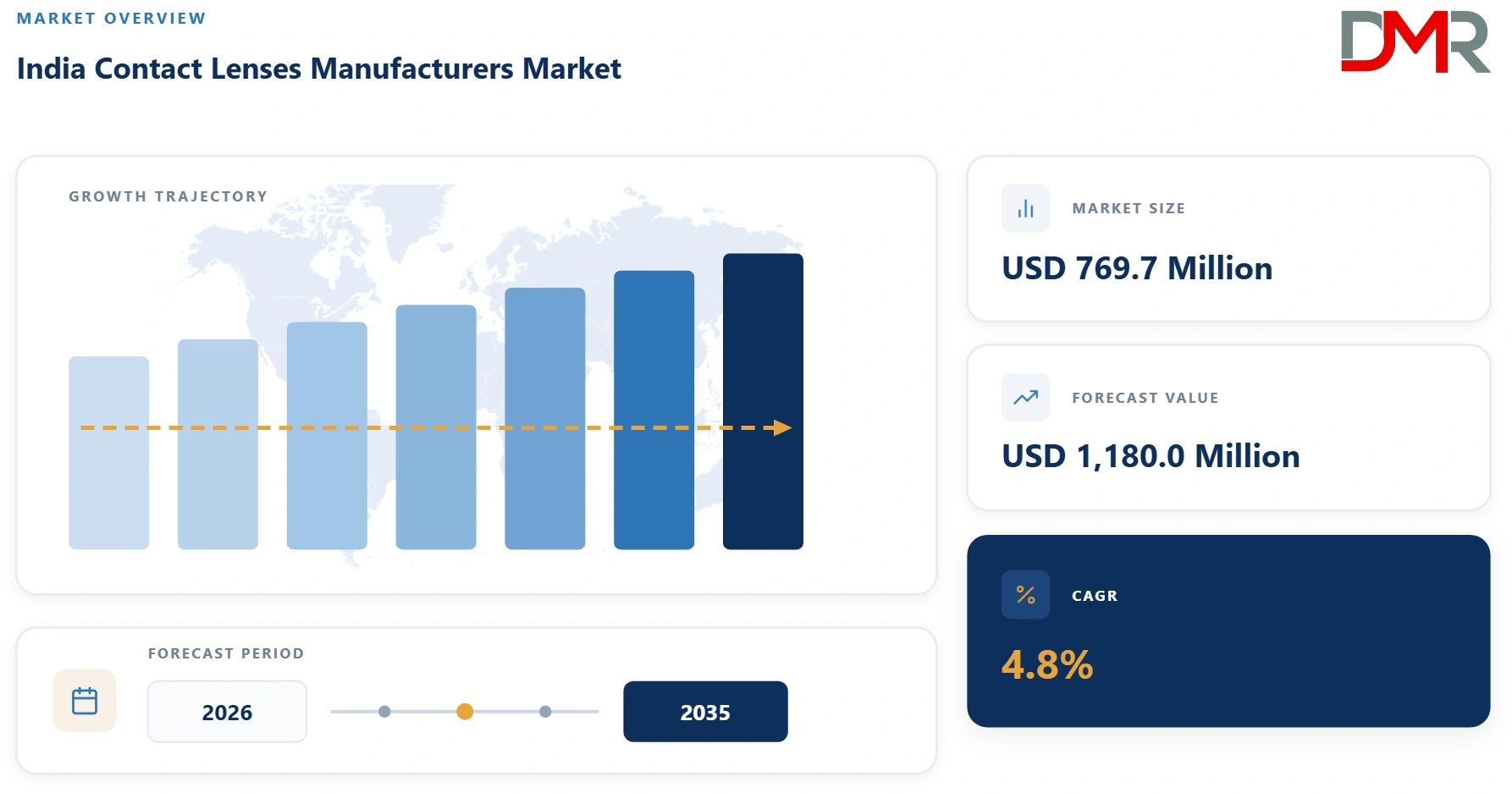
India's contact-lens market is estimated at USD 769.7 million in 2026 and is projected to reach approximately USD 1,180 million by 2035, representing a modeled CAGR of about 4.8%.
ℹ
To learn more about this report –
Download Your Free Sample Report Here
The India contact lenses manufacturers market encompasses the manufacture, import, private-label production, distribution and sale of ophthalmic contact lenses used for refractive correction, cosmetic enhancement, therapeutic purposes and myopia management. Products include soft lenses, rigid gas permeable lenses, hybrid and specialty lenses across spherical, toric, multifocal and other optical designs. The market serves consumers with myopia, hyperopia, astigmatism and presbyopia, as well as users seeking cosmetic alternatives to spectacles. Major participants combine product innovation, practitioner networks, optical retail distribution, e-commerce and consumer education to convert spectacle users into contact-lens wearers.
Use Cases
- Vision Correction: Corrects myopia, hyperopia, astigmatism and presbyopia without the visual limitations associated with spectacles.
- Cosmetic Enhancement: Changes or enhances iris appearance through colored and decorative contact lenses.
- Myopia Management: Specialized lenses can simultaneously correct myopia and slow progression in eligible children.
- Therapeutic Applications: Bandage and specialty lenses protect the cornea and support healing under ophthalmic supervision.
- Lifestyle Convenience: Provides unobstructed peripheral vision and compatibility with sports, outdoor activities and professional requirements.
- Presbyopia Management: Multifocal and monovision designs provide functional near, intermediate and distance vision.
Key Takeaways
- Market growth: The Indian market is estimated at USD 769.7 million in 2026 and approximately USD 1,180 million by 2035, implying 4.8% CAGR.
- Primary growth drivers: Rising refractive-error awareness, urbanization, higher disposable incomes, digital lifestyles and increasing aesthetic consciousness.
- Segment dominance: Soft contact lenses remain the dominant product category because of comfort, ease of fitting and broad prescription availability.
- Replacement leadership: Monthly lenses remain the largest replacement category, although daily disposables are gaining share.
- Fastest growth: Daily disposable lenses are estimated to expand at approximately 8.2% CAGR, supported by convenience, hygiene and premiumization.
- Channel shift: Optical stores remain dominant, but e-commerce and omnichannel replenishment are gaining importance.
- Competitive structure: The market is moderately concentrated around Bausch + Lomb, Johnson & Johnson/ACUVUE, Alcon and CooperVision, alongside Indian manufacturers and challengers. Euromonitor characterizes the market as moderately concentrated.
How Advanced Materials, Digital Fitting and AI are Transforming the Market?
Advanced material science is shifting Indian contact lenses from conventional hydrogel products toward silicone-hydrogel, water-gradient and high-oxygen-transmissibility designs. Manufacturers increasingly combine digital prescription workflows, computerized fitting and data-driven product recommendations with sophisticated optical designs. CooperVision's Indian portfolio, for example, includes silicone-hydrogel monthly and daily-replacement products across spherical, toric and multifocal designs.
Technology improves oxygen delivery, comfort, deposit resistance, visual performance and wearing time while reducing the friction associated with lens fitting and replacement. Daily disposable technology additionally reduces dependence on cleaning and storage routines.
Key Drivers in the India Contact Lenses Manufacturers Market
Rising Prevalence of Refractive Errors and Vision-Correction Needs
The India Contact Lenses Manufacturers Market is benefiting from the growing prevalence of myopia, astigmatism, hyperopia and presbyopia across urban and increasingly semi-urban populations. Greater screen exposure, changing lifestyles and increased awareness of eye health are encouraging consumers to seek alternatives to conventional spectacles. Contact lenses provide a wider field of vision, convenience during sports and professional activities, and aesthetic advantages. Younger consumers, students and working professionals are particularly important adoption groups. Increasing access to optometrists and organized optical retailers is also improving product awareness, fitting services and consumer confidence. As more consumers become familiar with contact lenses, manufacturers have opportunities to increase penetration through affordable products, improved comfort and specialized prescriptions.
Premiumization and Growing Demand for Advanced Lens Technologies
Another important growth driver for the India Contact Lenses Manufacturers Market is the shift toward premium products offering enhanced comfort, oxygen transmission, moisture retention and improved visual performance. Consumers are increasingly moving from conventional materials toward silicone-hydrogel and other advanced lens technologies. Daily disposable lenses are also gaining attention because they reduce the need for cleaning and storage and can provide a more convenient wearing experience. Manufacturers are responding with innovations in toric, multifocal, specialty and myopia-management lenses. Premiumization allows manufacturers to differentiate products beyond price while increasing opportunities for recurring purchases and higher-value prescriptions.
Restraints in the India Contact Lenses Manufacturers Market
Comfort Issues, Dryness and User Discontinuation
A major restraint for the India Contact Lenses Manufacturers Market is the difficulty some users experience with dryness, discomfort, irritation and lens intolerance. India's environmental conditions, including heat, dust and air pollution, can contribute to an uncomfortable wearing experience for certain consumers. Incorrect fitting, poor replacement practices and inadequate lens-care routines can further affect satisfaction. New users may discontinue contact lenses if they struggle with insertion, removal or maintaining proper hygiene. These issues make practitioner education, professional fitting and product development particularly important. Manufacturers must continuously improve material technology, surface properties and moisture management to increase wearer comfort and encourage long-term retention.
Affordability and Uneven Distribution Infrastructure
Affordability remains a significant challenge for the India Contact Lenses Manufacturers Market, particularly outside major metropolitan areas. Contact lenses involve recurring expenditure, unlike spectacles that can often be used for longer periods. Premium daily disposables, specialty lenses and advanced multifocal or toric products can be particularly expensive for price-sensitive consumers. Limited access to qualified optometrists and specialized fitting services in smaller cities can also restrict adoption. Manufacturers must balance premium product positioning with affordable alternatives that can expand the addressable consumer base. Wider distribution networks, local manufacturing, smaller pack formats and digital purchasing platforms can help reduce accessibility barriers.
Growth Opportunities in the India Contact Lenses Manufacturers Market
Myopia Management and Specialty Contact Lenses
Myopia management represents a significant emerging opportunity for the India Contact Lenses Manufacturers Market. Growing awareness of childhood myopia is increasing interest in products designed not only to correct vision but also to help manage myopia progression. Specialty lenses can also address conditions such as astigmatism, keratoconus, irregular corneas and presbyopia. Manufacturers can strengthen their position by investing in clinical research, practitioner education and specialized fitting programs. Pediatric eye-care networks represent another important opportunity because successful myopia-management programs can generate recurring demand over extended periods. Companies offering clinically supported products and professional services can differentiate themselves from manufacturers competing primarily on price.
E-Commerce, Omnichannel Distribution and Local Manufacturing
Expansion of e-commerce and omnichannel retail creates substantial opportunities for the India Contact Lenses Manufacturers Market. Existing contact-lens users can conveniently reorder products online after receiving their initial prescription and fitting through an eye-care professional. Subscription-based replenishment, digital reminders and personalized recommendations can improve convenience and repeat purchasing. At the same time, domestic manufacturing can help companies reduce dependence on imports, improve supply-chain responsiveness and develop products suited to India's price-sensitive consumer base. Local production and private-label manufacturing could particularly benefit companies targeting tier-2 and tier-3 markets. Combining optical-store services with digital replenishment can create an effective hybrid distribution model.
Trends in the India Contact Lenses Manufacturers Market
Shift Toward Silicone-Hydrogel and Daily Disposable Lenses
The India Contact Lenses Manufacturers Market is increasingly shifting toward advanced silicone-hydrogel materials and daily disposable products. Consumers are placing greater emphasis on comfort, eye health, convenience and simplified lens-care routines. Daily disposables eliminate the need for cleaning solutions and lens storage, making them particularly attractive to new and occasional users. Manufacturers are consequently investing in materials and designs that provide better oxygen transmission, moisture management and wearing comfort. This trend is also encouraging premiumization as consumers become more willing to pay for products offering improved overall wearing experiences.
Increasing Personalization and Specialty Lens Adoption
Personalization is becoming increasingly important in the India Contact Lenses Manufacturers Market, particularly as manufacturers expand toric, multifocal, specialty and myopia-management portfolios. Improved optical designs are enabling companies to address consumers with more complex prescriptions that were previously difficult to serve with conventional lenses. Multifocal lenses are gaining relevance as the presbyopic population expands, while toric products are addressing growing demand from astigmatic users. At the same time, digital prescription management and online replenishment are making customized products easier to access. This shift is moving competition toward optical performance, clinical support and user experience rather than price alone.
Research Scope and Analysis
The market is segmented By Product Type, By Design, By Replacement Schedule, By Application and By Distribution Channel. Shares below are modeled 2026 estimates designed to reconcile published market-level estimates with observed product portfolios and Indian channel dynamics.
ℹ
To learn more about this report –
Download Your Free Sample Report Here
By Product Type Analysis
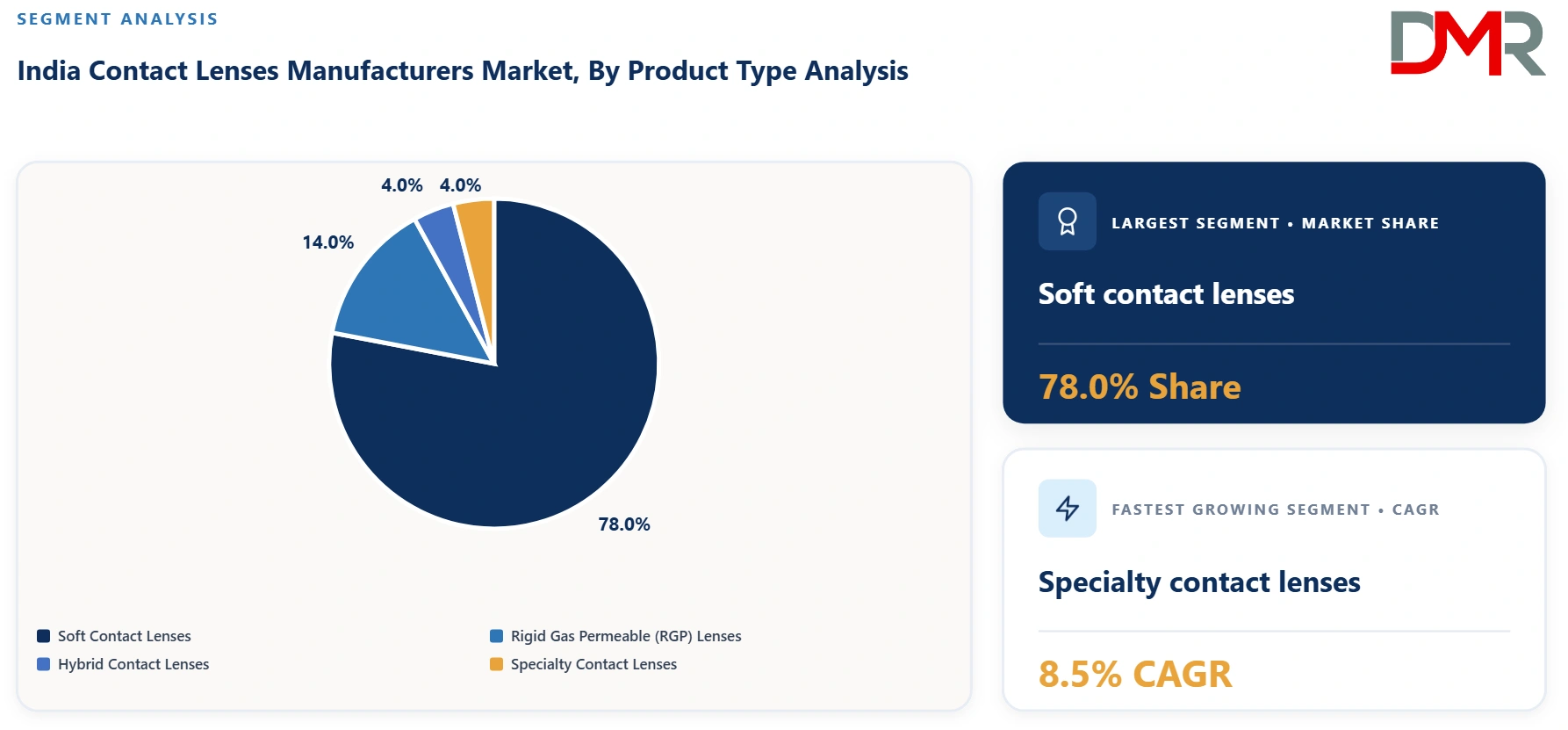
Soft contact lenses dominate the Indian market with an estimated 78% share in 2026, reflecting their comfort, relatively simple fitting process, broad prescription availability and suitability for mainstream vision correction. Specialty contact lenses are estimated to be the fastest-growing sub-segment at approximately 8.5% CAGR, supported by increasing demand for myopia management, keratoconus, irregular cornea and complex prescriptions. Rigid gas permeable (RGP) lenses represent an estimated 14% share and remain important for specialty applications where optical precision and corneal geometry are critical. Hybrid lenses, combining aspects of RGP and soft designs, account for approximately 4% and remain a niche category because of higher fitting complexity and cost.
By Design Analysis
Spherical lenses represent approximately 57% of 2026 revenue, making them the dominant design because myopia and hyperopia represent the largest mainstream correction applications and spherical lenses are generally simpler and less costly to fit. Toric lenses are estimated at approximately 25% and represent the fastest-growing major design at around 7.0% CAGR, reflecting greater recognition of astigmatism and improved stabilization technology. Multifocal lenses account for approximately 13% and are expected to grow around 7.5% CAGR as India's aging population expands the presbyopic consumer base and manufacturers improve simultaneous vision technology. Other designs including monovision, orthokeratology and specialty geometries represent roughly 5% but carry strategic importance because of premium pricing and specialist applications. CooperVision's Indian portfolio already spans spherical, toric and multifocal monthly products.
By Replacement Schedule Analysis
Monthly lenses are estimated to lead with approximately 46% share in 2026, primarily because they provide a compromise between affordability, convenience and recurring replacement. They remain particularly relevant among price-sensitive Indian consumers. Daily disposable lenses, at approximately 24% share, are the fastest-growing category at an estimated 8.2% CAGR, driven by hygiene, convenience, premiumization and growing consumer awareness of lens-care risks. Biweekly lenses account for approximately 12%, while conventional/extended-wear lenses represent approximately 18%. The latter is gradually losing share as consumers and practitioners shift toward more frequent replacement. Indian portfolios from CooperVision and Bausch + Lomb demonstrate the availability of both daily and monthly modalities.
By Application Analysis
Vision correction remains dominant with an estimated 76% share in 2026, reflecting the fundamental need to correct myopia, hyperopia, astigmatism and presbyopia. Myopia management is the fastest-growing application, with an estimated 11% CAGR, albeit from a comparatively small base. Growth is supported by increasing awareness of childhood myopia and the availability of specialized lens technologies. CooperVision reports that MiSight 1 day combines vision correction with myopia-progression management for eligible children. Cosmetic/decorative lenses represent approximately 12%, supported by fashion and social-media trends, while therapeutic lenses account for about 7% and are concentrated among clinical and ophthalmological applications.
By Distribution Channel Analysis
Optical stores remain the largest channel with an estimated 52% share in 2026, because first-time users typically require eye examinations, professional fitting, trial lenses and prescription verification. E-commerce is the fastest-growing channel at approximately 10% CAGR, supported by repeat purchases, home delivery, subscription models and improved digital customer acquisition. Hospitals and clinics account for approximately 18%, particularly for therapeutic and specialty lenses, while pharmacies contribute approximately 8%. The long-term model is increasingly omnichannel, with consumers discovering products online but receiving clinical support through optometrists and ophthalmologists.
The India Contact Lenses Manufacturers Market Report is segmented on the basis of the following:
By Product Type
- Soft Contact Lenses
- Rigid Gas Permeable (RGP) Lenses
- Hybrid Contact Lenses
- Specialty Contact Lenses
By Design
- Spherical
- Toric
- Multifocal
- Other Designs
By Replacement Schedule
- Daily Disposable
- Biweekly
- Monthly
- Conventional / Extended Wear
By Application
- Vision Correction
- Cosmetic / Decorative
- Therapeutic
- Myopia Management
By Distribution Channel
- Optical Stores
- Hospitals & Clinics
- Pharmacies
- E-commerce
Regulatory Landscape
India's contact-lens industry operates within the country's medical-device regulatory framework, with the Medical Devices Rules, 2017 administered by the Central Drugs Standard Control Organization (CDSCO). Regulatory requirements affect manufacturing, importing, licensing, labeling, quality systems, distribution and post-market surveillance depending on product classification and applicable notifications. Regulatory compliance is therefore an important competitive barrier, particularly for smaller manufacturers entering specialty or imported-lens categories. The increasing emphasis on authorized distribution also creates an opportunity for established manufacturers to differentiate on traceability and quality assurance. Companies that combine regulatory capabilities with clinical evidence and professional education should be better positioned as the market shifts toward specialty, pediatric and premium lenses.
Investment and White Space Analysis
The largest white spaces lie in daily disposable products, myopia management, affordable silicone-hydrogel lenses, toric/multifocal products and digitally enabled replenishment. Daily disposables offer particularly attractive growth because they increase recurring lens consumption while simplifying care. Specialty products can command higher margins but require clinical education and fitting capabilities. Domestic manufacturers can also pursue contract manufacturing and private-label opportunities for optical chains and e-commerce platforms. The market remains fragmented enough for specialist challengers while established companies retain significant advantages in brand recognition and practitioner networks. Investment priorities should therefore favor automated manufacturing, polymer technology, prescription customization, quality systems, digital distribution and optometrist engagement rather than purely expanding low-cost conventional capacity.
Competitive Landscape
The Indian contact-lens market is moderately concentrated, with Bausch + Lomb, Johnson & Johnson/ACUVUE, Alcon and CooperVision forming the principal international competitive group, while Indian manufacturers and regional brands participate in value, specialty and private-label niches. Euromonitor describes Bausch + Lomb, Johnson & Johnson and Alcon as maintaining leadership while challenger brands create competitive movementCompanies compete through product innovation, optical performance, clinical education, practitioner relationships, distribution coverage, pricing and consumer marketing. Bausch + Lomb reports more than 15,000 retail partners across India, illustrating the importance of distribution scale.
Some of the prominent players in the India Contact Lenses Manufacturers Market are:
- Bausch + Lomb India
- Alcon Laboratories India
- Johnson & Johnson Vision Care
- CooperVision India
- Carl Zeiss India
- Hoya Medical India
- GKB Ophthalmics
- Omni Lens
- Accurate Optics India
- Excellent Hi-Care
- UltraVision CLPL
- Transe Vision Care
- Truviz Ophthalmic
- Purecon Lenses
- Silklens
- GKB Hi-Tech Lenses
- Contek Solutions India
- Menicon
- SEED
- Contamac
- Essilor India
- Titan Eye+
- Lenskart Solutions
- Vision Rx Lab
- GKB Optic Technologies
- Aqualens
- Care Group Sight Solution
- STAAR Surgical
- Euclid Systems
- Satisloh
- Camax Optical
- Conforma Contact Lenses
- Sauflon Pharmaceuticals
- Clearlab
- Wöhlk Contactlinsen
- Mark'ennovy
- Medennium
- Art Optical Contact Lens
- X-Cel Specialty Contacts
- SynergEyes
- Other Key Players
Recent Developments
- February 2026: Alcon announced the launch of TOTAL30 Multifocal for Astigmatism, a multifocal toric monthly lens using Water Gradient Technology, targeting the growing presbyopic and astigmatic wearer segment.
- October 2025: CooperVision published a global MiSight 1 day impact report, highlighting advances in awareness, clinical adoption and outcomes in myopia management and reinforcing the strategic importance of specialty pediatric lenses.
- September 2025: Bausch + Lomb India reduced MRP across multiple contact-lens products, including ULTRA, ULTRA One Day and Biotrue ONEday, following GST-rate rationalization.
- June 2025: Johnson & Johnson launched ACUVUE OASYS MAX 1-Day MULTIFOCAL for ASTIGMATISM, expanding daily-disposable technology into the combined astigmatism-and-presbyopia segment.
Report Details
| Report Characteristics |
| Market Size (2026) |
USD 769.7 Mn |
| Forecast Value (2035) |
USD 1,180.0 Mn |
| CAGR (2026–2035) |
4.8% |
| Historical Data |
2021 – 2025 |
| Forecast Data |
2026 – 2035 |
| Base Year |
2025 |
| Segments Covered |
By Product Type, By Design, By Replacement Schedule, By Application, By Distribution Channel |
| Country Coverage |
India |
Frequently Asked Questions
What is the market size of the India Contact Lenses Manufacturers Market in 2026?
▾ The India Contact Lenses Manufacturers Market is estimated at approximately USD 769.7 million in 2026, supported by rising contact-lens adoption and vision-correction demand.
What will be the size of the India Contact Lenses Manufacturers Market by 2035?
▾ The India Contact Lenses Manufacturers Market is projected to reach approximately USD 1,180 million by 2035, reflecting sustained industry expansion.
What is the CAGR of the India Contact Lenses Manufacturers Market from 2026 to 2035?
▾ The India Contact Lenses Manufacturers Market is expected to expand at approximately 4.8% CAGR from 2026 to 2035, driven by product and channel expansion.
What are the key drivers of the India Contact Lenses Manufacturers Market?
▾ The India Contact Lenses Manufacturers Market is driven by rising myopia, urbanization, disposable incomes, aesthetic preferences, premium lenses, e-commerce and greater vision-care awareness.
What are the major trends in the India Contact Lenses Manufacturers Market?
▾ Major India Contact Lenses Manufacturers Market trends include silicone-hydrogel adoption, daily disposables, specialty lenses, myopia management, multifocal designs and omnichannel purchasing.
Which product segment dominates the India Contact Lenses Manufacturers Market?
▾ Soft contact lenses dominate the India Contact Lenses Manufacturers Market, accounting for an estimated 78% share in 2026 because of their comfort and broad applicability.
Which is the fastest-growing segment in the India Contact Lenses Manufacturers Market?
▾ Daily disposable lenses and specialty/myopia-management products are expected to be among the fastest-growing segments in the India Contact Lenses Manufacturers Market.
Who are the key players in the India Contact Lenses Manufacturers Market?
▾ Major participants in the India Contact Lenses Manufacturers Market include Bausch + Lomb, Johnson & Johnson/ACUVUE, Alcon, CooperVision, Purecon Lenses and Silklens.