India Elastomers Market Snapshot
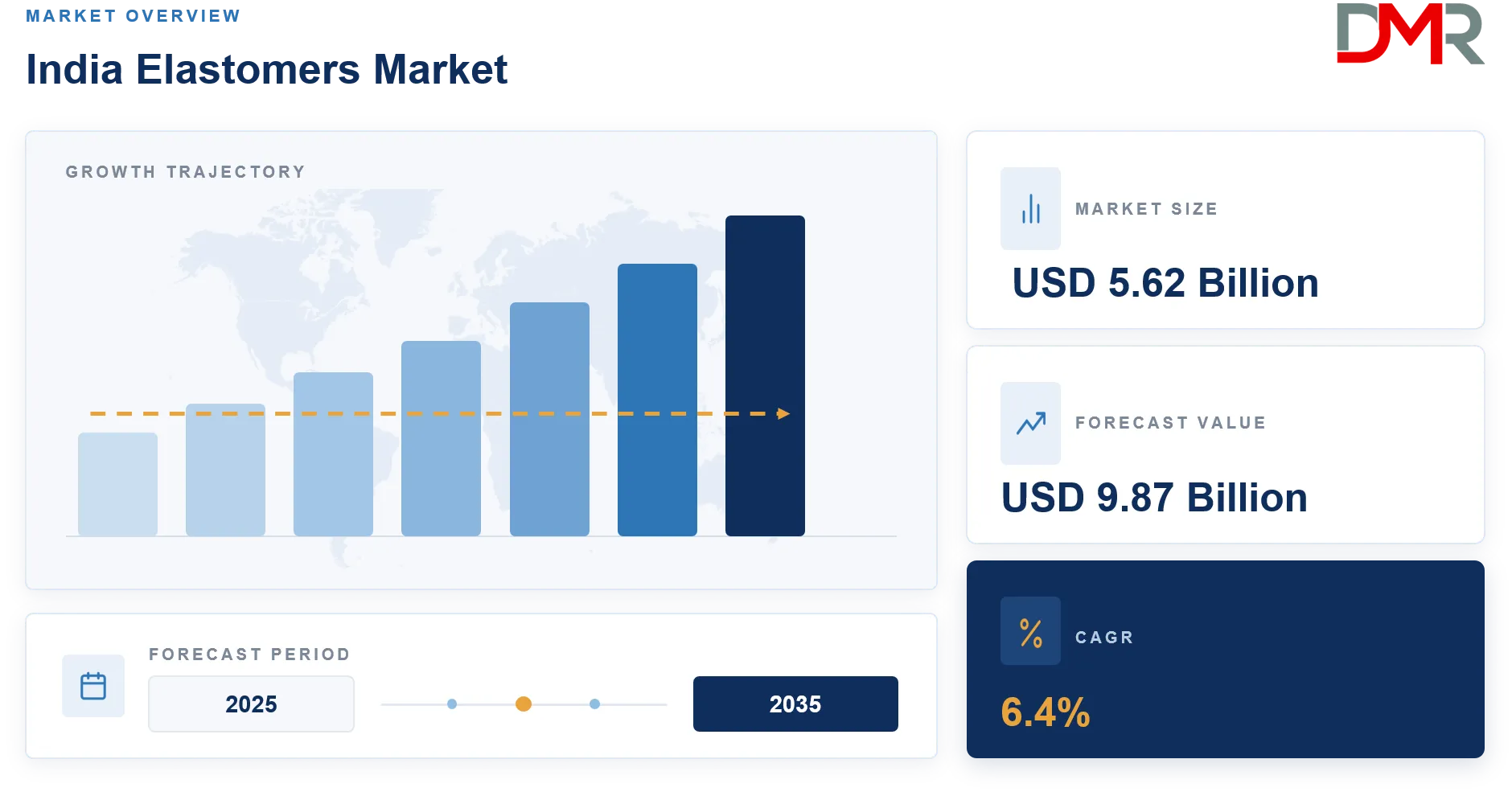
- Market Value: India elastomers market is valued at USD 5.62 billion in 2026 and is projected to reach USD 9.87 billion by 2035.
- CAGR: India elastomers market is expected to grow at a CAGR of 6.4% from 2026 to 2035.
- By Material Segment Analysis: Non-silicone elastomer sealing materials led the material segment with a 55.0% share in 2026.
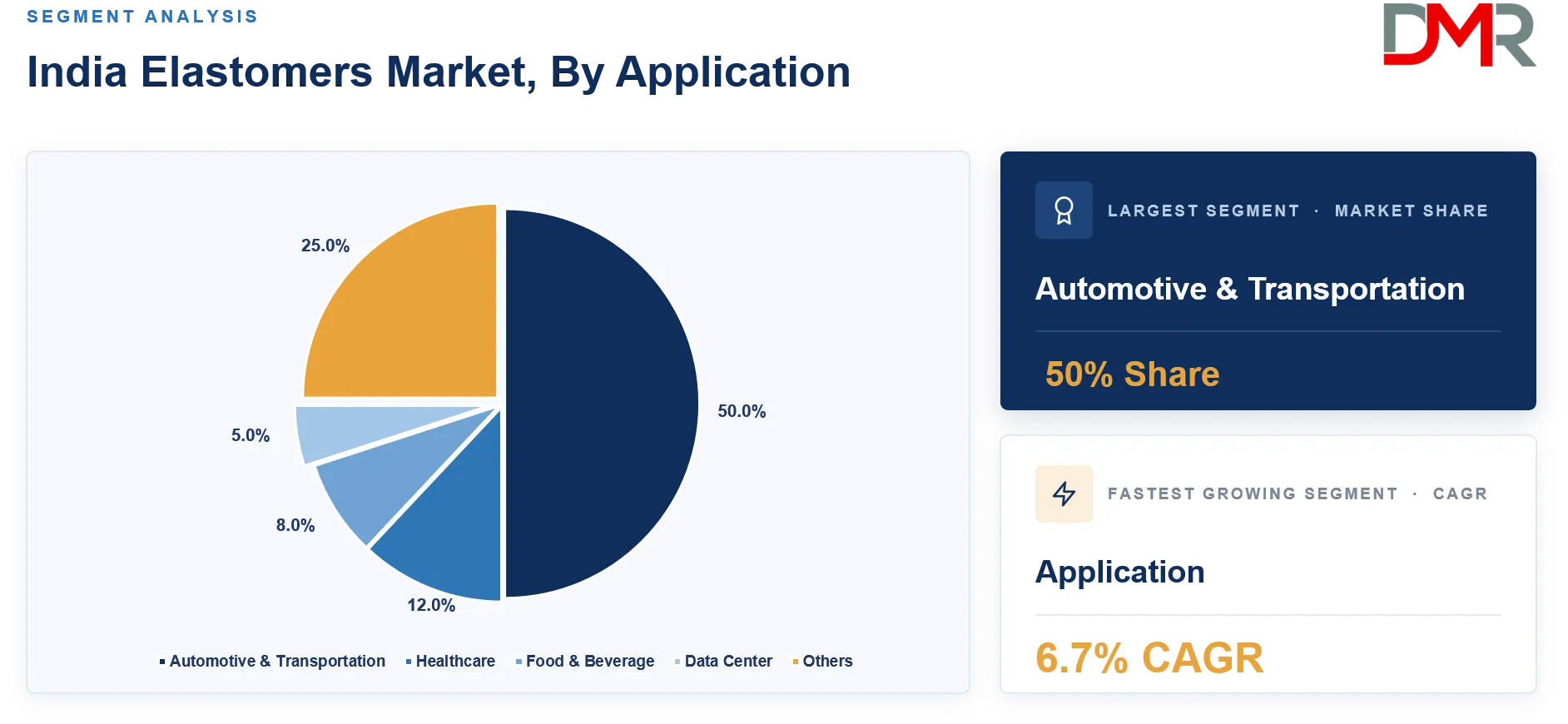
- By Application Segment Analysis: Automotive & transportation held a 50.0% share in 2026.
- Major Players: Motherson Group, Perfect Seals, SKF India, Hutchinson India, Uno Minda and Others.
What is the India Elastomers Market and its Market Size?
The India elastomers market size is projected to be valued at USD 5.62 billion in 2026 and reach USD 9.87 billion by 2035, expanding at a CAGR of 6.4% during the forecast period. Elastomers used across the Indian market include EPDM, FKM, HNBR, NBR, AEM/ACM, silicone grades such as HCR and LSR, and high-performance non-elastomeric sealing and wear materials including PTFE, PEEK, PFA, and PAI. Demand is closely tied to automotive sealing, fluid-management systems, thermal management, industrial equipment, data-center cooling infrastructure, medical devices, and hygienic food-processing systems.
ℹ
To learn more about this report –
Download Your Free Sample Report Here
India's large vehicle manufacturing base is particularly important: during 2025, the country produced about 53.8 lakh passenger vehicles, 11.1 lakh commercial vehicles, 12.2 lakh three-wheelers, and 255 lakh two-wheelers, creating a substantial addressable base for seals, O-rings, gaskets, hoses, vibration-control parts, and engineered elastomer components.
Use Cases
- Automotive Fluid Sealing: EPDM, FKM, HNBR, NBR, and specialty elastomers are used in engine, transmission, braking, steering, air-conditioning, fuel, and thermal-management systems. India's high vehicle production volumes create repeat demand from OEM platforms and replacement channels.
- EV Battery and Thermal Systems: Electric vehicles require elastomeric seals around battery packs, cooling circuits, connectors, housings, pumps, and high-voltage assemblies. Material selection increasingly focuses on temperature stability, dielectric performance, coolant resistance, and long service life.
- Data Center Cooling: Hyperscale, enterprise, and colocation data centers use elastomeric and fluoropolymer sealing materials in liquid-cooling circuits, pumps, valves, heat exchangers, piping connections, power systems, and HVAC equipment. India's data-center capacity reached about 1,500 MW by 2025.
- Medical Equipment: Silicone, EPDM, fluorocarbon materials, and engineered polymers support pumps, diagnostic systems, fluid pathways, device housings, connectors, and other components requiring cleanliness and controlled material performance. India had 4,108 licensed medical-device manufacturers as of March 2026.
- Food Processing Equipment: Food and beverage plants use seals in pumps, mixers, valves, filling lines, homogenizers, piping, and cleaning systems. Materials must withstand repeated temperature cycles, cleaning chemicals, oils, water, and hygienic operating conditions without contaminating processed products.
How AI/Gen AI is Transforming the India Elastomers Market?
Advanced analytics and machine-learning systems are changing how Indian elastomer manufacturers formulate compounds, control curing, inspect molded parts, and predict seal performance. Producers can combine laboratory data with operating variables such as temperature, pressure, chemical exposure, compression set, hardness, and dimensional tolerances to shorten formulation cycles. Computer-vision inspection is also becoming relevant for identifying flash, surface defects, dimensional variation, and molding inconsistencies in high-volume seals. For automotive suppliers producing millions of components, automated quality analysis can reduce scrap while improving process consistency and traceability.
Digital engineering is also strengthening application development. Seal suppliers can use simulation-assisted material selection to compare EPDM, FKM, HNBR, silicone, PTFE, and other materials before physical validation. This is increasingly valuable for EV battery cooling, hydrogen-related systems, high-temperature powertrain applications, and liquid-cooled data centers, where failure conditions differ from conventional equipment. Predictive maintenance models can additionally combine vibration, pressure, temperature, and leakage information to estimate seal degradation in industrial assets. The commercial effect is a shift from selling standardized molded components toward higher-value engineered sealing systems supported by material data, testing, design expertise, and lifecycle performance analysis.
Key Drivers in the India Elastomers Market
Large Automotive Manufacturing Base Expands Sealing Demand
Automotive manufacturing is the largest demand engine for the India elastomers market. Vehicle production during 2025 reached about 53.8 lakh passenger vehicles, 11.1 lakh commercial vehicles, 12.2 lakh three-wheelers, and 255 lakh two-wheelers. Each platform requires numerous seals, gaskets, O-rings, hoses, vibration-control parts, and fluid-management components. The government's ₹25,938 crore PLI scheme for automobiles and auto components further supports advanced automotive manufacturing, localization, and new component investment, increasing opportunities for domestic elastomer suppliers.
Electrification Raises Requirements for Advanced Materials
Vehicle electrification is changing rather than eliminating elastomer demand. Battery packs, e-axles, electric motors, thermal-management loops, charging interfaces, power electronics, and cooling systems create new sealing points with different temperature, coolant, dielectric, and durability requirements. EPDM remains relevant for coolant and weathering applications, while FKM, HNBR, silicone, and engineered thermoplastics address more demanding operating conditions. As Indian OEMs increase EV localization, material suppliers that can validate compounds for battery safety, cooling reliability, and long-life operation gain a stronger competitive position.
Restraints in the India Elastomers Market
Raw Material and Specialty Polymer Cost Exposure
Indian seal and elastomer processors remain exposed to movements in feedstock, specialty polymer, filler, curing-agent, and imported compound prices. High-performance grades such as FKM, specialty silicone, PEEK, PAI, and fluoropolymers carry a substantially higher material cost than conventional NBR or EPDM. Buyers in automotive and industrial supply chains also apply strong annual cost-reduction pressure. When raw-material inflation cannot be passed through rapidly, processors face margin compression, making formulation efficiency, localization, scrap reduction, and long-term sourcing contracts increasingly important.
Qualification Cycles Limit Rapid Material Substitution
Sealing materials are frequently safety-critical and cannot be replaced only on the basis of price. Automotive, railway, medical, food-processing, and high-pressure industrial applications require validation against temperature, chemicals, pressure, compression set, aging, dimensional tolerance, and service-life targets. OEM approvals can therefore make material transitions lengthy and technically demanding. Smaller Indian processors without laboratory infrastructure, traceability systems, simulation capability, or application engineering resources can face barriers when competing for high-value programs that require documented long-term performance.
Growth Opportunities in the India Elastomers Market
Liquid-Cooled Data Centers Create a New High-Value Application
India's data-center expansion is opening a specialized sealing opportunity beyond traditional automotive demand. National installed data-center capacity increased from about 375 MW in 2020 to around 1,500 MW by 2025, while power demand from data centers is estimated to reach 13.56 GW by 2031-32. Operators are adopting direct-to-chip liquid cooling, adiabatic cooling, immersion systems, and high-density racks. These architectures increase the importance of reliable seals in coolant distribution units, pumps, valves, heat exchangers, manifolds, piping, and auxiliary power systems.
Medical Device Localization Supports Specialty Elastomers
India's expanding medical-device manufacturing ecosystem creates opportunities for high-purity silicone and other application-specific sealing materials. The country had 4,108 licensed medical-device manufacturers as of March 2026, while medical-device exports increased from USD 2.5 billion in 2020-21 to USD 4.1 billion in 2024-25. Government-supported medical-device parks in Greater Noida, Ujjain, and Kanchipuram are also building manufacturing infrastructure. Suppliers offering validated materials, precise molding, controlled production, and documentation can target diagnostic, fluid-handling, surgical, pharmaceutical, and laboratory equipment programs.
Trends in the India Elastomers Market
Shift Toward Application-Specific High-Performance Compounds
The India elastomers market is moving from commodity selection toward compounds engineered around actual operating environments. Conventional NBR remains suitable for many oil-resistant applications, while EPDM supports weathering, water, coolant, and thermal-management functions. FKM is preferred where chemical and high-temperature resistance are critical, and HNBR offers strength and heat resistance in demanding dynamic applications. Silicone grades are gaining relevance in electronics, healthcare, and thermal systems. This shift increases the value of compounding expertise, testing, simulation, and customer-specific formulation.
Localization of Engineered Sealing Systems
OEMs are placing greater emphasis on localized supply chains, shorter development cycles, and supplier engineering support. This is encouraging Indian and multinational sealing companies to expand local molding, material-development, tooling, testing, and application-engineering capabilities. Freudenberg, for example, has invested in a Morinda production facility supporting its Vibracoustic and Freudenberg-NOK India operations. Localization is especially significant for automotive electrification because new battery, cooling, chassis, and drivetrain designs require seals to be developed alongside assemblies rather than sourced as standardized aftermarket components.
Research Scope and Analysis
The India elastomers market is segmented based on Material and Application. The study provides an in-depth analysis of key segments and sub-segments, covering their applications, industry adoption, demand patterns, material-performance requirements, and contribution to overall market growth.
By Material;
Non-silicone elastomer sealing materials dominated the India elastomers market with a 55.0% share in 2026. The segment includes FKM, EPDM, HNBR, AEM/ACM, NBR, and other engineered compounds. Its leadership reflects the broad performance range required by India's automotive and industrial sectors. EPDM is extensively suited to coolant, water, weathering, and environmental sealing, while NBR serves oil- and fuel-related applications where cost-performance balance is critical. HNBR addresses higher heat and mechanical demands, and FKM is used where resistance to aggressive fluids, chemicals, and elevated temperatures is required. Growing EV thermal-management systems are expanding opportunities for coolant-compatible elastomers, while conventional passenger vehicles, commercial vehicles, railway equipment, two-wheelers, pumps, machinery, and industrial systems maintain a large installed demand base. Suppliers capable of tailoring hardness, compression set, temperature resistance, chemical compatibility, and service life are positioned to capture higher-value programs.
ℹ
To learn more about this report –
Download Your Free Sample Report Here
By Application;
Automotive & transportation accounted for 50.0% of the India elastomers market in 2026, making it the leading application segment. The category covers passenger vehicles, commercial vehicles, railway vehicles, two- and three-wheelers, and specialized vehicles. India's 2025 production base of 53.8 lakh passenger vehicles and 255 lakh two-wheelers alone creates significant recurring demand for elastomer components. Applications range from shaft seals, O-rings, hoses, boots, gaskets, mounts, brake-system parts, steering components, air-conditioning seals, and weather strips to emerging battery and coolant-system components. Electrification is changing the material mix by reducing certain combustion-engine sealing points while creating new requirements around batteries, electric drives, thermal management, and electronics protection. Suppliers with OEM qualification capability, localized production, precision tooling, and advanced materials portfolios therefore have opportunities to increase value per platform even as vehicle architectures evolve.
The India Elastomers Market Report is segmented on the basis of the following:
By Material
- Non-Silicone Elastomer Sealing Materials
- FKM
- EPDM
- HNBR
- AEM/ACM
- NBR
- Others
- Silicone Sealing Materials
- HCR
- LSR
- Other Specialty Silicones
- Non-Elastomeric Dynamic Sealing And Wear Materials
By Application
- Data Center
- Hyperscale Data Centers
- Enterprise Data Centers
- Colocation Data Centers
- Automotive & Transportation
- Commercial Vehicles
- Passenger Vehicles
- Railway Vehicles
- 2/3-Wheelers
- Specialized Vehicles
- Healthcare
- Food & Beverage
- Others
Major Countries Analysis
India Elastomers Market
India's elastomer demand is supported by one of the world's largest vehicle manufacturing ecosystems, expanding digital infrastructure, medical-device localization, rail investment, and industrial equipment production. Policy measures are strengthening the downstream manufacturing base, including the ₹25,938 crore PLI program for automobiles and auto components. India also produced 255 lakh two-wheelers and 53.8 lakh passenger vehicles in 2025. At the same time, data-center capacity reached about 1,500 MW by 2025, adding a newer demand pool for thermal-management and liquid-handling seals. The combination favors suppliers with local compounding, molding, testing, engineering, and OEM qualification capabilities.
Competitive Landscape
The India elastomers market has a mixed competitive structure consisting of diversified automotive-component groups, specialist seal manufacturers, multinational engineered-material companies, and regional molders. Competition increasingly centers on material performance, OEM qualification, local engineering capability, application design, cost control, and reliable high-volume production rather than component price alone. Motherson Group and Uno Minda benefit from deep relationships across India's automotive supply chain, while SKF India participates through sealing and rotating-equipment solutions. Freudenberg Sealing Technologies brings expertise in static and dynamic seals for engines, transmissions, brakes, batteries, axles, steering, industrial systems, and electric-mobility applications. ElringKlinger supplies sealing solutions across engines, transmissions, exhaust systems, auxiliary units, body, chassis, batteries, and new propulsion technologies. Hutchinson, Cooper Standard, NOK-Freudenberg India, Perfect Seals, and Anand Motor Products further intensify competition across automotive and industrial applications. As EVs, liquid-cooled data centers, and advanced medical manufacturing expand, differentiation is likely to depend increasingly on specialty FKM, HNBR, silicone, fluoropolymer, and engineered wear-material capabilities combined with local validation and rapid product development.
Some of the prominent players in the India elastomers Industry are:
- Motherson Group
- Perfect Seals
- SKF India
- Hutchinson India
- Uno Minda
- Freudenberg Sealing Technologies
- Anand Motor Products (AMP)
- ElringKlinger India
- Cooper Standard Automotive India
- NOK-Freudenberg India
- Others
Regulatory Landscape
India elastomers market participants operate within a regulatory framework covering chemicals, automotive components, environmental compliance, product safety, waste management, and application-specific quality standards. Automotive sealing suppliers must align materials and components with OEM specifications and relevant requirements under the Central Motor Vehicles Rules and Automotive Industry Standards, particularly where seals affect braking, fuel handling, emissions, batteries, or vehicle safety. Chemical and polymer processors are also subject to environmental approvals and pollution-control requirements governing emissions, effluents, hazardous materials, and industrial waste. Extended Producer Responsibility provisions for plastic packaging are increasing attention to material traceability and end-of-life management. Healthcare and food & beverage applications require tighter control over composition, contamination, migration, cleanliness, and processing conditions. As EV adoption expands, suppliers must also respond to evolving battery safety and thermal-management requirements, increasing demand for tested, documented, and application-qualified elastomer solutions.
Investment and White Space Analysis
Investment opportunities in the India elastomers market are shifting toward specialized materials and locally engineered sealing systems rather than commodity elastomer capacity alone. With the market projected to increase from USD 5.62 billion in 2026 to USD 9.87 billion by 2035, attractive white spaces include FKM and HNBR compounds, specialty silicones, low-friction PTFE solutions, PEEK wear components, EV battery sealing, thermal-management seals, and high-performance products for data centers. Automotive & transportation already accounts for 50.0% of market demand, but electrification creates additional requirements around battery enclosures, coolant circuits, e-drive units, connectors, and power electronics. Another opportunity lies in import substitution through domestic compounding, precision molding, testing, tooling, and rapid prototyping. Suppliers that establish application-development centers near automotive and industrial clusters can shorten qualification cycles and strengthen OEM engagement. Healthcare, food processing, and liquid-cooled data centers offer further white space for high-purity and application-specific sealing materials.
Recent Developments
- May 2026: Freudenberg introduced modular TPE bellows production, lowering tooling costs for small batches and expanding customized elastomer options for Indian mobility suppliers.
- October 2025: Motherson approved Rubbertec Group asset acquisition through Motherson Elastomers, strengthening global rubber-component and sealing-system capabilities for auto programs.
Report Details
| Report Characteristics |
| Market Size (2026) |
USD 5.62 Bn |
| Forecast Value (2035) |
USD 9.87 Bn |
| CAGR (2026–2035) |
6.4% |
| The US Market Size (2026) |
USD 5.62 Bn |
| Historical Data |
2021 – 2025 |
| Forecast Data |
2027 – 2035 |
| Base Year |
2025 |
| Estimate Year |
2026 |
| Segments Covered |
By Material (Non-Silicone Elastomer Sealing Materials {FKM, EPDM, HNBR, AEM/ACM, NBR, and Others}, Silicone Sealing Materials {HCR, LSR, and Other specialty silicones}, and Non-Elastomeric Dynamic Sealing And Wear Materials {PEEK, PTFE, PFA, PAI, and Others}), By Application (Data Center {Hyperscale Data Centers, Enterprise Data Centers, and Colocation Data Centers}, Automotive & Transportation {Commercial Vehicles, Passenger Vehicles, Railway Vehicles, 2/3-Wheelers, and Specialized Vehicles}, Healthcare, Food & Beverage, and Others) |
| Regional Coverage |
India |
Frequently Asked Questions
What is the current size of the India Elastomers Market?
▾ The India elastomers market is valued at USD 5.62 billion in 2026 and is forecast to reach USD 9.87 billion by 2035.
What is the growth rate of the India Elastomers Market during the forecast period?
▾ The India elastomers market is expected to grow at a CAGR of 6.4% during the forecast period from 2026 to 2035.
What factors are driving the growth of the India Elastomers Market?
▾ India elastomers market growth is driven by automotive production, EV adoption, localization, and data center expansion.
What are the major challenges restraining the India Elastomers Market?
▾ India elastomers market growth faces raw material price volatility, high specialty polymer costs, and lengthy qualification cycles.
Which segment holds the largest share of the India Elastomers Market?
▾ Non-silicone elastomer sealing materials lead the India elastomers market material segment with a 55.0% share in 2026.
Who are the leading companies in the India Elastomers Market?
▾ Motherson Group, Perfect Seals, SKF India, Hutchinson India, Uno Minda, Freudenberg Sealing Technologies, Anand Motor Products (AMP), ElringKlinger India, Cooper Standard Automotive India, and NOK-Freudenberg India are leading companies in the India elastomers market.
How is AI influencing the India Elastomers Market?
▾ AI supports the India elastomers market through compound optimization, automated quality inspection, and predictive maintenance.
What are the future opportunities and trends in the India Elastomers Market?
▾ India elastomers market opportunities include EV sealing, liquid-cooled data centers, medical devices, and specialty materials.