Market Snapshot
- Market Size (2026): USD 1.8 Bn
- Forecast Value (2035): USD 11.3 Bn
- CAGR (2026-2035): 22.6%
- Leading Charger Type (2026): AC Charger, around 62%
- Leading Vehicle Type (2026): Two-Wheelers, close to 44%
- Key Players: Tata Power, Statiq, ChargeZone and others
What is India Electric Vehicle Charging Station Market and its Market Size?
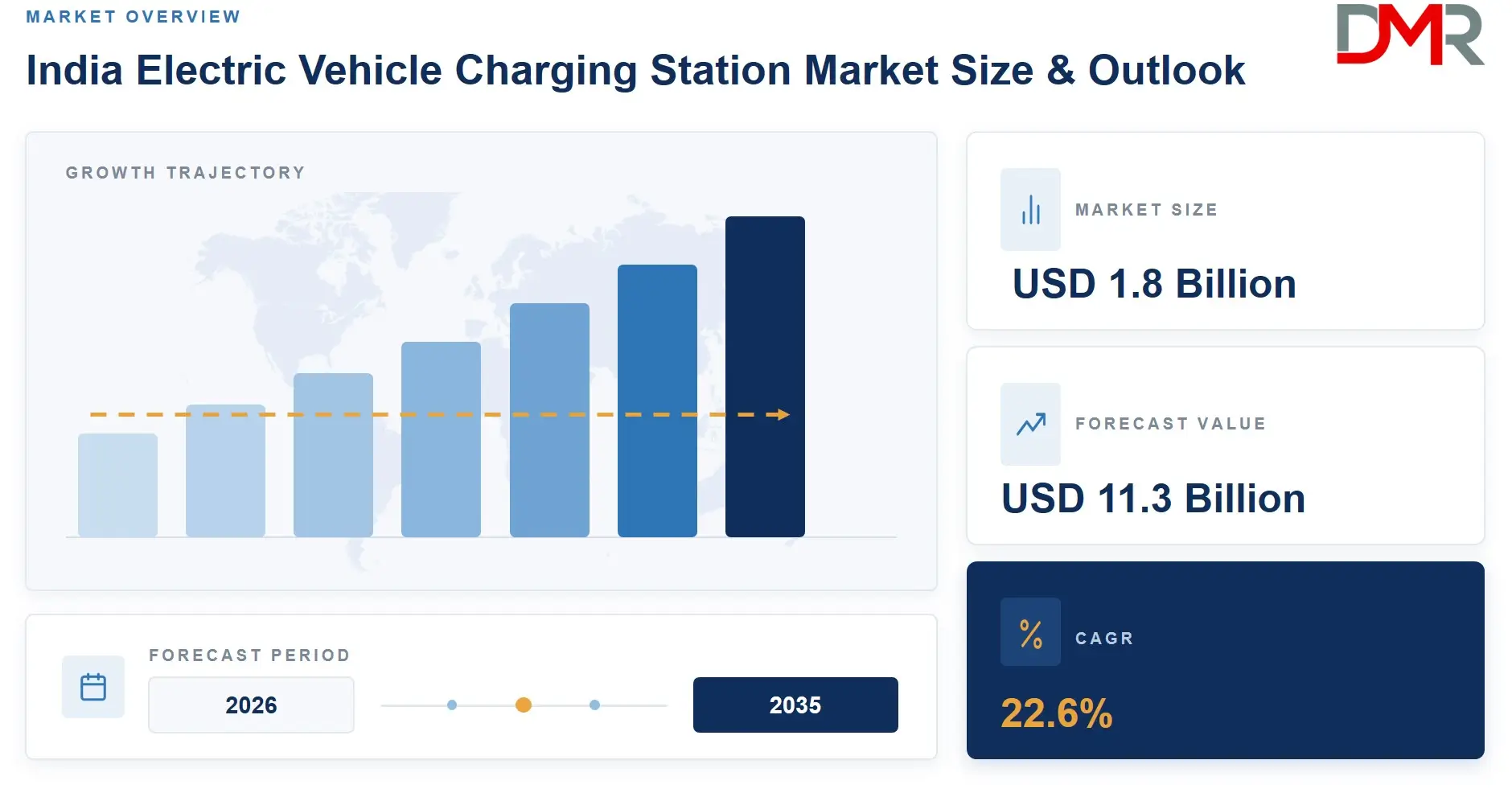
The India Electric Vehicle Charging Station Market size is estimated to reach USD 1.8 Bn in 2026 and is further anticipated to reach USD 11.3 Bn by 2035, at a CAGR of 22.6%.
ℹ
To learn more about this report –
Download Your Free Sample Report Here
The market covers the equipment, installation and network operation revenue generated from publicly accessible, workplace, residential and captive fleet charging points for electric two-wheelers, three-wheelers, passenger cars and buses across India. It excludes the sale price of the vehicles themselves and the value of electricity consumed, which sit in adjacent utility and automotive markets. The figures in this report describe demand generated inside India: revenue booked by installers, network operators and equipment suppliers for charging infrastructure deployed within the country, not the worldwide turnover of companies headquartered here.
Buyers span state-run discoms and municipal transport corporations procuring depot charging for electric bus fleets, private charge point operators building public networks along highways and in cities, real estate developers and resident welfare associations installing society-level chargers, and e-commerce and quick-commerce fleets electrifying last-mile delivery. Each buyer group weighs a different mix of upfront hardware cost, land availability, grid connection lead time and utilisation economics, which keeps the market fragmented across many regional operators rather than concentrated in a handful of national networks.
What is structurally changing is the shift from a hardware-led, subsidy-dependent industry toward one organised around network uptime, interoperability and financing. Early deployment relied heavily on capital subsidies tied to two-wheeler and three-wheeler adoption; the next phase is being shaped by mandatory charging standards, right-of-way reform for public land, and long-tenor financing structures that let operators build ahead of confirmed utilisation. Component localisation under production-linked incentive schemes is also narrowing the cost gap with imported power electronics, which supports margin recovery for domestic equipment makers.
Use Cases
- Highway Corridor Operators: Charge point operators install DC fast charging clusters at fuel retail outlets and dedicated plazas along national highways, letting intercity electric car and bus traffic recharge within a stop rather than planning routes around scarce infrastructure, which extends viable trip distance for electric fleets.
- Residential Society Charging: Resident welfare associations and property developers retrofit basement parking with metered AC chargers billed to individual flats, removing the single biggest adoption barrier for private car buyers who cannot access a dedicated home connection or approved installer in older housing stock.
- Last-Mile Delivery Fleets: E-commerce and quick-commerce operators build captive charging hubs sized to overnight and midday battery-swap or plug-in cycles for two-wheeler and three-wheeler delivery fleets, cutting per-kilometre fuel cost by approximately 60% against comparable petrol fleets while keeping vehicles on route during peak hours.
- State Transport Undertaking Depots: State road transport corporations fit bus depots with high-power overnight chargers and opportunity charging bays on select routes, sequencing electric bus rollout against depot power upgrades rather than vehicle delivery schedules alone.
Key Takeaways
- Market Size and Share: The market is valued at USD 1.8 Bn in 2026 and is set to expand to USD 11.3 Bn by 2035.
- Charger Type Analysis: AC Chargers are expected to account for approximately 62% of 2026 revenue, while DC Fast Chargers grow fastest.
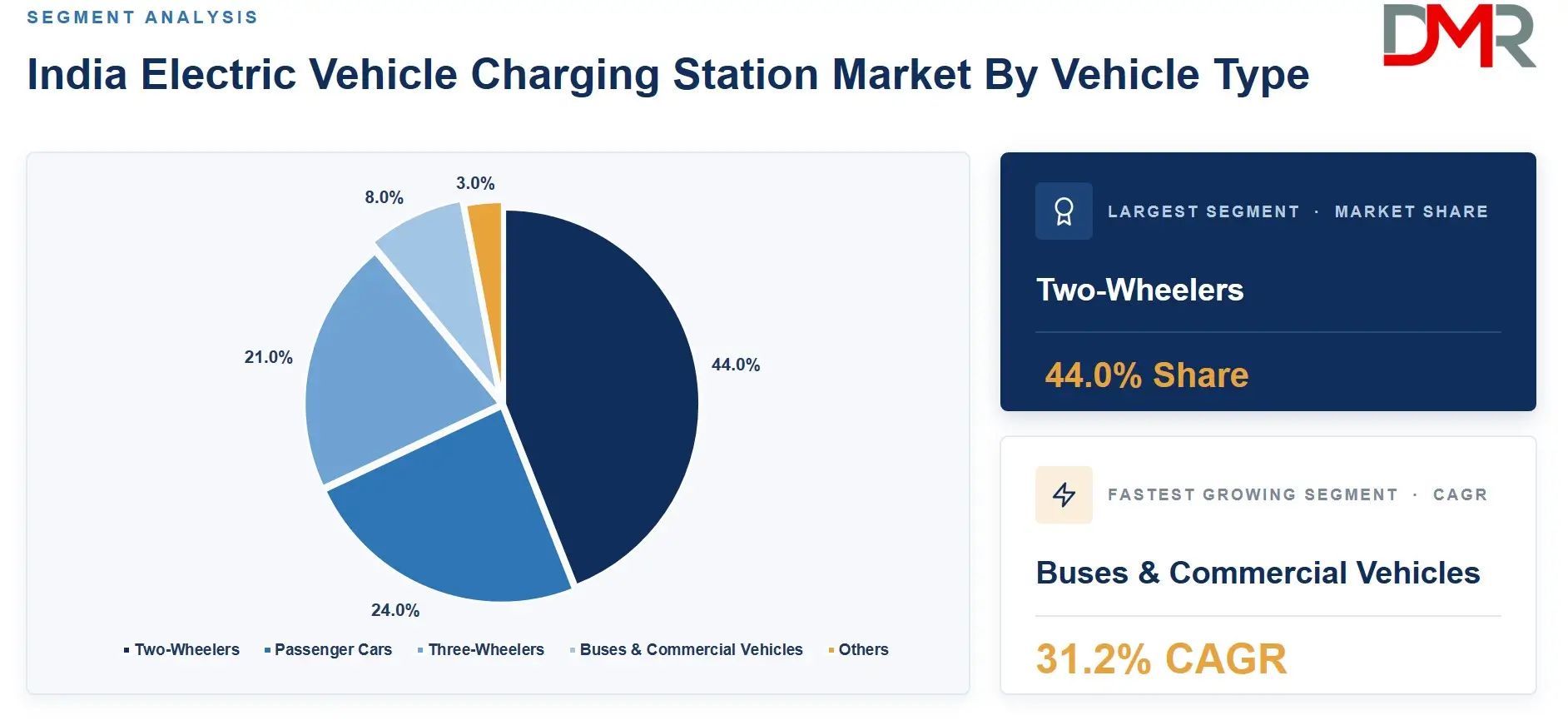
- Vehicle Type Analysis: Two-Wheelers hold the largest share of demand, with Buses and Commercial Vehicles the fastest-growing category through 2035.
- Demand Concentration: Charging deployment is concentrated around dense two-wheeler and three-wheeler ownership clusters and along freight-heavy national highway corridors.
- Policy Momentum: Central production-linked incentive schemes and state EV policies continue to anchor site economics for new charge point operators.
- Investment Activity: Oil marketing companies and private charge point operators are both scaling site counts, pointing to a still-consolidating competitive base.
How AI/Gen AI is Transforming the India Electric Vehicle Charging Station Market?
Artificial intelligence in Indian charging infrastructure is mostly operational rather than headline-generating: operators use it to keep scarce, capital-intensive sites running and to decide where the next site should go. Forecasting models sit at the centre of this, since a charger that is idle for most of the day or overloaded during a narrow evening window both destroy the same unit economics.
Demand and load forecasting models help operators size transformer capacity and set dynamic tariffs across peak and off-peak windows, while computer vision at forecourts flags occupied bays, cable faults and vandalism without a site visit. Predictive maintenance models trained on charger telemetry catch failing power modules before they cause a truck-roll, which matters more in India than in denser markets given the distances between service technicians and rural or highway sites. Site selection increasingly draws on machine learning models that combine traffic flow, grid feeder capacity and existing fuel retail footprints rather than manual surveys alone.
- Load Forecasting: predicts hourly demand per site to size grid connections and time-of-day pricing.
- Computer Vision Monitoring: remote bay-occupancy and fault detection across unmanned charging sites.
- Predictive Maintenance: telemetry-based failure prediction for power modules and connectors.
- AI-Assisted Site Selection: traffic, feeder-capacity and footfall modelling for new charger placement.
Key Drivers in the India Electric Vehicle Charging Station Market
Two forces are pulling investment into charging infrastructure ahead of confirmed utilisation.
- Central and State Electrification Policy: Production-linked incentive schemes for advanced battery and charger manufacturing, combined with state-level capital subsidies and land allotment for public charging sites, have lowered the entry cost for new charge point operators. States compete on faster approvals and lower electricity tariffs for EV charging, which has pulled deployment ahead of organic vehicle demand in several corridors. Municipal and highway authority mandates requiring charging bays in new commercial and residential construction add a second, steadier channel of site creation that does not depend on operator capital alone, spreading installation across thousands of smaller developers rather than a few large networks.
- Two-Wheeler and Fleet Electrification Volume: Electric two-wheelers and three-wheelers already account for the large majority of electric vehicles sold in India each year, and this installed base needs low-cost, high-frequency charging rather than the rare long-distance fast charge a passenger car needs. Delivery and ride-hailing fleets add a second volume driver, since fleet operators can commit to fixed charging locations and predictable daily cycles that make site utilisation easier to underwrite than scattered private car ownership, which is why captive fleet charging has scaled faster than public highway charging in absolute site count.
Restraints in the India Electric Vehicle Charging Station Market
Two structural brakes slow site rollout even where demand is confirmed.
- Fragmented Land and Right-of-Way Access: Public charging sites need parking bays with clear title or long-term lease, which is scarce in dense Indian cities and often tied up in slow municipal approval processes. Fuel retail outlets, the most obvious retrofit candidates, carry their own licensing constraints on co-locating electrical infrastructure. Highway sites depend on land allotted by national and state highway authorities, and allotment timelines frequently run longer than the vehicle-volume growth an operator underwrote its business case against, leaving completed sites waiting for traffic that has not yet arrived.
- Grid Capacity and Distribution Constraints: Many urban and semi-urban distribution feeders were not sized for clustered high-power charging load, so operators face long queues and significant cost for transformer upgrades before a fast-charging site can go live. Distribution utilities vary widely in how quickly they process new connection requests and in the tariff structure applied to EV charging load, which makes site-level economics difficult to standardise across states and slows the network effect operators need to reach profitability.
Growth Opportunities in the India Electric Vehicle Charging Station Market
The clearest white space sits away from the metro markets that first-generation networks targeted.
- Highway Charging Corridor Build-Out: Golden Quadrilateral and expressway corridors carrying freight and long-distance passenger traffic remain underserved relative to the electric car and bus volumes forecast for the next decade. Operators that secure land allotment early along these corridors, ahead of confirmed traffic, stand to hold a structural advantage once fast-charging becomes a standard trip-planning input, similar to the first-mover position fuel retail chains built decades earlier along the same routes.
- Fleet-as-a-Service Partnerships: Bundling charging access with vehicle leasing, battery-as-a-service and fleet management software gives logistics and ride-hailing aggregators a single commercial relationship instead of separate vehicle, energy and infrastructure contracts. This model lowers the fleet operator's upfront capital need and gives the charging operator a contracted, predictable utilisation base, which is scarce in a market still dominated by pay-per-use public charging.
Trends in the India Electric Vehicle Charging Station Market
Two shifts are changing how charging capacity gets built and sold.
- Move Toward DC Fast and Ultra-Fast Hubs: Early public deployment leaned on lower-cost AC chargers; new highway and hub sites increasingly specify DC fast and ultra-fast units to cut dwell time for commercial and passenger traffic. This raises upfront hardware and grid-connection cost per site but improves throughput per bay, changing the economics operators use to justify new locations.
- Interoperable Charge Point Management Software: Operators are consolidating disparate hardware fleets under management platforms built on open protocols, letting a single app and payment layer work across networks. This channel shift toward software-mediated access is reducing the customer-acquisition advantage that early proprietary networks held.
Research Scope and Analysis
Segment performance is assessed across five axes: charger type, vehicle type, deployment, component and standard. Each axis identifies the sub-segment carrying the largest share of 2026 revenue and the one expanding fastest through 2035, along with the commercial reason behind each position.
ℹ
To learn more about this report –
Download Your Free Sample Report Here
By Charger Type
AC Chargers are projected to hold the largest share by charger type in 2026, accounting for approximately 62% of revenue, since low-power AC units are the default choice for home, workplace and society charging where dwell time is long and hardware cost must stay low. Growth, however, is concentrated in DC Fast Chargers, expanding at a CAGR of 29.5% between 2026 and 2035 as highway corridor build-out and fleet operators prioritise throughput per bay over unit cost, pulling capital toward higher-power installations even though they carry a smaller share of total charger count today.
By Vehicle Type
Two-Wheelers are expected to remain the largest vehicle type by charging demand in 2026, holding close to 44% of the market, reflecting their dominant share of India's overall electric vehicle parc and their high-frequency, low-energy charging pattern. The steeper trajectory sits with Buses and Commercial Vehicles, forecast at a CAGR of 31.2% through 2035, as state transport undertakings and freight fleets commit to electrification on fixed routes, each vehicle requiring dedicated high-power depot charging that scales infrastructure spend well ahead of vehicle count.
By Deployment
Public Charging is set to lead deployment in 2026, accounting for around 46% of revenue, since city and highway networks currently represent the largest pool of installed, revenue-generating sites open to any user. Fleet and Captive Charging, however, is the fastest-growing deployment category, with a CAGR of 27.8% between 2026 and 2035, as logistics, ride-hailing and transport-corporation fleets increasingly build dedicated depot charging sized to their own duty cycles rather than relying on shared public infrastructure.
By Component
Hardware is anticipated to capture the largest component share in 2026, at approximately 58%, because every new site still carries a substantial one-time cost for chargers, switchgear and civil works regardless of network size. Services, covering installation, operations and maintenance, form the fastest-growing component at a CAGR of 26.4% through 2035, as the installed base of live chargers grows large enough to require recurring upkeep contracts rather than one-off deployment work.
By Standard
CCS2 is projected to hold the largest share by standard in 2026, close to 41%, having become the default connector specified for four-wheeler DC fast charging across most new public sites. The fastest-growing standard is the domestically mandated Bharat AC001 and DC001 specification, expanding at a CAGR of 33.1% through 2035, as regulatory requirements push low-cost, locally manufactured connectors into the high-volume two-wheeler and three-wheeler charging segment.
The India Electric Vehicle Charging Station Market Report is Segmented Based on the Following
By Charger Type
- AC Charger
- DC Fast Charger
- Others
By Vehicle Type
- Two-Wheelers
- Three-Wheelers
- Passenger Cars
- Buses and Commercial Vehicles
- Others
By Deployment
- Public Charging
- Private and Home Charging
- Fleet and Captive Charging
- Others
By Component
- Hardware
- Software
- Services
By Standard
- CCS2
- Bharat AC001 and DC001
- CHAdeMO
- Others
Regulatory Landscape
India's charging standards and safety rules have moved from voluntary guidance to mandated specifications over the past few years, with the domestic Bharat AC001 and DC001 protocols now required alongside CCS2 for public sites seeking incentive support. State electricity regulators have separately begun classifying EV charging as a distinct load category with its own tariff, replacing the commercial-rate billing that made early public charging uneconomic. The near-term opening lies in harmonising these state-level tariff orders, since operators building multi-state networks currently underwrite each state's approval and pricing regime separately. The persistent risk is policy inconsistency between the centre and individual states on subsidy continuity and land allotment, which can strand capital committed under one incentive cycle when the next state government revises terms, and this uncertainty continues to weigh on how quickly institutional capital commits to network-scale build-out.
Technology Analysis
Charging hardware has moved from basic AC wall units toward modular DC fast chargers with liquid-cooled cables and dynamic power-sharing across multiple bays, letting one grid connection serve several vehicles at once. What is shifting now is the pairing of hardware with charge point management software that handles remote diagnostics, dynamic pricing and interoperable payments across operator networks, reducing the customer friction that fragmented apps created in the market's early years. The commercial opening sits in vehicle-to-grid and smart-charging capability, which lets aggregated fleet batteries absorb surplus renewable generation and defer costly transformer upgrades. The brake is that most of India's existing distribution grid still lacks the metering and communication infrastructure such bidirectional charging needs, so the technology is likely to reach commercial fleets years before it reaches residential chargers, shaping which buyer segments adopt fastest and which operators can credibly compete on service quality rather than price alone.
Competitive Landscape
The market remains fragmented across oil marketing companies converting fuel retail sites, dedicated charge point operators building public networks, vehicle makers operating proprietary networks for their own fleets, and equipment manufacturers supplying hardware to all three. Competition centres on site count and uptime rather than price alone, since network coverage determines whether a charging app gets used for daily trip planning. Financing structures and land access increasingly separate the operators able to scale from those confined to single-city footprints, and consolidation through partnership and site-sharing agreements is becoming more common as networks chase national coverage.
Some of the Prominent Players in the India Electric Vehicle Charging Station Market Are
- ABB India
- Siemens Limited
- Schneider Electric India
- Delta Electronics India
- Panasonic Life Solutions India
- Bosch Limited
- Eaton India
- Legrand India
- Tata Power (EZ Charge)
- Statiq
- ChargeZone
- Fortum India (Charge and Drive)
- Magenta Power (ChargeGrid)
- Numocity Technologies
- EVRE
- Exicom Power Systems
- Servotech Power Systems
- Volttic
- Zeon Charging
- Charzer
- Massive Mobility (Chargeup)
- Sun Mobility
- Log9 Materials
- Ather Energy (Ather Grid)
- Ola Electric (Hypercharger)
- Jio-bp (Reliance BP Mobility)
- Bharat Petroleum Corporation Limited
- Indian Oil Corporation Limited
- Hindustan Petroleum Corporation Limited
- NTPC Vidyut Vyapar Nigam
- Power Grid Corporation of India
- Adani Total Energies
- Kirloskar Electric Company
- Havells India
- Luminous Power Technologies
- Okaya Power Group
- Amara Raja Energy and Mobility
- Mahindra Last Mile Mobility
- REIL (Rajasthan Electronics and Instruments)
- V-Guard Industries
- Other Key Players
Recent Developments
- In April 2026, Tata Power expanded its EZ Charge network past a new public charging point milestone, adding sites along additional national highway stretches to support intercity electric car travel.
- In February 2026, Statiq widened its fleet charging partnerships with quick-commerce operators, adding dedicated captive hubs sized for two-wheeler delivery fleets in several metro clusters.
- In October 2025, Jio-bp opened additional highway fast-charging bays at its retail outlets, pairing DC fast chargers with existing fuel forecourts on key freight corridors.
- In July 2025, Exicom Power Systems scaled up domestic manufacturing of DC fast charger power modules to meet demand from production-linked incentive-qualified projects.
- In April 2025, Bharat Petroleum Corporation Limited added public charging bays across a further set of company-owned retail outlets in southern and western India.
Report Details
| Report Characteristics |
| Market Size (2026) |
USD 1.8 Bn |
| Forecast Value (2035) |
USD 11.3 Bn |
| CAGR (2026-2035) |
22.6% |
| Historical Data |
2021 - 2025 |
| Forecast Data |
2026 - 2035 |
| Base Year |
2025 |
| Segments Covered |
By Charger Type, By Vehicle Type, By Deployment, By Component, By Standard |
| Regional Coverage |
India |
Frequently Asked Questions
How big is the India Electric Vehicle Charging Station Market?
▾ The India Electric Vehicle Charging Station Market is estimated at USD 1.8 Bn in 2026 and is projected to reach USD 11.3 Bn by 2035, driven by rising two-wheeler electrification, fleet adoption and highway corridor build-out across the country.
What is the growth rate of the India Electric Vehicle Charging Station Market?
▾ The market is forecast to grow at a CAGR of 22.6% between 2026 and 2035, as DC fast charging, fleet and captive deployment and domestically mandated charging standards pull investment ahead of confirmed vehicle volumes in several corridors.
What is driving demand in the India Electric Vehicle Charging Station Market?
▾ Demand is driven chiefly by the scale of two-wheeler and three-wheeler electrification, which needs high-frequency, low-cost charging, alongside central and state policy support through production-linked incentives, capital subsidies and mandated charging standards that lower the entry cost for new site operators.
Who are the key players in the India Electric Vehicle Charging Station Market?
▾ Key players include Tata Power, Statiq, ChargeZone, Fortum India, Magenta Power, ABB India, Siemens Limited and Bharat Petroleum Corporation Limited, alongside a broad base of domestic charger manufacturers and oil marketing companies converting retail sites.
Which charger type leads the India Electric Vehicle Charging Station Market?
▾ AC Chargers lead by revenue, accounting for approximately 62% of the market in 2026, reflecting their dominant role in home, workplace and society charging, while DC Fast Chargers are the fastest-growing category as highway and fleet sites prioritise charging speed.
What role does government policy play in the India Electric Vehicle Charging Station Market?
▾ Central production-linked incentive schemes for charger manufacturing, state capital subsidies for public charging sites and mandated domestic charging standards together shape site economics, with land allotment and electricity tariff treatment for EV load remaining the main policy levers still varying by state.