India Food Ingredients Market Snapshot
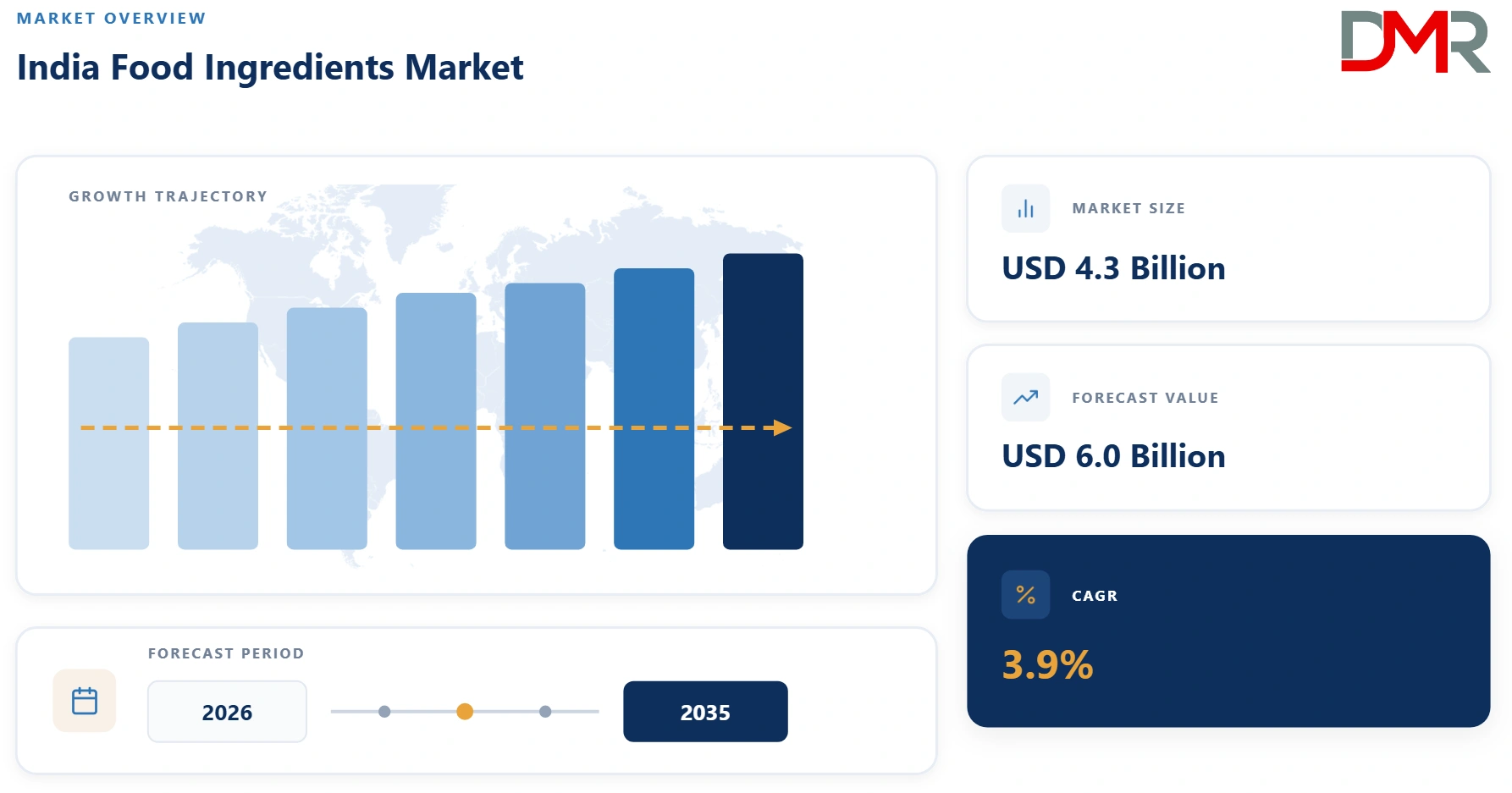
- India Food Ingredients Market Size in 2026: USD 4.3 Billion
- India Food Ingredients Market Size in 2035: USD 6.0 Billion
- CAGR from 2026 to 2035: 3.9%
- Sweeteners is the leading Type segment in 2026: 40.2%
- Plant-Based is the leading Source segment in 2026: 32.3%
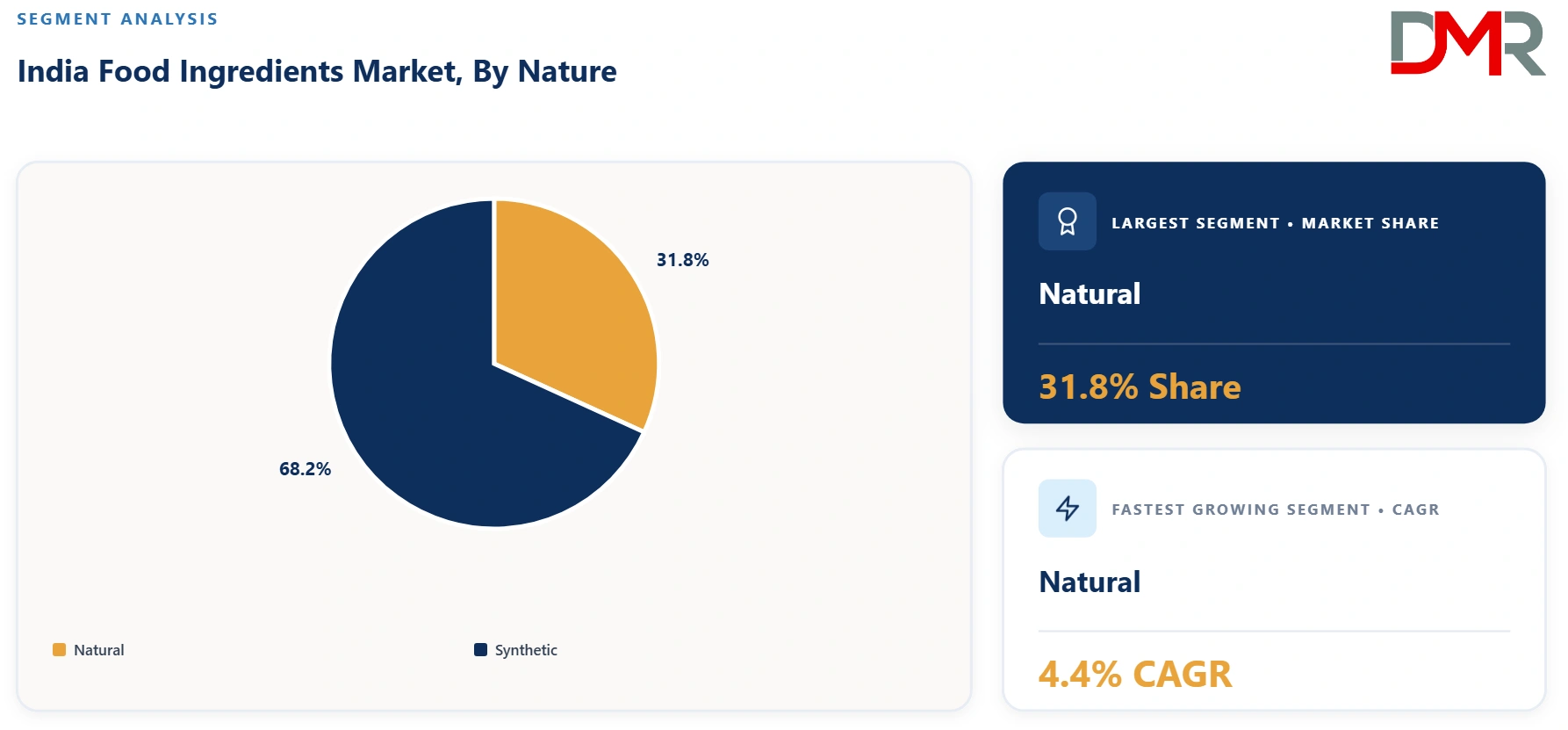
- Natural is the leading Nature segment in 2026: 31.8%
- Bakery & Confectionery is the leading Application segment in 2026: 42.1%
What is the Food Ingredients and its Market Size?
The India Food Ingredients Market is projected to reach USD 4.3 billion in 2026 and grow at a compound annual growth rate of 3.9% through 2035, reaching USD 6.0 billion.
ℹ
To learn more about this report –
Download Your Free Sample Report Here
The market includes sweeteners, flavors, colors, preservatives, emulsifiers, stabilizers, enzymes, proteins, vitamins, minerals, fibers, and other functional ingredients used across food and beverage manufacturing. Growth is driven by expanding processed food consumption, rapid urbanization, changing dietary preferences, and demand for convenience products. Rising consumer interest in natural, clean-label, fortified, and functional foods is also encouraging manufacturers to develop innovative ingredients that improve nutrition, taste, texture, quality, and shelf stability.
Use Cases
- Product Reformulation & Clean-Label Development: Food manufacturers use natural flavors, colors, sweeteners, preservatives, and functional ingredients to reformulate products with simpler labels while maintaining sensory quality, stability, shelf life, and processing performance in response to evolving consumer preferences.
- Nutritional Fortification & Functional Foods: Vitamins, minerals, proteins, dietary fibers, probiotics, and other functional ingredients are incorporated into foods and beverages to strengthen nutritional profiles, support specific wellness positioning, and enable development of fortified products targeting increasingly health-conscious Indian consumers.
- Shelf-Life & Food Quality Management: Preservatives, antioxidants, stabilizers, enzymes, and acidity regulators help manufacturers control microbial deterioration, oxidation, texture changes, and product instability, supporting longer distribution cycles, consistent quality, reduced food waste, and improved commercial viability across packaged food categories.
- Texture, Taste & Sensory Optimization: Emulsifiers, hydrocolloids, starches, flavors, sweeteners, and flavor enhancers enable manufacturers to optimize mouthfeel, consistency, taste, appearance, and overall sensory performance, helping differentiate products and deliver consistent consumer experiences across conventional and innovative food formulations.
Key Takeaways
- Market Size: The India Food Ingredients Market is anticipated to be valued at USD 4.3 billion in 2026 and is forecast to reach USD 6.0 billion by 2035, expanding steadily as processed, packaged, convenience, fortified, and functional food consumption increases across the country.
- Growth Rate and Outlook: The market is projected to expand at a CAGR of 3.9% from 2026 to 2035. Growth is supported by rapid urbanization, changing dietary habits, expanding organized food processing, premiumization, clean-label preferences, and increasing demand for ingredients that improve nutrition, taste, texture, stability, and shelf life.
- Primary Growth Drivers: Increasing consumption of processed and convenience foods, expansion of bakery and beverage industries, rising disposable incomes, growing health awareness, and demand for functional nutrition are accelerating ingredient consumption. Manufacturers are also investing in natural formulations, nutritional fortification, localized flavors, sugar reduction, and improved shelf-life solutions.
- By Type Analysis: Sweeteners are projected to lead the Type segment with a 40.2% share in 2026, supported by extensive utilization across beverages, confectionery, bakery, dairy, and processed foods. Growing demand for reduced-sugar formulations and alternative sweetening solutions is also encouraging innovation across natural and specialty sweeteners.
- By Source Analysis: Plant-Based ingredients are anticipated to lead the Source segment with a 32.3% share in 2026. Rising demand for natural, vegetarian, sustainable, and clean-label food products is supporting their adoption, while manufacturers increasingly incorporate plant-derived proteins, fibers, colors, flavors, sweeteners, and functional ingredients into new formulations.
- By Nature Analysis: Natural ingredients are expected to account for the leading share of 31.8% in 2026, driven by increasing consumer preference for recognizable ingredients and cleaner product labels. Food manufacturers are increasingly replacing synthetic additives with natural colors, flavors, preservatives, sweeteners, and functional ingredients to address evolving health and wellness preferences.
How AI/Gen AI is Transforming the India Food Ingredients Market?
AI and Generative AI are transforming the India Food Ingredients Market by accelerating ingredient discovery, product formulation, quality management, and manufacturing optimization. AI-powered analytics enable manufacturers to evaluate consumer preferences, nutritional requirements, sensory characteristics, and ingredient interactions to develop targeted formulations faster. Generative AI can support recipe development, alternative ingredient selection, clean-label reformulation, and sugar, salt, or fat reduction while maintaining desired taste and texture. Machine learning systems also improve demand forecasting, raw material procurement, inventory planning, and production efficiency. In quality control, AI-enabled imaging and predictive models can identify inconsistencies, contamination risks, and process deviations. Ingredient suppliers are also using advanced analytics to anticipate emerging functional food trends and customize solutions for bakery, beverage, dairy, and convenience food manufacturers, strengthening innovation and reducing product development timelines.
Rising Consumption of Processed and Convenience Foods
Rapid urbanization, changing lifestyles, increasing workforce participation, and expanding organized retail are strengthening demand for processed, packaged, and convenience foods across India. Food manufacturers increasingly require flavors, sweeteners, preservatives, emulsifiers, starches, enzymes, and stabilizers to maintain consistent taste, texture, appearance, and shelf life. Growth in bakery products, ready-to-eat meals, snacks, dairy products, beverages, and frozen foods is creating sustained ingredient demand. Expansion of modern retail, quick-commerce platforms, and foodservice chains is also increasing product accessibility. Consequently, manufacturers are developing differentiated formulations that meet consumer expectations for convenience, affordability, quality, and consistent sensory performance.
Growing Consumer Focus on Health, Nutrition, and Functional Foods
Increasing awareness of nutrition and preventive wellness is encouraging Indian consumers to seek foods offering benefits beyond basic nourishment. This shift is increasing demand for proteins, dietary fibers, vitamins, minerals, probiotics, plant-derived ingredients, and other functional components. Food and beverage manufacturers are responding by introducing fortified beverages, protein-rich snacks, functional dairy products, nutritional foods, and better-for-you alternatives. Growing interest in reduced sugar, lower sodium, improved digestive wellness, and balanced nutrition is further influencing formulation strategies. Ingredient suppliers capable of delivering scientifically supported, application-specific functional solutions are therefore gaining opportunities as brands expand their portfolios toward health-oriented and premium nutritional products.
Restraints in the India Food Ingredients Market
Volatility in Raw Material Prices and Supply Availability
Food ingredient manufacturers remain exposed to fluctuations in agricultural commodity prices, seasonal production, climate conditions, transportation costs, and international supply disruptions. Ingredients derived from grains, fruits, vegetables, oilseeds, dairy products, and specialty crops can experience considerable cost and availability variations. Dependence on imported specialty ingredients can further expose manufacturers to currency movements, freight expenses, and global supply constraints. These uncertainties increase production costs and complicate long-term procurement planning, particularly for smaller manufacturers operating with limited margins. Maintaining alternative suppliers, strategic inventories, and diversified sourcing networks can reduce disruption risks but may increase operational complexity and overall working-capital requirements.
Regulatory Compliance and Complex Formulation Requirements
Food ingredient suppliers must comply with evolving requirements concerning food safety, permitted additives, labeling, nutritional claims, contaminants, and ingredient usage levels. Compliance can require extensive testing, documentation, quality assurance, traceability, and reformulation investments, increasing commercialization costs and development timelines. Manufacturers serving multiple product categories may face additional complexity because ingredient functionality and permissible usage can differ by application. Growing consumer scrutiny surrounding artificial additives, excessive sugar, sodium, and unfamiliar ingredients also creates formulation challenges. Companies must therefore balance regulatory requirements, clean-label expectations, affordability, sensory performance, processing stability, and shelf life, which can constrain rapid product development and increase technical resource requirements.
Growth Opportunities in the India Food Ingredients Market
Expansion of Clean-Label and Natural Ingredient Solutions
Growing consumer preference for recognizable, minimally processed, and naturally derived ingredients creates significant opportunities for suppliers of natural flavors, colors, sweeteners, antioxidants, preservatives, fibers, and plant-based functional ingredients. Food manufacturers are increasingly exploring alternatives to synthetic additives while attempting to preserve taste, appearance, texture, stability, and shelf life. This transition creates opportunities for ingredient companies to develop application-specific clean-label solutions for bakery, beverages, dairy, snacks, sauces, and convenience foods. Suppliers that combine natural positioning with reliable functionality, scalable sourcing, competitive pricing, and technical formulation support can strengthen relationships with manufacturers seeking differentiated products aligned with evolving consumer expectations.
Innovation in Functional and Nutritionally Fortified Foods
India's expanding health-conscious consumer base provides opportunities for ingredients supporting protein enrichment, digestive wellness, immunity positioning, micronutrient fortification, and specialized nutrition. Manufacturers can incorporate proteins, fibers, vitamins, minerals, prebiotics, probiotics, and botanical ingredients into everyday food and beverage categories. Opportunities are particularly strong across fortified staples, nutritional beverages, dairy products, healthy snacks, breakfast products, and convenient nutrition formats. Ingredient suppliers can differentiate themselves through customized premixes, improved bioavailability, better taste masking, enhanced solubility, and formulation assistance. Continued innovation could broaden functional nutrition beyond premium consumers by enabling manufacturers to develop accessible products suited to diverse Indian dietary habits and price points.
Trends in the India Food Ingredients Market
Shift Toward Plant-Based and Naturally Derived Ingredients
Plant-derived ingredients are gaining prominence as manufacturers respond to demand for natural, vegetarian, sustainable, and health-oriented food formulations. Plant proteins, fibers, natural colors, botanical extracts, sweeteners, starches, and flavor solutions are increasingly being incorporated across beverages, snacks, dairy alternatives, bakery products, and nutritional foods. India's established vegetarian consumer base provides a favorable environment for developing plant-based formulations tailored to local preferences. Manufacturers are also exploring indigenous crops, grains, pulses, fruits, herbs, and botanical sources for ingredient innovation. This trend is encouraging suppliers to improve functionality, taste, solubility, texture, and processing characteristics while developing scalable plant-based solutions for mainstream applications.
Growing Adoption of Clean-Label Reformulation and Sugar Reduction
Indian food manufacturers are increasingly reformulating established products to address demand for simpler labels, improved nutritional profiles, and reduced levels of sugar, sodium, and artificial additives. This is increasing interest in natural sweeteners, flavor modulators, natural preservatives, alternative colors, fibers, and multifunctional ingredient systems. Reformulation requires careful management because removing conventional additives can affect taste, texture, stability, appearance, processing behavior, and shelf life. Ingredient companies are consequently developing integrated solutions that provide multiple functional benefits within simplified formulations. Advances in sensory optimization, enzyme technologies, fermentation-derived solutions, and ingredient blending are supporting manufacturers seeking healthier positioning without compromising consumer acceptance or production efficiency.
Research Scope and Analysis
The India Food Ingredients Market is segmented by type into sweeteners, flavors, colors, preservatives, emulsifiers, stabilizers, enzymes, starches, proteins, vitamins, minerals, fibers, and others. By source, it includes plant-based, animal-based, microbial-based, and synthetic. By nature, it covers natural and synthetic. By form, it includes dry, liquid, and semi-solid, while applications include bakery, beverages, dairy, snacks, and convenience foods.
ℹ
To learn more about this report –
Download Your Free Sample Report Here
By Type Analysis
Sweeteners are projected to lead the Type segment with a 40.2% share in 2026. Functional & Nutritional Ingredients are expected to register the highest CAGR of approximately 4.6% from 2026 to 2035, supported by growing demand for fortified, functional, and health-focused food products.
By Source Analysis
Plant-Based ingredients are expected to dominate the Source segment with a 32.3% share in 2026. Microbial-Based ingredients are projected to record the highest CAGR of approximately 4.5% from 2026 to 2035, supported by increasing adoption of fermentation-derived enzymes, cultures, proteins, and functional ingredients.
By Nature Analysis
Natural ingredients are projected to hold the highest share of 31.8% in 2026 and are also expected to register the highest CAGR of approximately 4.4% from 2026 to 2035, driven by clean-label preferences and increasing replacement of synthetic additives with naturally derived alternatives.
By Application Analysis
Bakery & Confectionery is expected to lead the Application segment with a 42.1% share in 2026. Dietary Supplements & Nutritional Products are projected to register the highest CAGR of approximately 4.7% from 2026 to 2035, driven by increasing health awareness and functional nutrition demand.
The India Food Ingredients Market Report is segmented based on the following:
By Type
- Sweeteners
- Flavors & Flavor Enhancers
- Food Colors
- Preservatives
- Emulsifiers
- Stabilizers
- Hydrocolloids & Thickeners
- Food Enzymes
- Starches
- Proteins & Amino Acids
- Vitamins & Minerals
- Dietary Fibers
- Fats & Oils
- Acidulants & pH Control Agents
- Functional & Nutritional Ingredients
- Others
By Source
- Plant-Based
- Animal-Based
- Microbial-Based
- Synthetic
By Nature
By Form
- Dry
- Liquid
- Paste/Semi-Solid
By Application
- Bakery & Confectionery
- Beverages
- Dairy & Dairy Alternatives
- Snacks & Savory Products
- Convenience & Processed Foods
- Meat, Poultry & Seafood
- Sauces, Dressings & Condiments
- Infant Nutrition
- Dietary Supplements & Nutritional Products
- Others
Regulatory Landscape
Indian Food Ingredients Market operates under a comprehensive regulatory framework administered primarily by the Food Safety and Standards Authority of India. Regulations cover food additives, product standards, contaminants, labeling, packaging, fortification, nutraceuticals, imports, and approval of non-specified ingredients. FSSAI continues to revise standards as food science, processing technologies, and consumption patterns evolve, including amendments during 2026. Increasing scrutiny of ingredient safety, permitted usage levels, nutritional declarations, and health claims creates compliance risks and additional testing requirements. However, clearer standards create opportunities for suppliers offering traceable, compliant, natural, and functional ingredients. Regulatory alignment can strengthen consumer confidence, improve product quality, and encourage organized manufacturers to invest in innovative ingredient formulations.
Investment and White Space Analysis
India offers substantial investment and white-space opportunities for food ingredient companies as processed foods, functional nutrition, clean-label products, plant-based formulations, and convenience foods expand. Government support for food processing strengthens the broader investment environment, with the Production Linked Incentive Scheme carrying an outlay of ₹10,900 crore and targeting greater processing capacity, investment, employment, and exports. Ingredient suppliers can pursue opportunities in natural sweeteners, specialty proteins, dietary fibers, fermentation-derived ingredients, natural preservatives, nutritional premixes, and locally sourced flavors. Developing application-specific solutions for regional tastes also offers differentiation potential. Key risks include agricultural price volatility, fragmented sourcing, infrastructure limitations, imported specialty ingredient dependence, and price-sensitive customers, requiring localized manufacturing, efficient sourcing, and technical formulation capabilities.
Competitive Landscape
The India Food Ingredients Market is fragmented and highly competitive, comprising multinational ingredient companies, established domestic manufacturers, regional suppliers, and specialized formulation businesses. Competition centers on product innovation, pricing, application expertise, regulatory compliance, supply reliability, and customized formulations. Major participants include Cargill, Kerry Group, Ingredion, dsm-firmenich, and IFF, alongside numerous Indian suppliers. Companies are strengthening portfolios in natural flavors, plant-based ingredients, proteins, enzymes, sweeteners, nutritional ingredients, and clean-label solutions. Multinationals generally compete through R&D capabilities and application technologies, while domestic participants leverage local sourcing, competitive pricing, regional distribution, and knowledge of Indian taste preferences. Growing demand for healthier formulations is intensifying investment in functional ingredients, sugar reduction, natural alternatives, and customized solutions for bakery, dairy, beverages, snacks, and convenience foods.
Some of the prominent players in the India Food Ingredients Market are:
- Cargill
- ADM
- Ingredion Incorporated
- Kerry Group
- dsm-firmenich
- International Flavors & Fragrances
- Givaudan
- Tate & Lyle
- BASF
- Novonesis
- Corbion
- Sensient Technologies
- Symrise
- MANE
- Ajinomoto
- Roquette
- Palsgaard
- Takasago International Corporation
- Oterra
- Glanbia Nutritionals
- Arla Foods Ingredients
- Kalsec
- Ariake Japan
- Lesaffre
- Angel Yeast
- AGRANA
- Tereos
- Gujarat Ambuja Exports Limited
- Sukhjit Starch & Chemicals Limited
- Synthite Industries
- Plant Lipids
- Vidya Herbs
- Camlin Fine Sciences
- Aarkay Food Products
- Vinayak Ingredients India
- Layn Natural Ingredients
- Prakash Chemicals Agencies
- Aachi Masala Foods
- VKL Seasoning
- Keva Flavours
- Other Key Players
Recent Developments
- In July 2026, Indian specialty food and nutraceutical ingredient technology company Arboreal raised ₹230 crore in Series A funding. The capital will expand manufacturing, strengthen R&D, and accelerate commercialization of functional ingredients, including next-generation proteins, natural zero-calorie sweeteners, functional fibers, and cocoa derivatives.
- In June 2026, Ingredion announced a strategic partnership with Sanstar, including a joint venture and equity investment, to expand specialty food and pharmaceutical ingredients in India. The partnership combines Sanstar's corn-based manufacturing capabilities with Ingredion's formulation and innovation expertise.
- In June 2026, Ingredion and Tate & Lyle: Ingredion agreed to acquire Tate & Lyle in a $3.6 billion transaction, creating a larger specialty food and beverage ingredients business focused on texture, sugar reduction, fiber, nutrition, and functional formulations, with relevance for growth markets including India.
- In May 2026, Safic-Alcan acquired a majority stake in India-based S.A. Ingredients, strengthening its Life Sciences presence in India. The transaction expands its specialty ingredient distribution capabilities, particularly across pharmaceutical and nutraceutical applications, and provides access to more than 400 customers.
Report Details
| Report Characteristics |
| Market Size (2026) |
USD 4.3 Bn |
| Forecast Value (2035) |
USD 6.0 Bn |
| CAGR (2026–2035) |
3.9% |
| Historical Data |
2021 – 2025 |
| Forecast Data |
2026 – 2035 |
| Base Year |
2025 |
| Segments Covered |
By Type, By Source, By Nature, By Form, By Application |
Frequently Asked Questions
How big is the India Food Ingredients Market?
▾ The India Food Ingredients Market is valued at approximately USD 4.3 billion in 2026 and is projected to reach USD 6.0 billion by 2035, driven by growing processed food consumption, functional nutrition, and demand for clean-label ingredients.
What is the CAGR of the India Food Ingredients Market from 2026 to 2035?
▾ The India Food Ingredients Market is expected to grow at a CAGR of 3.9% from 2026 to 2035, driven by urbanization, convenience food consumption, organized food processing, premiumization, and increasing demand for natural and functional ingredients.
What factors are driving the growth of the India Food Ingredients Market?
▾ Key growth drivers include increasing consumption of processed and convenience foods, expanding bakery and beverage industries, rising disposable incomes, urbanization, growing health awareness, nutritional fortification, clean-label preferences, and increasing demand for functional and plant-based food ingredients.
What are the major trends in the India Food Ingredients Market?
▾ Major trends include rising adoption of plant-based and naturally derived ingredients, clean-label reformulation, sugar and sodium reduction, functional nutrition, nutritional fortification, fermentation-derived ingredients, natural preservatives, alternative sweeteners, and increasing use of AI-supported formulation and product development.
Who are the key players in the India Food Ingredients Market?
▾ Key players include Cargill, ADM, Ingredion Incorporated, Kerry Group, dsm-firmenich, International Flavors & Fragrances, Givaudan, Tate & Lyle, BASF, Novonesis, Corbion, Sensient Technologies, Symrise, MANE, Ajinomoto, Roquette, Oterra, Synthite Industries, Plant Lipids, and Camlin Fine Sciences.
How is the India Food Ingredients Market segmented?
▾ The India Food Ingredients Market is segmented by Type, Source, Nature, Form, and Application. Major categories include sweeteners, flavors, colors, preservatives, plant-based and microbial ingredients, natural and synthetic ingredients, dry and liquid forms, and applications across bakery, beverages, dairy, snacks, processed foods, infant nutrition, and nutritional products.