India Food Packaging Market Snapshot
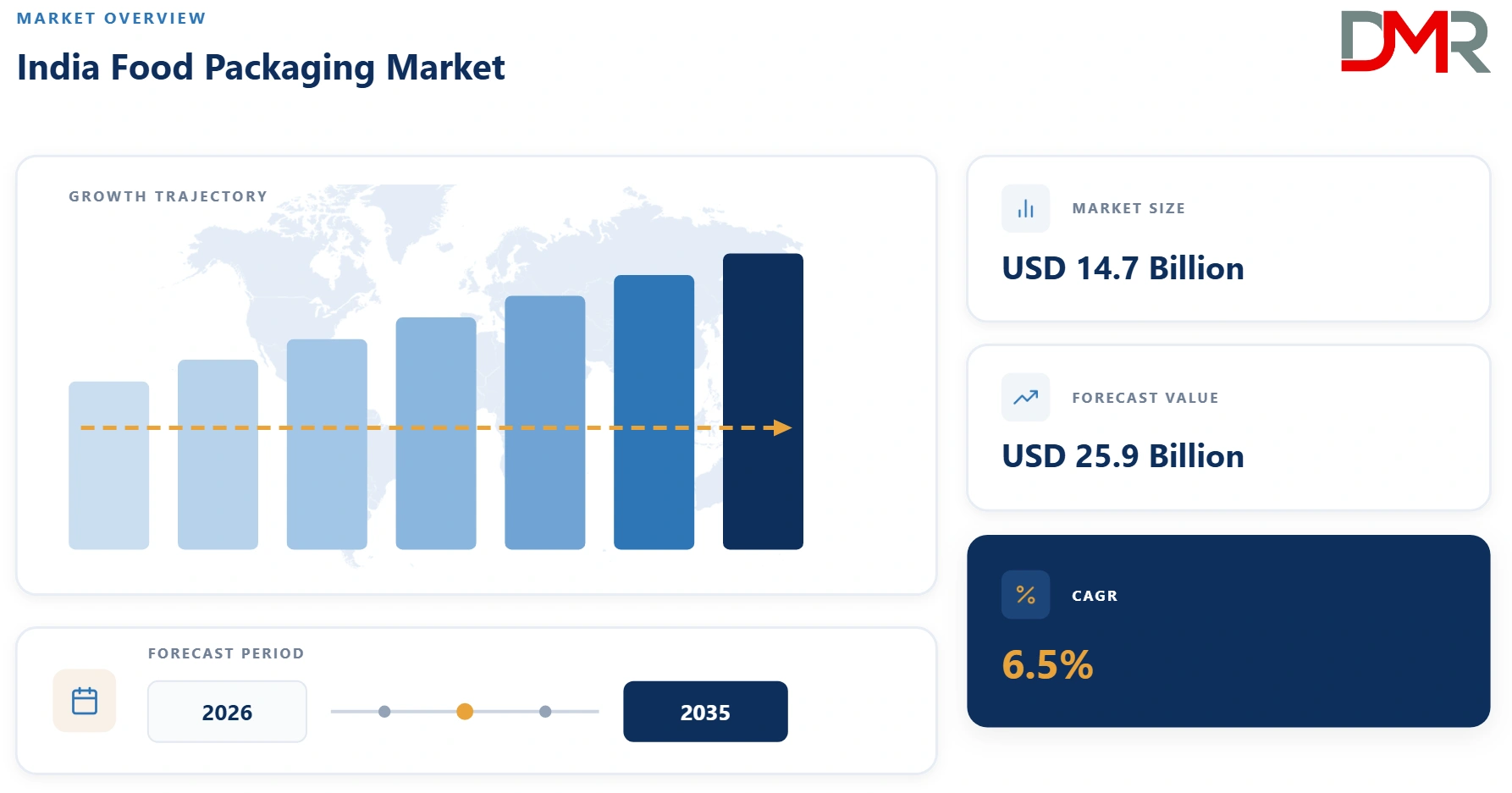
- India Food Packaging Market Size in 2026: USD 14.7 Billion
- India Food Packaging Market Size in 2035: USD 25.9 Billion
- CAGR from 2026 to 2035: 6.50%
- Flexible Packaging is the leading Packaging Type segment in 2026: 42.3%
- Meat, Fish, and Poultry is the leading Application segment in 2026: 24.8%
What is the India Food Packaging and its Market Size?
The India Food Packaging Market is projected to reach USD 14.7 billion in 2026 and grow at a CAGR of 6.50% through 2035, reaching USD 25.9 billion.
ℹ
To learn more about this report –
Download Your Free Sample Report Here
Market growth is driven by expanding packaged food consumption, urbanization, rising disposable incomes, and demand for convenient, hygienic, and longer-shelf-life food products. Flexible packaging, paper-based solutions, and rigid plastics are widely used across dairy, snacks, bakery, meat, poultry, convenience foods, and fresh produce. Sustainability initiatives and recyclable packaging innovations are also influencing industry development.
Use Cases
- Convenience and Ready-to-Eat Foods: Food packaging supports India’s expanding convenience and ready-to-eat food sector by providing lightweight, portable, and easy-to-use formats. Pouches, trays, containers, and wraps help preserve freshness, extend shelf life, prevent contamination, and improve product handling. Growing urbanization, busy lifestyles, food delivery adoption, and demand for portion-controlled products are increasing packaging requirements across ready meals, snacks, and instant foods.
- Dairy and Perishable Food Products: Packaging is widely used for milk, yogurt, cheese, butter, frozen products, meat, poultry, fish, fruits, and vegetables to maintain freshness and product quality. Barrier packaging, aseptic cartons, rigid containers, and flexible films protect foods against moisture, oxygen, microorganisms, and physical damage. Expansion of organized retail and cold-chain infrastructure is strengthening demand for reliable packaging for perishable foods across India.
- Bakery, Snacks, and Confectionery Products: Bakery, snacks, and confectionery manufacturers use packaging to protect products from moisture, air, breakage, and contamination while supporting branding and convenient consumption. Flexible films, laminates, paperboard cartons, pouches, and wrappers are commonly adopted for biscuits, cakes, chocolates, namkeen, chips, and sweets. Rising consumption of packaged snacks and branded foods is encouraging manufacturers to invest in attractive and functional packaging solutions.
Key Takeaways
- Market Size: The India Food Packaging Market is anticipated to be valued at USD 14.7 billion in 2026 and is forecast to reach USD 25.9 billion by 2035, expanding at a CAGR of 6.50%.
- Growth Rate and Outlook: Market expansion is supported by rising consumption of packaged and processed foods, rapid urbanization, increasing disposable incomes, growth of organized retail and food delivery, changing consumer lifestyles, expanding cold-chain infrastructure, and increasing demand for convenient, hygienic, lightweight, sustainable, and longer-shelf-life packaging solutions.
- Primary Growth Drivers: Growing demand for ready-to-eat and convenience foods, expansion of food processing industries, increasing e-commerce and quick-commerce penetration, rising food safety awareness, greater preference for portion-controlled packaging, and investments in recyclable, biodegradable, and high-barrier packaging materials are accelerating the development of India’s food packaging industry.
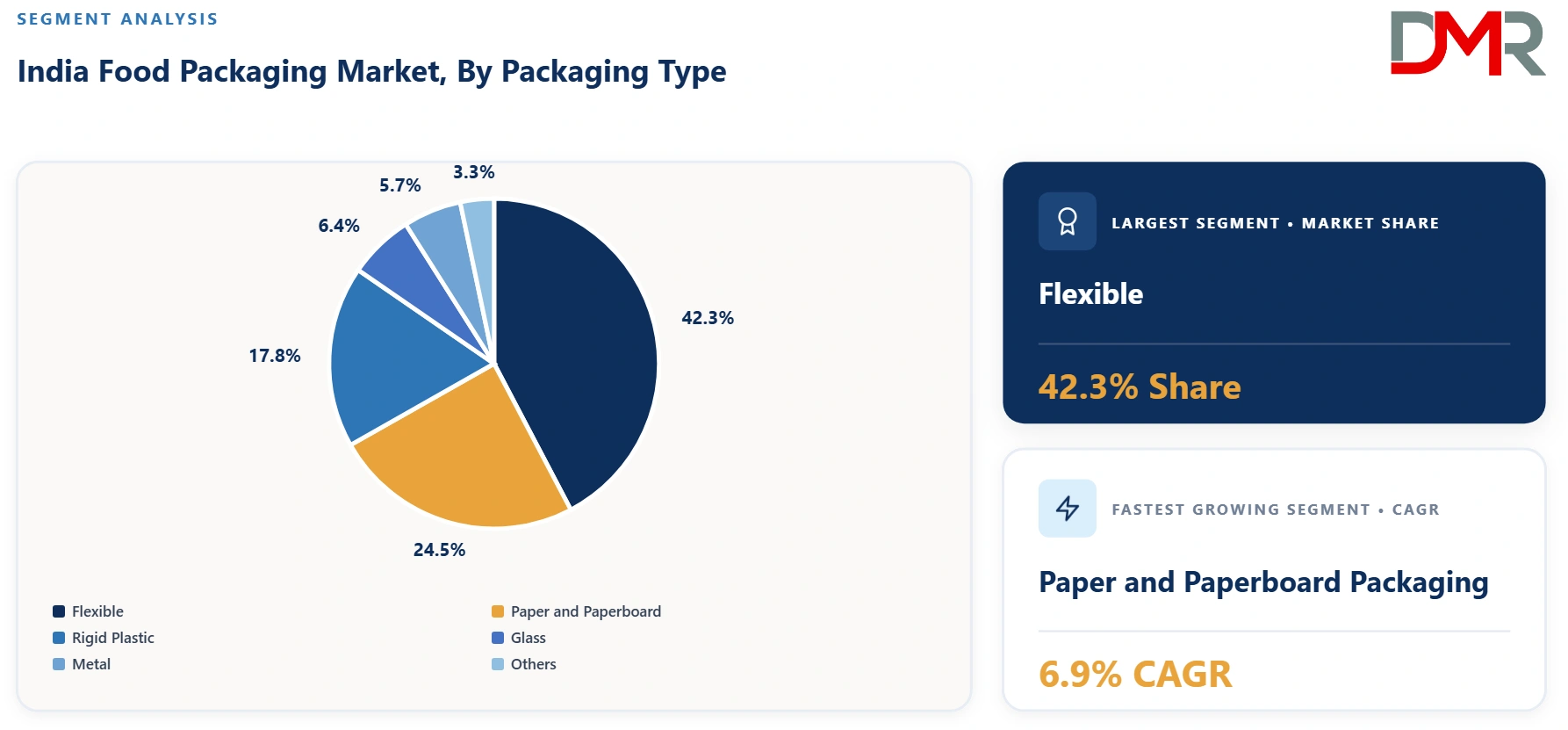
- By Packaging Type Analysis: Flexible Packaging is projected to lead the packaging type segment with a 42.3% share in 2026, supported by its lightweight structure, cost efficiency, convenience, strong barrier properties, and suitability for multiple food categories. Increasing adoption of pouches, films, sachets, and wraps across snacks, dairy, bakery, convenience foods, and processed products is strengthening its market position.
- By Application Analysis: Meat, Fish, and Poultry is expected to lead the application segment with a 24.8% share in 2026, driven by increasing consumption of packaged protein products and growing requirements for hygiene, freshness, extended shelf life, and contamination protection. Expansion of organized meat retail, cold-chain networks, frozen foods, and online grocery channels is further supporting packaging demand.
- Analysis
How AI/Gen AI is Transforming the India Food Packaging Market?
AI and Generative AI are transforming India’s food packaging market by improving packaging design, production efficiency, quality control, and supply chain management. AI-powered vision systems can detect packaging defects, labeling errors, contamination risks, and sealing inconsistencies in real time. Generative AI enables manufacturers to accelerate package design, optimize material usage, and develop customized packaging concepts based on consumer preferences. Predictive analytics supports demand forecasting, inventory planning, and equipment maintenance, reducing waste and downtime. AI also assists sustainability initiatives by evaluating material alternatives and optimizing packaging dimensions. As automation expands, AI-enabled technologies are supporting smarter, cost-efficient, sustainable, and responsive food packaging operations.
Key Drivers in the India Food Packaging Market
Rising Consumption of Packaged and Convenience Foods
Rapid urbanization, rising disposable incomes, smaller households, and increasingly busy lifestyles are strengthening demand for packaged, ready-to-eat, and convenience foods across India. Consumers are purchasing more snacks, dairy products, frozen foods, bakery items, processed meat, instant meals, and beverages that require reliable packaging for freshness and safety. Expansion of modern retail, supermarkets, quick-commerce platforms, and online grocery services further increases the need for durable and convenient packaging formats. Manufacturers are consequently adopting flexible pouches, rigid containers, cartons, trays, and high-barrier films that improve portability, portion control, shelf life, and overall consumer convenience.
Expansion of India’s Food Processing Industry
Continued expansion of India’s food processing sector is creating substantial demand for efficient packaging solutions across dairy, fruits and vegetables, meat, poultry, seafood, bakery, confectionery, and convenience foods. Investments in processing facilities, cold-chain infrastructure, organized retail, and distribution networks are increasing the volume of packaged products entering domestic and export markets. Food manufacturers require packaging that protects products against moisture, oxygen, contamination, physical damage, and temperature fluctuations throughout transportation and storage. Greater emphasis on food safety, standardized labeling, traceability, and longer shelf life is also encouraging adoption of advanced barrier materials, aseptic packaging, modified-atmosphere solutions, and automated packaging technologies.
Restraints in the India Food Packaging Market
Environmental Concerns and Plastic Waste Management Challenges
Growing concerns regarding plastic pollution and packaging waste are creating challenges for India’s food packaging industry, particularly for manufacturers dependent on multilayer plastics and other difficult-to-recycle materials. Increasing regulatory emphasis on waste collection, recycling, extended producer responsibility, and reduced dependence on single-use plastics requires companies to reconsider packaging materials and production processes. Transitioning toward recyclable, compostable, paper-based, or mono-material alternatives can involve significant research, equipment, sourcing, and certification costs. Smaller packaging manufacturers may face greater financial and technical difficulties in adapting. Maintaining food protection, barrier performance, affordability, and shelf life while improving environmental sustainability remains a significant industry challenge.
Volatility in Raw Material and Production Costs
Fluctuating prices of polymers, paper, paperboard, aluminum, steel, glass, adhesives, inks, and other packaging inputs can significantly affect production costs and manufacturer margins. India’s packaging industry is sensitive to changes in crude oil prices, energy expenses, transportation costs, exchange rates, and global supply conditions, particularly for petroleum-derived plastic materials. Food producers generally operate in highly price-sensitive categories, making it difficult for packaging companies to transfer substantial cost increases to customers. Rising investments required for advanced machinery, sustainable materials, quality compliance, and energy-efficient production can create additional financial pressure, especially for small and medium-sized packaging converters operating with limited economies of scale.
Growth Opportunities in the India Food Packaging Market
Expansion of Sustainable and Recyclable Packaging Solutions
Growing environmental awareness among consumers, brands, retailers, and policymakers is creating significant opportunities for sustainable food packaging across India. Manufacturers can expand portfolios incorporating recyclable mono-material structures, paper-based packaging, biodegradable materials, lightweight designs, reusable formats, and packaging containing recycled content. Major food brands are increasingly evaluating packaging strategies to reduce material consumption and improve recyclability without compromising food safety or shelf life. Innovation in coatings, barrier technologies, fiber-based materials, and bio-based polymers can further accelerate adoption. Packaging suppliers capable of combining sustainability, performance, scalability, and competitive pricing are positioned to capture growing demand as food companies strengthen circular economy and environmental commitments.
Growth of E-Commerce, Quick Commerce, and Food Delivery
Rapid expansion of online grocery platforms, quick-commerce services, meal delivery applications, and direct-to-consumer food brands presents considerable opportunities for packaging manufacturers. Products distributed through digital channels require packaging capable of withstanding handling, transportation, temperature variations, leakage risks, and last-mile delivery while maintaining product quality. Demand is increasing for tamper-evident, lightweight, portion-controlled, resealable, insulated, and durable packaging formats. Digital-first food brands also use packaging as an important consumer engagement and branding tool. Developing packaging specifically optimized for delivery efficiency, product protection, traceability, and convenient consumption can enable suppliers to address India’s rapidly evolving digital food distribution ecosystem.
Trends in the India Food Packaging Market
Shift Toward Flexible and Lightweight Packaging Formats
Flexible and lightweight packaging is gaining prominence across India as food manufacturers seek cost-effective solutions that reduce material consumption, transportation requirements, and storage space. Stand-up pouches, sachets, films, wraps, and resealable packages are increasingly used across snacks, confectionery, dairy, sauces, convenience foods, and processed products. Improvements in barrier films, printing technologies, closures, and mono-material structures are expanding the functionality and visual appeal of flexible packaging. Consumers also favor portable and easy-to-open formats suited to on-the-go consumption. This trend is encouraging packaging companies to develop thinner, stronger, recyclable, and high-performance structures that balance convenience, product protection, affordability, and sustainability.
Growing Adoption of Smart and Connected Packaging
Smart packaging technologies are gradually gaining attention as Indian food companies focus on traceability, product authenticity, consumer engagement, and supply chain transparency. QR codes, digital labels, temperature indicators, freshness sensors, RFID technologies, and serialization solutions can provide information regarding ingredients, sourcing, storage conditions, authenticity, and product usage. Connected packaging also enables brands to interact directly with consumers through promotions, recipes, loyalty programs, and personalized digital experiences. Increasing smartphone penetration and digital consumer engagement support this transition. As implementation costs decline, intelligent packaging is expected to become increasingly relevant for premium foods, dairy, meat, seafood, exports, and temperature-sensitive products.
Research Scope and Analysis
The India Food Packaging Market is analyzed by packaging type, including flexible packaging, paper and paperboard, rigid plastic, glass, metal, and others. Application analysis covers bakery, confectionery, pasta and noodles, dairy products, sauces, dressings and condiments, snacks and side dishes, convenience foods, meat, fish and poultry, fruits and vegetables, and other food categories across India.
ℹ
To learn more about this report –
Download Your Free Sample Report Here
By Packaging Type Analysis
Flexible Packaging is projected to hold the highest market share of 42.3% in 2026, supported by affordability, lightweight construction, convenience, and strong barrier properties. Paper and Paperboard Packaging is expected to register the highest CAGR of approximately 6.9% from 2026 to 2035, driven by recyclability, sustainability initiatives, and increasing preference for environmentally responsible packaging.
By Application Analysis
Meat, Fish, and Poultry is anticipated to hold the highest market share of 24.8% in 2026, supported by growing packaged protein consumption and demand for extended shelf life. Convenience Foods is projected to record the highest CAGR of approximately 7.0% from 2026 to 2035, driven by urbanization, busy lifestyles, and rising demand for ready-to-eat products.
The India Food Packaging Market Report is segmented based on the following:
By Packaging Type
- Flexible
- Paper and Paperboard
- Rigid Plastic
- Glass
- Metal
- Others
By Application
- Bakery, Confectionery, Pasta, and Noodles
- Dairy Products
- Sauces, Dressings, and Condiments
- Snacks and Side Dishes
- Convenience Foods
- Meat, Fish, and Poultry
- Fruits and Vegetables
- Others
Regulatory Landscape
India’s food packaging market is significantly influenced by evolving food safety, labelling, plastic waste management, and sustainability regulations. The Food Safety and Standards Authority of India establishes requirements for packaging materials that come into contact with food, supporting safety, hygiene, and product integrity. Extended Producer Responsibility requirements are encouraging producers and brand owners to strengthen plastic collection, recycling, and sustainable material strategies. Restrictions on certain single-use plastics are also accelerating interest in recyclable mono-materials, paper-based formats, and biodegradable alternatives. These developments create opportunities for compliant packaging suppliers and recycling technologies. However, changing requirements, certification expenses, material transition costs, and compliance complexity create risks, particularly for smaller manufacturers, while accelerating modernization across the market.
Technology Analysis
Technology innovation is reshaping India’s food packaging market through automation, smart packaging, advanced barrier materials, digital printing, and sustainable material development. Manufacturers are increasingly adopting automated filling, sealing, inspection, labeling, and palletizing systems to improve productivity, consistency, and production efficiency. High-barrier films, aseptic packaging, modified-atmosphere packaging, and active packaging technologies support longer shelf life and improved food protection. QR codes, RFID, sensors, and digital traceability solutions are creating opportunities for product authentication, supply chain visibility, and consumer engagement. Artificial intelligence and machine vision further strengthen quality inspection and predictive maintenance. However, high equipment costs, technology integration challenges, workforce skill gaps, and limited adoption among smaller converters may restrict widespread implementation.
Competitive Landscape
The India Food Packaging Market is moderately fragmented, featuring large domestic manufacturers, multinational packaging companies, and numerous regional converters. Key participants such as UFlex, TCPL Packaging, EPL, Huhtamaki, Amcor, Manjushree Technopack, Parksons Packaging, and AGI Greenpac compete through product innovation, manufacturing scale, quality, pricing, and customer relationships. Competition is increasingly shifting toward recyclable materials, mono-material structures, lightweight packaging, advanced barrier technologies, and environmentally responsible solutions. Companies are investing in automation, digital printing, high-performance films, aseptic packaging, and improved recycling capabilities. Strategic acquisitions, capacity expansions, partnerships, and technology investments are strengthening market positions. Growing requirements from food processors, FMCG companies, quick-commerce platforms, and organized retailers are also encouraging suppliers to provide customized, efficient, compliant, and sustainable packaging solutions.
Some of the prominent players in the India Food Packaging Market are:
- UFlex Limited
- Huhtamaki Oyj
- Amcor plc
- Tetra Pak International S.A.
- EPL Limited
- TCPL Packaging Limited
- Parksons Packaging Limited
- Manjushree Technopack Limited
- Mold-Tek Packaging Limited
- AGI Greenpac Limited
- Hindustan Tin Works Limited
- Haldyn Glass Limited
- Hindusthan National Glass & Industries Limited
- Parekhplast India Limited
- Pearl Polymers Limited
- Hitech Corporation Limited
- Oji Holdings Corporation
- Smurfit Westrock plc
- ITC Limited
- Cosmo First Limited
- Polyplex Corporation Limited
- Garware Hi-Tech Films Limited
- Jindal Poly Films Limited
- Constantia Flexibles
- Mondi plc
- Sonoco Products Company
- ProAmpac
- Swiss Pac Pvt. Ltd.
- Uma Polymers Limited
- Bilcare Limited
- Pyramid Technoplast Limited
- Pactiv Evergreen Inc.
- Ball Corporation
- Crown Holdings Inc.
- Graham Packaging Company
- Deccan Cans & Printers Pvt. Ltd.
- Autofits Packaging Private Limited
- P.R. Packagings Ltd.
- Hi-Can Industries Pvt. Ltd.
- Multiflex Packaging
- Other Key Players
Recent Developments
- In August 2026, UFlex commissioned its first overseas woven polypropylene bags manufacturing facility in Mexico, developed with an investment of approximately USD 52 million. The facility expands the company’s manufacturing capabilities and strengthens its packaging presence across the Americas.
- In July 2026, Huhtamaki reinforced its long-term commitment to India by participating in a high-level Finland–India business roundtable. India remains a strategic market for the company, where it operates 11 production sites serving packaging customers nationwide.
- In November 2025, UFlex announced an investment exceeding INR 700 crore to expand its packaging film manufacturing facility in Dharwad, Karnataka. The expansion is expected to add 54,000 MTPA of production capacity.
Report Details
| Report Characteristics |
| Market Size (2026) |
USD 14.7 Bn |
| Forecast Value (2035) |
USD 25.9 Bn |
| CAGR (2026–2035) |
6.50% |
| Historical Data |
2021 – 2025 |
| Forecast Data |
2026 – 2035 |
| Base Year |
2025 |
| Segments Covered |
By Packaging Type, By Application |
Frequently Asked Questions
How big is the India Food Packaging Market?
▾ The India Food Packaging Market is projected to reach USD 14.7 billion in 2026 and is expected to attain USD 25.9 billion by 2035.
What is the CAGR of the India Food Packaging Market from 2026 to 2035?
▾ The India Food Packaging Market is projected to expand at a CAGR of 6.50% from 2026 to 2035, supported by increasing packaged food consumption and packaging innovation.
What factors are driving the growth of the India Food Packaging Market?
▾ Growth is driven by rising packaged and convenience food consumption, urbanization, expanding food processing, organized retail, quick commerce, food delivery, and increasing demand for hygienic and sustainable packaging.
What are the major trends in the India Food Packaging Market?
▾ Major trends include growing adoption of flexible and lightweight packaging, recyclable materials, mono-material structures, smart packaging, digital traceability, high-barrier films, automation, and sustainable paper-based packaging solutions.
Who are the key players in the India Food Packaging Market?
▾ Key players include UFlex, Huhtamaki, Amcor, Tetra Pak, EPL, TCPL Packaging, Parksons Packaging, Manjushree Technopack, Mold-Tek Packaging, AGI Greenpac, ITC, and Cosmo First.
How is the India Food Packaging Market segmented?
▾ The market is segmented by Packaging Type into flexible, paper and paperboard, rigid plastic, glass, metal, and others, and by Application into bakery, confectionery, pasta and noodles, dairy products, sauces, dressings and condiments, snacks and side dishes, convenience foods, meat, fish and poultry, fruits and vegetables, and others.