India Food Processing Equipment Market Snapshot
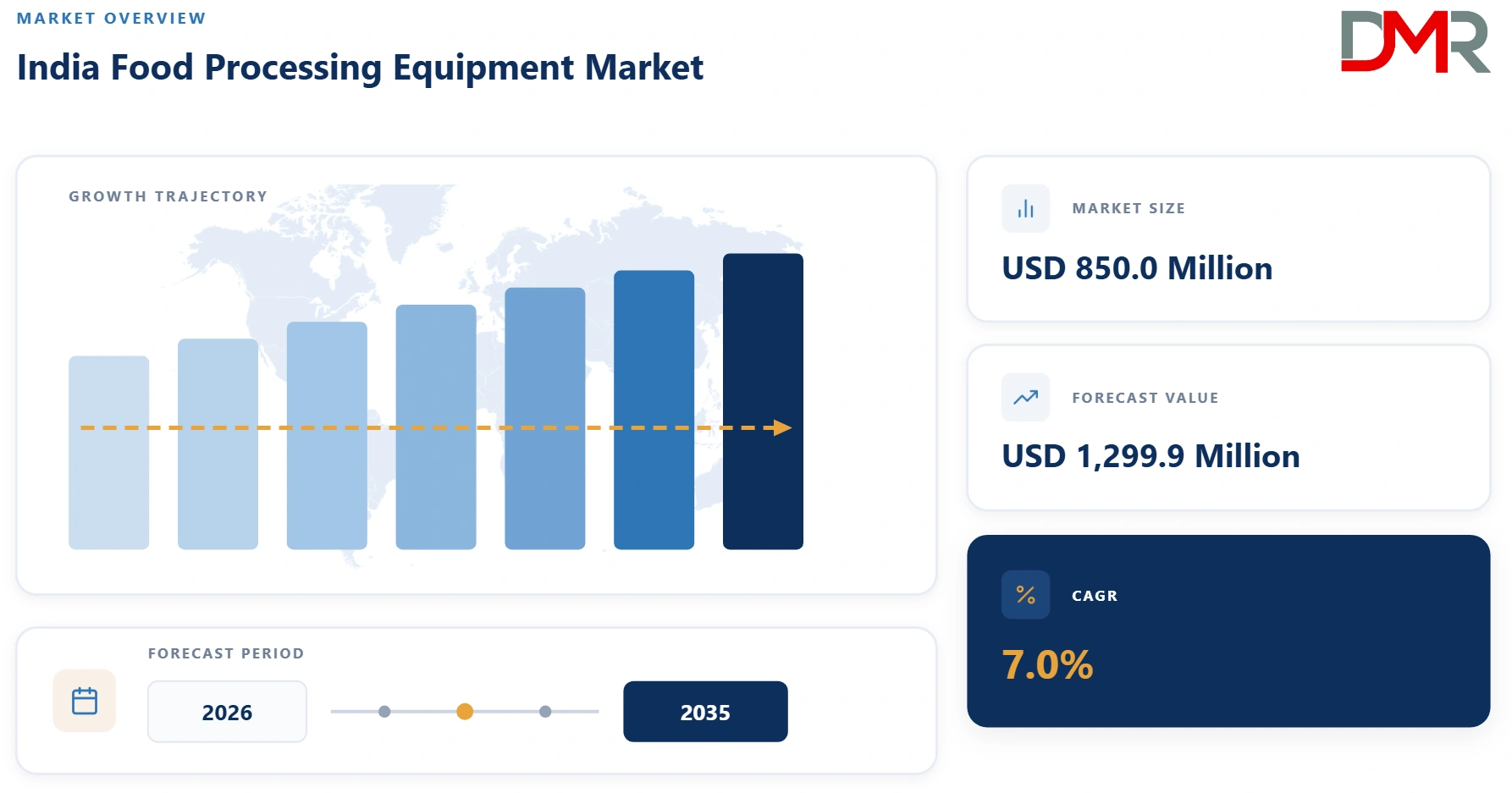
- India Food Processing Equipment Market Size in 2026: USD 850.0 Million
- India Food Processing Equipment Market Size in 2035: USD 1,299.9 Million
- India CAGR from 2026 to 2035: 4.8%
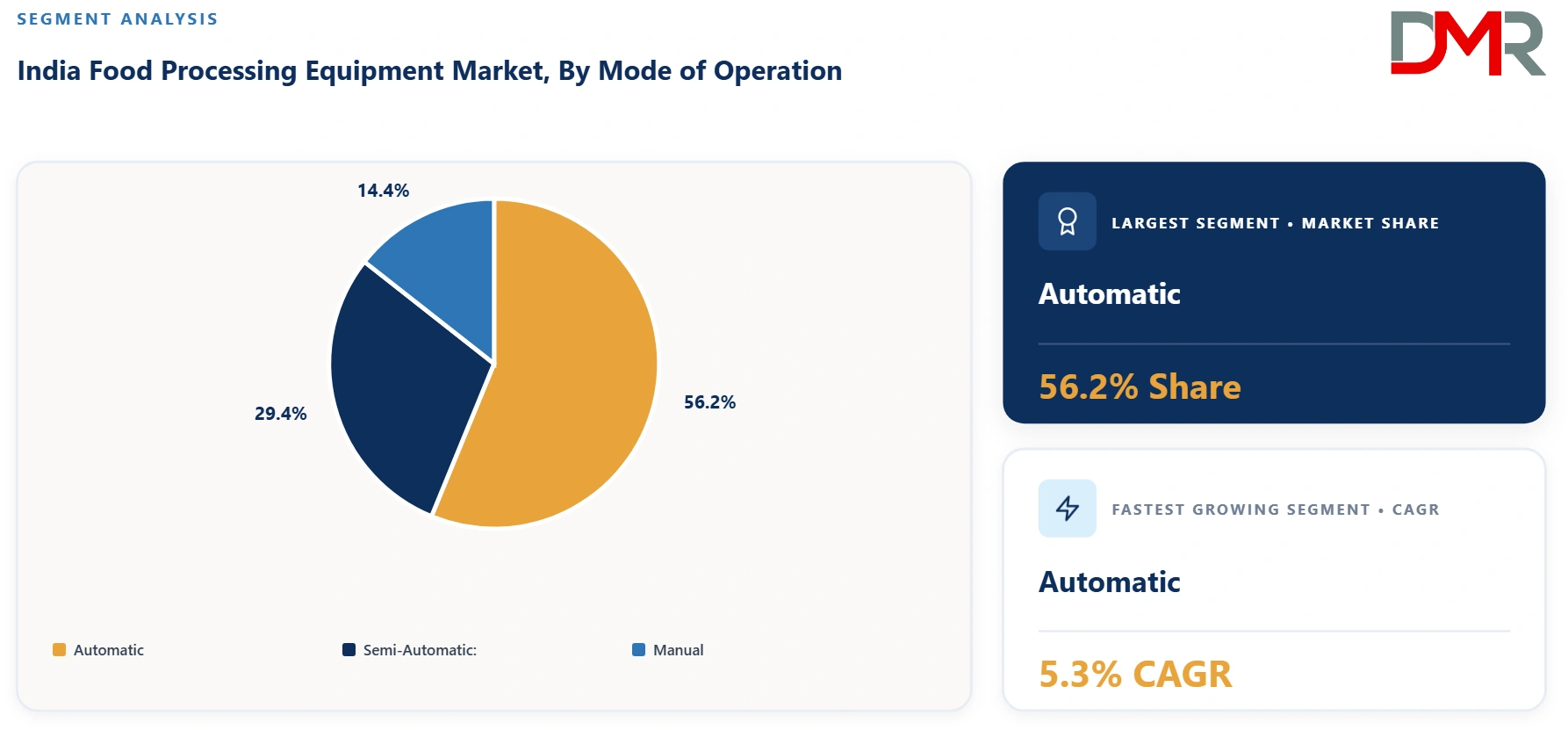
- Automatic is the leading Mode of Operation segment in 2026: 56.2%
- Heat Processing Equipment is the leading Equipment Type segment in 2026: 26.8%
- Dairy Products is the leading Application segment in 2026: 26.1%
- Direct is the leading Distribution Channel segment in 2026: 64.3%
What is the Food Processing Equipment and its Market Size?
The India Food Processing Equipment Market is projected to reach USD 850.0 million in 2026 and grow at a compound annual growth rate of 4.8% through 2035, reaching USD 1,299.9 million.
ℹ
To learn more about this report –
Download Your Free Sample Report Here
The market covers machinery used for preparation, processing, heating, preservation, packaging, and other food manufacturing operations. Growth is supported by rising consumption of processed and convenience foods, expansion of organized food manufacturing, and increasing adoption of automated production systems. Government initiatives supporting food-processing infrastructure and capacity expansion are also encouraging equipment investment. Demand is strengthening across dairy, bakery, beverages, fruits and vegetables, and meat processing as manufacturers prioritize higher throughput, consistent quality, food safety, and reduced processing losses.
Use Cases
- Dairy Processing: Food processing equipment supports milk pasteurization, homogenization, separation, fermentation, cheese production, and packaging across India’s expanding dairy industry. Automated processing lines help manufacturers improve hygiene, maintain temperature consistency, increase production capacity, and reduce product losses. Equipment is increasingly important for producing packaged milk, yogurt, butter, cheese, ice cream, and other value-added dairy products efficiently.
- Fruits & Vegetable Processing: Processing equipment enables washing, sorting, peeling, cutting, pulping, drying, freezing, preservation, and packaging of fruits and vegetables. Indian processors use these systems to extend shelf life, minimize post-harvest losses, and standardize product quality. Equipment supports production of juices, purees, frozen vegetables, dehydrated products, sauces, and packaged foods for domestic retail and export markets.
- Bakery & Confectionery Production: Industrial mixers, dough processing systems, ovens, cooling systems, depositors, molding equipment, and packaging machinery support large-scale bakery and confectionery manufacturing. These technologies enable consistent production of bread, biscuits, cakes, chocolates, candies, and snacks. Automation helps Indian manufacturers increase throughput, maintain recipe consistency, reduce manual handling, improve hygiene, and respond efficiently to growing packaged-food demand.
- Meat & Poultry Processing: Food processing equipment supports slaughtering, cutting, deboning, grinding, mixing, cooking, chilling, freezing, and packaging operations within India’s meat and poultry sector. Mechanized systems improve processing speed, hygiene, portion consistency, temperature control, and traceability. They are particularly valuable for manufacturers producing frozen meat, processed chicken, sausages, ready-to-cook products, and other packaged protein products for organized markets.
Key Takeaways
- Market Size: The India Food Processing Equipment Market is anticipated to be valued at USD 850.0 million in 2026 and is forecast to reach USD 1,299.9 million by 2035, reflecting continued investment in modern food manufacturing, processing automation, capacity expansion, and value-added food production.
- Growth Rate and Outlook: The market is projected to expand at a CAGR of 4.8% from 2026 to 2035. Growth is supported by increasing processed food consumption, expanding organized food manufacturing, modernization of processing facilities, rising demand for packaged and convenience foods, and adoption of automated, energy-efficient, hygienic processing technologies.
- Primary Growth Drivers: Rising urbanization, changing dietary patterns, increasing demand for packaged foods, growth in dairy and beverage processing, expansion of cold-chain infrastructure, food safety requirements, and government support for domestic food-processing capacity are encouraging equipment investments. Manufacturers are also adopting automation to improve productivity, consistency, hygiene, traceability, and operational efficiency.
- By Equipment Type Analysis: Heat Processing Equipment is projected to lead the equipment type segment with an estimated 26.8% share in 2026. Demand is supported by extensive use of heating, cooking, pasteurization, sterilization, drying, and thermal treatment across dairy, beverages, bakery, ready-to-eat foods, and other processed food categories.
- By Mode of Operation Analysis: Automatic equipment is anticipated to dominate the mode of operation segment with an estimated 56.2% share in 2026. Adoption is being driven by requirements for higher throughput, lower labor dependency, standardized product quality, improved hygiene, precise process control, reduced wastage, and integration of digitally controlled production lines.
- By Application Analysis: Dairy Products is expected to lead the application segment with an estimated 26.1% share in 2026. India's large milk-processing ecosystem and growing demand for packaged milk, cheese, yogurt, butter, ice cream, and other value-added dairy products are supporting investments in pasteurization, homogenization, separation, filling, and packaging equipment.
How AI/Gen AI is Transforming the India Food Processing Equipment Market?
AI and Generative AI are transforming India’s food processing equipment market by enabling smarter automation, predictive maintenance, real-time quality monitoring, and optimized production planning. AI-powered sensors and machine vision systems can identify product defects, improve sorting accuracy, reduce waste, and enhance food safety. Predictive analytics helps processors anticipate equipment failures and minimize unplanned downtime. GenAI can support equipment design, maintenance documentation, operator training, and troubleshooting. Integration with IoT-enabled machinery also improves energy consumption, process control, and traceability. As Indian food manufacturers modernize facilities, AI-enabled processing equipment is expected to support higher productivity, consistent quality, operational efficiency, and flexible manufacturing.
Key Drivers in the India Food Processing Equipment Market
Rising Demand for Processed and Convenience Foods
Rapid urbanization, changing lifestyles, increasing disposable incomes, and growth in organized retail are strengthening Indian demand for packaged, ready-to-eat, ready-to-cook, frozen, and convenience foods. Food manufacturers are consequently expanding processing capacity and investing in equipment for mixing, heating, freezing, preservation, filling, and packaging. Growth across dairy, bakery, beverages, fruits and vegetables, snacks, and meat processing further broadens equipment requirements. Manufacturers increasingly require machinery capable of maintaining consistent quality while supporting higher production volumes. Expansion of quick-service restaurants and modern food distribution channels is also encouraging processors to adopt scalable equipment and standardized production systems.
Government Support for Food Processing Infrastructure
Government initiatives aimed at strengthening India's food processing ecosystem are encouraging investment in modern manufacturing facilities and equipment. Programs supporting integrated cold chains, food processing clusters, preservation infrastructure, and production-linked incentives help improve processing capacity and domestic value addition. Policies administered by India's Ministry of Food Processing Industries also encourage modernization, reduction of post-harvest losses, and development of stronger farm-to-market linkages. These initiatives create demand for sorting, grading, refrigeration, processing, preservation, and packaging machinery. Increasing formalization of food manufacturing and greater emphasis on food safety standards further encourage processors to replace traditional production methods with technologically advanced and hygienic equipment.
Restraints in the India Food Processing Equipment Market
High Initial Investment and Financing Constraints
Advanced food processing equipment requires substantial upfront investment, particularly for automated production lines, industrial refrigeration systems, thermal processing machinery, intelligent packaging solutions, and digitally connected equipment. These costs can limit adoption among India's numerous small and medium-sized food processors operating with constrained capital budgets. Additional expenses related to installation, facility modification, maintenance, employee training, spare parts, and energy consumption increase total ownership costs. Access to affordable financing can also remain challenging for smaller manufacturers. Consequently, processors may continue using semi-automatic or older machinery, slowing technology replacement cycles and restricting penetration of advanced equipment outside large organized food manufacturing companies.
Fragmented Processing Industry and Skilled Workforce Gaps
India's food processing ecosystem includes numerous small, regional, and unorganized processors with considerable differences in production scale, technology adoption, and operational capabilities. This fragmentation makes standardized deployment of sophisticated equipment challenging. Advanced automated machinery requires trained technicians, operators, maintenance personnel, and process engineers capable of managing electronic controls, sensors, software, and integrated production systems. Shortages of appropriately trained personnel can increase downtime and maintenance dependence on equipment suppliers. Smaller processors may also lack sufficient technical knowledge to evaluate automation investments. These challenges can restrict equipment utilization, particularly across rural and developing processing clusters where technical support infrastructure remains comparatively limited.
Growth Opportunities in the India Food Processing Equipment Market
Expansion of Value-Added and Export-Oriented Food Processing
India's large agricultural and dairy production base provides substantial opportunities for expanding value-added processing of fruits, vegetables, milk, grains, seafood, meat, spices, and other agricultural commodities. Growing exports of processed foods can encourage manufacturers to invest in internationally compliant processing, preservation, refrigeration, and packaging technologies. Equipment suppliers can target processors seeking improved shelf life, standardized quality, traceability, and production efficiency. Opportunities are particularly attractive in frozen foods, dairy products, fruit concentrates, packaged snacks, ready meals, and processed agricultural products. Developing specialized machinery suited to Indian raw materials, operating conditions, production scales, and export-quality requirements could further expand addressable equipment demand.
Automation and Smart Equipment Adoption Among SMEs
Increasing availability of modular, scalable, and cost-effective automation creates a significant opportunity among India's small and medium-sized food processors. Equipment manufacturers can develop compact systems combining sensors, programmable controls, machine vision, IoT connectivity, and predictive maintenance without requiring complete facility replacement. Such technologies can help SMEs improve productivity, reduce labor dependency, minimize material waste, and maintain consistent food quality. Equipment-as-a-service, leasing, financing, and modular capacity expansion models could further lower adoption barriers. Growing digitalization across manufacturing facilities also creates opportunities for suppliers offering connected machinery, remote diagnostics, production analytics, and integrated maintenance services tailored specifically to emerging processors.
Trends in the India Food Processing Equipment Market
Shift Toward Automated and Digitally Connected Processing Lines
Indian food manufacturers are increasingly moving from labor-intensive operations toward automated and digitally integrated production systems. Modern equipment incorporates programmable logic controllers, IoT sensors, machine vision, robotics, real-time monitoring, and centralized process controls to improve operational consistency. Connected equipment enables manufacturers to track temperature, pressure, production speed, energy consumption, equipment condition, and product quality throughout processing. Predictive maintenance capabilities are also gaining relevance as companies seek to reduce unexpected machinery failures. This transition is particularly visible among larger dairy, beverage, bakery, packaged food, and ready-meal manufacturers seeking higher throughput, improved traceability, lower wastage, and more standardized manufacturing operations.
Growing Focus on Energy-Efficient and Hygienic Equipment
Energy efficiency, water conservation, sanitation, and hygienic equipment design are becoming increasingly important considerations for Indian food processors. Manufacturers are adopting machinery featuring efficient motors, heat recovery systems, optimized refrigeration, automated cleaning, and improved process controls to reduce utility consumption and operating costs. At the same time, stricter attention to food safety encourages demand for stainless-steel construction, clean-in-place systems, contamination-resistant surfaces, and equipment designed for easier sanitation. Equipment suppliers are therefore increasingly focusing on machinery that combines productivity with lower resource consumption and stronger hygiene performance. This trend supports modernization across dairy, beverages, meat, bakery, and other contamination-sensitive processing applications.
Research Scope and Analysis
The India Food Processing Equipment Market is analyzed by equipment type, including preparation equipment, mechanical processing equipment, heat processing equipment, preservation equipment, packaging equipment, and others. Mode of operation includes automatic, semi automatic, and manual equipment. Application analysis covers dairy products, bakery and confectionery, meat and poultry, fish and seafood, fruits and vegetables, beverages, grains and pulses, and others.
ℹ
To learn more about this report –
Download Your Free Sample Report Here
By Equipment Type Analysis
Heat processing equipment is projected to dominate the equipment type segment with an estimated 26.8% market share in 2026, driven by extensive thermal processing requirements. Packaging equipment is expected to register the highest CAGR of approximately 5.4% through 2035, supported by increasing packaged food production and demand for automated packaging technologies.
By Mode of Operation Analysis
Automatic equipment is anticipated to lead the mode of operation segment with an estimated 56.2% share in 2026, supported by increasing automation across large food processing facilities. Automatic equipment is also projected to record the highest CAGR of approximately 5.3% through 2035, driven by productivity improvements, labor optimization, and adoption of digitally controlled processing systems.
By Form of End Product Analysis
Solid products are expected to account for the largest share of approximately 47.6% in 2026, supported by substantial processing of bakery products, grains, snacks, meat, and packaged foods. Liquid products are projected to experience the highest CAGR of approximately 5.1% through 2035, driven by expanding dairy, beverage, juice, and liquid food processing capacity.
By Application Analysis
Dairy products are projected to dominate the application segment with an estimated 26.1% market share in 2026, supported by India's extensive milk processing industry. Beverages are anticipated to register the highest CAGR of approximately 5.2% through 2035, driven by growing consumption of packaged beverages, juices, functional drinks, and other processed liquid products.
The India Food Processing Equipment Market Report is segmented based on the following:
By Equipment Type
- Preparation Equipment
- Mechanical Processing Equipment
- Heat Processing Equipment
- Preservation Equipment
- Packaging Equipment
- Others
By Mode of Operation
- Automatic
- Semi-Automatic
- Manual
By Form of End Product
By Application
- Dairy Products
- Bakery & Confectionery
- Meat & Poultry
- Fish & Seafood
- Fruits & Vegetables
- Grains & Pulses
- Beverages
- Ready-to-Eat & Ready-to-Cook Foods
- Edible Oils
- Others
Technology Analysis
Technology analysis is highly relevant to the India Food Processing Equipment Market as manufacturers increasingly adopt automation, IoT-enabled machinery, robotics, machine vision, AI-based quality inspection, and predictive maintenance. Smart processing lines provide real-time monitoring of temperature, pressure, throughput, energy consumption, and equipment condition, improving productivity and product consistency. Opportunities are expanding for modular automation, digital controls, hygienic equipment designs, energy-efficient systems, and connected machinery suitable for small and medium processors. However, high implementation costs, integration challenges, cybersecurity concerns, and shortages of technically skilled operators can restrict adoption. Continued technological advancement will accelerate equipment modernization, reduce processing losses, strengthen food safety, and improve manufacturing competitiveness across India.
Investment and White Space Analysis
Investment and white space analysis highlight significant opportunities arising from India's expanding processed food industry, agricultural production base, and increasing manufacturing capacity. Investment is growing in dairy processing, beverages, frozen foods, fruits and vegetables, ready-to-eat products, cold-chain facilities, and automated packaging. Major white spaces include affordable automation for SMEs, equipment for regional processing clusters, energy-efficient machinery, compact processing lines, indigenous equipment manufacturing, and after-sales maintenance services. Opportunities also exist in equipment leasing and digitally connected processing solutions. Risks include high capital requirements, fragmented demand, fluctuating raw material availability, and slower technology adoption among smaller processors. Increasing domestic value addition should strengthen long-term equipment investment and market expansion.
Competitive Landscape
The India Food Processing Equipment Market features a competitive mix of multinational equipment manufacturers, domestic engineering companies, and specialized machinery suppliers serving dairy, beverages, bakery, fruits and vegetables, meat, grains, and packaged foods. Competition is increasingly centered on automation, energy efficiency, hygienic design, processing accuracy, equipment reliability, and after-sales support. Manufacturers leverage advanced technologies, established product portfolios, and integrated processing lines, while Indian companies compete through localized manufacturing, competitive pricing, customization, and extensive service networks. Growing demand from small and medium processors is encouraging suppliers to introduce modular and scalable equipment. Strategic partnerships, technology integration, local production, and service expansion remain important competitive approaches. Rising food-processing investments are expected to intensify competition and create opportunities for specialized equipment providers.
Some of the prominent players in the India Food Processing Equipment Market are:
- GEA Group
- Alfa Laval
- Tetra Pak
- Bühler Group
- JBT Marel
- Krones AG
- SPX FLOW
- The Middleby Corporation
- Heat and Control
- Syntegon Technology
- MULTIVAC
- KHS Group
- Sidel
- Danfoss
- Bizerba
- Ishida
- TOMRA
- Satake Corporation
- Provisur Technologies
- Key Technology
- Urschel Laboratories
- ANKO Food Machine
- Hosokawa Micron
- BAADER
- tna solutions
- Praj Industries
- Fowler Westrup
- Bajaj Processpack
- Nichrome India
- Goma Engineering
- Kumar Metal Industries
- Economode Food Equipment
- Bucher Industries
- Pentair
- Atlas Pacific Engineering
- Mareléc Food Technologies
- FENCO Food Machinery
- Foodmate
- MAINCA
- Bigtem
- Other Key Players
Recent Developments
- In July 2026, Krones reported increased second-quarter order intake despite uncertain market conditions, indicating continued investment demand for bottling, packaging, and processing equipment.
- In June 2026, JBT Marel highlighted its expanded South Asian strategy following the JBT–Marel combination, focusing on integrated end-to-end food processing technologies and strengthening its position in India and neighboring markets.
- In May 2026, Bühler introduced new food-processing technologies, including the TurbuBake Smart oven, RotaMold Max Smart rotary molder, and SoftDrop depositing solution, targeting greater efficiency, flexibility, and automation in bakery and food production.
- In May 2026, Tetra Pak continued expanding its India food-processing ecosystem through its Chakan facility, which supports food-processing equipment manufacturing, automation, digitalization, packaging production, and related services for Indian and international customers.
Report Details
| Report Characteristics |
| Market Size (2026) |
USD 850.0 Mn |
| Forecast Value (2035) |
USD 1,299.9 Mn |
| CAGR (2026–2035) |
4.8% |
| Historical Data |
2021 – 2025 |
| Forecast Data |
2026 – 2035 |
| Base Year |
2025 |
| Segments Covered |
By Equipment Type, By Mode of Operation, By Form of End Product, By Application |
Frequently Asked Questions
How big is the India Food Processing Equipment Market?
▾ The India Food Processing Equipment Market is projected to reach USD 850.0 million in 2026 and is expected to grow to USD 1,299.9 million by 2035.
What is the CAGR of the India Food Processing Equipment Market from 2026 to 2035?
▾ The India Food Processing Equipment Market is projected to expand at a CAGR of 4.8% from 2026 to 2035, supported by modernization, automation, and increasing processed food production.
What factors are driving the growth of the India Food Processing Equipment Market?
▾ Growth is driven by rising demand for processed and convenience foods, urbanization, changing dietary patterns, expanding organized food manufacturing, government support, cold-chain development, food safety requirements, and increasing adoption of automated processing equipment.
What are the major trends in the India Food Processing Equipment Market?
▾ Major trends include growing adoption of automated and digitally connected processing lines, IoT-enabled machinery, AI-based monitoring, predictive maintenance, machine vision, energy-efficient equipment, hygienic designs, and smart process control systems.
Who are the key players in the India Food Processing Equipment Market?
▾ Key players include GEA Group, Alfa Laval, Tetra Pak, Bühler Group, JBT Marel, Krones AG, SPX FLOW, The Middleby Corporation, Heat and Control, Syntegon Technology, MULTIVAC, KHS Group, Sidel, TOMRA, and Satake Corporation, among others.
How is the India Food Processing Equipment Market segmented?
▾ The market is segmented by Equipment Type, Mode of Operation, Form of End Product, and Application. Major categories include heat processing, automatic equipment, solid and liquid products, dairy products, bakery and confectionery, meat and poultry, beverages, fruits and vegetables, and grains and pulses.