India Food Safety Testing Market Snapshot
- India Food Safety Testing Market Size in 2026: USD 910.3 Million
- India Food Safety Testing Market Size in 2035: USD 1,898.2 Million
- CAGR from 2026 to 2035: 8.5%
- Pathogen Testing is the leading Type segment in 2026: 40.2%
- Meat and Meat Products is the leading Food Tested segment in 2026: 32.3%
- PCR-based Assay is the leading Technology segment in 2026: 31.8%
- North India is the leading Region in 2026: 38.5%%
What is the India Food Safety Testing and its Market Size?
India food safety testing refers to the analysis of food products to detect pathogens, chemical contaminants, toxins, genetically modified organisms, and other potential hazards to ensure compliance with safety and quality standards.
ℹ
To learn more about this report –
Download Your Free Sample Report Here
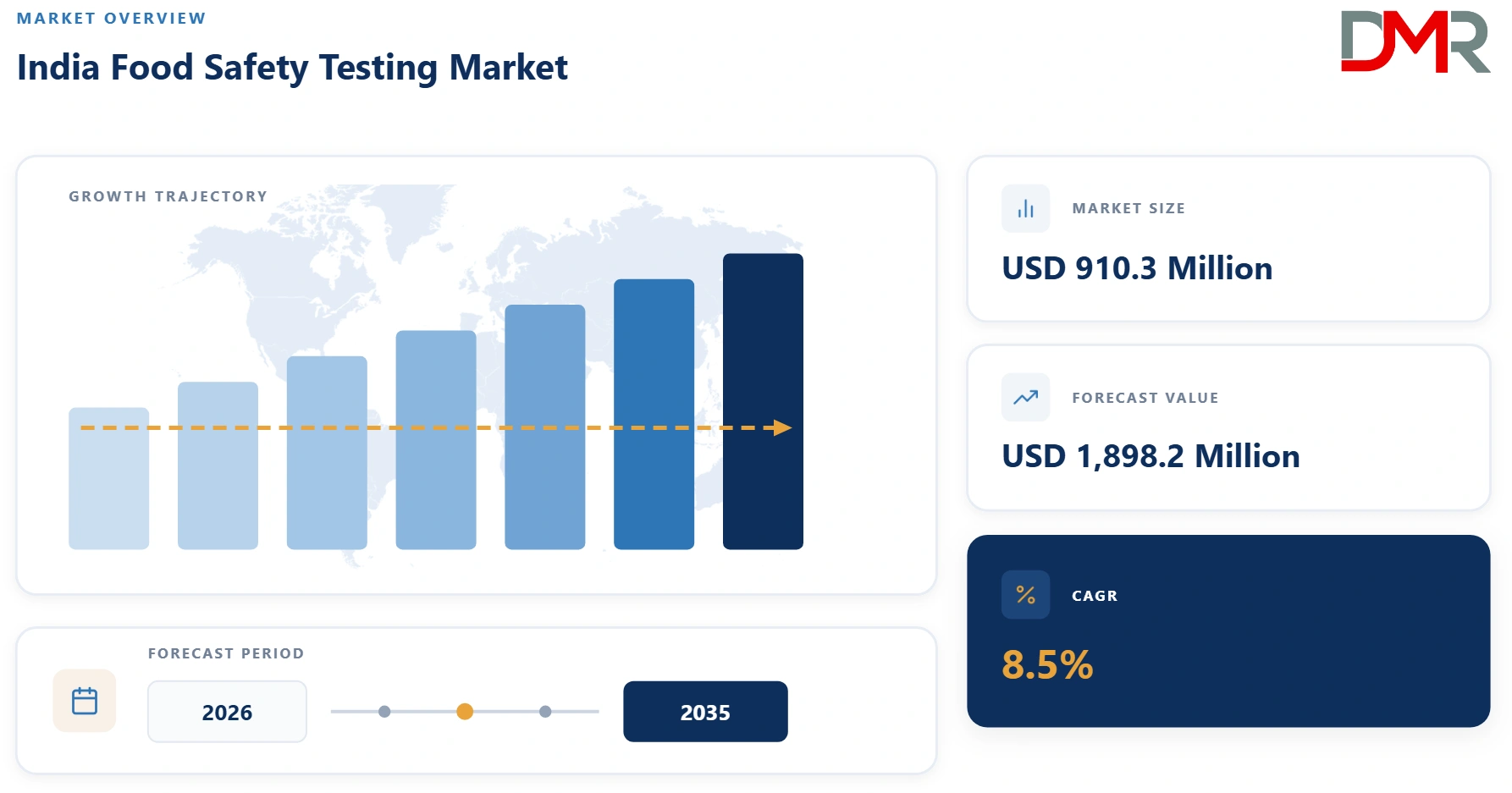
The India Food Safety Testing Market is projected to reach USD 910.3 million in 2026 and grow at a compound annual growth rate of 8.5% through 2035, reaching USD 1,898.2 million. Market growth is supported by stricter food safety regulations, rising consumer awareness, expansion of processed food production, increasing food exports, and wider adoption of advanced PCR-based and immunoassay testing technologies.
Use Cases
- Pathogen Detection: Food safety testing is widely used to identify harmful pathogens such as Salmonella, E. coli, Listeria, and Campylobacter across meat, dairy, processed foods, and other products. Rapid pathogen testing helps manufacturers detect contamination early, prevent product recalls, protect consumer health, and comply with regulatory requirements. Growing demand for ready-to-eat foods and expanding food processing activities in India are increasing the need for accurate, faster, and reliable pathogen detection solutions.
- Quality Control in Food Processing: Food manufacturers use safety testing throughout production to verify product quality, ingredient integrity, hygiene conditions, and compliance with established safety standards. Testing supports the identification of chemical residues, toxins, allergens, and microbial contamination before products reach consumers. As India’s packaged and processed food sector expands, manufacturers are strengthening internal quality control systems and adopting advanced testing methods to reduce contamination risks, maintain brand reputation, and meet domestic and export requirements.
- Regulatory Compliance and Certification: Food safety testing plays a critical role in helping companies comply with regulations established by authorities such as the Food Safety and Standards Authority of India. Testing verifies whether food products meet permissible limits for contaminants, additives, pesticide residues, toxins, and microbiological hazards. It also supports certification, audits, labeling compliance, and market approvals. Increasing regulatory enforcement is encouraging food businesses to invest in routine laboratory testing and standardized food safety management practices.
- Export and Import Food Inspection: Testing is essential for food products entering or leaving India to ensure they comply with destination-market safety requirements and international quality standards. Exporters use laboratory testing to verify microbiological safety, pesticide residues, toxins, chemical contaminants, and product authenticity before shipment. Import authorities also rely on testing to assess product compliance. Growth in India’s food trade is increasing demand for accredited laboratories, rapid testing technologies, and internationally recognized food certification services.
Key Takeaways
- Market Size: The India Food Safety Testing Market is anticipated to be valued at USD 910.3 million in 2026 and is forecast to reach USD 1,898.2 million by 2035, expanding at a CAGR of 8.5%.
- Growth Rate and Outlook: Market expansion is supported by stricter food safety regulations, increasing consumer awareness, rising packaged and processed food consumption, growing food exports, expanding organized retail, improved laboratory infrastructure, and increasing adoption of rapid, accurate, and technology-enabled food testing solutions across India.
- Primary Growth Drivers: Rising incidences of food contamination, stronger FSSAI enforcement, increasing demand for traceability, expansion of food processing industries, higher export quality requirements, growing awareness of foodborne illnesses, and adoption of advanced molecular and immunological testing methods are accelerating demand for food safety testing services.
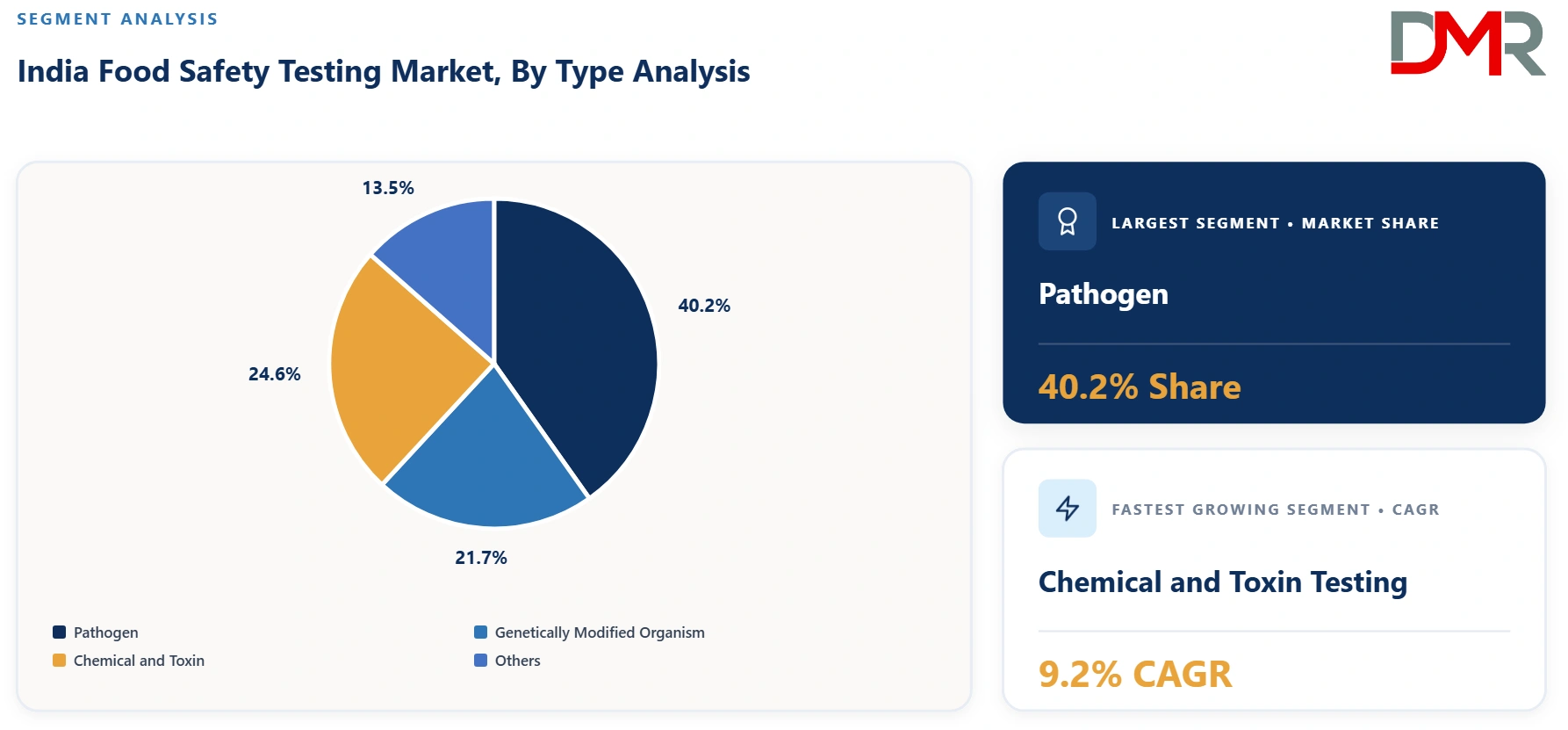
- By Type Analysis: Pathogen Testing is projected to lead the Type segment with a 40.2% share in 2026, supported by growing concerns regarding Salmonella, E. coli, Listeria, and other foodborne microorganisms. Increasing regulatory scrutiny and demand for rapid contamination detection are further strengthening pathogen testing across meat, dairy, and processed food categories.
- By Food Tested Analysis: Meat and Meat Products is expected to lead the Food Tested segment with a 32.3% share in 2026. High susceptibility to microbial contamination, strict hygiene requirements, expanding organized meat processing, cold-chain development, and increasing domestic and export demand are supporting extensive safety testing across meat and poultry products.
- By Technology Analysis: PCR-based Assay is anticipated to dominate the Technology segment with a 31.8% share in 2026, driven by its high sensitivity, specificity, rapid turnaround time, and ability to detect low levels of pathogens. Increasing adoption by laboratories and food manufacturers is strengthening its role in advanced food safety testing.
- Regional Leadership: North India is projected to lead the regional market with a 38.5% share in 2026, supported by a large food processing base, strong dairy and grain production, growing organized retail, expanding testing laboratory networks, and increasing regulatory compliance across major food-producing states. Leadership
How AI/Gen AI is Transforming the India Food Safety Testing Market?
AI and Generative AI are transforming India’s food safety testing market by improving contamination detection, data interpretation, traceability, and laboratory efficiency. AI-powered systems can analyze large testing datasets, identify microbial or chemical risk patterns, and support faster decision-making. Machine learning enhances image-based inspection, spectroscopy, and predictive quality control, while Gen AI can automate test reporting, regulatory documentation, and compliance summaries. These technologies also support predictive monitoring across food processing facilities and supply chains. As Indian food manufacturers adopt digital quality systems, AI-enabled testing is expected to reduce human error, accelerate turnaround times, improve accuracy, and strengthen preventive food safety management.
Key Drivers in the India Food Safety Testing Market
Stricter Food Safety Regulations and Compliance Requirements
Increasing regulatory oversight is a major driver of the India Food Safety Testing Market. The Food Safety and Standards Authority of India continues to strengthen standards related to contaminants, additives, microbiological safety, labeling, and product quality. Food manufacturers, processors, exporters, retailers, and foodservice operators are therefore increasing testing frequency to ensure compliance and reduce the risk of penalties, recalls, or reputational damage. Rising enforcement across organized and semi-organized food businesses is also supporting demand for accredited laboratories, rapid testing systems, and standardized quality assurance procedures across multiple food categories.
Rising Consumption of Processed and Packaged Foods
Rapid urbanization, changing lifestyles, higher disposable incomes, and the expansion of modern retail are increasing consumption of packaged, processed, frozen, and ready-to-eat foods across India. These products often pass-through complex manufacturing and distribution networks, increasing the importance of microbial, chemical, and quality testing. Food producers are strengthening safety controls to maintain shelf life, prevent contamination, and meet consumer expectations for consistent quality. Growth in dairy processing, meat products, bakery items, beverages, cereals, and convenience foods is consequently expanding the need for routine laboratory analysis and advanced food safety testing technologies.
Restraints in the India Food Safety Testing Market
High Cost of Advanced Testing Technologies
The high cost of sophisticated testing equipment, laboratory infrastructure, reagents, and skilled personnel can restrict market adoption, particularly among small and medium-sized food manufacturers. Technologies such as PCR-based assays, advanced chromatography, spectroscopy, and automated testing platforms require significant capital investment and ongoing maintenance. Smaller businesses may continue relying on basic testing methods or external laboratories, limiting frequent testing. In addition, imported instruments and consumables can increase operating costs. These financial barriers may slow adoption of advanced food safety solutions outside major urban and industrial centers, especially among fragmented food processing businesses.
Limited Testing Infrastructure and Skilled Workforce
Uneven availability of accredited laboratories and trained food safety professionals remains a significant restraint in India. Advanced testing infrastructure is concentrated largely in major cities and industrial regions, while smaller towns and rural food production clusters may have limited access to sophisticated analytical facilities. Shortages of qualified microbiologists, chemists, laboratory technicians, and quality assurance professionals can also affect testing accuracy and turnaround times. Transporting samples over long distances may further increase costs and delay results. These limitations can hinder consistent implementation of food safety standards across India's highly fragmented food production and distribution ecosystem.
Growth Opportunities in the India Food Safety Testing Market
Expansion of Food Exports and International Quality Compliance
India's growing participation in global food trade creates significant opportunities for food safety testing providers. Exporters of spices, seafood, meat, dairy products, cereals, fruits, vegetables, and processed foods must comply with stringent safety requirements in international markets. This increases demand for residue analysis, microbiological testing, toxin detection, allergen testing, and product authenticity verification. Accredited laboratories that can support international certifications and faster export clearances are positioned to benefit. As Indian food companies pursue new overseas markets, investment in internationally recognized testing capabilities and traceability systems is expected to expand considerably.
Adoption of Rapid, Automated, and Digital Testing Solutions
Rapid testing methods, automated laboratory systems, biosensors, portable devices, and digital quality platforms present substantial growth opportunities. Food manufacturers increasingly require faster test results to reduce production delays, improve inventory management, and enable real-time quality decisions. Technologies such as PCR, immunoassays, spectroscopy, AI-enabled analytics, and connected testing devices can shorten turnaround times while improving sensitivity and accuracy. Portable solutions can also expand testing in farms, warehouses, processing facilities, and distribution centers. Growing emphasis on preventive quality management is likely to accelerate investment in decentralized and technology-enabled food safety testing across India.
Trends in the India Food Safety Testing Market
Increasing Shift Toward Rapid and Molecular Testing
A notable market trend is the shift from conventional culture-based techniques toward rapid and molecular testing technologies. PCR-based assays, immunoassays, biosensors, and automated detection platforms are increasingly adopted because they can provide faster and more precise identification of pathogens and contaminants. Food companies are seeking shorter turnaround times to prevent contaminated batches from moving further through the supply chain. Laboratories are also integrating automation to improve throughput and standardize workflows. This transition is particularly evident in high-risk categories such as meat, dairy, processed foods, and export-oriented products requiring rigorous safety verification.
Growing Focus on Traceability and Preventive Food Safety
Food safety strategies in India are increasingly moving from reactive testing toward preventive risk management and end-to-end traceability. Manufacturers are adopting digital records, supply chain monitoring, batch tracking, sensor-based quality controls, and integrated laboratory information systems to identify risks earlier. Greater consumer interest in product origin, authenticity, and ingredient transparency is also reinforcing this trend. Testing is becoming closely linked with broader quality management systems rather than functioning only as a final compliance step. This approach helps companies reduce recall risks, improve accountability, and strengthen safety controls throughout sourcing, processing, storage, transportation, and retail.
Research Scope and Analysis
The India Food Safety Testing Market research scope evaluates market performance across type, food tested, technology, and region. Type includes pathogen, genetically modified organism, chemical and toxin, and others. Food tested covers meat, dairy, cereals, grains, pulses, processed food, and others. Technology includes agar culturing, PCR-based assay, immunoassay-based, and others. Regional analysis covers North, South, East, and West India.
ℹ
To learn more about this report –
Download Your Free Sample Report Here
By Type Analysis
Pathogen Testing is expected to dominate the Type segment with a 40.2% market share in 2026, supported by increasing concerns over foodborne illnesses and contamination. Chemical and Toxin Testing is projected to register the highest CAGR of approximately 9.2% from 2026 to 2035, driven by greater monitoring of pesticide residues, heavy metals, toxins, and chemical contaminants.
By Food Tested Analysis
Meat and Meat Products is projected to lead the Food Tested segment with a 32.3% market share in 2026, due to high susceptibility to microbial contamination and stringent safety requirements. Processed Food is anticipated to record the highest CAGR of approximately 9.4% from 2026 to 2035, supported by expanding packaged and convenience food consumption across India.
By Technology Analysis
PCR-based Assay is anticipated to dominate the Technology segment with a 31.8% market share in 2026, supported by rapid detection, high sensitivity, and precise pathogen identification. Immunoassay-based Testing is expected to register the highest CAGR of approximately 9.1% from 2026 to 2035, driven by faster testing procedures, improving automation, and increasing adoption across food laboratories.
The India Food Safety Testing Market Report is segmented based on the following:
By Type
- Pathogen
- Genetically Modified Organism
- Chemical and Toxin
- Others
By Food Tested
- Meat and Meat Products
- Dairy and Dairy Products
- Cereals, Grains and Pulses
- Processed Food
- Others
By Technology
- Agar Culturing
- PCR-based Assay
- Immunoassay-based
- Others
Regional Analysis
North is the Leading Region in the India Food Safety Testing Market
North India is projected to dominate the India Food Safety Testing Market with approximately 38.5% market share in 2026. Regional leadership is supported by a large food processing industry, strong dairy and agricultural production, expanding organized retail, and increasing concentration of accredited testing laboratories. Growing regulatory compliance across major food-producing states is also supporting testing demand. Rising consumption of packaged foods and increasing awareness of contamination risks further strengthen North India’s position in the national market.
South is the Fastest-Growing Region in the India Food Safety Testing Market
South India is expected to be the fastest-growing region in the India Food Safety Testing Market, expanding at an approximate CAGR of 9.3% from 2026 to 2035. Growth is supported by a strong processed food industry, seafood exports, dairy production, expanding biotechnology capabilities, and increasing adoption of advanced laboratory testing technologies. Rising investment in food manufacturing, export-oriented quality compliance, growing urban consumption, and strong testing infrastructure across major southern states are accelerating regional market expansion.
Regulatory Landscape Analysis
The regulatory landscape is highly relevant to the India Food Safety Testing Market because compliance requirements directly influence testing frequency, laboratory demand, and technology adoption. Strengthening FSSAI standards, tighter limits for contaminants, pesticide residues, additives, toxins, and microbiological hazards are encouraging food manufacturers to increase routine testing. Greater enforcement across processed food, dairy, meat, cereals, and export-oriented products creates opportunities for accredited laboratories and rapid testing providers. However, evolving standards, compliance costs, documentation requirements, and uneven enforcement across smaller food businesses remain risks. Overall, stricter regulation is expected to expand testing volumes, improve quality assurance practices, and accelerate adoption of standardized and advanced analytical methods across India.
Technology Analysis
Technology analysis is critical as food safety testing in India is shifting from conventional laboratory methods toward faster, automated, and highly sensitive platforms. PCR-based assays, immunoassays, biosensors, chromatography, spectroscopy, AI-enabled analytics, and portable testing devices are improving pathogen detection, contaminant identification, and turnaround times. Opportunities are emerging in rapid on-site testing, laboratory automation, digital reporting, traceability integration, and predictive quality control. However, high equipment costs, skilled workforce requirements, calibration needs, and dependence on imported instruments can restrict adoption among smaller laboratories. Continued technological advancement is expected to improve testing accuracy, reduce processing time, support preventive food safety management, and strengthen competitiveness across the market.
By Region
- North India
- South India
- East India
- West India
Competitive Landscape
The India Food Safety Testing Market is moderately fragmented, with strong competition among multinational testing companies, analytical technology providers, and domestic laboratories. Key players include SGS SA, Eurofins Scientific SE, Intertek Group plc, Bureau Veritas SA, TÜV SÜD AG, ALS Limited, Mérieux NutriSciences, Thermo Fisher Scientific, bioMérieux, QIAGEN, Bio-Rad Laboratories, Agilent Technologies, Neogen Corporation, Shimadzu Corporation, and Vimta Labs. Companies compete through laboratory network expansion, accreditation, faster turnaround times, broader testing portfolios, and adoption of PCR, immunoassay, chromatography, automation, and digital reporting technologies. Strategic partnerships with food processors, exporters, retailers, and government-linked institutions are also increasing. Domestic laboratories strengthen competition through regional accessibility and competitive pricing, while global companies benefit from established standards, advanced technologies, and broad technical capabilities.
Some of the prominent players in the India Food Safety Testing Market are:
- SGS SA
- Eurofins Scientific SE
- Intertek Group plc
- Bureau Veritas SA
- TÜV SÜD AG
- ALS Limited
- Mérieux NutriSciences Corporation
- NSF International
- Thermo Fisher Scientific Inc.
- bioMérieux SA
- QIAGEN N.V.
- Bio-Rad Laboratories, Inc.
- Agilent Technologies, Inc.
- Neogen Corporation
- PerkinElmer Inc.
- Shimadzu Corporation
- Waters Corporation
- Bruker Corporation
- Merck KGaA
- Danaher Corporation
- Romer Labs Division Holding GmbH
- Hygiena LLC
- 3M Company
- R-Biopharm AG
- Charm Sciences, Inc.
- Bureau of Indian Standards testing laboratories
- Vimta Labs Limited
- Auriga Research Private Limited
- AGSS Analytical & Research Lab Private Limited
- Apex Testing and Research Laboratory
- Fare Labs Private Limited
- TUV India Private Limited
- Shriram Institute for Industrial Research
- Envirocare Labs Private Limited
- MicroChem Silliker Private Limited
- Vsix Analytical Labs Private Limited
- Equinox Labs Private Limited
- Doctors Analytical Laboratories Private Limited
- Anacon Laboratories Private Limited
- Gujarat Laboratory
- Other Key Players
Recent Developments
- In June 2026, SGS certified Zomato Hyperpure Private Limited to FSSC 22000 Version 6 across nine warehouse facilities in India, strengthening standardized food safety management and compliance practices.
- In July 2026, Eurofins Scientific reported Food and Feed Testing growth in Asia-Pacific and highlighted a quality assessment of spice testing covering 13 independent laboratories in India.
- In June 2026, Thermo Fisher Scientific conducted an India-focused program on high-sensitivity antibiotic residue detection in food, emphasizing advanced LC-MS/MS methods for regulatory compliance and laboratory efficiency.
- In June 2026, TÜV SÜD highlighted FSSC 22000 Version 7 requirements, supporting Indian food processors with updated preventive controls, revised food-chain classifications, and stronger food safety certification standards.
Report Details
| Report Characteristics |
| Market Size (2026) |
USD 910.3 Mn |
| Forecast Value (2035) |
USD 1,898.2 Mn |
| CAGR (2026–2035) |
8.5% |
| Historical Data |
2021 – 2025 |
| Forecast Data |
2026 – 2035 |
| Base Year |
2025 |
| Segments Covered |
By Type, By Food Tested, By Technology |
| Regional Coverage |
North, South, East, West |
Frequently Asked Questions
How big is the India Food Safety Testing Market?
▾ The India Food Safety Testing Market is projected to reach USD 910.3 million in 2026 and is expected to increase to USD 1,898.2 million by 2035, supported by stricter food safety regulations, growing processed food consumption, rising export requirements, and increasing adoption of advanced testing technologies.
What is the CAGR of the India Food Safety Testing Market from 2026 to 2035?
▾ The India Food Safety Testing Market is expected to expand at a CAGR of 8.5% from 2026 to 2035.
What factors are driving the growth of the India Food Safety Testing Market?
▾ Major growth drivers include stronger FSSAI enforcement, rising incidences of food contamination, increasing consumer awareness, expansion of packaged and processed foods, growing food exports, demand for traceability, and increasing adoption of PCR-based assays, immunoassays, automation, and other rapid food testing technologies.
What are the major trends in the India Food Safety Testing Market?
▾ Major trends include increasing adoption of rapid and molecular testing, greater use of PCR-based assays and immunoassays, laboratory automation, AI-enabled analytics, digital reporting, portable testing systems, growing traceability requirements, and a shift from reactive testing toward preventive food safety management.
Which region held the largest share of the India Food Safety Testing Market in 2026?
▾ North India is projected to hold the largest share of the India Food Safety Testing Market in 2026, accounting for approximately 38.5% of the market, supported by a strong food processing base, dairy and grain production, organized retail, and expanding testing laboratory infrastructure.
Which region is expected to grow the fastest in the India Food Safety Testing Market?
▾ South India is expected to be the fastest-growing regional market, expanding at an approximate CAGR of 9.3% from 2026 to 2035, driven by processed food production, seafood exports, dairy processing, biotechnology capabilities, and increasing adoption of advanced testing technologies.
Who are the key players in the India Food Safety Testing Market?
▾ Key players include SGS SA, Eurofins Scientific SE, Intertek Group plc, Bureau Veritas SA, TÜV SÜD AG, ALS Limited, Mérieux NutriSciences, Thermo Fisher Scientific, bioMérieux, QIAGEN, Bio-Rad Laboratories, Agilent Technologies, Neogen Corporation, Shimadzu Corporation, Waters Corporation, and Vimta Labs Limited, among others.
How is the India Food Safety Testing Market segmented?
▾ The market is segmented by Type into Pathogen, Genetically Modified Organism, Chemical and Toxin, and Others. By Food Tested, it includes Meat and Meat Products, Dairy and Dairy Products, Cereals, Grains and Pulses, Processed Food, and Others. By Technology, it includes Agar Culturing, PCR-based Assay, Immunoassay-based, and Others. Regionally, the market covers North India, South India, East India, and West India.