India Genset Market Snapshot
- Market Size in 2026: USD 2.1 Billion
- Market Size in 2035: USD 3.8 Billion
- CAGR (2026–2035): 6.9%
- Leading Power Rating Segment in 2026: 101–500 kVA, 38% share
- Leading Fuel Type Segment in 2026: Diesel, 78% share
- Leading Application Segment in 2026: Industrial, 43% share
- Fastest-Growing Segment: 1,001–3,000 kVA, 9.0% CAGR
What is the India Genset and its Market Size?
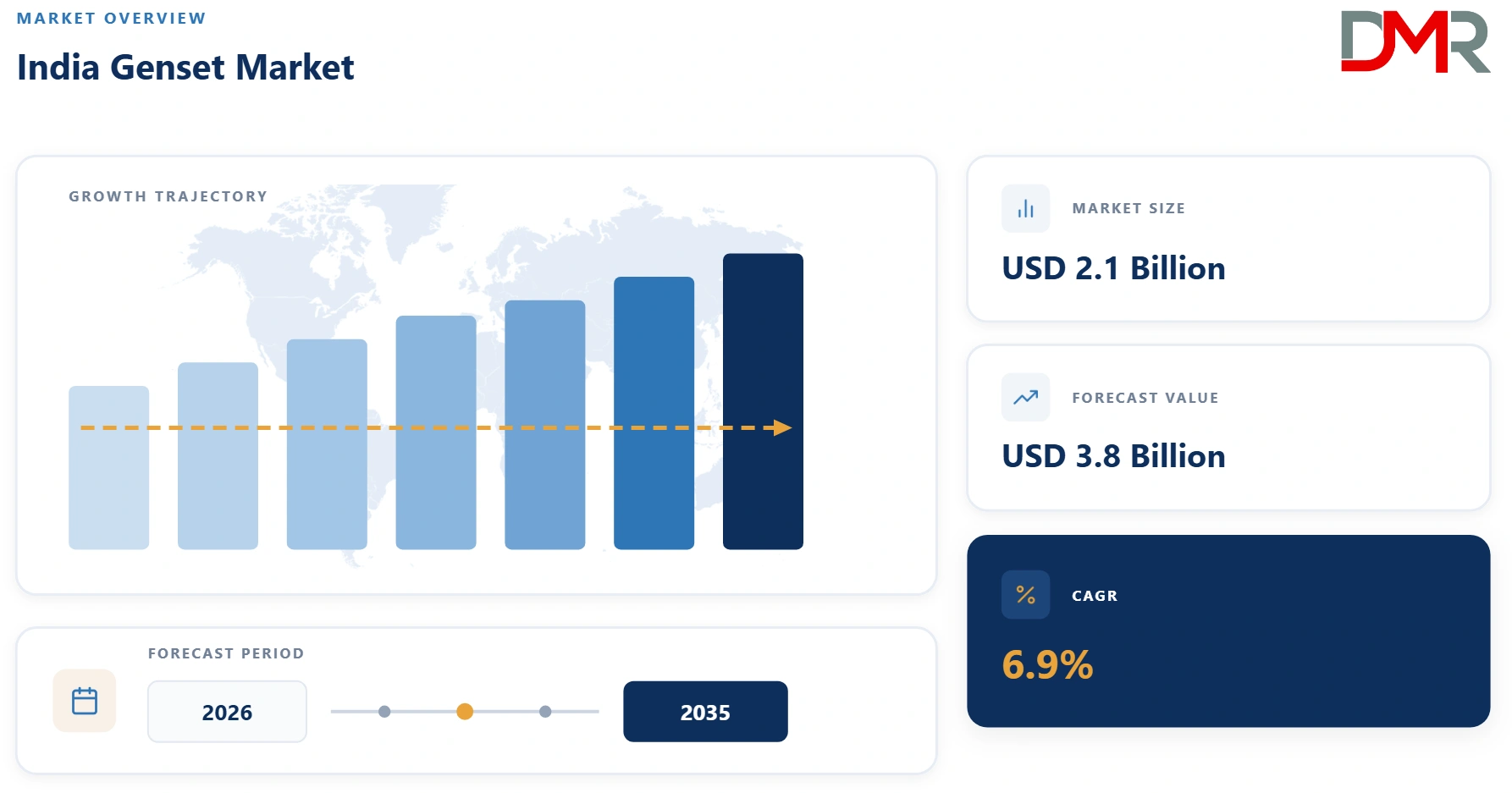
The India genset market is estimated to reach USD 2.1 billion in 2026 and is projected to increase to approximately USD 3.8 billion by 2035, registering a CAGR of 6.9% during the forecast period. Market expansion is supported by increasing industrialization, infrastructure development, urbanization and rising electricity requirements across commercial establishments.
ℹ
To learn more about this report –
Download Your Free Sample Report Here
The India genset market comprises the manufacturing, distribution, installation and sale of generator sets used to produce electricity for residential, commercial, industrial and infrastructure applications. These systems combine an internal combustion engine with an electrical alternator to generate electricity during grid failures or provide primary power in locations with limited electricity access. The market includes diesel, natural gas, compressed natural gas (CNG), gasoline and other alternative-fuel generator sets across different power capacities. It also encompasses associated equipment such as control panels, automatic transfer switches, monitoring systems and power-management components. Gensets provide dependable electricity, operational continuity and backup power for facilities requiring uninterrupted energy availability.
Use Cases
- Industrial Manufacturing: Providing uninterrupted electricity to factories, processing facilities and production lines during grid interruptions.
- Commercial Infrastructure: Supporting backup electricity requirements across hotels, shopping malls, office buildings and business parks.
- Residential Applications: Supplying emergency electricity to independent homes, apartment complexes, elevators and essential household equipment.
- Data Centres: Maintaining continuous power availability for servers, cloud infrastructure, networking equipment and critical digital services.
- Healthcare Facilities: Supporting hospitals, intensive care units, diagnostic laboratories and medical equipment requiring continuous electricity.
- Construction and Infrastructure: Providing temporary and dependable electricity to construction sites, mining operations, highways and remote infrastructure projects.
Key Takeaways
- Market Size and Growth Rate: The India genset market is estimated at USD 2.1 billion in 2026 and is projected to reach USD 3.8 billion by 2035, expanding at a CAGR of 6.9%.
- Key Growth Drivers: Industrial expansion, infrastructure investments, increasing data-centre capacity and demand for uninterrupted electricity are supporting market growth.
- Key Segment Dominance: The 101–500 kVA power rating category dominates with 38% share, while diesel accounts for 78% of fuel-type revenue.
- Application Leadership: Industrial applications represent approximately 43% of market revenue because of manufacturing, processing and operational continuity requirements.
- Fastest-Growing Segment: The 1,001–3,000 kVA category is projected to grow at approximately 9.0% CAGR, driven by data centres and large industrial facilities.
- Emerging Trends: CPCB IV+ compliance, intelligent monitoring, hybrid power systems and alternative-fuel generators are reshaping product development and competition.
How AI/Gen AI is Transforming the India Genset Market?
Artificial intelligence, Internet of Things (IoT), cloud computing and advanced electronic control systems are transforming India's genset industry. Manufacturers are incorporating remote monitoring devices, intelligent controllers, automated fault detection and predictive maintenance capabilities into modern generator sets. These technologies enable real-time monitoring of fuel consumption, engine temperature, operating hours, battery condition and equipment performance across multiple installations.
Digital technologies improve operational efficiency by identifying potential equipment failures, reducing maintenance expenses and minimising unexpected downtime. Automated load management, remote diagnostics and predictive servicing help industrial and commercial customers improve generator reliability while controlling operating expenditure.
Key Drivers in the India Genset Market
Increasing Industrialization and Infrastructure Development
India's expanding industrial and infrastructure sectors are major drivers of genset market growth. Increasing investments in manufacturing facilities, industrial corridors, highways, airports, metro rail projects, commercial buildings and logistics infrastructure are creating demand for dependable electricity-generation equipment. Manufacturing industries such as automotive, pharmaceuticals, chemicals, textiles, food processing and engineering require continuous electricity to maintain production schedules and prevent operational interruptions. Gensets provide essential backup electricity where grid interruptions, voltage fluctuations or insufficient distribution infrastructure can affect industrial productivity. Furthermore, increasing construction activity across residential and commercial developments is generating demand for portable and stationary generator sets. Government initiatives supporting domestic manufacturing, infrastructure modernisation and industrial investment are expected to sustain equipment demand. Growing electricity requirements from urbanisation and expanding industrial clusters will further support the adoption of medium- and high-capacity gensets throughout the forecast period.
Expansion of Data Centres and Critical Infrastructure
The rapid expansion of India's digital economy is creating significant demand for reliable power-generation systems. Increasing adoption of cloud computing, artificial intelligence, digital payments, online services and enterprise applications is accelerating investments in hyperscale and colocation data centres. These facilities require uninterrupted electricity to maintain server operations, cooling systems, networking infrastructure and information security. Generator sets are an essential component of their backup power architecture, providing emergency electricity during grid disruptions. Healthcare facilities, telecommunications networks, airports and financial institutions similarly require reliable backup systems to protect critical operations. India's data-centre capacity expansion is expected to increase demand for high-capacity generator sets, synchronized generator installations and advanced power-management technologies. This development is particularly beneficial for manufacturers offering generators above 1,000 kVA, integrated monitoring systems and long-term maintenance services.
Restraints in the India Genset Market
Stringent Environmental Regulations and Compliance Costs
Increasingly stringent environmental regulations represent a significant challenge for the Indian genset industry. The implementation of CPCB IV+ emission standards has required manufacturers to introduce advanced engine technologies, electronic fuel injection, improved combustion systems and emission-control equipment. Compliance increases manufacturing complexity, research expenditure and product development costs, particularly for smaller manufacturers with limited financial resources. Advanced emission-control components and specialised maintenance requirements can also increase the purchase price and lifecycle expenditure for customers. In addition, operating restrictions imposed in certain highly polluted urban regions can affect generator utilisation and purchasing decisions. Small commercial establishments and residential customers may find compliant generator sets relatively expensive compared with conventional alternatives. Manufacturers must therefore balance environmental compliance, equipment affordability, fuel efficiency and operational reliability while maintaining competitive pricing. These requirements may create entry barriers for smaller suppliers and increase consolidation among established OEMs.
High Operating Costs and Improving Grid Electricity Availability
High fuel consumption and operating expenditure remain important constraints for the India genset market. Diesel-powered generators are exposed to fluctuations in fuel prices, transportation costs and maintenance expenses. For facilities operating generators frequently, fuel expenditure can significantly increase the total cost of ownership. Regular servicing, lubricant replacement, filter changes and engine overhauls further contribute to operational costs. Additionally, improvements in India's electricity generation, transmission and distribution infrastructure are gradually reducing dependence on conventional backup generation in several regions. According to the Ministry of Power, India's energy deficit was approximately 0.1% during FY2024–25, indicating substantial improvement in electricity availability. The growing adoption of battery energy storage systems, inverters and solar-plus-storage solutions also creates competition for smaller generator applications. Consequently, genset manufacturers increasingly depend on critical backup requirements, industrial applications and mission-critical facilities rather than general electricity shortages.
Growth Opportunities in the India Genset Market
Increasing Investments in Data Centres and AI Infrastructure
The expansion of hyperscale data centres and artificial intelligence infrastructure presents a major growth opportunity for the Indian genset industry. Data centres require highly reliable power systems capable of supporting continuous operations, rapid emergency response and redundant electricity generation. Large facilities frequently deploy multiple high-capacity generator sets operating through synchronized configurations to support critical electricity loads. Increasing investments in cloud computing, enterprise digitalisation and AI infrastructure are creating opportunities for manufacturers offering high-capacity generators, advanced control panels, automatic transfer switches and remote monitoring capabilities. Manufacturers can also generate recurring revenue through maintenance agreements, engine overhauls, replacement components and equipment-management services. Major data-centre markets, including Mumbai, Chennai, Hyderabad, Bengaluru and Delhi NCR, offer attractive opportunities for established generator manufacturers. The increasing importance of power reliability is expected to strengthen demand for premium gensets and integrated power-generation solutions.
Adoption of Gas-Powered and Hybrid Generator Systems
The growing emphasis on environmental sustainability and fuel efficiency is creating opportunities for gas-powered and hybrid gensets. Natural gas generators can offer lower particulate emissions and reduced local air pollutants compared with conventional diesel systems under appropriate operating conditions. Expanding city gas distribution infrastructure and natural-gas availability in selected industrial clusters can encourage their adoption among commercial and industrial customers. Additionally, biogas-powered generator systems provide opportunities in agricultural processing, wastewater treatment and municipal waste-management facilities. Hybrid systems integrating solar photovoltaic installations, battery storage and generator sets can reduce diesel consumption while maintaining electricity reliability. Such solutions are particularly relevant for remote industrial facilities, telecom infrastructure and commercial establishments. Manufacturers investing in alternative-fuel technologies, intelligent energy-management systems and hybrid power solutions can differentiate their portfolios and access emerging customer segments. However, adoption will depend on fuel availability, infrastructure investment and overall lifecycle economics.
Trends in the India Genset Market
Increasing Adoption of Digitally Connected Gensets
The Indian genset industry is witnessing increasing adoption of digitally connected generator systems equipped with IoT-enabled controllers, remote monitoring and predictive maintenance capabilities. These technologies enable customers to monitor equipment performance, fuel consumption, operating hours and maintenance requirements through centralised digital platforms. Industrial facilities, telecom operators, hospitals and data centres are increasingly adopting connected systems to improve operational reliability and reduce maintenance expenditure. Manufacturers are also strengthening digital aftermarket services to generate recurring revenue and improve customer retention.
Transition Toward CPCB IV+ Compliant and Hybrid Power Solutions
Environmental compliance is encouraging the development of advanced generator sets incorporating electronic fuel injection, improved combustion systems and emission-control technologies. Manufacturers are expanding their CPCB IV+ compliant product portfolios to meet regulatory requirements and replacement demand. Simultaneously, hybrid systems combining generators, solar electricity and battery storage are gaining attention among commercial and industrial customers. Increasing focus on fuel efficiency, lower emissions and total ownership costs is expected to influence product innovation and purchasing decisions throughout the forecast period.
Research Scope and Analysis
The India genset market is segmented by power rating, fuel type, and application. The analysis evaluates market shares, customer preferences, equipment requirements, technology adoption and segment-specific growth opportunities across residential, commercial and industrial applications.
ℹ
To learn more about this report –
Download Your Free Sample Report Here
By Power Rating Analysis
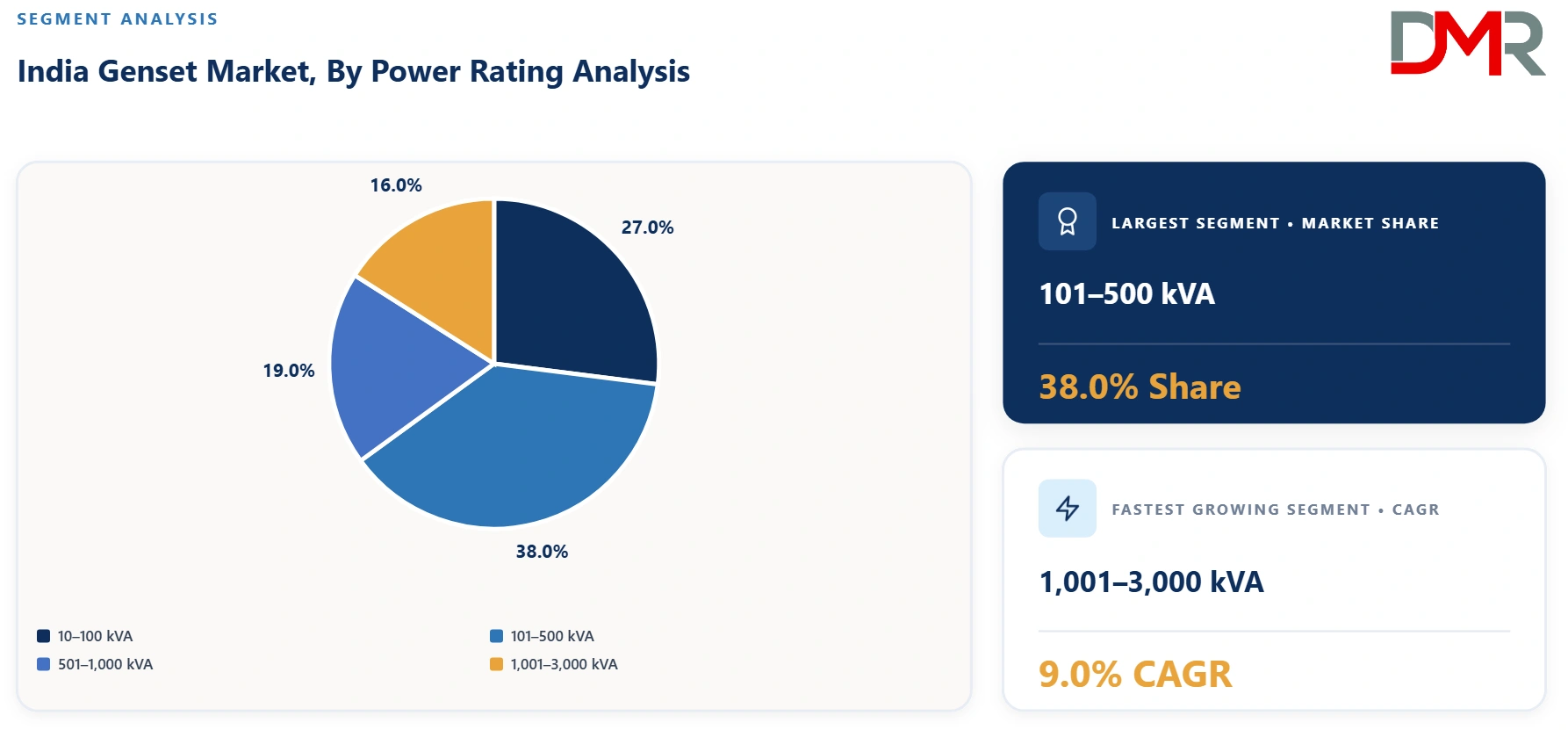
The 101–500 kVA segment is estimated to dominate the India genset market in 2026, accounting for approximately 38% of total market revenue. Its leadership is primarily attributed to widespread adoption across manufacturing facilities, commercial buildings, hospitals, hotels, construction projects and medium-sized industrial establishments. This category offers an optimal balance between power-generation capacity, installation costs and operating efficiency. The 10–100 kVA segment represents the second-largest category, with an estimated 27% share, supported by residential buildings, small businesses, retail establishments and telecom installations. The 501–1,000 kVA category accounts for approximately 19%, driven by large commercial properties and industrial facilities. Meanwhile, the 1,001–3,000 kVA category represents approximately 16% of the market. This segment is expected to be the fastest-growing, registering approximately 9.0% CAGR through 2035. Increasing investments in hyperscale data centres, large manufacturing facilities, airports and mission-critical infrastructure are driving demand for high-capacity generator sets. Growing requirements for synchronized generator installations, redundant backup systems and advanced power-management solutions are further supporting the expansion of this category.
By Fuel Type Analysis
The diesel segment is estimated to dominate the India genset market in 2026, accounting for approximately 78% of total market revenue. Its leadership is supported by established fuel distribution infrastructure, high power-generation capabilities, dependable performance and widespread availability of diesel-powered generator sets. Diesel gensets are extensively used across manufacturing facilities, commercial buildings, healthcare institutions, construction projects and data centres. The gas segment represents the second-largest category, with an estimated 15% market share, supported by increasing interest in cleaner distributed power generation, natural-gas availability and emission-conscious equipment investments. The gasoline segment accounts for approximately 7% of market revenue, primarily serving residential users, small businesses and portable power applications. Gas-powered gensets are expected to be the fastest-growing fuel category, registering approximately 9.2% CAGR through 2035. Growing environmental awareness, expansion of city gas distribution networks and demand for alternative-fuel power systems are supporting this growth. Nevertheless, diesel generators are expected to maintain their leading position because of their suitability for high-capacity applications, established servicing infrastructure and operational flexibility.
By Application Analysis
The industrial segment is estimated to dominate the India genset market in 2026, accounting for approximately 43% of total revenue. Its leadership is driven by increasing demand for dependable electricity across manufacturing plants, processing facilities, warehouses, industrial parks and production units. Industrial customers require backup power to prevent operational interruptions, equipment damage and production losses. The commercial segment represents the second-largest category, accounting for approximately 37% of market revenue. Demand originates from hospitals, hotels, shopping centres, office complexes, educational institutions, IT parks and data centres requiring uninterrupted electricity. The residential segment contributes approximately 20% of the market, supported by apartment complexes, independent houses and residential developments requiring emergency power backup. Industrial applications are expected to grow at approximately 7.3% CAGR through 2035, supported by manufacturing expansion, infrastructure investment and increasing automation. Commercial applications are also expected to record strong growth due to data-centre expansion and modern commercial infrastructure. Residential demand is expected to grow comparatively moderately as electricity distribution improvements and battery-based backup systems influence purchasing decisions.
The India Genset Market Report is segmented on the basis of the following:
By Power Rating
- 10–100 kVA
- 101–500 kVA
- 501–1,000 kVA
- 1,001–3,000 kVA
By Fuel Type
By Application
- Residential
- Commercial
- Industrial
Regulatory Landscape
The Indian genset market is significantly influenced by environmental regulations introduced by the Central Pollution Control Board (CPCB) and the Ministry of Environment, Forest and Climate Change. CPCB IV+ emission standards, implemented for applicable new generator engines from July 2023, have encouraged manufacturers to adopt electronic fuel injection, advanced combustion technologies and emission-control systems. Compliance requirements have increased manufacturing costs and created technical entry barriers for smaller manufacturers. However, these regulations are generating replacement demand for compliant generator sets and encouraging technological innovation. Manufacturers with established engineering capabilities, testing infrastructure and certified product portfolios are better positioned to benefit. Additional operating restrictions in highly polluted cities may encourage cleaner fuels, hybrid generator installations and improved emission-management technologies.
Investment and White Space Analysis
Investment opportunities in the Indian genset market are increasingly concentrated in high-capacity generator systems, data-centre infrastructure, gas-powered equipment and hybrid energy solutions. The expansion of hyperscale data centres creates opportunities for manufacturers offering synchronized generator installations, redundant power systems and integrated monitoring technologies. Additional white spaces exist in biogas-powered generators, hybrid solar-battery-genset installations and digitally enabled aftermarket services. Emerging industrial corridors and Tier-2 cities also provide opportunities for distribution expansion and localized servicing. Manufacturers investing in CPCB IV+ compliant products, alternative-fuel engines and advanced control technologies can strengthen their competitive positioning. However, investors must consider capital requirements, diesel-price volatility, competition from battery energy storage and changing environmental regulations when evaluating long-term opportunities.
Competitive Landscape
The India genset market is moderately consolidated, with competition among established domestic manufacturers, international power-generation companies and regional equipment suppliers. Major participants include Cummins India, Kirloskar Oil Engines, Mahindra Powerol, Ashok Leyland, Caterpillar, Greaves Cotton, Jakson Group, Powerica Limited and Honda India Power Products. Leading manufacturers compete through product reliability, fuel efficiency, emission compliance, pricing, technological innovation and nationwide distribution networks. Companies are increasingly focusing on CPCB IV+ compliant products, high-capacity generator systems, digital monitoring technologies and comprehensive aftermarket services. Strategic initiatives include manufacturing capacity expansion, product development, partnerships with data-centre operators and geographic expansion. The growing demand for mission-critical power systems is encouraging manufacturers to strengthen their presence in premium industrial and commercial applications. Competition is also intensifying in gas-powered and hybrid generator technologies as customers increasingly consider environmental performance and total cost of ownership.
Some of the prominent players in the India Genset Market are:
- Kirloskar Oil Engines Limited
- Cummins India Limited
- Mahindra Powerol
- Ashok Leyland – LEYPOWER
- Greaves Cotton Limited
- TAFE Motors and Tractors Limited
- Caterpillar India
- Jakson Group
- Sudhir Power Limited
- Powerica Limited
- Cooper Corporation
- Sterling Generators
- Atlas Copco India
- FG Wilson
- Perkins Engines
- Rehlko Power Systems (Kohler)
- Mitsubishi Heavy Industries
- Rolls-Royce Power Systems (mtu)
- Wärtsilä India
- Volvo Penta India
- Other Key Players
Recent Developments
- In August 2026, Powerica's expanding data-centre generator order book highlighted increasing demand for high-capacity backup power systems, driven by investments in India's digital infrastructure sector.
- In June 2026, Kirloskar Oil Engines secured an order for 96 units of its 2,500 kVA Optiprime Dual Core power systems from digital infrastructure company HyperNext, representing 192 MW of generator capacity.
- In May 2025, Mahindra Powerol was recognised as India's leading diesel genset manufacturer by volume for FY2025, reporting a 23.8% market share based on Frost & Sullivan's DG Tracker report.
- In January 2025, Cummins India commissioned its approximately INR 600 crore manufacturing facility at Phaltan, Maharashtra, adding reported annual production capacity of 50,000 CPCB IV+ generator sets to support growing domestic demand.
Report Details
| Report Characteristics |
| Market Size (2026) |
USD 2.1 Bn |
| Forecast Value (2035) |
USD 3.8 Bn |
| CAGR (2026–2035) |
6.9% |
| Historical Data |
2021 – 2025 |
| Forecast Data |
2026 – 2035 |
| Base Year |
2025 |
| Segments Covered |
By Power Rating, By Fuel Type, By Application |
| Country Coverage |
India |
Frequently Asked Questions
What is the size of the India Genset Market in 2026?
▾ The India Genset Market is estimated to reach USD 2.1 billion in 2026, supported by industrial, commercial and infrastructure electricity requirements.
What will be the India Genset Market size by 2035?
▾ The India Genset Market is projected to reach approximately USD 3.8 billion by 2035, driven by increasing backup power and infrastructure investments.
What is the expected CAGR of the India Genset Market?
▾ The India Genset Market is forecast to register approximately 6.9% CAGR between 2026 and 2035, supported by expanding industrial and commercial applications.
What are the major growth drivers of the India Genset Market?
▾ Industrialisation, data-centre expansion, infrastructure development, manufacturing investments and increasing requirements for uninterrupted electricity are the primary growth drivers of the India Genset Market.
Which fuel type dominates the India Genset Market?
▾ Diesel dominates the India Genset Market with an estimated 78% share in 2026, owing to established infrastructure, reliability and broad industrial applications.
Which segment is expected to grow fastest in the India Genset Market?
▾ The 1,001–3,000 kVA power-rating segment of the India Genset Market is expected to grow at approximately 9.0% CAGR through 2035.
Who are the major players in the India Genset Market?
▾ Major players in the India Genset Market include Cummins India, Kirloskar Oil Engines, Mahindra Powerol, Ashok Leyland, Caterpillar, Greaves Cotton and Jakson Group.
What are the major trends in the India Genset Market?
▾ CPCB IV+ compliance, IoT-enabled monitoring, gas-powered generators, hybrid energy systems and high-capacity data-centre gensets are major emerging trends in the India Genset Market.