Market Snapshot
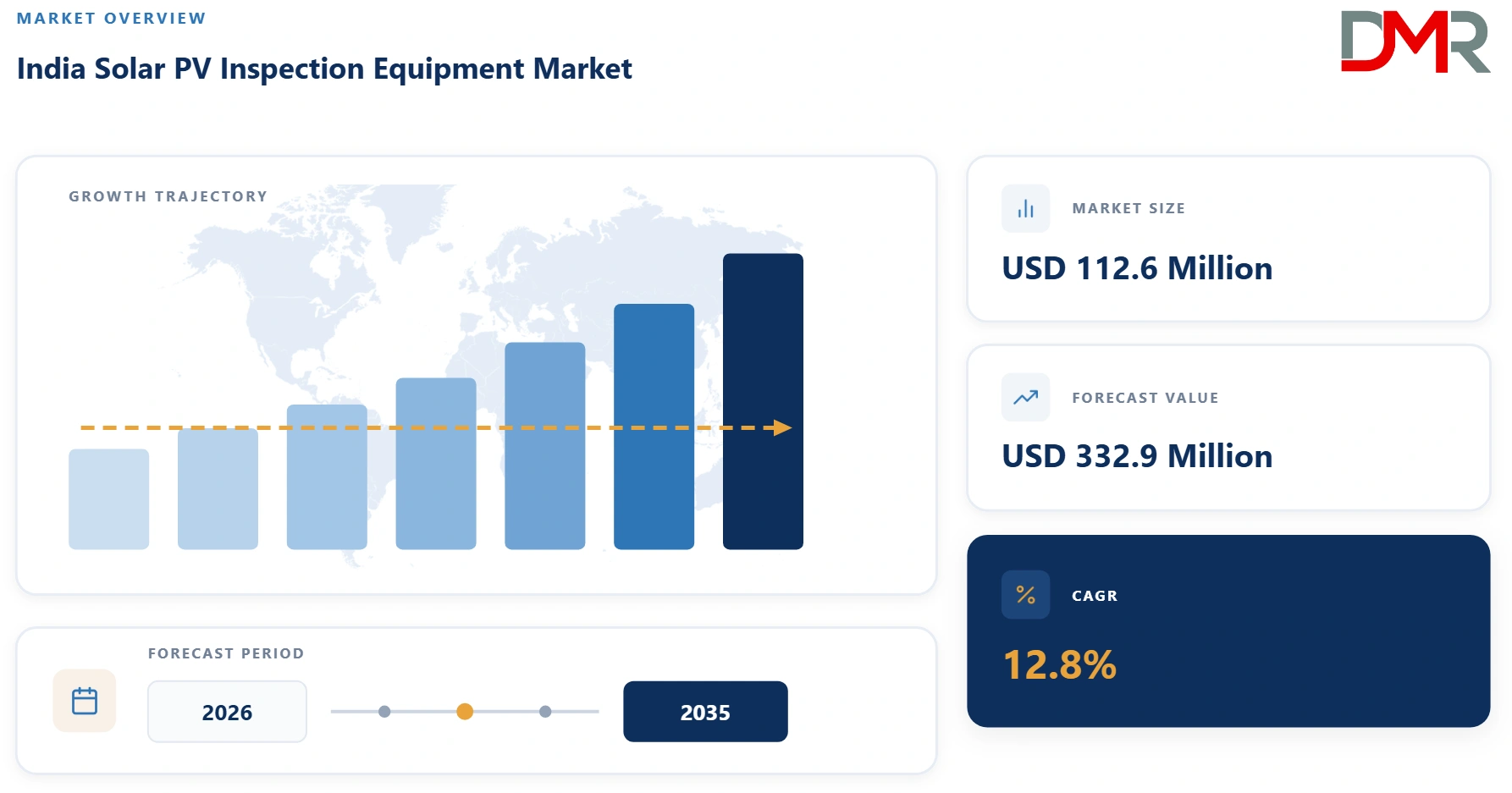
- Market Size (2026): USD 112.6 Mn
- Forecast Value (2035): USD 332.9 Mn
- CAGR (2026-2035): 12.8%
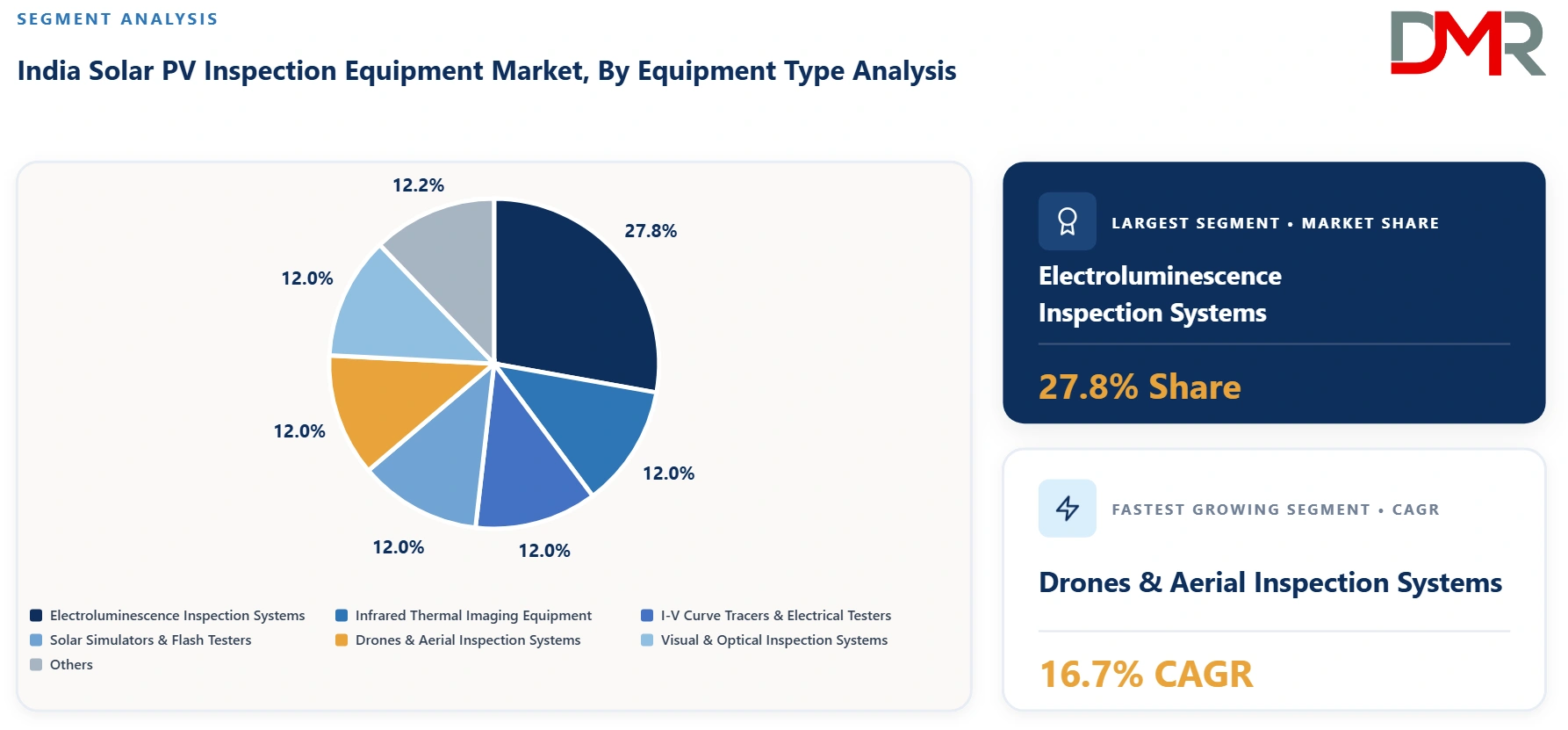
- Leading Equipment Type (2026): Electroluminescence Inspection Systems, around 27.8%
- Leading Technology (2026): Infrared Thermography, close to 28.4%
- Key Players: Fluke Corporation, Teledyne FLIR, Keysight Technologies, and Others
What is India Solar PV Inspection Equipment Market and its Market Size?
The India Solar PV Inspection Equipment Market size is estimated to reach USD 112.6 Mn in 2026 and is further anticipated to reach USD 332.9 Mn by 2035, at a CAGR of 12.8%.
ℹ
To learn more about this report –
Download Your Free Sample Report Here
Solar PV inspection equipment comprises instruments and systems used to detect defects, verify electrical and optical performance, assess installation quality, and monitor degradation across photovoltaic modules and operating solar assets. The market includes electroluminescence imaging systems, infrared cameras, I-V curve tracers, insulation and electrical safety testers, flash testers, optical inspection systems, drones, sensors, and inspection software used from manufacturing through commissioning and long-term operations.
India's rapidly expanding solar fleet is increasing the economic value of systematic inspection. Utility-scale plants require fast methods for locating hot spots, cracked cells, bypass-diode failures, connector problems, string mismatch, soiling patterns, shading, insulation faults, and underperforming blocks. Rooftop and commercial systems also require commissioning and periodic electrical checks, particularly as asset owners place greater emphasis on performance guarantees, safety, and lifetime energy yield.
Inspection equipment procurement is influenced by measurement accuracy, field portability, inspection speed, automation, thermal sensitivity, imaging resolution, data traceability, compatibility with large plants, and the ability to convert raw measurements into actionable maintenance priorities. Drone-based thermography and AI-assisted analytics are reducing the time required to inspect large projects, while electroluminescence remains important for detecting microcracks and cell-level defects that are difficult to identify visually.
Manufacturing expansion creates a parallel demand stream for inline and laboratory inspection. Module producers need equipment for visual checks, EL imaging, flash testing, insulation verification, and quality documentation to support certification and customer acceptance. India's evolving quality-control framework and ALMM requirements reinforce the need for consistent product testing and inspection throughout the domestic solar value chain.
Use Cases
- Module Manufacturing Quality Control: PV manufacturers use electroluminescence imaging, flash testing, optical inspection, and electrical safety equipment to identify cell cracks, soldering defects, inactive areas, power deviations, insulation problems, and workmanship issues before modules are released for shipment.
- Utility-Scale Plant Inspection: Developers and O&M teams deploy drones, thermal cameras, I-V tracers, and electrical testers to screen thousands of modules rapidly, identify underperforming strings and hot spots, prioritize field interventions, and reduce lost generation.
- Commissioning & Acceptance: EPC contractors and independent inspectors verify module condition, polarity, insulation resistance, string current, I-V performance, thermal behavior, workmanship, and documentation before plant handover or final acceptance by owners and lenders.
- Warranty & Degradation Assessment: Asset owners use repeat inspections to document microcracks, potential-induced degradation indicators, hot spots, connector failures, and output deterioration, supporting warranty claims and long-term performance benchmarking.
Key Takeaways
- Market Size & Share: The market is estimated at USD 112.6 Mn in 2026 and projected to reach USD 332.9 Mn by 2035.
- Equipment Type Analysis: Drone & Aerial Inspection Systems are projected to expand fastest at an estimated CAGR of 16.7%.
- Technology Analysis: Infrared Thermography leads with approximately 28.4% of 2026 revenue because it supports rapid field-level fault detection.
- Application Analysis: Utility-Scale Solar Plants account for around 42.7% of demand, supported by India's large and expanding ground-mounted fleet.
- Commercial Catalyst: India's cumulative solar capacity exceeded 164 GW by July 2026, enlarging the installed base requiring commissioning and lifecycle inspection.
- Competitive Dynamics: Inspection demand spans global instrument vendors, domestic drone companies, analytics providers, certification laboratories, and solar O&M specialists.
How AI/Gen AI is Transforming the India Solar PV Inspection Equipment Market?
AI is improving the productivity of solar PV inspection by automating defect recognition across thermal, RGB, electroluminescence, and electrical datasets. Computer-vision models can classify hot spots, disconnected strings, diode failures, cracked cells, shading, vegetation encroachment, and other anomalies across large image sets. When combined with drone flight automation and geospatial mapping, these tools allow operators to rank defects by severity and location rather than manually reviewing every image.
Generative AI is emerging as a support layer for inspection reporting, technician workflows, and asset knowledge management. It can summarize inspection findings, draft maintenance recommendations from validated defect classifications, and retrieve procedures from technical manuals. Human validation remains necessary because warranty decisions, electrical safety, and maintenance dispatch depend on accurate defect interpretation and traceable measurements.
- Automated Defect Classification: Computer vision identifies and categorizes thermal and visual anomalies across large solar farms.
- Inspection Prioritization: Analytics rank defects by estimated energy loss, safety risk, and maintenance urgency.
- Predictive Degradation: Historical inspection and performance data support early identification of modules or strings with abnormal deterioration.
- Automated Reporting: Gen AI assists with structured inspection summaries and maintenance work-order preparation after validated analysis.
Key Drivers in the India Solar PV Inspection Equipment Market
Rapid Expansion of Installed Solar Capacity
India's solar fleet is expanding rapidly across utility-scale, rooftop, hybrid, and distributed projects. Every additional gigawatt creates inspection requirements during construction, commissioning, acceptance, warranty periods, and ongoing operation. Large plants contain hundreds of thousands or millions of modules, making manual inspection increasingly impractical. Asset owners therefore require thermal cameras, drones, electrical testers, I-V tracers, and analytics platforms that can screen large areas quickly and identify the small proportion of modules requiring physical intervention. Growth in the installed base also creates recurring demand because inspection is repeated over the operating life of the plant rather than occurring only at initial installation.
Stronger Focus on Quality, Yield, and Compliance
Solar project economics depend on long-term energy yield, making early detection of module and balance-of-system defects commercially important. Developers, lenders, EPC contractors, and O&M providers increasingly use inspection evidence to verify construction quality, identify warranty issues, and reduce avoidable generation losses. India's quality-control framework for solar products, including BIS conformity and ALMM-related requirements, also reinforces attention to module quality and traceability. As module manufacturing expands domestically, inspection shifts upstream into factories as well as downstream into operating plants, broadening demand for EL imaging, flash testing, safety testing, machine vision, and certification-grade measurement equipment.
Restraints in the India Solar PV Inspection Equipment Market
High Cost of Advanced Inspection Systems
High-resolution electroluminescence systems, scientific thermal cameras, solar simulators, drone payloads, automated analytics, and calibrated electrical instruments can represent a significant capital expense for smaller EPC contractors and O&M providers. Advanced equipment also requires trained operators, calibration, software subscriptions, data storage, and periodic maintenance. Service providers may therefore rely on rented equipment or subcontract specialist inspection companies rather than purchase complete platforms. Price sensitivity is particularly important for rooftop and smaller commercial projects where inspection budgets are limited. This can slow adoption of premium instruments even when they offer better sensitivity, automation, or reporting capability.
Skill Gaps and Inconsistent Inspection Practices
Inspection quality depends on correct test conditions, operator competence, calibration, flight planning, electrical safety procedures, and accurate interpretation of anomalies. Thermal imaging can produce misleading results if irradiance, wind, viewing angle, load, and environmental conditions are not controlled. Similarly, I-V and EL measurements require appropriate procedures to distinguish real defects from measurement artifacts. India's rapidly expanding solar workforce creates uneven technical capability across contractors and regions. Inconsistent inspection practices can reduce confidence in results and encourage price-based procurement instead of performance-based selection, limiting the value captured by advanced inspection equipment suppliers.
Growth Opportunities in the India Solar PV Inspection Equipment Market
Drone-Based Thermography and AI Analytics
India's large utility-scale solar parks create an attractive use case for autonomous or semi-autonomous drone inspection. Aerial thermal and RGB imaging can cover far more modules per day than ground teams and can be linked with plant maps to pinpoint anomalies. AI-based defect classification further reduces manual image review and enables standardized reporting across portfolios. Opportunities extend beyond drone hardware to thermal payloads, flight-planning software, geospatial analytics, defect libraries, digital twins, and recurring inspection services. Domestic drone manufacturers and solar analytics companies can combine local field support with software tailored to Indian site conditions and asset-management workflows.
Domestic Module Manufacturing Inspection Infrastructure
India is expanding domestic solar cell and module manufacturing capacity, creating demand for factory inspection equipment. Production lines require machine vision, EL imaging, flash testing, insulation testing, dimensional inspection, and traceability systems to verify product consistency and meet customer and certification requirements. Higher-efficiency cell technologies and larger-format modules increase the importance of detecting subtle cracks, interconnection defects, and power deviations before shipment. Equipment vendors can address this opportunity through automated inline inspection, laboratory systems, calibration services, and data platforms that link quality results with manufacturing process parameters.
Trends in the India Solar PV Inspection Equipment Market
Integration of Multiple Inspection Modalities
Solar inspection is moving from single-instrument checks toward combined workflows using thermal imaging, RGB imagery, electroluminescence, electrical testing, SCADA data, and I-V analysis. Each technique detects different failure modes, and combining them improves diagnostic confidence. Large asset owners increasingly want inspection platforms that link anomalies to exact module or string locations and preserve a historical record across repeated campaigns. This trend supports interoperable software, standardized data formats, and service providers capable of combining aerial screening with targeted ground testing rather than treating each inspection method as an isolated activity.
Shift Toward Automated and Portfolio-Level Inspection
Owners with multi-gigawatt portfolios are standardizing inspection procedures across projects to compare asset health and maintenance performance. Automated drone missions, cloud-based analytics, mobile technician applications, and centralized dashboards make it possible to manage inspection at portfolio scale. Equipment suppliers are responding with connected instruments, remote data transfer, automated report generation, and APIs that integrate inspection findings with computerized maintenance management and asset-performance systems. This trend favors solutions that reduce inspection time while maintaining traceability and consistent defect classification across different sites, technologies, and service teams.
Research Scope and Analysis
The study evaluates the India solar PV inspection equipment market by equipment type, inspection type, technology, application, and end user, with segment leadership and growth assessed across the 2026-2035 forecast period.
ℹ
To learn more about this report –
Download Your Free Sample Report Here
By Equipment Type
Electroluminescence Inspection Systems is estimated to lead the equipment type segment with around 27.8% of 2026 revenue. Its position reflects broad use across manufacturing, commissioning, field inspection, and asset-quality workflows. Buyers prioritize measurement reliability, portability, inspection speed, data traceability, and compatibility with large PV portfolios. Growth, however, is concentrated in Drones & Aerial Inspection Systems, which is projected to expand at a CAGR of 16.7% between 2026 and 2035. Expansion is supported by India's growing solar installed base, domestic module manufacturing, digital O&M adoption, quality-control requirements, and increasing use of automated inspection technologies.
By Inspection Type
Routine Preventive Inspection is estimated to lead the inspection type segment with around 25.6% of 2026 revenue. Its position reflects broad use across manufacturing, commissioning, field inspection, and asset-quality workflows. Buyers prioritize measurement reliability, portability, inspection speed, data traceability, and compatibility with large PV portfolios. Growth, however, is concentrated in Fault & Defect Inspection, which is projected to expand at a CAGR of 14.9% between 2026 and 2035. Expansion is supported by India's growing solar installed base, domestic module manufacturing, digital O&M adoption, quality-control requirements, and increasing use of automated inspection technologies.
By Technology
Infrared Thermography is estimated to lead the technology segment with around 28.4% of 2026 revenue. Its position reflects broad use across manufacturing, commissioning, field inspection, and asset-quality workflows. Buyers prioritize measurement reliability, portability, inspection speed, data traceability, and compatibility with large PV portfolios. Growth, however, is concentrated in AI-Assisted Analytics, which is projected to expand at a CAGR of 19.3% between 2026 and 2035. Expansion is supported by India's growing solar installed base, domestic module manufacturing, digital O&M adoption, quality-control requirements, and increasing use of automated inspection technologies.
By Application
Utility-Scale Solar Plants is estimated to lead the application segment with around 42.7% of 2026 revenue. Its position reflects broad use across manufacturing, commissioning, field inspection, and asset-quality workflows. Buyers prioritize measurement reliability, portability, inspection speed, data traceability, and compatibility with large PV portfolios. Growth, however, is concentrated in Commercial & Industrial Solar, which is projected to expand at a CAGR of 15.8% between 2026 and 2035. Expansion is supported by India's growing solar installed base, domestic module manufacturing, digital O&M adoption, quality-control requirements, and increasing use of automated inspection technologies.
By End User
Solar Project Developers & IPPs is estimated to lead the end user segment with around 31.9% of 2026 revenue. Its position reflects broad use across manufacturing, commissioning, field inspection, and asset-quality workflows. Buyers prioritize measurement reliability, portability, inspection speed, data traceability, and compatibility with large PV portfolios. Growth, however, is concentrated in O&M Service Providers, which is projected to expand at a CAGR of 15.4% between 2026 and 2035. Expansion is supported by India's growing solar installed base, domestic module manufacturing, digital O&M adoption, quality-control requirements, and increasing use of automated inspection technologies.
The India Solar PV Inspection Equipment Market Report is Segmented Based on the Following
By Equipment Type
- Electroluminescence Inspection Systems
- Infrared Thermal Imaging Equipment
- I-V Curve Tracers & Electrical Testers
- Solar Simulators & Flash Testers
- Drones & Aerial Inspection Systems
- Visual & Optical Inspection Systems
- Others
By Inspection Type
- Pre-Installation Inspection
- Manufacturing & Factory Inspection
- Commissioning Inspection
- Routine Preventive Inspection
- Fault & Defect Inspection
- Performance & Degradation Assessment
- Others
By Technology
- Electroluminescence Imaging
- Infrared Thermography
- Electrical Characterization
- Optical Imaging & Machine Vision
- Aerial & Drone-Based Imaging
- AI-Assisted Analytics
- Others
By Application
- PV Module Manufacturing
- Utility-Scale Solar Plants
- Commercial & Industrial Solar
- Residential Rooftop Solar
- Solar EPC & Commissioning
- Research & Certification
- Others
By End User
- Solar PV Manufacturers
- Solar Project Developers & IPPs
- EPC Contractors
- Testing Inspection & Certification Companies
- O&M Service Providers
- Utilities & Government Agencies
- Others
Regulatory Landscape
India's solar PV inspection environment is influenced by the Ministry of New and Renewable Energy, Bureau of Indian Standards, compulsory product conformity requirements, ALMM rules, accredited testing laboratories, and project-specific quality assurance procedures. The Solar Systems, Devices and Components Goods Order, 2025 reinforces conformity to applicable Indian Standards and use of the BIS Standard Mark for covered products. Module testing includes design qualification, safety, performance, and production-related measurements, while recognized laboratories operate under defined scopes. These requirements increase the importance of calibrated inspection and test equipment, traceable reports, and standardized procedures across manufacturers, laboratories, EPC contractors, and project owners.
Technology Analysis
Inspection technology is converging around high-resolution imaging, portable electrical characterization, automated aerial data collection, and AI-assisted analysis. Electroluminescence detects cell cracks and inactive regions, infrared thermography identifies abnormal heating, and I-V tracers quantify electrical underperformance at string or module level. Drone platforms combine thermal and RGB payloads for rapid utility-scale surveys, while machine vision supports factory inspection. Advanced systems increasingly geotag defects, integrate with plant layouts, and compare inspection results with SCADA or historical performance data. AI-based computer vision is improving defect classification and reducing manual review, while connected instruments enable centralized reporting and portfolio-level maintenance planning.
Competitive Landscape
The India solar PV inspection equipment market includes international electrical test and thermal-imaging manufacturers, domestic drone companies, inspection analytics providers, certification laboratories, solar EPC firms, and O&M specialists. Instrument vendors compete on measurement accuracy, ruggedness, calibration support, safety, and field usability. Drone and software providers compete on inspection speed, automation, defect-classification accuracy, geospatial mapping, and integration with asset-management systems. Certification companies and laboratories influence equipment adoption through standardized testing procedures and acceptance requirements. Domestic solar manufacturers and large project developers are also building internal quality capabilities. Competition is therefore increasingly ecosystem-based, with hardware, analytics, inspection services, and technical expertise combined into integrated quality-assurance workflows.
Some of the Prominent Players in the India Solar PV Inspection Equipment Market Are:
- Fluke Corporation
- Teledyne FLIR
- Keysight Technologies
- Megger
- Seaward Electronic Ltd.
- HT Instruments
- Gossen Metrawatt
- Metrel d.o.o.
- HIOKI E.E. Corporation
- Yokogawa Electric Corporation
- Kyoritsu Electrical Instruments Works
- PCE Instruments
- Sonel S.A.
- BENNING Elektrotechnik und Elektronik
- Raytech GmbH
- UV Power
- DJI
- ideaForge Technology Limited
- Asteria Aerospace Limited
- Garuda Aerospace
- Skylark Drones
- Detect Technologies
- SenseHawk
- Prescinto Technologies
- Novergy Energy Solutions
- TÜV Rheinland India
- TÜV SÜD South Asia
- UL Solutions
- SGS India
- Intertek India
- Bureau Veritas India
- National Institute of Solar Energy
- Central Power Research Institute
- M.N. Dastur & Company
- Mahindra Teqo
- Sterling and Wilson Renewable Energy
- Tata Power Solar Systems
- Adani Solar
- Waaree Energies
- Vikram Solar
- Other Key Players
Recent Developments
- In July 2026, India's cumulative solar power capacity reached approximately 164.6 GW, including 122.6 GW of ground-mounted solar and 30.7 GW of grid-connected rooftop solar, expanding the installed base requiring inspection and maintenance.
- In August 2026, MNRE continued updating ALMM List-II for solar PV cells, reinforcing domestic solar manufacturing quality and traceability requirements.
- In June 2026, MNRE issued a waiver of selected factory inspections under ALMM for higher-power-bin solar PV modules, reflecting continued refinement of module quality-control procedures.
- In December 2025, MNRE issued revised guidelines for series approval of SPV modules for testing under the Solar Systems, Devices and Components Goods Order, 2025.
- In 2026, BIS continued publishing uniform test report formats for photovoltaic module safety and photovoltaic power-conditioner efficiency testing, supporting standardized laboratory reporting.
- In 2026, BIS laboratory scopes continued to list accredited Indian facilities for PV module safety and inverter anti-islanding testing, supporting a broader domestic testing and inspection ecosystem.
Report Details
| Report Characteristics |
| Market Size (2026) |
USD 112.6 Mn |
| Forecast Value (2035) |
USD 332.9 Mn |
| CAGR (2026–2035) |
12.8% |
| Historical Data |
2021 – 2025 |
| Forecast Data |
2026 – 2035 |
| Base Year |
2025 |
| Segments Covered |
By Equipment Type, By Inspection Type, By Technology, By Application, By End User |
| Geographic Coverage |
India |
Frequently Asked Questions
How big is the India Solar PV Inspection Equipment Market?
▾ The India Solar PV Inspection Equipment Market size is estimated to reach USD 112.6 Mn in 2026 and is projected to reach USD 332.9 Mn by 2035, growing at a CAGR of 12.8%.
What is the growth rate of the India Solar PV Inspection Equipment Market?
▾ The market is expected to expand at a CAGR of 12.8% from 2026 to 2035, supported by rapid solar capacity additions, manufacturing growth, quality requirements, and digital O&M adoption.
Which equipment type holds the largest share in the India Solar PV Inspection Equipment Market?
▾ Electroluminescence Inspection Systems lead with approximately 27.8% of 2026 revenue, supported by module manufacturing, incoming inspection, warranty assessment, and cell-level defect detection.
Who are the key players in the India Solar PV Inspection Equipment Market?
▾ Prominent participants include Fluke Corporation, Teledyne FLIR, Keysight Technologies, Megger, ideaForge, Garuda Aerospace, and testing, inspection, certification, and analytics providers.
Which application is leading the India Solar PV Inspection Equipment Market?
▾ Utility-Scale Solar Plants lead the application segment with roughly 42.7% of 2026 revenue because large plants require rapid commissioning, thermal, electrical, aerial, and recurring O&M inspection.
Which segment is expanding fastest in the India Solar PV Inspection Equipment Market?
▾ AI-Assisted Analytics is projected to record the highest technology growth, with an estimated CAGR of 19.3% through 2035 as operators automate defect classification and portfolio-level inspection workflows.
What are the major growth drivers in the India Solar PV Inspection Equipment Market?
▾ Growth is driven by India's expanding solar installed base, domestic PV manufacturing, stronger quality-control requirements, rising O&M spending, drone-based inspection, and greater emphasis on plant availability and lifetime energy yield.