India Switchgear Market Snapshot
- Market Size, 2026: USD 6.1 billion
- Market Size, 2035: USD 11.9 billion
- CAGR, 2026-2035: 7.7%
- Leading Insulation Segment: Air-insulated switchgear, 55% share
- Leading Voltage Segment: Medium voltage, 48% share
- Leading End-user Segment: Transmission & distribution utilities, 42.4% share
- Fastest-growing Segment: Vacuum-insulated switchgear, 10.8% CAGR
What is the India Switchgear and its Market Size?
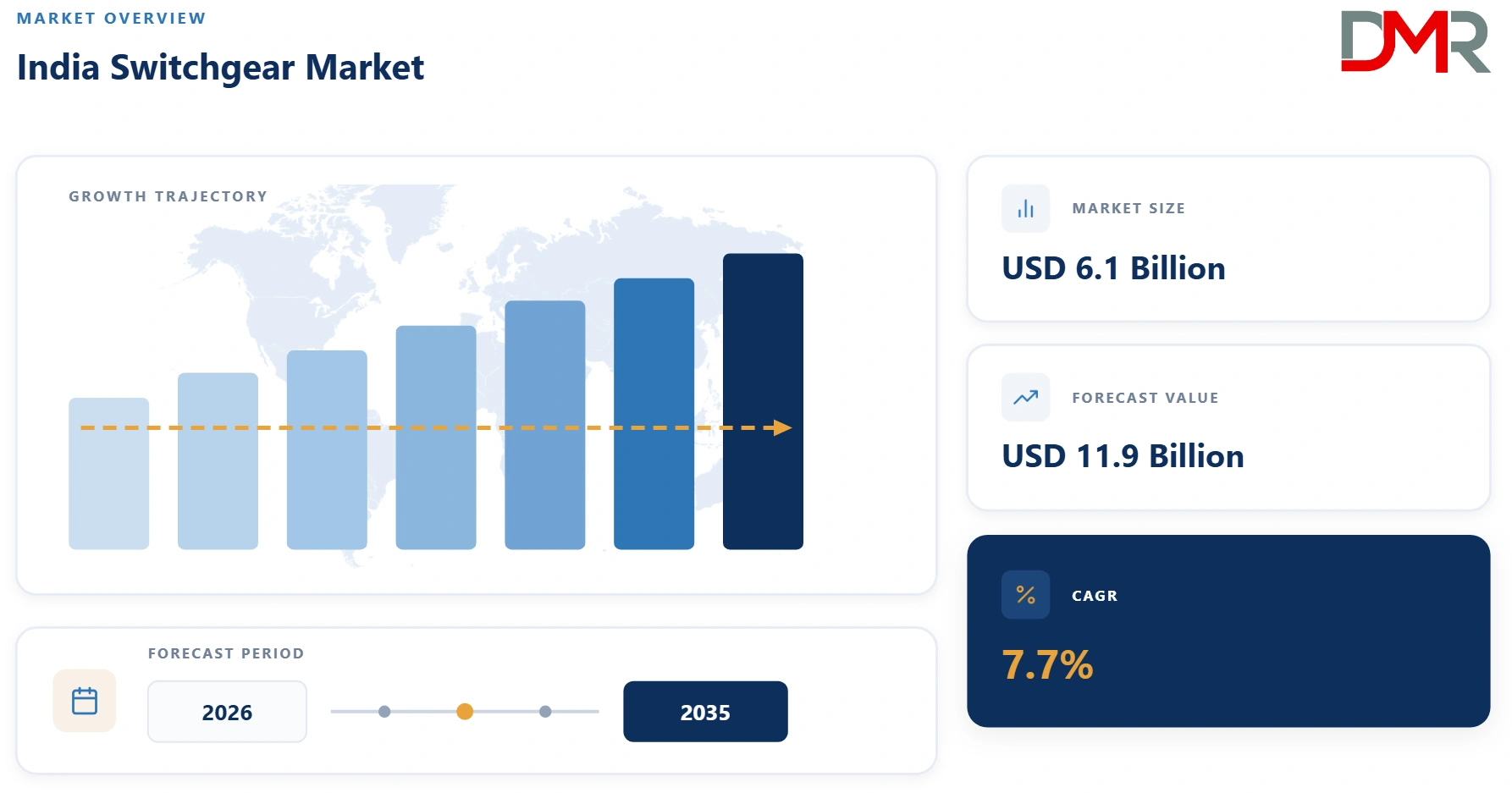
The India switchgear market is estimated at USD 6.1 billion in 2026 and is projected to reach approximately USD 11.9 billion by 2035, representing a 7.7% CAGR.
ℹ
To learn more about this report –
Download Your Free Sample Report Here
Growth is supported by electricity-demand expansion, replacement of aging grid infrastructure, renewable-energy evacuation, urbanization, industrial electrification, railway and metro expansion, data-center construction and increasing investment in transmission and distribution networks.
India switchgear comprises electrical equipment used to switch, control, protect, isolate and monitor electrical circuits across generation, transmission, distribution and end-use installations. The market encompasses circuit breakers, disconnectors, switches, fuses, protection relays, metering and control equipment, switchboards, ring-main units, air-insulated switchgear (AIS), gas-insulated switchgear (GIS), vacuum-based systems and associated digital monitoring technologies. Switchgear protects networks against overloads, short circuits and fault currents while enabling safe maintenance and reliable electricity distribution. Its value proposition is therefore centered on electrical safety, continuity of supply, grid reliability, asset protection and increasingly, digital condition monitoring.
Use Cases
- Transmission substations: High-voltage switchgear isolates faults and enables reliable bulk power transmission across regional networks.
- Distribution networks: Medium-voltage equipment controls feeders, transformers and ring-main networks while reducing outage risks.
- Renewable-energy projects: Switchgear connects solar, wind and storage assets safely to increasingly complex electrical grids.
- Industrial facilities: Factory switchboards protect motors, production equipment, transformers and critical electrical loads.
- Data centers: High-reliability switchgear provides resilient power distribution, fault isolation and increasingly digital asset monitoring.
- Commercial buildings: Low-voltage switchgear supports safe power distribution, energy management and emergency electrical isolation.
Key Takeaways
- Market Size: The market is estimated at USD 6.07 billion in 2026, reaching USD 11.85 billion by 2035.
- Growth: The forecast CAGR is approximately 7.72%, above mature-market electrical-equipment growth rates.
- Key Drivers: Grid modernization, renewable integration, industrialization, urbanization and electricity-demand growth remain the primary demand catalysts.
- Segment Dominance: Air-insulated switchgear, medium-voltage equipment and utility applications retain the largest revenue pools.
- Fastest Growth: Vacuum and digitally enabled switchgear should outperform conventional technologies as utilities and industrial customers prioritize reliability, compactness and lower environmental impact.
- Strategic Direction: The market is moving from conventional hardware toward connected, automated, predictive and lower-GWP switchgear architectures
How AI/Gen AI is Transforming the India Switchgear Market?
AI, IoT sensors, cloud connectivity and digital protection systems are increasingly embedded into switchgear to capture breaker condition, temperature, partial-discharge indicators, load behavior and fault information. Connected switchboards can communicate with SCADA, substation automation and energy-management platforms, enabling remote supervision and automated fault response. Schneider Electric, for example, markets IoT-connected MV switchgear with condition monitoring and predictive-maintenance capabilities.
The principal benefits are predictive maintenance, reduced unplanned downtime, longer asset life, faster fault diagnosis and lower maintenance costs. AI-based analytics can identify abnormal operating patterns before equipment failure, while remote diagnostics reduce the need for physical inspection.
Key Drivers in the India Switchgear Market
Transmission & Distribution Modernization
India's power infrastructure is undergoing a prolonged investment cycle as utilities expand transmission capacity, strengthen distribution networks and replace aging equipment. The Revamped Distribution Sector Scheme and related infrastructure programs are supporting substation upgrades, distribution transformers, HT/LT lines and smart-metering infrastructure. Government information indicates that infrastructure works under RDSS, including smart-metering and network upgrades, have received substantial sanctions.
Renewable Integration & Electrification
India's rapid addition of solar, wind, storage and electrified industrial loads is increasing the complexity of power flows. Renewable projects are often located far from consumption centers, requiring new substations and transmission corridors. The CEA's 2026 transmission plan specifically addresses integration of more than 900 GW of non-fossil capacity by 2035-36.
Restraints in the India Switchgear Market
High Capital Cost and Procurement Sensitivity
High-end GIS, digital switchgear and advanced high-voltage equipment require substantial upfront investment. Indian utilities and industrial customers remain highly price-sensitive, particularly where projects are awarded through competitive tenders. This creates pressure on manufacturers to localize production, optimize component costs and provide lifecycle-value arguments rather than relying exclusively on technology differentiation.
Regulatory, Technical and Skills Complexity
Switchgear must meet increasingly demanding technical, safety and environmental requirements, including applicable BIS and IEC standards, utility specifications and project-specific testing requirements. Digital switchgear additionally introduces cybersecurity, interoperability and data-management considerations.
Growth Opportunities in the India Switchgear Market
SF₆-Free and Vacuum Switchgear
Environmental concerns surrounding SF₆ are creating a long-term opening for alternative insulation and interruption technologies. Vacuum circuit breakers combined with pure-air or solid insulation can reduce environmental impact while maintaining the reliability required by distribution networks. Schneider Electric's Indian portfolio already includes SF₆-free primary and secondary MV products, demonstrating that the technology is moving from niche applications toward commercial deployment.
Digital Switchgear and Data-Center Electrification
Data centers, semiconductor facilities, manufacturing plants and digital infrastructure require extremely high power availability. These applications create demand for intelligent LV/MV switchboards, high-speed protection, condition monitoring, redundant power architectures and predictive maintenance.
Trends in the India Switchgear Market
From Hardware to Connected Electrical Assets
Switchgear is increasingly becoming a connected asset rather than a passive electrical enclosure. Embedded sensors, digital protection, remote diagnostics and asset-management software enable customers to move from scheduled maintenance toward condition-based maintenance. This trend should increase demand for smart breakers, connected RMUs, digital substations and lifecycle service contracts.
Localization and Sustainable Manufacturing
Indian customers increasingly value domestic manufacturing, shorter lead times and localized service. Global suppliers are responding by expanding Indian manufacturing and engineering capabilities. At the same time, SF₆-free switchgear, lower-loss designs and energy-efficient manufacturing are becoming important differentiators as sustainability moves into procurement decisions.
Research Scope and Analysis
The India switchgear market is analyzed by insulation, voltage, installation and end user. The segmentation captures technology choice, electrical-rating requirements, physical deployment conditions and purchasing behavior across utilities, industry, commercial buildings and residential applications.
ℹ
To learn more about this report –
Download Your Free Sample Report Here
By Insulation Analysis
Air-insulated switchgear (AIS) is estimated to dominate in 2026 with approximately 55% market share, reflecting its established installed base, relatively low upfront cost, straightforward maintenance and broad applicability across distribution, industrial and commercial projects. Medium-voltage AIS remains particularly attractive where land constraints are manageable. Gas-insulated switchgear (GIS) represents the second-largest segment at approximately 30%, supported by compact footprints, urban substations, railways, renewable projects and high-voltage applications. Vacuum-insulated/vacuum-based switchgear is estimated to be the fastest-growing technology at approximately 10.8% CAGR, driven by its strong interruption performance, reduced maintenance and compatibility with SF₆-free architectures. Oil-insulated equipment is estimated at only around 3%, reflecting its declining relevance in new installations. The broader market evidence supports strong AIS adoption while also indicating accelerating demand for GIS and alternative technologies.
By Voltage Analysis
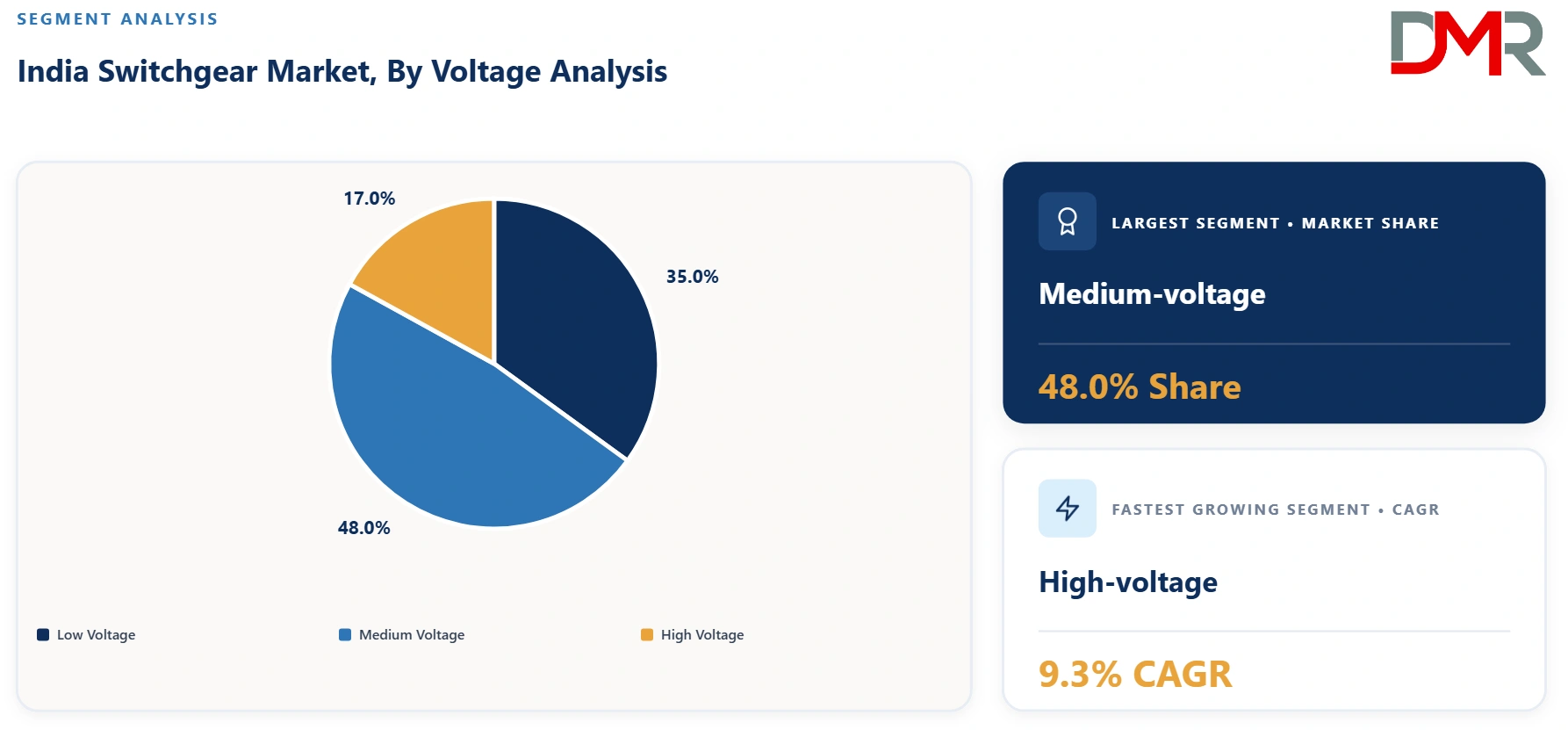
Medium-voltage switchgear is estimated to lead with approximately 48% share in 2026, benefiting from extensive requirements across distribution utilities, commercial facilities, industrial plants, renewable-energy projects and infrastructure. India's distribution-network modernization creates a particularly large installed-base replacement opportunity in the MV category. Low-voltage switchgear follows with approximately 35%, supported by buildings, factories, data centers, residential infrastructure and commercial electrical systems. High-voltage switchgear accounts for approximately 17%, but is projected to grow fastest at around 9.3% CAGR through 2035 because of interstate transmission corridors, renewable-energy evacuation, 400/765-kV projects and grid reinforcement. High-voltage projects carry substantially higher equipment values, meaning their revenue contribution can increase faster than unit volumes. Published market research similarly identifies high voltage as one of India's fastest-expanding voltage categories.
By Installation Analysis
Indoor switchgear is estimated to account for approximately 57% of the 2026 market, making it the dominant installation category. Indoor systems benefit from controlled environmental conditions, lower exposure to pollution and weather, compact layouts and strong adoption in industrial plants, commercial buildings, urban substations and data centers. Outdoor installations account for roughly 43% and remain essential for utility substations, transmission networks, renewable-energy plants and large industrial facilities. Outdoor switchgear is expected to grow at approximately 8.1% CAGR, slightly faster than indoor systems, as grid expansion and renewable-energy transmission require new outdoor substations. Technavio's India market analysis independently identifies indoor installation as the largest installation-site category.
By End User Analysis
Transmission & distribution utilities are estimated to remain the largest end-user segment, representing approximately 42.4% of 2026 revenues. Utilities benefit from ongoing substation construction, feeder modernization, renewable-energy evacuation and distribution-loss reduction programs. Industrial users are estimated to represent about 31%, making this the second-largest category and one of the fastest-growing at approximately 8.2% CAGR, driven by manufacturing expansion, metals, chemicals, pharmaceuticals, oil and gas, data centers and electrification. Commercial and residential applications account for the remaining 26.6%, supported by urbanization, commercial construction, hospitals, airports and high-rise development. Mordor Intelligence similarly estimates utilities at approximately 42.4% of 2025 market revenues, reinforcing the assessment that utilities remain the principal purchasing group.
The India Switchgear Market Report is segmented on the basis of the following:
By Insulation
By Voltage
- Low Voltage
- Medium Voltage
- High Voltage
By Installation
By End User
- Transmission & Distribution (T&D) Utilities
- Industrial
- Commercial & Residential
Regulatory Landscape
India's switchgear market is shaped by BIS/IEC technical standards, electricity-safety requirements, utility procurement specifications, environmental objectives and energy-efficiency policies. The regulatory direction is increasingly supportive of network modernization and renewable integration. The CEA's March 2026 transmission plan for more than 900 GW of non-fossil capacity by 2035-36 provides a long-term infrastructure catalyst, while BEE's energy-efficiency framework influences electrical-system design in commercial buildings. Environmental pressure on SF₆ is likely to encourage vacuum, pure-air and solid-insulation technologies, although adoption will depend on technical qualification and procurement economics.
Investment and White Space Analysis
The largest investment white spaces are high-voltage transmission, SF₆-free MV switchgear, digital substations, data centers and localized component manufacturing. The CEA's long-term transmission requirements create substantial demand for high-value equipment, while RDSS supports distribution-side modernization. Manufacturers can also target underserved aftermarket opportunities involving retrofit breakers, digital relays, sensors, condition-monitoring systems and service contracts. Hitachi Energy's major Indian manufacturing investments illustrate the scale of localization opportunities created by grid expansion.
Competitive Landscape
The India switchgear market is moderately consolidated at the premium/high-voltage end but highly fragmented across LV/MV equipment and panel-building, with multinational technology companies competing alongside large Indian electrical manufacturers and regional panel builders. Major competitors include Schneider Electric, Siemens, ABB, Hitachi Energy, GE Vernova, Larsen & Toubro, CG Power and several specialized Indian manufacturers. Competition is based on product reliability, certification, installed base, price, localization, delivery time, engineering capabilities, digital functionality and after-sales support. Players are increasingly differentiating through SF₆-free products, IoT connectivity, predictive maintenance, local manufacturing and turnkey grid solutions rather than through conventional switchgear hardware alone.
Some of the prominent players in the India Switchgear Market are:
- Schneider Electric India
- Siemens India
- ABB India
- Larsen & Toubro (L&T)
- CG Power & Industrial Solutions
- Hitachi Energy India
- GE T&D India
- Havells India
- Legrand India
- Bharat Heavy Electricals (BHEL)
- Eaton India
- HPL Electric & Power
- C&S Electric
- Mitsubishi Electric India
- Kirloskar Electric
- Toshiba Energy Systems & Solutions
- Hyosung T&D India
- Lucy Electric India
- CHINT Electric India
- MEIDEN India
- Crompton Greaves Consumer Electricals
- Salzer Electronics
- BCH Electric
- Indo Asian Electric
- Apar Industries
- Finolex Cables
- Polycab India
- V-Guard Industries
- Indo Tech Transformers
- Voltamp Transformers
- Tricolite Electrical Industries
- Secure Meters
- Hager India
- Socomec India
- Fuji Electric India
- Powell Industries
- Schneider Electric Infrastructure
- Nissin Electric India
- Tavrida Electric India
- Ormazabal India
- Other Key Players
Recent Developments
- June 2026: Hitachi Energy India announced an approximately INR 2,000 crore investment in a new large-power-transformer factory in Vadodara, supporting India's growing transmission, data-center and industrial electrification requirements.
- May 2026: Hitachi Energy India reported FY26 revenue growth of 27.6% and a record order backlog of INR 29,555.3 crore, demonstrating strong demand for advanced grid equipment and related technologies.
- April 2026: Schneider Electric hosted Innovation Summit India 2026 and introduced more than 30 new solutions spanning energy management, infrastructure, data centers, industry and buildings, reinforcing its India-focused electrification and digitalization strategy.
- February 2025: Siemens India showcased low-voltage switchgear, advanced power-distribution panels, digitalization platforms and grid technologies at ELECRAMA, highlighting the industry's shift toward integrated electrification and digital infrastructure.
Report Details
| Report Characteristics |
| Market Size (2026) |
USD 6.1 Bn |
| Forecast Value (2035) |
USD 11.9 Bn |
| CAGR (2026–2035) |
7.7% |
| Historical Data |
2021 – 2025 |
| Forecast Data |
2026 – 2035 |
| Base Year |
2025 |
| Segments Covered |
By Insulation, By Voltage, By Installation, By End User |
| Country Coverage |
India |
Frequently Asked Questions
What is the size of the India Switchgear Market in 2026?
▾ The India Switchgear Market is estimated at USD 6.1 billion in 2026, supported by grid modernization, renewable integration and industrial electrification.
What will the India Switchgear Market be worth in 2035?
▾ The India Switchgear Market is projected to reach approximately USD 11.9 billion by 2035, assuming a 7.72% compound annual growth rate.
What is the CAGR of the India Switchgear Market?
▾ The India Switchgear Market is expected to expand at approximately 7.7% CAGR during 2026-2035, driven by infrastructure investment and technology adoption.
What are the key drivers of the India Switchgear Market?
▾ The India Switchgear Market is primarily driven by grid modernization, renewable-energy integration, rising electricity demand, industrialization, urbanization and transmission expansion.
Which insulation segment dominates the India Switchgear Market?
▾ Air-insulated switchgear is estimated to dominate the India Switchgear Market in 2026 due to its established installed base, cost advantages and broad applicability.
Which is the fastest-growing segment in the India Switchgear Market?
▾ Vacuum-based switchgear is expected to be the fastest-growing segment in the India Switchgear Market as demand increases for reliable, low-maintenance and SF6-free technologies.
Who are the major players in the India Switchgear Market?
▾ Major players in the India Switchgear Market include Schneider Electric, Siemens, ABB, Hitachi Energy, GE Vernova, Larsen & Toubro, CG Power and regional manufacturers.
How is the India Switchgear Market segmented?
▾ The India Switchgear Market is segmented by insulation, voltage, installation and end user, covering major technology, application and customer categories.