Indonesia Cold Chain Logistics Market Snapshot
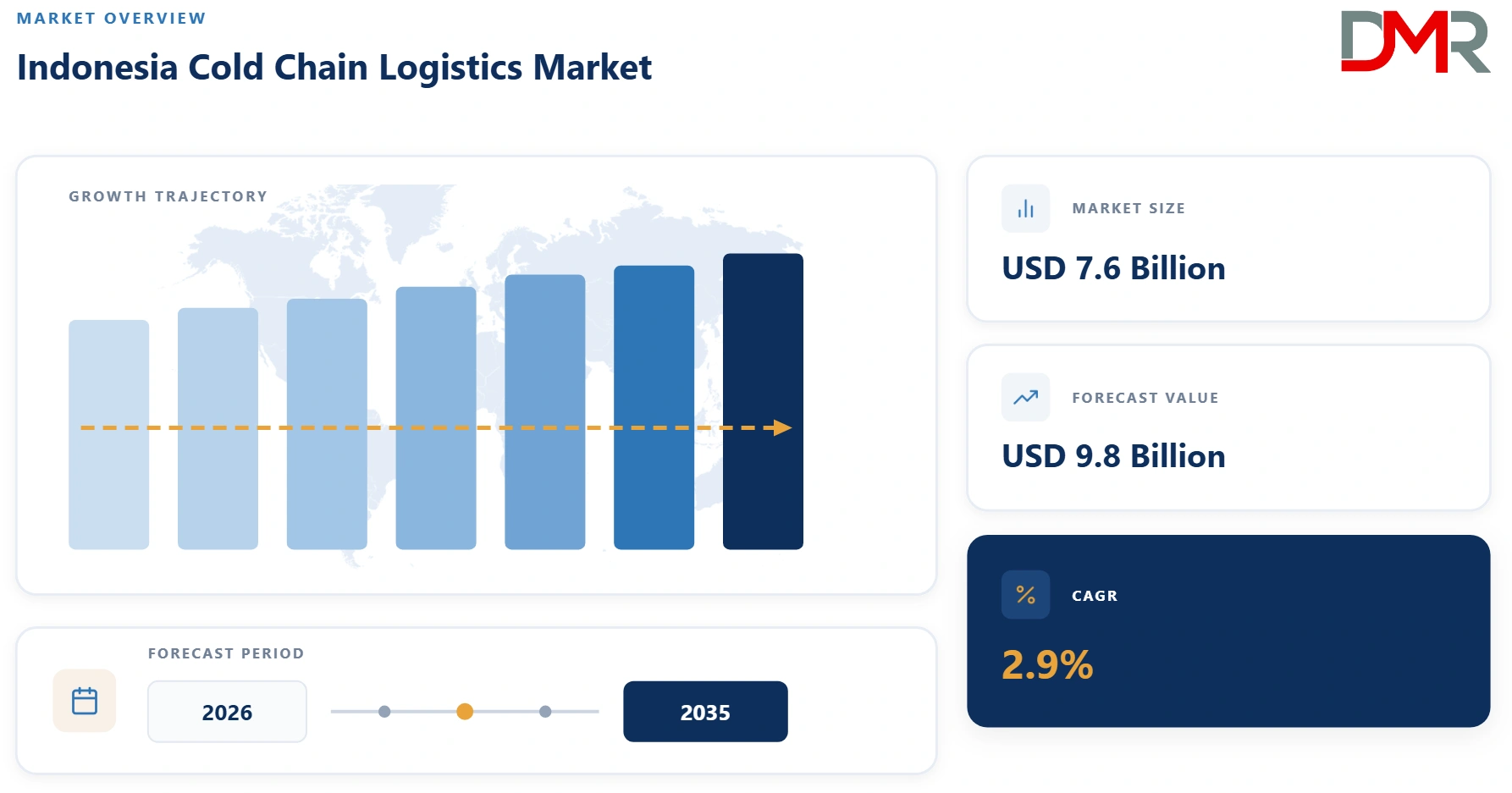
- Indonesia Cold Chain Logistics Market Size in 2026: USD 7.6 Billion
- Indonesia Cold Chain Logistics Market Size in 2035: USD 9.8 Billion
- Global CAGR from 2026 to 2035: 2.9%
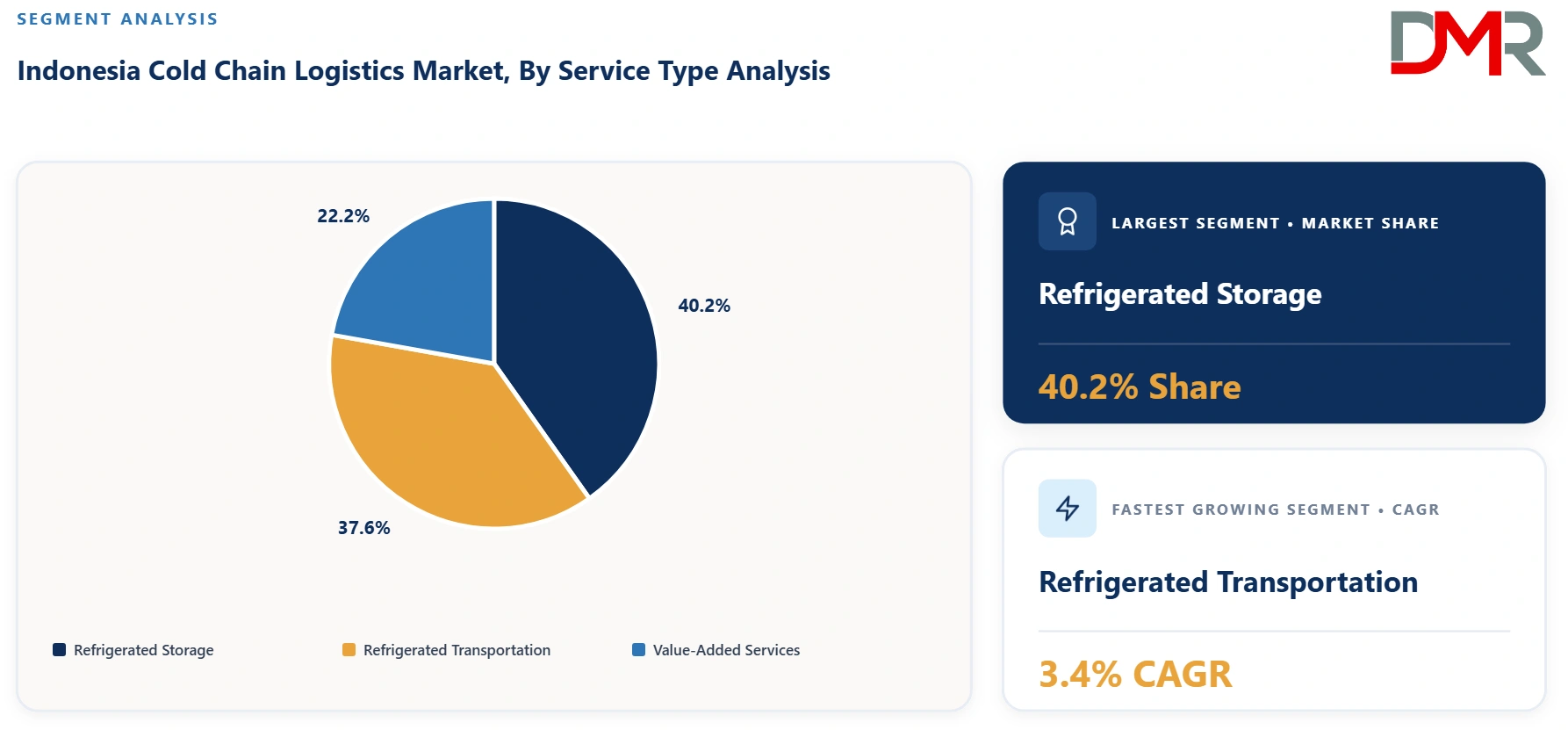
- Refrigerated Storage is the leading Service Type segment in 2026: 40.2%
- Fruits & Vegetables is the leading Application segment in 2026: 32.3%
- Frozen is the leading Temperature Type segment in 2026: 31.8%
What is the Indonesia Cold Chain Logistics Market and its Market Size?
The Indonesia Cold Chain Logistics Market is projected to reach USD 7.6 billion in 2026 and grow at a compound annual growth rate of 2.9% through 2035, reaching USD 9.8 billion.
ℹ
To learn more about this report –
Download Your Free Sample Report Here
The market supports temperature-controlled storage and transportation of food, pharmaceuticals, biologics, and other perishables. Growth is driven by expanding e-commerce grocery services, rising frozen food consumption, pharmaceutical distribution requirements, urbanization, and investment in refrigerated warehousing, transportation networks, and advanced temperature-monitoring technologies.
Use Cases
- Food and Beverage Distribution: Cold chain logistics supports Indonesia’s food and beverage sector by preserving freshness, quality, and safety across fruits, vegetables, meat, seafood, dairy, and frozen products. Refrigerated storage and transportation help reduce spoilage, extend shelf life, maintain compliance, and ensure efficient distribution between producers, processors, retailers, restaurants, and consumers nationwide more effectively.
- Pharmaceutical and Healthcare Logistics: Pharmaceutical companies and healthcare distributors rely on cold chain logistics to maintain temperature-sensitive medicines, vaccines, biologics, and clinical materials within required conditions. Controlled storage, validated transportation, real-time monitoring, and reliable last-mile delivery help protect product integrity, support regulatory compliance, reduce wastage, and improve access across Indonesia’s healthcare network more efficiently.
- E-Commerce Grocery Fulfillment: Indonesia’s growing e-commerce grocery and quick-commerce sectors use cold chain logistics to deliver chilled, frozen, and perishable products safely to consumers. Refrigerated fulfillment centers, insulated packaging, temperature-controlled vehicles, and route optimization support faster deliveries, maintain product quality, reduce losses, and enable retailers to expand online fresh-food offerings across urban markets.
Key Takeaways
- Market Size: The Indonesia Cold Chain Logistics Market is anticipated to be valued at USD 7.6 billion in 2026 and is forecast to reach USD 9.8 billion by 2035, reflecting steady expansion across temperature-controlled storage, transportation, and value-added logistics services serving food, pharmaceutical, and other perishable product industries.
- Growth Rate and Outlook: The market is projected to expand at a CAGR of 2.9% from 2026 to 2035. Growth is supported by increasing consumption of frozen and chilled foods, expansion of organized retail and e-commerce grocery channels, rising pharmaceutical distribution requirements, infrastructure development, and growing investment in temperature-controlled warehousing and transportation.
- Primary Growth Drivers: Rising demand for fresh and frozen food products, growth in seafood and meat exports, expanding pharmaceutical and biologics distribution, increasing urbanization, development of modern retail networks, and adoption of temperature-monitoring technologies are strengthening demand for reliable cold chain logistics services across Indonesia.
- By Service Type Analysis: Refrigerated Storage is projected to lead the service type segment with a 40.2% share in 2026, supported by increasing demand for temperature-controlled warehousing for food, seafood, dairy, pharmaceuticals, and frozen products. Expansion of distribution centers and modern cold storage facilities is further supporting segment growth.
- By Temperature Type Analysis: Frozen is expected to dominate the temperature type segment with a 31.8% share in 2026. Growing consumption of frozen foods, seafood, meat products, desserts, and processed foods, together with rising demand for extended shelf life and improved product quality, is supporting frozen cold chain infrastructure.
- By Application Analysis: Fruits & Vegetables is projected to lead the application segment with a 32.3% share in 2026, driven by Indonesia’s large agricultural output, high perishability of fresh produce, rising organized retail penetration, and increasing demand for better post-harvest handling, refrigerated storage, and temperature-controlled transportation.
How AI/Gen AI is Transforming the Indonesia Cold Chain Logistics Market?
AI and Generative AI are transforming the Indonesia cold chain logistics market by improving visibility, forecasting, automation, and efficiency across temperature-sensitive supply chains. AI-powered demand forecasting helps logistics providers predict shipment volumes, optimize inventory, and reduce spoilage of food, pharmaceuticals, and other perishables. Machine learning systems analyze temperature, humidity, route, and equipment data to detect anomalies and support predictive maintenance for refrigerated warehouses and vehicles. Gen AI is also improving planning by generating route recommendations, operational reports, customer responses, and scenario-based insights for disruptions. Computer vision can strengthen warehouse monitoring, product inspection, and compliance tracking, while intelligent platforms enable real-time decision-making across fragmented logistics networks.
Key Drivers in the Indonesia Cold Chain Logistics Market
Rapid Urbanization and Digital Grocery Adoption
Indonesia’s growing urban population and expanding digital connectivity are increasing demand for reliable refrigerated distribution. World Bank data show that about 58.8% of Indonesians lived in urban areas in 2024, while BPS reported that 72.78% of the population accessed the internet during the same year. Higher urban density supports supermarket networks, quick-commerce platforms, online grocery services, and restaurant delivery, all of which require dependable chilled and frozen logistics. As consumers increasingly expect fresh products, shorter delivery windows, and broader product availability, logistics providers are investing in temperature-controlled warehouses, refrigerated vehicles, route optimization systems, and urban fulfillment hubs.
Expanding Fisheries and Perishable Food Production
Indonesia’s large fisheries base creates substantial demand for cold storage and refrigerated transportation from production centers to domestic and export markets. The Ministry of Marine Affairs and Fisheries reported national grow-out aquaculture production of about 15.75 million tons in 2024, including more than 1.56 million tons of tilapia and around 786,000 tons of vannamei shrimp. Separately, government monitoring of 339 cold storage facilities in March 2024 recorded 68,039 tons of fish inventory. These volumes reinforce the need for freezing, storage, handling, and transportation infrastructure that can preserve product quality and reduce deterioration across long distribution routes.
Restraints in the Indonesia Cold Chain Logistics Market
Archipelagic Geography and Uneven Logistics Infrastructure
Indonesia’s physical geography makes nationwide cold-chain coverage expensive and operationally complex. BPS notes that the country has 16,056 registered islands with valid coordinates, creating dependence on multimodal road, port, ferry, and air connections. Temperature-sensitive shipments moving between distant islands face longer transit times, repeated handling, weather disruption, and infrastructure differences across provinces. These factors increase the risk of temperature excursions and raise equipment, fuel, and maintenance costs. Cold-chain operators must often establish multiple regional storage points instead of relying on centralized facilities, making network planning, asset utilization, and service consistency more difficult, particularly outside major economic centers.
High Energy Dependence and Uneven Asset Utilization
Refrigeration facilities require continuous electricity, making power reliability and operating efficiency critical constraints. PLN reported that average electricity interruption frequency declined from 4.27 to 3.23 times per customer per year in 2024, but uninterrupted power remains especially important for frozen and pharmaceutical products. Utilization can also vary considerably by location and season. In July 2024, the Ministry of Marine Affairs and Fisheries reported that 931 cold warehouses across Java had average occupancy of only 48%. Such uneven utilization can weaken investment returns, while backup generators, monitoring systems, maintenance, and energy costs raise the operating burden for providers.
Growth Opportunities in the Indonesia Cold Chain Logistics Market
Healthcare and Pharmaceutical Cold-Chain Expansion
Indonesia’s broad healthcare network creates an opportunity for specialized storage and transportation of vaccines, biologics, medicines, and diagnostic products. BPS village-potential data for 2024 identified 3,115 hospitals, 4,846 inpatient public health centers, and 5,730 non-inpatient health centers. The government has also strengthened vaccine logistics, with 330 vaccine refrigerators distributed to 232 districts and cities across 32 provinces through international support. As healthcare access expands, logistics providers can develop validated pharmaceutical warehouses, monitored transport, last-mile temperature control, and compliance-focused services. Greater use of digital inventory and temperature-monitoring platforms can further improve reliability and traceability across healthcare distribution networks.
Food-Loss Reduction Through Modern Cold Infrastructure
Reducing food loss presents a major opportunity for investment in refrigerated warehousing, pre-cooling, insulated transport, and temperature-monitoring solutions. Bappenas estimates that Indonesia generated 23 to 48 million tons of food loss and waste annually during 2000 to 2019, equivalent to 115 to 184 kilograms per person each year. The agency also indicates that roughly 15% of the country’s total food supply is lost or wasted from production through consumption. Better cold-chain access can extend shelf life for seafood, meat, dairy, fruits, and vegetables while reducing deterioration during storage and transit. This creates opportunities for regional hubs, shared cold facilities, and technology-enabled distribution services.
Trends in the Indonesia Cold Chain Logistics Market
IoT-Based Monitoring and Digital Traceability
Cold-chain operators are increasingly adopting connected sensors, cloud platforms, and real-time monitoring to strengthen temperature control and product traceability. Indonesia’s Ministry of Health has implemented IoT-enabled monitoring in vaccine refrigerators, linking temperature information with the SMILE electronic logistics platform so officials can monitor conditions from local facilities through higher administrative levels. Digital adoption is supported by broader connectivity: BPS reported that 72.78% of Indonesians accessed the internet in 2024, up from 69.21% in 2023. This environment supports wider deployment of telematics, automated alerts, inventory analytics, digital proof of delivery, and predictive maintenance across refrigerated logistics operations.
Growth of Integrated Cold Storage and Distribution Facilities
Indonesia is increasingly using integrated cold-chain facilities that combine freezing, storage, handling, and downstream distribution. In Kampar, Riau, an integrated cold storage facility supporting the government’s nutritious-meal program includes two 2.5-ton air-blast freezers and two 50-ton cold-storage units. The facility supplies fish to six program kitchens serving 54 nearby schools, demonstrating how cold infrastructure is being connected directly with institutional food distribution. Elsewhere, public facilities in Muara Baru include cold stores with capacities of 1,000 tons and 2,000 tons. This trend supports hub-based distribution, higher product quality, and better coordination between producers and end users.
Research Scope and Analysis
Indonesia Cold Chain Logistics Market covers service types including refrigerated storage, refrigerated transportation, and value-added services, temperature types including chilled, frozen, and deep frozen or ultra-low temperature, and applications covering fruits and vegetables, meat and poultry, fish and seafood, dairy and frozen desserts, bakery and confectionery, ready to eat foods, pharmaceuticals and biologics, chemicals and specialty materials, and others.
ℹ
To learn more about this report –
Download Your Free Sample Report Here
By Service Type Analysis
Refrigerated Storage is projected to lead the service type segment with a 40.2% market share in 2026, supported by rising demand for temperature-controlled warehousing. Refrigerated Transportation is expected to register the highest CAGR of approximately 3.4% from 2026 to 2035, driven by expanding food distribution, pharmaceutical logistics, and inter-island cold chain movement.
By Temperature Type Analysis
Frozen is anticipated to dominate the temperature type segment with a 31.8% market share in 2026, supported by strong demand for frozen seafood, meat, dairy, and processed foods. Chilled is projected to record the highest CAGR of approximately 3.2% from 2026 to 2035, driven by increasing consumption of fresh food and temperature-sensitive products.
By Application Analysis
Fruits & Vegetables is expected to lead the application segment with a 32.3% market share in 2026, supported by Indonesia’s substantial fresh produce production and distribution requirements. Pharmaceuticals & Biologics is anticipated to register the highest CAGR of approximately 3.7% from 2026 to 2035, driven by expanding healthcare distribution and temperature-sensitive medicine demand.
The Indonesia Cold Chain Logistics Market Report is segmented based on the following:
By Service Type
- Refrigerated Storage
- Refrigerated Transportation
- Value-Added Services
By Temperature Type
- Chilled
- Frozen
- Deep-Frozen / Ultra-Low Temperature
By Application
- Fruits & Vegetables
- Meat & Poultry
- Fish & Seafood
- Dairy & Frozen Desserts
- Bakery & Confectionery
- Ready-to-Eat & Processed Foods
- Pharmaceuticals & Biologics
- Chemicals & Specialty Materials
- Others
Technology Analysis
Technology is reshaping Indonesia’s cold chain logistics through IoT sensors, real-time temperature monitoring, telematics, warehouse automation, route optimization, and AI-based demand forecasting. Adoption is strongest among pharmaceutical distributors, seafood exporters, modern retailers, and large logistics providers requiring tighter quality control and traceability. Opportunities exist in affordable cloud platforms, predictive maintenance, energy-efficient refrigeration, and digital fleet management for fragmented regional networks. Key risks include high implementation costs, limited technical skills, cybersecurity exposure, and uneven connectivity outside major cities. Wider technology adoption can reduce spoilage, improve asset utilization, strengthen regulatory compliance, and support reliable temperature-controlled distribution across Indonesia’s complex archipelagic supply chain, improving service consistency across domestic and export markets.
Investment and White Space Analysis
Indonesia offers significant white-space opportunities in secondary cities, eastern provinces, fisheries hubs, pharmaceutical distribution, and last-mile refrigerated delivery. Existing cold storage capacity remains concentrated around major urban and industrial centers, creating gaps in underserved islands and production regions. Investment opportunities include multi-temperature warehouses, reefer fleets, solar-assisted refrigeration, micro cold rooms, and shared facilities for small producers. Risks include high capital expenditure, electricity costs, uneven utilization, infrastructure constraints, and longer project payback periods. Strategic partnerships with food processors, healthcare distributors, retailers, and government-backed programs can improve utilization. New investment can expand national coverage, reduce product losses, strengthen cold-chain resilience, and attract broader private sector participation.
Competitive Landscape
Indonesia’s cold chain logistics market is moderately fragmented, with domestic logistics providers, specialized cold storage operators, transportation companies, and international supply chain firms competing across food, pharmaceutical, and industrial applications. Competition is increasingly based on warehouse capacity, nationwide distribution reach, temperature accuracy, fleet reliability, technology integration, and value-added services. Leading participants are investing in refrigerated warehouses, modern transport fleets, real-time temperature monitoring, warehouse management systems, and energy-efficient refrigeration infrastructure. Partnerships with food processors, retailers, pharmaceutical companies, and e-commerce platforms are becoming increasingly important. Companies are also expanding into secondary cities and inter-island routes to strengthen coverage. Service differentiation, regulatory compliance, cold chain visibility, and the ability to manage multiple temperature ranges remain key factors shaping competitive positioning across Indonesia today.
Some of the prominent players in the Indonesia Cold Chain Logistics Market are:
- PT Kiat Ananda Cold Storage
- PT Enseval Putera Megatrading Tbk
- PT MGM Bosco Logistics
- PT Pluit Cold Storage
- PT Adib Cold Logistics
- PT YCH Indonesia
- PT Wira Logitama Saksama
- PT DHL Supply Chain Indonesia
- PT BGR Logistik Indonesia
- PT Wahana Coldstorage Indonesia
- PT Yusen Logistics Indonesia
- PT Nittsu Lemo Indonesia Logistik
- PT Tira Cipta Logistik
- PT CKL Indonesia Raya
- PT Perishable Logistics Indonesia
- PT Mitsubishi Logistics Indonesia
- PT JAS Worldwide Indonesia
- PT Dua Putra Perkasa Pratama
- PT Sukanda Djaya
- PT Halal Logistic Multi Terminal Indonesia
- PT Perintis Sempurna Bersama (Coldspace)
- PT Kawanishi Warehouse Indonesia
- PT Gudang Segar Indonesia
- PT Paxel Algorita Unggul
- PT Superkul Amerta Indonesia
- PT Persada Antaran Segar (Fastrex Fresh)
- PT Winson Singa Logistik (Ekspedingin)
- PT Gabungan Era Mandiri
- PT Kamigumi Indonesia
- PT KAI Logistik
- PT Nichirei Mega Sejahtera
- PT Perikanan Indonesia
- PT Bumi Menara Internusa
- PT Delta Mina Perkasa
- PT Agro Boga Utama
- PT Mitsui-Soko Indonesia
- PT Seino Indomobil Logistics
- PT Sumiso Logistics Indonesia
- PT Sankyu Indonesia International
- PT Itochu Logistics Indonesia
- Other Key Players
Recent Developments
- August 2026 – Coldspace obtained Halal certification for its cold-chain operations, strengthening standardized handling across cold storage, reefer trucks, cold containers, and fulfillment services for products requiring halal-compliant storage and distribution in Indonesia.
- July 2026 – Nichirei Logistics Group acquired a majority of Class A shares in PT Nichirei Mega Sejahtera, strengthening its position in Indonesia’s temperature-controlled warehousing and transportation sector and expanding its participation in the country’s developing cold-chain infrastructure.
- April 2026 – PT Mitsui-Soko Indonesia obtained Good Distribution Practice certification, strengthening its capability to provide standardized logistics services for products requiring controlled handling, including pharmaceutical and other temperature-sensitive goods across its Indonesian warehousing and distribution operations.
Report Details
| Report Characteristics |
| Market Size (2026) |
USD 7.6 Bn |
| Forecast Value (2035) |
USD 9.8 Bn |
| CAGR (2026–2035) |
2.9% |
| Historical Data |
2021 – 2025 |
| Forecast Data |
2026 – 2035 |
| Base Year |
2025 |
| Segments Covered |
By Service Type, By Temperature Type, By Application |
Frequently Asked Questions
How big is the Indonesia Cold Chain Logistics Market?
▾ The Indonesia Cold Chain Logistics Market is projected to reach USD 7.6 billion in 2026 and is expected to grow to USD 9.8 billion by 2035, supported by increasing demand for temperature-controlled storage and transportation across food, pharmaceutical, biologics, and other perishable product categories.
What is the CAGR of the Indonesia Cold Chain Logistics Market from 2026 to 2035?
▾ The Indonesia Cold Chain Logistics Market is projected to expand at a CAGR of 2.9% from 2026 to 2035, driven by increasing consumption of chilled and frozen foods, expanding pharmaceutical distribution, organized retail growth, e-commerce grocery adoption, and investment in refrigerated logistics infrastructure.
What factors are driving the growth of the Indonesia Cold Chain Logistics Market?
▾ Major growth drivers include rising demand for fresh and frozen foods, growth in seafood and meat distribution, expanding pharmaceutical and biologics logistics, urbanization, growth of organized retail and online grocery channels, food-loss reduction initiatives, and increasing investment in cold storage facilities, refrigerated transportation, and temperature-monitoring technologies.
What are the major trends in the Indonesia Cold Chain Logistics Market?
▾ Major trends include growing adoption of IoT-based temperature monitoring, digital traceability, AI-enabled demand forecasting, predictive maintenance, route optimization, warehouse automation, and integrated cold storage and distribution facilities. Expansion of multi-temperature infrastructure and technology-enabled refrigerated logistics across secondary cities and inter-island routes is also gaining importance.
Who are the key players in the Indonesia Cold Chain Logistics Market?
▾ The market includes domestic logistics companies, specialized cold storage operators, refrigerated transportation providers, and international supply chain companies. These players compete based on cold storage capacity, geographic coverage, fleet reliability, temperature accuracy, technology integration, regulatory compliance, and value-added services.
How is the Indonesia Cold Chain Logistics Market segmented?
▾ The Indonesia Cold Chain Logistics Market is segmented by Service Type into Refrigerated Storage, Refrigerated Transportation, and Value-Added Services. By Temperature Type, it includes Chilled, Frozen, and Deep-Frozen or Ultra-Low Temperature. By Application, it covers Fruits & Vegetables, Meat & Poultry, Fish & Seafood, Dairy & Frozen Desserts, Bakery & Confectionery, Ready-to-Eat & Processed Foods, Pharmaceuticals & Biologics, Chemicals & Specialty Materials, and Others.