Indonesia Food Packaging Market Snapshot
- Indonesia Food Packaging Market Size in 2026: USD 6.5 Billion
- Indonesia Food Packaging Market Size in 2035: USD 10.1 Billion
- CAGR from 2026 to 2035: 5.0%
- Flexible is the leading Type segment in 2026: 58.5%
- Plastics is the leading Material segment in 2026: 61.0%
- Bakery & Confectionery is the leading Application segment in 2026: 26.5%
- Pouches is the leading Packaging Type segment in 2026: 32.5%
- Shelf Stable Food is the leading Food Type segment in 2026: 47.0%
What is the Indonesia Food Packaging and its Market Size?
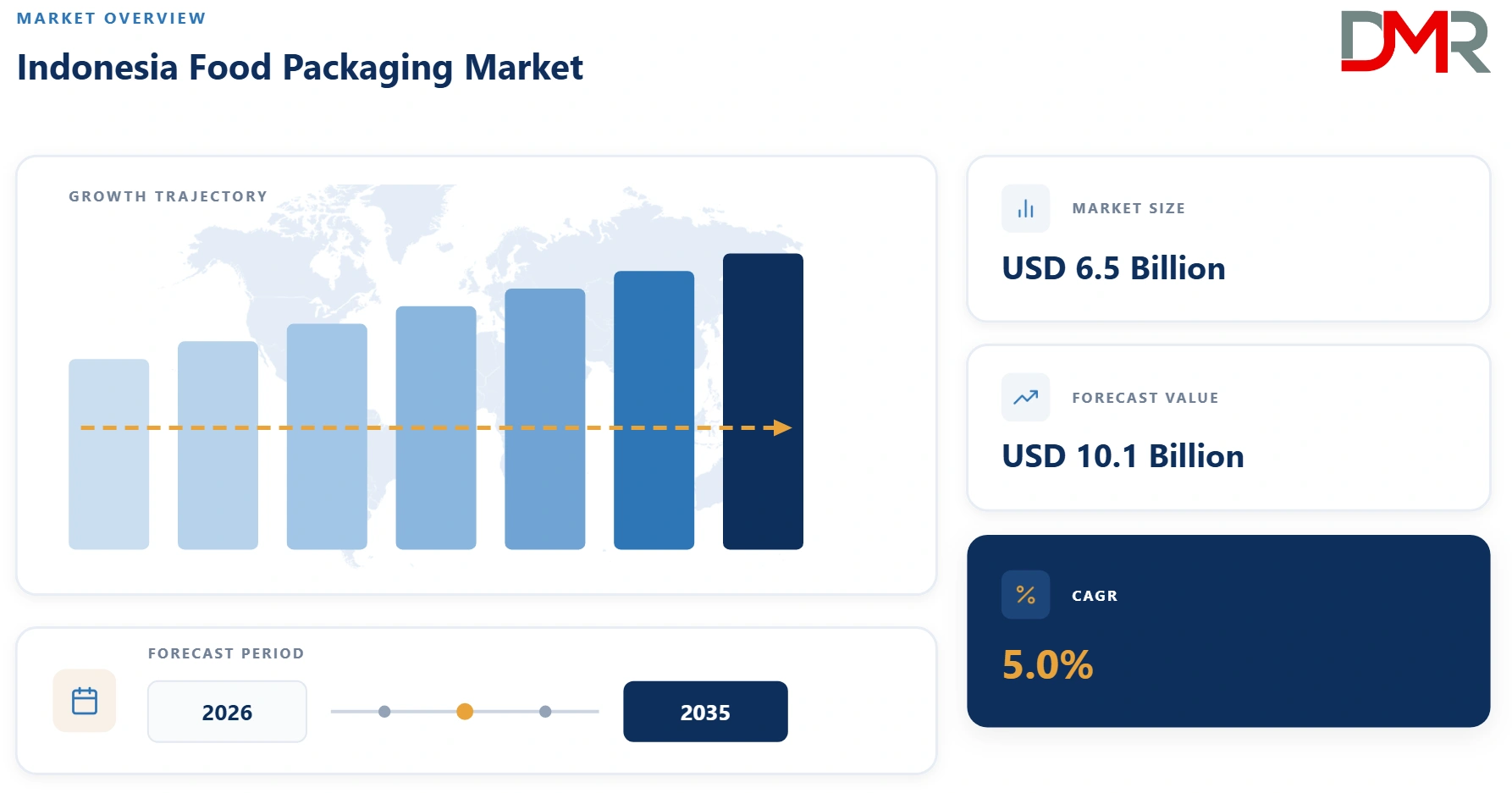
The Indonesia Food Packaging Market is projected to reach USD 6.5 billion in 2026 and grow at a compound annual growth rate of 5.0% from 2026 to 2035 to reach a value of USD 10.1 billion by 2035.
ℹ
To learn more about this report –
Download Your Free Sample Report Here
The market is expanding due to rising consumption of packaged and processed foods, rapid urbanization, growth of modern retail, increasing food delivery services, and demand for convenient packaging solutions. Flexible packaging, plastics, pouches, and shelf-stable food packaging remain prominent across the market. Growing sustainability concerns are also encouraging manufacturers to adopt recyclable, lightweight, paper-based, and resource-efficient packaging solutions while maintaining food safety, shelf life, convenience, and product quality.
Use Cases
- Food Preservation and Shelf-Life Extension: Food packaging is widely used to protect processed foods, dairy products, bakery items, meat, seafood, and produce from contamination, moisture, oxygen, and physical damage. Barrier films, trays, bottles, cans, and pouches help maintain freshness, extend shelf life, reduce food waste, and support safe distribution across Indonesia’s vast island network efficiently.
- Convenience and On-the-Go Consumption: Convenience packaging supports Indonesia’s growing demand for ready-to-eat meals, snacks, beverages, sauces, frozen foods, and takeaway products. Resealable pouches, portion packs, microwaveable trays, cups, and lightweight containers improve portability, ease of use, and storage convenience, helping food brands serve urban consumers, modern retailers, and food delivery channels more efficiently nationwide.
- Branding, Labeling, and Traceability: Food packaging also serves branding, labeling, traceability, and regulatory communication needs for manufacturers and retailers. Printed packs provide nutritional information, expiry dates, ingredient details, barcodes, QR codes, and brand messaging. This improves consumer trust, supports compliance, strengthens shelf visibility, and helps companies differentiate products in Indonesia’s competitive food market effectively.
Key Takeaways
- Market Size: The Indonesia Food Packaging Market is anticipated to be valued at USD 6.5 billion in 2026 and is forecast to reach USD 10.1 billion by 2035, expanding at a CAGR of 5.0% during the forecast period.
- Growth Rate and Outlook: Market expansion is supported by increasing consumption of packaged and processed foods, rapid urbanization, growth of modern retail and e-commerce, rising food delivery activity, changing consumer lifestyles, and growing demand for convenient, lightweight, hygienic, and sustainable packaging solutions across Indonesia.
- Primary Growth Drivers: Rising disposable incomes, expanding food processing activity, increasing demand for ready-to-eat and convenience foods, growth of organized retail, expanding cold-chain infrastructure, higher food safety awareness, and increasing adoption of recyclable and resource-efficient packaging materials are strengthening demand for food packaging solutions across the country.
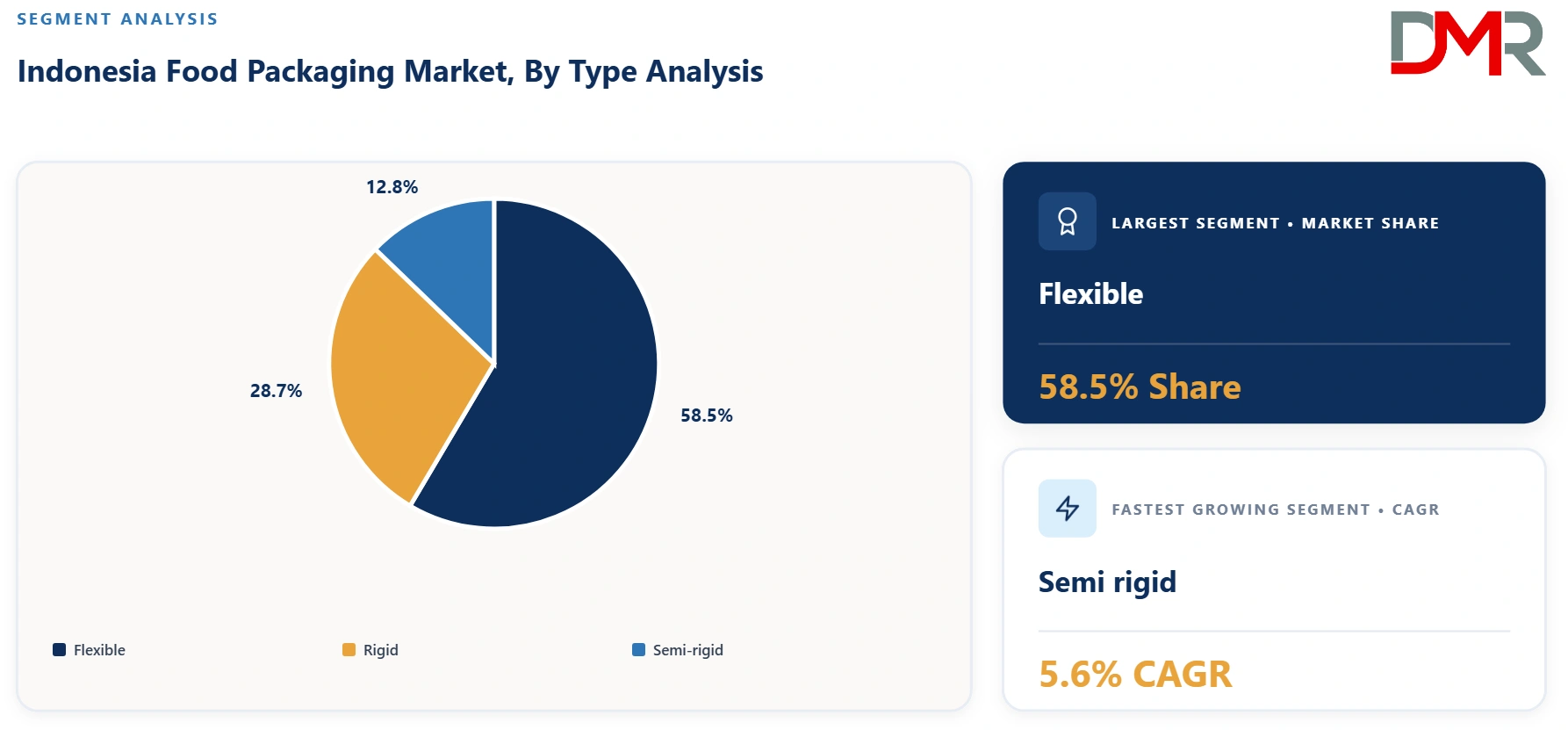
- By Type Analysis: Flexible packaging is projected to lead the Type segment with approximately 58.5% share in 2026, supported by its lightweight structure, lower transportation costs, strong barrier properties, printing flexibility, and widespread use across snacks, bakery products, sauces, frozen foods, and other packaged food categories.
- By Material Analysis: Plastics are expected to dominate the Material segment with approximately 61.0% share in 2026 due to their durability, low cost, lightweight properties, moisture resistance, processing versatility, and extensive use in films, pouches, bottles, trays, and other food packaging formats.
- By Application Analysis: Bakery & Confectionery is anticipated to lead the Application segment with approximately 26.5% share in 2026, driven by strong consumption of bread, biscuits, cakes, chocolates, candies, and snack products, alongside increasing demand for attractive, portion-controlled, resealable, and shelf-life-enhancing packaging.
How AI/Gen AI is Transforming the Indonesia Food Packaging Market?
AI and Generative AI are transforming the Indonesia Food Packaging Market by improving packaging design, production efficiency, quality control, and supply chain planning. AI-powered vision systems help detect defects, improve labeling accuracy, and reduce material waste, while predictive analytics optimize inventory, demand forecasting, and production schedules. Generative AI supports faster development of package designs, labeling concepts, and sustainability-focused formats. Smart packaging integrated with AI can also improve traceability, freshness monitoring, and consumer engagement, helping manufacturers enhance operational efficiency, reduce costs, strengthen food safety, and respond faster to changing market preferences.
Key Drivers in the Indonesia Food Packaging Market
Rising Urbanization and Demand for Convenience Foods
Rising urbanization and changing lifestyles are increasing demand for packaged, portable, and ready-to-consume foods across Indonesia. World Bank data show that 59.4% of Indonesia’s population was urban in 2025, up from 56.3% in 2020, expanding the consumer base for convenience-oriented food formats. Urban households increasingly rely on supermarkets, minimarkets, food delivery, and modern retail, which favor standardized, durable, and visually differentiated packaging. This shift supports greater use of flexible packs, pouches, trays, bottles, and portion-controlled formats. Packaging suppliers are therefore benefiting from higher requirements for shelf life, product safety, portability, and brand communication across fast-moving food categories.
Expanding Food Processing and Foodservice Ecosystem
Indonesia’s large food processing and foodservice ecosystem is creating sustained packaging demand across bakery, dairy, snacks, sauces, meat, seafood, and ready meals. BPS reported about 5.28 million food and beverage service businesses operating in 2024, while manufacturing growth in 2025 was supported strongly by food and beverage production. Greater production volumes increase requirements for primary, secondary, and transport packaging that can protect products through storage and distribution. Local processors are also expanding product variety and retail reach, encouraging wider use of printed films, rigid containers, pouches, cans, and trays designed for food safety, merchandising, portioning, and longer shelf life.
Restraints in the Indonesia Food Packaging Market
Plastic Waste Management and Recycling Challenges
Plastic waste management remains a major restraint because food packaging relies heavily on plastic films, pouches, bottles, and other lightweight formats. World Bank research estimated that Indonesia generates about 7.8 million tonnes of plastic waste annually, with roughly 4.9 million tonnes mismanaged through inadequate collection, open dumping, or leakage. These conditions increase regulatory, reputational, and redesign pressures on food manufacturers and packaging suppliers. Companies must invest in recyclable structures, material reduction, collection partnerships, and improved labeling while maintaining barrier performance and affordability. The challenge is especially significant for multilayer flexible packaging, which is difficult to collect and recycle through existing waste-management systems.
Complex Archipelagic Logistics and Distribution Costs
Indonesia’s geography creates distribution and cost challenges for food packaging companies serving customers across the archipelago. The Ministry of Transportation notes that the country has around 17,380 islands, making logistics connectivity and balanced freight flows difficult, particularly in eastern and remote regions. Packaging must often withstand longer transport routes, humidity, handling, and multiple distribution stages, increasing performance requirements and material costs. Producers also face uneven access to recycling, warehousing, cold-chain infrastructure, and modern retail channels outside major urban centers. These constraints can slow adoption of advanced packaging technologies and make lightweight, high-barrier, and transport-efficient solutions essential for maintaining product integrity across dispersed markets.
Growth Opportunities in the Indonesia Food Packaging Market
Sustainable and Circular Packaging Innovation
Indonesia’s producer waste-reduction policy is creating opportunities for recyclable, reusable, paper-based, mono-material, and lightweight packaging solutions. Ministry of Environment Regulation No. 75/2019 requires producers to prepare waste-reduction roadmaps and target a 30% reduction in product and packaging waste by the end of 2029. This is encouraging food manufacturers to redesign packs, reduce unnecessary material, improve recyclability, and participate in take-back systems. Packaging suppliers that can provide high-barrier mono-material films, recyclable rigid plastics, fiber-based formats, downgauged structures, and reuse-ready systems are positioned to benefit as food brands align packaging portfolios with circular-economy requirements and evolving sustainability expectations.
Growth of Digital Commerce and Direct-to-Consumer Distribution
Expansion of online commerce and social shopping is opening opportunities for packaging designed for transport safety, tamper evidence, portion control, and direct-to-consumer distribution. Google, Temasek, and Bain reported that Indonesia recorded about 2.6 billion video-commerce transactions in 2025, up 90% year on year, while online sellers and stores increased 75% to around 800,000. This digital shift increases demand for packaging that protects food during last-mile delivery while remaining lightweight, leak-resistant, stackable, and easy to open. Suppliers can differentiate through resealable pouches, paper-based takeaway packs, smart labels, tamper-evident closures, and compact formats optimized for omnichannel food retail.
Trends in the Indonesia Food Packaging Market
Shift Toward Recyclable and Material-Efficient Packaging
Sustainability is becoming a central packaging trend as producers respond to regulation, consumer scrutiny, and plastic-waste concerns. Indonesia’s waste-reduction roadmap requires a 30% reduction in producer-generated packaging waste by 2029 and promotes reduce, reuse, and recycle practices. Food companies are increasingly evaluating mono-material structures, thinner films, recyclable rigid plastics, paper-based alternatives, reusable containers, and packaging with improved recovery value. This trend is also encouraging closer collaboration between brand owners, converters, recyclers, and waste collectors. The competitive focus is shifting from packaging cost alone toward material efficiency, recyclability, circular design, and documented waste-reduction performance without compromising shelf life, hygiene, or product protection.
Smart, Digital, and Delivery-Optimized Packaging
Digital commerce and smarter packaging are reshaping how Indonesian food brands engage consumers and manage products through the supply chain. Online food-delivery sales through major platforms increased about 18% in 2025, reinforcing demand for packaging that performs reliably during last-mile transport. This environment is encouraging QR codes, digital traceability, interactive promotions, serialized labels, tamper-evident features, and stronger visual design for online-first purchasing. At the operational level, converters are increasingly using automated inspection, digital printing, and data-driven quality control to support shorter runs and faster customization. Packaging is therefore becoming more connected, flexible, traceable, and responsive to rapidly changing retail and consumer preferences.
Research Scope and Analysis
The Indonesia Food Packaging Market is analyzed by Type including Flexible, Rigid and Semi rigid, by Material including Plastics, Paper and Paper Based Materials, Glass, Metal and Others, by Application including Bakery and Confectionery, Dairy Products, Fruits and Vegetables, Meat and Seafood, Sauces and Dressings and Others, by Packaging Type including Cups, Bottles, Cans, Pouches, Trays and Others, and by Food Type including Frozen Food, Chilled Food, Canned Food and Shelf Stable Food.
ℹ
To learn more about this report –
Download Your Free Sample Report Here
By Type Analysis
Flexible packaging is expected to dominate the Indonesia Food Packaging Market with approximately 58.5% share in 2026, supported by its lightweight structure, cost efficiency, and broad use across food categories.
Semi rigid packaging is projected to register the fastest growth during 2026 to 2035.
The segment is anticipated to expand at a CAGR of around 5.6%, driven by demand for convenient and durable food containers.
By Material Analysis
Plastics are projected to lead the Material segment with approximately 61.0% share in 2026, owing to their versatility, barrier properties, durability, and extensive use across flexible and rigid formats.
Paper and Paper Based Materials are expected to record the highest CAGR through 2035.
The segment is anticipated to grow at around 5.8% CAGR, supported by sustainability initiatives and increasing preference for recyclable packaging.
By Application Analysis
Bakery and Confectionery is anticipated to hold the largest Application share at approximately 26.5% in 2026, supported by high consumption of bread, biscuits, snacks, chocolates, and confectionery products.
Meat and Seafood is projected to witness the fastest growth during the forecast period.
The segment is expected to expand at a CAGR of around 5.5%, driven by rising packaged protein consumption and cold chain development.
By Packaging Type Analysis
Pouches are expected to dominate the Packaging Type segment with approximately 32.5% share in 2026, supported by convenience, lightweight design, reliability, and strong adoption across snacks, sauces, and processed foods.
Trays are projected to record the highest CAGR from 2026 to 2035.
The segment is anticipated to grow at around 5.7% CAGR, supported by expanding ready meal, meat, seafood, and chilled food applications.
The Indonesia Food Packaging Market Report is segmented based on the following:
By Type
- Flexible
- Rigid
- Semi-rigid
By Material
- Plastics
- Paper & Paper-Based Materials
- Glass
- Metal
- Others
By Application
- Bakery & Confectionery
- Dairy Products
- Fruits & Vegetables
- Meat & Seafood
- Sauces & Dressings
- Others
By Packaging Type
- Cups
- Bottles
- Cans
- Pouches
- Trays
- Others
By Food Type
- Frozen Food
- Chilled Food
- Canned Food
- Shelf Stable Food
Regulatory Landscape
Indonesia’s food packaging sector is increasingly shaped by stricter food safety, labeling, material, and waste reduction requirements. BPOM Regulation No. 11 of 2026 now governs food packaging and replaced the 2019 framework, while mandatory SNI requirements apply to paper and carton used for primary food packaging. These rules create opportunities for compliant, recyclable, and safer material solutions, particularly among organized manufacturers. However, certification costs, reformulation, testing, and compliance complexity may pressure smaller converters and food producers. Regulatory tightening should accelerate investment in traceable, lower waste, food contact compliant packaging, strengthening quality standards while gradually shifting competition toward suppliers with advanced testing, documentation, and sustainable design capabilities across the Indonesian market.
Technology Analysis
Technology adoption is moving Indonesia’s food packaging industry toward recyclable structures, smart identification, automation, and higher performance materials. Mono material films and advanced coatings are gaining relevance because they can improve recyclability while preserving moisture and oil resistance; DIC opened an Indonesian facility in 2025 for direct food contact coatings supporting recyclable packaging. QR codes, sensors, RFID, and digital printing also create opportunities for traceability, consumer engagement, authentication, and shorter customized production runs. Risks include higher equipment costs, limited recycling infrastructure, technology integration challenges, and affordability constraints among smaller producers. Wider adoption should improve efficiency, reduce waste, support premiumization, and strengthen competitiveness across domestic and export oriented food packaging applications.
Competitive Landscape
The Indonesia Food Packaging Market is moderately competitive, with multinational packaging companies, regional converters, and domestic manufacturers competing across flexible, rigid, paper-based, metal, and specialty packaging formats. Leading players focus on product innovation, lightweight materials, recyclable structures, high-barrier films, digital printing, and customized solutions for food processors and consumer brands. Competition is intensifying as sustainability requirements encourage investment in mono-material packaging, recycled content, and fiber-based alternatives. Companies are also strengthening local manufacturing, distribution networks, and partnerships to improve supply reliability across Indonesia’s dispersed geography. Price sensitivity remains significant, particularly among small and medium food producers, creating opportunities for cost-efficient local suppliers.
Some of the prominent players in the Indonesia Food Packaging Market are:
- Amcor plc
- Tetra Pak International S.A.
- SIG Group AG
- Huhtamaki Oyj
- Sealed Air Corporation
- Mondi plc
- Sonoco Products Company
- Constantia Flexibles Group GmbH
- UFlex Limited
- ALPLA Group
- PT Dynapack Asia
- PT Berlina Tbk
- PT Indo Tirta Abadi
- PT Trias Sentosa Tbk
- PT Indopoly Swakarsa Industry Tbk
- PT Argha Karya Prima Industry Tbk
- PT Primajaya Eratama
- PT ePac Flexibles Indonesia
- PT Indonesia Toppan Printing
- PT DNP Indonesia
- PT Lotte Packaging
- PT Dinakara Putra
- PT Artec Package Indonesia
- PT Karuniatama Polypack
- PT Masplast Poly Film
- PT Polidayaguna Perkasa
- PT Plasindo Lestari
- PT Solusi Prima Packaging
- PT Hasil Raya Industries
- PT Lamipak Primantara
- PT Indo Polypack
- PT Packindo Sedya Pratama
- PT Greencore Packaging Indonesia
- PT Pura Barutama
- PT Pabrik Kertas Indonesia Pakerin
- PT Surabaya Mekabox
- Asia Pulp & Paper Sinar Mas
- PT Industri Pembungkus Internasional
- Glopac Indonesia
- PT Converpak Indonesia
- Other Key Players
Recent Developments
- July 2026: SIG introduced its Drinksplus technology in Indonesia in collaboration with Diamond Cold Storage, enabling the launch of locally produced UHT flavored milk containing nata de coco pieces in aseptic carton packaging. The solution allows beverages with up to 10% particulates to be filled using standard SIG systems.
- June 2026: Tetra Pak launched its Cartons for Communities initiative in Indonesia to strengthen the collection and recycling of used food and beverage cartons. The program brings together collectors, recyclers, communities, schools, industry participants, and government stakeholders to improve circular packaging infrastructure.
- June 2026: Dynapack Asia expanded rooftop solar deployment across its manufacturing operations, including facilities in Indonesia, as part of its Sustainability Targets 2030. The initiative supports its objective of reducing absolute greenhouse gas emissions by 30% while improving the environmental performance of packaging production.
Report Details
| Report Characteristics |
| Market Size (2026) |
USD 6.5 Bn |
| Forecast Value (2035) |
USD 10.1 Bn |
| CAGR (2026–2035) |
5.0% |
| Historical Data |
2021 – 2025 |
| Forecast Data |
2026 – 2035 |
| Base Year |
2025 |
| Segments Covered |
By Type, By Material, By Application, By Packaging Type, By Food Type |
Frequently Asked Questions
How big is the Indonesia Food Packaging Market?
▾ The Indonesia Food Packaging Market is projected to be valued at USD 6.5 billion in 2026 and is expected to reach USD 10.1 billion by 2035. Growth is supported by rising packaged food consumption, expanding food processing activity, increasing urbanization, modern retail development, food delivery services, and demand for convenient and sustainable packaging formats.
What is the CAGR of the Indonesia Food Packaging Market from 2026 to 2035?
▾ The Indonesia Food Packaging Market is projected to expand at a CAGR of 5.0% from 2026 to 2035. Growth is expected to be supported by increasing consumption of processed and convenience foods, greater adoption of flexible packaging, expansion of e-commerce and food delivery, and increasing demand for recyclable and lightweight packaging materials.
What factors are driving the growth of the Indonesia Food Packaging Market?
▾ Key growth drivers include rapid urbanization, rising disposable incomes, expanding food processing and foodservice industries, increasing consumption of ready-to-eat and packaged foods, growth of organized retail, and rising food safety awareness. Expanding cold chain infrastructure and increasing adoption of recyclable, lightweight, and resource-efficient packaging solutions are also supporting market development.
What are the major trends in the Indonesia Food Packaging Market?
▾ Major trends include growing adoption of recyclable and mono-material packaging, lightweight and material-efficient designs, paper-based alternatives, smart labels, QR codes, digital traceability, and tamper-evident formats. Companies are also investing in automated inspection, digital printing, high-barrier packaging, and delivery-optimized solutions to serve e-commerce, food delivery, and changing consumer preferences.
Who are the key players in the Indonesia Food Packaging Market?
▾ Key players include Amcor plc, Tetra Pak International S.A., SIG Group AG, Huhtamaki Oyj, Sealed Air Corporation, Mondi plc, Sonoco Products Company, Constantia Flexibles Group GmbH, UFlex Limited, ALPLA Group, PT Dynapack Asia, PT Berlina Tbk, PT Trias Sentosa Tbk, PT Indopoly Swakarsa Industry Tbk, PT Argha Karya Prima Industry Tbk, and other domestic packaging manufacturers.
How is the Indonesia Food Packaging Market segmented?
▾ The Indonesia Food Packaging Market is segmented by Type into Flexible, Rigid, and Semi-rigid. By Material, it includes Plastics, Paper and Paper-Based Materials, Glass, Metal, and Others. By Application, it covers Bakery and Confectionery, Dairy Products, Fruits and Vegetables, Meat and Seafood, Sauces and Dressings, and Others. By Packaging Type, it includes Cups, Bottles, Cans, Pouches, Trays, and Others. By Food Type, it includes Frozen Food, Chilled Food, Canned Food, and Shelf Stable Food.