Indonesia Food Processing Equipment Market Snapshot
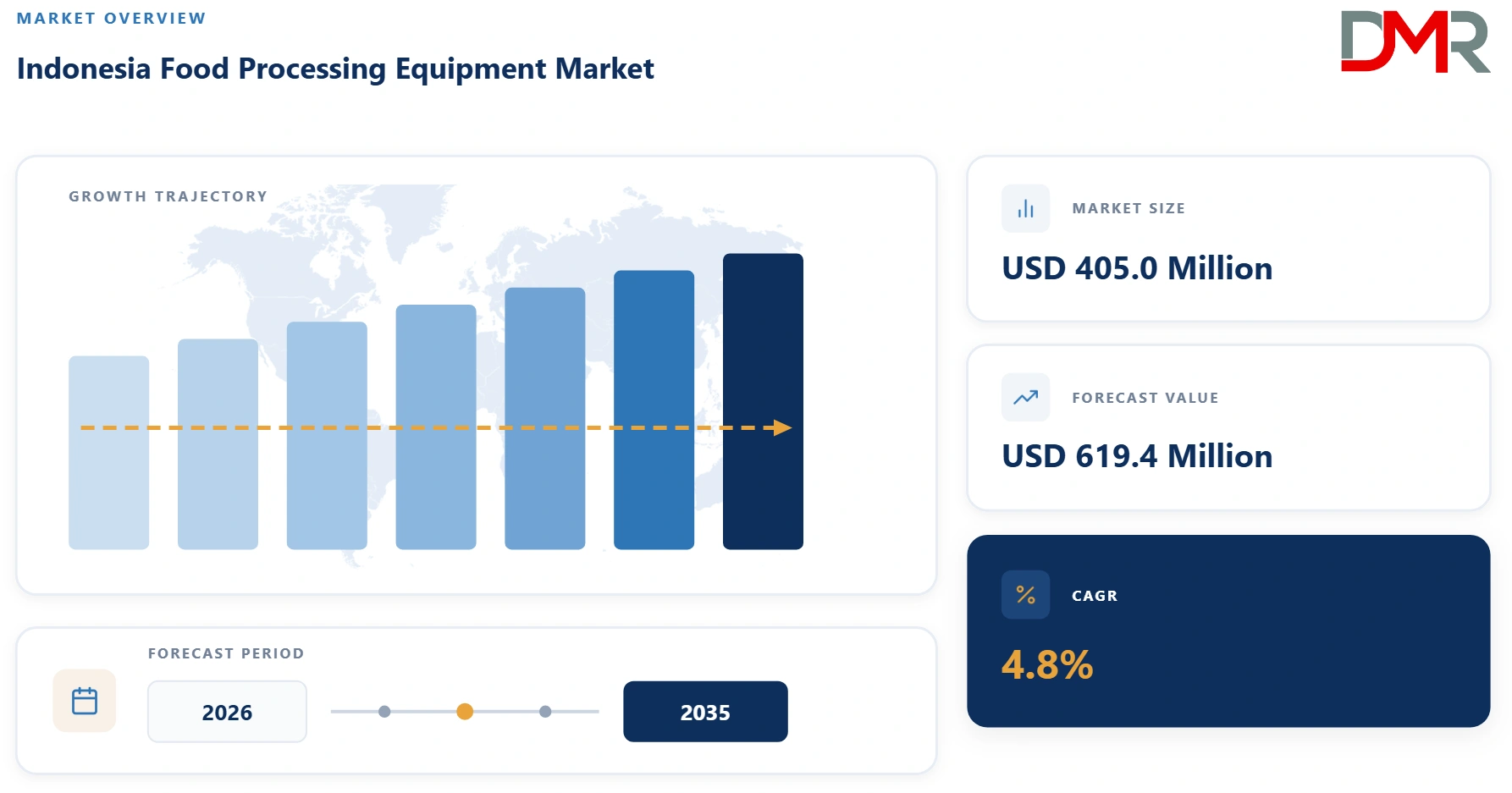
- Indonesia Food Processing Equipment Market Size in 2026: USD 405.0 Million
- Indonesia Food Processing Equipment Market Size in 2035: USD 619.4 Million
- CAGR from 2026 to 2035: 4.8%
- Heat Processing Equipment is the leading Equipment Type segment in 2026: 40.2%
- Automatic is the leading Mode of Operation segment in 2026: 42.3%
- Solid is the leading Form of End Product segment in 2026: 51.8%
- Dairy Products is the leading Application segment in 2026: 40.1%
What is the Indonesia Food Processing Equipment and its Market Size?
The Indonesia Food Processing Equipment Market is projected to reach USD 405.0 Million in 2026 and grow at a compound annual growth rate of 4.8% through 2035 to reach USD 619.4 Million. The market includes machinery used for preparation, processing, heating, preservation, packaging, and handling of food and beverages. Growth is supported by expanding processed food consumption, rising automation, urbanization, food manufacturing investments, and increasing demand for efficient, hygienic, and high-capacity production systems across Indonesia.
ℹ
To learn more about this report –
Download Your Free Sample Report Here
Use Cases
- Dairy Processing: Dairy processors use food processing equipment for milk pasteurization, homogenization, separation, fermentation, cooling, and packaging. Automated systems improve hygiene, product consistency, throughput, and shelf life while reducing manual handling. Equipment supports production of milk, yogurt, cheese, butter, and other dairy products for Indonesia’s growing consumer market nationwide at commercial scale.
- Meat, Poultry & Seafood Processing: Meat, poultry, and seafood companies use processing equipment for cutting, grinding, mixing, cooking, chilling, freezing, and packaging. These systems help maintain food safety, reduce contamination risks, improve processing speed, and standardize product quality. Rising demand for packaged protein products supports wider equipment adoption across Indonesian processing facilities serving domestic markets.
- Bakery, Confectionery & Beverage Production: Bakery, confectionery, and beverage manufacturers use food processing equipment for mixing, blending, forming, baking, filling, bottling, and packaging. Automated machinery enables consistent quality, higher production capacity, reduced waste, and efficient handling of diverse recipes. Growing urban consumption and convenience-food demand are strengthening equipment utilization across Indonesia’s food industry nationwide efficiently.
Key Takeaways
- Market Size: The Indonesia Food Processing Equipment Market is anticipated to be valued at USD 405.0 million in 2026 and is forecast to reach USD 619.4 million by 2035, expanding at a CAGR of 4.8% during the forecast period.
- Growth Rate and Outlook: Market growth is supported by rising demand for processed and packaged foods, expanding food manufacturing capacity, increasing automation, modernization of production facilities, higher food safety requirements, growing urban consumption, and stronger investment in efficient processing, preservation, and packaging technologies across Indonesia.
- Primary Growth Drivers: Increasing consumption of convenience foods, expansion of dairy, bakery, meat, seafood, beverage, and ready-to-eat industries, rising adoption of automated machinery, improving production efficiency, labor optimization, stricter hygiene standards, and growing investment by domestic and international food manufacturers are driving equipment demand across the country.
- By Equipment Type Analysis: Heat Processing Equipment is projected to lead the equipment type segment with a 40.2% share in 2026, supported by its extensive use in cooking, baking, pasteurization, sterilization, drying, and thermal treatment. Growing processed food production and the need for improved food safety and shelf life are supporting demand.
- By Mode of Operation Analysis: Automatic equipment is expected to dominate the mode of operation segment with a 42.3% share in 2026. Its leadership is driven by demand for higher productivity, consistent output quality, reduced labor dependence, better hygiene control, lower processing time, and increasing adoption of digitally integrated production systems.
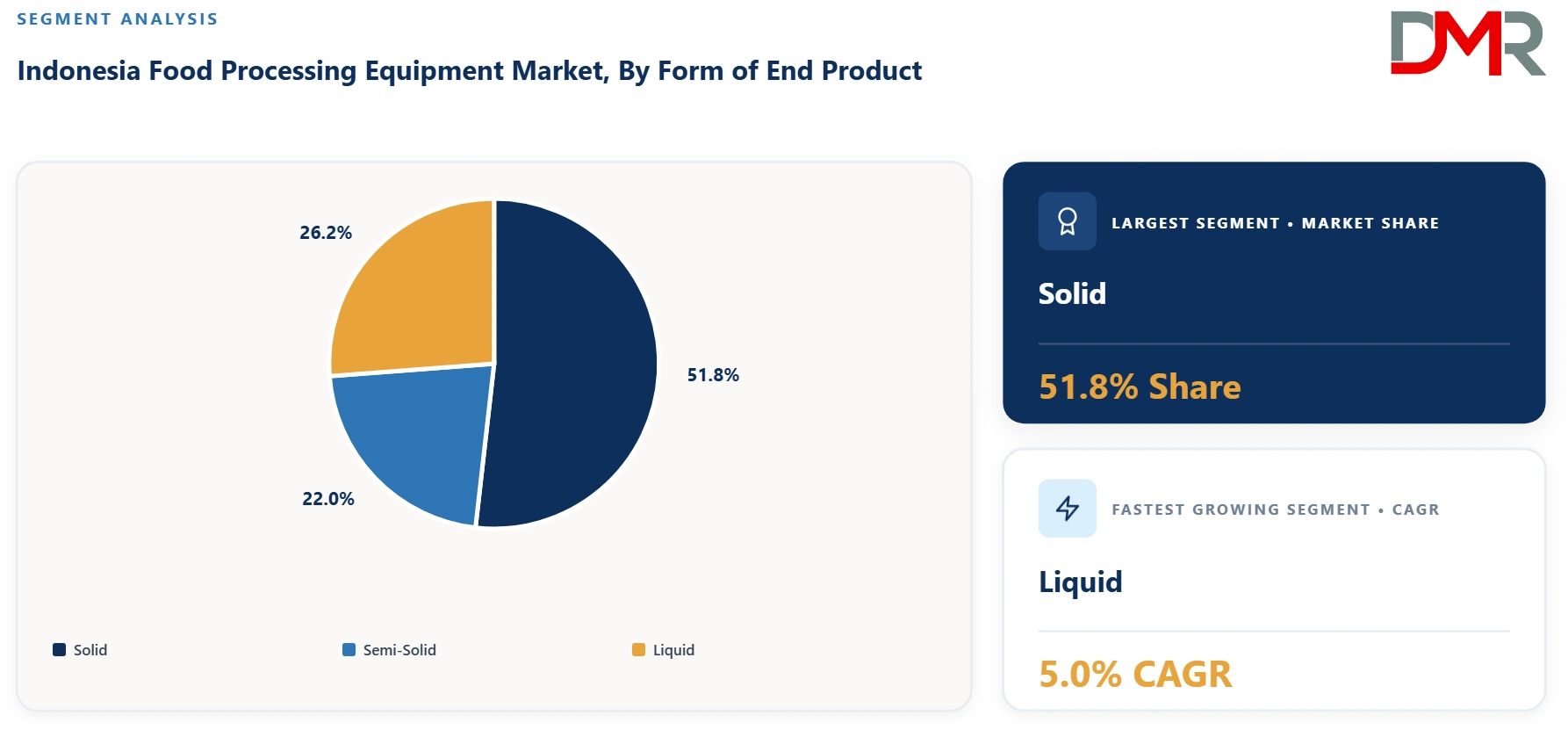
- By Form of End Product Analysis: Solid products are anticipated to lead the form of end product segment with a 51.8% share in 2026, driven by substantial processing volumes across bakery products, meat and poultry, confectionery, grains, snacks, packaged foods, and ready-to-eat products.
- By Application Analysis: Dairy Products are projected to dominate the application segment with a 40.1% share in 2026, supported by growing consumption of milk, yogurt, cheese, butter, and other processed dairy products. Rising investment in pasteurization, homogenization, cooling, filling, and packaging equipment is further strengthening segment growth.
Key Drivers in the Indonesia Food Processing Equipment Market
Large Consumer Base and Rising Urban Food Consumption
Indonesia’s large and increasingly urban consumer base is strengthening demand for processed, packaged, and convenience foods, encouraging manufacturers to expand production capacity. The World Bank estimates Indonesia’s population at about 285.7 million in 2025, while 59.4% of residents lived in urban areas, creating a broad market for standardized food products. This consumption base supports higher utilization of mixing, cooking, pasteurization, preservation, filling, and packaging systems. As supermarkets, convenience stores, foodservice outlets, and e-commerce grocery channels expand, processors require equipment that can deliver larger volumes, consistent quality, improved hygiene, and longer product shelf life across multiple food categories.
Strong Food and Beverage Manufacturing Base
Food and beverage manufacturing remains one of Indonesia’s most important industrial activities, supporting continued investment in production technology. The Ministry of Industry reported that food and beverage manufacturing contributed 39.91% of non-oil and gas manufacturing GDP in the first quarter of 2024. Its exports reached USD 41.70 billion during 2023, generating a trade surplus of USD 25.21 billion. This industrial scale encourages processors to modernize factories with automatic machinery, integrated heat-processing systems, digital controls, and higher-capacity packaging lines. Equipment upgrades help producers improve efficiency, meet export-quality requirements, reduce waste, and maintain reliable output across expanding domestic and international operations.
Restraints in the Indonesia Food Processing Equipment Market
High Equipment Acquisition and Financing Costs
High equipment acquisition and financing costs remain a significant barrier, particularly for Indonesia’s micro and small processors. Advanced automatic lines, thermal systems, refrigeration equipment, and high-speed packaging machinery can require substantial capital, while imported systems add freight, installation, spare-parts, and currency-exposure costs. BPS notes that Indonesian micro and small industries continue to face limitations involving access to capital, human-resource quality, management capability, and business legality. These constraints can delay modernization and encourage smaller producers to retain manual or semi-automatic machinery. Limited financing also makes it harder to adopt energy-efficient equipment, digital monitoring, and preventive-maintenance systems despite their longer-term operating benefits.
Technical Skill Gaps and Maintenance Complexity
The growing sophistication of food processing machinery creates operational challenges for manufacturers that lack specialized technicians and trained operators. Automated systems increasingly depend on programmable controls, sensors, data monitoring, hygienic design, and preventive maintenance, requiring stronger technical capabilities than conventional machinery. BPS reported that Indonesia’s food and beverage service activities employed about 9.80 million workers in 2023, highlighting the scale of the wider food ecosystem, but workforce size does not automatically translate into advanced engineering skills. Processors outside major industrial centers can face additional difficulties obtaining technical support, replacement components, and specialized training, potentially increasing downtime and slowing adoption of complex production systems.
Growth Opportunities in the Indonesia Food Processing Equipment Market
Modernization Across Indonesia’s Extensive Food Business Ecosystem
Indonesia’s extensive food business base creates substantial opportunities for equipment suppliers serving processors that are upgrading from small-scale production toward standardized manufacturing. BPS recorded about 5.28 million food and beverage service businesses in 2024, up from 4.85 million in 2023, demonstrating the breadth of downstream food activity. As suppliers, central kitchens, processors, and packaged-food producers expand alongside this ecosystem, demand can rise for scalable mixers, ovens, sterilizers, refrigeration units, filling systems, and packaging machinery. Vendors offering modular equipment, local servicing, financing support, and flexible capacity configurations can address manufacturers seeking gradual modernization without committing immediately to fully integrated high-capacity processing lines.
Export-Oriented Processing and Quality Upgrades
Export-oriented food production presents another opportunity for suppliers of hygienic, energy-efficient, and quality-control equipment. Indonesia’s food and beverage exports reached USD 41.70 billion in 2023, while the sector recorded a USD 25.21 billion trade surplus, indicating strong participation in international markets. Exporters must maintain consistency, traceability, shelf stability, and compliance with destination-market requirements, supporting investment in pasteurization, sterilization, automated inspection, temperature control, and advanced packaging technologies. Equipment manufacturers can benefit by providing systems that reduce energy and water consumption, improve process documentation, support digital traceability, and enable producers to handle multiple product formats for domestic and overseas customers.
Trends in the Indonesia Food Processing Equipment Market
Integration of Automation and Connected Processing Systems
Indonesian food manufacturers are gradually shifting from standalone machinery toward connected and automated production lines that provide greater control over quality, throughput, energy use, and downtime. This trend is reinforced by the scale of the food and beverage sector, which represented 39.91% of non-oil and gas manufacturing GDP in the first quarter of 2024. Larger processors are increasingly integrating sensors, programmable logic controllers, automated inspection, and production-monitoring software with processing and packaging equipment. These technologies support real-time process adjustment, traceability, preventive maintenance, and consistent product specifications, while helping manufacturers manage higher production volumes with fewer manual interventions and more standardized operating procedures.
Flexible and Hygienic Equipment Designs
Demand is increasing for flexible and hygienic equipment that can process multiple product varieties while supporting faster cleaning and changeovers. Indonesia’s foodservice landscape included about 5.28 million businesses in 2024, reflecting a highly diverse consumption environment with demand spanning dairy, bakery, meat, seafood, beverages, snacks, and ready-to-eat foods. Processors serving these channels increasingly need modular systems capable of switching recipes, formats, and package sizes without lengthy production interruptions. Stainless-steel construction, clean-in-place systems, sanitary conveyors, automated dosing, and adaptable filling and packaging lines are becoming more relevant as producers seek stronger contamination control, shorter product cycles, and efficient response to changing consumer preferences.
Research Scope and Analysis
Indonesia Food Processing Equipment Market is segmented by equipment type into preparation equipment, mechanical processing equipment, heat processing equipment, preservation equipment, packaging equipment, and others. Mode of operation includes automatic, semi-automatic, and manual. Form of end product covers solid, semi-solid, and liquid and applications include dairy, bakery and confectionery, meat and poultry, seafood, beverages, and others.
ℹ
To learn more about this report –
Download Your Free Sample Report Here
By Equipment Type Analysis
Heat Processing Equipment is expected to dominate the equipment type segment with a 40.2% market share in 2026, supported by its widespread use across dairy, bakery, meat, beverage, and ready food production. Packaging Equipment is projected to be the fastest growing segment, expanding at a CAGR of around 5.2% through 2035.
By Mode of Operation Analysis
Automatic equipment is projected to lead the mode of operation segment with a 42.3% market share in 2026, driven by rising demand for productivity, consistency, and reduced manual intervention. Automatic Equipment is also expected to record the highest CAGR of around 5.1%, supported by increasing automation across food processing facilities.
By Form of End Product Analysis
Solid products are anticipated to dominate the form of end product segment with a 51.8% market share in 2026, supported by strong processing volumes across bakery, meat, snacks, grains, and ready food categories. Liquid products are expected to grow at the fastest CAGR of around 5.0%, driven by expanding beverage and dairy production.
By Application Analysis
Dairy Products are expected to lead the application segment with a 40.1% market share in 2026, supported by growing consumption of milk, yogurt, cheese, and other processed dairy products. Beverages are projected to be the fastest growing application, expanding at a CAGR of around 5.2% through 2035.
The Indonesia Food Processing Equipment Market Report is segmented based on the following:
By Equipment Type
- Preparation Equipment
- Mechanical Processing Equipment
- Heat Processing Equipment
- Preservation Equipment
- Packaging Equipment
- Others
By Mode of Operation
- Automatic
- Semi-Automatic
- Manual
By Form of End Product
By Application
- Dairy Products
- Bakery & Confectionery
- Meat & Poultry
- Fish & Seafood
- Fruits & Vegetables
- Grains & Pulses
- Beverages
- Ready-to-Eat & Ready-to-Cook Foods
- Edible Oils
- Others
Technology Analysis
Indonesia’s food processing equipment sector is increasingly shaped by automation, Industry 4.0 adoption, smart sensors, digital controls, predictive maintenance, and energy efficient machinery. The Ministry of Industry identifies food and beverages as a priority under Making Indonesia 4.0, while 115 food and beverage factories completing INDI 4.0 self assessments recorded an average readiness score of 2.26, indicating moderate to mature digital readiness. This creates opportunities for connected processing lines, robotic handling, automated inspection, and hygienic systems. Key risks include skills shortages, cybersecurity exposure, integration costs, and uneven adoption among smaller processors. Overall, technology upgrades should improve productivity, consistency, traceability, and equipment replacement demand nationwide over time.
Investment and White Space Analysis
Indonesia offers strong white space for food processing equipment suppliers as manufacturers expand capacity, modernize plants, and localize production. Food industry investment reached about Rp31.30 trillion in the third quarter of 2024, while government machinery restructuring incentives reimburse part of eligible equipment purchases, including 35 percent for qualifying domestically produced machinery. Opportunities are strongest in automated processing, thermal systems, hygienic equipment, packaging lines, energy efficient machinery, and aftermarket services for small and mid sized processors. Risks include financing constraints, imported equipment dependence, currency volatility, and uneven industrial infrastructure outside major manufacturing centers. Continued investment could accelerate equipment replacement, encourage local assembly, and deepen supplier partnerships across Indonesia more broadly.
Competitive Landscape
Indonesia’s food processing equipment market is moderately fragmented, with competition among domestic machinery manufacturers, engineering firms, distributors, and established international OEMs. Local players compete through cost efficiency, customization, installation support, and familiarity with Indonesian processing requirements, while global companies differentiate through automation, advanced thermal processing, hygienic design, digital controls, and integrated production lines. Competition is particularly strong across dairy, bakery, meat, seafood, beverage, packaging, and ready-to-eat applications. Leading suppliers increasingly focus on energy-efficient systems, modular equipment, predictive maintenance, and after-sales services to strengthen customer retention. Partnerships with local distributors and service providers remain important for market access, technical support, spare parts availability, and expansion across Indonesia’s major food manufacturing clusters and emerging regional processing centers nationwide.
Some of the prominent players in the Indonesia Food Processing Equipment Market are:
- PT Fotec Inter Makmur
- PT Putra Chandra Sentosa FOMAC
- PT Makmur Sejahtera Mesindo MASEMA
- PT Wasindo Panca Mitra
- PT Jupiter Mitra Setia
- PT Todda Perkasa
- PT Catureka Suwarna Abadi
- PT Surya Agro Mandiri
- PT Jetpak Mandiri Jaya
- PT Krisna Maju Makmur
- PT Changdong Indonesia Utama
- PT Alfa Mas Sakti
- PT Asys Manufacture Indonesia
- PT Berikan Teknologi Indonesia
- PT Valtekindo Global Intertek
- PT Royal Sutan Agung
- PT Indonesia Equipment Centre
- Rotaryana Prima
- Zeppelin Indonesia
- PT Daya Dinamis Industri
- PT Kharisma Pratama Abadi Sejatindo
- PT Mandiri Raya Tangguh
- PT Hikmah Jaya Sentosa
- UD Tiga Berkah Engineering
- CV Arta Mitra Usaha
- PT Hinoka Alsindo
- PT Xuzhong Group Indonesia
- PT Inti Karya Karisma
- GEA Group AG
- Tetra Pak International S.A.
- Alfa Laval AB
- Bühler AG
- Krones AG
- JBT Marel Corporation
- Syntegon Technology GmbH
- MULTIVAC Group
- Heat and Control Inc.
- The Middleby Corporation
- SPX FLOW Inc.
- Satake Corporation
- Other Key Players
Recent Developments
- In August 2026 Tsung Hsing announced that it will participate in ALLPACK Indonesia 2026 in Jakarta with its Indonesian partner Rieckermann. The company will showcase frying, drying, and automated food-processing solutions while providing technical consultation and equipment-planning support to Indonesian food manufacturers.
- In July 2026, GEA GETRA participated in Food & Hospitality Indonesia 2026, held from July 21 to 24 at JIExpo Kemayoran, Jakarta. The exhibition brought together more than 500 companies from 32 countries, with GEA GETRA presenting equipment and technology solutions for Indonesia’s foodservice and food-processing ecosystem.
- In June, 2026, Tetra Pak launched Cartons for Communities in Indonesia, bringing together recyclers, collectors, industry participants, government stakeholders, schools, and communities to strengthen food and beverage carton collection and recycling and support Indonesia’s circular-economy objectives.
Report Details
| Report Characteristics |
| Market Size (2026) |
USD 405.0 Mn |
| Forecast Value (2035) |
USD 619.4 Mn |
| CAGR (2026–2035) |
4.8% |
| Historical Data |
2021 – 2025 |
| Forecast Data |
2026 – 2035 |
| Base Year |
2025 |
| Segments Covered |
By Equipment Type, By Mode of Operation, By Form of End Product, By Application |
Frequently Asked Questions
How big is the Indonesia Food Processing Equipment Market?
▾ The Indonesia Food Processing Equipment Market is valued at USD 405.0 million in 2026 and is projected to reach USD 619.4 million by 2035, supported by rising processed food consumption, automation, food manufacturing investment, and modernization of production facilities.
What is the CAGR of the Indonesia Food Processing Equipment Market from 2026 to 2035?
▾ The Indonesia Food Processing Equipment Market is expected to grow at a CAGR of 4.8% from 2026 to 2035, driven by increasing demand for automated, hygienic, energy-efficient, and high-capacity food processing systems.
What factors are driving the growth of the Indonesia Food Processing Equipment Market?
▾ Market growth is driven by rising demand for processed and convenience foods, urbanization, expansion of dairy, bakery, meat, seafood, beverage, and ready-to-eat industries, growing food manufacturing investments, stricter hygiene standards, and increasing adoption of automated equipment.
What are the major trends in the Indonesia Food Processing Equipment Market?
▾ Major trends include increasing automation, Industry 4.0 adoption, connected processing lines, smart sensors, predictive maintenance, energy-efficient machinery, hygienic equipment designs, modular processing systems, automated inspection, and flexible production lines capable of handling multiple food formats and recipes.
Who are the key players in the Indonesia Food Processing Equipment Market?
▾ Key players include PT Fotec Inter Makmur, PT Putra Chandra Sentosa FOMAC, PT Makmur Sejahtera Mesindo MASEMA, PT Wasindo Panca Mitra, PT Jupiter Mitra Setia, GEA Group AG, Tetra Pak International S.A., Alfa Laval AB, Bühler AG, Krones AG, JBT Marel Corporation, MULTIVAC Group, Heat and Control Inc., and Satake Corporation.
How is the Indonesia Food Processing Equipment Market segmented?
▾ The market is segmented by equipment type into preparation, mechanical processing, heat processing, preservation, packaging, and others, by mode of operation into automatic, semi-automatic, and manual, by form of end product into solid, semi-solid, and liquid, and by application into dairy products, bakery and confectionery, meat and poultry, fish and seafood, fruits and vegetables, grains and pulses, beverages, ready-to-eat and ready-to-cook foods, edible oils, and others.