Indonesia Halal Food & Beverage Ingredients Market Snapshot
- Indonesia Halal Food & Beverage Ingredients Market Size in 2026: USD 87.0 Billion
- Indonesia Halal Food & Beverage Ingredients Market Size in 2035: USD 131.8 Billion
- CAGR from 2026 to 2035: 4.7%
- Meat, Poultry & Seafood is the leading Product type segment in 2026: 35.2%
- Traditional Retailers is the leading Distribution Channel segment in 2026: 47.3%
What is the Indonesia Halal Food & Beverage Ingredients and its Market Size?
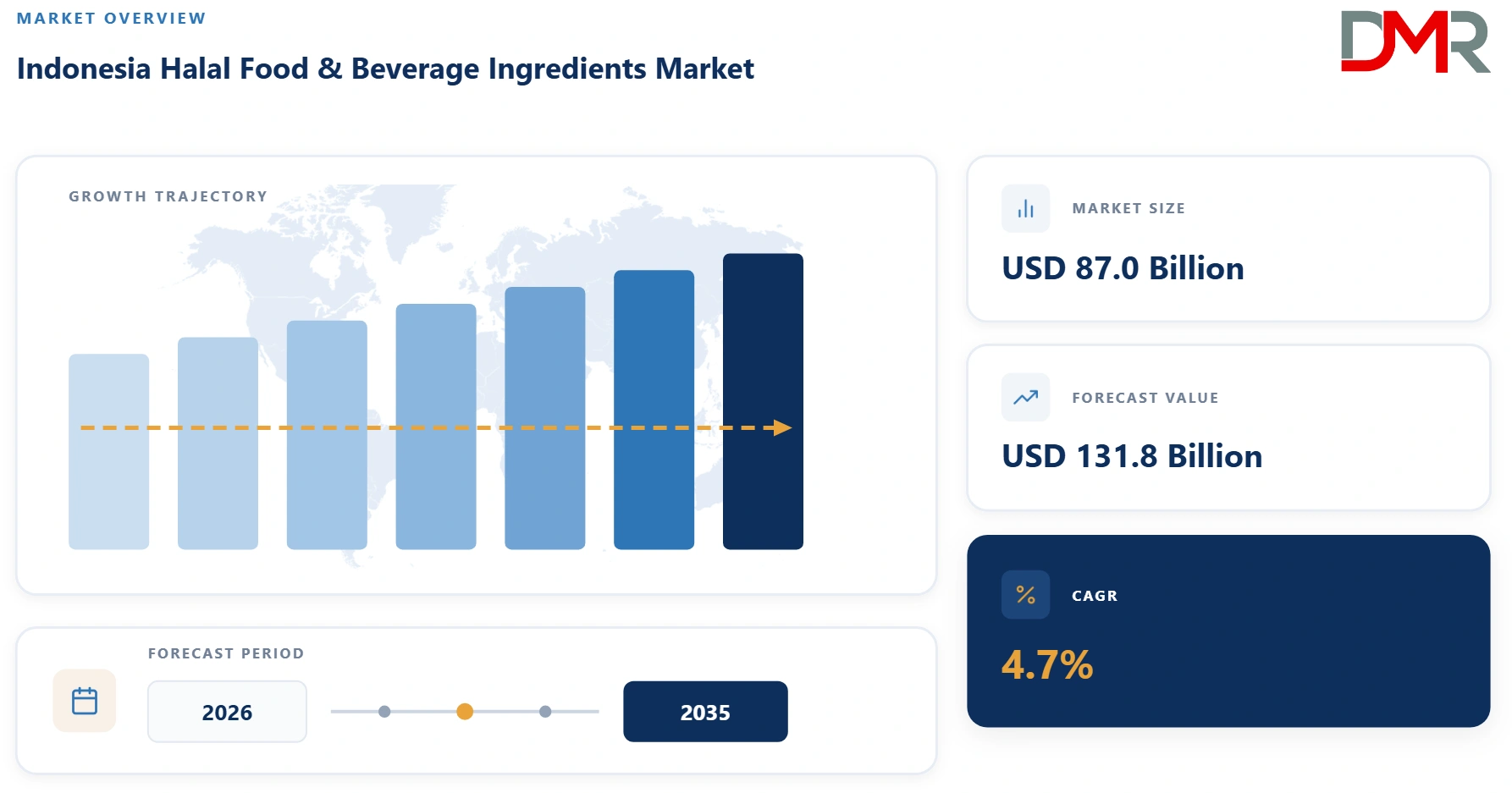
The Indonesia Halal Food & Beverage Ingredients Market covers certified ingredients such as flavors, sweeteners, emulsifiers, enzymes, proteins, dairy ingredients, preservatives, colors, and functional additives used in halal-compliant products. The market is projected to reach USD 87.0 billion in 2026 and expand at a CAGR of 4.7% through 2035, reaching USD 131.8 billion. Growth is supported by rising halal certification, packaged food consumption, ingredient localization, export opportunities, and stronger demand for traceable, compliant, and innovative food formulations across Indonesia nationwide.
ℹ
To learn more about this report –
Download Your Free Sample Report Here
Use Cases
- Halal Food Manufacturing: Halal-certified ingredient manufacturing supports Indonesian food processors producing meat products, dairy foods, bakery items, beverages, snacks, and ready meals. Manufacturers use certified emulsifiers, enzymes, flavors, stabilizers, sweeteners, proteins, and preservatives to ensure compliance throughout formulation and production. This use case is especially important for companies serving Muslim consumers, modern retail chains, foodservice operators, and export markets where ingredient traceability, certification integrity, and consistent halal assurance influence purchasing decisions significantly nationwide.
- Export-Oriented Food Production: Export-oriented food and beverage producers use halal-certified ingredients to access markets across Southeast Asia, the Middle East, and other Muslim-majority economies. Verified sourcing of enzymes, colors, flavors, dairy derivatives, proteins, and functional additives helps exporters meet destination-country halal requirements while improving supply-chain transparency. This use case supports product reformulation, private-label manufacturing, premium packaged foods, and cross-border brand expansion, strengthening Indonesia’s position as a competitive halal food manufacturing hub globally today.
Key Takeaways
- Market Size: The Indonesia Halal Food & Beverage Ingredients Market is anticipated to be valued at USD 87.0 billion in 2026 and is forecast to reach USD 131.8 billion by 2035, expanding at a CAGR of 4.7% during the forecast period.
- Growth Rate and Outlook: Market growth is supported by rising demand for halal-certified packaged foods, growing consumer awareness regarding ingredient traceability, expansion of domestic food processing, increasing halal certification across product categories, growth in modern retail, and rising exports of halal food and beverage products to regional and international markets.
- Primary Growth Drivers: Indonesia’s large Muslim consumer base, mandatory halal certification requirements, expanding processed food consumption, growing demand for clean-label and functional ingredients, increasing localization of ingredient sourcing, rising investments in food manufacturing, and stronger export opportunities are encouraging manufacturers to adopt certified halal flavors, enzymes, emulsifiers, sweeteners, proteins, preservatives, and other specialty ingredients.
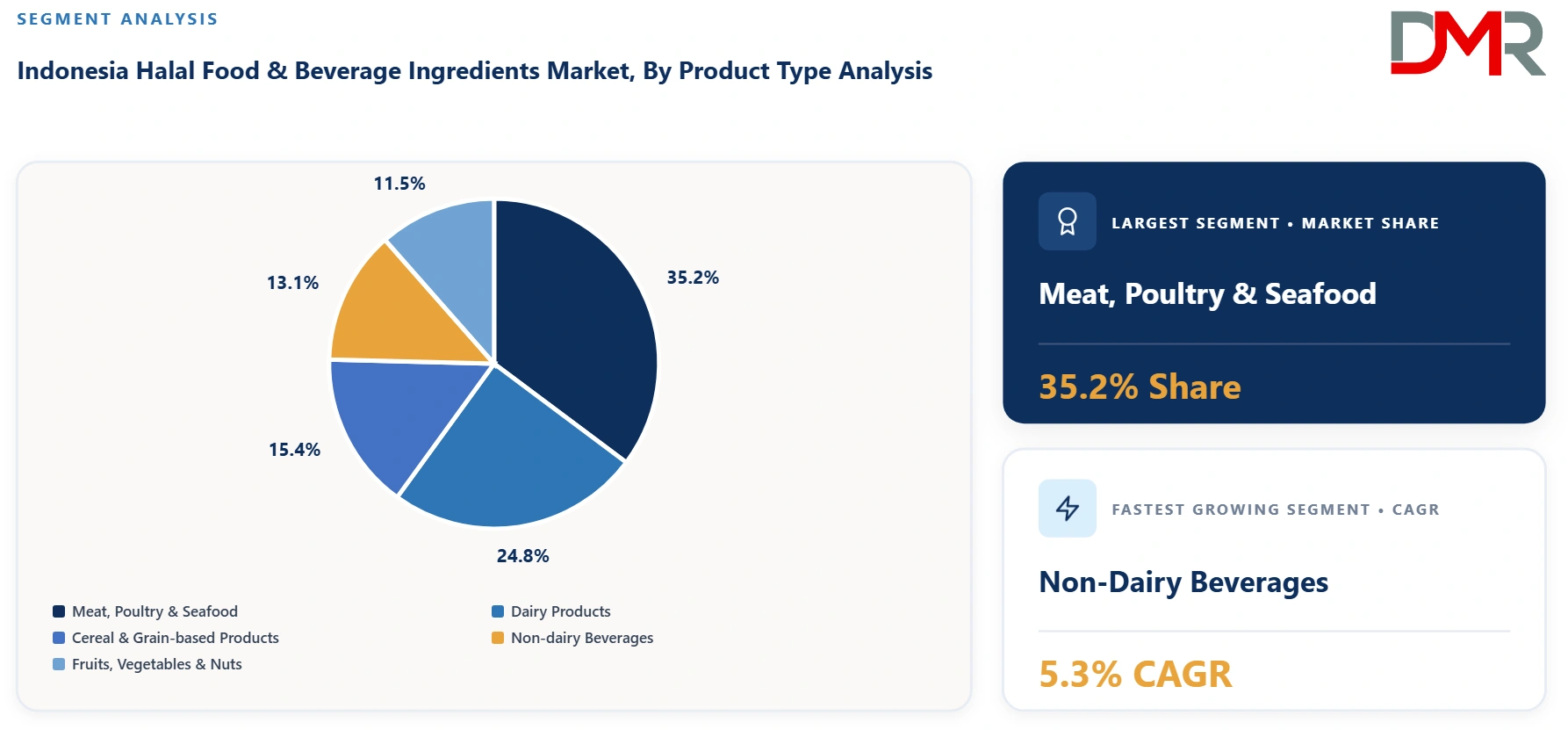
- By Product Type Analysis: Meat, Poultry & Seafood is projected to lead the product type segment with approximately 35.2% share in 2026, supported by high consumption of halal-certified poultry, meat, and seafood products. Cereal and grain-based products are also expected to account for a significant share due to strong demand for rice-based foods, noodles, bakery products, snacks, and other staple food categories.
- By Distribution Channel Analysis: Traditional Retailers are expected to dominate the distribution channel segment with approximately 47.3% share in 2026, driven by Indonesia’s extensive network of neighborhood stores, traditional markets, and independent retailers. Supermarkets and hypermarkets are also gaining importance, while online retail is expanding rapidly due to increasing e-commerce adoption, digital payment usage, convenience purchasing, and broader access to certified halal food and beverage products.
Key Drivers in the Indonesia Halal Food & Beverage Ingredients Market
Mandatory Halal Certification Expanding Ingredient Compliance
Indonesia’s halal regulatory framework is becoming a direct demand driver for certified food and beverage ingredients. From 18 October 2026, mandatory halal certification extends to food and beverage products from micro and small enterprises as well as imported products, and explicitly covers raw materials, food additives, and processing aids. This broadens compliance requirements beyond finished products and pushes manufacturers to verify enzymes, emulsifiers, flavors, proteins, colors, and other inputs. Ingredient suppliers that can provide documented traceability, recognized certification, and segregation controls are therefore becoming increasingly important across Indonesia’s food-processing ecosystem.
Large Muslim Consumer Base and Expanding Processed Food Demand
Indonesia’s predominantly Muslim population creates a structurally strong domestic requirement for halal-assured food and beverage ingredients. Demand is reinforced by the expansion of packaged foods, ready meals, bakery products, dairy alternatives, beverages, snacks, and convenience products across urban centers. Food manufacturers increasingly require certified flavors, sweeteners, stabilizers, proteins, preservatives, and functional ingredients that can support both religious compliance and modern product formulation. Growing consumer attention to ingredient origin, production methods, and labeling is also encouraging brands to strengthen halal assurance throughout sourcing, processing, storage, and distribution rather than relying only on finished-product certification.
Restraints in the Indonesia Halal Food & Beverage Ingredients Market
Certification Complexity and Supply-Chain Traceability Costs
Halal compliance can be operationally demanding for ingredient producers that use imported inputs, multi-origin raw materials, shared processing lines, or complex formulations. Companies must maintain documentation covering ingredient sources, manufacturing processes, storage, handling, and distribution while ensuring that certified materials remain segregated from non-compliant inputs. Smaller suppliers may face difficulties in building internal halal assurance systems, managing audits, and updating certificates when formulations or vendors change. These requirements can lengthen product-development cycles and increase administrative costs, particularly for specialty ingredients with multiple processing stages or internationally sourced components.
Dependence on Imported Specialty Ingredients
Indonesia still relies on international supply chains for a range of specialty food ingredients, including certain enzymes, functional proteins, cultures, emulsifiers, flavors, stabilizers, and advanced additives. Import dependence can complicate halal verification when suppliers operate under different certification bodies or documentation standards. Currency movements, shipping disruptions, customs procedures, and recognition of overseas halal certificates can further increase procurement complexity. The regulatory transition for foreign products also requires closer coordination between overseas manufacturers and Indonesian authorities, making supplier qualification more demanding for local processors that need consistent quality, halal compliance, technical functionality, and reliable delivery.
Growth Opportunities in the Indonesia Halal Food & Beverage Ingredients Market
Localization of Halal Ingredient Production
Indonesia has a strong opportunity to reduce dependence on imported specialty ingredients by expanding domestic production of halal-certified flavors, sweeteners, starches, proteins, emulsifiers, cultures, and functional additives. Local manufacturing can shorten lead times, improve traceability, lower exposure to logistics disruptions, and make certification easier to manage across the supply chain. It also creates opportunities to develop ingredients from locally available resources such as coconut, cassava, seaweed, tropical fruits, spices, and plant proteins. Suppliers that combine local sourcing with standardized halal assurance and food-technology capabilities can serve both large processors and Indonesia’s extensive MSME food manufacturing base.
Export Expansion Through Halal-Certified Ingredients
Indonesia can strengthen its position in global halal value chains by developing ingredients that meet domestic requirements while also being acceptable in major Muslim consumer markets. Certified Indonesian flavors, botanical extracts, coconut derivatives, starches, seaweed ingredients, sweeteners, and plant-based inputs can target Southeast Asia, the Middle East, and other export destinations. The opportunity is particularly strong for suppliers that provide internationally recognized documentation, consistent quality, and application support for manufacturers. Broader export participation can also encourage Indonesian ingredient companies to improve traceability systems, production standards, packaging, and technical specifications, raising their competitiveness beyond the domestic market.
Trends in the Indonesia Halal Food & Beverage Ingredients Market
Shift Toward Clean-Label and Plant-Based Halal Ingredients
Indonesian food manufacturers are increasingly combining halal compliance with demand for simpler labels, natural positioning, and plant-based formulations. This is encouraging interest in natural colors, botanical flavors, plant proteins, fruit-based sweeteners, seaweed-derived hydrocolloids, and fermentation-based ingredients that can replace synthetic or animal-derived alternatives. Local raw materials such as coconut, cassava, spices, and tropical fruits offer additional formulation opportunities. Suppliers are therefore moving beyond basic halal certification toward ingredients that simultaneously address health perception, sustainability, functionality, and religious compliance, especially in beverages, snacks, bakery products, dairy alternatives, and convenience foods.
Digital Traceability and Stronger Halal Assurance Systems
Traceability is becoming more important as Indonesia’s halal requirements cover not only finished foods but also raw materials, additives, processing aids, storage, and other supply-chain activities. Ingredient companies are increasingly expected to maintain clearer supplier records, batch documentation, certificates, production controls, and segregation procedures. BPJPH reported that 5.77 million products had been certified halal cumulatively from 2019 through 2024, illustrating the expanding scale of the certification ecosystem. As compliance volumes rise, digital documentation, supplier databases, QR-linked verification, and integrated halal assurance processes are likely to become more common across manufacturers and ingredient suppliers.
Research Scope and Analysis
The Indonesia Halal Food and Beverage Ingredients Market research scope evaluates the market by product type covering meat poultry and seafood dairy products cereal and grain based products nondairy beverages and fruits vegetables and nuts along with distribution channels including traditional retailers supermarkets and hypermarkets online retail and others across Indonesia through 2035 for analysis.
ℹ
To learn more about this report –
Download Your Free Sample Report Here
By Product Type Analysis
Meat, poultry, and Seafood is expected to lead the product type segment with a 35.2% share in 2026, supported by strong domestic consumption and widespread halal certification across meat and poultry products. Non-Dairy Beverages is projected to be the fastest-growing segment, expanding at a CAGR of approximately 5.3% through 2035, driven by rising demand for functional beverages, plant-based drinks, and halal-certified refreshments.
By Distribution Channel Analysis
Traditional Retailers is anticipated to dominate the distribution channel segment with a 47.3% share in 2026, supported by the extensive presence of neighborhood stores, traditional markets, and independent outlets across Indonesia. Online Retail is expected to register the fastest growth, expanding at a CAGR of around 5.6% through 2035, driven by growing e-commerce adoption, digital payments, and convenient access to halal-certified products.
The Indonesia Halal Food & Beverage Ingredients Market Report is segmented based on the following:
By Product Type
- Meat, Poultry & Seafood
- Dairy Products
- Cereal & Grain-based Products
- Non-dairy Beverages
- Fruits, Vegetables & Nuts
By Distribution Channel
- Traditional Retailers
- Supermarkets/Hypermarkets
- Online Retail
- Others
Regulatory Landscape
Indonesia’s regulatory landscape is the most critical analysis for halal food and beverage ingredients, as certification requirements increasingly extend across raw materials, additives, processing aids, and imported products. Mandatory halal compliance from October 2026 strengthens demand for certified enzymes, flavors, emulsifiers, proteins, sweeteners, and functional ingredients while improving traceability and consumer confidence. Opportunities favor suppliers with recognized certification, transparent sourcing, segregated production, and robust halal assurance systems. However, compliance costs, documentation complexity, audit readiness, and foreign certificate recognition may burden smaller firms and importers. Overall, tighter regulation is expected to formalize supply chains, accelerate certified ingredient adoption, and strengthen competitive differentiation among compliant producers operating throughout Indonesia’s food manufacturing ecosystem.
Export Import Analysis
Export-import analysis is highly relevant because Indonesia’s food processing industry depends on overseas supplies of wheat, dairy ingredients, soy products, specialty additives, flavors, enzymes, and other inputs while exporting processed foods and locally derived ingredients. Rising demand creates opportunities for foreign certified suppliers and domestic companies developing substitutes from coconut, cassava, seaweed, spices, and tropical crops. Halal certification requirements for imported ingredients will increasingly influence supplier selection, documentation, and border compliance. Key risks include currency volatility, import licensing, shipping disruptions, tariffs, and delays in certificate recognition. Greater local sourcing could reduce exposure while expanding Indonesia’s potential to export traceable, halal certified ingredients across Muslim markets and neighboring regional markets.
Competitive Landscape
The Indonesia Halal Food & Beverage Ingredients Market features strong competition among multinational and domestic ingredient suppliers. Key players include Cargill Indonesia, PT Kerry Ingredients Indonesia, PT ADM Indonesia Trading and Logistics, dsm-firmenich, PT Givaudan Indonesia, PT Symrise Indonesia, PT Sensient Technologies Indonesia, PT Ajinomoto Indonesia, PT Daesang Ingredients Indonesia, PT Tereos FKS Indonesia, PT Budi Starch & Sweetener Tbk, Musim Mas Group, PT Indesso Aroma, PT Foodex Inti Ingredients, and PT Haldin Pacific Semesta. Companies compete through halal-certified portfolios, local manufacturing, technical support, distribution reach, and formulation capabilities. Domestic players benefit from local raw material sourcing, while multinational companies leverage advanced technologies and broader product portfolios. Increasing demand for clean-label, plant-based, functional, and traceable ingredients is intensifying product innovation and strategic partnerships across Indonesia.
Some of the prominent players in the Indonesia Halal Food & Beverage Ingredients Market are:
- Cargill Indonesia
- PT Kerry Ingredients Indonesia
- PT ADM Indonesia Trading and Logistics
- International Flavors & Fragrances Inc.
- dsm-firmenich
- PT Givaudan Indonesia
- PT Symrise Indonesia
- PT Sensient Technologies Indonesia
- Ingredion Incorporated
- Tate & Lyle PLC
- Roquette Frères
- Wilmar International Limited
- PT Ajinomoto Indonesia
- PT Daesang Ingredients Indonesia
- PT Tereos FKS Indonesia
- PT Budi Starch & Sweetener Tbk
- PT Sinar Mas Agro Resources and Technology Tbk
- Musim Mas Group
- PT Indesso Aroma
- PT Lautan Luas Tbk
- PT Foodex Inti Ingredients
- PT Sumber Food Ingredient Indonesia
- PT Intrasindo
- PT Pangan Mahkota Emas
- PT Barentz
- Azelis Indonesia
- Brenntag Indonesia
- IMCD Indonesia
- Jebsen & Jessen Ingredients Indonesia
- PT MANE Indonesia
- PT Takasago International Indonesia
- PT Hasegawa Flavour and Fragrance Indonesia
- PT Robertet Group Indonesia
- PT KH Roberts Indonesia
- PT Ogawa Indonesia
- PT Bintang Kreasi Aroma
- PT Silesia Flavours Indonesia
- PT Haldin Pacific Semesta
- AAK AB
- Novonesis A/S
- Other Key Players
Recent Developments
- In July 2026, Givaudan inaugurated a new CHF 50 million production facility in Cikarang, Indonesia, covering about 24,000 square meters. The facility will manufacture savoury, sweet, and snack flavour powders and expand the company’s local production and innovation capacity for Indonesia’s food and beverage industry.
- In July 2026, Cargill highlighted productivity improvement, responsible sourcing, and innovation as priorities for strengthening Indonesia’s cocoa value chain at the Indonesia International Cocoa Conference in Yogyakarta. The initiative supports Indonesia’s potential to supply higher-value cocoa and chocolate ingredients to domestic and regional food manufacturers.
- In June 2026, Indesso Aroma joined the United Nations Global Compact, reinforcing its focus on responsible sourcing, environmental practices, and sustainable operations. The development is relevant to its Indonesian natural extracts, specialty food ingredients, flavors, and aroma ingredient businesses, where traceable sourcing is becoming increasingly important.
Report Details
| Report Characteristics |
| Market Size (2026) |
USD 87.0 Bn |
| Forecast Value (2035) |
USD 131.8 Bn |
| CAGR (2026–2035) |
4.7% |
| Historical Data |
2021 – 2025 |
| Forecast Data |
2026 – 2035 |
| Base Year |
2025 |
| Segments Covered |
By Product Type, By Distribution Channel |
Frequently Asked Questions
How big is the Indonesia Halal Food & Beverage Ingredients Market?
▾ The Indonesia Halal Food & Beverage Ingredients Market is valued at USD 87.0 billion in 2026 and is projected to reach USD 131.8 billion by 2035.
What is the CAGR of the Indonesia Halal Food & Beverage Ingredients Market from 2026 to 2035?
▾ The Indonesia Halal Food & Beverage Ingredients Market is expected to expand at a CAGR of 4.7% from 2026 to 2035.
What factors are driving the growth of the Indonesia Halal Food & Beverage Ingredients Market?
▾ Growth is driven by mandatory halal certification, Indonesia’s large Muslim population, expanding processed food consumption, increasing demand for clean-label and functional ingredients, local ingredient sourcing, stronger traceability requirements, and growing halal food exports.
What are the major trends in the Indonesia Halal Food & Beverage Ingredients Market?
▾ Major trends include rising adoption of clean-label and plant-based halal ingredients, increased use of natural colors and botanical flavors, greater utilization of locally sourced coconut and cassava ingredients, and growing adoption of digital traceability and integrated halal assurance systems.
Who are the key players in the Indonesia Halal Food & Beverage Ingredients Market?
▾ Key players include Cargill Indonesia, PT Kerry Ingredients Indonesia, PT ADM Indonesia Trading and Logistics, dsm-firmenich, PT Givaudan Indonesia, PT Symrise Indonesia, PT Ajinomoto Indonesia, Musim Mas Group, PT Indesso Aroma, PT Foodex Inti Ingredients, and PT Haldin Pacific Semesta.
How is the Indonesia Halal Food & Beverage Ingredients Market segmented?
▾ The market is segmented by Product Type into Meat Poultry & Seafood, Dairy Products, Cereal & Grain-based Products, Non-Dairy Beverages, and Fruits Vegetables & Nuts. By Distribution Channel, it is segmented into Traditional Retailers, Supermarkets/Hypermarkets, Online Retail, and Others.