Indonesia Rice Market Snapshot
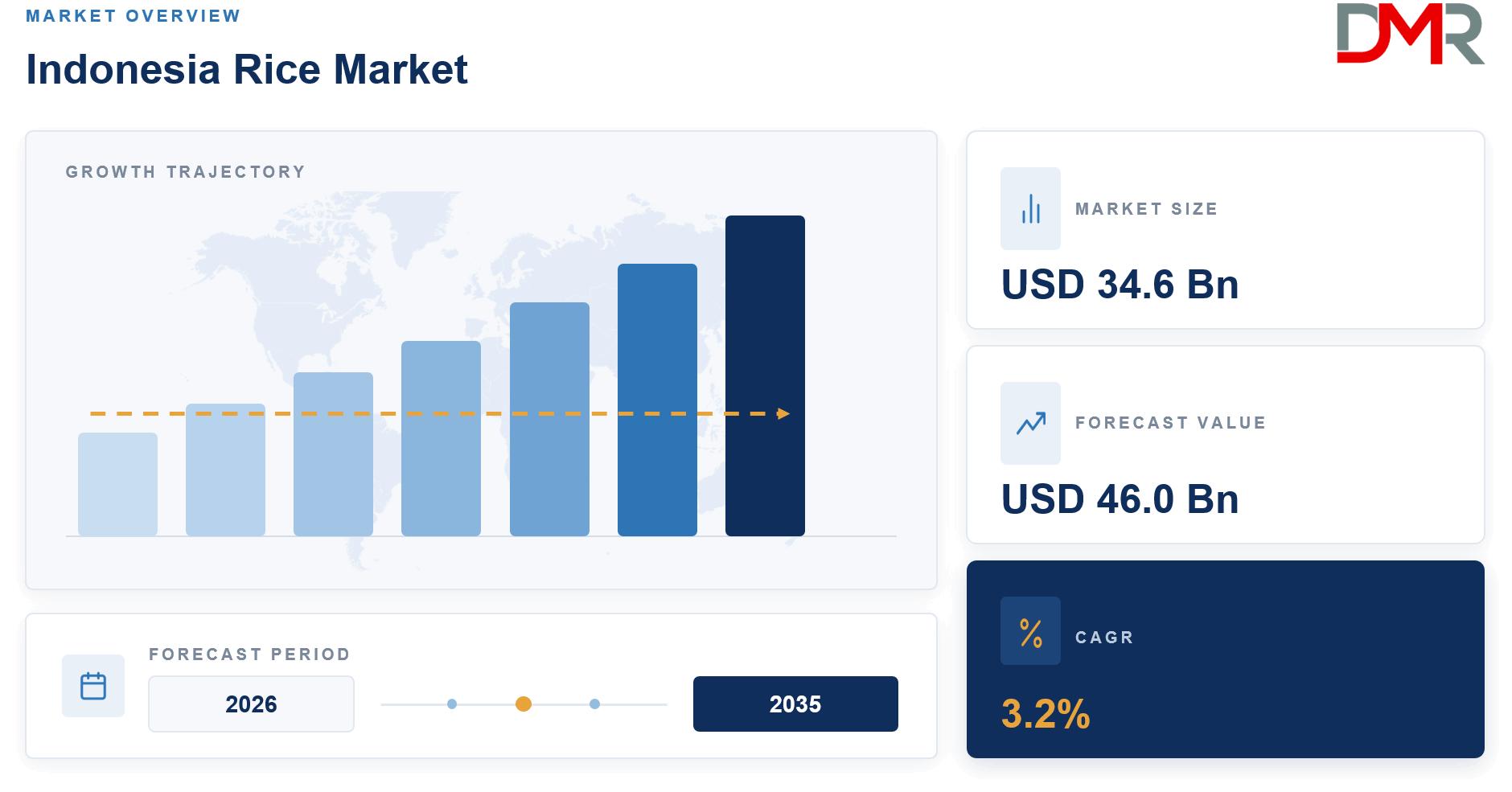
- Market Value: Indonesia rice market is valued at USD 34.6 billion in 2026 and is projected to reach USD 46.0 billion by 2035.
- CAGR: Indonesia rice market is expected to grow at a CAGR of 3.2% from 2026 to 2035.
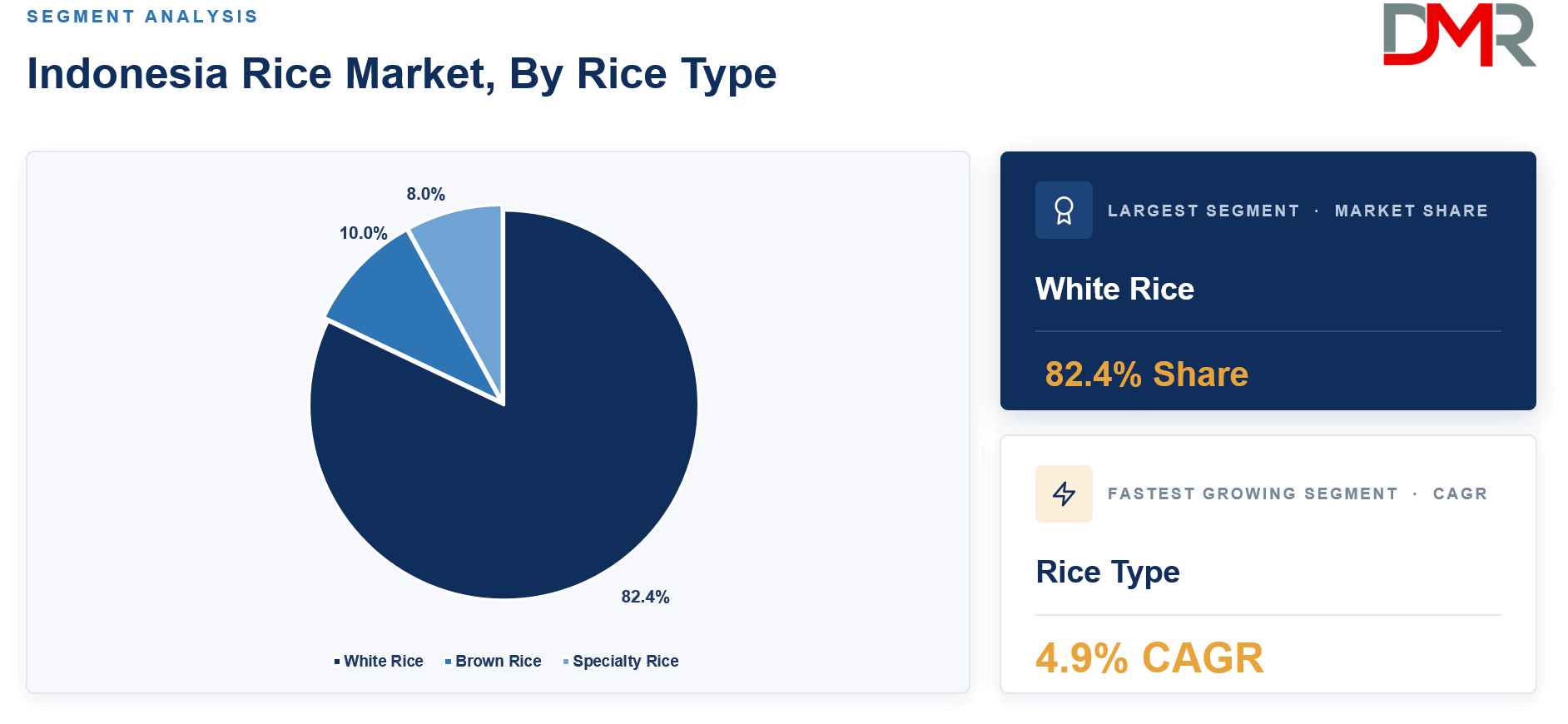
- By Rice Type Segment Analysis:White Rice led the rice type segment with a 82.4% share in 2026.
- By Grain Size Segment Analysis:Long Grain Rice held a 68.7% share in 2026.
- By Quality/Grade Segment Analysis:Medium-Grade Rice accounted for a 57.9% share in 2026.
- By End User Segment Analysis:Household Consumption dominated the end-user segment with a 76.8% share in 2026.
- By Distribution Channel Segment Analysis:Traditional Markets held a 51.6% share in 2026.
- By Region Segment Analysis:Java led the regional segment with a 53.2% share in 2026.
- All Key Players: Perum BULOG, Wilmar Group Indonesia, Indofood CBP, FKS Group, Sungai Budi Group, Louis Dreyfus Company Indonesia and Others.
What is the Indonesia Rice Market and its Market Size?
The Indonesia rice market size is projected to be valued at USD 34.6 billion in 2026 and is projected to reach USD 46.0 billion by 2035, expanding at a CAGR of 3.2% during the forecast period. Rice remains a core food staple and a strategic commodity in Indonesia, supporting steady demand across households, foodservice operators, food processors, and institutional buyers. Market expansion is supported by population needs, urban food consumption, retail modernization, and government efforts to strengthen domestic supply.
ℹ
To learn more about this report –
Download Your Free Sample Report Here
Supply conditions are also improving. Statistics Indonesia reported that national paddy production reached 60.21 million tonnes of dry unhusked rice in 2025, up 13.29% from 2024, while rice production intended for population food consumption increased to 34.69 million tonnes. Harvested paddy area reached about 11.32 million hectares. These gains provide a stronger supply base for milling, distribution, and retail activity.
Use Cases
- Household Consumption: Rice remains a daily staple across Indonesian households, making retail demand the largest use case and supporting recurring purchases of white and medium-grade varieties.
- Foodservice: Restaurants, catering businesses, hotels, and street-food operators depend on stable rice supplies, creating consistent bulk demand and increasing interest in predictable quality and pricing.
- Food Processing: Rice is used in processed foods, snacks, flour, beverages, and other products, creating opportunities for processors seeking standardized grain quality and reliable procurement.
- Institutional Demand: Schools, hospitals, public institutions, military facilities, and social programs require dependable rice procurement, strengthening the role of organized suppliers and government-linked distribution.
- Modern Retail: Supermarkets, convenience stores, and e-commerce platforms are expanding packaged rice availability, enabling branded, premium, specialty, and traceable products to reach urban consumers.
How AI/Gen AI is Transforming the Indonesia Rice Market?
AI is gradually moving from experimental agriculture projects toward practical tools for rice production and supply-chain management. Machine learning can combine satellite imagery, weather data, soil information, crop history, and field observations to estimate yields, identify crop stress, and improve planting decisions. Drones and computer vision can support crop scouting by detecting water stress, pests, disease symptoms, or uneven crop growth. These tools can help farmers and agribusinesses use fertilizer, irrigation, and crop protection inputs more precisely. Indonesia's push for agricultural modernization is also creating room for digital monitoring and automated equipment. In 2025, Agrinas Pangan Nusantara announced plans to invest about 8 trillion rupiah through 2026 in food-production infrastructure, including grain dryers, rice mills, silos, machinery, drones, and satellite monitoring.
Generative AI adds another layer by making agricultural information easier to interpret and act on. Digital assistants can convert weather forecasts, market prices, crop observations, and agronomic recommendations into simple guidance for farmers, traders, and procurement teams. For rice processors and distributors, AI can improve demand forecasting, inventory planning, quality documentation, and logistics scheduling. The technology is especially relevant to a market with a complex distribution chain. Statistics Indonesia found that rice can pass through two to seven trade actors depending on regional conditions, while the dominant national pattern is producer to wholesaler to retailer to final consumer. Better forecasting and digital coordination can therefore reduce supply mismatches and improve visibility across the value chain.
Key Drivers in the Indonesia Rice Market
Strong Staple-Food Demand
Rice has a central position in Indonesian diets, creating a large and recurring consumption base. Household consumption accounts for 76.8% of the market in the supplied 2026 segmentation, showing how strongly demand is tied to everyday food needs. Urbanization, population requirements, and the continued importance of rice-based meals support stable purchasing volumes. Rising packaged-food availability is also widening product choice, while foodservice and institutional buyers provide additional demand beyond households.
Domestic Production and Food-Security Investment
Higher domestic production is strengthening the supply foundation for the Indonesia rice market. BPS reported 2025 paddy production of 60.21 million tonnes, 13.29% above 2024, while rice production for population food consumption reached 34.69 million tonnes. Public and private investment in irrigation, milling, storage, mechanization, and production centers can further improve supply reliability. Such investment supports market expansion by reducing post-harvest losses, improving quality, and strengthening the link between farmers and commercial buyers.
Restraints in the Indonesia Rice Market
Climate and Production Volatility
Rice production remains exposed to rainfall variability, flooding, drought, pests, and changes in seasonal conditions. These risks can affect planting schedules, yields, grain quality, and farm income. Although 2025 production recorded strong growth, future weather shocks could create supply gaps and price pressure. Climate variability also increases the need for irrigation, resilient varieties, crop monitoring, and insurance, raising operating costs for producers and processors.
Complex Distribution Structure
The rice supply chain includes multiple intermediaries across Indonesia, with the number of trade actors varying by region. BPS reported that the national distribution pattern most commonly follows producer, wholesaler, retailer, and final consumer. Multiple layers can increase transportation and trading costs and make price transmission less efficient. Remote islands face additional logistics challenges because of distance, port dependence, and fragmented regional markets.
Growth Opportunities in the Indonesia Rice Market
Expansion of Modern Rice Processing
Investment in modern mills, dryers, storage facilities, grading equipment, and automated handling creates a significant opportunity for the Indonesia rice market. Better post-harvest infrastructure can improve milling recovery, consistency, shelf life, and product presentation. The development of integrated food-production centers also creates opportunities for equipment suppliers, technology providers, logistics companies, and organized agricultural groups. Such infrastructure can help connect production areas with higher-value urban markets.
Digital and Premium Rice Products
Consumers are gaining access to a wider range of packaged and differentiated rice products through supermarkets, convenience stores, and e-commerce. Premium, specialty, healthier, traceable, and conveniently packaged products can command higher margins than commodity rice. Digital commerce also allows producers and brands to reach consumers without relying entirely on traditional retail networks. Greater use of QR-based traceability, digital payments, online promotions, and AI-supported demand forecasting could further strengthen this opportunity.
Trends in the Indonesia Rice Market
Shift Toward Data-Driven Agriculture
Rice production is increasingly incorporating satellite monitoring, drones, farm machinery, sensors, and digital advisory systems. These tools support better crop observation and more targeted resource use. Indonesia's emerging agricultural modernization projects show growing interest in combining physical infrastructure with digital technologies. This trend is likely to continue as producers seek higher yields, lower input waste, and greater resilience against weather variability.
Growth of Organized and Digital Distribution
Traditional markets continue to dominate the supplied distribution segmentation, but modern retail and e-commerce are becoming more important for packaged rice. Consumers in urban areas can compare brands, prices, pack sizes, and quality claims more easily through digital channels. At the supply-chain level, digital systems can improve inventory visibility and procurement planning. The long-term trend is therefore a blended distribution model in which traditional wholesalers and retailers operate alongside organized supermarkets and online platforms.
Research Scope and Analysis
The Indonesia rice market is segmented based on rice type, grain size, quality/grade, end user, distribution channel, region, and other relevant categories. The study provides an in-depth analysis of key segments and sub-segments, covering their applications, industry adoption, demand patterns, and contribution to overall market growth.
ℹ
To learn more about this report –
Download Your Free Sample Report Here
By Rice Type
White rice leads the rice type segment with an estimated 82.4% share in 2026, reflecting its broad acceptance among Indonesian consumers and its strong presence across household, foodservice, and institutional applications. The segment benefits from established milling infrastructure, familiar cooking characteristics, wide retail availability, and competitive pricing. Demand is supported by daily household consumption, while packaged white rice continues to gain visibility through supermarkets and online channels. Future growth will depend on improvements in milling efficiency, product consistency, packaging, traceability, and distribution. Premium white rice products may also create higher-value opportunities as urban consumers show greater interest in quality, convenience, and reliable product standards.
By Grain Size
Long grain rice accounts for 68.7% of the grain size segment in 2026, making it a major contributor to overall Indonesia rice market growth. Its established consumer acceptance and broad application across household cooking and foodservice support the segment's leading position. Long grain products can serve diverse culinary requirements and are widely available through traditional retailers and organized channels. Future demand is expected to be supported by packaged products, branded offerings, and improved quality control. Investment in modern milling, sorting, and packaging can help suppliers maintain consistent grain appearance and reduce quality variation across regional markets.
The Indonesia Rice Market Report is segmented on the basis of the following:
By Rice Type
- White Rice
- Brown Rice
- Specialty Rice
By Grain Size
- Long Grain Rice
- Medium Grain Rice
- Short Grain Rice
By Quality/Grade
- Premium
- Medium
- Low/Economy
By End User
- Household Consumption
- Foodservice
- Food Processing
- Institutional
By Distribution Channel
- Traditional Markets
- Wholesalers
- Supermarkets & Hypermarkets
- Convenience Stores
- E-commerce
Competitive Landscape
The competitive landscape of the Indonesia rice market includes state-linked procurement organizations, integrated agribusiness companies, food manufacturers, commodity traders, poultry and feed businesses with agricultural supply chains, and branded consumer-food companies. Perum BULOG has a strategic role in rice procurement and food-security programs, while companies such as Wilmar International and Indofood CBP participate in broader food and agricultural value chains. FKS Group and Olam Agri add scale across commodity sourcing, processing, trading, and distribution. Competition increasingly centers on procurement reach, product quality, pricing, storage, milling efficiency, distribution coverage, brand strength, and digital supply-chain capabilities. Companies that can combine reliable sourcing with modern processing and efficient distribution are positioned to capture value as Indonesia's rice market expands through 2035.
Statistics Indonesia's latest distribution study shows that rice can move through two to seven trade actors depending on regional market conditions, highlighting the importance of logistics and intermediary relationships. The dominant national distribution pattern remains producer to wholesaler to retailer to final consumer. This structure creates room for competitors to differentiate through supply-chain integration, inventory management, traceability, and direct-to-consumer channels.
Some of the prominent players in the Indonesia Rice Industry are:
- Perum BULOG
- Wilmar Group Indonesia
- Indofood CBP
- FKS Group
- Sungai Budi Group
- Tiga Pilar Sejahtera Food
- Olam Agri Indonesia
- Japfa Comfeed Indonesia
- Sinar Mas Agro Resources and Technology (SMART)
- Budi Starch & Sweetener
- Cargill Indonesia
- GarudaFood
- Charoen Pokphand Indonesia
- Mayora Indah
- Louis Dreyfus Company Indonesia
- Others
Regulatory Landscape
The regulatory landscape of the Indonesia rice market is closely linked to food security, domestic production, consumer protection, trade management, and price stability. Government agencies and state-owned entities play an important role in managing rice procurement, reserves, distribution, imports, quality standards, and market intervention. Perum BULOG remains a key institution in national food-security programs, including government rice procurement and reserve management. Rice trading is also influenced by import and export policies, domestic production targets, food-price controls, labeling requirements, and standards for food safety and quality. The National Food Agency has a major role in coordinating food availability and price policies, while the Ministry of Agriculture oversees agricultural production, seed systems, farm productivity, and related standards. Recent policy efforts have placed greater emphasis on strengthening domestic rice production and reducing supply vulnerability. In 2025, Indonesia recorded strong growth in paddy and rice output, supporting government efforts to improve national food resilience. Regulatory changes can directly affect procurement costs, import volumes, retail prices, and inventory strategies for market participants. Companies operating in the market therefore need to monitor changes in import licensing, quality specifications, food labeling, government procurement, and distribution rules. Compliance with evolving food-safety and traceability requirements is also becoming more important as modern retail and packaged rice sales expand. This regulatory environment creates both operational requirements and opportunities for organized producers, processors, distributors, and technology providers that can maintain reliable documentation, quality control, and supply-chain transparency.
Investment and White Space Analysis
Investment opportunities in the Indonesia rice market extend across farm mechanization, irrigation, post-harvest handling, milling, storage, logistics, digital agriculture, packaging, and modern retail. A major white-space opportunity exists in regions where production is strong but drying, warehousing, milling, and distribution infrastructure remains less developed. Investment in modern dryers, silos, automated grading systems, efficient rice mills, and cold-chain-adjacent logistics can reduce post-harvest losses and improve product consistency. Digital agriculture also offers significant potential through satellite monitoring, drones, AI-based yield forecasting, farm advisory platforms, and digital procurement systems. The market provides further room for branded premium rice, specialty varieties, traceable products, smaller consumer packs, and health-oriented offerings aimed at urban households. E-commerce and organized retail can help brands reach consumers directly while providing better visibility into demand patterns. Investors can also target integrated models that connect farmers with processors, distributors, and institutional buyers through structured procurement networks. Regional opportunities are particularly relevant outside Java, where improvements in transport, storage, milling capacity, and digital connectivity can unlock additional supply. Public investment is supporting this direction, with Agrinas Pangan Nusantara announcing plans for large-scale investment in food-production infrastructure, including rice mills, dryers, silos, agricultural machinery, drones, and satellite monitoring. These developments indicate a growing opportunity for private capital, equipment suppliers, agritech firms, logistics providers, and food brands to participate in the modernization of Indonesia's rice value chain.
Recent Developments
-
June 2026: Perum BULOG government rice reserves reached about 5.17 million tonnes by June 23, while 1.02 million tonnes had been distributed through food assistance and price-stabilisation programs.
-
November 2025: Olam Agri Indonesia and GIZ signed an MoU covering sustainable rice supply chains, farmer livelihoods, traceability, post-harvest-loss reduction and climate-resilient agriculture across developing markets.
-
July 2025: Indonesian authorities investigated Wilmar Padi Indonesia and other major millers over alleged premium-rice mislabelling, including claims that lower-grade rice was sold as premium rice.
-
July 2025: PT Sentosa Utama Lestari, part of Japfa Group, was among rice companies summoned in Indonesia’s investigation into alleged irregularities in the rice subsidy and distribution scheme.
Report Details
| Report Characteristics |
| Market Size (2026) |
USD 34.6 Bn |
| Forecast Value (2035) |
USD 46.0 Bn |
| CAGR (2026-2035) |
3.2% |
| Historical Data |
2021-2025 |
| Forecast Data |
2027-2035 |
| Base Year |
2025 |
| Estimate Year |
2026 |
| Segments Covered |
By Rice Type (White Rice, Brown Rice, and Specialty Rice), By Grain Size (Long Grain Rice, Medium Grain Rice, and Short Grain Rice), By Quality/Grade (Premium, Medium, and Low/Economy), By End User (Household Consumption, Foodservice, Food Processing, and Institutional), By Distribution Channel (Traditional Markets, Wholesalers, Supermarkets & Hypermarkets, Convenience Stores, and E-commerce), and By Region (Java, Sumatra, Kalimantan, Sulawesi, Bali & Nusa Tenggara, and Maluku & Papua) |
| Regional Coverage |
Indonesia |
Frequently Asked Questions
What is the current size of the Indonesia Rice Market?
▾ Indonesia rice market is valued at USD 34.6 billion in 2026 and is forecast to reach USD 46.0 billion by 2035.
What is the growth rate of the Indonesia Rice Market during?
▾ Indonesia rice market is expected to grow at a CAGR of 3.2% during the 2026 to 2035 forecast period.
What factors are driving the growth of the Indonesia Rice Market?
▾ Rising staple-food demand, production growth, infrastructure investment, and retail expansion drive growth.
What are the major challenges restraining the Indonesia Rice Market?
▾ Climate risks, supply volatility, complex distribution, and logistics costs challenge the Indonesia rice market.
Which segment holds the largest share of the Indonesia Rice Market?
▾ White rice holds the largest share of the Indonesia rice market, accounting for 82.4% in 2026, by rice type.
Who are the leading companies in the global Indonesia Rice Market?
▾ Perum BULOG, Wilmar Group Indonesia, Indofood CBP, FKS Group, Sungai Budi Group, and other companies.
How is AI influencing the Indonesia Rice Market?
▾ AI improves the Indonesia rice market through crop monitoring, yield forecasting, demand planning, and logistics.
What are the future opportunities and trends in the Indonesia Rice Market?
▾ Digital farming, modern milling, e-commerce, premium rice, traceability, and smarter logistics offer opportunities.