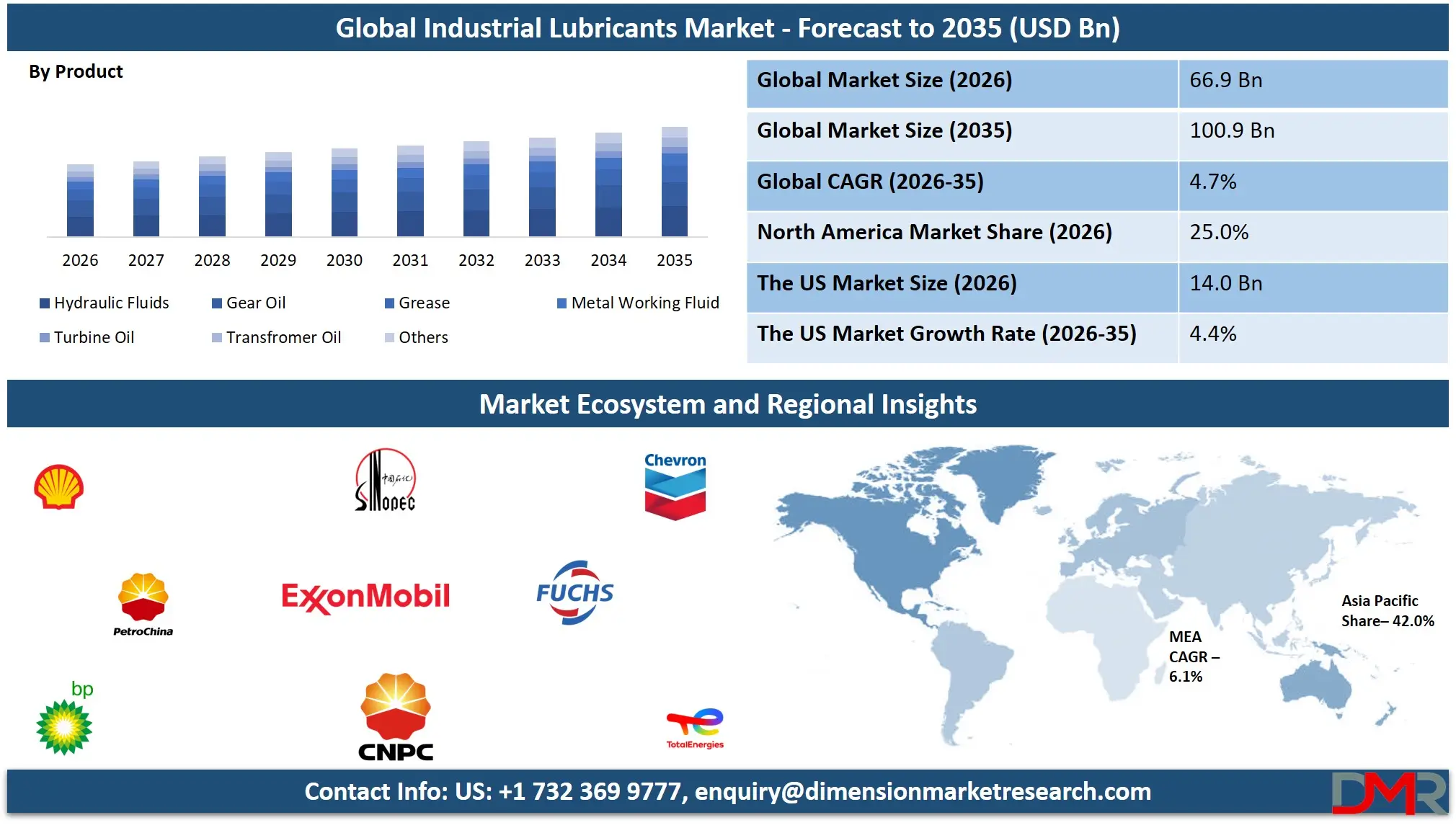
Global Industrial Lubricants Market Key Takeaways:
What is the Industrial Lubricants?
Industrial lubricants are specially formulated products such as oils, greases and fluids used to reduce friction, heat and wear between components of industrial equipment and machinery. They are typically made from base oils (mineral, synthetic or bio-based oils) and additives that improve performance. They play a crucial role in facilitating smooth operation, enhancing energy efficiency and prolonging the life of machinery and equipment. Industrial lubricants are used extensively in manufacturing, construction, mining, power and transportation industries, and are a key element in modern industrial processes and maintenance programs.
ℹ
To learn more about this report –
Download Your Free Sample Report Here
Global Industrial Lubricants Market Size & Overview
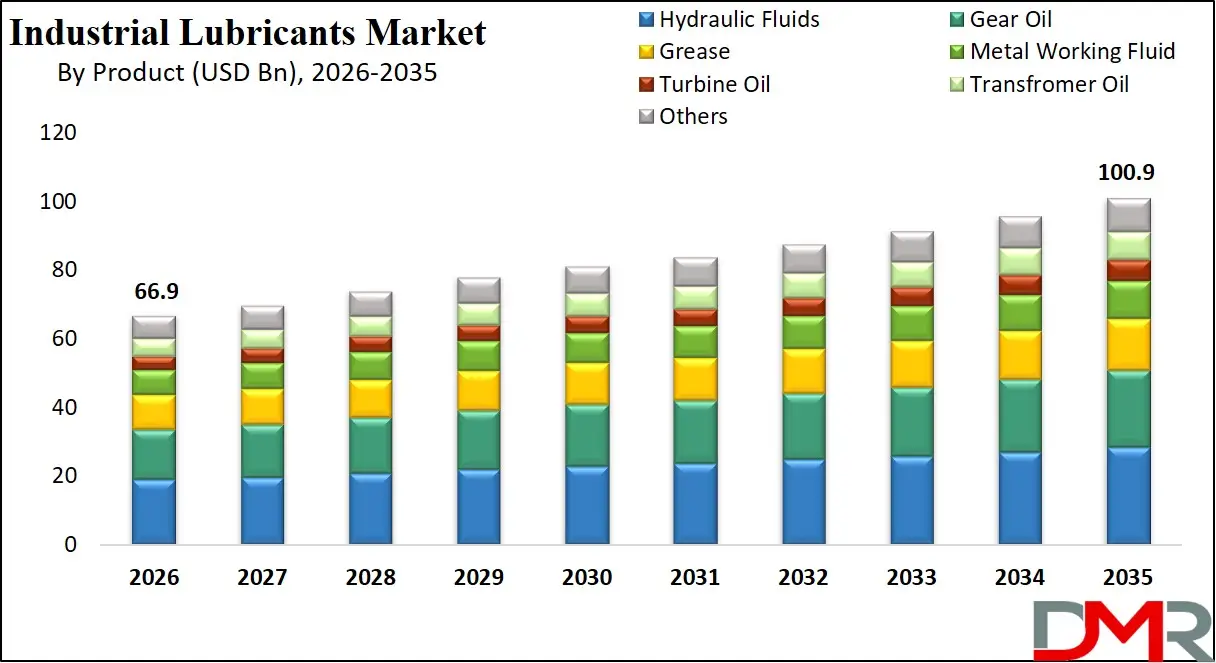
The Global Industrial Lubricants size is expected to be USD 66.9 billion in 2026 and increase at a compound annual growth rate of 4.7% to USD 100.9 billion in 2035 due to the growing use of renewable energy sources like solar and wind.
The Industrial lubricants consist of oils, greases, and fluids which are utilized to reduce friction, wear, and heat caused between the equipment and machinery in manufacturing, construction, energy production, and automotive sectors. Lubrication is required for smooth functioning, increased durability of machines, and reduced cost of maintenance. Growth in automation in industry, adoption of energy-efficient machinery, and emergence of biological and synthetic lubricants are some of the trends seen in the industrial lubricants market. Moreover, sustainable practices along with demands for superior lubricants are contributing towards market growth in the future.
Use Cases
-
Manufacturing Equipment Maintenance: Industrial lubricants are extensively used in production lines to ensure smooth machinery operation, reduce downtime, and enhance productivity by minimizing wear and tear in high-speed equipment.
- Power Generation Systems: Turbine oils and hydraulic fluids play a critical role in power plants by maintaining efficiency, reducing friction losses, and ensuring reliable operation under extreme temperature and pressure conditions.
- Construction Machinery Operation: Heavy equipment such as excavators and cranes rely on lubricants to withstand harsh environments, prevent corrosion, and ensure optimal performance in demanding construction activities.
- Metal Processing Applications: Metalworking fluids are used in cutting, grinding, and shaping processes to reduce heat, improve precision, and extend tool life, enhancing overall manufacturing efficiency.
How AI Is Transforming the Industrial Lubricants Market
AI is revolutionising the industrial lubricants industry with predictive maintenance and real-time monitoring of equipment. AI-powered systems use sensor data to determine the right timing for lubrication, minimizing waste and avoiding machinery breakdowns. This boosts productivity and reduces downtime in manufacturing processes.
AI also facilitates product innovation through data-driven insights, enabling the development of new lubricant products that meet specific requirements. Furthermore, AI enhances supply chain and demand forecasting, enabling manufacturers to streamline production and distribution processes and provide tailored products to the end consumer.
Market Dynamic
Driving Factors: Technological Advancements and Automation
Growing use of automation and smart manufacturing technologies are playing a crucial role in the industrial lubricants market. New equipment is running faster and more accurately, necessitating specific lubricants. Technologies like smart lubrication and condition monitoring allow for predictive maintenance, improving efficiency and cutting costs. These technologies are driving the shift towards high-quality synthetic lubricants, increasing efficiency and productivity in manufacturing and heavy industries.
Rising Demand for Energy Efficiency
Increasing focus on energy efficiency and productivity is another market driver. Lubricants in industries minimise friction and energy losses, affecting machinery efficiency and energy usage. There is a strong emphasis on energy efficiency from governments and other bodies, urging industries to adopt new lubricants. This is especially true in power generation and manufacturing, where energy efficiency and greenhouse gas emissions are critical to reduce energy consumption and emissions, creating a demand for advanced lubricants.
Restraints: High Cost of Synthetic and Bio-Based Lubricants
A key restraint in the market is the higher cost of synthetic and bio-based lubricants compared to traditional mineral oils. Although these next-generation lubricants provide better performance and environmental sustainability, their higher upfront cost may discourage their use, especially in small and medium businesses. This can restrict their use, particularly in cost-sensitive industries, and can impact market expansion.
Environmental and Regulatory Challenges
Lubricant manufacturers and users face environmental regulatory challenges in terms of disposal and emissions. Meeting these regulations involves extra costs in product formulation and waste management. Additionally, the demand for compliance with different regional requirements enhances complexities for international companies. Such compliance requirements can delay product approvals and market entry in areas with stringent environmental regulations.
Opportunities: Growth of Bio-Based Lubricants:
The rise of sustainability is an opportunity for bio-based lubricants. These eco-friendly products are becoming more popular because they are biodegradable and have a reduced environmental footprint. The industry is looking for environmentally friendly alternatives to meet regulatory requirements and enhance corporate social responsibility. This shift is creating opportunities for producers to develop new products and tap into a growing market for sustainable industrial products.
Expansion in Emerging Economies
The growth of industry in emerging countries presents significant opportunities for the market. Asia-Pacific, Latin America and Africa are witnessing significant investments in infrastructure and manufacturing, which will increase the need for industrial lubricants. Growth in construction, mining, and energy sectors in these countries provides a conducive market growth environment, promoted by growing foreign investments and government policies.
Trends: Shift Toward Synthetic Lubricants
One major market trend is the increasing demand for synthetic lubricants because of their enhanced performance, durability and capacity to withstand harsh conditions. Companies are turning to these lubricants to enhance performance and minimise maintenance needs. This trend is especially noticeable in high-tech industries like aerospace and automotive manufacturing, where accuracy and performance are essential.
Digitalization and Smart Monitoring Systems
Digitalization is revolutionising lubrication systems. IoT-based monitoring and smart sensors monitor the state of lubricants in real time, facilitating predictive maintenance and minimising downtime. This practice improves equipment performance and efficiency in lubricant use, which translates into cost and lubricant savings, and is redefining the industry's approach to lubrication.
Research Scope and Analysis
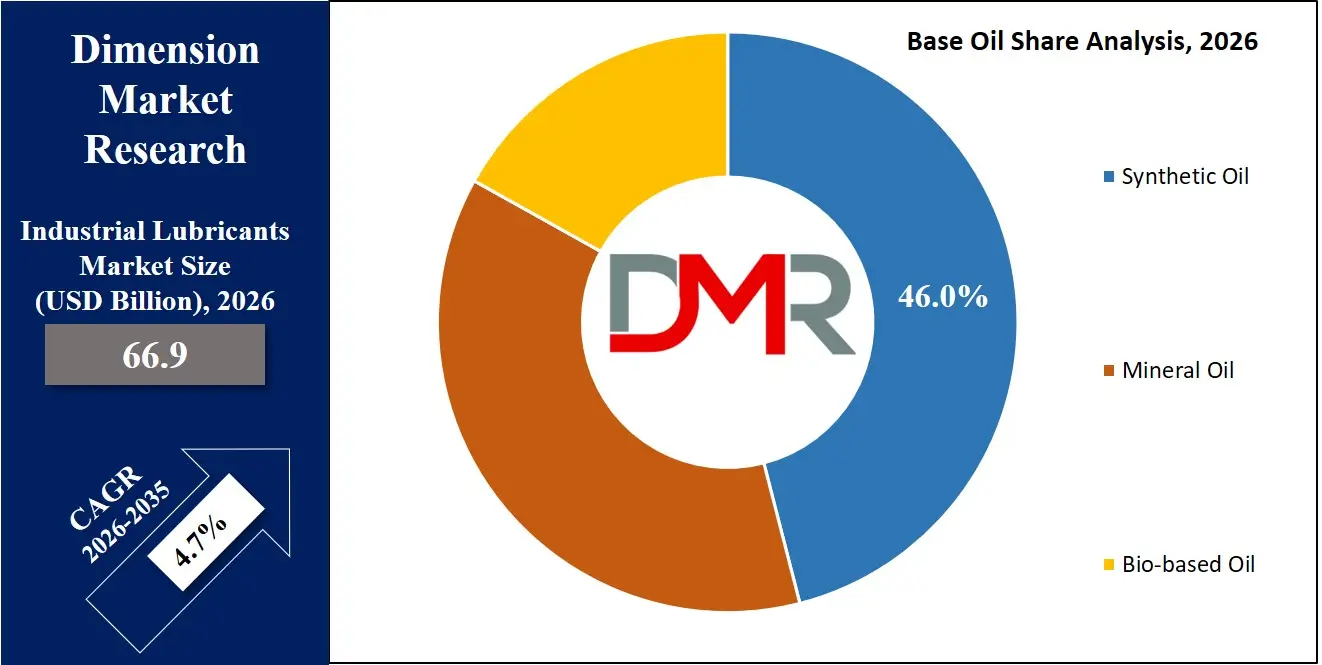
Research Scope and Analysis highlights synthetic oils leading the base oil segment due to performance benefits, while bio-based oils grow fastest due to sustainability. Hydraulic fluids dominate product use, and automotive remains key end-user, with power generation emerging as the fastest-growing sector.
ℹ
To learn more about this report –
Download Your Free Sample Report Here
By Base Oil Analysis
Synthetic oil is likely to lead the base oil market with a share of about 46% by 2026, as it offers better thermal and oxidative stability, and longer life. Synthetic lubricants are increasingly favoured by industries for high-performance applications and extreme operating conditions, especially in the aerospace, automotive and machinery industries. Such lubricants also enable longer drain periods, minimising maintenance and downtime. On the other hand, bio-based oils are the fastest-growing category due to environmental regulations and sustainability concerns. They are biodegradable and low-toxic, and are preferred in Europe and North America where regulations are stringent and industries are transitioning to more environmentally friendly lubricants. Ongoing research in bio-lubricant development is also improving their properties and broadening their use in various applications.
By Product Analysis
Hydraulic fluids are expected to be the highest share product with around 28% volume share in 2026 due to high demand from construction, manufacturing and heavy machinery industries. Their key use in transmitting power, transferring loads, and operating machines guarantees steady consumption in numerous industrial applications. Growing infrastructure projects and automation are driving their use. Conversely, metalworking fluids are experiencing strong growth given rising precision manufacturing and the need for quality metal parts. These are critical in various machining operations including cutting, grinding and forming, extending tool life and improving finish. The fluid formulations are also benefiting from technological innovations such as enhanced cooling and lubrication, further driving their use in advanced manufacturing processes and high-speed machining.
ℹ
To learn more about this report –
Download Your Free Sample Report Here
By End User Analysis
The automobile industry is expected to dominate the market with an estimated 24% market share in 2026 owing to the extensive use of lubricants in automotive manufacturing, assembly and maintenance. The growth in vehicle production, along with the development of new engine technologies and electric vehicle components, sustain this trend. Lubricants play a crucial role in enhancing efficiency, performance and product life spans of equipment used in automotive manufacturing plants. On the other hand, the power generation industry is set to be the fastest-growing segment given the increasing demand for energy and the growth in renewable energy sources, such as wind and solar farms. This sector needs specific lubricants for turbines and other equipment to boost efficiency. In addition, investment in energy infrastructure and grid upgrades is also driving the demand for lubricants in this sector.
The Industrial Lubricants Market Report is segmented on the basis of the following:
By Base Oil
- Synthetic Oil
- Mineral Oil
- Bio-Based Oil
By Product
- Hydraulic Fluid
- Gear Oil
- Grease
- Metal Working Fluid
- Turbine Oil
- Transformer Oil
- Others
By End-User
- Metal & Mining
- Construction
- Power Generation
- Cement Production
- Oil & Gas
- Textile
- Food Processing
- Automotive
- Others
Regional Analysis
Leading Region in the Industrial Lubricants Market
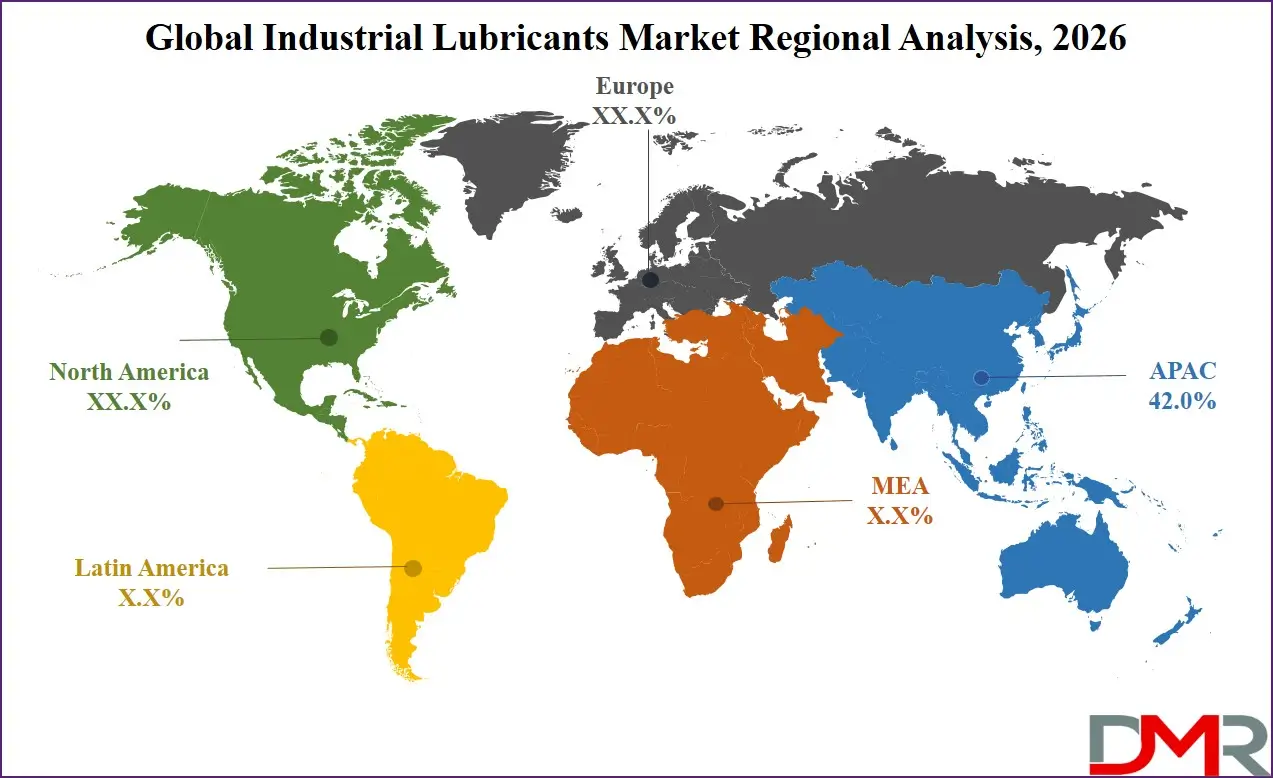
In the upcoming years, the Asia-Pacific region is likely to become the dominant force in the global market for industrial lubricants with its expected share being 42% in 2026. The growth in the region will be mainly attributed to the development of the economy and the increasing presence of manufacturing industries as well as infrastructure developments in countries like China and India. Increasing consumption of lubricants due to the growing industries in automobile production, metal production and building industry is another reason why this region will lead the market.
Fastest Growing Region in the Industrial Lubricants Market
The ME&A region is anticipated to become the fastest-growing one owing to the growth in investments in oil and gas, construction, and power sectors. Development initiatives like intelligent city development and industrial zones are also adding to the growth in the industrial lubricant market. The initiative by the government to achieve economic diversification by reducing dependence on oil exports is aiding the manufacturing and industrial development. In addition, advanced technological developments and equipment are creating avenues for premium lubricants. Development of energy and industrialization in leading countries will fuel quick growth in coming years.
By Region
North America
Europe
- Germany
- The U.K.
- France
- Italy
- Russia
- Spain
- Benelux
- Nordic
- Rest of Europe
Asia-Pacific
- China
- Japan
- South Korea
- India
- ANZ
- ASEAN
- Rest of Asia-Pacific
Latin America
- Brazil
- Mexico
- Argentina
- Colombia
- Rest of Latin America
Middle East & Africa
- Saudi Arabia
- UAE
- South Africa
- Israel
- Egypt
- Rest of MEA
ℹ
To learn more about this report –
Download Your Free Sample Report Here
Major Countries Analysis
The US Industrial Lubricants Market Insight:
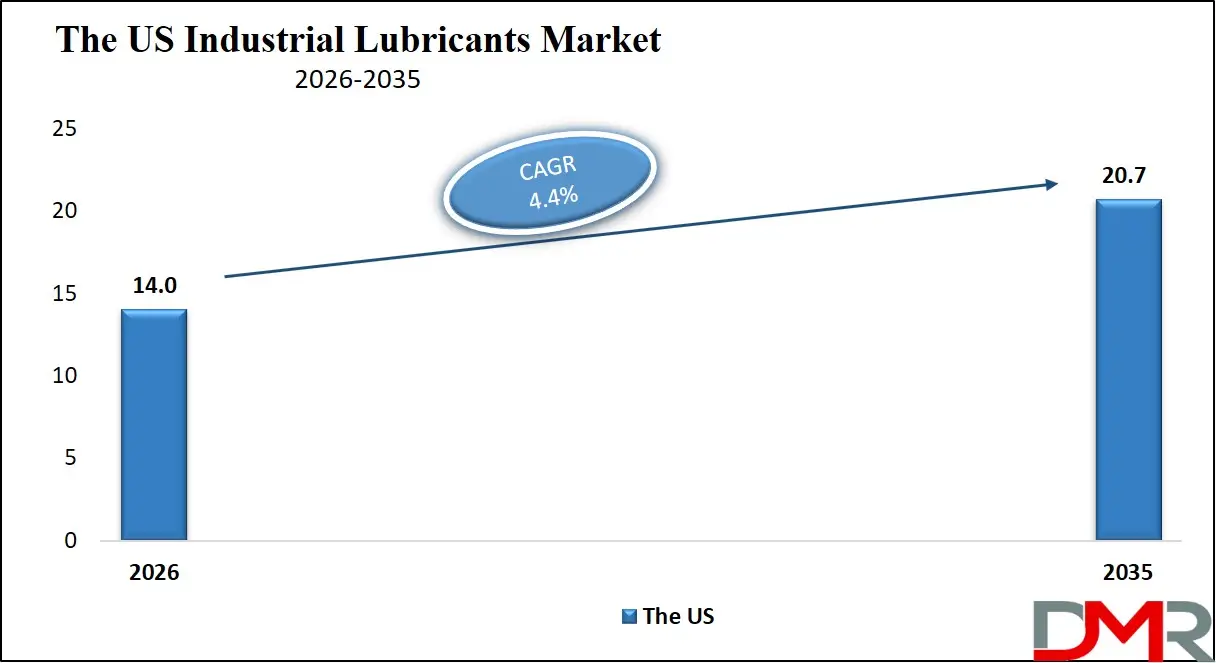
The US Industrial Lubricants size is estimated to be USD 14.0 billion in 2026 and is expected to increase at a CAGR of 4.4% over the forecast period.
Market drivers of industrial lubricants in the United States are modernized manufacturing facilities, extensive use of automation, and industrialization investments. End-user sectors that drive the demand for these products include aerospace, automotive, and energy. The government policies for energy conservation and environment friendly lubricants are encouraging the use of both synthetic and bio-based lubricants. Besides, predictive maintenance and monitoring systems are influencing trends in the demand for lubricants, along with local manufacturing, which provides supply chain security and affordable prices
ℹ
To learn more about this report –
Download Your Free Sample Report Here
Europe Industrial Lubricants Market Insight:
The Europe Industrial Lubricants size is estimated to be USD 16.7 billion in 2026 and at a CAGR of 4.3% over the forecast period.
The market for lubricants in Europe has been impacted by strong environmental standards and sustainability practices such as the European Green Deal. Eco-friendly and biodegradable products have gained emphasis as far as the production of bio-lubricants is concerned. The presence of robust industries like the automotive industry and renewables contributes to growth in the sector. Germany and France lead in innovation within the field of lubricants due to the concept of a circular economy.
Japan Industrial Lubricants Market Insight:
The Japan Industrial Lubricants Market size will be USD 4.7 billion in 2026 and at a CAGR of 3.9% in the forecast period.
Japan's industrial lubricants market is supported by its cutting-edge manufacturing technologies, especially in the automotive, electronics, and robotics industries. Japan's emphasis on precision engineering and high-speed machinery creates a need for high-quality synthetic lubricants. Energy efficiency and industrial innovation policies by the government also drive market expansion. But the challenges of an aging population and scarce resources drive the use of automation and effective lubrication practices. Rural to urban migration and technological innovations open new avenues for lubricant use.
Competitive Landscape
The industry of lubricants for industries operates under a lot of competition. Companies undertake research and development activities to create unique and environmentally friendly lubricants that meet all industry standards. The companies have effective distribution networks, as well as alliances with industrial clients, which give them an edge over others. Entry barriers include high investments, while mergers and acquisitions form part of the strategies that firms use to gain a competitive advantage.
Some of the prominent players in the global Industrial Lubricants are:
- Royal Dutch Shell
- Exxon Mobil Corporation
- BP plc
- Chevron Corporation
- TotalEnergies
- China Petroleum & Chemical Corporation (Sinopec)
- China National Petroleum Corporation (CNPC)
- PetroChina
- FUCHS Petrolub SE
- Idemitsu Kosan Co., Ltd.
- Valvoline Inc.
- Phillips 66
- Petrobras
- Indian Oil Corporation
- Hindustan Petroleum Corporation Limited
- Bharat Petroleum Corporation Limited
- ENEOS Corporation
- Repsol
- Petronas
- SK Lubricants
- Other Key Players
Recent Developments
- In March 2024, ExxonMobil will invest nearly USD 110 million in a Maharashtra plant, producing 159,000 kiloliters of lubricants annually, targeting commercial startups by late 2025, which aims to support local sourcing by new job opportunities.
- In October 2022, Valeo and Totalenergies formed an agreement to develop a new product that can minimize the heat emissions by batteries in electric vehicles by using high-performance dielectric liquid.
- In July 2022, SKF RecondOil’s Double Separation Technology (DST) with Quaker Houghton’s industrial oils has come into agreement to share their expertise in this market by working together to reduce the unsustainable use of oil.
Report Details
| Report Characteristics |
| Market Size (2026) |
USD 66.9 Bn |
| Forecast Value (2035) |
USD 100.9 Bn |
| CAGR (2026–2035) |
4.7% |
| Historical Period |
2021 – 2025 |
| Forecast Period |
2027 – 2035 |
| Base Year |
2025 |
| Estimate Year |
2026 |
| Segments Covered |
By Base Oil, By Product, By End User |
| Regional Coverage |
North America – The US and Canada; Europe – Germany, The UK, France, Russia, Spain, Italy, Benelux, Nordic, & Rest of Europe; Asia-Pacific – China, Japan, South Korea, India, ANZ, ASEAN, Rest of APAC; Latin America – Brazil, Mexico, Argentina, Colombia, Rest of Latin America; Middle East & Africa – Saudi Arabia, UAE, South Africa, Turkey, Egypt, Israel, & Rest of MEA |
Frequently Asked Questions
What is the size of the Industrial Lubricants Market?
▾ The Industrial Lubricants Market is valued at USD 66.9 billion in 2026 and is projected to reach USD 100.9 billion by 2035.
What is the growth rate of the Industrial Lubricants Market?
▾ The Industrial Lubricants Market is expected to grow at a CAGR of 4.7% during 2026-2035.
Which region dominates the global Industrial Lubricants Market?
▾ Asia-Pacific leads the Industrial Lubricants Market with an estimated 42.0% share in 2026.
What factors are driving the growth of the Industrial Lubricants Market?
▾ Automation, energy efficiency, industrialization, and synthetic lubricant adoption drive the Industrial Lubricants Market.
What are the major challenges restraining the Industrial Lubricants Market?
▾ High lubricant costs and strict environmental regulations restrain the Industrial Lubricants Market.
Which segment holds the largest share of the Industrial Lubricants Market?
▾ Synthetic oil holds the largest Industrial Lubricants Market share at approximately 46% in 2026.
Who are the leading companies in the global Industrial Lubricants Market?
▾ The leading companies in the global Industrial Lubricants Market include Royal Dutch Shell, Exxon Mobil Corporation, BP plc, Chevron Corporation, TotalEnergies, Sinopec, China National Petroleum Corporation (CNPC), PetroChina, FUCHS Petrolub SE, Idemitsu Kosan Co., Ltd., Valvoline Inc., Phillips 66, Petrobras, Indian Oil Corporation, Hindustan Petroleum Corporation Limited, Bharat Petroleum Corporation Limited, ENEOS Corporation, Repsol, Petronas, and SK Lubricants.
How is AI influencing the Industrial Lubricants Market?
▾ AI enhances predictive maintenance, smart monitoring, and lubricant optimization in the Industrial Lubricants Market.
What are the future opportunities in the Industrial Lubricants Market?
▾ Bio-based lubricants, IoT, emerging markets, and renewable energy create opportunities in the Industrial Lubricants Market.