Global Industrial X-Ray Inspection Equipment Imaging Software Market Snapshot
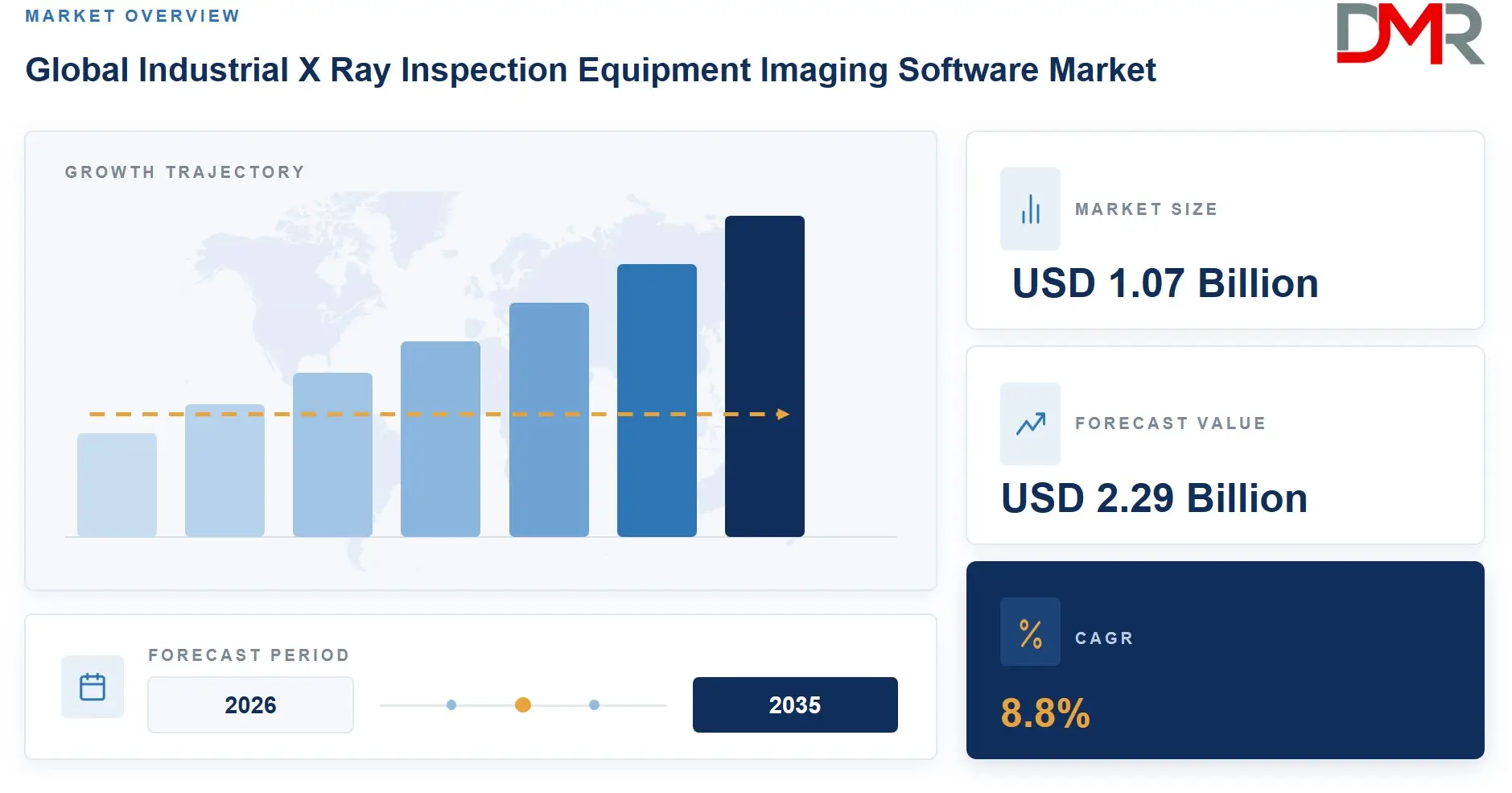
- Market Size, 2026: USD 1.07 billion
- Market Size, 2035: USD 2.29 billion
- Global CAGR, 2026–2035: 8.8%
- Leading Software Type: Image Acquisition & Processing Software, 32%
- Leading Inspection Technology: 2D X-Ray Inspection, 58%
- Leading End-Use Industry: Electronics & Semiconductors, 27%
- Fastest-Growing Segment: Cloud-Based Deployment, 15.5% CAGR
- Leading Region: Asia-Pacific, 36% share
What is the Global Industrial X-Ray Inspection Equipment Imaging Software and its Market Size?
The global market is estimated at USD 1.07 billion in 2026 and is projected to reach approximately USD 2.29 billion by 2035, representing an estimated 8.8% CAGR. The forecast is anchored to the published 2026 market baseline and 2030 projection, with the 2031–2035 period modeled around continuing adoption of automated inspection, CT, AI-enabled defect detection and connected manufacturing systems.
ℹ
To learn more about this report –
Download Your Free Sample Report Here
Growth is supported by stricter quality requirements, increasing complexity of manufactured products, higher production of electric vehicles and electronics, advanced semiconductor packaging, additive manufacturing, aerospace components and growing demand for nondestructive testing. Industrial CT is particularly important because manufacturers increasingly need to inspect internal geometries that cannot be evaluated reliably through surface-based metrology. Modern platforms increasingly combine acquisition, reconstruction, measurement, defect detection and reporting in a single digital workflow. ZEISS, for example, provides CT visualization, metrology, automated defect analysis and reporting through ZEISS INSPECT X-Ray, while Nikon has integrated advanced CT reconstruction and production-floor connectivity.
Use Cases
- Defect Detection & Classification: Identifies porosity, cracks, voids, inclusions, solder defects and other internal manufacturing anomalies.
- Dimensional Measurement: Measures internal and external geometries where conventional optical or tactile methods cannot reach.
- Assembly Verification: Confirms correct positioning, bonding, soldering and component assembly without destructive teardown.
- Material Analysis: Evaluates density variations, inclusions, composite structures and internal material characteristics.
- Process Optimization: Uses inspection data to identify recurring production problems and improve manufacturing parameters.
- Failure Analysis: Reconstructs internal damage and defects to determine root causes of component or product failures.
Key Takeaways
- Market Size: The market is estimated at USD 1.07 billion in 2026, reaching approximately USD 2.29 billion by 2035.
- Growth Rate: The modeled 2026–2035 CAGR is approximately 8.8%, supported by automation, CT adoption and AI-based analytics.
- Growth Drivers: Electronics miniaturization, EV battery production, aerospace quality requirements, Industry 4.0 and nondestructive testing adoption are central growth engines.
- Segment Dominance: 2D X-ray remains the largest inspection-technology segment, while image acquisition and processing represents the largest software category.
- Fastest Growth: Cloud-based deployment is expected to expand fastest as centralized analytics, remote service and multi-site quality management mature.
- Regional Leadership: Asia-Pacific accounts for an estimated 36% of 2026 revenue, supported by electronics, semiconductor, automotive and manufacturing investment.
How AI/Gen AI is Transforming the Industrial X-Ray Inspection Equipment Imaging Software Market?
Artificial intelligence is moving X-ray inspection from operator-assisted image interpretation toward automated, repeatable defect recognition. Machine-learning models can segment porosity, cracks, inclusions and other anomalies directly from 2D radiographs or 3D CT volumes. ZEISS's ZADD Segmentation, for example, uses AI-based analysis to detect and evaluate defects in CT data, while Nikon markets AI reconstruction to improve CT image quality and accelerate inspection.
The principal benefits are higher inspection throughput, lower manual-analysis requirements, more consistent decisions and better utilization of inspection data. AI also makes it possible to identify subtle defects in complex or imperfect images, while automated reporting can feed results into manufacturing execution and quality-management systems.
Key Drivers in the Global Industrial X-Ray Inspection Equipment Imaging Software Market
Expansion of Automated Quality Control and Smart Manufacturing
Manufacturers are increasingly replacing sampling-based inspection with automated, data-driven quality control. Higher product complexity makes conventional inspection insufficient for internal defects, while labor shortages and throughput requirements encourage automation. X-ray systems can inspect components without cutting or dismantling them, making them especially attractive for high-value aerospace parts, EV batteries, electronics assemblies and precision castings. Recent market research identifies growing quality-control requirements, automation-driven inspection lines, real-time assurance
Increasing Product Complexity in Electronics, EVs and Aerospace
Advanced electronics packages, battery cells, power modules, lightweight castings and composite aerospace structures contain internal features that are difficult to validate using optical inspection. Industrial CT provides volumetric visibility, while 2D X-ray remains valuable for rapid inline inspection. Nikon's limited-angle CT technology, for example, targets complex components, PCBs, EV battery cells and carbon-fiber parts while reducing the need for full sample rotation.
Restraints in the Global Industrial X-Ray Inspection Equipment Imaging Software Market
High System Cost and Integration Complexity
Advanced CT systems require expensive X-ray sources, detectors, motion systems, shielding, computing infrastructure and specialized software. The capital burden is particularly significant for smaller manufacturers that do not have continuous high-value inspection requirements. Software integration can also be complicated because customers may operate legacy inspection machines, different detector types and multiple quality-management platforms. Market research continues to identify high initial investment and the need for skilled personnel as important constraints.
Growth Opportunities in the Global Industrial X-Ray Inspection Equipment Imaging Software Market
AI-Native Inspection and Autonomous Quality Control
The strongest software opportunity lies in moving beyond visualization toward autonomous inspection. AI can automate defect segmentation, classification, severity scoring, comparison against golden samples and generation of inspection reports. ZEISS already provides AI-based automated defect segmentation, while Nordson markets machine-learning software within its X-ray inspection portfolio.
Connected, Cloud-Enabled Multi-Site Quality Platforms
Cloud-connected inspection can transform X-ray systems from isolated machines into enterprise quality-data sources. Manufacturers operating multiple factories can centralize inspection results, compare defect distributions, monitor equipment performance and deploy standardized inspection recipes.
Trends in the Global Industrial X-Ray Inspection Equipment Imaging Software Market
Rapid Migration Toward 3D CT and Hybrid Inspection
Computed tomography is increasingly used where 2D inspection cannot provide adequate information about internal structures. The trend is particularly visible in complex castings, batteries, electronics, additive manufacturing and aerospace components. Vendors are therefore investing in faster reconstruction, limited-angle scanning and automated volume analysis.
Software Becoming a Larger Source of Differentiation
Hardware performance is increasingly converging around high-resolution digital detectors, sophisticated sources and standardized motion platforms. Competitive differentiation is therefore moving toward reconstruction algorithms, AI, workflow automation, connectivity and user experience.
Research Scope and Analysis
The market is analyzed by Software Type, Inspection Technology, Deployment, Application and End-Use Industry. Shares represent 2026 analyst estimates within the combined industrial X-ray inspection equipment and imaging software market.
ℹ
To learn more about this report –
Download Your Free Sample Report Here
By Software Type Analysis
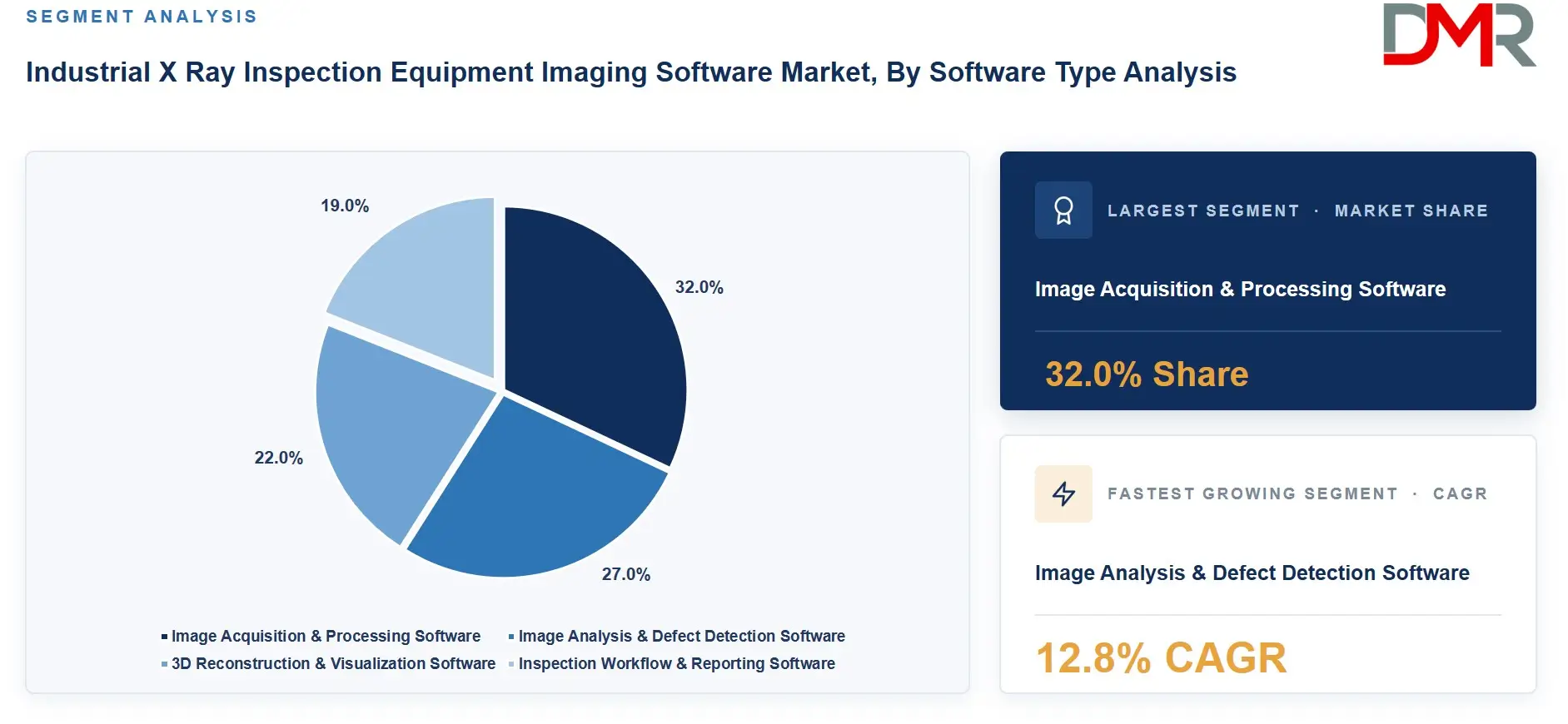
Image Acquisition & Processing Software is estimated to dominate in 2026 with approximately 32% share, reflecting its essential role in detector control, image correction, reconstruction preparation and image-quality optimization across virtually every digital X-ray installation. Image Analysis & Defect Detection Software follows at approximately 28%, supported by increasing automation and AI adoption. 3D Reconstruction & Visualization Software represents approximately 24%, benefiting from growing CT deployment and volumetric inspection. Inspection Workflow & Reporting Software accounts for the remaining 16%, but is expected to expand steadily as manufacturers demand traceability and standardized reporting. The fastest-growing sub-segment is estimated to be Image Analysis & Defect Detection Software at approximately 12.8% CAGR, driven by AI-enabled inspection and rising labor costs. Software that connects image analysis with MES/QMS platforms is particularly attractive because it converts X-ray inspection from a standalone measurement activity into a manufacturing-data service. ZEISS and Nikon illustrate the shift toward integrated reconstruction, analysis, automation and production connectivity.
By Inspection Technology Analysis
2D X-Ray Inspection is estimated to remain dominant in 2026 with approximately 58% share, because it offers rapid acquisition, lower system complexity and strong economics for high-volume electronics, casting and assembly inspection. 3D Computed Tomography accounts for approximately 42%, but is the faster-growing category, with an estimated 11.8% CAGR through 2035. CT adoption is supported by the need to inspect complex internal structures, battery cells, advanced semiconductor packages and additive-manufactured components. CT also creates greater software value because reconstruction, segmentation, visualization, metrology and automated defect analysis are computationally intensive. Limited-angle CT, AI reconstruction and faster acquisition are lowering some historical barriers around speed and throughput. Nikon's limited-angle CT technology demonstrates the direction of the market, using reduced rotation requirements to improve resolution and scan efficiency for complex components.
By Deployment Analysis
On-Premises deployment is estimated to account for approximately 82% of 2026 revenue because industrial X-ray inspection often operates inside controlled production environments with strict cybersecurity, latency, IP-protection and machine-integration requirements. Cloud-Based deployment represents approximately 18%, but is projected to grow at approximately 15.5% CAGR, making it the fastest-growing deployment model. Cloud adoption is strongest for centralized analytics, remote service, fleet monitoring, benchmarking and multi-site quality management rather than primary image acquisition itself. Hybrid architectures are likely to dominate the medium term, with raw X-ray processing occurring locally while selected inspection metadata, reports and model-management information are synchronized with cloud platforms. This model reduces latency and protects sensitive manufacturing data while retaining the enterprise benefits of centralized analytics.
By Application Analysis
Defect Detection & Classification is estimated to lead with approximately 38% share in 2026, reflecting the fundamental role of X-ray inspection in finding pores, cracks, voids, inclusions, solder defects and other anomalies. Assembly & Component Verification represents approximately 25%, followed by Dimensional Measurement at 22% and Material Analysis at 15%. Dimensional measurement is expected to be the fastest-growing application, at approximately 10.9% CAGR, because CT can measure inaccessible internal features while simultaneously detecting defects. The increasing integration of CT with CAD comparison and GD&T is strengthening its role in metrology rather than limiting X-ray inspection to conventional NDT. ZEISS INSPECT X-Ray, for example, combines CT visualization with metrological evaluation, defect analysis and reporting.
By End Use Industry Analysis
Electronics & Semiconductors is estimated to hold the largest 2026 share at approximately 27%, reflecting high-volume PCB inspection, solder-joint analysis, semiconductor packaging, power-module inspection and component counting. Automotive & Transportation follows at roughly 24%, supported by EV batteries, castings, power electronics and lightweight components. Aerospace & Defense represents approximately 17%, Energy & Power 13%, General Manufacturing 12%, and other industries approximately 7%. Automotive and transportation are expected to show particularly strong growth because EV architectures increase the importance of battery, inverter, power-module and structural-casting inspection. Electronics remains structurally attractive because miniaturization and advanced packaging create increasingly difficult internal inspection requirements. Inline X-ray platforms such as Nordson's AXI systems combine high-speed inspection, multiple acquisition modes and MES traceability for electronics manufacturing.
The Global Industrial X-Ray Inspection Equipment Imaging Software Market Report is segmented on the basis of the following:
By Software Type
- Image Acquisition & Processing Software
- Image Analysis & Defect Detection Software
- 3D Reconstruction & Visualization Software
- Inspection Workflow & Reporting Software
By Inspection Technology
- 2D X-Ray Inspection
- 3D Computed Tomography (CT)
By Deployment
By Application
- Defect Detection & Classification
- Dimensional Measurement
- Assembly & Component Verification
- Material Analysis
By End-Use Industry
- Automotive & Transportation
- Electronics & Semiconductors
- Aerospace & Defense
- Energy & Power
- General Manufacturing
Regional Analysis
Asia Pacific is the Leading Region in the Global Industrial X-Ray Inspection Equipment Imaging Software Market
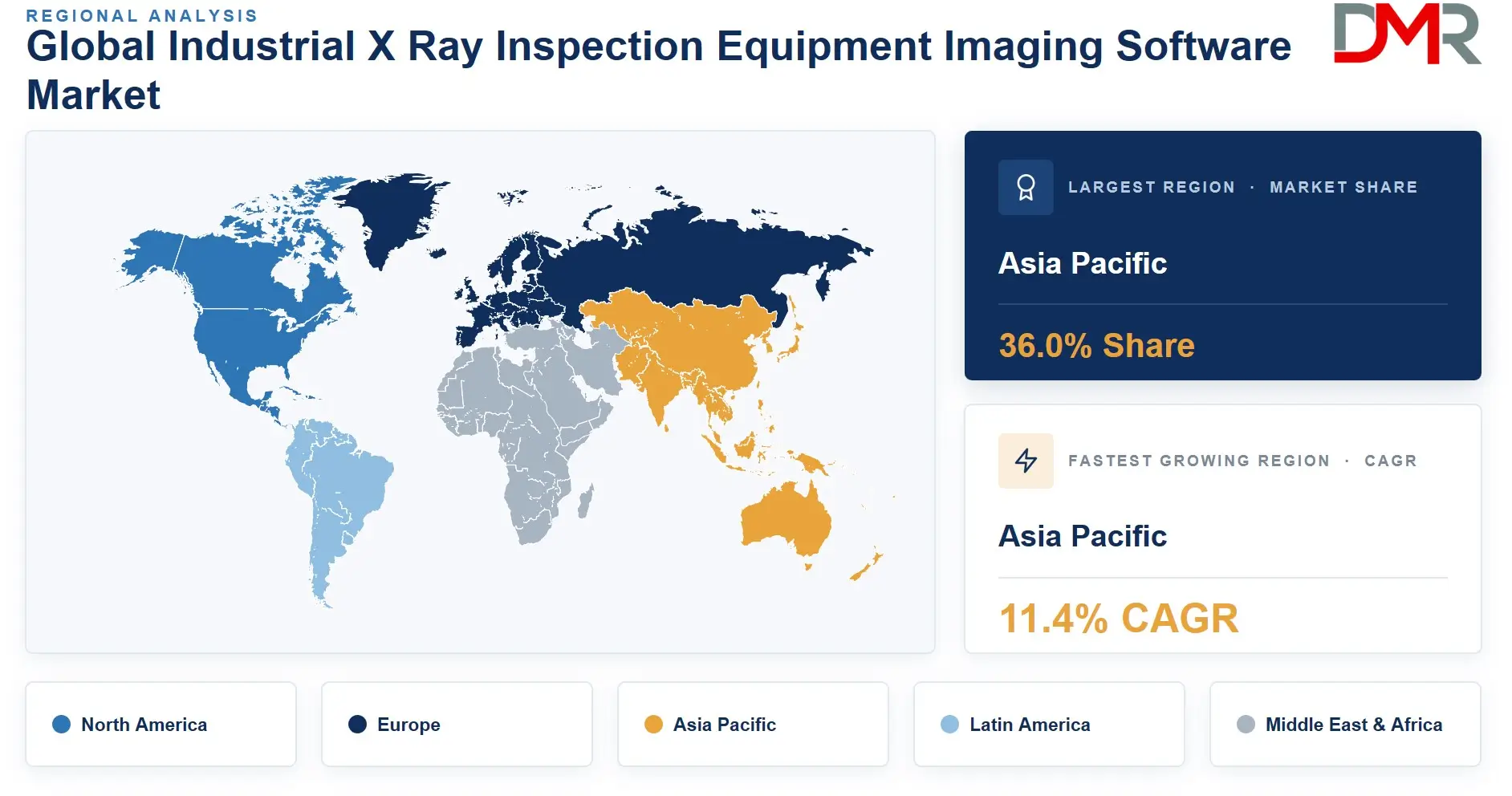
Asia-Pacific is estimated to lead the global market in 2026 with approximately 36% share, equivalent to roughly USD 385 million. The region benefits from its concentration of electronics, semiconductor, automotive, battery, machinery and contract-manufacturing capacity. China, Japan, South Korea, Taiwan and increasingly India are important demand centers. High-volume production creates a strong business case for automated X-ray inspection because even small defect-rate improvements can generate significant economic benefits. The region is also the fastest-growing market according to recent industry research.
ℹ
To learn more about this report –
Download Your Free Sample Report Here
Asia-Pacific's advantage is reinforced by semiconductor investment, EV manufacturing expansion, electronics localization and growing adoption of Industry 4.0. Japanese and European inspection vendors are also deeply established in the region, while local equipment and detector suppliers are increasing price competition.
Asia Pacific is the Fastest-Growing Region in the Global Industrial X-Ray Inspection Equipment Imaging Software Market
Asia-Pacific is projected to remain the fastest-growing region, with an estimated 11.4% CAGR from 2026 to 2035. China remains the largest individual market, while India, Southeast Asia and South Korea offer strong incremental growth. Semiconductor fabs, advanced packaging facilities, EV battery plants and automotive production are increasing demand for high-resolution 2D and 3D inspection. Expansion of manufacturing capacity is also encouraging suppliers to provide more localized service, software support and application engineering.
The Europe Industrial X-Ray Inspection Equipment Imaging Software Market
Europe is estimated at approximately USD 246 million in 2026 and is projected to reach approximately USD 516 million by 2035, representing an estimated 8.6% CAGR. Germany remains the central market because of its automotive, aerospace, machinery and industrial-equipment base. Europe also has strong expertise in industrial metrology and NDT software. ZEISS's X-ray software integrates CT visualization, metrology, automated defect detection and reporting, illustrating the region's emphasis on high-value inspection workflows.
Latin America Industrial X-Ray Inspection Equipment Imaging Software Market
Latin America is estimated at approximately USD 75 million in 2026, reaching approximately USD 145 million by 2035, at around 7.6% CAGR. Brazil and Mexico account for most demand, driven by automotive manufacturing, aerospace supply chains, oil and gas, metal processing and general manufacturing. Growth will depend on capital expenditure cycles, local service capabilities and adoption of automated quality-control systems.
MEA Industrial X-Ray Inspection Equipment Imaging Software Market
MEA is estimated at approximately USD 64 million in 2026 and is projected to reach approximately USD 119 million by 2035, representing about 7.1% CAGR. Demand is concentrated in Saudi Arabia, UAE, South Africa and Israel. Energy infrastructure, aerospace, defense, large industrial projects and localization initiatives create opportunities for nondestructive testing. Saudi Arabia's industrial diversification agenda should support long-term demand for inspection equipment and software.
Major Countries Analysis
United States Industrial X-Ray Inspection Equipment Imaging Software Market
The U.S. market is estimated at approximately USD 245 million in 2026, rising to approximately USD 476 million by 2035, at an estimated 7.6% CAGR. Aerospace and defense, automotive, semiconductors, energy, additive manufacturing and advanced industrial production are major demand centers. Strong NDT expertise and stringent quality requirements support premium inspection systems. AI-enabled analytics, digital radiography and CT-based metrology are increasingly important as manufacturers pursue automation.
Japan Industrial X-Ray Inspection Equipment Imaging Software Market
Japan is estimated at approximately USD 70 million in 2026 and approximately USD 142 million by 2035, implying an estimated 8.2% CAGR. Demand is supported by automotive, electronics, robotics, precision machinery and battery manufacturing. Japanese suppliers have significant expertise in X-ray imaging and CT reconstruction. Nikon's CT portfolio includes optimized reconstruction, shop-floor integration and AI reconstruction, reflecting Japan's emphasis on high-precision automated inspection.
Saudi Arabia Industrial X-Ray Inspection Equipment Imaging Software Market
Saudi Arabia is estimated at approximately USD 18 million in 2026, reaching roughly USD 35 million by 2035, or around 7.7% CAGR. Growth is linked to industrial diversification, energy infrastructure, aerospace and defense investment, localization of manufacturing and increasing use of formal NDT procedures. Demand is likely to favor rugged systems, service contracts and software capable of maintaining inspection traceability across large industrial assets.
Regulatory Landscape
Industrial X-ray inspection is governed by radiation-safety requirements, NDT standards, equipment-specific regulations and industry quality frameworks. ISO 17636-2:2022 specifies digital radiographic X- and gamma-ray techniques using computed radiography and digital detector arrays for weld inspection and emphasizes repeatable digital radiography practices. Industrial CT metrology is also influenced by VDI/VDE guidance, calibration requirements and customer-specific aerospace, automotive and electronics standards. In the U.S., radiation-producing equipment is subject to federal and state requirements, while industrial radiography operations may also fall under occupational-safety and radiation-control rules. In Europe, software increasingly faces additional expectations around cybersecurity, traceability and—where AI qualifies under applicable rules—AI governance. Vendors therefore increasingly need audit trails, version control, validation records and explainable inspection outputs.
Investment and White Space Analysis
The most attractive investment white spaces are AI-based defect detection, cloud/hybrid inspection analytics, CT reconstruction acceleration, battery inspection, semiconductor advanced packaging and software-independent inspection platforms. The opportunity is particularly strong for software that can work across multiple X-ray OEMs rather than remaining locked to one hardware ecosystem. Asia-Pacific offers the largest greenfield opportunity because of manufacturing expansion, while Europe and North America offer attractive upgrade and software-retrofit markets. AI reconstruction is another high-value opportunity because reducing scan time without sacrificing image quality directly improves equipment utilization. Research into sparse-view and artifact-reduction reconstruction further supports the potential for software-driven CT acceleration.
By Region
North America
Europe
- Germany
- France
- The U.K.
- Italy
- Spain
- Rest of Europe
Asia-Pacific
- China
- Japan
- India
- Australia
- South Korea
- Rest of APAC
Latin America
- Mexico
- Brazil
- Rest of LATAM
Middle East & Africa
- Saudi Arabia
- The UAE
- South Africa
- Rest of MEA
Competitive Landscape
The market is moderately concentrated but technologically fragmented, with major equipment vendors competing alongside specialist NDT, metrology, detector and software companies. Competitive advantage increasingly depends on integrated hardware-software ecosystems, detector performance, reconstruction algorithms, AI defect recognition, metrology capabilities, application libraries, customer service and manufacturing-system connectivity. Major players pursue product innovation, acquisitions, software expansion and strategic integration. The acquisition of Waygate Technologies by Hexagon illustrates the industry's move toward combining X-ray hardware with CT analysis, visualization, production-quality software and broader manufacturing-data platforms.
Some of the prominent players in the Global Industrial X-Ray Inspection Equipment Imaging Software Market are:
- Waygate Technologies
- Nikon Metrology
- ZEISS Industrial Quality Solutions
- YXLON International
- Comet Yxlon
- VJ Technologies
- North Star Imaging
- SciAps
- DÜRR NDT
- Hitachi High-Tech
- Shimadzu Corporation
- Rigaku Corporation
- Matsusada Precision
- Carestream NDT
- Teledyne DALSA
- Hamamatsu Photonics
- Detection Technology
- Varex Imaging
- Rayence
- Vieworks
- Canon Electron Tubes & Devices
- Fujifilm
- Evident Scientific
- Bruker
- Thermo Fisher Scientific
- Philips
- Siemens
- GE HealthCare
- Varian
- Koninklijke Philips
- Creative Electron
- SEC Co., Ltd.
- Unicomp Technology
- Nordson DAGE
- Glenbrook Technologies
- Scienscope International
- Visiconsult
- Matsusada Precision
- X-Ray WorX
- Bosello High Technology
- Other Key Players
Recent Developments
- August 2026: Teledyne announced an approximately USD 1.1 billion acquisition of Varex Imaging, strengthening its X-ray imaging portfolio across industrial inspection and other imaging applications.
- April 2026: Hexagon announced a roughly USD 1.45 billion acquisition of Waygate Technologies, combining Waygate's CT, radiography and RVI capabilities with Hexagon's CT analysis, visualization and manufacturing-quality software.
- March 2026: Nordson's Test & Inspection portfolio continues to expand autonomous X-ray capabilities through AXI systems and machine-learning software, emphasizing inline inspection, traceability and factory-level quality analytics.
- November 2025: ZEISS announced its 2026 software release, adding improvements to ZEISS INSPECT X-Ray including automated volume-data workflows, multi-part separation, flexible licensing and enhanced X-ray inspection capabilities.
- June 2025: Nikon launched Limited Angle CT for VOXLS and XT H 225 systems, targeting complex components such as PCBs, EV battery cells and carbon-fiber structures with faster, high-resolution acquisition.
Report Details
| Report Characteristics |
| Market Size (2026) |
USD 1.07 Bn |
| Forecast Value (2035) |
USD 2.29 Bn |
| CAGR (2026–2035) |
8.8% |
| The US Market Size (2026) |
USD 0.25 Bn |
| Historical Data |
2021 – 2025 |
| Forecast Data |
2026 – 2035 |
| Base Year |
2025 |
| Segments Covered |
By Software Type, By Inspection Technology, By Deployment, By Application, By End-Use Industry |
| Regional Coverage |
North America – The US and Canada; Europe – Germany, France, The UK, Italy, Spain, Rest of Europe; Asia-Pacific – China, Japan, India, Australia, South Korea, Rest of APAC; Latin America – Mexico, Brazil, Colombia, Argentina, Rest of LATAM; Middle East & Africa – Saudi Arabia, The UAE, South Africa, Rest of MEA |
Frequently Asked Questions
What is the Industrial X-Ray Inspection Equipment and Imaging Software Market size in 2026?
▾ The Industrial X-Ray Inspection Equipment and Imaging Software Market is estimated at USD 1.07 billion in 2026, based on the combined-market baseline.
What will the Industrial X-Ray Inspection Equipment and Imaging Software Market be worth in 2035?
▾ The Industrial X-Ray Inspection Equipment and Imaging Software Market is projected to reach approximately USD 2.29 billion by 2035, representing an estimated 8.8% CAGR.
What is the CAGR of the Industrial X-Ray Inspection Equipment and Imaging Software Market?
▾ The Industrial X-Ray Inspection Equipment and Imaging Software Market is expected to expand at approximately 8.8% CAGR from 2026 to 2035.
What are the key factors driving the Industrial X-Ray Inspection Equipment and Imaging Software Market?
▾ The Industrial X-Ray Inspection Equipment and Imaging Software Market is driven by manufacturing automation, electronics miniaturization, EV battery production, aerospace requirements, Industry 4.0 and AI-based inspection.
Which segment dominates the Industrial X-Ray Inspection Equipment and Imaging Software Market?
▾ 2D X-Ray Inspection is estimated to dominate the Industrial X-Ray Inspection Equipment and Imaging Software Market, accounting for approximately 58% of the market in 2026.
Which is the fastest-growing segment in the Industrial X-Ray Inspection Equipment and Imaging Software Market?
▾ Cloud-Based Deployment is estimated to be the fastest-growing segment in the Industrial X-Ray Inspection Equipment and Imaging Software Market, with an approximately 15.5% CAGR.
Which region leads the Industrial X-Ray Inspection Equipment and Imaging Software Market?
▾ Asia-Pacific leads the Industrial X-Ray Inspection Equipment and Imaging Software Market, accounting for approximately 36% of global market revenue in 2026.
Who are the key players in the Industrial X-Ray Inspection Equipment and Imaging Software Market?
▾ Key players in the Industrial X-Ray Inspection Equipment and Imaging Software Market include Nikon, ZEISS, Waygate Technologies, Nordson, Hexagon/Volume Graphics, Rigaku, Teledyne, Varex Imaging and VJ Technologies.