What is the Infrared Imaging Software Market Size in 2026?
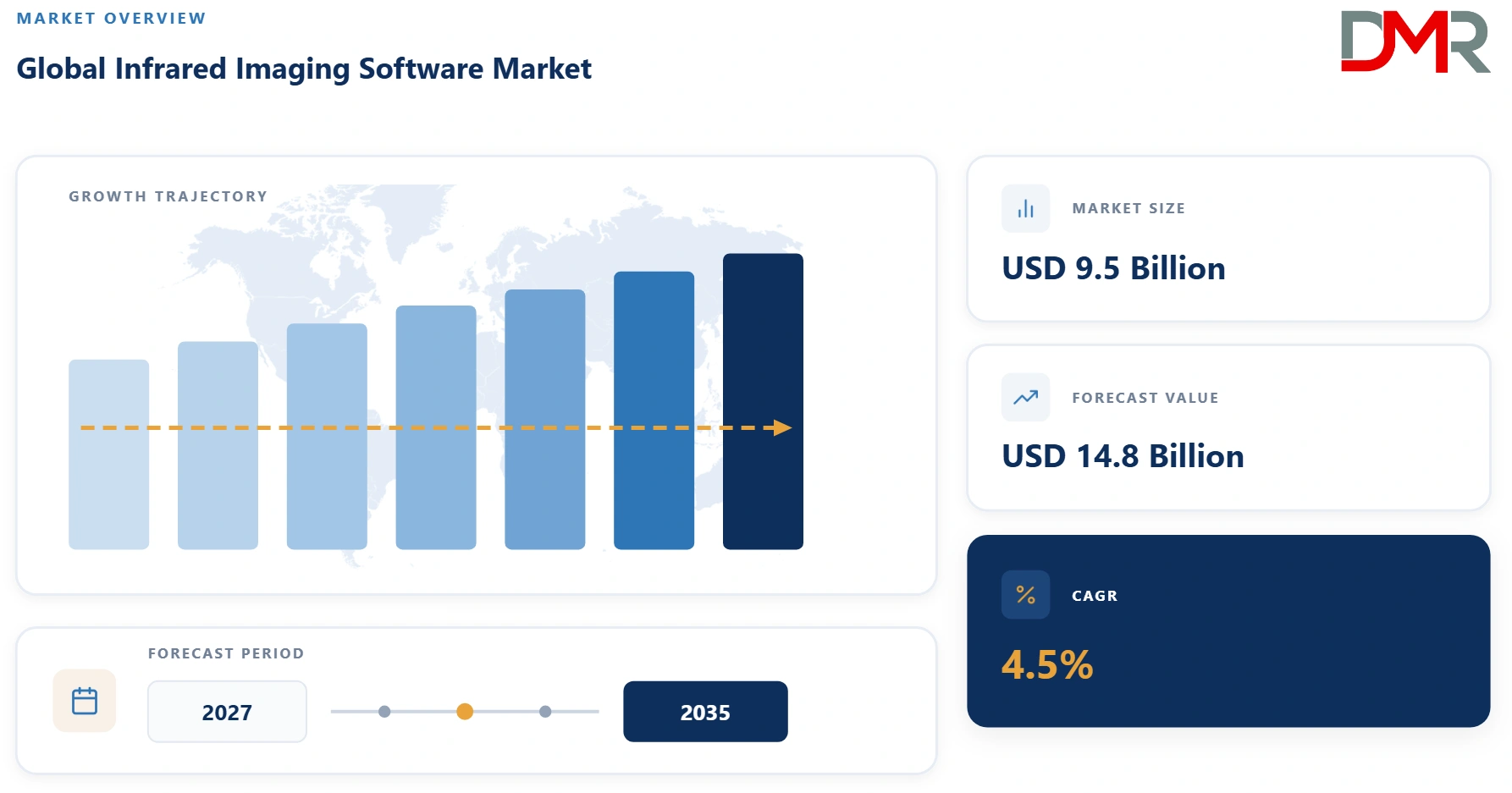
The Global Infrared Imaging Software Market is valued at USD 9.5 billion in 2026 and is projected to reach USD 14.8 billion by 2035, growing at a CAGR of 4.5% from 2027 to 2035. Market growth is driven by increasing adoption of industrial predictive maintenance solutions, growing demand for advanced thermal image analytics, expansion of security and surveillance infrastructure, and rising investments in industrial automation and digital asset management technologies.
ℹ
To learn more about this report –
Download Your Free Sample Report Here
Infrared imaging software refers to specialized software applications that enable the acquisition, processing, visualization, analysis, and interpretation of images captured through infrared imaging systems. These solutions incorporate thermal image analysis, temperature measurement, image enhancement, automated anomaly detection, data visualization, and inspection reporting capabilities. These applications help organizations identify temperature variations, monitor equipment performance, detect operational abnormalities, and improve analytical efficiency across industrial, commercial, healthcare, and scientific environments.
The Global Infrared Imaging Software Market encompasses thermal imaging analysis, infrared image processing, infrared image acquisition and visualization, and other specialized software solutions deployed through cloud-based and on-premises environments. The market covers manufacturing, aerospace & defense, energy & utilities, healthcare, automotive, construction & real estate, government & public safety, and other industries. Software subscriptions, perpetual licensing, enterprise licensing, software development kits, attributable embedded software revenue, and associated technical support are included in the revenue assessment.
Infrared Imaging Software Market Snapshot
Infrared Imaging Software Market Snapshot, 2027-2035
| Metric |
Value |
| Market Size (2026) |
USD 9.5 Billion |
| Forecast Value (2035) |
USD 14.8 Billion |
| CAGR (2027–2035) |
4.5% |
| Largest Region (2026) |
North America, 34.7% share |
| Fastest-Growing Region (2027–2035) |
Asia Pacific, 5.8% CAGR |
| Leading Software Type (2026) |
Thermal Imaging Analysis, 43.2% share |
| Leading Deployment (2026) |
On-Premises, 67.6% share |
| Key Players |
Teledyne FLIR LLC; Fluke Corporation; InfraTec GmbH; Optris GmbH; Testo SE & Co. KGaA; MoviTHERM; Workswell s.r.o.; Thermoteknix Systems Ltd. |
Key Takeaways
- Market Growth: The market is valued at USD 9.5 billion in 2026 and is projected to reach USD 14.8 billion by 2035, registering a CAGR of 4.5%.
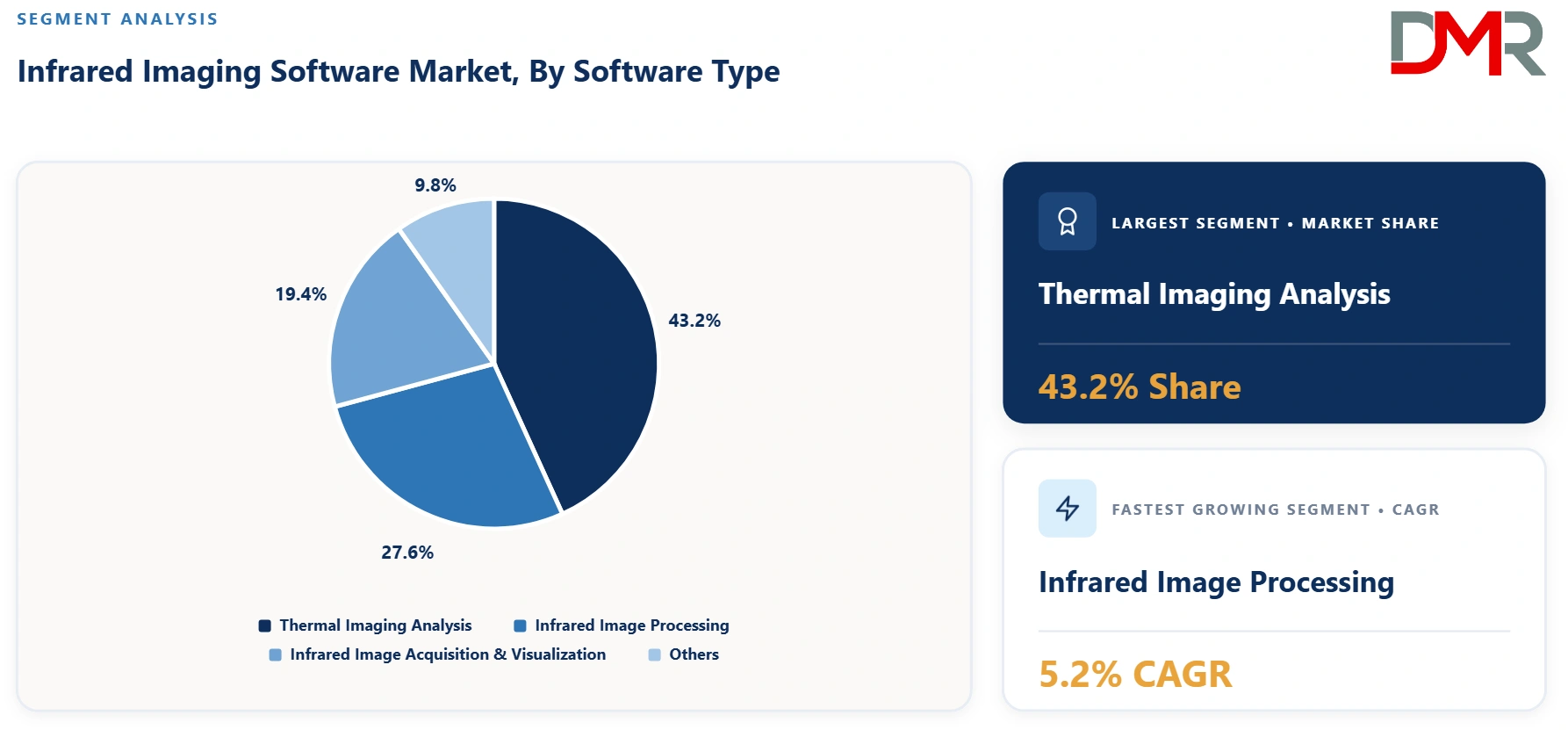
- Software Type Leader: Thermal Imaging Analysis accounts for 43.2% of market revenue in 2026, supported by increasing adoption of industrial thermography and equipment inspection solutions.
- Fastest-Growing Software Type: Infrared Image Processing is projected to register a CAGR of 5.2%, driven by growing demand for automated image enhancement and intelligent analytical capabilities.
- Deployment Leader: On-Premises deployment accounts for 67.6% of market revenue in 2026, supported by localized data processing, infrastructure control, and information security requirements.
- Fastest-Growing Deployment: Cloud-Based deployment is projected to register a CAGR of 5.9%, driven by increasing demand for remote monitoring and centralized thermal image analytics.
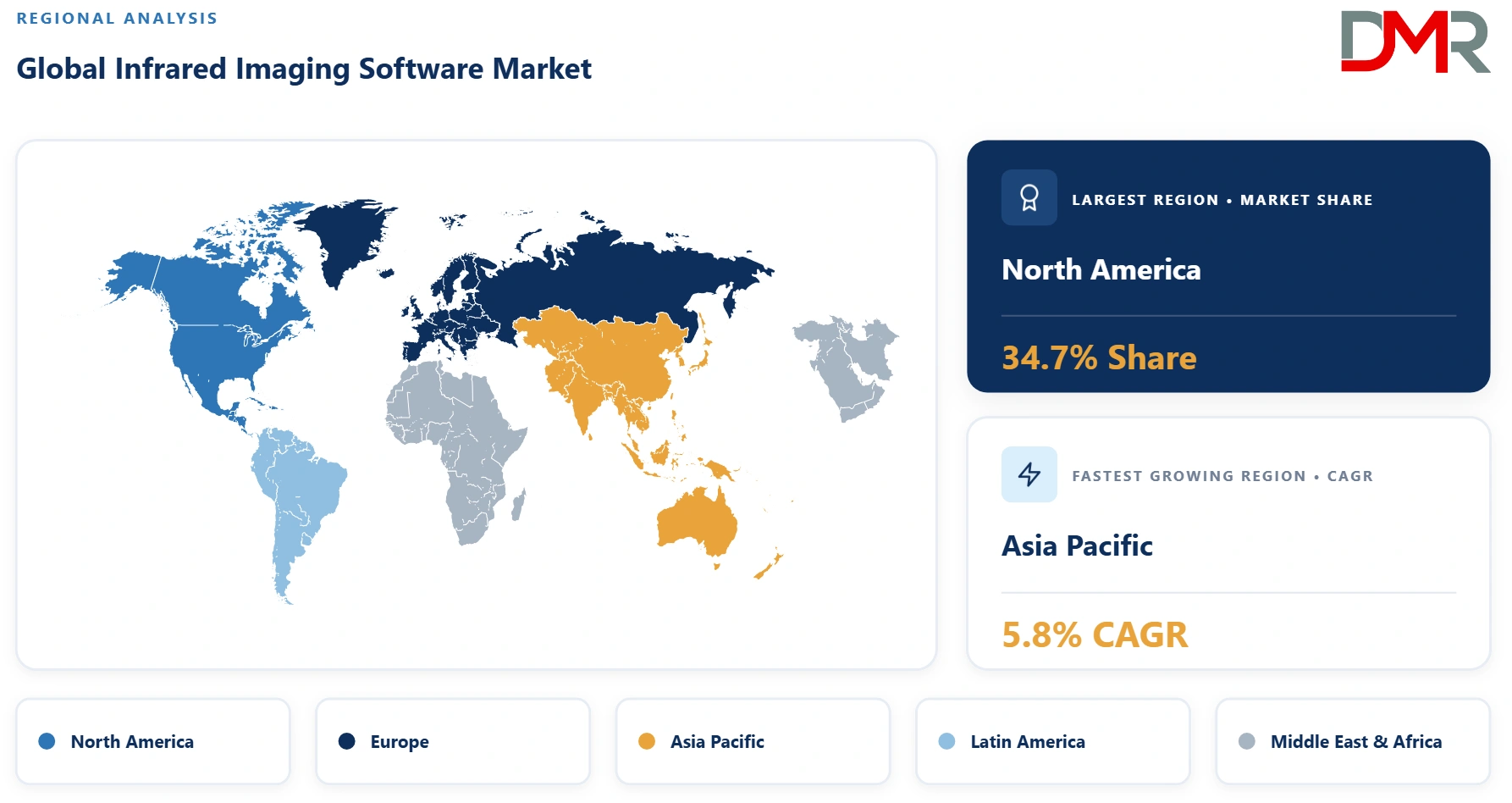
- Regional Picture: North America leads 34.7% market share in 2026, while Asia Pacific is projected to grow at a CAGR of 5.8%.
What are the Key Use Cases of Infrared Imaging Software?
- Industrial Predictive Maintenance: Identifies abnormal thermal patterns in machinery and electrical equipment, supporting early fault detection, maintenance optimization, and improved operational reliability.
- Security and Surveillance: Enhances infrared image interpretation for perimeter monitoring, intrusion detection, and security operations under low-light and challenging environmental conditions.
- Medical Imaging and Diagnostics: Supports non-invasive thermal pattern visualization, physiological monitoring, clinical research, and specialized medical image analysis across healthcare environments.
- Building and Infrastructure Inspection: Facilitates detection of insulation deficiencies, moisture intrusion, electrical abnormalities, and thermal inefficiencies across residential, commercial, and industrial infrastructure.
How are Foundation Models and Generative AI Transforming the Infrared Imaging Software Market
Foundation models and generative AI are transforming the Infrared Imaging Software Market through automated thermal image interpretation, intelligent anomaly detection, synthetic image generation, and enhanced analytical workflows. Advanced machine learning models support the identification of temperature abnormalities, equipment deterioration, and complex thermal patterns across industrial and commercial applications. Generative AI supports automated inspection report preparation, infrared image enhancement, and synthetic dataset generation for training specialized image recognition models002E
Foundation models also enable multimodal analysis by combining infrared images with visible-light imagery, equipment sensor readings, and operational information. Natural language interfaces help maintenance professionals retrieve historical inspection records and interpret analytical results efficiently. Integration with industrial IoT platforms and digital twins facilitates continuous condition monitoring and predictive maintenance planning. Increasing demand for automated inspection, reduced analytical workloads, and improved operational reliability encourages investment in AI-enabled infrared imaging software platforms.
Infrared Imaging Software Market Dynamics at a Glance
Drivers, Restraints, Opportunities and Trends in the Infrared Imaging Software Market
| Type |
Factor |
Impact |
| Driver |
Increasing Adoption of Predictive Maintenance and Industrial Automation |
High |
| Driver |
Growing Demand for Advanced Security and Surveillance Solutions |
High |
| Restraint |
High Software Implementation and Integration Costs |
High |
| Restraint |
Limited Availability of Skilled Professionals and Standardized Analytical Workflows |
Medium |
| Opportunity |
Expanding Applications of Infrared Imaging in Healthcare |
High |
| Opportunity |
Growing Commercial Potential of Cloud-Based Thermal Imaging Platforms |
High |
| Trend |
Increasing Integration of Artificial Intelligence and Automated Image Analytics |
High |
| Trend |
Growing Integration with Industrial IoT and Digital Twin Technologies |
High |
What is Driving the Growth of the Infrared Imaging Software Market?
Increasing Adoption of Predictive Maintenance and Industrial Automation
Increasing adoption of predictive maintenance and industrial automation is driving demand for infrared imaging software across manufacturing, energy, and infrastructure environments. Organizations increasingly utilize thermal imaging technologies to identify equipment overheating, electrical abnormalities, mechanical deterioration, and operational inefficiencies. Infrared imaging software supports temperature measurement, thermal pattern analysis, historical performance comparison, and automated inspection reporting. These capabilities help maintenance professionals identify potential equipment failures before significant operational disruptions occur. Integration with enterprise asset management platforms further improves maintenance planning and equipment monitoring. Growing emphasis on reducing unexpected downtime, improving production efficiency, and optimizing maintenance expenditure encourages investment in advanced infrared imaging software across industrial facilities.
Growing Demand for Advanced Security and Surveillance Solutions
Growing demand for advanced security and surveillance solutions is accelerating infrared imaging software adoption across commercial facilities, government organizations, transportation infrastructure, and industrial environments. Infrared imaging technologies support surveillance under low-light conditions and other challenging environmental circumstances. Specialized software enhances thermal image visualization, automated event detection, object recognition, and surveillance data management. Integration with centralized security management platforms enables organizations to monitor multiple locations and improve situational awareness. Increasing investments in critical infrastructure protection, perimeter security, and intelligent surveillance networks support commercial demand. Software providers are developing advanced analytical capabilities and scalable monitoring platforms to address evolving security requirements across public and private organizations.
What are the Key Restraints in the Infrared Imaging Software Market?
High Software Implementation and Integration Costs
High software implementation and integration costs present significant challenges for infrared imaging software adoption, particularly among organizations with limited technology budgets. Advanced platforms may require substantial expenditure on software licensing, computing infrastructure, system configuration, customization, and employee training. Additional expenses arise from integrating infrared imaging applications with existing cameras, industrial control systems, and enterprise monitoring platforms. Organizations operating legacy infrastructure may encounter compatibility challenges during deployment. Recurring software subscriptions, technical support, maintenance, and upgrade expenditure can further increase the total cost of ownership. These financial considerations restrict adoption of advanced infrared imaging software across smaller enterprises and cost-sensitive industrial environments.
Limited Availability of Skilled Professionals and Standardized Analytical Workflows
Limited availability of skilled professionals and standardized analytical workflows restricts effective infrared imaging software adoption across industrial and specialized environments. Accurate thermal image interpretation requires knowledge of thermography, emissivity, environmental influences, temperature measurement, and image processing techniques. Organizations may encounter difficulties recruiting professionals capable of distinguishing equipment abnormalities from external thermal variations. Differences in proprietary image formats, calibration procedures, analytical methodologies, and software interfaces can complicate interoperability between imaging systems. Healthcare applications also require appropriate clinical expertise and validation. These limitations increase dependence on specialized training, technical assistance, and manual verification, potentially slowing software adoption across emerging industries and developing economies.
What are the Key Opportunities in the Infrared Imaging Software Market?
Expanding Applications of Infrared Imaging in Healthcare
Expanding applications of infrared imaging in healthcare create commercial opportunities for software providers developing specialized medical image processing and analytical solutions. Healthcare institutions and research organizations are investigating thermal imaging for non-invasive physiological assessment, temperature distribution analysis, inflammation research, vascular evaluation, and other specialized applications. Advanced infrared imaging software enables thermal pattern visualization, quantitative measurement, image comparison, and research-oriented data analysis. Integration with artificial intelligence and healthcare information systems can improve analytical workflows and support clinical research activities. Increasing investments in digital healthcare infrastructure and medical imaging research create opportunities for application-specific software development, subject to appropriate clinical validation and regulatory authorization.
Growing Commercial Potential of Cloud-Based Thermal Imaging Platforms
Growing commercial potential of cloud-based thermal imaging platforms creates opportunities for software providers offering scalable, accessible, and centralized analytical solutions. Organizations operating geographically distributed facilities require platforms that enable remote access to thermal images, inspection reports, and equipment condition information. Cloud-based software facilitates centralized data storage, real-time collaboration, automated reporting, and subscription-based deployment. Smaller enterprises can access advanced analytical capabilities without substantial investment in dedicated computing infrastructure. Integration with connected infrared imaging systems and enterprise maintenance applications further improves operational coordination. Expanding industrial digitalization and growing demand for remote asset monitoring support commercial opportunities for software providers offering flexible cloud-based thermal imaging platforms.
What are the Latest Trends in the Infrared Imaging Software Market?
Increasing Integration of Artificial Intelligence and Automated Image Analytics
Increasing integration of artificial intelligence reflects changing requirements for efficient and accurate infrared image interpretation. Software developers are incorporating machine learning algorithms, automated thermal anomaly detection, image segmentation, and intelligent pattern recognition into infrared imaging platforms. These capabilities help maintenance professionals process large volumes of thermal images and prioritize potential equipment abnormalities. AI-assisted analytical tools also support temperature trend analysis, automated classification, and inspection report preparation. Organizations increasingly seek software solutions capable of reducing manual analytical workloads while maintaining consistent interpretation standards. Growing investments in industrial automation and intelligent imaging technologies encourage providers to expand AI-enabled functionalities across industrial, scientific, and commercial applications.
Growing Integration with Industrial IoT and Digital Twin Technologies
Growing integration with industrial IoT and digital twin technologies reflects the transition toward connected asset management and continuous equipment monitoring. Infrared imaging software increasingly supports the collection, processing, and visualization of thermal information from connected imaging systems. Integration with industrial IoT platforms allows organizations to combine thermal measurements with vibration, pressure, and other operational sensor information. Digital twins incorporate thermal datasets into virtual representations of physical equipment and infrastructure, supporting condition assessment and maintenance planning. Centralized analytical dashboards improve visibility across geographically distributed assets. Increasing demand for interoperable monitoring platforms encourages software providers to develop automated data exchange capabilities, standardized interfaces, and intelligent visualization tools.
Research Scope and Analysis
The research covers the Global Infrared Imaging Software Market across software type, deployment, application, end-use industry, and region. The analysis evaluates revenue generated through software subscriptions, perpetual licensing, enterprise licensing, application-specific analytical modules, software development kits, embedded infrared imaging software, and directly associated software support services. Market assessment incorporates technological developments, enterprise adoption, competitive positioning, software deployment preferences, industrial imaging requirements, and commercial growth opportunities across diverse industries and geographic markets. Revenue attributable exclusively to infrared cameras, sensors, optical components, and other imaging hardware is excluded from the market assessment.
ℹ
To learn more about this report –
Download Your Free Sample Report Here
By Software Type Analysis
Thermal Imaging Analysis is projected to dominate the software type segment in the Global Infrared Imaging Software Market, accounting for 43.2% of the total market share in 2026. Dominance is supported by extensive adoption of thermography software for industrial equipment monitoring, electrical inspection, temperature measurement, predictive maintenance, and infrastructure assessment. Infrared Image Processing is projected to be the fastest-growing segment, registering a CAGR of 5.2% from 2027 to 2035, driven by increasing demand for automated image enhancement, noise reduction, intelligent pattern recognition, image segmentation, and AI-assisted analytical capabilities across industrial, healthcare, security, and scientific applications.
By Deployment Analysis
On-Premises deployment is projected to dominate the deployment segment in the Global Infrared Imaging Software Market, accounting for 67.6% of the total market share in 2026. Dominance is supported by localized data processing requirements, established industrial computing infrastructure, information security considerations, and integration with existing infrared imaging systems. Cloud-Based deployment is projected to be the fastest-growing segment, registering a CAGR of 5.9% from 2027 to 2035, driven by increasing demand for remote thermal image analysis, centralized data management, flexible software subscriptions, multi-location collaboration, and scalable industrial monitoring capabilities across enterprise environments.
By Application Analysis
Predictive Maintenance & Inspection is projected to dominate the application segment in the Global Infrared Imaging Software Market, accounting for 29.4% of the total market share in 2026. Dominance is supported by increasing industrial automation, equipment condition monitoring requirements, electrical inspection activities, and organizational emphasis on reducing unexpected operational disruptions. Medical Imaging & Diagnostics is projected to be the fastest-growing segment, registering a CAGR of 5.6% from 2027 to 2035, driven by increasing research into non-invasive thermal assessment, expanding digital healthcare infrastructure, advanced image processing capabilities, and growing investment in AI-assisted medical imaging applications.
By End-Use Industry Analysis
Manufacturing is projected to dominate the end-use industry segment in the Global Infrared Imaging Software Market, accounting for 26.4% of the total market share in 2026. Dominance is supported by extensive utilization of thermal imaging software for equipment condition monitoring, production quality inspection, electrical maintenance, process optimization, and industrial safety applications. Healthcare is projected to be the fastest-growing segment, registering a CAGR of 5.5% from 2027 to 2035, driven by expanding medical imaging research, increasing investments in digital diagnostic technologies, growing interest in non-invasive physiological monitoring, and development of specialized infrared image analysis platforms.
How is the Infrared Imaging Software Market Segmented?
By Software Type
- Thermal Imaging Analysis
- Infrared Image Processing
- Infrared Image Acquisition & Visualization
- Others
By Deployment
By Application
- Predictive Maintenance & Inspection
- Surveillance & Security
- Temperature Monitoring
- Medical Imaging & Diagnostics
- Research & Development
- Building & Infrastructure Inspection
- Others
By End-Use Industry
- Manufacturing
- Aerospace & Defense
- Energy & Utilities
- Healthcare
- Automotive
- Construction & Real Estate
- Government & Public Safety
- Others
Which Region Leads the Infrared Imaging Software Market?
North America leads the Global Infrared Imaging Software Market with a market share of 34.7% in 2026, while Asia Pacific is projected to register the highest CAGR of 5.8% from 2027 to 2035.
ℹ
To learn more about this report –
Download Your Free Sample Report Here
Region with the Largest Revenue Share
North America dominates the Global Infrared Imaging Software Market, accounting for approximately 34.7% of the total market share in 2026. The regional market is valued at USD 3.3 billion in 2026 and is projected to reach USD 5.2 billion by 2035, registering a CAGR of 4.7%. Regional dominance is supported by established industrial infrastructure, advanced thermal imaging technologies, and substantial investments in predictive maintenance and industrial automation solutions. The U.S. and Canada contribute to regional demand through manufacturing modernization, energy infrastructure monitoring, aerospace research, and expanding security applications. Growing demand for intelligent image processing, automated reporting, and integrated asset monitoring solutions further supports regional market expansion.
Region with the Highest CAGR
Asia Pacific is projected to register the highest CAGR of 5.8% in the Global Infrared Imaging Software Market from 2027 to 2035. Regional growth is supported by rapid industrialization, expanding manufacturing capabilities, increasing investments in smart infrastructure, and growing adoption of industrial automation technologies. China, Japan, India, Australia, and South Korea contribute through manufacturing modernization, energy infrastructure development, automotive production, and scientific research initiatives. Increasing demand for affordable thermal imaging software, automated inspection capabilities, and remote equipment monitoring supports market expansion. Growing investments in digital healthcare and advanced imaging technologies further strengthen commercial opportunities across established and emerging regional economies.
Regional Analysis
Europe Infrared Imaging Software Market
The Europe Infrared Imaging Software Market is supported by established manufacturing infrastructure, increasing adoption of industrial automation technologies, and growing investments in energy-efficient building management. Germany, France, the U.K., Italy, and Spain contribute to regional demand through automotive production, aerospace research, industrial equipment manufacturing, and infrastructure modernization. Organizations increasingly utilize infrared imaging software for equipment condition assessment, production quality monitoring, energy audits, and preventive maintenance. Growing emphasis on industrial safety, environmental sustainability, and building energy performance supports adoption of advanced thermal analysis platforms. Expanding investments in intelligent manufacturing and specialized scientific imaging further create opportunities for infrared imaging software providers across regional industries.
Latin America Infrared Imaging Software Market
The Latin America Infrared Imaging Software Market is supported by expanding industrial infrastructure, increasing investments in energy and utilities, and growing adoption of digital asset monitoring technologies. Mexico and Brazil contribute to regional demand through automotive manufacturing, industrial production, oil and gas operations, and infrastructure development. Organizations increasingly utilize thermal imaging software to monitor electrical equipment, identify operational abnormalities, and optimize maintenance activities. Growing demand for affordable software solutions, localized technical support, and remote analytical capabilities supports commercial opportunities. Expanding adoption of industrial automation and digital monitoring platforms is expected to encourage market growth across established enterprises and emerging regional businesses.
Middle East & Africa Infrared Imaging Software Market
The Middle East & Africa Infrared Imaging Software Market is supported by expanding energy infrastructure, national industrial diversification initiatives, and increasing investments in construction and public safety technologies. Saudi Arabia, the UAE, and South Africa contribute to regional demand through oil and gas operations, power generation, infrastructure development, and industrial modernization. Organizations increasingly utilize thermal imaging software for electrical inspections, equipment monitoring, building assessments, and industrial maintenance activities. Growing demand for continuous temperature monitoring, automated inspection reporting, and remote asset management supports commercial opportunities. Expansion of smart infrastructure projects and increasing adoption of advanced industrial technologies encourage investment in specialized infrared imaging software across regional markets.
By Region
North America
Europe
- Germany
- France
- The U.K.
- Italy
- Spain
- Rest of Europe
Asia-Pacific
- China
- Japan
- India
- Australia
- South Korea
- Rest of APAC
Latin America
- Mexico
- Brazil
- Rest of LATAM
Middle East & Africa
- Saudi Arabia
- The UAE
- South Africa
- Rest of MEA
Regulatory Landscape
The regulatory landscape of the Global Infrared Imaging Software Market is influenced by industrial safety requirements, thermographic inspection standards, information security frameworks, medical device regulations, and data protection requirements. ISO 18434-1 establishes general procedures for thermography-based machinery condition monitoring and diagnostics, while ISO 18436-7 specifies qualification and assessment requirements for personnel performing infrared thermographic inspections. ASTM E1934 provides guidance for examining electrical and mechanical equipment using infrared thermography. Information security frameworks such as ISO/IEC 27001 and data protection regulations such as the General Data Protection Regulation (GDPR) influence software deployment and data management practices where applicable. Infrared imaging software intended for regulated medical applications may also be subject to relevant medical device regulations. These requirements encourage software providers to prioritize analytical reliability, measurement traceability, information security, and application-specific validation.
Technology Analysis
Technological advancements in the Global Infrared Imaging Software Market focus on radiometric image analysis, artificial intelligence, real-time image processing, automated anomaly detection, cloud computing, and industrial IoT integration. Modern platforms incorporate temperature measurement, emissivity correction, image segmentation, thermal pattern recognition, multi-camera visualization, and automated inspection reporting capabilities. Application programming interfaces and software development kits facilitate integration with infrared imaging hardware, industrial control systems, enterprise asset management platforms, and digital twin environments. Advanced image processing algorithms support image enhancement, noise reduction, multispectral image fusion, and quantitative thermal analysis. Cloud-based infrastructure facilitates centralized data storage, remote monitoring, and scalable analytical workflows. Increasing demand for efficient equipment inspection and intelligent thermal monitoring encourages investment in predictive analytics, automated image classification, and interoperable software platforms.
Who are the Leading Companies in the Infrared Imaging Software Market?
The Global Infrared Imaging Software Market is characterized by competition among established thermal imaging technology manufacturers, specialized infrared imaging software developers, machine vision solution providers, and industrial monitoring technology companies. Major participants include Teledyne FLIR LLC, Fluke Corporation, InfraTec GmbH, Optris GmbH, and Testo SE & Co. KGaA. Competitive differentiation focuses on thermal measurement accuracy, analytical functionality, image processing capabilities, hardware compatibility, software integration, deployment flexibility, automation, and licensing models. Companies strengthen market positioning through software innovation, intelligent analytical capabilities, strategic partnerships, and expanded application-specific software offerings.
- Teledyne FLIR LLC (Oregon, U.S.): Provides infrared imaging software through FLIR Thermal Studio and FLIR Research Studio, supporting thermal image processing, radiometric data acquisition, temperature analysis, automated reporting, and scientific research applications.
- Fluke Corporation (Washington, U.S.): Offers infrared imaging analysis and reporting software supporting equipment condition monitoring, electrical inspection, temperature measurement, and industrial preventive maintenance applications.
- InfraTec GmbH (Dresden, Germany): Provides IRBIS thermography software supporting infrared camera operation, thermal image acquisition, quantitative temperature analysis, automated monitoring, and professional thermographic inspection reporting.
- Optris GmbH (Berlin, Germany): Offers infrared imaging software through PIX Connect and Optris Connect, supporting real-time thermal image visualization, temperature monitoring, radiometric analysis, and industrial camera connectivity.
- Testo SE & Co. KGaA (Germany): Provides IRSoft thermography software supporting infrared image analysis, temperature measurement, thermal pattern interpretation, and professional inspection reporting across industrial and commercial applications.
Some of the prominent players in the global infrared imaging software market are:
- Teledyne FLIR LLC
- Fluke Corporation
- InfraTec GmbH
- Optris GmbH
- Testo SE & Co. KGaA
- MoviTHERM
- Workswell s.r.o.
- Thermoteknix Systems Ltd.
- HIKMICRO
- Guide Sensmart Tech Co., Ltd.
- InfiRay
- Telops Inc.
- Image Engineering GmbH & Co. KG
- Allied Vision Technologies GmbH
- Xenics
- AMETEK Land
- DIAS Infrared GmbH
- Micro-Epsilon Messtechnik GmbH & Co. KG
- ThermoAnalytics, Inc.
- GRAYESS Inc.
- Thermay Automation
- Infrared Cameras Inc. (ICI)
- FOTRIC Inc.
- Nippon Avionics Co., Ltd.
- SATIR
- Jenoptik AG
- Opgal Optronic Industries Ltd.
- DJI
- Zhejiang Dali Technology Co., Ltd.
- Shenzhen Everbest Machinery Industry Co., Ltd. (CEM)
- Raptor Photonics Ltd.
- New Imaging Technologies (NIT)
- IRCAM GmbH
- IRCameras LLC
- Infrared Laboratories, Inc.
- Thermal Trend
- Stress Photonics Inc.
- Keysight Technologies, Inc.
- MathWorks, Inc.
- Pix4D SA
- Other Key Players
Recent Developments
- In November 2026, Optris GmbH introduced version 12 of its Thermal Camera Software Development Kit (OTC SDK). The development simplifies infrared camera integration and radiometric data acquisition, supporting customized software applications across industrial temperature monitoring, automation, and scientific research.
- In July 2026, Optris GmbH launched Optris Connect, a new software platform designed for its PI and Xi thermal imaging cameras. The platform simplifies infrared thermography workflows, improves software usability, and provides a scalable foundation for advanced thermal imaging applications.
- In April 2026, HIKMICRO introduced its AI-powered SuperScene Mode, designed to simplify thermal imaging configuration and interpretation. The development integrates intelligent analytical capabilities to improve inspection efficiency and thermal image interpretation across electrical, HVAC, and industrial maintenance applications.
- In October 2025, MoviTHERM launched its iTL 2.0 thermal monitoring platform, offering simplified deployment and automated monitoring capabilities. The platform supports continuous thermal analysis, early fire detection, equipment condition monitoring, and industrial asset protection.
- In August 2025, HIKMICRO released version 2.4.6 of its HIKMICRO Viewer application. The software update supports thermal imaging workflows, mobile image analysis, and inspection reporting, improving accessibility and operational convenience for thermography professionals.
Report Scope and Research Methodology
Definition: The Infrared Imaging Software Market encompasses specialized software solutions supporting infrared image acquisition, thermal imaging analysis, image processing, temperature measurement, data visualization, automated anomaly detection, and analytical reporting across industrial, commercial, healthcare, scientific, and security environments globally. Embedded software, software development kits, and integrated imaging platforms are included only to the extent that revenue is attributable to infrared imaging software functionality and associated services. Revenue generated exclusively through infrared cameras, sensors, optical components, and other hardware is excluded.
Methodology: DMR's market estimation methodology combines bottom-up analysis of infrared imaging software provider revenues, paid subscriptions, perpetual and enterprise licensing, software adoption rates, embedded software revenue allocation, and associated software support expenditure with top-down validation against infrared imaging technology, industrial monitoring software, and specialized image processing software spending. Primary interviews with infrared imaging software providers, thermal imaging equipment manufacturers, system integrators, industrial maintenance professionals, thermography specialists, and enterprise end users support validation of pricing, adoption, and revenue assumptions. Forecasts incorporate segment-level growth expectations for 2027–2035 and periodic assessment of technological advancements, industrial requirements, competitive developments, and market conditions.
Report Details
| Report Characteristics |
Details |
| Market Size (2026) |
USD 9.5 Billion |
| Market Size (2027) |
USD 10.4 Billion |
| Forecast Value (2035) |
USD 14.8 Billion |
| CAGR (2027–2035) |
4.5% |
| Historical Data |
2021–2026 |
| Forecast Data |
2027–2035 |
| Base Year |
2026 |
| Estimate Year |
2027 |
| Regional Coverage |
North America (The US, Canada); Europe (Germany, France, The UK, Italy, Spain, Rest of Europe); Asia Pacific (China, Japan, India, Australia, South Korea, Rest of APAC); Latin America (Mexico, Brazil, Rest of LATAM); Middle East & Africa (Saudi Arabia, The UAE, South Africa, Rest of MEA) |
Frequently Asked Questions
How big is the Infrared Imaging Software Market in 2026?
▾ The Global Infrared Imaging Software Market is valued at USD 9.5 billion in 2026 and is projected to reach USD 14.8 billion by 2035.
What is the growth rate of the Infrared Imaging Software Market?
▾ The Global Infrared Imaging Software Market is projected to grow at a CAGR of 4.5% from 2027 to 2035.
Which region leads the Infrared Imaging Software Market?
▾ North America dominates the Global Infrared Imaging Software Market, accounting for an implied market share of 34.7% in 2026.
Which software type segment dominates the Infrared Imaging Software Market?
▾ Thermal Imaging Analysis dominates the software type segment of the Infrared Imaging Software Market, accounting for a 43.2% share in 2026.
Which end-use industry is growing fastest in the Infrared Imaging Software Market?
▾ Healthcare is projected to be the fastest-growing end-use industry, registering a CAGR of 5.5% from 2027 to 2035.
Who are the key players in the Infrared Imaging Software Market?
▾ Key players include Teledyne FLIR LLC, Fluke Corporation, InfraTec GmbH, Optris GmbH, Testo SE & Co. KGaA, MoviTHERM, Workswell s.r.o., and Thermoteknix Systems Ltd.
What are the main challenges facing the Infrared Imaging Software Market?
▾ High software implementation and integration costs, limited availability of skilled professionals, and insufficiently standardized analytical workflows represent significant market challenges.