What is the Infrastructure Solution Integration Service Market Size?
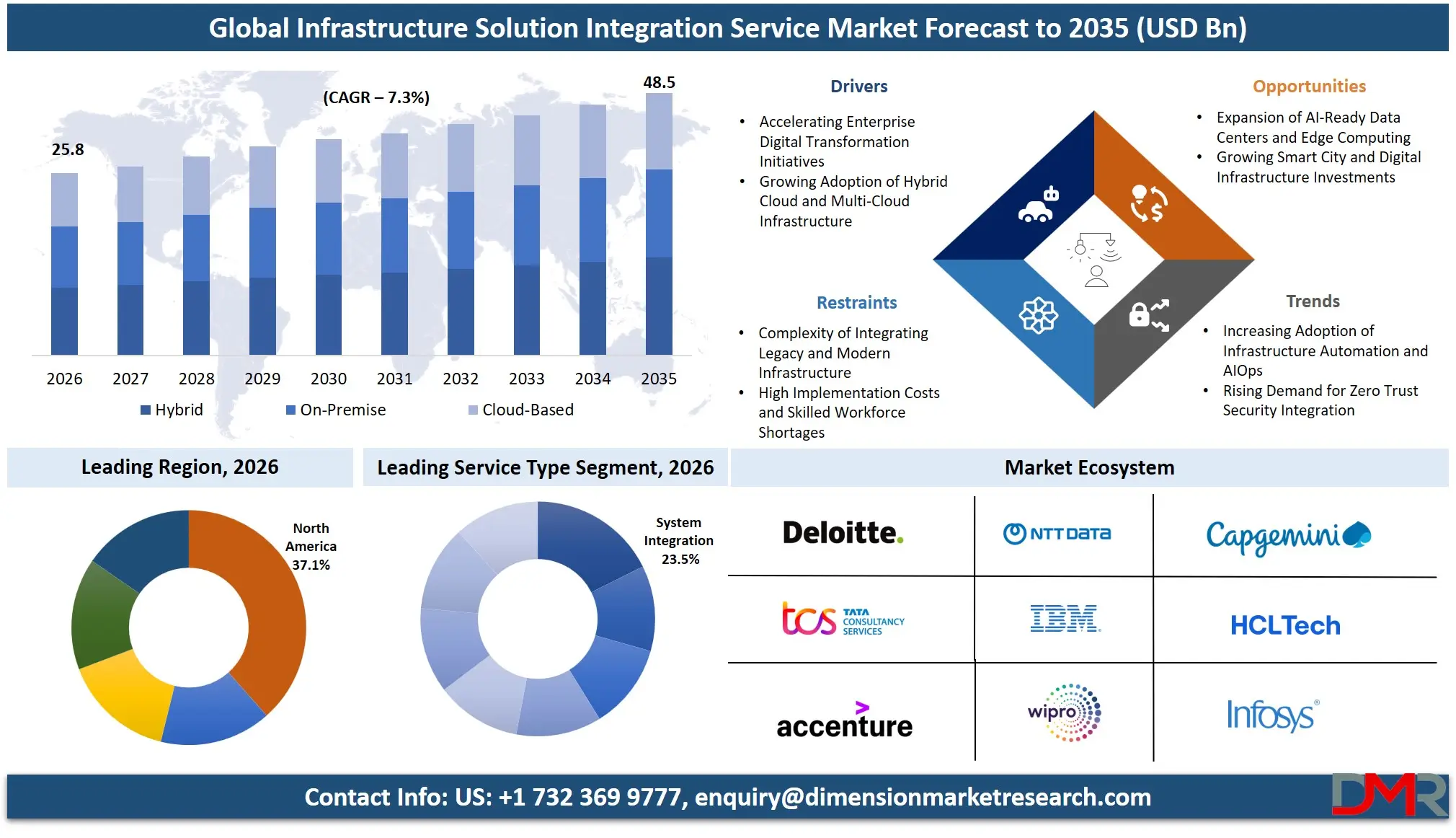
The Global Infrastructure Solution Integration Service Market is expected to reach a value of USD 25.8 billion in 2026, and it is further anticipated to reach USD 48.5 billion by 2035, growing at a CAGR of 7.3% during the forecast period.
ℹ
To learn more about this report –
Download Your Free Sample Report Here
The market is experiencing steady growth as enterprises navigate increasingly fragmented IT environments that blend legacy systems with modern cloud architectures. This market encompasses the professional design, consolidation, and orchestration of disparate compute, network, storage, and security components into a cohesive, high-performing technology backbone. The escalating need to ensure seamless interoperability between on-premise data centers, public cloud platforms, and edge computing nodes is driving demand for specialized integration services. Enterprises are most aggressively integrating hybrid infrastructure models, as they seek to balance the scalability of the cloud with the control of private infrastructure. The BFSI, healthcare, and manufacturing sectors are key clients, requiring integrated systems that guarantee low-latency performance, data integrity, and operational resilience.
The US Infrastructure Solution Integration Service Market
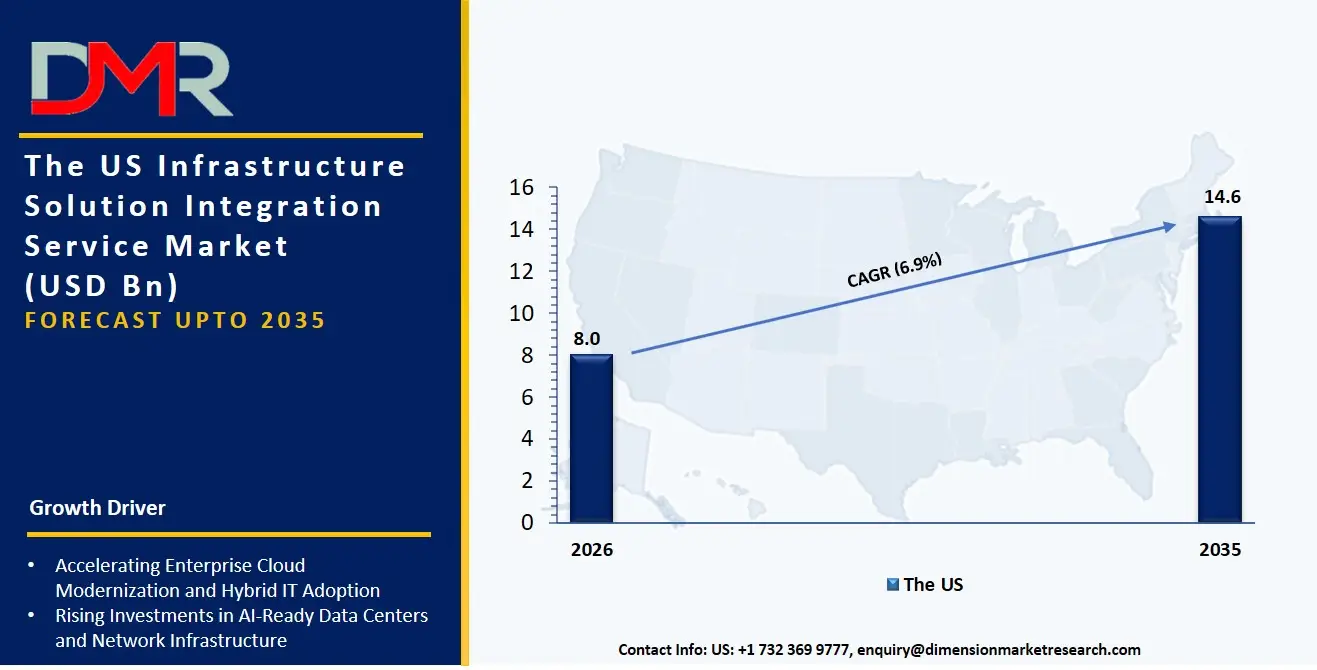
The US Infrastructure Solution Integration Service Market is projected to reach USD 8.0 billion in 2026 at a compound annual growth rate of 6.9% over its forecast period, culminating in a value of USD 14.6 billion by 2035.
ℹ
To learn more about this report –
Download Your Free Sample Report Here
The US remains the largest and most sophisticated market, driven by the modernization agendas of large enterprises and federal government mandates for IT infrastructure consolidation. The market is characterized by high demand for Data Center Integration services as organizations pivot to software-defined architectures, and for Security Integration, where zero-trust network access (ZTNA) is being woven into the fabric of the infrastructure. The integration of AI for predictive maintenance within managed infrastructure services is also a defining trend, creating a parallel need for specialized integration to support data-intensive operations.
The Europe Infrastructure Solution Integration Service Market
The Europe Infrastructure Solution Integration Service Market is estimated to be valued at USD 7.4 billion in 2026 and is further anticipated to reach USD 13.8 billion by 2035 at a CAGR of 7.1%. The European market is heavily influenced by regulatory frameworks like GDPR and the EU Data Strategy, which necessitate sovereign and secure integration solutions. This drives strong demand for Hybrid Infrastructure integration, enabling data to be classified and stored across private and public environments to meet data residency requirements. The region, led by Germany and France, is seeing accelerated growth in Network Transformation services as manufacturers integrate operational technology (OT) with enterprise IT networks, requiring robust integration to maintain real-time, secure data flows from the factory floor to the cloud analytics layer.
The Japan Infrastructure Solution Integration Service Market
The Japan Infrastructure Solution Integration Service Market is projected to be valued at USD 2.7 billion in 2026. It is further expected to witness robust growth, holding USD 4.9 billion in 2035 at a CAGR of 6.7%. The Japanese market is uniquely shaped by a corporate imperative for "Society 5.0," which demands the integration of cyber and physical spaces. This fuels substantial investment in Cloud Infrastructure Integration and Maintenance and Support Services as traditional conglomerates dismantle IT silos and migrate from aging mainframes. There is a profound need for deep local integration expertise to bridge the gap between proprietary industrial control systems and modern enterprise software, creating a niche for System Integration that ensures seamless data interoperability across the manufacturing and healthcare sectors.
Key Takeaways
- Market Size & Forecast: The Global Infrastructure Solution Integration Service market is projected to reach USD 25.8 billion in 2026, expanding to USD 48.5 billion by 2035, fueled by the relentless growth of data and the need to unify complex, multi-vendor IT estates into a manageable whole.
- Growth Rate & Outlook: Global market growth is expected at a CAGR of 7.3%, driven by a critical architectural challenge: making agile, cloud-native applications communicate securely and reliably with legacy mission-critical systems.
- Primary Growth Drivers: Key forces include the standardization around hybrid-by-design models, the mandate for IT Infrastructure Modernization to reduce technical debt, and the imperative for Cybersecurity Integration to embed security controls directly into the network and compute fabric.
- Key Market Trends: Major trends include the rise of infrastructure-as-code (IaC) for automated integration, the use of AIOps within Managed Infrastructure Services for self-healing systems, and the shift toward composable, software-defined infrastructure that can be reconfigured on demand.
- By Infrastructure Type Analysis: Hybrid Infrastructure dominates strategic discussions as it reflects the prevailing enterprise reality. Integration services are critical for building a unified control plane that provides visibility and governance across disparate cloud and on-premise resources.
- By Enterprise Function Analysis: IT Infrastructure Modernization and Cloud Migration are the most impactful enterprise functions, as they form the foundational steps for all other transformation initiatives. Cybersecurity Integration is the fastest-growing function, embedded into every integration project as a non-negotiable design principle.
- Regional Leadership: North America is poised to dominate this market, commanding an estimated 37.1% market share in 2026, due to its high concentration of hyperscale data centers, pioneering technology enterprises, and a mature ecosystem of global system integrators.
What is the Infrastructure Solution Integration Service Market?
Infrastructure Solution Integration Services are the specialized advisory and technical implementation offerings that enable a unified and optimized IT ecosystem. Unlike discrete hardware or software procurement, these services focus on the architecture of coherence—how servers, storage, networks, and security controls are designed, deployed, and orchestrated to function as a single, reliable system. This involves System Integration to connect multi-vendor hardware and software, Infrastructure Consulting to design a future-ready technology roadmap, and Data Center Integration to consolidate facilities into agile, software-defined environments. With most organizations managing a mix of on-premise, colocation, and multi-cloud resources, these services are essential for eradicating operational silos, automating workflows, and ensuring that the entire infrastructure estate delivers optimal performance, security, and cost efficiency.
Use Cases
- High-Frequency Trading Platform Integration in Banking: A global investment bank engages System and Network Integration services to design an ultra-low-latency computing fabric, synchronizing co-located exchange servers with cloud-based risk analytics engines to process millions of transactions per second.
- Interoperable Electronic Health Record (EHR) Systems in Healthcare: A national hospital network uses Cloud Infrastructure Integration to build a data-sharing layer across disparate EHR systems and private cloud-based PACS imaging archives, enabling clinicians to access a unified, 360-degree patient record.
- Industrial IoT and Data Center Consolidation in Manufacturing: A multinational manufacturer employs Data Center Consolidation and Network Transformation services to integrate data from thousands of IoT sensors on the factory floor into a centralized private cloud, enabling real-time predictive maintenance and supply chain visibility.
- Sovereign Government IT Modernization: A federal agency commissions Security and Cloud Infrastructure Integration services to create a secure government community cloud, integrating it with legacy mainframe citizen databases while ensuring all data and encryption keys remain within national borders.
How AI is Transforming the Infrastructure Solution Integration Service Market
AI is fundamentally reshaping infrastructure integration by shifting it from a reactive, manual discipline to a predictive and autonomous one. In Managed Infrastructure Services, AI-driven operations (AIOps) platforms ingest massive streams of telemetry data to predict capacity exhaustion and detect anomalies, triggering automated remediation before a service outage occurs. This transforms support from a break-fix model to a proactive, health-management function.
Within Network Integration, AI is powering intent-based networking, where a high-level business policy is automatically translated into network configuration across hundreds of devices, drastically reducing the human error associated with manual setups. For Security Integration, AI models analyze east-west traffic within a data center in real time to identify lateral movement of threats, enabling dynamic micro-segmentation that isolates a compromised server instantaneously, an act impossible for static security tools alone.
Research Scope and Analysis
The Global Infrastructure Solution Integration Service Market is segmented by Service Type, Infrastructure Type, Deployment Mode, Organization Size, Enterprise Function, and End User. The market covers system integration, cloud and network infrastructure, hybrid deployments, enterprise modernization, cloud migration, cybersecurity integration, and serves industries including IT and telecommunications, BFSI, government, healthcare, manufacturing, retail, energy, transportation, education, media, and others.
ℹ
To learn more about this report –
Download Your Free Sample Report Here
By Service Type Analysis
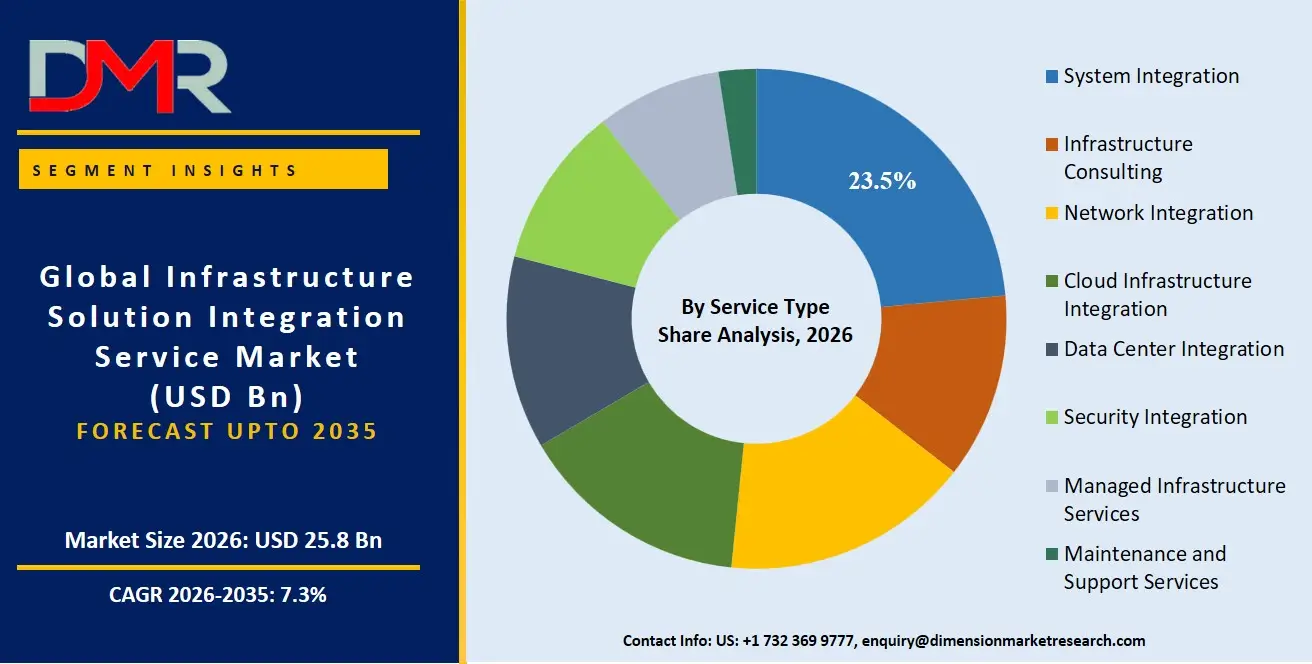
System Integration is projected to dominate the Global Infrastructure Solution Integration Service Market because enterprises increasingly require seamless integration of diverse IT environments, including cloud platforms, legacy systems, networking equipment, cybersecurity tools, and enterprise applications. Organizations undertaking digital transformation prioritize unified infrastructure that enhances operational efficiency, minimizes system complexity, and supports business continuity. System integration services enable interoperability across hybrid and multi-cloud environments while reducing deployment risks and improving resource utilization. Growing investments in enterprise modernization, automation, AI-enabled operations, and digital workplaces further strengthen demand. As businesses seek scalable, secure, and interconnected IT ecosystems, system integration remains the leading service category globally.
By Infrastructure Type Analysis
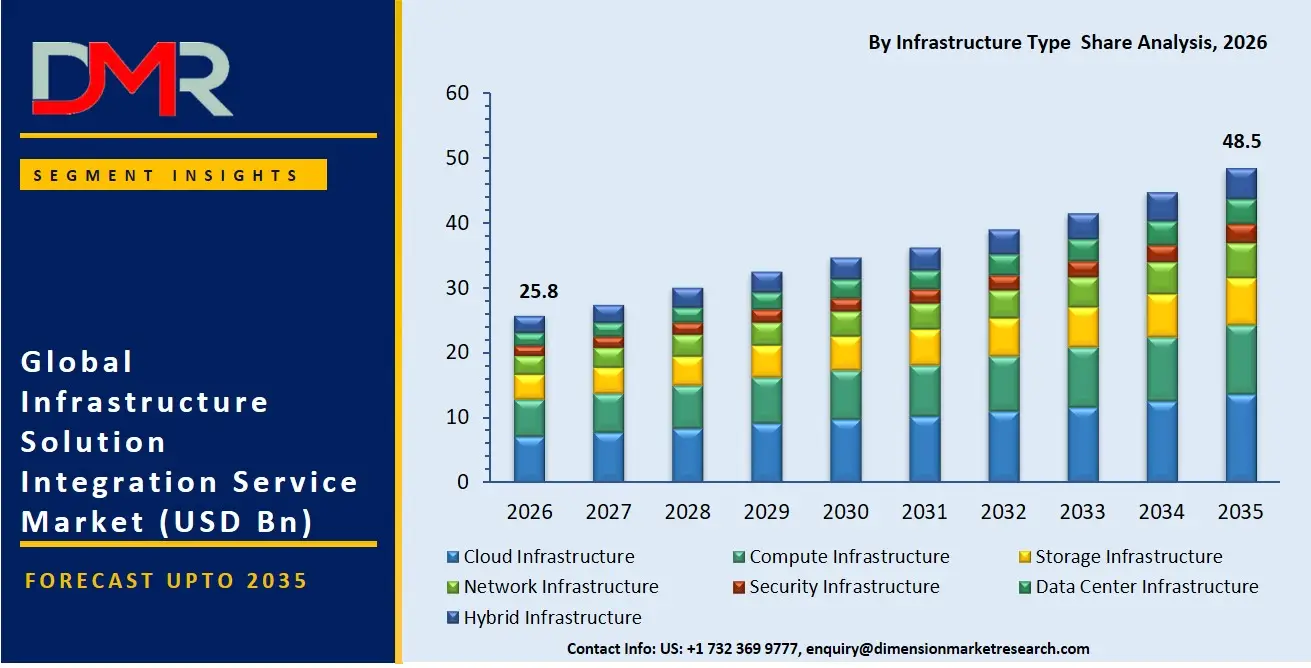
Cloud Infrastructure is expected to dominate the market due to widespread enterprise migration toward scalable, flexible, and cost-efficient cloud environments. Organizations increasingly deploy cloud-native applications, hybrid cloud architectures, and software-as-a-service platforms to improve business agility and operational resilience.
ℹ
To learn more about this report –
Download Your Free Sample Report Here
Infrastructure integration services help unify public, private, and hybrid cloud resources while ensuring security, governance, and workload optimization. The rapid adoption of artificial intelligence, analytics, remote work technologies, and digital business models continues to accelerate cloud infrastructure investments. Enterprises across industries prioritize cloud integration to modernize IT operations, reduce infrastructure costs, improve scalability, and support long-term digital transformation initiatives.
By Deployment Mode Analysis
Hybrid deployment is anticipated to dominate because enterprises increasingly combine on-premise infrastructure with public and private cloud environments to balance performance, security, compliance, and cost efficiency. Hybrid architectures allow organizations to maintain critical workloads on-premise while leveraging cloud scalability for dynamic business applications. Infrastructure integration providers enable seamless connectivity, workload orchestration, and centralized management across distributed environments. The growing need for business continuity, regulatory compliance, disaster recovery, and digital transformation has accelerated hybrid infrastructure adoption worldwide. As organizations seek flexibility without completely replacing legacy systems, hybrid deployment continues to represent the preferred infrastructure integration model.
By Organization Size Analysis
Large enterprises is poised to dominate the Infrastructure Solution Integration Service Market because they operate highly complex IT environments spanning multiple business units, geographies, cloud platforms, and data centers. These organizations require advanced integration services to modernize infrastructure, improve operational efficiency, strengthen cybersecurity, and support digital transformation initiatives. Large enterprises also possess significant technology budgets, enabling investments in enterprise-wide cloud migration, network modernization, automation, and hybrid infrastructure. The increasing adoption of AI, edge computing, and digital workplace solutions further drives integration demand. Their continuous focus on business resilience and scalable infrastructure maintains their dominant market position.
By Enterprise Function Analysis
Cloud Migration is projected to dominate the enterprise function segment because organizations across industries continue shifting critical workloads from legacy infrastructure to cloud environments to improve scalability, flexibility, and operational efficiency. Infrastructure integration services simplify migration planning, application modernization, workload optimization, security implementation, and hybrid cloud connectivity while minimizing operational disruptions. Businesses increasingly prioritize cloud migration to support remote work, digital transformation, advanced analytics, and artificial intelligence initiatives. The need to reduce infrastructure costs, improve disaster recovery capabilities, and accelerate innovation continues to drive substantial investments in cloud migration services, making it the leading enterprise integration function globally.
By End User Analysis
IT and Telecommunications is anticipated to dominate the market because service providers and technology companies continually invest in advanced network infrastructure, cloud platforms, edge computing, 5G deployment, and data center modernization. These organizations require sophisticated integration services to connect diverse technologies while maintaining network reliability, cybersecurity, and operational efficiency. Rapid growth in digital services, cloud adoption, artificial intelligence, and enterprise connectivity has significantly increased infrastructure complexity, driving demand for professional integration expertise. Continuous investments in network transformation, hybrid cloud environments, and digital service delivery ensure that the IT and Telecommunications sector remains the largest end-user segment.
The Global Infrastructure Solution Integration Service Market Report is segmented on the basis of the following:
By Service Type
- System Integration
- Infrastructure Consulting
- Network Integration
- Cloud Infrastructure Integration
- Data Center Integration
- Security Integration
- Managed Infrastructure Services
- Maintenance and Support Services
By Infrastructure Type
- Cloud Infrastructure
- Compute Infrastructure
- Storage Infrastructure
- Network Infrastructure
- Security Infrastructure
- Data Center Infrastructure
- Hybrid Infrastructure
By Deployment Mode
- Hybrid
- On-Premise
- Cloud-Based
By Organization Size
- Large Enterprises
- Small and Medium Enterprises
By Enterprise Function
- Cloud Migration
- IT Infrastructure Modernization
- Network Transformation
- Data Center Consolidation
- Disaster Recovery and Business Continuity
- Cybersecurity Integration
- Digital Workplace Enablement
- Others
By End User
- IT and Telecommunications
- Banking, Financial Services and Insurance
- Government and Public Sector
- Healthcare and Life Sciences
- Manufacturing
- Retail and E-commerce
- Energy and Utilities
- Transportation and Logistics
- Education
- Media and Entertainment
- Others
Regional Analysis
Leading Region by Market Share
ℹ
To learn more about this report –
Download Your Free Sample Report Here
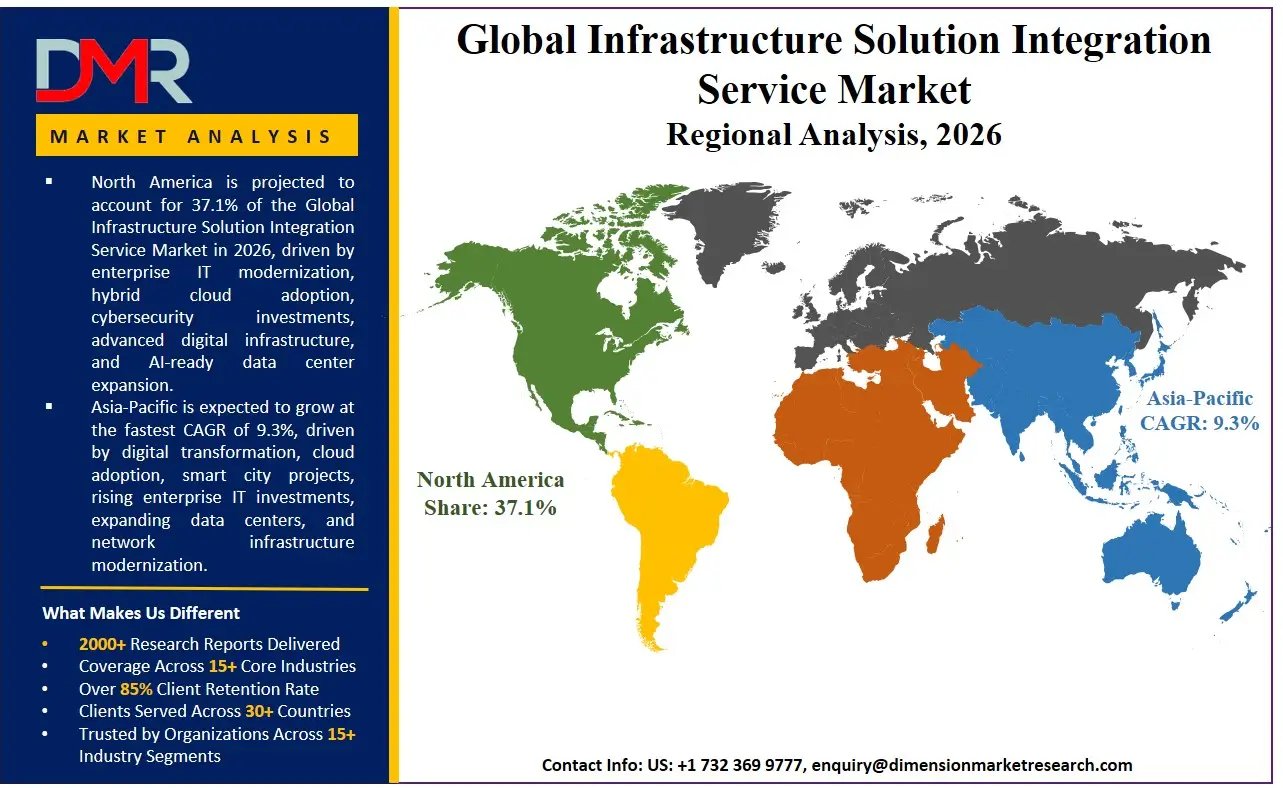
North America is poised to dominate the global infrastructure solution integration service market, holding an estimated 37.1% of the market share in 2026. The United States anchors this leadership, driven by the world's highest concentration of hyperscale data center operators and a corporate culture that aggressively leverages technology for competitive advantage. The market is propelled by enterprise-wide initiatives to modernize technical debt, consolidate sprawling IT assets from M&A activity, and integrate AI/ML infrastructure stacks. The presence of a mature ecosystem of global system integrators and a deep bench of architects skilled in software-defined data centers ensures that complex, large-scale integration programs are executed successfully, cementing the region's dominant position.
Fastest-Growing Regional Market
Asia-Pacific is expected to be the most rapidly expanding market, fueled by state-led smart city initiatives, massive digital transformation in India, China, and Southeast Asia, and the rapid industrialization of its digital economies. The region is leapfrogging traditional IT models, with greenfield projects demanding the seamless integration of IoT, 5G private networks, and cloud-native compute right from inception. A severe shortage of full-stack integration talent forces a high reliance on external system integrators and infrastructure consultants to design, build, and manage these next-generation platforms. This vendor dependency, combined with the sheer scale of infrastructure build-out, creates a high-velocity growth environment for professional integration services.
By Region
North America
Europe
- Germany
- The U.K.
- France
- Italy
- Russia
- Spain
- Benelux
- Nordic
- Rest of Europe
Asia-Pacific
- China
- Japan
- South Korea
- India
- ANZ
- ASEAN
- Rest of Asia-Pacific
Latin America
- Brazil
- Mexico
- Argentina
- Colombia
- Rest of Latin America
Middle East & Africa
- Saudi Arabia
- UAE
- South Africa
- Israel
- Egypt
- Rest of MEA
Competitive Landscape
The competitive landscape of the global infrastructure solution integration service market is a diverse arena comprising massive global system integrators (GSIs), traditional telecommunication and network services companies, and specialized pure-play data center integrators. The key differentiator is shifting from generic IT outsourcing to deep domain expertise in software-defined platforms (compute, storage, networking) and AIOps-driven automation. Strategic alliances with VMware, Cisco, Dell, and major public cloud providers are critical for early access to technology roadmaps and co-creating reference architectures. Market consolidation is accelerating, with consulting-led firms acquiring niche players specializing in cybersecurity integration and cloud-native networking to offer a complete, end-to-end infrastructure transformation portfolio. Proprietary intellectual property, in the form of automated infrastructure assessment tools, IaC libraries, and self-healing managed services platforms, is becoming the central pillar of competitive advantage.
Some of the prominent players in the Global Infrastructure Solution Integration Service Market are:
- Accenture plc
- IBM Corporation
- Deloitte
- Capgemini SE
- Tata Consultancy Services
- Infosys Limited
- Wipro Limited
- HCLTech
- NTT DATA Group Corporation
- Fujitsu Limited
- Kyndryl Holdings, Inc.
- DXC Technology Company
- Atos SE
- Cognizant Technology Solutions Corporation
- Unisys Corporation
- CGI Inc.
- Hewlett Packard Enterprise
- Cisco Systems, Inc.
- Oracle Corporation
- Hewlett Packard Enterprise Aruba Networking
- Other Key Players
Recent Developments
- May 2026: Kyndryl introduced a new agentic AI capability within Kyndryl Bridge, enabling enterprises to proactively detect, predict, and resolve IT infrastructure risks before they become outages, strengthening AI-driven infrastructure operations.
- April 2026: Kyndryl expanded its Distributed Cloud Services with Google Cloud, helping enterprises integrate hybrid and multi-cloud environments while supporting AI-ready application modernization and sovereign cloud deployments.
- March 2026: IBM launched its first Infrastructure Innovation Center in India to accelerate enterprise-scale AI adoption and infrastructure engineering through collaboration with clients, ecosystem partners, and global system integrators.
Report Details
| Report Characteristics |
| Market Size (2026) |
USD 25.8 Bn |
| Forecast Value (2035) |
USD 48.5 Bn |
| CAGR (2026–2035) |
7.3% |
| The US Market Size (2026) |
USD 8.0 Bn |
| Historical Data |
2021 – 2025 |
| Forecast Data |
2027 – 2035 |
| Base Year |
2025 |
| Estimate Year |
2026 |
| Segments Covered |
By Service Type, By Infrastructure Type, By Deployment Mode, By Organization Size, By Enterprise Function, and By End User |
| Regional Coverage |
North America – The US and Canada; Europe – Germany, The UK, France, Russia, Spain, Italy, Benelux, Nordic, & Rest of Europe; Asia-Pacific – China, Japan, South Korea, India, ANZ, ASEAN, Rest of APAC; Latin America – Brazil, Mexico, Argentina, Colombia, Rest of Latin America; Middle East & Africa – Saudi Arabia, UAE, South Africa, Turkey, Egypt, Israel, & Rest of MEA |
Frequently Asked Questions
How big is the Global Infrastructure Solution Integration Service Market?
▾ The Global Infrastructure Solution Integration Service market is poised to be valued at USD 25.8 billion in 2026 and is projected to reach USD 48.5 billion by 2035, driven by the universal need to orchestrate complex, multi-vendor IT ecosystems into efficient and secure platforms.
What is the CAGR of the Global Infrastructure Solution Integration Service Market from 2026 to 2035?
▾ The market is expected to grow at a CAGR of 7.3% from 2026 to 2035, reflecting the persistent architectural challenge of making agile, cloud-native applications and legacy mission-critical systems function as a single, cohesive unit.
What factors are driving the growth of the Global Infrastructure Solution Integration Service Market?
▾ Key drivers include the unmanageable complexity of hybrid multi-cloud orchestration, the architectural mandate to embed zero-trust security across the entire infrastructure fabric, and the critical skills shortage of full-stack integration architects within enterprises.
Which region held the largest share of the Infrastructure Solution Integration Service Market in 2026?
▾ North America held an estimated 37.1% market share in 2026, driven by a mature ecosystem of system integrators and aggressive enterprise investment in modernizing data centers and integrating AI/ML compute infrastructure.
Which region is expected to grow the fastest in the Infrastructure Solution Integration Service Market?
▾ The Asia-Pacific region is expected to grow the fastest, fueled by massive greenfield digital infrastructure projects in India, China, and Southeast Asia that demand seamless integration of IoT, 5G, and cloud-native technologies from inception.
What are the major trends in the Global Infrastructure Solution Integration Service Market?
▾ Major trends include the programmatic management of infrastructure through Infrastructure-as-Code (IaC), the use of AIOps in managed services for predictive and autonomous operations, and the design of modular, composable hardware architectures.
Who are the key players in the Global Infrastructure Solution Integration Service Market?
▾ Key players include Global System Integrators like IBM, Accenture, TCS, and HCLTech, infrastructure-focused service providers like Kyndryl and NTT DATA, and technology vendors with vast professional services arms like Cisco.
How is the Global Infrastructure Solution Integration Service Market segmented?
▾ The market is segmented by Service Type, Infrastructure Type, Deployment Mode, Organization Size, Enterprise Function, and End User, to provide a comprehensive view of the ecosystem focused on creating unified, optimized IT operating environments.