Global Inside Sales Software Market Snapshot
- Global Inside Sales Software Market Size in 2026: USD 9,248.7 million
- Global Inside Sales Software Market Size in 2035: USD 23,658.5 million
- Global CAGR from 2027 to 2035: 11.0%
- Sales Engagement Platforms are the leading Solution Type segment in 2026: 36.8%
- IT & Telecommunications is the leading End User segment in 2026: 24.6%
- Conversational Intelligence and Sales Analytics is the fastest-growing Solution Type segment from 2026 to 2035: 15.6% CAGR
- Healthcare & Life Sciences is the fastest-growing End User segment from 2026 to 2035: 14.2% CAGR
- North America is the leading Region in 2026: 38.9%
- Asia Pacific is the fastest-growing region from 2026 to 2035: 13.4% CAGR
What is the Global Inside Sales Software and its Market Size?
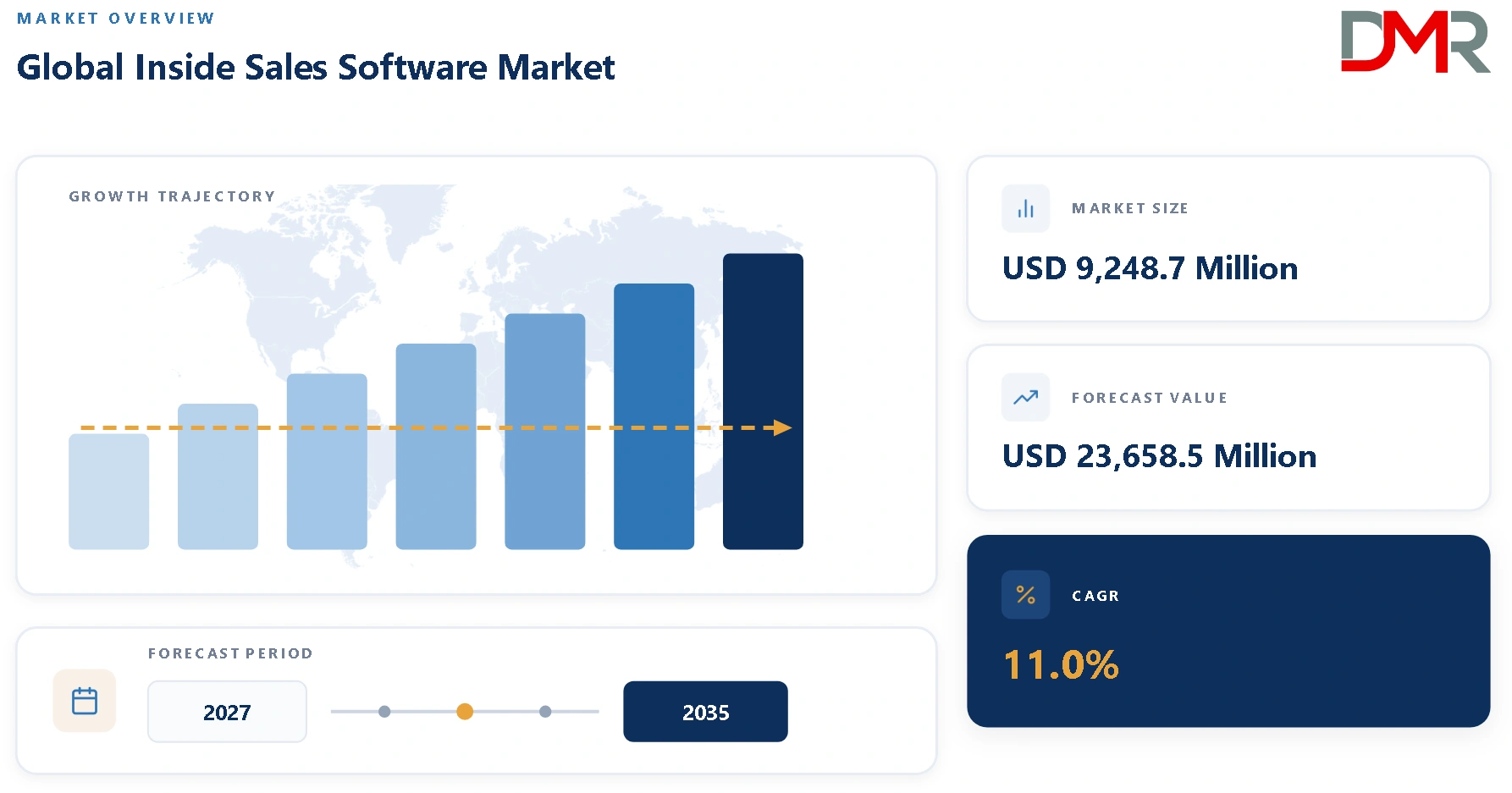
The Global Inside Sales Software Market size is projected to be valued at USD 9,248.7 million in 2026, and it is further anticipated to reach a market value of USD 23,658.5 million by 2035 at a CAGR of 11.0%.
ℹ
To learn more about this report –
Download Your Free Sample Report Here
The global market for inside sales software has been expanding steadily over the last decade as B2B and B2C selling has shifted from field-based visits to remote, phone, email, video, and digital-first engagement. Inside sales software refers to the platforms that sales teams use to sell remotely, including sales engagement platforms, dialers and cloud telephony, lead management and prospecting tools, and conversational intelligence and sales analytics solutions. Market growth is driven by the growing adoption of cloud-based sales technology, the rising use of AI and generative AI to automate prospecting and follow-ups, and the need for sales organizations to lower the cost of sales while increasing rep productivity. Inside sales software is applied across IT, financial services, healthcare, retail, manufacturing, real estate, and education to generate pipeline, shorten sales cycles, coach representatives, and improve forecast accuracy.
Use Cases
- Lead Generation and Outbound Prospecting: Inside sales teams use prospecting and data enrichment tools to identify target accounts, find verified contacts, and prioritize leads using buying signals such as funding rounds, hiring activity, and intent data. This helps sales development teams build qualified pipeline faster and with less manual research.
- Multichannel Sales Engagement: Sales engagement platforms automate cadences across email, phone, LinkedIn, and messaging, keeping outreach consistent and personalized at scale. Automated follow-ups and task management help representatives handle more prospects without losing relevance.
- Calling, Coaching, and Conversation Intelligence: Dialers, call recording, and AI-based conversation analysis help sales managers monitor calls, surface objections and competitor mentions, and coach representatives. These tools increase connect rates and improve conversion of calls and meetings into opportunities.
- Pipeline Management and Sales Forecasting: Sales analytics tools consolidate CRM and engagement data to provide deal risk alerts, pipeline inspection, and forecasting. This improves forecast accuracy and gives revenue leaders earlier visibility into at-risk deals.
Key Takeaways
- Global Market Value: The global inside sales software market is valued at a revenue of USD 9,248.7 million in 2026 and is further anticipated to reach USD 23,658.5 million by 2035.
- Global Growth Rate: The global inside sales software market is expected to have a CAGR of 11.0% during the forecast period from 2027 to 2035.
- Technology Trends: The growing use of generative AI, AI sales agents, conversational intelligence, and workflow automation is increasing the adoption of inside sales software across enterprises and SMEs, while vendors consolidate engagement, intelligence, and forecasting into unified revenue platforms.
- Market Drivers: The shift to remote and hybrid selling, the increasing adoption of cloud-based CRM and sales tools, and the demand for higher sales productivity and lower cost of sales are some of the key drivers of the global inside sales software market.
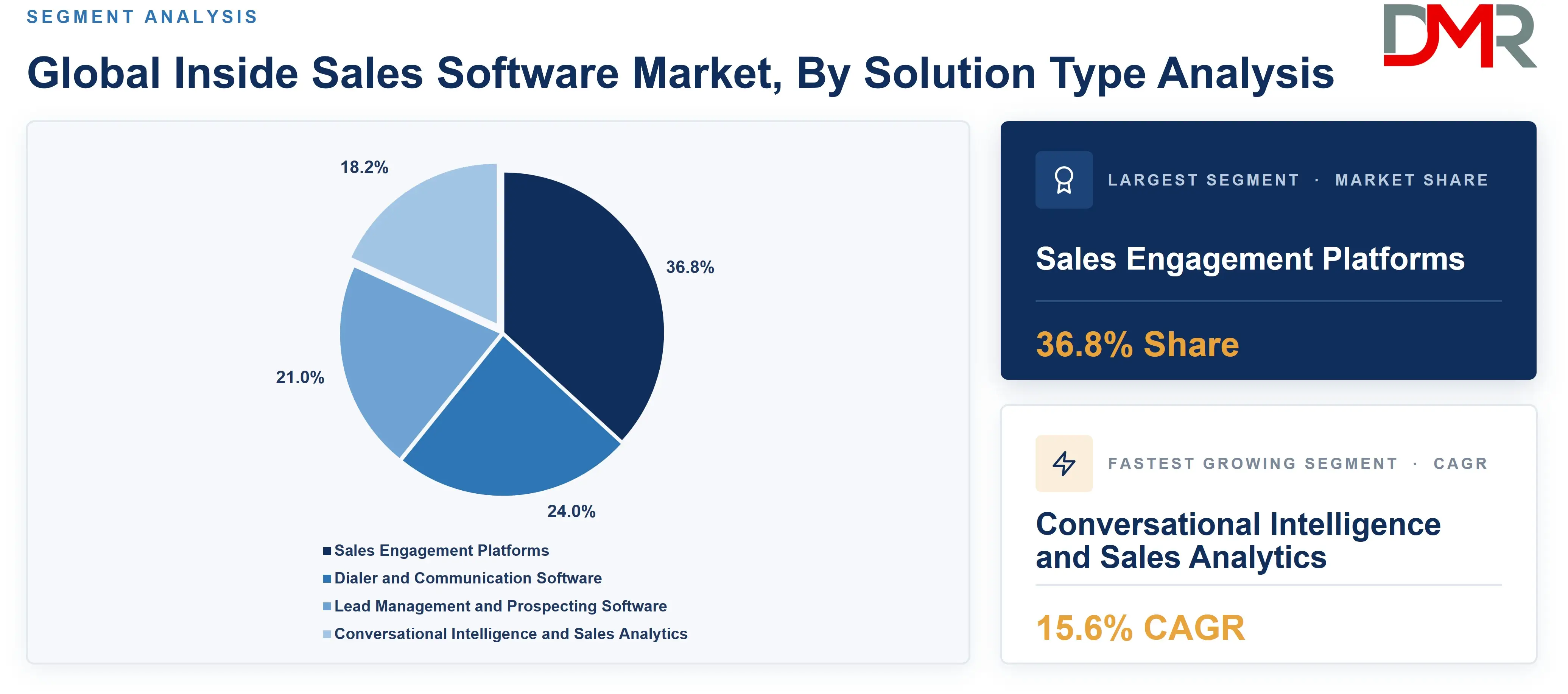
- Solution Type Segment Analysis: The Sales Engagement Platforms segment is anticipated to be the largest solution type segment, having a market share of 36.8% by the end of 2026. Whereas the Conversational Intelligence and Sales Analytics segment is expected to be the fastest-growing segment with a CAGR of 15.6% from 2027 to 2035.
- End User Segment Analysis: IT & Telecommunications is the major end-user segment, representing the highest market share of 24.6% in 2026, while the Healthcare & Life Sciences segment is projected to have the highest growth rate with a CAGR of 14.2% during the forecast period.
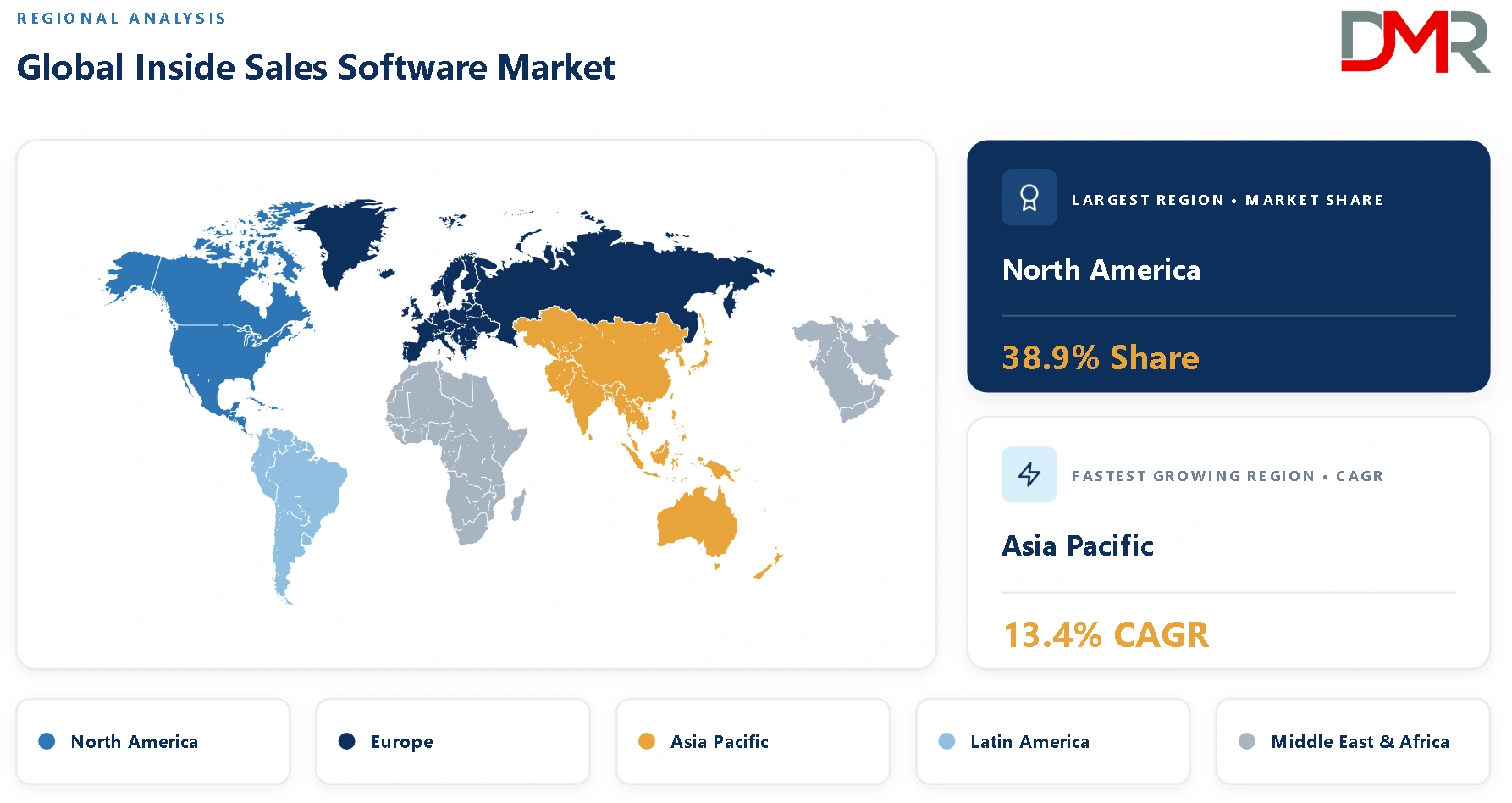
- Regional Analysis: The North America region is poised to hold the largest market share of 38.9% in the global market in 2026. While the Asia Pacific region is expected to be the fastest-growing region with a CAGR of 13.4% during the forecast period.
How AI/Gen AI is Transforming the Inside Sales Software Market?
Artificial Intelligence (AI) and Generative AI (GenAI) are reshaping inside sales software by moving it from a system of record to a system of action. Large language models now draft personalized emails and call scripts, summarize calls and meetings, update CRM fields automatically, and recommend the next best action for each deal. AI sales agents and prospecting agents can monitor accounts for buying signals, research prospects, build contact lists, and prepare outreach for representative review, reducing the time spent on manual administrative work. Conversational intelligence tools analyze calls at scale to identify risks, coaching opportunities, and winning behaviors, while predictive models improve lead scoring, routing, and forecasting. As a result, vendors across sales engagement, prospecting, and revenue intelligence are embedding AI assistants and agent-building capabilities into their platforms, and buyers are increasingly evaluating products on measurable productivity gains rather than features alone.
Key Drivers in the Global Inside Sales Software Market
Adoption of AI-Powered Sales Automation
The integration of AI and generative AI into sales platforms is one of the strongest growth drivers for the inside sales software market. Automated prospecting, personalized outreach, call summarization, and AI-assisted forecasting allow smaller teams to cover more accounts and reduce the manual workload of representatives. Sales leaders are therefore increasing their investment in platforms that combine data, engagement, and AI agents to improve pipeline creation and conversion, which is expanding the addressable base for inside sales software vendors.
Shift to Remote and Hybrid Selling Models
Buyers increasingly prefer to research and purchase remotely through digital channels, and sales organizations have moved a large share of their selling activity to inside and virtual teams. This model lowers travel costs and the cost of sales and enables companies to scale territories quickly. Cloud-based inside sales software supports distributed teams with calling, video, engagement tracking, and analytics from a single environment, making it a core part of the modern sales technology stack.
Restraints in the Global Inside Sales Software Market
Data Privacy and Regulatory Challenges
One of the major hindrances to the growth of the inside sales software market is the tightening of data privacy and communication regulations. Prospecting, enrichment, call recording, and automated outreach rely on large volumes of personal and business contact data. Regulations such as Europe's GDPR, state-level privacy laws in the United States, anti-spam laws, and rules governing telemarketing, call recording, and do-not-call registries restrict how sales teams can collect data and contact prospects. Compliance requirements increase costs for vendors and customers and can limit the deployment of automated outreach and AI-based call analysis in certain regions.
Tool Sprawl, Integration Complexity, and Cost
Many organizations operate several overlapping sales tools across engagement, data, dialing, and analytics, and integrating them with CRM systems can be complex and costly. Per-seat licensing, add-on pricing for AI features, and data credits increase the total cost of ownership, which is an entry barrier for small businesses. Difficulty in demonstrating return on investment, low representative adoption, and the effort needed to change established sales processes can slow purchasing decisions and lead some buyers to consolidate or delay tool purchases.
Growth Opportunities in the Global Inside Sales Software Market
Rising Demand for Sales Productivity Tools Among SMEs
Small and medium-sized enterprises are adopting affordable, cloud-based sales tools to compete with larger organizations without expanding headcount. Vendors offering bundled data, engagement, and calling capabilities with simple pricing are attracting these customers. As digital adoption deepens in emerging economies, SMEs in Asia Pacific, Latin America, and the Middle East and Africa represent a large untapped customer base for inside sales software providers.
Investment in AI, Data, and Platform Convergence
Vendors and investors are directing significant funding toward AI agents, B2B data, and revenue intelligence. Industry consolidation, such as the combination of sales engagement, conversation intelligence, and forecasting into unified revenue platforms, is creating broader offerings and opening opportunities for partnerships, acquisitions, and new product categories. Solution providers that offer verified data, open integrations, and governed AI agents are well placed to capture a larger share of sales technology budgets.
Trends in the Global Inside Sales Software Market
Rise of Agentic AI in Sales Workflows
Inside sales software is moving from tools that assist representatives to agents that execute tasks such as researching accounts, sequencing outreach, preparing meetings, updating deals, and flagging risks, with human approval at key steps. Vendors are launching conversational assistants and agent-building studios that allow revenue operations teams to create custom agents, and CRM and engagement platforms are increasingly connecting to external data providers to ground those agents in verified information.
Consolidation into Unified Revenue Platforms
Sales engagement, conversation intelligence, data, and forecasting products are converging into unified revenue platforms. Mergers and acquisitions, expanded native capabilities from CRM vendors, and bundled offerings from data and engagement providers are reducing the number of tools that a sales team needs and are intensifying competition between platform vendors and best-of-breed specialists.
Research Scope and Analysis
The global inside sales software market is segmented based on solution type into sales engagement platforms, dialer and communication software, lead management and prospecting software, and conversational intelligence and sales analytics, while in the context of end user, the global inside sales software market consists of IT & telecommunications, BFSI, healthcare & life sciences, retail & e-commerce, manufacturing, real estate, education, and other sectors.
ℹ
To learn more about this report –
Download Your Free Sample Report Here
By Solution Type Analysis
Sales Engagement Platforms are projected to dominate the solution type segment in the inside sales software market as they will hold 36.8% of the total market share in 2026. The dominance is due to their central role in automating multichannel outreach, managing cadences, and keeping representatives productive, along with strong adoption among both enterprises and mid-sized sales teams. While Conversational Intelligence and Sales Analytics is poised to have the highest CAGR of 15.6% during the forecast period (2026-2035) in the solution type segment, as AI-based call analysis, deal intelligence, and forecasting tools are increasingly used to coach representatives, identify deal risks, and improve revenue predictability.
By End User Analysis
IT & Telecommunications is expected to be the leading end-user segment in the inside sales software market, as it is poised to hold 24.6% of the market share by the end of 2026. The segment dominates due to its large base of software and technology companies that run high-volume, remote sales motions, rely on subscription selling, and are early adopters of sales technology. On the other hand, the Healthcare & Life Sciences segment is poised to have the highest CAGR of 14.2% during the forecast period (2026-2035) due to the growing digitization of commercial operations among pharmaceutical, medical device, and digital health companies, which are expanding remote engagement with providers and institutions.
The Global Inside Sales Software Market Report is segmented based on the following:
By Solution Type
- Sales Engagement Platforms
- Email and Cadence Automation
- Multichannel Outreach (Email, Phone, LinkedIn, and Messaging)
- AI Sales Agents and Assistants
- Dialer and Communication Software
- Power and Predictive Dialers
- Cloud Telephony and VoIP
- Video Meetings and Messaging
- Lead Management and Prospecting Software
- Contact and Intent Data
- Lead Scoring and Routing
- Lead Capture and Enrichment
- Conversational Intelligence and Sales Analytics
- Call Recording and Transcription
- Forecasting and Pipeline Analytics
- Coaching and Performance Management
By End User
- IT & Telecommunications
- BFSI
- Healthcare & Life Sciences
- Retail & E-commerce
- Manufacturing
- Real Estate
- Education
- Other End User
Regional Analysis
North America is the Leading Region in the Global Inside Sales Software Market
The North American market is anticipated to be the leader of the global inside sales software market, as it is poised to take up 38.9% of the entire market share in 2026. This market domination is attributed to the strong presence of leading sales technology vendors, high cloud adoption, and the large base of technology, financial services, and healthcare companies that run inside sales teams in the region. Early adoption of AI-based sales tools, mature CRM penetration, and significant venture and corporate investment in revenue technology continue to support market growth. North America is expected to retain its leadership over the forecast period. The North America market is valued at USD 3,597.7 million in 2026 and is projected to reach USD 8,553.0 million by 2035, registering a CAGR of 10.1% from 2027 to 2035.
ℹ
To learn more about this report –
Download Your Free Sample Report Here
Asia Pacific is the Fastest-Growing Region in the Global Inside Sales Software Market
The Asia Pacific region is anticipated to have the fastest-growing regional market at a compound annual growth rate of 13.4% over the forecast period of 2027 to 2035. Rapid digitization of SMEs, the growth of software and e-commerce sectors, and the expansion of outsourced and offshore sales operations are boosting the regional market. Countries like India, China, Japan, Australia, and South Korea are adopting cloud-based CRM, sales engagement, and cloud telephony solutions, and the availability of local vendors offering competitively priced tools is expanding adoption among mid-sized and smaller businesses. The Asia Pacific market is expected to grow from USD 2,090.2 million in 2026 to USD 6,482.0 million in 2035.
Europe Inside Sales Software Market
Europe is a mature market for inside sales software, supported by strong adoption of cloud CRM and a large base of B2B companies selling across multiple countries and languages. Germany, the UK, and France are leading in the adoption of sales engagement, prospecting, and conversation intelligence tools. Data protection requirements such as GDPR shape product design and vendor selection, increasing demand for compliant data sources, consent management, and regional data hosting. The Europe market is valued at USD 2,478.7 million in 2026 and is projected to reach USD 5,652.9 million by 2035, registering a CAGR of 9.6% from 2027 to 2035.
Latin America Inside Sales Software Market
The growth of the inside sales software market is attributed to increasing digitization of sales processes, rising adoption of cloud-based CRM by SMEs, and the growth of e-commerce and fintech sectors. Brazil and Mexico are the main contributors, supported by a growing base of technology companies and the expansion of inside sales and customer acquisition teams. Affordable subscription-based tools and local language support are opening new opportunities for vendors. The Latin America market is projected to grow from USD 591.9 million in 2026 to USD 1,589.4 million in 2035, registering a CAGR of 11.6% from 2027 to 2035.
Middle East and Africa (MEA) Inside Sales Software Market
Growth is driven by national digital transformation programs, the expansion of enterprise and SME cloud adoption, and the development of financial services, telecom, and real estate sectors in the Gulf countries. The UAE and Saudi Arabia are investing in digital infrastructure and customer-facing technologies, while South Africa is a leading market in Africa for CRM and sales technology adoption. The market is still at an early stage, and growth is expected to accelerate with the increase in cloud penetration and local partner ecosystems. The Middle East and Africa market is projected to grow from USD 490.2 million in 2026 to USD 1,381.3 million in 2035, registering a CAGR of 12.2% from 2027 to 2035.
Major Countries Analysis
United States Inside Sales Software Market
The US Inside Sales Software Market is projected to be valued at USD 3,126.0 million in 2026. It is expected to witness subsequent growth in the upcoming period, reaching USD 7,493.2 million in 2035, registering a CAGR of 10.2% from 2027 to 2035. The US inside sales software market is at the forefront of technological developments and innovations, as it is home to many of the leading CRM, sales engagement, data, and revenue intelligence vendors. Technology, financial services, and healthcare companies have widely adopted remote sales models, and demand is rising for AI-driven prospecting, conversation intelligence, and agentic sales tools. Key trends include platform consolidation, the integration of AI agents into CRM workflows, and increased focus on data compliance and measurable return on investment.
India Inside Sales Software Market
India is one of the fastest-growing markets for inside sales software, supported by a large base of SaaS companies, startups, and outsourced sales and customer acquisition teams. Rising SME digitization, strong cloud adoption, and the presence of domestic vendors offering cost-effective CRM and sales engagement tools are driving demand. Companies are also deploying AI-based calling, lead management, and analytics tools to scale inside sales operations serving both domestic and international customers.
United Kingdom Inside Sales Software Market
The UK is a leading European market for inside sales software, driven by a mature B2B services sector, strong financial services and technology industries, and widespread use of cloud CRM. Adoption of sales engagement, prospecting, and conversation intelligence tools is high among mid-sized and large enterprises. Compliance with UK data protection and electronic communications rules influences vendor selection and the way outbound campaigns are designed.
Regulatory Landscape
The inside sales software market operates under a changing set of laws that govern data privacy, electronic communications, telemarketing, call recording, and the responsible use of AI. Regulations such as GDPR in Europe, privacy laws in the United States, anti-spam and do-not-call rules, and emerging AI governance frameworks in North America, Europe, and Asia Pacific affect how vendors collect and process contact data, record and analyze conversations, and automate outreach. Requirements for consent, transparency, data residency, and human oversight of automated decisions influence product design, data sourcing, and market entry strategies.
Investment and White Space Analysis
Investment in the inside sales software ecosystem is increasing, with venture capital, private equity, and strategic buyers funding AI sales agents, B2B data providers, revenue intelligence, and sales engagement platforms. Mergers and acquisitions are reshaping the competitive landscape as vendors seek to offer unified revenue platforms. There is significant white space in AI-native prospecting and outreach agents, vertical-specific sales tools for healthcare, financial services, and real estate, affordable all-in-one platforms for SMEs, multilingual and regional language solutions, and compliant data and consent management. Emerging markets in Asia Pacific, Latin America, and the Middle East and Africa also present substantial opportunities.
By Region
North America
Europe
- Germany
- France
- The U.K.
- Italy
- Spain
- Rest of Europe
Asia-Pacific
- China
- Japan
- India
- Australia
- South Korea
- Rest of APAC
Latin America
- Mexico
- Brazil
- Rest of LATAM
Middle East & Africa
- Saudi Arabia
- The UAE
- South Africa
- Rest of MEA
Competitive Landscape
The competitive environment for the inside sales software market is characterized by a mix of CRM platform vendors, specialist sales engagement providers, data and intelligence companies, and cloud communications providers. CRM leaders such as Salesforce, Microsoft, and HubSpot are adding native engagement and AI agent capabilities, while specialists such as Outreach, , Apollo.io, and Gong compete in sales engagement, prospecting, conversation intelligence, and forecasting. Data providers such as ZoomInfo and Cognism supply contact and intent data to prospecting workflows, and communications providers such as Five9, Dialpad, RingCentral, and Aircall serve the calling and dialer segment. Vendors are competing on AI agent capabilities, data quality, integration depth, and pricing, and industry consolidation is increasing.
Some of the prominent players in the Global Inside Sales Software Market are:
- Salesforce
- HubSpot
- Microsoft
- Outreach
- Clari
- Gong
- Apollo.io
- ZoomInfo
- Zoho
- Pipedrive
- Freshworks
- Close
- Nutshell
- LeadSquared
- Dialpad
- Five9
- RingCentral
- Aircall
- Orum
- Nooks
- Reply.io
- Amplemarket
- Mixmax
- Cognism
- Lusha
- Seamless.AI
- Clay
- Revenue.io
- Insightly
- Copper
- Instantly
- Other Key Players
Recent Developments
- In April 2026, Outreach introduced Omni, a conversational AI agent for accessing revenue insights and taking action through chat. Its product release also added configurable Agent Studio workflows for lead engagement and deal alerts. www.outreach.ai
- In April 2026, HubSpot announced its Spring Spotlight product updates, including HubSpot AEO, a rebuilt Prospecting Agent, the new Smart Deal Progression feature, and Customer Agent enhancements across its agentic customer platform. www.hubspot.com
- In March 2026, Apollo.io announced its acquisition of Pocus, adding enterprise revenue intelligence that analyzes CRM and behavioral buying signals to help sales teams identify opportunities, prioritize accounts, and guide go-to-market actions. www.apollo.io
- In December 2025, Clari and Salesloft completed their merger on December 3, combining revenue data, sales engagement, and forecasting capabilities. The combined company appointed Steve Cox CEO and outlined a Predictive Revenue System.
Report Details
| Report Characteristics |
| Market Size (2026) |
USD 9,248.7 Mn |
| Forecast Value (2035) |
USD 23,658.5 Mn |
| CAGR (2027–2035) |
11.0% |
| The US Market Size (2026) |
USD 3,126.0 Mn |
| Historical Data |
2021 – 2025 |
| Forecast Data |
2026 – 2035 |
| Base Year |
2025 |
| Segments Covered |
By Solution Type (Sales Engagement Platforms, Dialer and Communication Software, Lead Management and Prospecting Software, and Conversational Intelligence and Sales Analytics), By End User (IT & Telecommunications, BFSI, Healthcare & Life Sciences, Retail & E-commerce, Manufacturing, Real Estate, Education, and Other End User) |
| Regional Coverage |
North America – The US and Canada; Europe – Germany, France, The UK, Italy, Spain, Rest of Europe; Asia-Pacific – China, Japan, India, Australia, South Korea, Rest of APAC; Latin America – Mexico, Brazil, Rest of LATAM; Middle East & Africa – Saudi Arabia, The UAE, South Africa, Rest of MEA |
Frequently Asked Questions
How big is the Inside Sales Software Market?
▾ The global inside sales software market is projected to be valued at USD 9,248.7 million in 2026 and is expected to reach USD 23,658.5 million by 2035.
What is the CAGR of the Inside Sales Software Market from 2027 to 2035?
▾ The global inside sales software market is anticipated to grow at a compound annual growth rate (CAGR) of 11.0% during the forecast period from 2027 to 2035.
What factors are driving the growth of the Inside Sales Software Market?
▾ The market is driven by the increasing adoption of AI and generative AI in sales workflows, the shift to remote and hybrid selling, rising adoption of cloud-based CRM and sales tools, demand for higher sales productivity and lower cost of sales, and expanding use across IT, financial services, healthcare, retail, and manufacturing sectors.
What are the major trends in the Inside Sales Software Market?
▾ Key market trends include the rise of agentic AI and AI sales agents, consolidation of sales engagement, conversation intelligence, and forecasting into unified revenue platforms, integration of verified B2B data into AI workflows, and increasing adoption of sales technology among SMEs.
Which region held the largest share of the Inside Sales Software Market in 2026?
▾ North America is poised to hold the largest share of the global inside sales software market in 2026, accounting for 38.9% of the total market.
Which region is expected to grow the fastest in the Inside Sales Software Market?
▾ Asia Pacific is projected to be the fastest-growing regional market during the forecast period, registering a CAGR of 13.4%.
Who are the key players in the Inside Sales Software Market?
▾ Major companies operating in the market include Salesforce, HubSpot, Microsoft, Outreach, Clari, Gong, Apollo.io, ZoomInfo, Zoho, Pipedrive, Freshworks, Close, Nutshell, LeadSquared, Dialpad, Five9, RingCentral, Aircall, Orum, Nooks, Reply.io, Amplemarket, Mixmax, Cognism, Lusha, Seamless.AI, Clay, Revenue.io, Insightly, Copper, Instantly, and other key players.
How is the Inside Sales Software Market segmented?
▾ The market is segmented by Solution Type into Sales Engagement Platforms, Dialer and Communication Software, Lead Management and Prospecting Software, and Conversational Intelligence and Sales Analytics. By End User, it is segmented into IT & Telecommunications, BFSI, Healthcare & Life Sciences, Retail & E-commerce, Manufacturing, Real Estate, Education, and Other End User. Geographically, the market is analyzed across North America, Europe, Asia Pacific, Latin America, and the Middle East & Africa.