What is the Instrumentation Sterilization Containers Market Size?
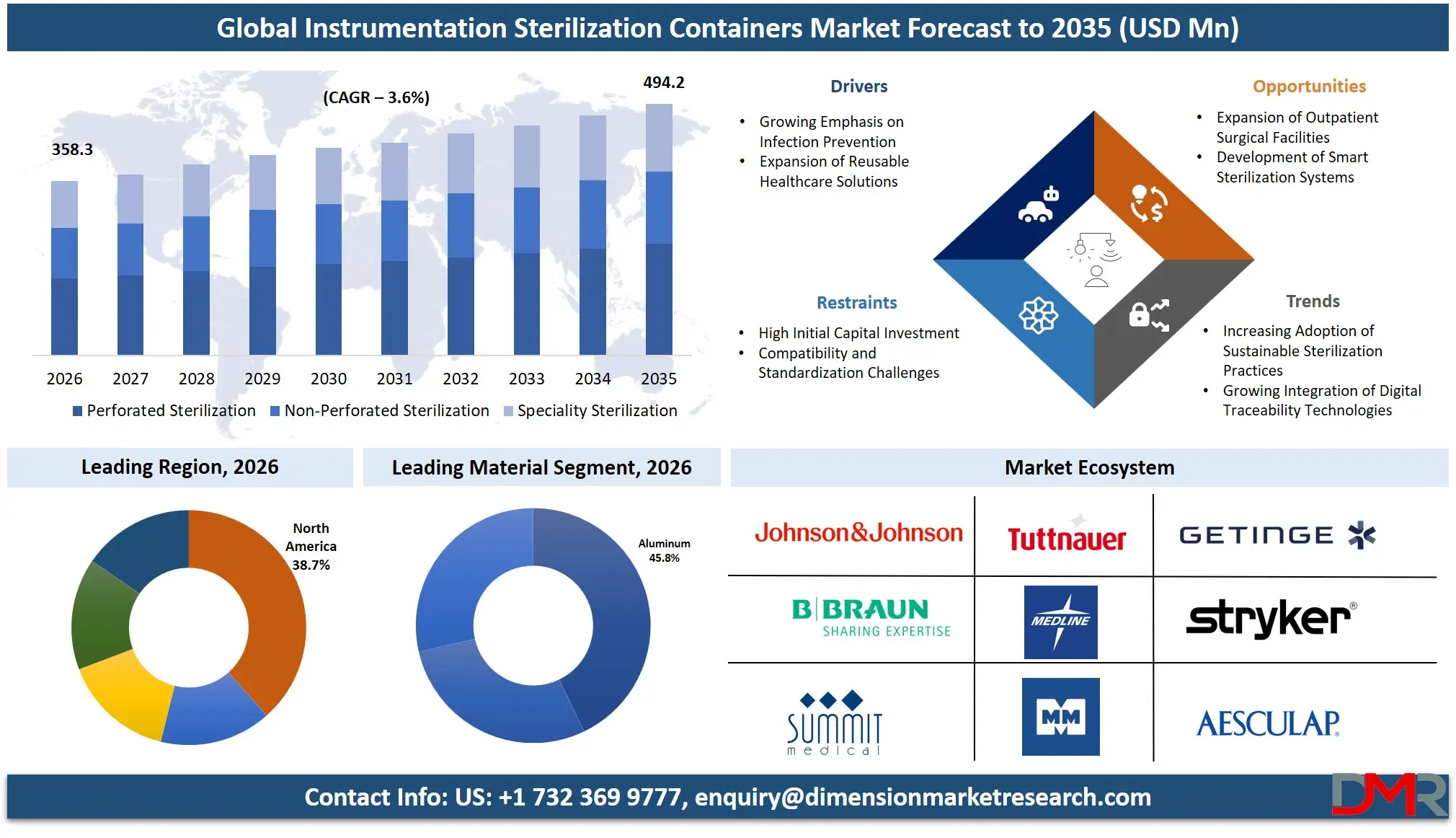
The Instrumentation Sterilization Containers Market size is expected to be USD 358.3 million in 2026 and increase at a compound annual growth rate of 3.6% to USD 494.2 million in 2035 due to growing emphasis on infection prevention.
ℹ
To learn more about this report –
Download Your Free Sample Report Here
Instrumentation sterilization containers are reusable rigid systems designed to safely organize, protect, transport, sterilize, and store surgical instruments throughout healthcare workflows. These containers incorporate filters, valves, locking mechanisms, and durable materials that maintain sterility while reducing dependence on disposable sterilization wraps. Growing emphasis on infection prevention, cost optimization, sustainable healthcare practices, and compliance with stringent sterilization standards is accelerating market expansion. Hospitals, ambulatory surgical centers, specialty clinics, and medical device manufacturers increasingly prefer advanced container systems that improve operational efficiency, reduce instrument damage, enhance traceability, and support standardized sterile processing departments, driving continuous innovation and long-term market adoption.
The US Instrumentation Sterilization Containers Market
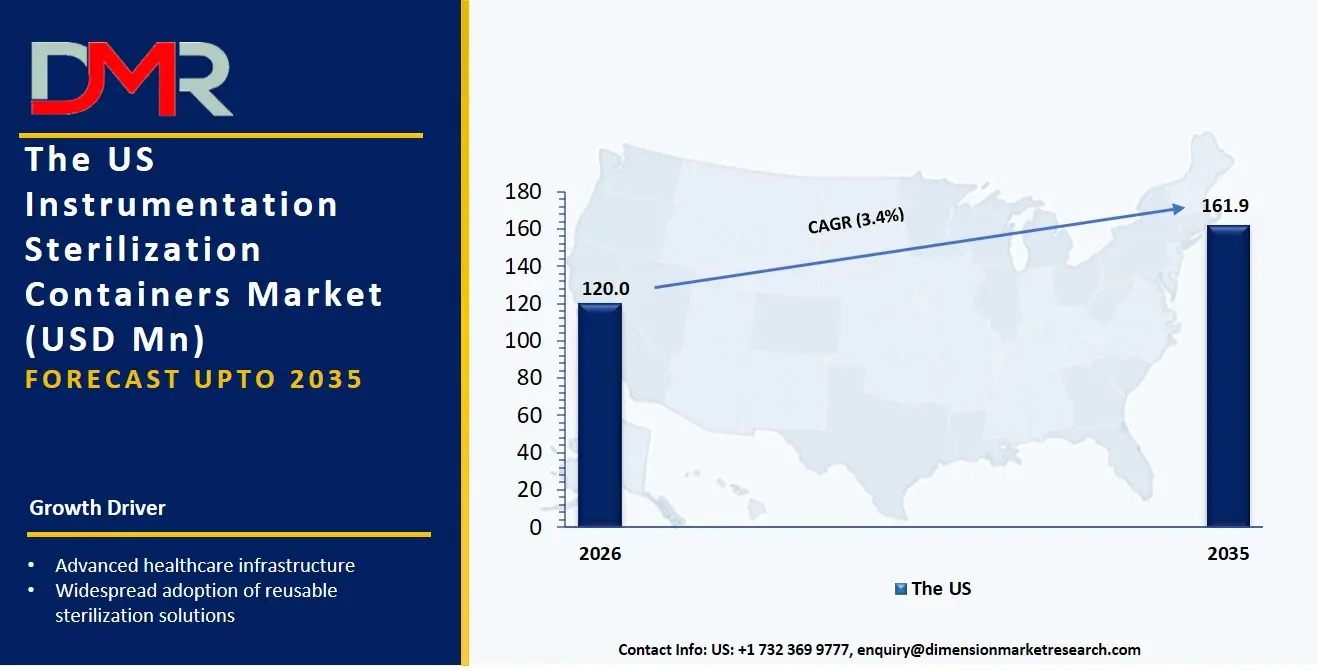
The US Instrumentation Sterilization Containers Market size is estimated to be USD 120.0 million in 2026 and is expected to increase at a CAGR of 3.4% over the forecast period.
ℹ
To learn more about this report –
Download Your Free Sample Report Here
The US Instrumentation Sterilization Containers Market is supported by advanced healthcare infrastructure, widespread adoption of reusable sterilization solutions, and strict infection prevention regulations. Hospitals continue investing in modern sterile processing departments to improve surgical efficiency and reduce healthcare-associated infections. High procedural volumes, increasing outpatient surgeries, technological innovation, and strong purchasing power encourage continuous replacement of conventional sterilization packaging with durable container systems, while regulatory compliance further strengthens market expansion.
Europe Instrumentation Sterilization Containers Market
The Europe Instrumentation Sterilization Containers Market size is estimated to be USD 78.8 million in 2026 and is expected to increase at a CAGR of 3.5% over the forecast period.
The Europe Instrumentation Sterilization Containers Market benefits from stringent healthcare regulations, sustainability initiatives, and growing investments in reusable medical products. Policies promoting waste reduction and environmentally responsible hospital operations encourage healthcare providers to replace disposable sterilization wraps with reusable container systems. Continuous modernization of hospitals, emphasis on patient safety, standardized sterilization procedures, and innovation in medical device manufacturing contribute to steady market growth across major European healthcare systems.
Japan Instrumentation Sterilization Containers Market
The market size of Japan Instrumentation Sterilization Containers will be USD 17.9 million in 2026 and at a CAGR of 3.7% in the forecast period.
The Japan Instrumentation Sterilization Containers Market is expanding due to advanced healthcare technologies, an aging population requiring more surgical procedures, and government initiatives supporting hospital modernization. Healthcare facilities increasingly adopt premium sterilization systems to improve workflow efficiency and infection prevention. Strong quality standards, continuous technological innovation, increasing investment in automated sterile processing departments, and demand for durable reusable medical products create favorable opportunities for sustained market development.
Key Takeaways
- Market Size & Forecast: The Instrumentation Sterilization Containers Market size is projected to reach USD 358.3 million in 2026 and is anticipated to have a value of USD 494.2 million in 2035.
- Growth Rate & Outlook: The Instrumentation Sterilization Containers Market size is set to grow at a compound annual growth rate of 3.6% during the forecast period of 2026 to 2035.
- Primary Growth Drivers: Some of the major growth drivers in the market are Growing Emphasis on Infection Prevention, and more.
- Key Market Trends: Some of the major trends in the market are Increasing Adoption of Sustainable Sterilization Practices, and more.
- By Product Type: Perforated Sterilization are anticipated to get the majority share of the Instrumentation Sterilization Containers Market in 2026.
- By Material Type: Aluminum is expected to get the largest revenue share in 2026 in the Instrumentation Sterilization Containers Market.
- Regional Leadership: North America is set to lead the Instrumentation Sterilization Containers Market with an estimated 38.7% share in 2026.
What is the Instrumentation Sterilization Containers?
Instrumentation sterilization containers are reusable, rigid enclosures specifically engineered to protect surgical instruments during sterilization, storage, transportation, and clinical use. Manufactured from materials such as aluminum, stainless steel, or high-performance polymers, they feature secure locking systems, filters, valves, and identification mechanisms that preserve sterility after processing. These containers minimize contamination risks, improve instrument organization, reduce packaging waste, extend instrument lifespan, and support standardized infection prevention protocols within healthcare facilities.
Use Cases
- Surgical Instrument Sterilization: Hospitals utilize instrumentation sterilization containers to securely hold complete surgical instrument sets during sterilization cycles. These containers maintain sterility after processing while protecting delicate instruments from contamination and physical damage throughout transportation and storage, ensuring readiness for surgical procedures.
- Ambulatory Surgical Centers: Ambulatory surgical centers rely on sterilization containers to streamline instrument handling between procedures. Reusable container systems improve operational efficiency, reduce turnaround times, minimize packaging waste, and support standardized sterilization practices that enhance patient safety while lowering operating costs.
- Medical Device Manufacturing: Medical device manufacturers use sterilization containers for validating sterilization processes, transporting sterile products, and ensuring compliance with quality management standards. These systems provide consistent protection during manufacturing, packaging, storage, and distribution while maintaining product integrity.
- Research and Academic Laboratories: Universities, research institutes, and teaching hospitals employ sterilization containers for laboratory instruments, surgical training equipment, and research tools. Their reusable design supports frequent sterilization cycles, reduces consumable expenses, and ensures reliable contamination control in highly controlled research environments.
How AI Is Transforming the Instrumentation Sterilization Containers Market
Artificial Intelligence (AI) is increasingly influencing the instrumentation sterilization containers market by improving sterile processing efficiency, inventory management, and workflow automation. AI-powered analytics can monitor sterilization cycles, predict maintenance requirements, optimize instrument utilization, and identify potential process failures before they affect operations. Integration with RFID-enabled containers and digital tracking platforms enables real-time visibility of surgical instruments, reducing losses and improving operational accuracy.
AI technologies are also enhancing quality control by analyzing sterilization data, identifying contamination risks, and supporting compliance with healthcare standards. Predictive analytics help hospitals optimize container usage, reduce processing delays, and improve resource allocation. As healthcare facilities continue adopting smart hospital technologies, AI-driven sterilization management solutions are expected to become an important factor in improving patient safety, cost efficiency, and sterile processing performance.
Market Dynamic
Driving Factors in the Instrumentation Sterilization Containers Market
Growing Emphasis on Infection Prevention
Healthcare providers are placing greater importance on preventing healthcare-associated infections through improved sterilization practices. Instrumentation sterilization containers provide enhanced microbial protection compared to disposable wrapping materials while ensuring consistent sterility throughout storage and transportation. Increasing surgical procedures, accreditation requirements, and investments in sterile processing departments continue encouraging healthcare facilities to adopt reusable container systems that improve patient safety, operational efficiency, and regulatory compliance.
Restraints in the Instrumentation Sterilization Containers Market
High Initial Capital Investment
Although reusable sterilization containers reduce long-term operational expenses, their higher upfront purchase costs can discourage adoption among smaller healthcare facilities. Budget limitations, competing capital expenditure priorities, and additional investments required for staff training and sterilization validation slow purchasing decisions. Financial constraints remain particularly challenging for developing healthcare systems and smaller private hospitals seeking cost-effective sterilization solutions.
Opportunities in the Instrumentation Sterilization Containers Market
Expansion of Outpatient Surgical Facilities
Rapid growth of ambulatory surgical centers creates substantial opportunities for sterilization container manufacturers. These facilities require efficient, reusable, and standardized instrument management systems capable of supporting high surgical volumes while minimizing turnaround times. Increasing investments in outpatient healthcare infrastructure worldwide are expected to generate sustained demand for compact, durable sterilization container solutions.
Trends in the Instrumentation Sterilization Containers Market
Increasing Adoption of Sustainable Sterilization Practices
Healthcare organizations are prioritizing environmentally responsible sterilization methods by replacing disposable wraps with reusable container systems. Sustainability targets, waste reduction initiatives, and lifecycle cost advantages are encouraging hospitals to invest in durable sterilization containers. Manufacturers continue introducing recyclable materials, lightweight designs, and longer-lasting products that align with environmental objectives while maintaining sterilization effectiveness.
Research Scope and Analysis
The research scope of the instrumentation sterilization containers market covers product types, materials, sterilization methods, end users, regional performance, competitive landscape, technological advancements, and emerging trends. The analysis evaluates market growth drivers, challenges, opportunities, AI integration, and adoption patterns across healthcare facilities to provide comprehensive industry insights and future growth perspectives.
ℹ
To learn more about this report –
Download Your Free Sample Report Here
By Product Type Analysis
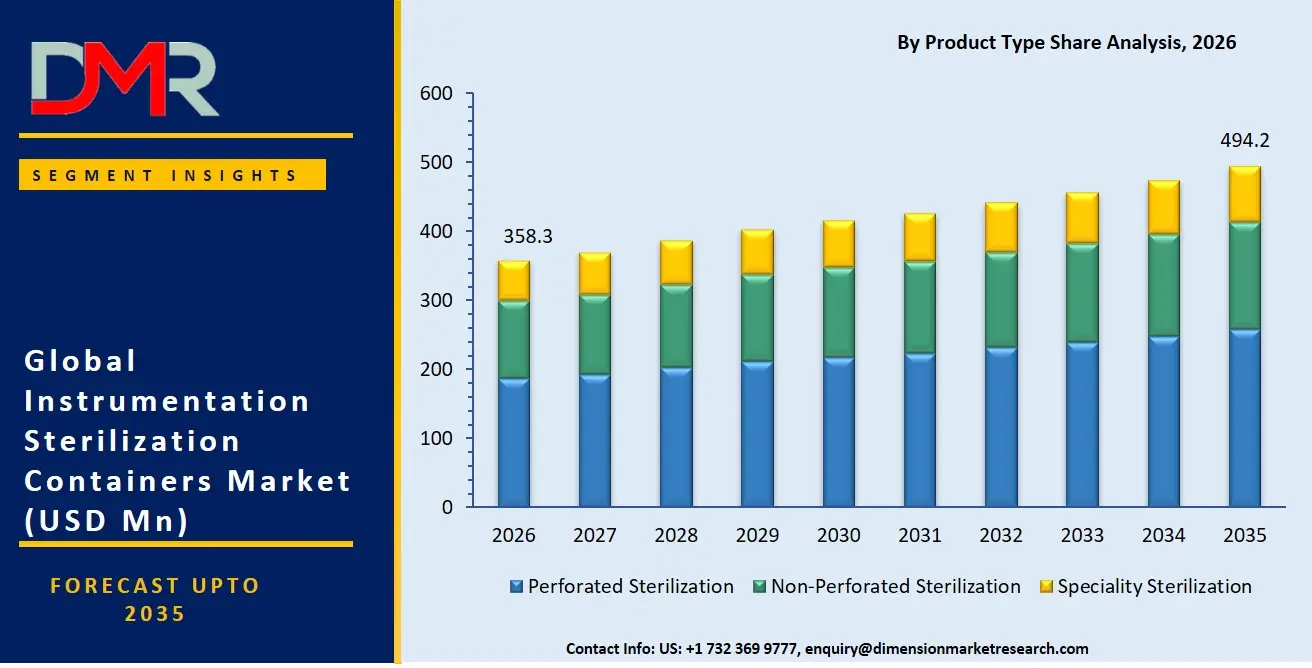
The instrumentation sterilization containers market by product type is categorized into perforated sterilization containers, non-perforated sterilization containers, and specialty sterilization containers. Among these, perforated sterilization containers are estimated to hold the leading market share of approximately 52.4% in 2026 due to their widespread use in hospitals for steam sterilization applications, efficient air removal, and reliable penetration of sterilizing agents.
ℹ
To learn more about this report –
Download Your Free Sample Report Here
Their compatibility with frequently used surgical instruments and established clinical acceptance supports market dominance. Specialty sterilization containers represent the fastest-growing segment as healthcare facilities increasingly demand customized solutions for complex surgical instruments, robotic surgery tools, and delicate medical devices. Rising minimally invasive procedures and advancements in surgical technologies are accelerating demand for specialized container designs with enhanced protection, organization, and tracking capabilities.
By Material Type Analysis
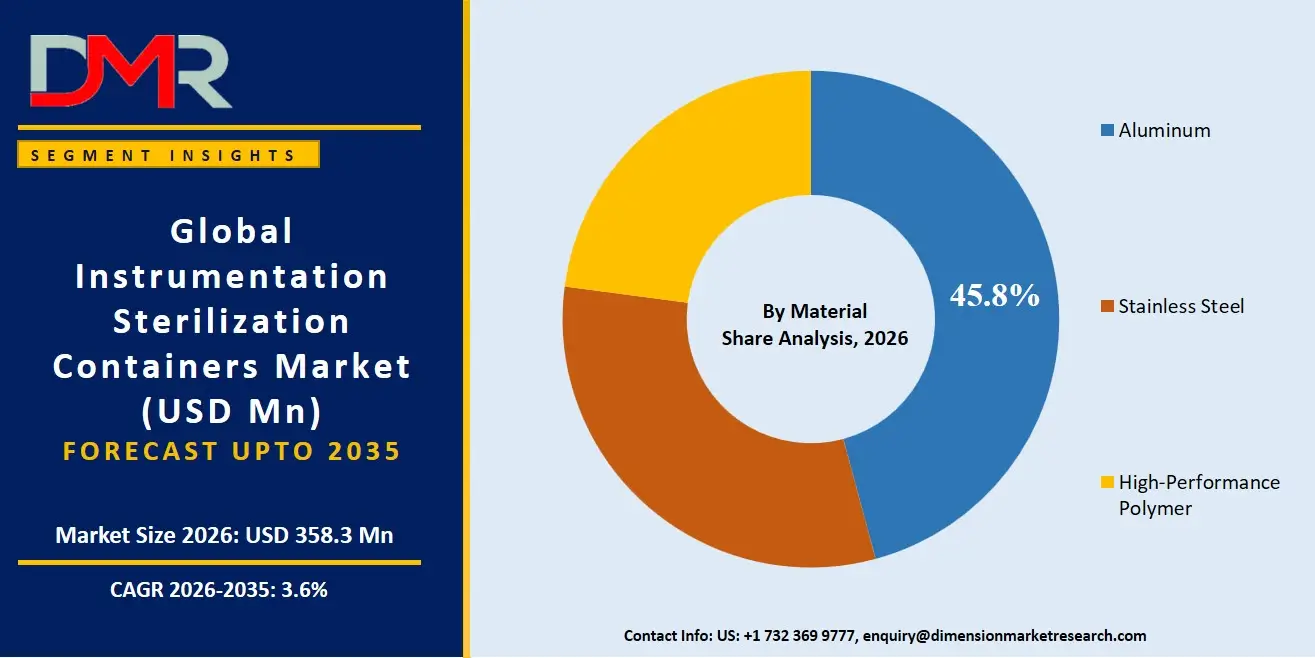
The instrumentation sterilization containers market by material includes aluminum, stainless steel, and high-performance polymer containers. Aluminum sterilization containers are projected to account for the largest market share of approximately 45.8% in 2026 because of their lightweight structure, corrosion resistance, durability, and widespread adoption in hospital sterile processing departments. Aluminum systems provide effective protection for surgical instruments while allowing repeated sterilization cycles, making them economically attractive over long-term usage. High-performance polymer containers are expected to register the fastest growth due to advantages such as reduced weight, chemical resistance, improved handling convenience, and compatibility with modern low-temperature sterilization technologies. Increasing demand for ergonomic healthcare products and advancements in polymer engineering are supporting adoption of next-generation lightweight container solutions.
By Sterilization Method Analysis
The instrumentation sterilization containers market by sterilization method includes steam sterilization, hydrogen peroxide plasma sterilization, ethylene oxide sterilization, and other low-temperature sterilization methods. Steam sterilization is expected to dominate with an estimated market share of approximately 61.6% in 2026 due to its reliability, cost-effectiveness, widespread availability, and compatibility with a broad range of surgical instruments. Hospitals continue to prioritize steam-based sterilization because of established regulatory acceptance and operational efficiency. Hydrogen peroxide plasma sterilization is anticipated to be the fastest-growing segment as demand increases for low-temperature processing of heat-sensitive medical devices. Growth in minimally invasive surgery, advanced surgical equipment adoption, and increasing use of delicate electronic instruments are encouraging healthcare providers to invest in alternative sterilization technologies.
By End User Analysis
The instrumentation sterilization containers market by end user is segmented into hospitals, ambulatory surgical centers (ASCs), specialty clinics, medical device manufacturers, and research & academic institutions. Among these, hospitals are estimated to hold the leading market share of approximately 58.9% in 2026 due to their high surgical volumes, extensive instrument inventories, and strong requirement for standardized sterilization workflows. Hospitals operate large sterile processing departments that rely heavily on reusable sterilization containers to maintain infection control standards, improve instrument organization, and reduce long-term packaging costs. Ambulatory surgical centers (ASCs) represent the fastest-growing segment as the shift toward outpatient procedures, minimally invasive surgeries, and cost-efficient healthcare delivery continues. Increasing investments in ASC infrastructure, shorter patient recovery cycles, and demand for efficient instrument turnaround systems are driving greater adoption of compact and advanced sterilization container solutions in this segment.
The Instrumentation Sterilization Containers Market Report is segmented on the basis of the following:
By Product Type
- Perforated Sterilization Containers
- Non-Perforated Sterilization Containers
- Specialty Sterilization Containers
By Material
- Aluminum
- Stainless Steel
- High-Performance Polymer
By Sterilization Method
- Steam Sterilization
- Hydrogen Peroxide Plasma Sterilization
- Ethylene Oxide (EtO) Sterilization
- Other Low-Temperature Sterilization Methods
By End User
- Hospitals
- Ambulatory Surgical Centers (ASCs)
- Specialty Clinics
- Medical Device Manufacturers
- Research & Academic Institutions
Regional Analysis
Leading Region in the Instrumentation Sterilization Containers Market
ℹ
To learn more about this report –
Download Your Free Sample Report Here
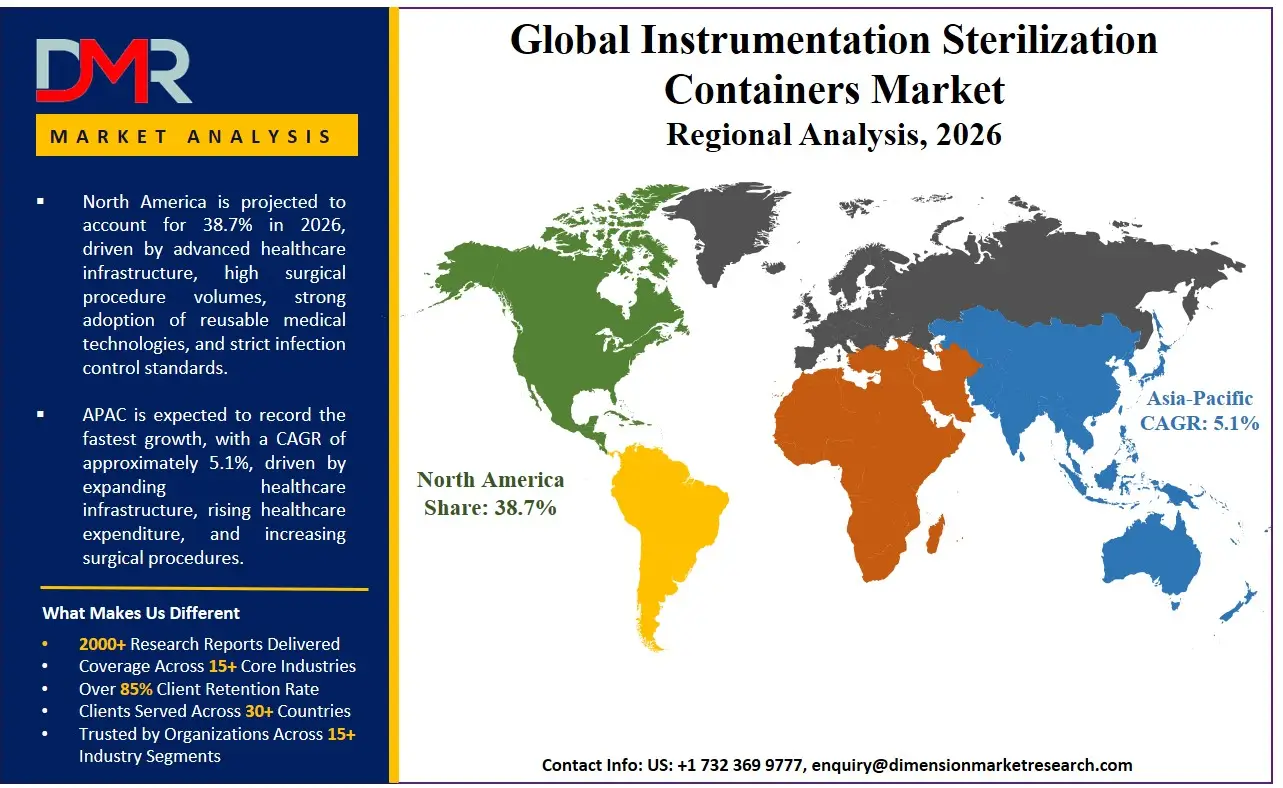
North America is expected to remain the leading region in the instrumentation sterilization containers market, accounting for an estimated 38.7% market share in 2026. The region's dominance is supported by advanced healthcare infrastructure, high surgical procedure volumes, strong adoption of reusable medical technologies, and strict infection control standards. The presence of technologically advanced hospitals, well-developed sterile processing departments, and increasing investments in healthcare automation further strengthen regional growth. Government regulations emphasizing patient safety and infection prevention encourage healthcare providers to upgrade sterilization systems. Additionally, growing adoption of outpatient surgical centers and digital instrument tracking technologies continues to reinforce North America's position as the largest market.
Fastest Growing Region in the Instrumentation Sterilization Containers Market
Asia-Pacific is projected to be the fastest-growing region in the instrumentation sterilization containers market due to expanding healthcare infrastructure, rising healthcare expenditure, and increasing surgical procedures. Countries including Japan, China, India, and South Korea are investing heavily in hospital modernization, advanced sterilization equipment, and infection prevention systems. Growing medical tourism, increasing adoption of minimally invasive surgeries, and government initiatives improving healthcare accessibility are accelerating demand. The shift toward reusable healthcare solutions, increasing awareness regarding sterile processing standards, and expansion of private healthcare facilities create significant opportunities for market participants operating in the region.
By Region
North America
Europe
- Germany
- The U.K.
- France
- Italy
- Russia
- Spain
- Benelux
- Nordic
- Rest of Europe
Asia-Pacific
- China
- Japan
- South Korea
- India
- ANZ
- ASEAN
- Rest of Asia-Pacific
Latin America
- Brazil
- Mexico
- Argentina
- Colombia
- Rest of Latin America
Middle East & Africa
- Saudi Arabia
- UAE
- South Africa
- Israel
- Egypt
- Rest of MEA
Competitive Landscape
The instrumentation sterilization containers market demonstrates moderate competition, with manufacturers focusing on product innovation, material improvements, digital integration, and expansion of healthcare partnerships. Companies are strengthening their market position through investments in research and development, development of lightweight and durable container designs, and integration of tracking technologies. Competitive advantages are increasingly based on regulatory compliance, product reliability, sterilization compatibility, and after-sales support. High-quality manufacturing standards and strong relationships with hospitals and surgical facilities create entry barriers for new participants. Strategic collaborations, technology upgrades, and expansion into emerging healthcare markets remain important approaches for maintaining long-term competitiveness.
Some of the prominent players in the global Instrumentation Sterilization Containers are:
- Aesculap, Inc.
- B. Braun SE
- Johnson & Johnson MedTech (DePuy Synthes)
- Stryker Corporation
- Medline Industries, LP
- Integra LifeSciences Holdings Corporation
- Case Medical, Inc.
- Peters Surgical
- Summit Medical, LLC
- Wexler Surgical
- Healthmark, A Getinge Company
- Getinge AB
- MELAG Medizintechnik GmbH & Co. KG
- Tuttnauer
- MMM Group
- Shinva Medical Instrument Co., Ltd.
- Belintra NV
- Key Surgical
- STERIS plc
- Richard Wolf GmbH
- Other Key Players
Recent Developments
- In November 2025, Getinge introduced an updated version of its Solsus 66 Steam Sterilizer to address evolving requirements of Central Sterile Supply Departments (CSSDs). The upgraded solution incorporated improvements focused on operational efficiency, flexibility, and reduced environmental impact. While focused on steam sterilization infrastructure, the development supports the broader instrumentation sterilization ecosystem by improving sterile processing workflows where reusable sterilization containers are utilized.
- In May 2025, Innovative Sterilization Technologies received FDA clearance for its ONE TRAY® Sealed Sterilization Container System, expanding the availability of advanced sterilization container technologies. The system was cleared as a sterilization wrap container, tray, cassette, and accessory solution designed for healthcare sterilization applications. The regulatory approval highlights increasing demand for innovative container designs that improve instrument handling, maintain sterility assurance, and enhance sterile processing workflows.
- In May 2025, B. Braun Aesculap achieved regulatory clearance for its Aicon® Series Container System, strengthening its position in reusable sterilization container solutions for surgical instruments. The US FDA cleared the container system under the sterilization wrap containers, trays, cassettes, and accessories category, supporting its commercialization for healthcare facilities. The Aicon® system is designed to improve instrument protection, workflow efficiency, and sterile processing reliability.
Report Details
| Report Characteristics |
| Market Size (2026) |
USD 358.3 Mn |
| Forecast Value (2035) |
USD 494.2 Mn |
| CAGR (2026–2035) |
3.6% |
| Historical Period |
2021 – 2025 |
| Forecast Period |
2027 – 2035 |
| Base Year |
2025 |
| Estimate Year |
2026 |
| Segments Covered |
By Product Type, By Material, By Sterilization Method, By End User |
| Regional Coverage |
North America – The US and Canada; Europe – Germany, The UK, France, Russia, Spain, Italy, Benelux, Nordic, & Rest of Europe; Asia-Pacific – China, Japan, South Korea, India, ANZ, ASEAN, Rest of APAC; Latin America – Brazil, Mexico, Argentina, Colombia, Rest of Latin America; Middle East & Africa – Saudi Arabia, UAE, South Africa, Turkey, Egypt, Israel, & Rest of MEA |
Frequently Asked Questions
How big is the Instrumentation Sterilization Containers Market?
▾ The Instrumentation Sterilization Containers Market size is expected to reach USD 358.3 million by 2026 and is projected to reach USD 494.2 million by the end of 2035.
What is the CAGR of the Instrumentation Sterilization Containers Market from 2026 to 2035?
▾ The market is growing at a CAGR of 3.6 percent over the forecasted period.
What factors are driving the growth of the Instrumentation Sterilization Containers Market?
▾ Growing Emphasis on Infection Prevention, and more are the factors driving the growth of the Instrumentation Sterilization Containers Market.
What are the major trends in the Instrumentation Sterilization Containers Market?
▾ Increasing Adoption of Sustainable Sterilization Practices, and more are some of the major trends in the market.
Who are the key players in the Instrumentation Sterilization Containers Market?
▾ Some of the key players in the Instrumentation Sterilization Containers Market include Stryker, B Braun, MMM Groups, more
How is the Instrumentation Sterilization Containers Market segmented?
▾ The Instrumentation Sterilization Containers Market is segmented by product type, material, sterilization method, end user.
Which region held the largest share of the Instrumentation Sterilization Containers Market in 2026?
▾ North America is set to lead the Instrumentation Sterilization Containers Market with an estimated 38.7% share in 2026.
Which region is expected to grow the fastest in the Instrumentation Sterilization Containers Market?
▾ Asia Pacific is the fastest-growing region in the Instrumentation Sterilization Containers Market during the forecast period.