Market Overview
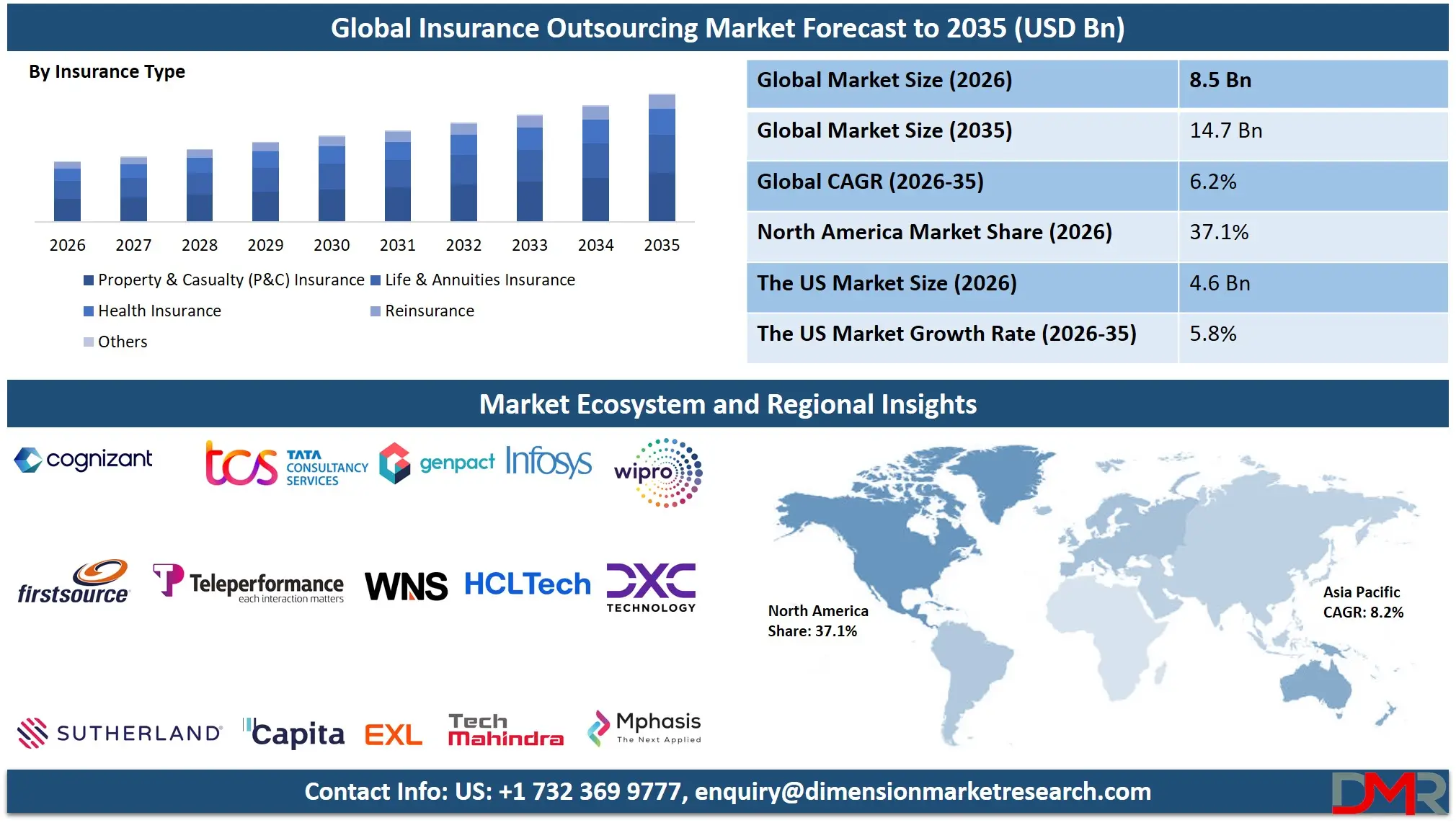
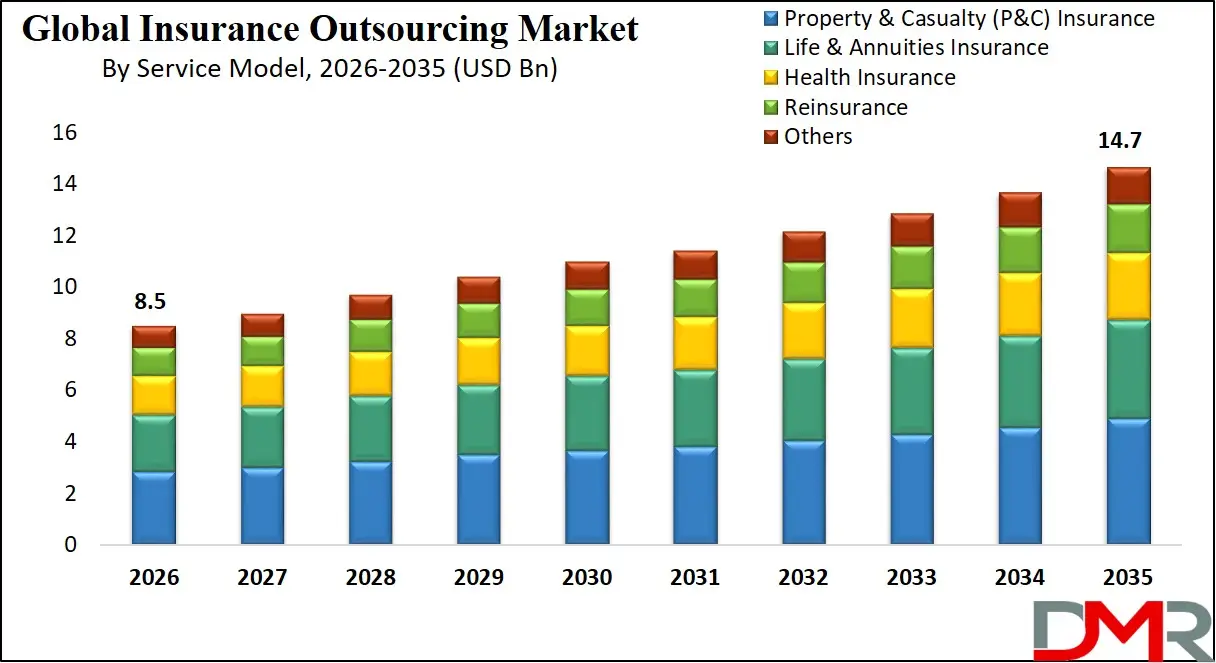
The Global Insurance Outsourcing Market is poised for substantial expansion, with its value estimated to reach USD 8.5 billion in 2026 and projected to grow at a CAGR of 6.2% from 2026 to 2035, reaching a market value of USD 14.7 billion by 2035.
ℹ
To learn more about this report –
Download Your Free Sample Report Here
This growth is driven by the rising pressure on insurance companies to minimize costs and improve efficiency and customer experience. Moreover, use of technology and the requirement of specialized skills are helping the insurance outsourcing industry grow. The insurance outsourcing business model is experiencing unprecedented growth due to changes in the regulatory environment and increasing complexity in insurance products. This is because of the opportunity to hire from global talent pool and perform advanced analytics. Advanced analytics and global talent pools, especially claims management and underwriting support, play a critical role in the success of the insurance outsourcing model.
ℹ
To learn more about this report –
Download Your Free Sample Report Here
Another key factor behind the success of the insurance outsourcing model is that it enables insurers to cut down claim turnaround times from weeks to a few days. It is putting traditional insurance companies into a dilemma where they have two options either to outsource non-core activities or partner with specialized BPOs. Another reason for the growing popularity of the insurance outsourcing model is that it allows insurers to take advantage of advancements such as Artificial Intelligence (AI) and robotic process automation (RPA).
The US Insurance Outsourcing Market
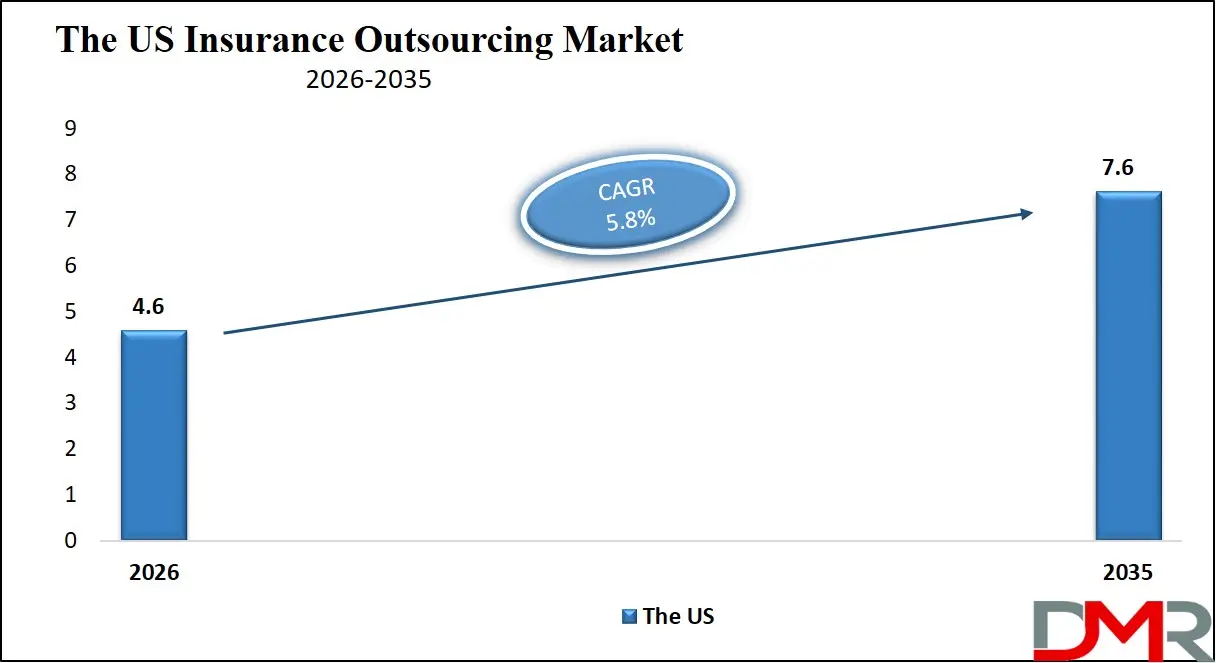
The U.S. Insurance Outsourcing Market is projected to reach USD 4.6 billion in 2026 and grow at a CAGR of 5.8%, reaching USD 7.6 billion by 2035. One of the highest numbers of insurance companies and third-party administrators (TPA) is observed in the USA. These insurance companies and TPA demonstrate their power in influencing the global outsourcing trend through their specific demands on BPO solutions.
ℹ
To learn more about this report –
Download Your Free Sample Report Here
An increased level of adoption of digital tools, as well as the growth in popularity of cloud-based solutions, enabled outsourcing vendors to successfully reach different types of insurance providers in North America. Ability to provide fast claims processing and effective policy management through outsourcing services is one of the major factors that differentiate outsourcing vendors and make them preferred partners among traditional insurers.
The Europe Insurance Outsourcing Market
The Europe insurance outsourcing market is poised for steady growth, with its value estimated to reach USD 2.6 billion in 2026 and projected to expand at a CAGR of around 5.8% from 2026 to 2035, reaching nearly USD 4.3 billion by 2035. This market is driven by the dynamics of regulation (Solvency II), but also by a significant influence of digitization and cost-optimized operations in European insurance markets, such as Germany, France, the UK, and Switzerland. Improvement in data protection regulations (GDPR), as well as in the adoption of hybrid delivery models, has allowed outsourcing providers to provide efficient services to different sectors of the insurance industry. Ability to respond to new regulations quickly is considered one of the major competitive advantages. Growth in popularity of outcome-oriented approaches to outsourcing prices is pressuring conventional insurers to adopt more dynamic outsourcing partnerships.
The Japan Insurance Outsourcing Market
The Japan Insurance Outsourcing Market is anticipated to be valued at approximately USD 900.0 billion in 2026 and is expected to attain nearly USD 1,400.0 billion by 2035, expanding at a CAGR of about 5.2% during the forecast period. It should be observed that the Japanese market of insurance outsourcing is distinguished by specific requirements concerning quality, accuracy, and precision. At the same time, the market has already entered the mature phase due to ongoing demands for outsourcing related to policy administration and customer service management. It should be highlighted that over the last few years, the market has experienced considerable development, which was characterized by the effective combination of outsourcing with quality management and control measures implemented by leading domestic and foreign companies. In addition, nearshoring and hybrid services became popular in the Japanese market of insurance outsourcing.
Insurance Outsourcing Market: Key Takeaways and Other Influencing Factors
- Strong Global Market Growth Outlook: The Global Insurance Outsourcing Market is estimated to be worth USD 8.5 billion in 2026, which is further expected to reach USD 14.7 billion by the end of 2035.
- Steady CAGR Driven by Digital Transformation: The global insurance outsourcing market is set to grow at a compound annual growth rate of 6.2% from 2026 to 2035, as more investments are made in cloud-based BPO platforms, AI-driven analytics, and flexible service models.
- Strong Growth Trajectory in the United States: The U.S. Insurance Outsourcing Market is currently valued at USD 4.6 billion in 2026, which is set to grow to USD 7.6 billion by 2035, growing at a compound annual growth rate of 5.8%.
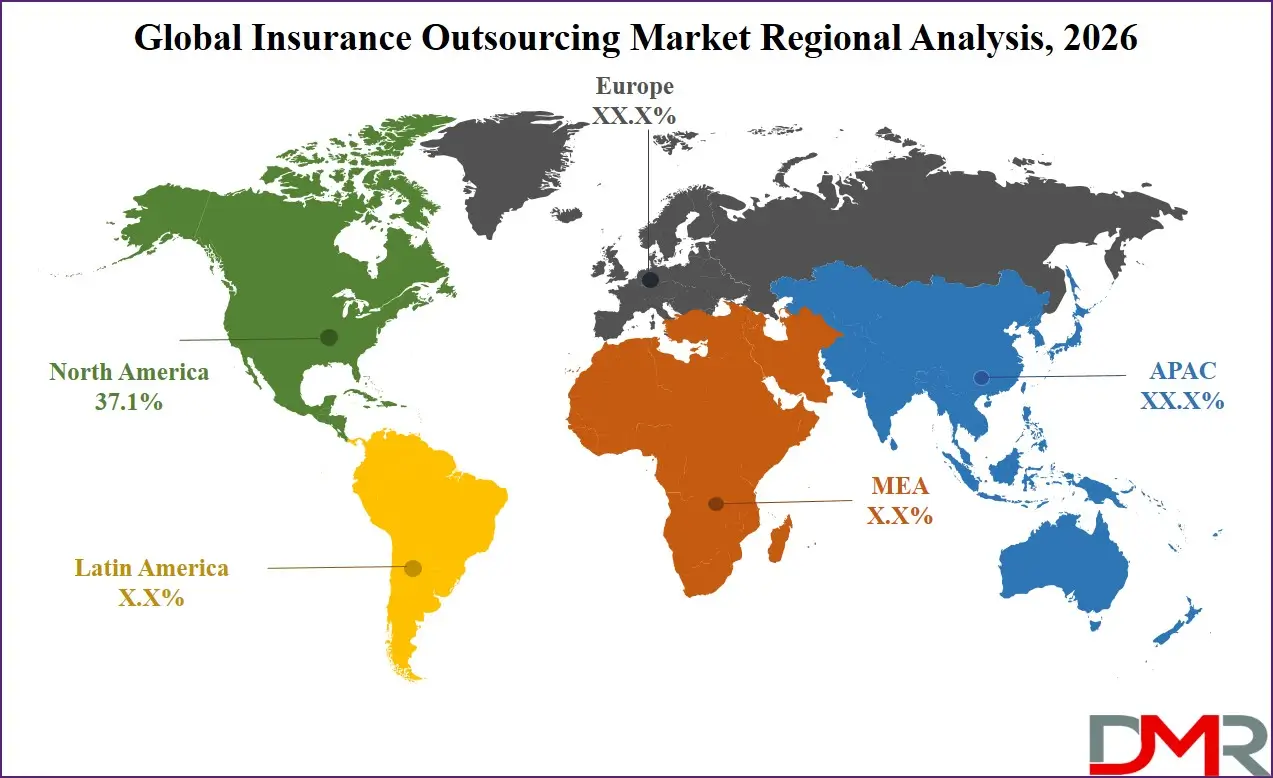
- Regional Dominance: The North America region is projected to dominate the global insurance outsourcing market, with 37.1% of market share in 2026, owing to its large insurance industry, high operational costs, and massive demand for specialized BPO services.
- Rapid Advancement in AI & Automation: The insurance outsourcing industry has seen a significant increase in the use of AI-based claims processing, automated underwriting, robotic process automation (RPA), and fraud detection analytics.
- OECD (Organisation for Economic Co-operation and Development): The average amount of government outsourcing spending was 9.2% of GDP in 2023 among OECD countries, of which 6.2% was on the purchase of goods and services by governments, and 3.1% was on services provided to citizens.
- OECD: OECD insurance statistics offer a broad coverage of information for over 60 countries around the world, offering support to regulatory authorities, central banks, and finance ministries in policy formulation, financial stability, and supervision of insurance markets globally.
Impact of Iran Conflict on the Global Insurance Outsourcing Market
The ongoing Iran crisis has had a significant impact on the global insurance outsourcing market, which has been severely disrupted due to logistical disruptions and the difficulty associated with conducting risk assessments. Inflation in energy costs and restricted logistics, especially in the Strait of Hormuz, have contributed to a rise in claims for P&C insurance, which, in turn, has created a need for outsourcing claims management processes. Another factor that has influenced the global insurance outsourcing market is the delay in transferring data and complying with reporting obligations, which is a direct consequence of geopolitical unrest.
Insurance Outsourcing Market: Use Cases
- Claims Processing Efficiency: Insurance companies outsource claims processing by automating their intake, validation, adjudication, and resolution to minimize delays and expenses. Outsourcing partners leverage technology and data analytics to optimize the process, minimize errors, combat fraud, and increase client satisfaction in large claims handling scenarios.
- Policy Management and Customer Service: Through outsourcing, insurance firms are able to provide an excellent customer experience with respect to policy issuance, renewal, endorsements, and customer care. The contact center takes charge of answering clients' questions, updating their policies, and cross-selling additional insurance policies to them.
- Assistance with Underwriting and Risk Assessment: Through outsourcing services, data gathering, analysis of risks and underwriting decision support is made possible through the use of artificial intelligence. These services enhance risk selection effectiveness, increase efficiency, accelerate policy issuance, and enable insurance companies to undertake their core activities.
Market Dynamics
Driving Factors in the Global Insurance Outsourcing Market
Accelerating Digital and Cloud-Based Platforms
Cloud computing, AI, and automation technologies are quickly revolutionizing outsourcing in the insurance industry. Outsourcing service providers utilize digital technology to streamline claims management, underwriting, and customer management processes to achieve efficiency and accuracy. BPO cloud-based services provide insurers with scalable and cost-effective business models without having to incur huge capital expenditures on IT infrastructure.
Pressures to Reduce Costs and Need for Operational Efficiency
Insurers are under increasing pressure to manage their operational costs effectively without compromising on quality. With increasing claims volume, complicated regulations, and competitive pricing structures, insurers are compelled to explore outsourcing options. The outsourcing of activities like claims handling and policy administration allows insurers to lower their costs considerably. This is achieved through outsourcing firms' knowledge of business processes, workflow standardization, and the advantage of size.
Restraints in the Global Insurance Outsourcing Market
Growing Concerns Over Data Security and Compliance
Data security and regulatory compliance are among the important issues that affect insurance outsourcing services. In dealing with the data of customers, insurers become prone to cyber attacks and data breaches when they outsource their business processes. Data privacy regulations like GDPR and HIPAA create additional compliance challenges for insurance companies and outsourced vendors. Non-compliance is punishable by heavy fines and damages. For this reason, most insurers prefer not to outsource any processes associated with customer data due to fears of non-compliance. Consequently, this constraint hinders the expansion of the market.
Service Quality and Cultural Differences
Consistency in the quality of services offered by outsourcing companies working across various geographical regions poses a major problem. There could be problems in communication due to differences in languages and cultures. The issue of higher staff turnover and labor costs is another area where outsourcing companies face major difficulties. This makes it extremely tough for the outsourcing company to meet the needs of the client without incurring higher costs in the process. In order to meet demands placed by insurance companies regarding high standards, the outsourcing firm has to work hard to maintain these relationships.
Opportunities in the Global Insurance Outsourcing Market
Expansion into Outcome-Based and Hybrid Pricing Models
Moving from a traditional pricing model to an outcomes-driven structure provides a great deal of opportunities for outsourcing companies. Insurance firms tend to have a preference for such pricing schemes that allow linking their costs to performance and results obtained. The use of transactional agreements and outcome-oriented ones helps achieve greater transparency and accountability while reducing the cost predictability of the process. Additionally, it enables better cooperation between insurance firms and outsourcing organizations due to aligning mutual objectives.
Hyper-Specialization and Data-Driven Analytics
The progress in AI and analytics is allowing outsourcing vendors to provide extremely specialized services for particular insurance markets. By using big data, analytics, and machine learning, outsourcing vendors will be able to provide more accurate insurance underwriting, identify insurance frauds, and perform better risk assessment. Specialization will decrease human errors and improve decision-making processes. Moreover, by specializing in some niche markets like cyber insurance and parametric insurance, outsourcing vendors will generate additional income streams.
Trends in the Global Insurance Outsourcing Market
Preeminence of Offshore and Nearshore BPO Models
Offshore and nearshore approaches still remain the most preferred outsourcing models among insurance organizations owing to their relative benefits in terms of cost-effectiveness and scalability. Businesses prefer such models for acquiring the right talent pool at low prices without compromising on productivity. The benefit that emerges from the nearshore model is that of synchronization with culture and time zone, thus aiding collaboration. In this context, it becomes imperative for the traditional onshore firms to come up with hybrid delivery models to remain relevant in the outsourcing market.
Focus on Transparency and ESG in Outsourcing
Environmental, Social, and Governance (ESG) is now an essential consideration in outsourced services. Insurance companies prefer working with outsourcing partners who exhibit good labor practices, are environmentally sustainable, and are run in an open manner. As a result, service providers have adopted ESG standards, produced sustainability reports, and improved on their governance. By being open in the areas of reporting and performance, trust is established and better relationships created. This strategy not only improves corporate image but helps the firms comply with regulations.
Insurance Outsourcing Market: Research Scope and Analysis
By Service Type Analysis
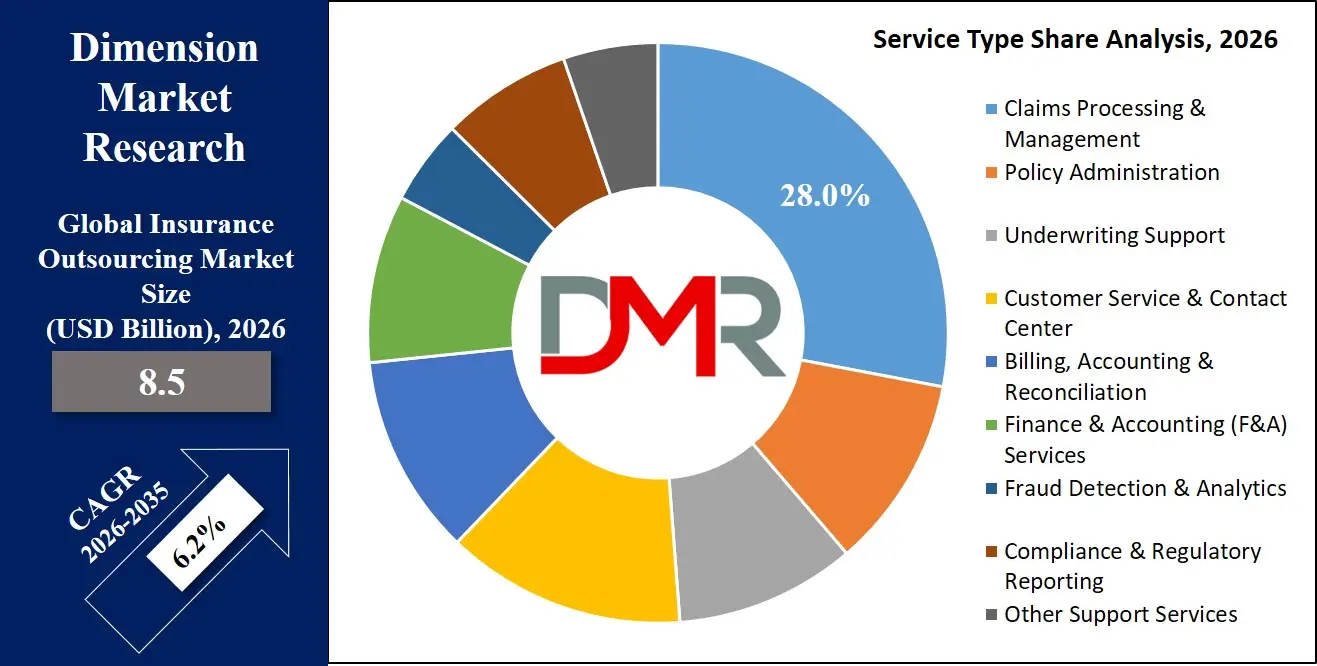
The service type segment is poised by Claims Processing & Management, owing to the high number of claims processed by insurance firms every year. This is because the nature of claims processing is complicated and expensive. There are literally millions of claims in Property & Casualty insurance as well as health insurance lines that have to be settled each year, which explains why insurers are eager to outsource this process. They can benefit from quicker claims settlement, enhanced customer experience, and minimized operational costs when they opt to outsource claims management.
ℹ
To learn more about this report –
Download Your Free Sample Report Here
By Insurance Type Analysis
Property & Casualty (P&C) Insurance is projected to possesses the highest market share because of the high incidence and volatility of claims related to automotive insurance, property insurance, and liability insurance. There is always a constant need for claims handling, underwriting, and customer care in these policies, which makes outsourcing quite necessary. The difficulty and complexities involved in assessing risk in P&C insurance also necessitate outsourcing. Furthermore, natural disasters and higher claim volumes add to the work of the insurance company, and thus outsourcing is needed to handle this situation effectively. Therefore, P&C insurance companies form the majority of outsourcers worldwide.
By Service Model Analysis
Offshore BPO is expected to be the leading player in the service model segment because of its cost effectiveness and availability of manpower. Asian countries like India and the Philippines play a pivotal role as outsourcing destinations with quality service delivery at a reasonable cost. With the offshore model, insurance companies can run their businesses round-the-clock and increase their efficiency and productivity. However, security issues and communication problems posed by offshore BPOs can be overcome through technological innovations. Cost reduction is the main advantage of this type of business model, which explains its popularity among insurance firms.
By Pricing Model Analysis
Transaction-based pricing is projected to dominate the category of pricing models since it directly links costs to the number of transactions performed. Such a pricing model works very well for operations such as claims management, policy generation, and client management, where operations are measured in units. It guarantees predictability and transparency of costs for the insurer while providing opportunities for efficiency optimization to the vendor performing the operation. It is worth noting that transactional pricing differs from fixed or time-based pricing models in that it guarantees that clients will pay only for performed transactions.
By Organization Size Analysis
Large enterprises is projected to dominate this segment because of the wide operational span of these companies and their bigger budgets for outsourcing. These are big firms with complex portfolios of insurance policies, many customers, and huge numbers of claims, hence process management is very important. With outsourcing, they will be able to simplify processes and concentrate on the most strategic activities while benefiting from economies of scale. Large companies can also embrace innovative solutions like artificial intelligence via outsourcing. They are also capable of signing long-term agreements with the service providers.
By Delivery Channel Analysis
Third-party vendors or specialized BPO providers are expected to dominate the delivery channel segment in this market. The outsourcing players or the specific BPOs play an important role in the delivery channels segment owing to the efficiency of cost, expertise, and scale that they can offer. The outsourcing players have built their infrastructure, expertise, and technology solutions for serving the insurance industry specifically. The insurers find it more efficient to outsource their tasks to these players instead of building internal capacity owing to the savings on investments in resources and technology solutions. Moreover, the third-party providers continue to innovate and automate their services in line with the latest standards, thus improving the overall quality of service.
By End-User Analysis
Property & Casualty insurance insurers form the major part of the end-user category owing to their heavy dependence on outsourcing activities in claim management. The insurance products offered by the P&C insurer are characterized by varied categories of risks such as automobile, property, and liability risks, which are consistent throughout the year. Through outsourcing, P&C insurers can manage their peak workload periods, minimize the time taken to settle claims, and enhance the level of customer satisfaction. Moreover, the need to detect fraudulent claims and the requirement to process large volumes of information compel the insurers to adopt outsourcing services.
The Insurance Outsourcing Market Report is segmented on the basis of the following:
By Service Type
- Claims Processing & Management
- Policy Administration
- Underwriting Support
- Customer Service & Contact Center
- Billing, Accounting & Reconciliation
- Finance & Accounting (F&A) Services
- Fraud Detection & Analytics
- Compliance & Regulatory Reporting
- Other Support Services
By Insurance Type
- Property & Casualty (P&C) Insurance
- Life & Annuities Insurance
- Health Insurance
- Reinsurance
- Others
By Service Model
- Onshore BPO Services
- Offshore BPO Services
- Nearshore BPO Services
- Hybrid BPO Services
By Pricing Model
- Fixed Pricing
- Time & Material Pricing
- Transaction-Based Pricing
- Outcome / Performance-Based Pricing
- Others
By Organization Size
- Large Enterprises
- Small & Mid-Sized Enterprises (SMEs)
By Delivery Channel
- Third-Party Vendors / BPO Providers
- Direct Sales (In-house Contracts)
- Digital Platforms / Cloud-Based BPO
- System Integrators & Consulting Firms
- Others
By End-User
- Property & Casualty Insurance Providers
- Life Insurance Providers
- Health Insurance Providers
- Reinsurance Companies
- Insurance Brokers & Agencies
- InsurTech Companies
- Others
Impact of Artificial Intelligence in the Insurance Outsourcing Market
The outsourcing industry for insurance is now feeling the effects of artificial intelligence through the use of intelligent automation. With the aid of artificial intelligence software, BPO firms can assess claim information in real-time. Through the use of artificial intelligence software, outsourcing organizations will be able to detect fraudulent activities within a claim submission process. Artificial intelligence software will allow outsourcing organizations to accurately predict the number of incoming claims that need to be processed and adjust their staff accordingly. Artificial intelligence software will allow insurance BPO companies to develop document extraction models based on specific policies. With the assistance of artificial intelligence software, outsourcing firms can keep pace with their competitors by reducing the time and error rate associated with processing claims.
Insurance Outsourcing Market: Regional Analysis
Region with the Largest Revenue Share
North America is poised to dominate the global insurance outsourcing market in terms of revenue share as it holds 38.5% of the market share by the end of 2026, because of the high cost of insurance, high carrier density, and penetration of BPO services. The United States is the leading country in the region, where there is a huge population of P&C and health insurance companies that tend to outsource claims, customer service, and policy management.
ℹ
To learn more about this report –
Download Your Free Sample Report Here
This is due to the fact that these organizations have very high operating costs, advanced regulatory framework, and digital transformation requirements. The United States is the major contributor to the insurance outsourcing market in North America since there is a higher number of cost-sensitive insurance companies that aim to focus on their core competencies.
Region with the Highest CAGR
Asia-Pacific region will be the leader in terms of CAGR in the insurance outsourcing market globally. It is attributed to several reasons such as having a huge number of employees who speak fluent English, high standards of data security, and high youth population. Countries like India and Philippines have contributed to increased demand for outsourcing of business process outsourcing (BPO). This is attributed to high penetration of technological infrastructure and labor costs. Also, the Asia-Pacific region acts as a delivery center for the majority of insurers globally. This provides an opportunity for BPO companies to take advantage of lower cost of production and scalability.
By Region
North America
Europe
- Germany
- The U.K.
- France
- Italy
- Russia
- Spain
- Benelux
- Nordic
- Rest of Europe
Asia-Pacific
- China
- Japan
- South Korea
- India
- ANZ
- ASEAN
- Rest of Asia-Pacific
Latin America
- Brazil
- Mexico
- Argentina
- Colombia
- Rest of Latin America
Middle East & Africa
- Saudi Arabia
- UAE
- South Africa
- Israel
- Egypt
- Rest of MEA
Global Insurance Outsourcing Market: Competitive Landscape
The Global Insurance Outsourcing Market has the presence of a combination of large BPO players, insurance outsourcing-focused players, and technology platforms. The major players of the Global Insurance Outsourcing Market include large vertically integrated BPO firms with advanced delivery centers, along with digitally native technology platforms that have AI-enabled automation features. Established BPO firms such as Genpact, WNS, and EXL are innovating themselves amid the disruption caused by InsurTech firms by emphasizing data analytics and digital services. Players such as Cognizant and Accenture are disrupting the market through their end-to-end insurance outsourcing offerings.
Some of the prominent players in the Global Insurance Outsourcing Market are:
- Accenture plc
- Cognizant Technology Solutions
- Infosys Limited
- Genpact Limited
- DXC Technology Company
- WNS (Holdings) Limited
- Tech Mahindra Limited
- EXLService Holdings, Inc.
- Capita plc
- Mphasis Limited
- Concentrix Corporation
- Teleperformance SE
- Sutherland Global Services
- Firstsource Solutions Limited
- Hinduja Global Solutions (HGS)
- ReSource Pro
- Patra Corporation
- Tata Consultancy Services (TCS)
- Wipro Limited
- HCL Technologies Limited
- Other Key Players
Recent Developments in Insurance Outsourcing Market
- October 2025: Genpact launched a new AI-powered claims processing platform for P&C insurers, reducing average claims settlement time by 35% using computer vision and natural language processing.
- September 2025: WNS Global Holdings announced a strategic partnership with a major European health insurer to provide end-to-end policy administration and customer service from its delivery centers in Poland and India.
- August 2025: Cognizant introduced a blockchain-based solution for reinsurance contract management and claims reconciliation, aimed at reducing disputes and manual effort.
- July 2025: EXL Service Holdings expanded its nearshore delivery capabilities in Latin America, opening a new center in Colombia to serve U.S. health insurance clients.
Report Details
| Report Characteristics |
| Market Size (2026) |
USD 8.5 Bn |
| Forecast Value (2035) |
USD 14.7 Bn |
| CAGR (2026–2035) |
6.2% |
| The US Market Size (2026) |
USD 4.6 Bn |
| Historical Data |
2021 – 2025 |
| Forecast Data |
2027 – 2035 |
| Base Year |
2025 |
| Estimate Year |
2026 |
| Report Coverage |
Market Revenue Estimation, Market Dynamics, Competitive Landscape, Growth Factors and etc. |
| Segments Covered |
By Service Type (Claims Processing & Management, Policy Administration, Underwriting Support, Customer Service & Contact Center, Billing, Accounting & Reconciliation, Finance & Accounting Services, Fraud Detection & Analytics, Compliance & Regulatory Reporting, Others), By Insurance Type (Property & Casualty Insurance, Life & Annuities Insurance, Health Insurance, Reinsurance, Others), By Service Model (Onshore, Offshore, Nearshore, Hybrid BPO Services), By Pricing Model (Fixed, Time & Material, Transaction-Based, Outcome/Performance-Based, Others), By Organization Size (Large Enterprises, SMEs), By Delivery Channel (Third-Party Vendors, Direct Sales, Digital/Cloud Platforms, System Integrators & Consulting Firms, Others), By End-User (P&C Insurance Providers, Life Insurance Providers, Health Insurance Providers, Reinsurance Companies, Insurance Brokers & Agencies, InsurTech Companies, Others). |
| Regional Coverage |
North America – The US and Canada; Europe – Germany, The UK, France, Russia, Spain, Italy, Benelux, Nordic, & Rest of Europe; Asia-Pacific – China, Japan, South Korea, India, ANZ, ASEAN, Rest of APAC; Latin America – Brazil, Mexico, Argentina, Colombia, Rest of Latin America; Middle East & Africa – Saudi Arabia, UAE, South Africa, Turkey, Egypt, Israel, & Rest of MEA |
| Prominent Players |
Accenture plc, Cognizant Technology Solutions, Infosys Limited, Genpact Limited, Tata Consultancy Services (TCS), Wipro Limited, HCL Technologies Limited, DXC Technology Company, WNS (Holdings) Limited, Tech Mahindra Limited, EXLService Holdings Inc., Capita plc, Mphasis Limited, Concentrix Corporation, Teleperformance SE, Sutherland Global Services, Firstsource Solutions Limited, Hinduja Global Solutions (HGS), ReSource Pro, Patra Corporation, and Other Key Players |
Frequently Asked Questions
How big is the Global Insurance Outsourcing Market?
▾ The Global Insurance Outsourcing Market size is estimated to have a value of USD 8.5 billion in 2026 and is expected to reach USD 14.7 billion by the end of 2035.
What is the growth rate in the Global Insurance Outsourcing Market?
▾ The market is growing at a CAGR of 6.2% over the forecasted period of 2026-2035.
What is the size of the US Insurance Outsourcing Market?
▾ The US Insurance Outsourcing Market is projected to be valued at USD 4.6 billion in 2026. It is expected to witness subsequent growth as it holds USD 7.6 billion in 2035 at a CAGR of 5.8%.
Which region accounted for the largest Global Insurance Outsourcing Market?
▾ North America is expected to have the largest market share in the Global Insurance Outsourcing Market, accounting for over 37.1% in 2026.
Who are the key players in the Global Insurance Outsourcing Market?
▾ Some of the major key players in the Global Insurance Outsourcing Market are Accenture, Cognizant, Genpact, WNS Global Holdings, EXL Service Holdings, TCS, Infosys BPM, and many others.