What is the Integrated Facility Management Market Size?
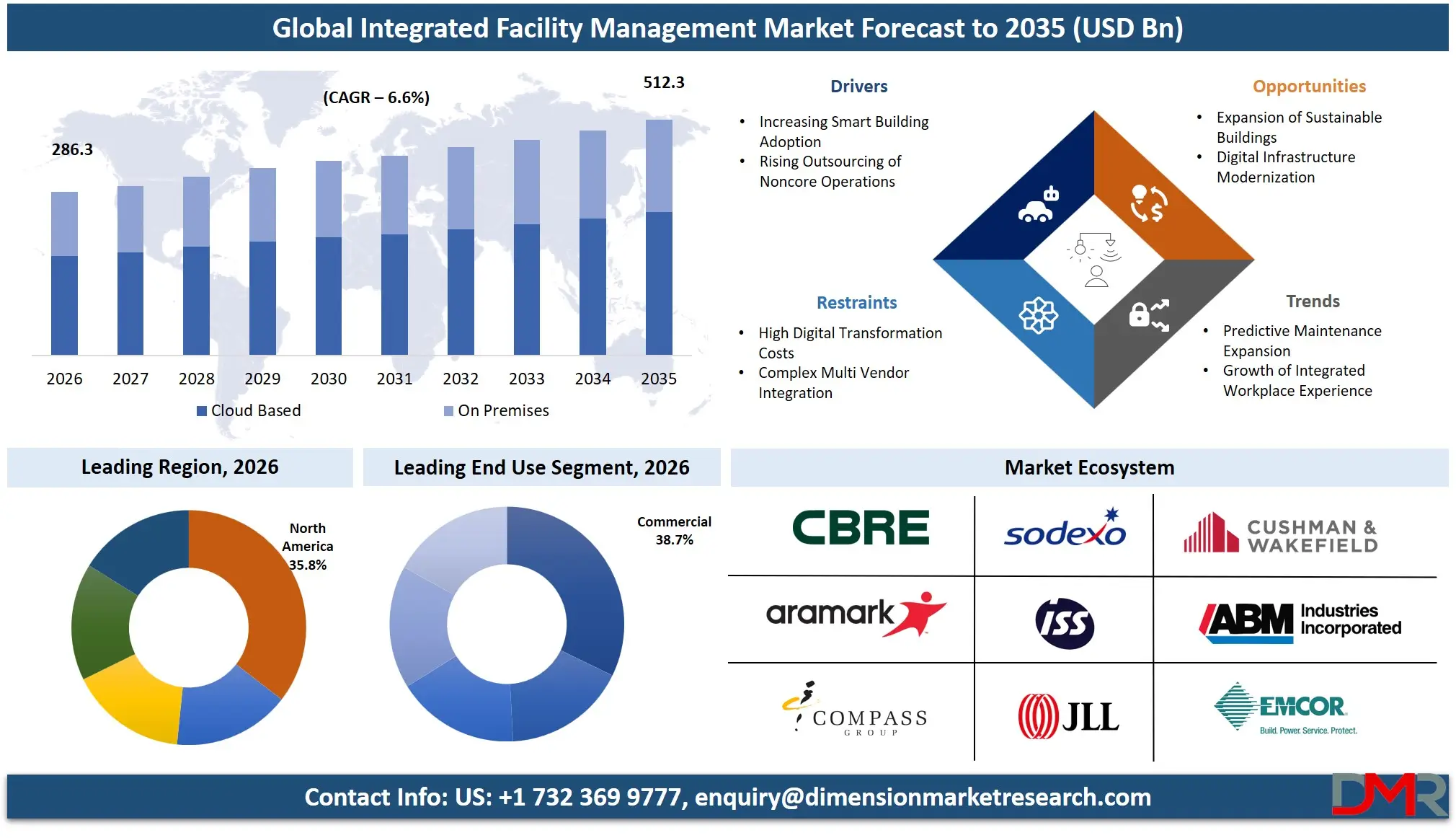
The Global Integrated Facility Management Market is projected to grow from USD 286.3 billion in 2026 to USD 512.3 billion by 2035, expanding at a CAGR of 6.6%. Integrated facility management combines multiple hard, soft, and workplace services under a unified operating model to improve operational efficiency, reduce costs, and enhance occupant experience across commercial, industrial, and institutional facilities.
ℹ
To learn more about this report –
Download Your Free Sample Report Here
Market growth is supported by rapid digitalization of buildings, increasing outsourcing of noncore business functions, and rising investments in smart infrastructure worldwide. According to the International Energy Agency, buildings account for nearly 30% of global final energy consumption, driving demand for integrated energy and asset management solutions. Governments are also strengthening building efficiency regulations and sustainability targets, encouraging organizations to adopt centralized facility management platforms. Growing deployment of Internet of Things technologies, predictive maintenance, and artificial intelligence enabled building operations is expected to further accelerate market expansion throughout the forecast period.
The US Integrated Facility Management Market
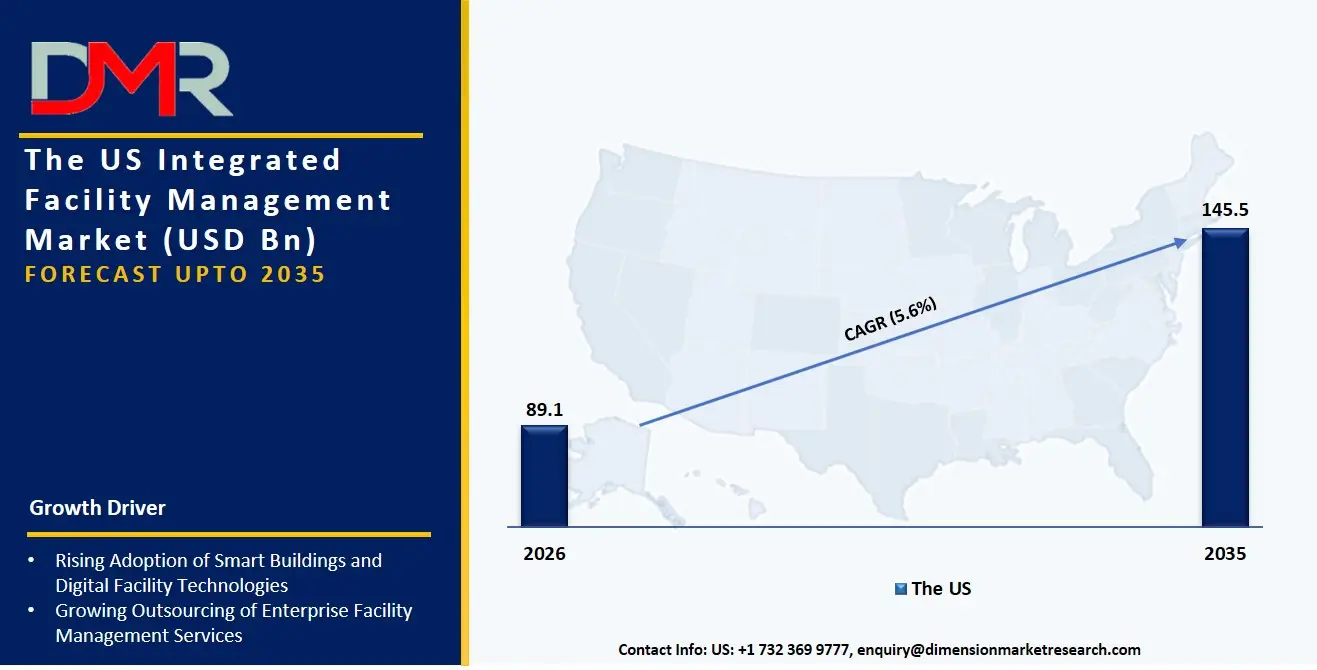
The United States Integrated Facility Management Market is expected to increase from USD 89.1 billion in 2026 to USD 145.5 billion by 2035, registering a CAGR of 5.6%.
ℹ
To learn more about this report –
Download Your Free Sample Report Here
The United States represents the largest regional market due to its mature commercial real estate sector, widespread outsourcing culture, and rapid adoption of intelligent building technologies. Increasing demand for workplace optimization, regulatory compliance, and energy efficient building operations continues to support market growth across corporate, healthcare, industrial, and government facilities. According to the U.S. Energy Information Administration, commercial buildings consume approximately 18% of total U.S. energy use, creating significant opportunities for integrated facility and energy management services. Federal sustainability initiatives and modernization of public infrastructure are further encouraging adoption of digital facility management solutions. Continued investments in smart buildings, cloud platforms, and predictive maintenance technologies are expected to sustain long term market growth.
The Europe Integrated Facility Management Market
The Europe Integrated Facility Management Market is projected to grow from USD 82.1 billion in 2026 to USD 129.7 billion by 2035, at a CAGR of 5.2%. Europe remains a major market owing to stringent environmental regulations, widespread outsourcing of facility operations, and strong emphasis on sustainable building management. Increasing renovation of aging infrastructure and implementation of digital workplace solutions are driving demand for integrated facility management across commercial, industrial, healthcare, and public sector facilities. According to the European Commission, buildings are responsible for around 40% of energy consumption and 36% of greenhouse gas emissions in the European Union, reinforcing the need for efficient facility and energy management practices. Regulatory frameworks promoting energy performance and carbon reduction continue to encourage investment in integrated services. Future growth will also be supported by smart city initiatives, automation technologies, and expansion of green building programs across the region.
The Japan Integrated Facility Management Market
The Japan Integrated Facility Management Market is anticipated to reach USD 38.1 billion by 2035 from USD 23.4 billion in 2026, expanding at a CAGR of 5.5%. Japan's market is driven by increasing modernization of commercial infrastructure, an aging building stock, and rising demand for operational efficiency through integrated service delivery. Organizations are adopting digital building management systems to improve asset performance, reduce maintenance costs, and address workforce shortages through automation. According to Japan's Ministry of Land, Infrastructure, Transport and Tourism, the country continues to promote smart city development and digital transformation of urban infrastructure, supporting advanced facility management adoption. Growing emphasis on energy conservation, disaster resilience, and sustainable building operations further strengthens market demand. Integration of artificial intelligence, robotics, and Internet of Things technologies is expected to create substantial opportunities for the Japanese integrated facility management market over the coming years.
Key Takeaways
- Market Size: The Global Integrated Facility Management Market is expected to grow from USD 286.3 billion in 2026 to USD 512.3 billion by 2035, driven by increasing enterprise demand for integrated building operations, workplace optimization, and digital asset management solutions.
- Growth Rate and Outlook: The market is projected to expand at a CAGR of 6.6% during 2026 to 2035, supported by rising outsourcing adoption, smart building investments, sustainability mandates, cloud based facility management platforms, and predictive maintenance technologies.
- Primary Growth Drivers: Rising outsourcing of noncore operations, increasing adoption of Internet of Things enabled buildings, stricter environmental regulations, workplace digitization, and infrastructure investments are driving market expansion, contributing to growth from USD 286.3 billion in 2026 to USD 512.3 billion by 2035.
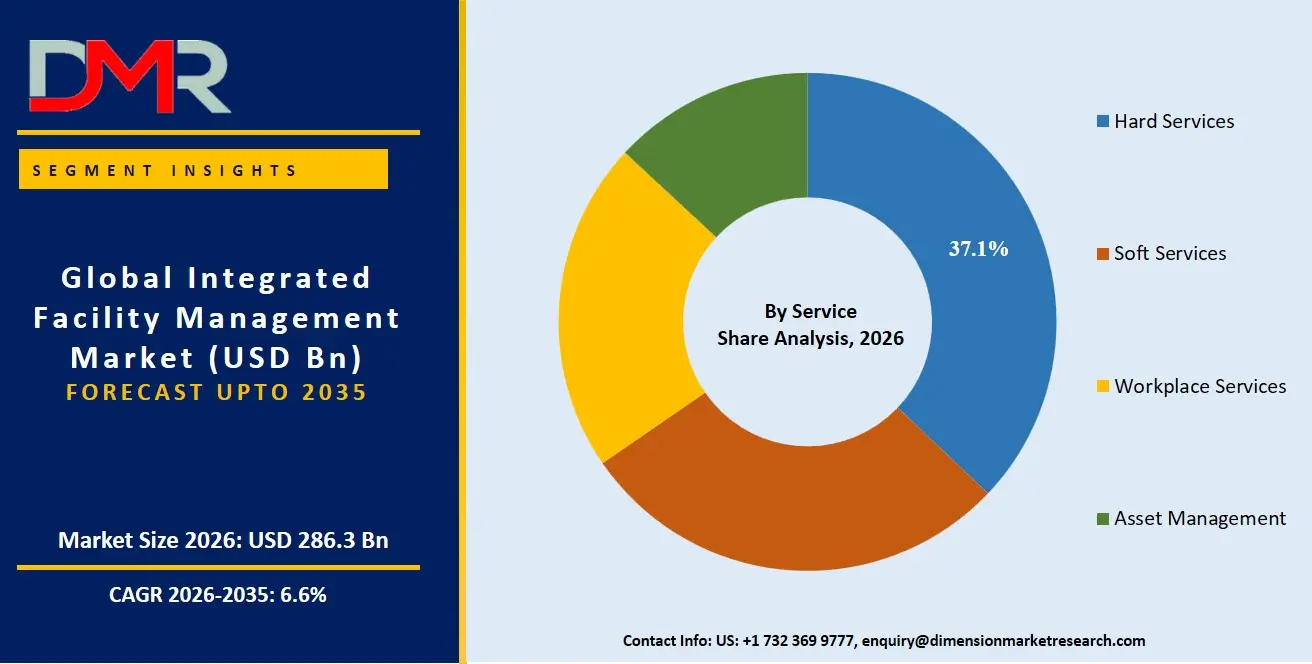
- By Service Analysis: Hard Services dominated the market with 56.8% market share in 2026, while Workplace Services are expected to register the highest CAGR of 8.4%, and Soft Services held the second largest share of 31.6%.
- By End Use Analysis: Commercial facilities accounted for the largest market share of 38.7%, supported by office modernization and workplace optimization, while Infrastructure is projected to witness the highest CAGR of 8.3%, and Industrial held the second largest share of 27.4%.
- By Deployment Analysis: Cloud Based deployment led the market with 58.1% share in 2026 and is anticipated to grow at the highest CAGR of 8.9%, whereas On Premises deployment represented the second largest market share of 41.9%.
- Regional Leadership: North America held the largest regional market share of 35.8% in 2026, while Europe accounted for the second largest share of 28.7%. Asia Pacific is projected to register the highest CAGR of 8.9% through 2035, driven by rapid urbanization and smart infrastructure investments.
What is Integrated Facility Management Market?
The Integrated Facility Management Market comprises comprehensive solutions that combine multiple facility services under a single management framework to optimize building performance, occupant comfort, operational efficiency, and regulatory compliance. These services include maintenance, security, cleaning, workplace management, energy optimization, and asset lifecycle management delivered through one service provider. According to the United Nations Environment Programme, buildings generate approximately 37% of global energy related carbon dioxide emissions, increasing the need for integrated and sustainable facility operations. Organizations are increasingly adopting digital platforms, Internet of Things technologies, automation, and predictive maintenance to improve service quality while reducing lifecycle costs. The market serves commercial, industrial, institutional, residential, and infrastructure facilities worldwide and continues expanding as organizations prioritize sustainability, workplace experience, and operational resilience.
Use Cases
- Corporate Workplace Management: Large enterprises use integrated facility management to coordinate maintenance, security, workspace utilization, and employee services from a unified platform. This improves operational efficiency while reducing administrative complexity and facility operating costs.
- Healthcare Facility Operations: Hospitals utilize integrated facility management to maintain critical infrastructure, manage medical equipment environments, ensure regulatory compliance, and improve patient safety through continuous monitoring and preventive maintenance.
- Manufacturing Plant Management: Manufacturers deploy integrated facility management to maximize equipment availability, optimize utility consumption, schedule preventive maintenance, and improve production continuity through centralized asset management.
- Smart Public Infrastructure: Airports, railway stations, and government buildings adopt integrated facility management to integrate security, utilities, cleaning, maintenance, and energy management for improved service quality and efficient infrastructure operations.
How AI is Transforming the Integrated Facility Management Market?
Artificial intelligence is transforming integrated facility management by enabling predictive maintenance, automated fault detection, intelligent energy optimization, and digital workplace management. AI analyzes data from Internet of Things sensors to identify equipment anomalies before failures occur, reducing maintenance costs and minimizing downtime. According to the International Energy Agency, digital technologies can improve building energy efficiency through continuous optimization and intelligent control systems. AI powered occupancy analytics optimize heating, ventilation, air conditioning, lighting, and workspace utilization based on real time occupancy patterns. Global facility management providers are increasingly integrating AI into computerized maintenance management systems and digital twins for asset lifecycle optimization. AI chatbots also automate service requests and workplace support, while computer vision improves security monitoring and safety compliance across commercial, healthcare, industrial, and public infrastructure facilities.
Market Dynamics
Key Drivers in the Global Integrated Facility Management Market
Increasing Smart Building Adoption
Rapid deployment of smart buildings equipped with Internet of Things devices, connected sensors, intelligent automation, and digital monitoring systems is significantly increasing demand for integrated facility management services. Organizations require centralized platforms capable of managing building assets, energy consumption, maintenance scheduling, security, and workplace operations through real time analytics. Governments are also promoting energy efficient infrastructure and digital building standards, encouraging enterprises to adopt integrated facility management solutions that improve operational visibility, reduce maintenance costs, and enhance occupant comfort while supporting sustainability objectives across commercial, industrial, healthcare, and institutional facilities.
Rising Outsourcing of Noncore Operations
Organizations across industries are increasingly outsourcing facility operations to specialized service providers, enabling greater focus on core business activities while improving service quality and cost efficiency. Integrated facility management providers deliver bundled services under unified contracts, reducing vendor complexity and improving operational coordination. Growing demand for standardized service delivery, regulatory compliance, workforce optimization, and lifecycle asset management continues to accelerate outsourcing across office buildings, hospitals, manufacturing facilities, educational institutions, airports, and public infrastructure, creating sustained demand for integrated facility management solutions globally.
Restraints in the Global Integrated Facility Management Market
High Digital Transformation Costs
Implementing integrated facility management platforms often requires substantial investments in software, Internet of Things infrastructure, sensors, cloud systems, workforce training, and existing building modernization. Small and medium enterprises frequently face budget constraints that delay digital facility transformation projects. Integration with legacy infrastructure further increases implementation complexity, limiting adoption despite long term operational savings. These financial barriers remain a significant challenge for widespread market expansion, particularly in developing economies with aging commercial infrastructure and limited digital readiness.
Complex Multi Vendor Integration
Many organizations operate facilities using multiple legacy software platforms, equipment vendors, and service providers, creating integration challenges during digital transformation. Data standardization, interoperability issues, cybersecurity concerns, and inconsistent operational processes complicate centralized facility management implementation. Managing different maintenance systems, security platforms, energy monitoring tools, and workplace applications requires extensive customization and technical expertise, increasing deployment time and operational risk while slowing adoption across complex enterprise environments.
Growth Opportunities in the Global Integrated Facility Management Market
Expansion of Sustainable Buildings
Growing investments in green buildings and carbon reduction initiatives present substantial opportunities for integrated facility management providers. Organizations increasingly require continuous energy monitoring, waste management, indoor environmental quality management, and sustainability reporting. Integrated platforms enable centralized environmental performance monitoring, supporting regulatory compliance and corporate sustainability objectives. Rising adoption of energy efficient buildings across commercial and institutional sectors is expected to generate long term demand for specialized facility management services worldwide.
Digital Infrastructure Modernization
Governments and private organizations continue investing in smart cities, digital public infrastructure, intelligent transportation facilities, and advanced commercial buildings. These projects require integrated facility management providers capable of supporting connected infrastructure through predictive maintenance, digital asset management, cybersecurity monitoring, and intelligent workplace operations. Increasing deployment of cloud computing, digital twins, and advanced analytics creates new service opportunities for providers delivering comprehensive technology enabled facility management solutions.
Trends in the Global Integrated Facility Management Market
Predictive Maintenance Expansion
Facility operators are increasingly replacing reactive maintenance with predictive maintenance using Internet of Things sensors, artificial intelligence, and advanced analytics. Continuous monitoring enables early detection of equipment degradation, improving asset reliability, reducing unexpected downtime, and optimizing maintenance budgets. This transition supports higher operational efficiency while extending infrastructure lifespan across commercial, industrial, healthcare, and transportation facilities.
Growth of Integrated Workplace Experience
Organizations are increasingly adopting workplace experience platforms that integrate facility management with employee services, occupancy analytics, visitor management, meeting room scheduling, and hybrid workplace optimization. Digital workplace technologies improve employee satisfaction while maximizing space utilization and operational efficiency. As hybrid working models continue evolving globally, integrated workplace management is becoming a strategic priority for corporate facility operators.
Research Scope and Analysis
The Integrated Facility Management Market analysis highlights strong growth across hard services, integrated delivery models, cloud deployment, outsourced operations, and large enterprises. Rising digital transformation, smart building adoption, workplace optimization, and increasing demand from commercial, industrial, and infrastructure sectors continue to drive market expansion and long-term industry development.
ℹ
To learn more about this report –
Download Your Free Sample Report Here
By Service Analysis
Hard Services are projected to dominate the Integrated Facility Management Market with 56.8% of the total market share, driven by the essential nature of mechanical systems, electrical infrastructure, plumbing, heating ventilation and air conditioning, fire protection, and building maintenance across commercial, industrial, and institutional facilities. Organizations prioritize these services to ensure business continuity, regulatory compliance, and asset reliability. Workplace Services are projected to register the highest CAGR of 8.4% during the forecast period, supported by increasing demand for hybrid workplace management, occupancy analytics, employee experience solutions, and digital workspace optimization. Meanwhile, Soft Services accounted for the second largest market share of 31.6%, reflecting sustained demand for cleaning, security, catering, landscaping, and waste management services that improve workplace safety, hygiene, operational efficiency, and occupant satisfaction.
By Delivery Model Analysis
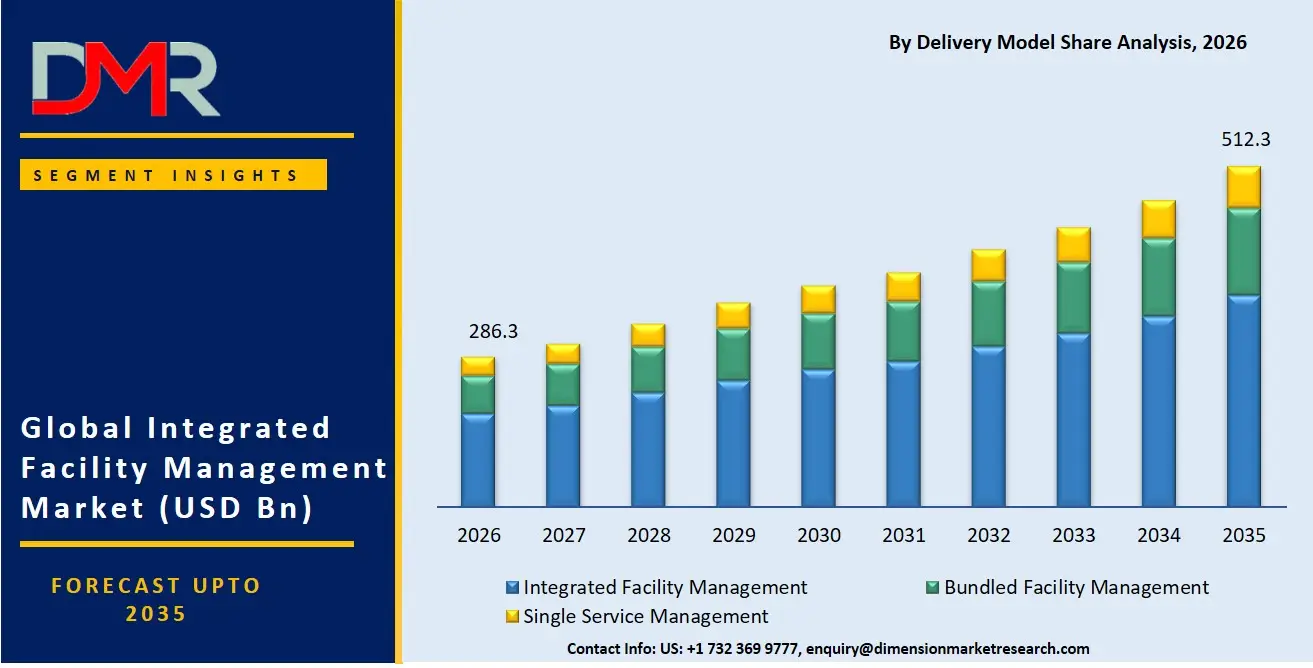
Integrated Facility Management is projected to hold the largest market share of 62.3%, reflecting growing enterprise preference for centralized service delivery through a single contract and provider. This model enables organizations to streamline vendor management, reduce operating costs, improve service consistency, and leverage integrated technology platforms for better asset visibility and performance.
ℹ
To learn more about this report –
Download Your Free Sample Report Here
The segment is also projected to witness the highest CAGR of 7.4%, supported by increasing outsourcing strategies, digital facility operations, and demand for comprehensive workplace management solutions. Bundled Facility Management represented the second largest market share of 25.4%, as organizations increasingly consolidate selected services under unified contracts while retaining flexibility for specialized operations. Rising emphasis on operational efficiency and service integration continues to strengthen demand across both delivery models.
By Deployment Analysis
Cloud Based deployment is anticipated to account for the largest share of the Integrated Facility Management Market with 58.1%, driven by growing adoption of scalable software platforms, remote facility monitoring, centralized data management, and lower infrastructure costs. Cloud solutions enable real time asset tracking, predictive maintenance, workforce mobility, and seamless integration with Internet of Things devices, making them the preferred deployment option for large enterprises. The segment is also expected to register the highest CAGR of 8.9%, supported by accelerating digital transformation, artificial intelligence integration, and increasing investment in smart buildings. On Premises deployment held the second largest market share of 41.9%, particularly among organizations requiring enhanced data security, regulatory compliance, and greater control over mission critical facility management systems.
By Enterprise Size Analysis
Large Enterprises is poised to dominate the market with 72.5% of total revenue, owing to extensive facility portfolios, higher outsourcing expenditure, and significant investments in digital building technologies. These organizations increasingly implement integrated facility management solutions to optimize operational efficiency, reduce maintenance costs, improve sustainability performance, and manage complex infrastructure across multiple locations. Small and Medium Enterprises are anticipated to record the highest CAGR of 7.8%, driven by growing affordability of cloud based facility management platforms and increasing awareness of outsourced facility services. The segment also accounted for the second largest market share of 27.5%, supported by expanding commercial infrastructure, business modernization initiatives, and rising adoption of scalable workplace management solutions across developing economies.
By Sourcing Analysis
Outsourced facility management is expected to dominated the market with a 69.4% share, as organizations increasingly rely on specialized service providers to improve operational efficiency, reduce administrative complexity, and optimize lifecycle costs. Outsourcing enables access to advanced technologies, skilled personnel, standardized service delivery, and integrated maintenance solutions while allowing enterprises to focus on core business activities. The segment is also anticipated to register the highest CAGR of 7.2%, supported by rising demand for bundled service contracts, digital facility management platforms, and performance based outsourcing models. In House sourcing accounted for the second largest market share of 30.6%, remaining relevant among organizations with stringent security requirements, highly specialized operational needs, and greater preference for direct control over facility operations and maintenance.
By End Use Analysis
The Commercial segment is projected to led the Integrated Facility Management Market with a 38.7% market share, supported by rising demand from corporate offices, retail complexes, hospitality establishments, and mixed use developments. Businesses increasingly invest in integrated facility management to improve operational efficiency, occupant experience, regulatory compliance, and energy optimization while reducing overall facility operating costs. Infrastructure is projected to witness the highest CAGR of 8.3%, driven by increasing investments in airports, railway stations, utilities, and public infrastructure modernization projects requiring advanced facility management capabilities. Industrial facilities represented the second largest market share of 27.4%, reflecting growing demand for predictive maintenance, asset lifecycle management, utility optimization, and uninterrupted production support across manufacturing and logistics operations.
The Global Integrated Facility Management Market Report is segmented on the basis of the following:
By Service
- Hard Services
- Mechanical Systems
- Electrical Systems
- Plumbing Systems
- Heating Ventilation and Air Conditioning
- Fire Protection
- Building Fabric
- Energy Management
- Soft Services
- Cleaning
- Security
- Catering
- Waste Management
- Landscaping
- Pest Control
- Mailroom Services
- Front Office Services
- Workplace Services
- Space Management
- Workplace Experience
- Relocation Management
- Asset Management
- Asset Lifecycle
- Preventive Maintenance
- Predictive Maintenance
By Delivery Model
- Integrated Facility Management
- Bundled Facility Management
- Single Service Management
By Deployment
By Enterprise Size
- Large Enterprises
- Small and Medium Enterprises
By Sourcing
By End Use
- Commercial
- Corporate Offices
- Retail
- Hospitality
- Industrial
- Manufacturing
- Warehousing
- Logistics
- Institutional
- Healthcare
- Education
- Government
- Residential
- Infrastructure
- Airports
- Railways
- Utilities
Regional Analysis
Leading Region by Market Share
ℹ
To learn more about this report –
Download Your Free Sample Report Here
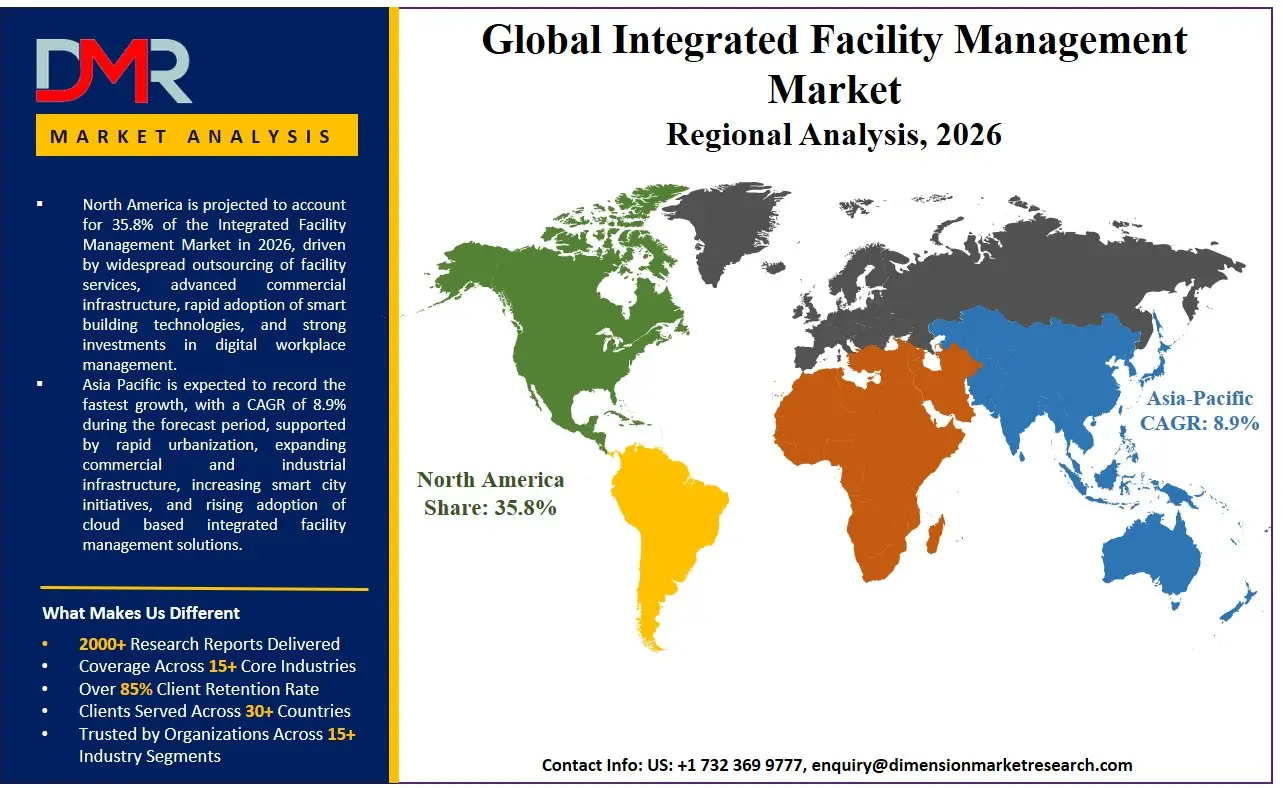
North America is poised to be dominate the Global Integrated Facility Management Market with 35.8% of the total market share in 2026, supported by its mature commercial real estate sector, advanced digital infrastructure, and widespread outsourcing of facility operations. Large enterprises across the United States and Canada increasingly deploy integrated facility management solutions to optimize asset performance, improve workplace efficiency, and reduce operational costs through centralized service delivery. Strong adoption of smart buildings, cloud based facility platforms, Internet of Things enabled monitoring, and predictive maintenance technologies further reinforces regional leadership. Stringent workplace safety standards, sustainability initiatives, and continuous investments in healthcare, education, transportation, and corporate infrastructure continue to accelerate market demand. The presence of leading facility management providers and rapid adoption of artificial intelligence driven building operations are expected to maintain North America's dominant position throughout the forecast period.
Fastest-Growing Regional Market
Asia Pacific is projected to register the highest CAGR of 8.9% during the forecast period, driven by rapid urbanization, accelerating commercial construction, and increasing investments in smart infrastructure across China, India, Japan, South Korea, and Southeast Asia. Expanding industrialization, growing demand for outsourced facility services, and rising adoption of cloud based building management platforms are creating substantial growth opportunities throughout the region. Governments continue investing in smart cities, transportation infrastructure, healthcare facilities, and energy efficient buildings, encouraging broader deployment of integrated facility management solutions. The increasing penetration of Internet of Things technologies, artificial intelligence enabled maintenance, digital twins, and automated workplace management is further transforming facility operations. Rising foreign direct investment, expanding commercial real estate development, and continuous modernization of public infrastructure are expected to sustain Asia Pacific's position as the fastest growing regional market.
By Region
North America
Europe
- Germany
- The U.K.
- France
- Italy
- Russia
- Spain
- Benelux
- Nordic
- Rest of Europe
Asia-Pacific
- China
- Japan
- South Korea
- India
- ANZ
- ASEAN
- Rest of Asia-Pacific
Latin America
- Brazil
- Mexico
- Argentina
- Colombia
- Rest of Latin America
Middle East & Africa
- Saudi Arabia
- UAE
- South Africa
- Israel
- Egypt
- Rest of MEA
Competitive Landscape
The Global Integrated Facility Management Market is highly competitive, with multinational facility service providers, engineering companies, and workplace management specialists competing through integrated service portfolios, digital transformation capabilities, and sustainability solutions. Leading companies are expanding cloud based facility management platforms, Internet of Things enabled building monitoring, predictive maintenance, and artificial intelligence driven asset optimization to strengthen their market position. Major participants such as CBRE Group offer integrated real estate and workplace solutions, JLL provides Integrated Facility Management and Intelligent Operations services, Sodexo delivers workplace and technical facility services, ISS focuses on workplace experience and property services, while Cushman and Wakefield offers integrated property and facility management solutions. Strategic acquisitions, long term outsourcing contracts, smart building technologies, and environmental sustainability initiatives continue to shape the competitive environment as organizations increasingly seek end to end facility management partners.
Some of the prominent players in the Global Integrated Facility Management Market are:
- CBRE Group Inc.
- Jones Lang LaSalle Incorporated
- ISS A S
- Sodexo S A
- Compass Group PLC
- Aramark Corporation
- Cushman and Wakefield PLC
- EMCOR Group Inc.
- ABM Industries Incorporated
- Mitie Group PLC
- OCS Group Limited
- Veolia Environment S A
- ENGIE Solutions
- SPIE S A
- Apleona GmbH
- Atlas FM Limited
- VINCI Facilities
- Bilfinger SE
- EFS Facilities Services Group
- BGIS Global Integrated Solutions Canada LP
- Other Key Players
Recent Developments
- December 2025: JLL announced the acquisition of a significant stake in FMTECH, a Saudi integrated facility management company backed by the Public Investment Fund. The transaction expands JLL's digital facility management capabilities and strengthens its presence in the Middle East facilities management sector.
- March 2025: CBRE launched its Integrated Facilities Management Solutions portfolio in Saudi Arabia, introducing Smart Solutions, an Integrated Facility Management Hub, Workplace Experience services, and an Integrated FM Academy to improve operational efficiency, sustainability, and artificial intelligence driven building management for commercial and public sector clients.
- April 2025: JLL partnered with ServiceNow to expand its Integrated Workplace Management System capabilities by combining ServiceNow Workplace Service Delivery with JLL's workplace and facility management expertise. The solution enhances workplace automation, facilities operations, and employee experience through a unified digital platform.
Report Details
| Report Characteristics |
| Market Size (2026) |
USD 286.3 Bn |
| Forecast Value (2035) |
USD 512.3 Bn |
| CAGR (2026–2035) |
6.6% |
| The US Market Size (2026) |
USD 89.1 Bn |
| Historical Data |
2021 – 2025 |
| Forecast Data |
2027 – 2035 |
| Base Year |
2025 |
| Estimate Year |
2026 |
| Segments Covered |
By Service, By Delivery Model, By Deployment, By Enterprise Size, By Sourcing, By End Use |
| Regional Coverage |
North America – The US and Canada; Europe – Germany, The UK, France, Russia, Spain, Italy, Benelux, Nordic, & Rest of Europe; Asia-Pacific – China, Japan, South Korea, India, ANZ, ASEAN, Rest of APAC; Latin America – Brazil, Mexico, Argentina, Colombia, Rest of Latin America; Middle East & Africa – Saudi Arabia, UAE, South Africa, Turkey, Egypt, Israel, & Rest of MEA |
Frequently Asked Questions
How big is the Integrated Facility Management Market?
▾ The Global Integrated Facility Management Market is valued at USD 286.3 billion in 2026 and is projected to reach USD 512.3 billion by 2035, reflecting sustained demand for integrated building operations, outsourced services, and smart facility management solutions.
What is the CAGR of the Integrated Facility Management Market from 2026 to 2035?
▾ The Integrated Facility Management Market is projected to expand at a CAGR of 6.6% between 2026 and 2035, supported by increasing outsourcing, digital transformation, sustainability initiatives, and growing adoption of intelligent building management technologies globally.
What factors are driving the growth of the Integrated Facility Management Market?
▾ Market growth is driven by rising outsourcing of noncore operations, smart building adoption, Internet of Things integration, artificial intelligence enabled maintenance, sustainability regulations, expanding commercial infrastructure, workplace optimization, and increasing demand for predictive asset management.
What are the major trends in the Integrated Facility Management Market?
▾ Major trends include cloud based facility management platforms, artificial intelligence driven predictive maintenance, digital twins, Internet of Things enabled monitoring, workplace experience solutions, energy optimization, sustainability initiatives, and data driven operational decision making across modern facilities.
Which region held the largest share of the Integrated Facility Management Market in 2026?
▾ North America held the largest market share of 35.8% in 2026, supported by mature commercial infrastructure, widespread outsourcing, advanced smart building technologies, strong regulatory compliance requirements, and significant investments in digital facility management platforms.
Which region is expected to grow the fastest in the Integrated Facility Management Market?
▾ Asia Pacific is expected to witness the fastest growth with a CAGR of 8.9%, driven by rapid urbanization, smart city projects, infrastructure modernization, commercial construction, and increasing adoption of digital facility management technologies.
Who are the key players in the Integrated Facility Management Market?
▾ Leading companies include CBRE Group, Jones Lang LaSalle, ISS, Sodexo, Compass Group, Aramark, Cushman and Wakefield, EMCOR Group, ABM Industries, Mitie Group, Bilfinger, Apleona, ENGIE Solutions, OCS Group, and BGIS.
How is the Integrated Facility Management Market segmented?
▾ The market is segmented by Service, Delivery Model, Deployment, Enterprise Size, Sourcing, End Use, covering hard and soft services, cloud deployment, commercial facilities, outsourced management, and major global geographic markets.