Global Intelligent Emergency Response System Infrastructure Market Snapshot
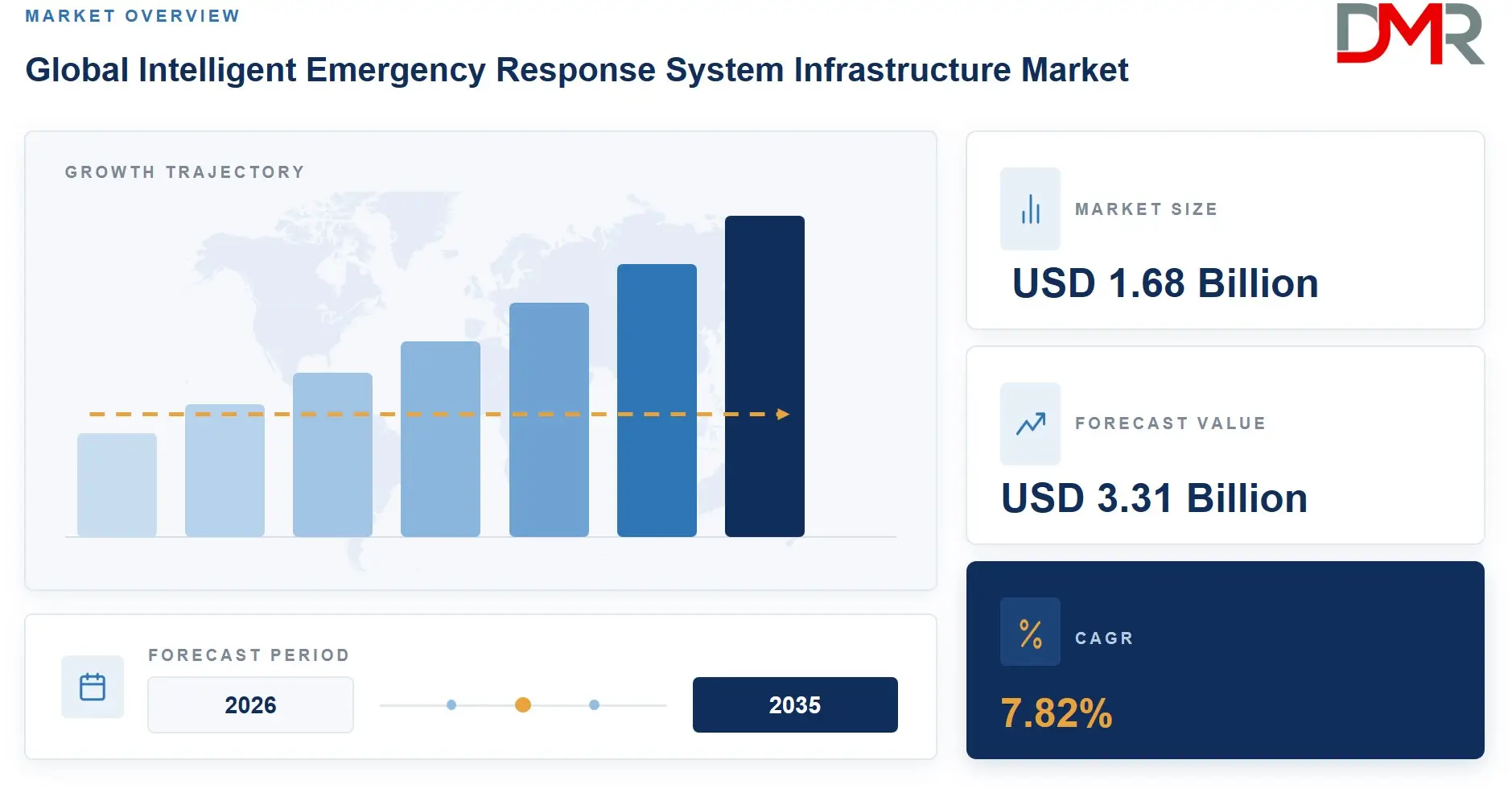
- Market Size in 2026: USD 1.68 billion
- Market Size in 2035: USD 3.31 billion
- Global CAGR, 2026-2035: 7.82%
- Leading Component Segment: Hardware, 52% share
- Leading Technology Segment: IoT & Connected Devices, 27% share
- Leading Emergency Type: Fire & Smoke Emergencies, 29% share
- Fastest-Growing Segment: Cloud-Based Deployment, 10.2% CAGR
- Leading Region in 2026: North America, 37% share
What is the Global Intelligent Emergency Response System Infrastructure and its Market Size?
The global Intelligent Emergency Response System Infrastructure Market is estimated at USD 1.68 billion in 2026 and is projected to reach approximately USD 3.31 billion by 2035, representing an estimated 7.82% CAGR.
ℹ
To learn more about this report –
Download Your Free Sample Report Here
Demand is shifting from isolated emergency devices toward integrated platforms capable of detecting incidents, validating alerts, locating people and assets, coordinating agencies and supporting first responders in real time. Government modernization, smart-city programs, critical-infrastructure resilience, climate-related disaster preparedness and healthcare digitization are reinforcing this transition. India's ERSS-112, for example, already integrates voice, SMS, SOS, email, web, chatbot, media crawler, IoT and other signals through common PSAP infrastructure and GIS-enabled dispatch.
Use Cases
- Emergency Detection & Monitoring: Sensors, cameras and connected devices identify fires, accidents, intrusions and hazardous conditions in real time.
- Emergency Communication & Alerting: Multichannel platforms distribute location-aware alerts through mobile, radio, SMS, public-address and digital channels.
- Emergency Dispatch & Coordination: CAD and GIS systems prioritize incidents and direct police, fire, medical and rescue resources.
- Incident Management: Command platforms consolidate operational data, automate workflows and maintain common situational awareness across agencies.
- Evacuation & Crowd Management: Intelligent systems model crowd movement, identify congestion and support dynamic evacuation instructions.
- Disaster Response: Integrated infrastructure coordinates warning, response, communications, logistics and recovery during floods, earthquakes, storms and industrial incidents.
Key Takeaways
- Market Size: The market is estimated at USD 1.68 billion in 2026, with a scenario-based 2035 value of approximately USD 3.31 billion.
- Growth Driver: Connected sensors, public-safety modernization, AI-assisted dispatch and increasing disaster resilience requirements are accelerating adoption.
- Segment Dominance: Hardware remains the largest component because sensors, communication equipment and surveillance infrastructure form the physical foundation of intelligent response.
- Fastest Growth: Cloud-based deployment is expected to expand fastest as agencies seek scalable command centers, remote access and lower infrastructure overhead.
- Regional Leadership: North America leads because of mature public-safety communications, large government technology budgets and advanced 911/NG911 infrastructure.
- Technology Shift: AI is moving from analytics toward operational assistance, including call triage, translation, decision support and automated workflow execution.
How AI/Gen AI is Transforming the Intelligent Emergency Response System Infrastructure Market?
AI is increasingly embedded throughout emergency workflows, from detecting anomalies in camera and IoT feeds to classifying emergency calls, translating conversations, recommending dispatch decisions and generating operational summaries. Motorola Solutions, for example, expanded AI agents for 911 workflows in 2026, including real-time translation and pre-dispatch intelligence.
The principal benefits are faster triage, reduced alert fatigue, better use of scarce personnel, improved situational awareness and more consistent information sharing. AI can combine structured and unstructured inputs, including audio, video, sensor data, GIS information and historical incidents to provide dispatchers with a more complete operating picture.
Key Drivers in the Global Intelligent Emergency Response System Infrastructure Market
Public-Safety Modernization and Integrated Emergency Communications
Governments and public-safety agencies are replacing fragmented emergency infrastructure with unified platforms capable of receiving multiple signal types, identifying incidents and coordinating responders. Modern emergency systems increasingly combine 911/112 communications, GIS, CAD, mobile data, IoT signals and automated alerts. India's ERSS-112 demonstrates this integrated model by connecting more than ten input channels to state-level PSAPs and dispatching police, health, fire and disaster-response resources using GIS-enabled systems.
Rising Disaster and Critical-Infrastructure Resilience Requirements
Floods, wildfires, storms, industrial accidents, cyber-physical disruptions and mass-casualty events are increasing the value of early detection and coordinated response. Organizations operating transport networks, utilities, healthcare facilities, industrial plants and public venues increasingly require resilient communications and command systems that continue functioning during infrastructure disruptions.
Restraints in the Global Intelligent Emergency Response System Infrastructure Market
High Installation, Integration and Lifecycle Costs
Intelligent emergency infrastructure frequently requires hardware replacement, communications upgrades, sensor deployment, cybersecurity controls, software integration and specialized training. Legacy radio, CAD, surveillance, building-management and healthcare systems can be difficult to connect without costly middleware and systems integration. Smaller municipalities and organizations therefore face longer procurement cycles and may prioritize incremental upgrades rather than complete modernization.
Growth Opportunities in the Global Intelligent Emergency Response System Infrastructure Market
Cloud-Based and Hybrid Emergency Command Centers
Cloud deployment provides agencies with scalable infrastructure, centralized software updates, remote access, redundancy and easier integration of data sources. Hybrid models can retain sensitive workloads on-premises while moving analytics, collaboration and non-critical applications to cloud environments.
AI-Powered Multimodal Emergency Intelligence
The strongest longer-term opportunity is the convergence of AI with voice, video, GIS, IoT, wearables, connected vehicles and building systems. AI can automatically correlate signals that would otherwise remain isolated across agencies.
Trends in the Global Intelligent Emergency Response System Infrastructure Market
Shift from Reactive Response to Predictive Situational Awareness
Emergency systems are evolving from detecting incidents after they occur toward identifying abnormal patterns, forecasting risk and providing early warnings. AI, sensor fusion, digital maps and historical incident data increasingly support proactive intervention.
Agentic AI in Emergency Operations
AI is moving beyond dashboards toward task-oriented assistants capable of interpreting calls, generating information, translating communications and automating routine workflows. Motorola's 2026 expansion of agentic AI illustrates this transition.
Research Scope and Analysis
The market is analyzed across Component, Technology, Emergency Type, Deployment, Application and End User. The estimates below are analyst-derived 2026 shares designed to provide a consistent market model; they are not presented as directly published segment shares. The underlying industry reports confirm these broad segmentation dimensions.
ℹ
To learn more about this report –
Download Your Free Sample Report Here
By Component Analysis
Hardware is estimated to remain the dominant component at approximately 52% of 2026 revenue, supported by continuing demand for sensors, cameras, communication equipment, servers, monitoring devices and emergency notification infrastructure. Hardware remains essential because intelligent response begins with reliable data capture and resilient communications. Software represents the second-largest category at an estimated 29% share, benefiting from growing demand for CAD, incident management, GIS, analytics and emergency-management platforms. Services account for roughly 19%, covering integration, deployment, consulting, maintenance and support. The software segment is expected to be the fastest-growing component at about 10.0% CAGR, as agencies increasingly prioritize AI, cloud analytics and unified command applications. The market's published structure explicitly includes hardware, software platforms and lifecycle services.
By Technology Analysis
IoT & Connected Devices is estimated to lead with approximately 27% share in 2026, reflecting the proliferation of sensors, connected cameras, vehicles, wearables, building systems and other devices capable of transmitting real-time incident data. GIS & Location Intelligence is estimated as the second-largest technology category at around 21%, because precise location is central to emergency dispatch and situational awareness. AI & Machine Learning, at roughly 18%, is the fastest-growing segment at approximately 13.0% CAGR, driven by automated call analysis, anomaly detection, predictive analytics and decision support. Cloud, edge computing and automated emergency notification collectively account for the balance and increasingly operate as interconnected layers rather than isolated technologies.
By Emergency Type Analysis
Fire & Smoke Emergencies are estimated to represent approximately 29% of the 2026 market, supported by mature fire detection, life-safety and building-management deployments across commercial, industrial, healthcare and public facilities. Medical Emergencies follow at about 24%, supported by emergency medical services, hospitals and connected patient-response infrastructure. Natural Disasters are the fastest-growing category at approximately 9.5% CAGR, as governments invest in flood, wildfire, earthquake, severe-weather and mass-evacuation preparedness. Security and public-safety incidents and industrial/hazardous-material emergencies remain significant use cases, particularly in transportation, energy and manufacturing. The broader published market taxonomy similarly identifies medical, natural-disaster and man-made-hazard response as core applications.
By Deployment Analysis
On-Premises deployment is estimated to hold approximately 46% share in 2026, reflecting the mission-critical nature of emergency operations and the continuing preference of government agencies and large infrastructure operators for direct control over sensitive systems. Hybrid deployment represents roughly 31% and is increasingly favored where organizations need both local resilience and cloud-based analytics. Cloud-Based deployment is the fastest-growing category at approximately 10.2% CAGR, driven by scalable infrastructure, centralized updates, remote operations and lower upfront capital requirements. Cloud adoption is especially attractive to smaller municipalities and enterprises that cannot justify large dedicated data centers. Published market segmentation explicitly includes public, private and hybrid cloud alongside on-premises control centers and enterprise data centers.
By Application Analysis
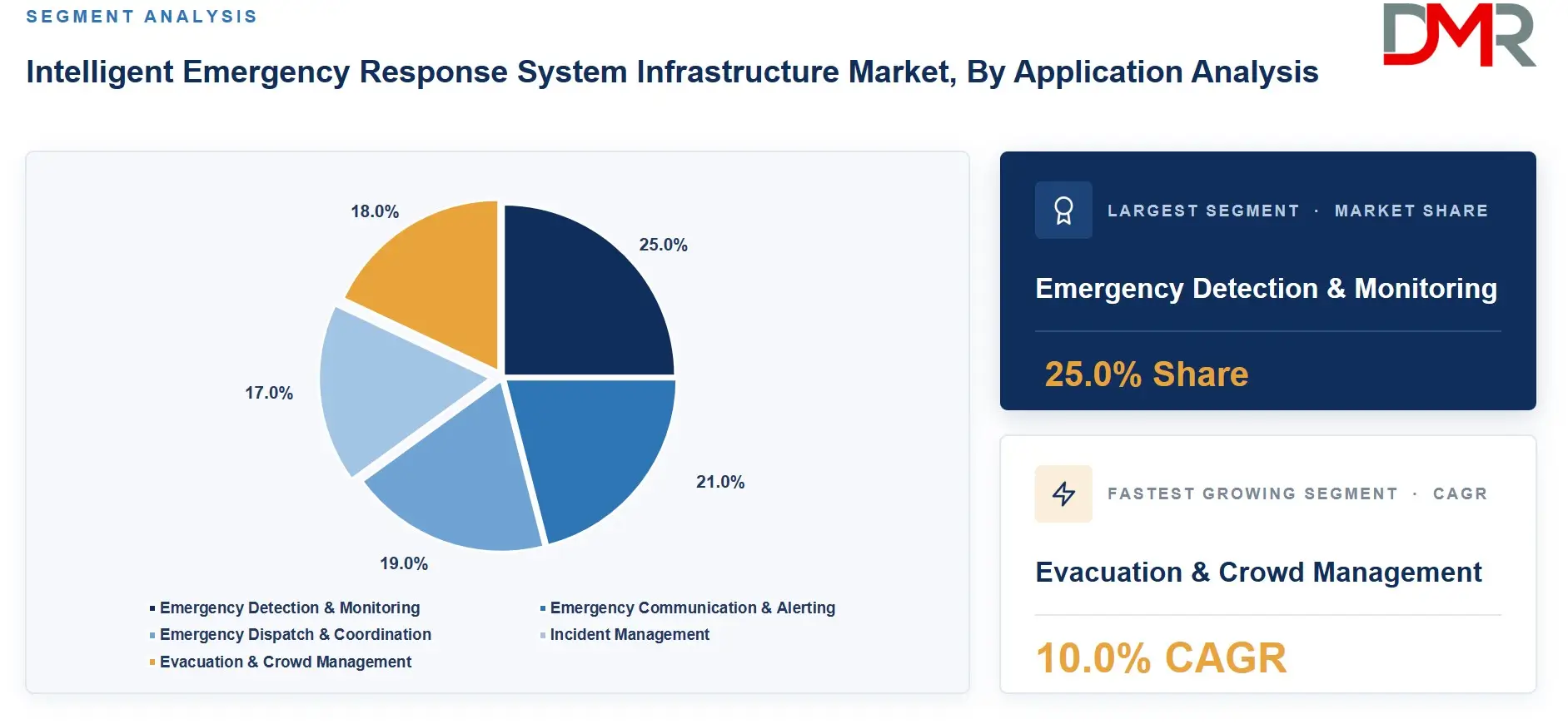
Emergency Detection & Monitoring is estimated to lead with approximately 25% share in 2026, reflecting widespread deployment of sensors, cameras, alarms and connected monitoring systems. Emergency Communication & Alerting follows at roughly 22%, while emergency dispatch and coordination accounts for approximately 21%. Evacuation & Crowd Management is projected to be the fastest-growing application at about 10.0% CAGR, driven by smart venues, transportation hubs, large events and urban resilience programs. Incident management remains a major cross-functional application because it provides the operational layer linking detection, communication, dispatch and recovery.
By End User Analysis
Government & Public Safety is estimated to dominate with approximately 31% share in 2026, reflecting spending by police, fire, EMS, emergency-management agencies and municipal authorities. Healthcare represents around 20%, followed by industrial/manufacturing and transportation/logistics. Energy & Utilities is expected to be among the fastest-growing end-user categories at roughly 9.6% CAGR, as operators protect distributed assets against physical incidents, extreme weather and cyber-physical risks. Commercial facilities are also expanding adoption through integrated fire, security, building-management and mass-notification platforms. The published market scope identifies healthcare, military, utilities, event operators and public-safety agencies as important users.
The Global Intelligent Emergency Response System Infrastructure Market Report is segmented on the basis of the following:
By Component
- Hardware
- Sensors & Detectors
- Communication & Notification Devices
- Surveillance & Monitoring Equipment
- Software
- Emergency Management & Dispatch Software
- Incident Management Software
- GIS & Situational Awareness Software
- Services
- System Integration & Deployment
- Maintenance & Support
By Technology
- IoT & Connected Devices
- Artificial Intelligence & Machine Learning
- Cloud Computing
- Edge Computing
- GIS & Location Intelligence
- Automated Emergency Notification
By Emergency Type
- Fire & Smoke Emergencies
- Medical Emergencies
- Natural Disasters
- Security & Public Safety Incidents
- Industrial & Hazardous Material Emergencies
By Deployment
- On-Premises
- Cloud-Based
- Hybrid
By Application
- Emergency Detection & Monitoring
- Emergency Communication & Alerting
- Emergency Dispatch & Coordination
- Incident Management
- Evacuation & Crowd Management
By End User
- Government & Public Safety
- Healthcare
- Industrial & Manufacturing
- Transportation & Logistics
- Energy & Utilities
- Commercial Facilities
Regional Analysis
North America is the Leading Region in the Global Intelligent Emergency Response System Infrastructure Market
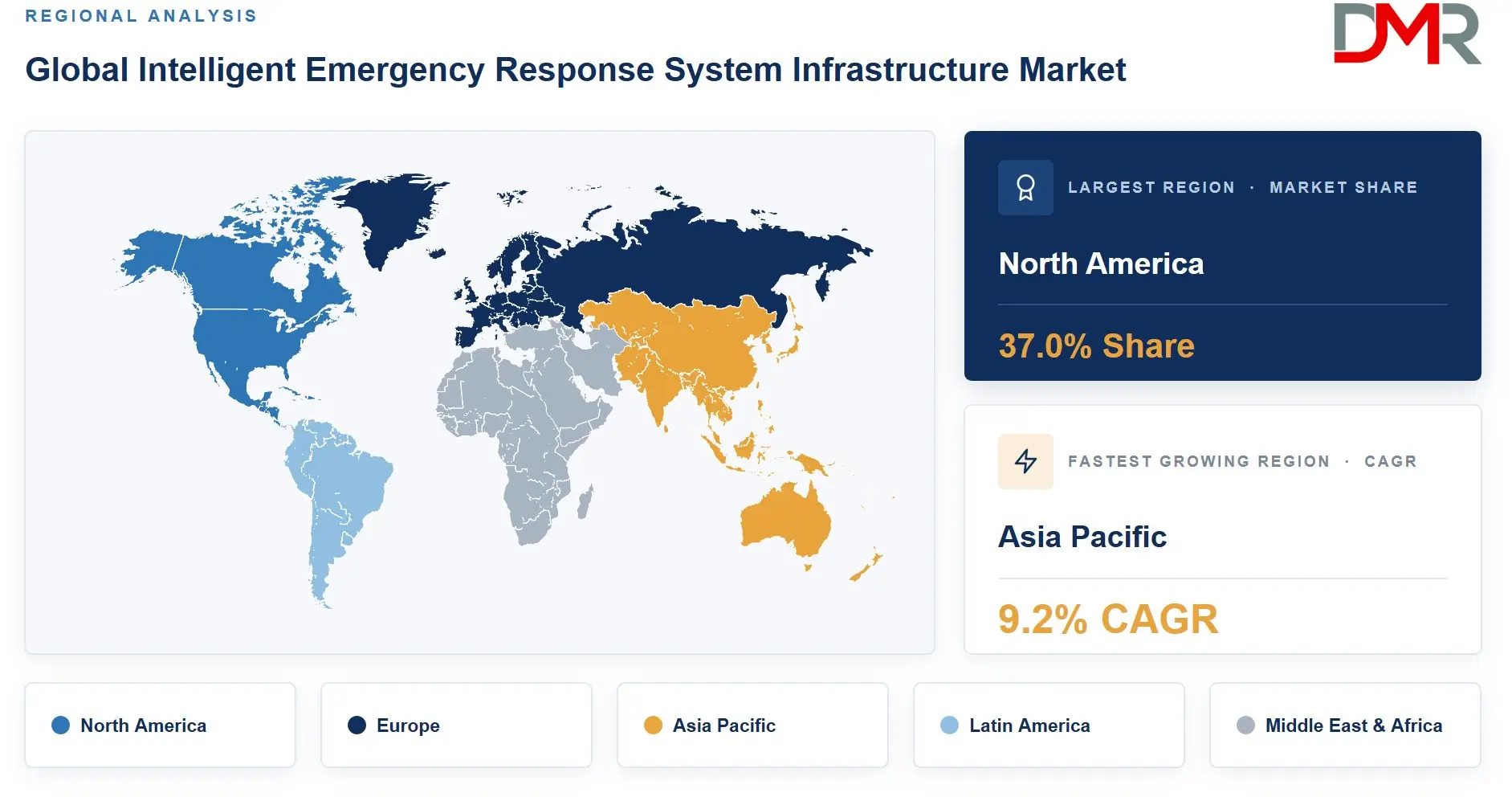
North America is estimated to account for approximately 37% of the global market in 2026, making it the largest regional market. The region benefits from mature emergency communications infrastructure, established 911 ecosystems, public-safety software adoption, large municipal technology budgets and high demand for interoperable command-and-control platforms. The transition toward NG911, multimedia emergency communications, cloud CAD, AI-assisted dispatch and connected-device data is expanding the addressable market. Motorola Solutions' recent expansion of AI-enabled 911 capabilities illustrates the region's move toward intelligent emergency workflows.
ℹ
To learn more about this report –
Download Your Free Sample Report Here
Asia Pacific is the Fastest-Growing Region in the Global Intelligent Emergency Response System Infrastructure Market
Asia-Pacific is projected to be the fastest-growing major region at approximately 9.2% CAGR. Urbanization, smart-city investment, expanding digital infrastructure, disaster exposure and modernization of emergency communications are supporting demand. China, Japan, South Korea, India and Southeast Asian markets are developing integrated systems spanning public safety, transportation, healthcare and disaster management. India's ERSS-112 and Japan's disaster-prevention digital transformation programs demonstrate the region's emphasis on integrated digital response.
The Europe Intelligent Emergency Response System Infrastructure Market
Europe is estimated at approximately USD 0.35 billion in 2026 and is projected to reach about USD 0.67 billion by 2035, representing approximately 7.5% CAGR. Demand is supported by critical-infrastructure resilience, smart-city initiatives, emergency communications modernization and increasing cybersecurity requirements. AI governance and critical-infrastructure regulations are also increasing the emphasis on traceability, risk management, security and human oversight.
Latin America Intelligent Emergency Response System Infrastructure Market
Latin America is estimated at approximately USD 0.13 billion in 2026 and is projected to reach about USD 0.28 billion by 2035, equivalent to approximately 8.7% CAGR. Urbanization, public-security requirements, disaster exposure and modernization of emergency communications are the principal drivers. Cloud-based systems offer particular potential because they can reduce infrastructure requirements for municipalities and regional agencies.
MEA Intelligent Emergency Response System Infrastructure Market
The Middle East & Africa market is estimated at approximately USD 0.13 billion in 2026 and is projected to reach about USD 0.28 billion by 2035, corresponding to roughly 8.9% CAGR. Smart-city programs, major infrastructure projects, healthcare modernization, industrial safety and large-event security are supporting adoption. Saudi Arabia is an important growth market, with its emergency-health system increasingly emphasizing digital operations and faster response. The Saudi Red Crescent Authority reported more than 1.4 million emergency calls handled in 2025 and highlighted digital workflow adoption under Vision 2030.
Major Countries Analysis
United States Intelligent Emergency Response System Infrastructure Market
The U.S. market is estimated at approximately USD 0.50 billion in 2026 and could reach USD 0.99 billion by 2035, implying roughly 7.9% CAGR. NG911 modernization, AI-assisted dispatch, cloud CAD, connected-device data and public-safety communications are major drivers. Demand is reinforced by staffing pressures at emergency communications centers and growing adoption of AI assistants.
Japan Intelligent Emergency Response System Infrastructure Market
Japan is estimated at approximately USD 0.08 billion in 2026, rising to about USD 0.15 billion by 2035 at approximately 7.4% CAGR. Disaster preparedness, aging infrastructure, earthquake and weather risks, digital government and smart-city technologies are key drivers. Japan's Digital Agency is actively promoting disaster-prevention digital transformation and public-private collaboration.
Saudi Arabia Intelligent Emergency Response System Infrastructure Market
Saudi Arabia is estimated at approximately USD 35 million in 2026 and could reach around USD 70 million by 2035, representing approximately 8.0% CAGR. Vision 2030, smart-city development, healthcare digitization, large infrastructure projects, Hajj-related emergency preparedness and AI adoption are supporting demand. SRCA's 2025 results demonstrate continuing investment in digitally enabled emergency operations.
Regulatory Landscape
The regulatory environment is becoming more important because intelligent emergency systems combine critical infrastructure, personal data, communications, cybersecurity and AI. In the European Union, deployments can intersect with the EU AI Act, GDPR, NIS2 cybersecurity requirements, the Cyber Resilience Act, Data Act and critical-infrastructure resilience requirements depending on system architecture and use case. The AI governance environment increasingly emphasizes risk management, technical documentation, human oversight and accountability for high-consequence applications. In the United States, emergency communications must also comply with federal, state and local public-safety requirements, while 911 modernization and communications-network resilience remain important procurement considerations. India provides another model through ERSS-112, which integrates multiple emergency channels, PSAPs, CAD, GIS and responder communications under government-operated infrastructure.
Investment and White Space Analysis
The most attractive investment opportunities are AI-assisted emergency dispatch, cloud/hybrid command centers, sensor-fusion platforms, emergency communications interoperability, predictive disaster intelligence and cybersecurity for emergency infrastructure. Smaller municipalities represent a particularly large white space because many lack the capital or personnel to deploy sophisticated systems independently. Managed cloud platforms, subscription-based CAD, AI call triage and shared regional PSAP models can reduce adoption barriers. Asia-Pacific and the Middle East offer additional opportunities because urbanization and smart-city investment are creating new infrastructure rather than merely replacing legacy systems. India, Saudi Arabia and Southeast Asia are particularly attractive for localized solutions integrating mobile, IoT, GIS and multilingual emergency communications.
By Region
North America
Europe
- Germany
- France
- The U.K.
- Italy
- Spain
- Rest of Europe
Asia-Pacific
- China
- Japan
- India
- Australia
- South Korea
- Rest of APAC
Latin America
- Mexico
- Brazil
- Rest of LATAM
Middle East & Africa
- Saudi Arabia
- The UAE
- South Africa
- Rest of MEA
Competitive Landscape
The market is moderately consolidated at the platform level but fragmented across specialized hardware, software and services. Major competitors include Motorola Solutions, Honeywell, Hexagon, Cisco, IBM, Johnson Controls, Siemens, Everbridge, RapidSOS, Securitas, Bosch and specialized public-safety software providers. Published competitive analyses identify Motorola Solutions, Honeywell, Hexagon, IBM, Everbridge, Johnson Controls and RapidSOS among the significant participants. Competitive differentiation increasingly depends on AI functionality, cloud architecture, interoperability, GIS, cybersecurity, installed base, reliability and systems-integration capabilities. Partnerships, acquisitions and cross-platform integration are becoming important routes to expanding capabilities.
Some of the prominent players in the Global Intelligent Emergency Response System Infrastructure Market are:
- Motorola Solutions
- Hexagon
- Honeywell
- Siemens
- Johnson Controls
- NEC Corporation
- Cisco Systems
- Nokia
- Everbridge
- RapidSOS
- Carbyne
- CentralSquare Technologies
- Tyler Technologies
- Priority Dispatch
- Intrado
- Prepared
- Mark43
- Versaterm
- RapidDeploy
- First Due
- ImageTrend
- Esri
- Harris Computer
- Airbus
- Thales
- L3Harris Technologies
- RTX
- Motorola Solutions CommandCentral
- Axon Enterprise
- Genetec
- Avigilon
- Bosch Security Systems
- Hikvision
- Axis Communications
- Teledyne FLIR
- Smiths Detection
- Dräger
- Philips
- GE HealthCare
- Stryker
- Other Key Players
Recent Developments
- In June 2026, Motorola Solutions expanded its Assist AI portfolio for 911, introducing real-time translation and live audio-streaming capabilities integrated into CAD and responder mobile applications.
- In June 2026, Honeywell expanded its fire and life-safety portfolio, adding advanced smoke-control capabilities and cloud-connected innovations designed to improve compliance, visibility and intelligent emergency response.
- In April 2026, Motorola Solutions acquired Hyper, a conversational agentic-AI company, to expand AI automation across its Command Center portfolio and address staffing pressure in public-safety answering points.
- In April 2026, RapidSOS expanded its public-safety engagement through a partnership with actor and first-responder advocate Jeremy Renner, highlighting the company's focus on improving the intelligence available to emergency responders.
- In February 2026, Hexagon announced an AI-enhanced cloud public-safety deployment for Arlington County, combining HxGN OnCall Dispatch, Smart Advisor AI, analytics and mobile capabilities.
Report Details
| Report Characteristics |
| Market Size (2026) |
USD 1.68 Bn |
| Forecast Value (2035) |
USD 3.31 Bn |
| CAGR (2026–2035) |
7.82% |
| The US Market Size (2026) |
USD 0.5 Bn |
| Historical Data |
2021 – 2025 |
| Forecast Data |
2026 – 2035 |
| Base Year |
2025 |
| Segments Covered |
By Component, By Technology, By Emergency Type, By Deployment, By Application, By End User |
| Regional Coverage |
North America – The US and Canada; Europe – Germany, France, The UK, Italy, Spain, Rest of Europe; Asia-Pacific – China, Japan, India, Australia, South Korea, Rest of APAC; Latin America – Mexico, Brazil, Colombia, Argentina, Rest of LATAM; Middle East & Africa – Saudi Arabia, The UAE, South Africa, Rest of MEA |
Frequently Asked Questions
What is the market size of the Global Intelligent Emergency Response System Infrastructure Market in 2026?
▾ The Global Intelligent Emergency Response System Infrastructure Market is estimated at USD 1.68 billion in 2026, based on current industry estimates.
What is the projected size of the Intelligent Emergency Response System Infrastructure Market by 2035?
▾ The Intelligent Emergency Response System Infrastructure Market is projected to reach approximately USD 3.31 billion by 2035, based on an extrapolated 7.82% CAGR.
What is the CAGR of the Intelligent Emergency Response System Infrastructure Market from 2026 to 2035?
▾ The Intelligent Emergency Response System Infrastructure Market is expected to expand at approximately 7.82% CAGR during 2026-2035.
What are the key growth drivers of the Intelligent Emergency Response System Infrastructure Market?
▾ Key drivers include public-safety modernization, IoT adoption, AI-enabled emergency response, disaster preparedness, smart-city development and critical-infrastructure resilience.
What are the major trends shaping the Intelligent Emergency Response System Infrastructure Market?
▾ Major trends include cloud-based emergency platforms, AI-assisted dispatch, sensor fusion, GIS-enabled response, automated alerts and integration of connected devices.
Which region leads the Intelligent Emergency Response System Infrastructure Market?
▾ North America is estimated to lead the Intelligent Emergency Response System Infrastructure Market, supported by mature emergency communications, advanced public-safety infrastructure and strong technology investment.
Which region is expected to grow fastest in the Intelligent Emergency Response System Infrastructure Market?
▾ Asia-Pacific is projected to be the fastest-growing regional market, driven by urbanization, smart-city investment, digital transformation and increasing disaster-preparedness requirements.
Who are the key players in the Intelligent Emergency Response System Infrastructure Market?
▾ Major players include Motorola Solutions, Honeywell, Hexagon, Cisco, IBM, Johnson Controls, Siemens, Everbridge and RapidSOS, among other specialized providers.
How is the Intelligent Emergency Response System Infrastructure Market segmented?
▾ The market is segmented by component, technology, emergency type, deployment, application and end user, covering hardware, software, services, IoT, AI, cloud and emergency-response applications.
What technologies are driving the Intelligent Emergency Response System Infrastructure Market?
▾ Key technologies include AI and machine learning, IoT, cloud computing, edge computing, GIS and location intelligence, and automated emergency notification systems.