What is the Interactive Residential Security Market Size in 2026?
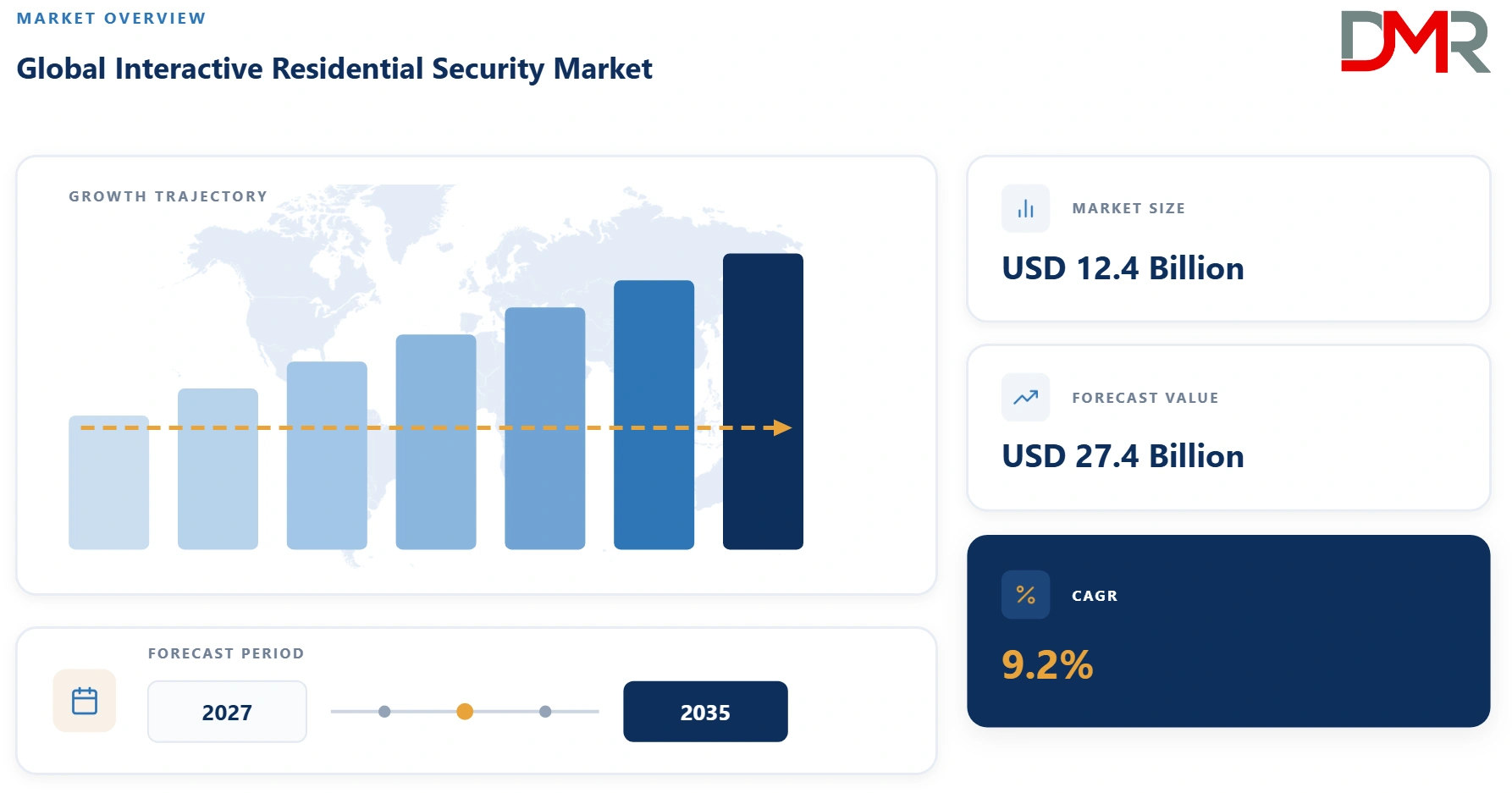
The global interactive residential security market is valued at USD 12.4 billion in 2026 and is projected to reach USD 27.4 billion by 2035, growing at a CAGR of 9.2% from 2027 to 2035. Growth is driven by rising burglary and package theft concerns, smart home adoption, AI-enabled cameras and sensors, and recurring professional monitoring subscriptions.
ℹ
To learn more about this report –
Download Your Free Sample Report Here
The interactive residential security market comprises connected home protection systems that combine sensors, cameras, smart locks, control panels and cloud software with real-time alerts and remote app control. These systems let homeowners monitor, arm, disarm and verify events from anywhere, while optional professional monitoring centers dispatch responders. Revenue includes hardware, software licenses, installation, integration and recurring monitoring fees. The definition excludes commercial security installations and traditional standalone alarms that lack internet connectivity or remote management.
The Interactive Residential Security market in this report measures the value of connected home protection systems, including hardware, cloud and AI software, installation and recurring monitoring services, rather than traditional standalone alarms or commercial security installations. Demand comes from homeowners guarding against burglary and package theft, property managers digitizing apartment access, insurers rewarding verified protection, and telecom operators bundling smart home services with broadband. The report covers four segments across five regions, including major national markets in each.
Interactive Residential Security Market Snapshot
Interactive Residential Security Market Snapshot, 2027-2035
| Metric |
Value |
| Market Size (2026) |
USD 12.4 Billion |
| Forecast Value (2035) |
USD 27.4 Billion |
| CAGR (2027-2035) |
9.2% |
| Largest Region (2026) |
North America, 35.8% share |
| Fastest-Growing Region (2027-2035) |
Asia Pacific, 11.9% CAGR |
| Leading Component (2026) |
Hardware, 47.2% share |
| Leading System Type (2026) |
Video Surveillance Systems, 36.4% share |
| Key Players |
ADT, Alarm.com, Resideo Technologies, Vivint, Ring, SimpliSafe, Google Nest, Arlo Technologies |
Interactive Residential Security Market: Key Takeaways
- Market growth: The market is valued at USD 12.4 billion in 2026 and is expected to reach USD 27.4 billion by 2035, expanding at a 9.2% CAGR from 2027 to 2035.
- Component leader: Hardware holds a 47.2% share of the market in 2026, led by cameras, video doorbells, smart locks, sensors and control panels.
- Fastest component: Software is set to grow at a 13.4% CAGR through 2035, ahead of the overall market, on AI analytics, cloud storage and subscription tiers.
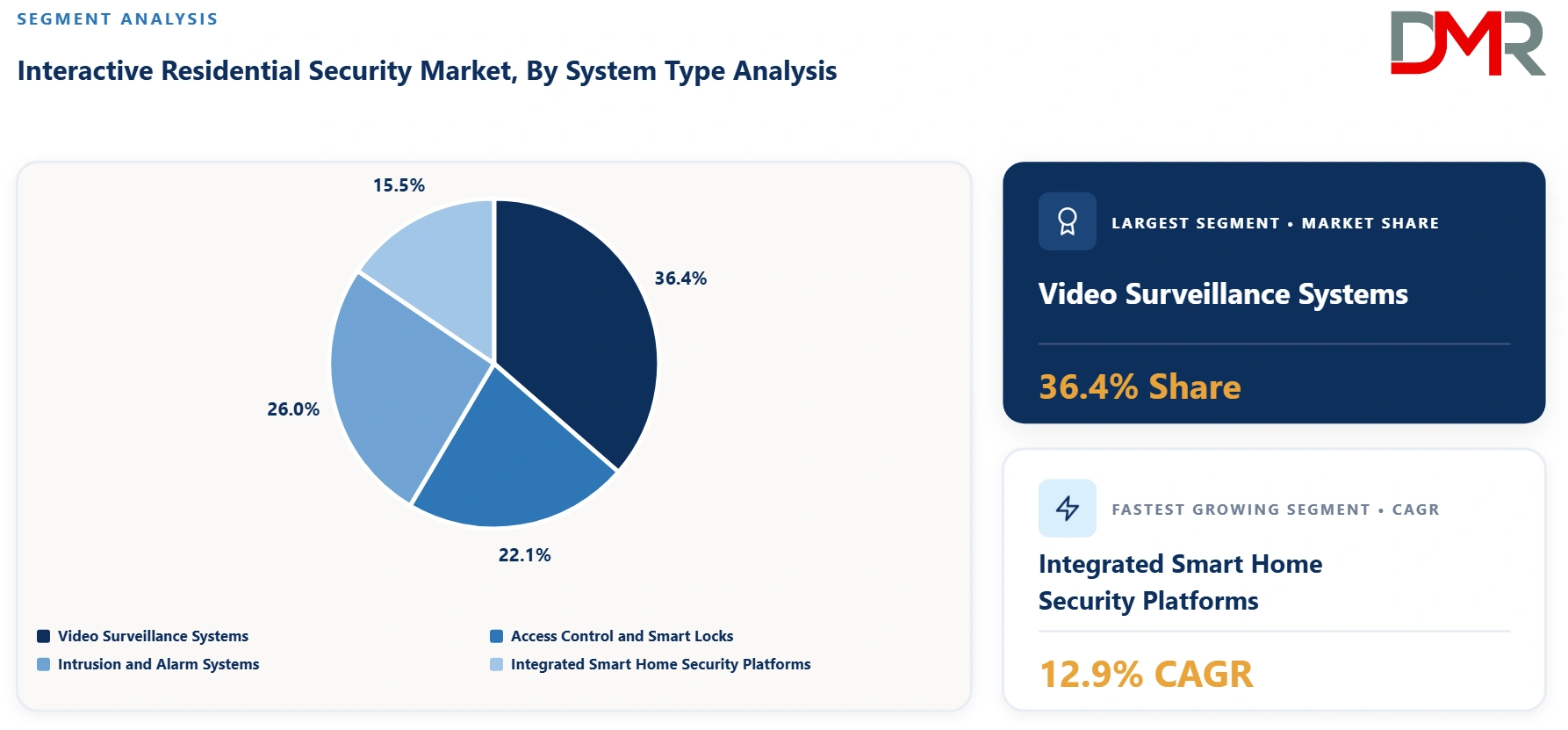
- System type leader: Video Surveillance Systems account for 36.4% of 2026 demand, as homeowners seek visible deterrence, live viewing and event verification.
- Fastest system type: Integrated Smart Home Security Platforms are projected to grow at a 12.9% CAGR, supported by single-app control of alarms, video, locks and safety sensors.
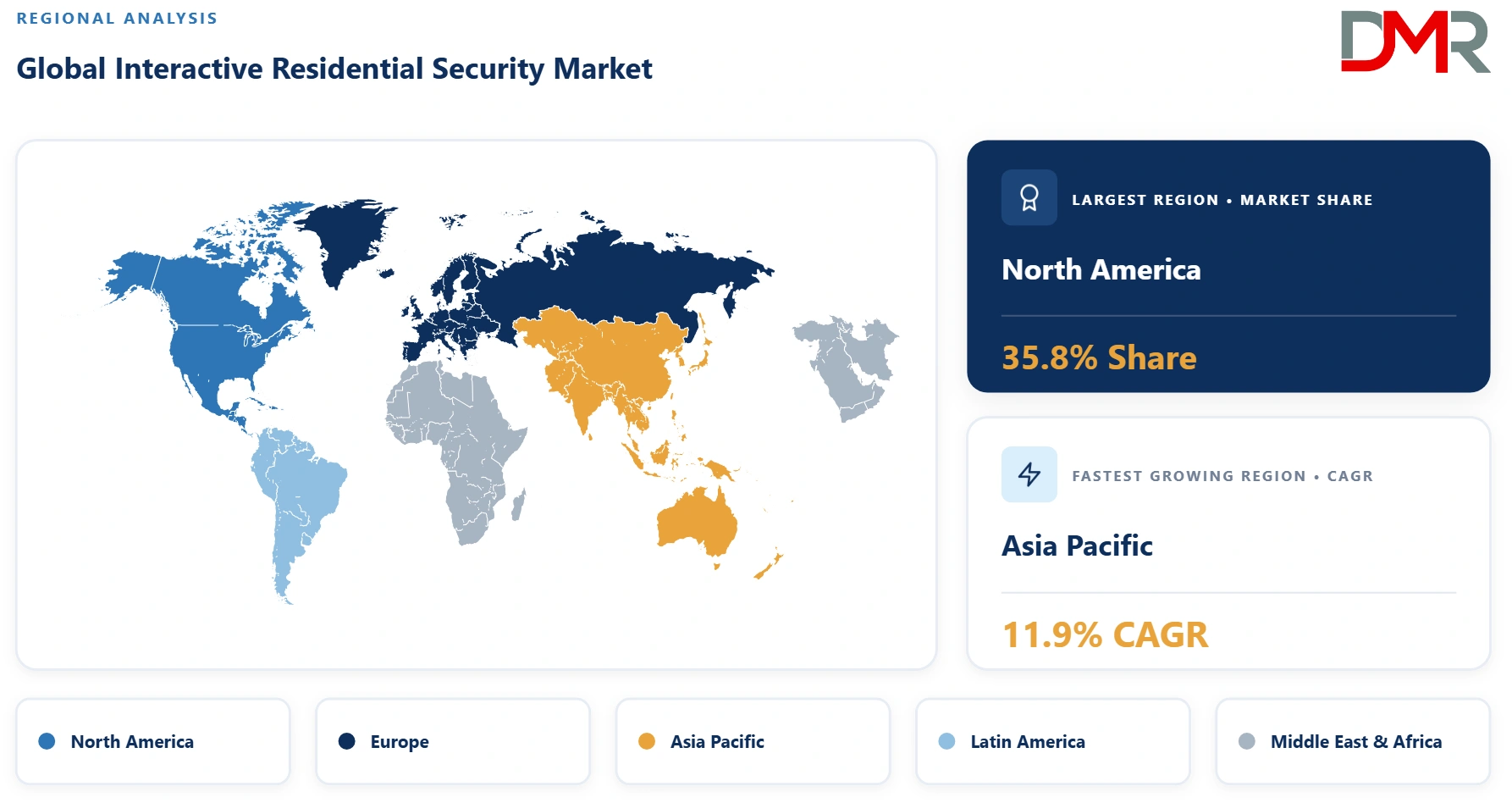
- Regional picture: North America leads with a 35.8% share in 2026, while Asia Pacific is the fastest-growing region at an 11.9% CAGR.
What are the Key Use Cases of Interactive Residential Security?
- Video Doorbells and Perimeter Monitoring: AI cameras detect people, packages and vehicles at entrances, cutting false alerts and giving insurers and subscription providers measurable theft deterrence.
- Professional Monitoring and Alarm Verification: Central stations use video and sensor verification to prioritize genuine break-ins, lowering dispatch costs and sustaining recurring monitoring revenue.
- Smart Access and Remote Entry Control: Smart locks and keypads issue temporary codes to guests, tenants and service staff, supporting rental operators and multi-family property managers.
- Safety and Aging-in-Place Monitoring: Smoke, leak and presence sensors alert family members and responders to hazards and unusual inactivity, opening a recurring care-adjacent service line.
How are Foundation Models and Generative AI Transforming the Interactive Residential Security Market?
Foundation models and generative AI are turning interactive residential security from rule-based alerting into context-aware home intelligence. Vision language models describe what a camera sees in plain language, letting homeowners search footage with natural questions and receive short event summaries instead of raw clips. Providers classify people, pets, vehicles and packages, learn each household routine and flag unusual activity, which lowers false alarms and speeds alarm verification at monitoring centers. WiFi sensing and multimodal sensor fusion add camera-free presence detection for privacy-sensitive rooms. Generative assistants also automate installer support, automation scripting and customer service, reducing truck rolls. Adoption is rising as premium subscription tiers bundle AI features, lifting revenue per user and shifting competition toward software, data and recurring services. Providers with large proprietary video datasets gain a clear edge.
Interactive Residential Security Market Dynamics at a Glance
Drivers, Restraints, Opportunities and Trends in the Interactive Residential Security Market
| Type |
Factor |
Impact |
| Driver |
Rising Residential Crime and Safety Awareness |
High |
| Driver |
Smart Home Adoption and AI-Enabled Devices |
High |
| Restraint |
Subscription Fatigue and Price Sensitivity |
Medium |
| Restraint |
Privacy, Cybersecurity and False Alarm Rules |
High |
| Opportunity |
Insurance Partnerships and Operator Bundles |
Medium |
| Opportunity |
Emerging Regions and Multi-Family Housing |
High |
| Trend |
Matter and Thread Interoperability |
Medium |
| Trend |
AI Verification and Camera-Free Sensing |
High |
What is Driving the Growth of the Interactive Residential Security Market?
Rising Residential Crime and Safety Awareness
Concerns about burglary, package theft and personal safety keep pushing households toward connected protection. Homeowners want visible deterrence, instant alerts and remote property checks, which interactive systems deliver far better than siren-only alarms. Insurers increasingly recognize monitored and sensor-based systems through premium discounts, improving payback for buyers. Urbanization, rising property values and dual-income households that spend long hours away from home reinforce demand, supporting steady hardware replacement and recurring monitoring revenue across all major regions.
Smart Home Adoption and AI-Enabled Devices
Smart home penetration is turning security into the entry point for the connected home. Broadband coverage, affordable cameras, voice assistants and smartphone ownership have made installation simple, while AI features such as person, package and vehicle detection make devices more useful and less noisy. Vendors bundle cameras, locks, sensors and lighting under one app, encouraging households to add devices over time and move to paid cloud tiers. This broader base lifts both hardware volumes and software revenue.
What are the Key Restraints in the Interactive Residential Security Market?
Subscription Fatigue and Price Sensitivity
Recurring fees remain a sticking point for many buyers. Monitoring plans, cloud video storage and premium AI features can add up to a sizable annual cost, and consumers who already pay for streaming, mobile and other services are increasingly selective. Do-it-yourself brands offer low-cost kits with optional or no contracts, which pressures the pricing and contract models of traditional installers and slows upgrades from basic to professionally monitored plans. Price sensitivity is sharper in emerging economies, where disposable income is lower and informal guards remain a cheaper substitute. Providers respond with flexible plans and bundled hardware, but margin pressure and churn limit near-term growth for subscription-led business models.
Privacy, Cybersecurity and False Alarm Rules
Interactive systems collect video, audio and occupancy data inside the home, which exposes vendors to privacy rules and cybersecurity scrutiny. Data protection laws, biometric restrictions and limits on recording shared spaces raise compliance costs, while breaches or hijacked cameras damage brand trust. Many cities also impose permits, fines and verified-response requirements to curb false alarms, increasing operating costs for monitoring providers and installers. The European Union Cyber Resilience Act will require secure-by-design products and long-term update support, adding engineering burden for smaller manufacturers. Together these obligations lengthen product cycles, increase liability and can slow launches of advanced video and AI features, particularly in Europe.
What are the Key Opportunities in the Interactive Residential Security Market?
Insurance Partnerships and Operator Bundles
Insurers, telecom operators, utilities and builders can all turn security into a bundled service. Premium discounts for verified systems, water-leak and fire sensors that reduce claims, and operator bundles that add security to broadband or energy plans create low-cost acquisition channels. Telecom providers already distribute branded smart home packages in several markets, and insurers are piloting data-sharing programs that reward risk reduction. Because sensors prevent costly losses such as flooding, these partnerships give vendors co-marketing budgets and customers a tangible return on investment. Providers able to share verified data safely with insurers can secure large embedded customer bases and more predictable recurring revenue.
Emerging Regions and Multi-Family Housing
Asia Pacific, Latin America and the Middle East have low penetration but growing urban middle classes, rising broadband access and heightened concern about property crime. Affordable wireless kits from Chinese and global brands, together with local installers, allow sales without expensive wiring. Multi-family housing offers another large opportunity, because developers and property managers adopt shared access control, package rooms and unit-level sensors to reduce operating costs and attract renters. Smart apartment programs in North America and Europe show that bulk contracts can lower customer acquisition costs. Vendors that localize pricing, languages, monitoring services and compliance can capture a large unserved base over the forecast period.
What are the Latest Trends in the Interactive Residential Security Market?
Matter and Thread Interoperability
Matter, Thread and related interoperability standards are reducing the fragmentation that once locked consumers into single brands. Security vendors increasingly certify cameras, locks and sensors to work across ecosystems from Apple, Google, Amazon and Samsung, lowering installation friction and widening the addressable buyer base. Low-power mesh networking supports battery-based sensors that run for years, and hub-free designs such as those built on Amazon Sidewalk simplify setup. Professional channels are adjusting too, with ADT named as installer for Apple smart home products in October 2026. Interoperability shifts competition from closed hardware ecosystems toward service quality, software features and installation support.
AI Verification and Camera-Free Sensing
Artificial intelligence is moving from simple motion detection to contextual understanding of what is happening in and around the home. Cameras now learn household routines and flag unusual activity, as Ring showed at CES 2026. Camera-free WiFi sensing is emerging as well, with ADT acquiring Origin AI in February 2026 for about USD 170 million to verify human presence and cut false alarms, and Verisure licensing the technology under a five-year renewable agreement. Better verification helps monitoring centers dispatch faster, lowers municipal false alarm penalties and supports privacy-sensitive rooms where cameras are unwelcome. Expect AI features to anchor premium subscription tiers and drive consolidation among platform providers.
Research Scope and Analysis
The report segments the interactive residential security market by component, system type, connectivity technology and end user across five regions and key countries.
ℹ
To learn more about this report –
Download Your Free Sample Report Here
By Component Analysis
Hardware leads the component segment with a 47.2% share in 2026 because every installation requires cameras, sensors, locks, control panels and hubs, and device replacement cycles keep volumes high. Retail and online channels sell low-cost kits in large numbers, while professional installers sell premium bundles. Software is the fastest-growing component, expanding at a 13.4% CAGR from 2027 to 2035. Growth comes from AI video analytics, cloud storage, remote management dashboards and subscription tiers that raise revenue per household long after the hardware sale. Services cover professional monitoring, installation and integration, and provide steady recurring revenue as more households move to professionally monitored and installer-supported plans.
By System Type Analysis
Video Surveillance Systems hold a 36.4% share in 2026, led by video doorbells and indoor and outdoor cameras that give homeowners visible deterrence and proof of events. Low prices, easy wireless installation and AI detection support strong demand. Integrated Smart Home Security Platforms are the fastest-growing system type at a 12.9% CAGR over 2027 to 2035, as households and operators prefer a single app that unites alarms, video, locks, lighting, safety sensors and energy devices with automated routines.
By Connectivity Technology Analysis
Wi-Fi connectivity accounts for 43.5% of 2026 revenue, helped by near-universal home broadband, inexpensive chipsets and simple setup without hubs, which suits cameras and doorbells that stream video. Mesh Protocols, including Zigbee, Z-Wave and Thread, grow fastest at a 13.6% CAGR through 2035 as Matter support spreads and battery-powered sensors need low-power, reliable links. Cellular backup also gains importance because it keeps systems online during broadband or power outages.
By End User Analysis
Single-Family Homes lead the end user segment with a 58.1% share in 2026 because owners control installation decisions, have higher incomes and often buy multi-device systems with monitoring. Multi-Family Apartments and Condominiums are the fastest-growing group at a 12.6% CAGR between 2027 and 2035. Property managers and developers adopt smart access, package management, leak detection and unit-level alarms to cut costs, attract renters and meet resident safety expectations.
How is the Interactive Residential Security Market Segmented?
By Component
- Hardware
- Software
- Services
By System Type
- Video Surveillance Systems
- Access Control and Smart Locks
- Intrusion and Alarm Systems
- Integrated Smart Home Security Platforms
By Connectivity Technology
- Wi-Fi
- Cellular and LTE
- Mesh Protocols (Zigbee, Z-Wave, Thread)
- Wired and Hybrid
By End User
- Single-Family Homes
- Multi-Family Apartments and Condominiums
- Luxury Villas and Gated Communities
- Rental and Student Housing
Which Region Leads the Interactive Residential Security Market?
North America leads the interactive residential security market with a 35.8% share in 2026, while Asia Pacific is projected to grow at an 11.9% CAGR from 2027 to 2035.
ℹ
To learn more about this report –
Download Your Free Sample Report Here
Region with the Largest Revenue Share
North America accounted for 35.8% of global revenue in 2026, supported by high smart home adoption, a large base of professionally monitored homes and strong brands such as ADT, Vivint, Ring, SimpliSafe and Alarm.com. The United States dominates regional sales, while Canada adds steady demand through telecom operator bundles. Insurance discounts and mature retail channels sustain demand. Growth now relies on upgrades to AI cameras, Matter-enabled devices and subscription tiers, so the region should keep the largest share despite slower expansion than emerging markets.
Region with the Highest CAGR (2027-2035)
Asia Pacific is projected to grow at an 11.9% CAGR from 2027 to 2035, the fastest of any region. China leads regional production and domestic demand through brands such as Hikvision, Xiaomi, Reolink and Tuya-powered products, while Japan and South Korea favor premium access control and integrated apartment systems. India and Australia are expanding quickly as broadband spreads, urban crime concerns rise and affordable wireless cameras reach retail shelves. Large new-build housing programs and rising middle class incomes support smart home installation through 2035.
Regional Analysis
Europe Interactive Residential Security Market
Europe is a mature and regulated market led by Germany, the United Kingdom, France, Italy and Spain. Professionally monitored alarms are widespread, with Verisure, Securitas, Prosegur and Bosch holding strong positions alongside telecom operators and consumer brands such as Ajax Systems, Ring and Arlo. Demand rises with burglary prevention needs, energy-efficiency retrofits that add smart controls and the digitization of rental housing. GDPR, the Cyber Resilience Act and national alarm standards raise compliance costs but favor trusted vendors. Growth is steady, driven by wireless retrofits and AI-based alarm verification.
Latin America Interactive Residential Security Market
Latin America is an emerging market where urban crime concerns and gated community living support demand for monitored alarms, cameras and access control. Brazil and Mexico generate most regional revenue, with Chile, Colombia and Argentina contributing smaller volumes. Prosegur, Verisure and local integrators offer monitoring, while Chinese and global brands supply low-cost wireless cameras through e-commerce. Currency volatility and lower incomes slow premium adoption, yet expanding broadband, mobile payments and smart apartment construction are improving access. Growth is expected to be healthy from a small base, led by video doorbells and DIY kits.
Middle East & Africa Interactive Residential Security Market
Middle East and Africa is a smaller but fast-modernizing market led by Saudi Arabia, the UAE and South Africa. Smart city programs, luxury housing and large construction pipelines drive demand for integrated villa and apartment security in the Gulf, while South Africa has an established armed-response and alarm industry that is adding video verification and app control. Expatriate populations, high villa ownership and growing broadband help adoption. Limited installers, unreliable power and price sensitivity restrain other African markets, but cellular-connected, solar-powered devices create openings.
By Region
North America
Europe
- Germany
- France
- The U.K.
- Italy
- Spain
- Rest of Europe
Asia-Pacific
- China
- Japan
- India
- Australia
- South Korea
- Rest of APAC
Latin America
- Mexico
- Brazil
- Rest of LATAM
Middle East & Africa
- Saudi Arabia
- The UAE
- South Africa
- Rest of MEA
Regulatory Landscape
Regulation shapes product design, data handling and operating costs in interactive residential security. Data protection laws such as the General Data Protection Regulation and several US state privacy and biometric statutes govern video, audio and facial recognition data, pushing vendors toward consent controls, encryption and clear retention policies. Cybersecurity rules are tightening, with the European Union Cyber Resilience Act requiring secure-by-design products and long-term vulnerability support, and the United Kingdom product security regime banning default passwords. Local authorities add alarm permit, verified-response and false alarm fine requirements, while standards such as EN 50131 and UL listings guide alarm equipment. Companies that invest early in compliance can turn trust into a premium advantage.
Investment and White Space Analysis
Capital is flowing toward platforms that combine hardware, software and recurring monitoring. Thrive Holdings agreed in October 2026 to acquire ADT in a take-private deal valued at USD 15.3 billion in enterprise value, signaling strong investor appetite for subscription-based home security. ADT also bought Origin AI in February 2026 to add camera-free sensing. White space remains in multi-family housing, insurance-linked offerings, aging-in-place monitoring, small-home DIY plans with professional escalation and emerging Asian and Latin American cities. Risks include subscription churn, tariff-driven hardware cost swings, privacy litigation and competition from large technology platforms. Investors should favor assets with high recurring revenue, low churn and defensible AI data advantages.
Who are the Leading Companies in the Interactive Residential Security Market?
The interactive residential security market is moderately fragmented, with global leaders competing alongside regional alarm companies, technology platforms and low-cost hardware makers. Professional monitoring leaders such as ADT, Vivint and Verisure rely on recurring contracts and large sales and service networks, while Ring, Google Nest, SimpliSafe and Arlo compete through consumer devices, AI features and flexible subscriptions. Alarm.com and Resideo supply platforms and equipment to thousands of dealers, and Chinese manufacturers including Hikvision, Dahua and Xiaomi compete on price and scale. Differentiation increasingly depends on AI verification, interoperability, installation quality and service bundles. Mid-sized regional providers remain important in local monitoring and installation. ADT’s Origin AI purchase and Apple installation role show consolidation around software-rich platforms.
- ADT Inc. (Boca Raton, US): Largest US residential security provider with professional monitoring, a vast installer network and AI sensing through Origin AI; agreed in October 2026 to be acquired by Thrive Holdings.
- Alarm.com Holdings (Tysons, US): Cloud platform provider powering interactive security, video analytics and energy services through a broad network of professional service providers.
- Resideo Technologies (Scottsdale, US): Supplies First Alert and Honeywell Home security devices and the ProSeries platform, distributed to installers through its ADI channel.
- Vivint (Provo, US): Smart home security provider owned by NRG Energy, selling integrated alarms, cameras and automation with proprietary software and bundled services.
- Ring (Santa Monica, US): Amazon-owned leader in video doorbells and cameras, expanding into sensors, alarm services, an app store and, in November 2026, a home security drone.
Some of the prominent players in the Global Interactive Residential Security Market are:
- ADT Inc.
- Alarm.com Holdings
- Resideo Technologies
- Vivint (NRG Energy)
- Ring (Amazon)
- SimpliSafe
- Google Nest (Alphabet)
- Arlo Technologies
- Verisure
- Brinks Home
- Comcast (Xfinity Home)
- Johnson Controls
- Bosch Security and Safety Systems
- Honeywell International
- Assa Abloy
- Allegion
- Hikvision
- Dahua Technology
- Axis Communications
- Schneider Electric
- Legrand (Netatmo)
- Samsung Electronics (SmartThings)
- Xiaomi
- Tuya Smart
- Control4 (Snap One)
- Abode Systems
- Wyze Labs
- Eufy (Anker Innovations)
- Ajax Systems
- Securitas
- Prosegur
- Panasonic Holdings
- Lorex Technology
- Swann Communications
- Reolink
- TP-Link (Tapo)
- Somfy
- Chamberlain Group (myQ)
- Deutsche Telekom (Smart Home)
- TELUS (SmartHome Security)
- Other Key Players
Recent Developments
- In February 2026, ADT acquired Origin AI for about USD 170 million and signed a five-year renewable licensing agreement with Verisure, bringing camera-free AI sensing to professionally monitored homes.
- In October 2026, ADT was named professional installer for Apple’s new smart home lineup, extending the Apple ecosystem into professionally installed security and automation.
- In October 2026, Thrive Holdings agreed to acquire ADT in an all-cash deal valued at USD 15.3 billion in enterprise value, taking the market leader private.
- In November 2026, Amazon’s Ring unveiled a docked home security drone through its robotics push, planned for launch in early 2027 to investigate triggered alarms.
Report Scope and Research Methodology
Market definition: Interactive residential security covers connected alarm, video, access control and sensor systems installed in homes, with remote app control, real-time alerts, cloud services and optional professional monitoring. It excludes commercial security systems and standalone alarms without any remote connectivity.
Methodology: Dimension Market Research built the estimate bottom-up from company revenues, device shipments, subscriber counts, and average revenue per household for each component and end-user segment, then checked it top-down against home security and smart home spending totals. Primary interviews with device makers, monitoring providers, installers, and distributors validated adoption rates and pricing. Forecasts apply segment-level growth assumptions for 2026-2035 and are reviewed at each report update.
Report Details
| Report Characteristics |
Details |
| Market Size (2026) |
USD 12.4 Billion |
| Forecast Value (2035) |
USD 27.4 Billion |
| CAGR (2027-2035) |
9.2% |
| Historical Data |
2021–2026 |
| Forecast Data |
2027–2035 |
| Base Year |
2026 |
| Estimate Year |
2027 |
| Segments Covered |
By Component, By System Type, By Connectivity Technology, By End User |
| Regional Coverage |
North America (The US, Canada); Europe (Germany, France, The UK, Italy, Spain, Rest of Europe); Asia Pacific (China, Japan, India, Australia, South Korea, Rest of APAC); Latin America (Mexico, Brazil, Rest of LATAM); Middle East & Africa (Saudi Arabia, The UAE, South Africa, Rest of MEA) |
Frequently Asked Questions
How big is the Interactive Residential Security Market in 2026?
▾ The global interactive residential security market is valued at about USD 12.4 billion in 2026 and is projected to reach USD 27.4 billion by 2035.
What is the growth rate of the Interactive Residential Security Market?
▾ The market is expected to grow at a CAGR of 9.2% from 2027 to 2035, driven by AI-enabled cameras, smart home adoption and recurring monitoring services.
Which region leads the Interactive Residential Security Market?
▾ North America leads with a 35.8% share in 2026, while Asia Pacific is the fastest-growing region at an 11.9% CAGR over 2027 to 2035.
Which product segment dominates the Interactive Residential Security Market?
▾ Hardware dominates the component segment with a 47.2% share in 2026.
Which end user is growing fastest in the Interactive Residential Security Market?
▾ Multi-Family Apartments and Condominiums are the fastest-growing end user group at a 12.6% CAGR from 2027 to 2035, as property managers adopt smart access, package and leak detection systems.
Who are the key players in the Interactive Residential Security Market?
▾ Key players include ADT, Alarm.com, Resideo Technologies, Vivint, Ring, SimpliSafe, Google Nest, Arlo Technologies, Verisure and Hikvision.
What are the main challenges facing the Interactive Residential Security Market?
▾ Main challenges include subscription fatigue, price-sensitive DIY competition, data privacy and cybersecurity obligations, false alarm regulation and fragmented device standards.