Market Overview
The interior leveling tools market covers instruments used to establish horizontal and vertical reference planes across construction interiors. Laser levels, line lasers, dot lasers, and 360° plane lasers sit at the core of this market. Spirit levels, optical instruments, and heavy civil-surveying equipment fall outside its scope. The market connects directly to the broader construction tools industry, where finishing-trade productivity and precision installation standards set the commercial ceiling for tool upgrade cycles.
Contractors across flooring, drywall, ceiling, and MEP trades have moved from spirit levels toward self-leveling laser systems at a pace that reflects how tightly labor productivity now links to tool capability. A single laser system eliminates the repeated manual checks that slow installation on large commercial fit-outs. For tool manufacturers, that productivity argument now anchors the premium tier sales conversation more reliably than feature specifications alone.
Green-beam laser technology has reset buyer expectations across professional segments. Red-beam tools held the professional tier for over a decade. Green-beam visibility advantages, particularly in brighter interiors and larger floor plates, have pulled professional buyers toward newer platforms faster than manufacturers initially forecast. That shift accelerated upgrade cycles and created a secondary market for refurbished red-beam units that now serves the price-sensitive DIY and micro-contractor segments.
Key Takeaways
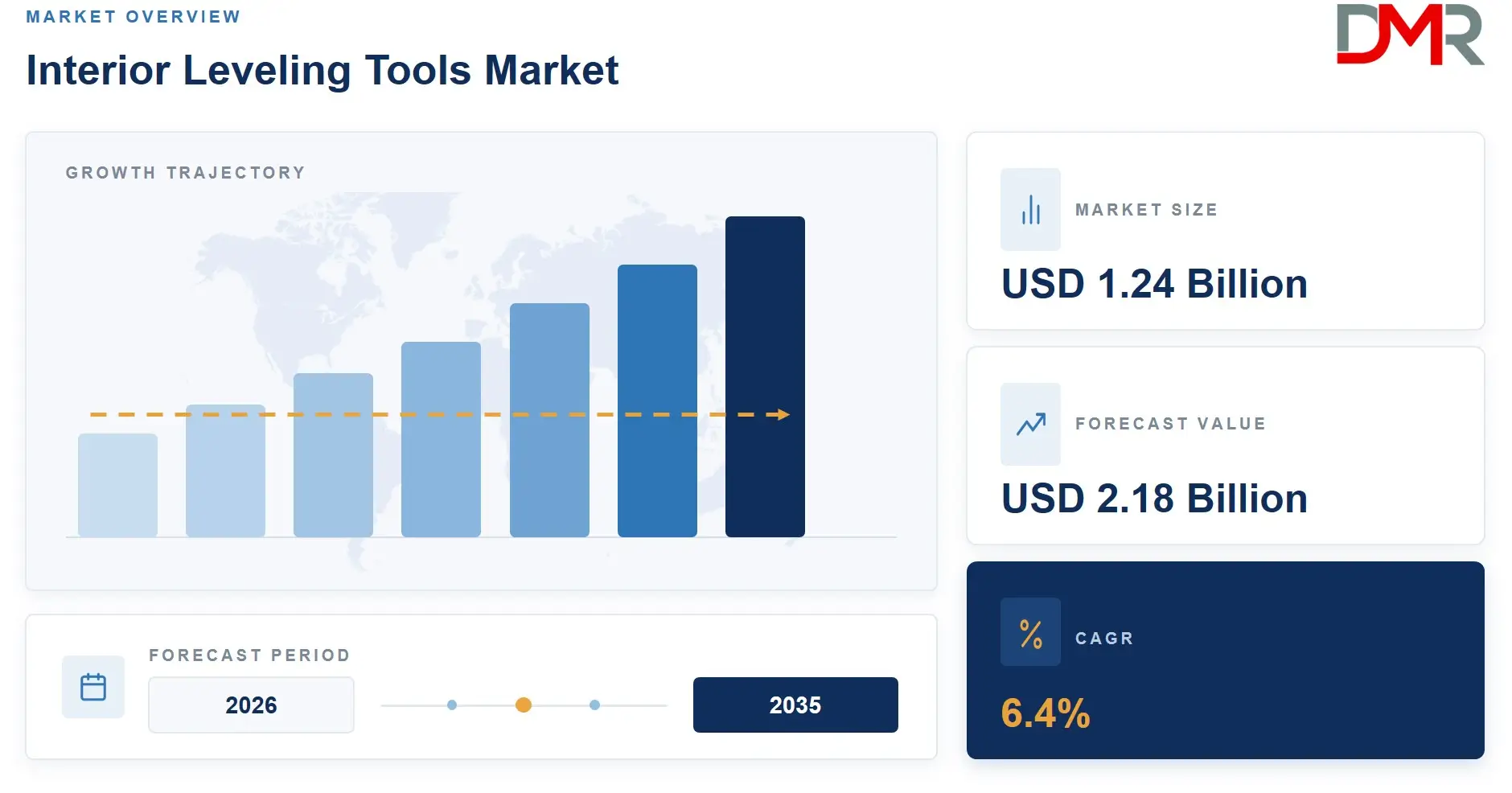
- The market size is USD 1.24 Billion in 2026, and is projected to hit USD 2.18 Billion by 2035 at a CAGR of 6.4%.
- By Category: Plane/360 Laser Levels led as the largest category with the highest CAGR of 12.3% in 2026.
- By User Type: Professional led as the largest category with the highest CAGR of 8.3% in 2026.
- By Price Tier: Mid-range (USD 100–450) led as the largest category with the highest CAGR in 2026.
- By Distribution Channel: E-Commerce led as a fast-growing channel reshaping interior leveling tool distribution in 2026.
- By Application: Ceiling Installation led as the fastest-growing application category in 2026.
- By Region: Asia Pacific led with a 42.6% share in 2026.
- Rental-fleet programs and private-label e-commerce portfolios represent two of the clearest white-space opportunities for vendors targeting underserved contractor and home-improvement segments.
Market Size and Forecast
The Global Interior Leveling Tools Market size is estimated at USD 1.24 Billion in 2026, and is projected to reach USD 2.18 Billion by 2035, exhibiting a CAGR of 6.4% during the forecast period.
Commercial fit-out and renovation activity provided the foundation for consistent revenue growth through the 2020–2024 historical period. Contractors replacing manual layout methods with self-leveling laser systems drove steady volume across professional channels, while DIY participation added a secondary growth layer as green-beam products moved into accessible price tiers. The forecast assumes that commercial construction pipelines in Asia Pacific and North America sustain professional-grade tool demand while rental and e-commerce channels absorb volume from intermittent-use buyers.
Downside risk concentrates around prolonged interest-rate pressure on commercial construction starts. A sustained slowdown in new-build fit-out activity would compress professional tool replacement cycles and push buyers toward rental rather than ownership. Upside potential rests on the speed at which contractors in emerging construction markets convert from manual instruments to entry-level laser systems, a conversion that has outpaced consensus estimates in Southeast Asia across the historical period.
ℹ
To learn more about this report –
Download Your Free Sample Report Here
Category Analysis
Plane/360 Laser Levels captured the highest CAGR of 12.3% across Category demand in 2026, ahead of all rivals.
Bosch's GLL300-42GL, which projects three 360° green-beam planes including one horizontal and two vertical reference planes, illustrates the specification standard that now defines professional interior layout expectations. Multi-plane 360° systems removed the constraint of repositioning tools between trades on complex fit-outs, letting electricians, tilers, and drywalllers share a single horizontal reference simultaneously. That workflow benefit, not the laser specification itself, explains why contractors are replacing single-line devices with 360° platforms faster than any other category shift in this market.
Line Laser Levels retain strong volume among smaller contractors and DIY buyers who do not require full-plane coverage. Dot and Point Laser Levels serve specialized plumb-transfer applications in electrical and plumbing alignment where a cross-line projection adds unnecessary cost. Combination Laser Levels, which blend line and point functions, attract finish-trade specialists running mixed-application workflows. Vendors offering modular or combination formats are best positioned to capture buyers who face variable jobsite conditions across a single working week.
User Type Analysis
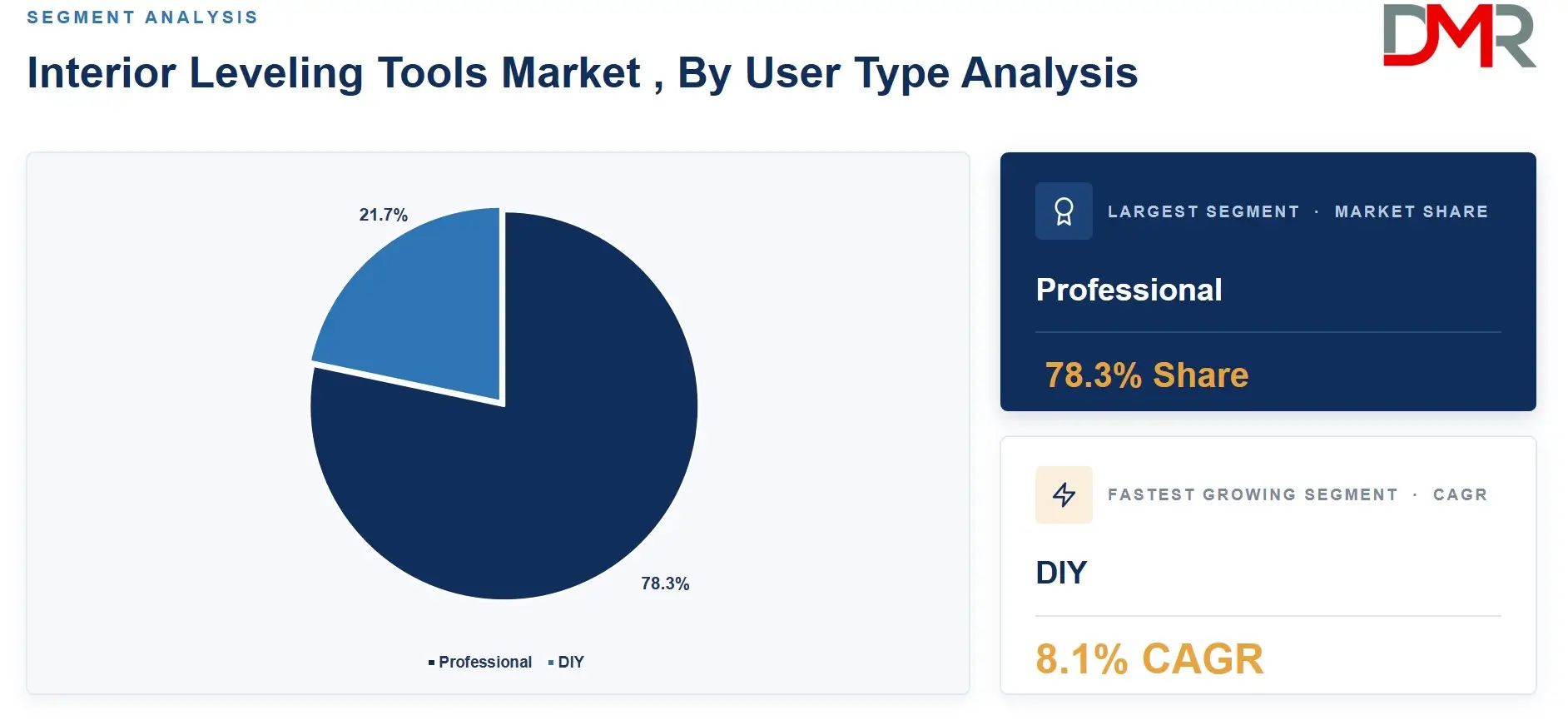
Professional users led the User Type segment as the largest category in 2026.
Professional-grade tools across the interior leveling category now compete on runtime, accuracy tolerance, and environmental protection ratings as much as on laser brightness. Makita's SK700D and SK700DG three-plane lasers, specified at ±1/16 inch at 33 feet with green-beam visibility reaching 115 feet, illustrate the precision standard professional buyers now use as a baseline for purchase decisions. Milwaukee's M12 Green 360° platform specifies a self-leveling tolerance of ±4° tilt, meaning the tool compensates for imperfect placement automatically, reducing setup time on uneven subfloors. Professional adoption of these specifications creates a reference point that effectively prices out lower-specification tools from serious contractor procurement.
The DIY segment participates primarily in Line Laser and entry-level Combination formats. Milwaukee's M12 Green Cross Line laser, rated for 15+ hours of continuous runtime with a CP 3.0 battery and green-beam visibility extending to 125 feet, sits at the upper boundary of what a performance-conscious DIY buyer considers. Products above that capability threshold convert poorly outside the professional channel, signaling that vendors targeting DIY must anchor their value proposition around ease of use and runtime rather than multiplane coverage.
ℹ
To learn more about this report –
Download Your Free Sample Report Here
Price Tier Analysis
Mid-range (USD 100–450) led the Price Tier segment with the highest CAGR as the dominant category in 2026.
Mid-range price positioning captures both the upgrading DIY buyer and the cost-conscious smaller contractor. Milwaukee's M12 Green 360° 3-Plane Laser, rated for 10+ hours in standard brightness and 6+ hours in boosted mode with a REDLITHIUM XC 4.0 battery, occupies the upper mid-range band where runtime and multi-plane capability intersect at a price point contractors can justify without capital approval. That sweet spot is precisely where volume competition among Tier-1 vendors is most intense.
Entry-tier products below USD 100 serve price-led buyers where laser accuracy and runtime are secondary to acquisition cost. High-end tools above USD 450 address specialty contractors and survey-adjacent applications where IP-rated enclosures, extended range, and calibration traceability justify a significant price premium over the mid-range. Vendors entering the high-end tier face entrenched loyalty among professional buyers who prioritize service network access and tool warranty coverage alongside raw specification.
Distribution Channel Analysis
E-Commerce led the Distribution Channel segment as the largest fast-growing category in 2026.
Manufacturer-direct webstores and third-party e-commerce platforms have reshaped how interior leveling tools reach end buyers, particularly in the mid-range and entry tiers. Private-label brands built exclusively for e-commerce channels compete on price visibility and review volume rather than distributor relationships or shelf placement. Specialist trade channels and industrial distributors retain dominance among professional buyers who require jobsite demonstration, calibration services, and credit terms that online platforms cannot replicate at scale.
Application Analysis
Ceiling Installation led the Application segment as the fastest-growing category in 2026.
Suspended ceiling installation across commercial office, retail, and hospitality fit-outs demands consistent horizontal reference planes across large floor plates. A 360° laser positioned once at ceiling height eliminates the repeated measurement checks that slow grid installation and introduce cumulative alignment errors. Flooring and Tiling follows closely, as tile lippage standards on large-format installations have tightened across European and North American specification guides. Wall Installation and Finishing, Electrical and Plumbing Alignment, and Other Applications serve narrower trade niches where laser adoption rates vary by contractor scale and project type.
Key Market Segments
By Category
- Plane/360 Laser Levels
- Line Laser Levels
- Dot/Point Laser Levels
- Combination Laser Levels
By User Type
By Price Tier
- Entry — Under USD 100
- Mid-range — USD 100–450
- High-end/Premium — Above USD 450
By Distribution Channel
- Manufacturing Direct/Webstore
- Wholesaler/Industrial Distributors
- Specialist Trade Channel
- DIY Super Stores/Trade
- E-Commerce
By Application
- Ceiling Installation
- Flooring & Tiling
- Wall Installation & Finishing
- Electrical & Plumbing Alignment
- Other Applications
Regional Analysis
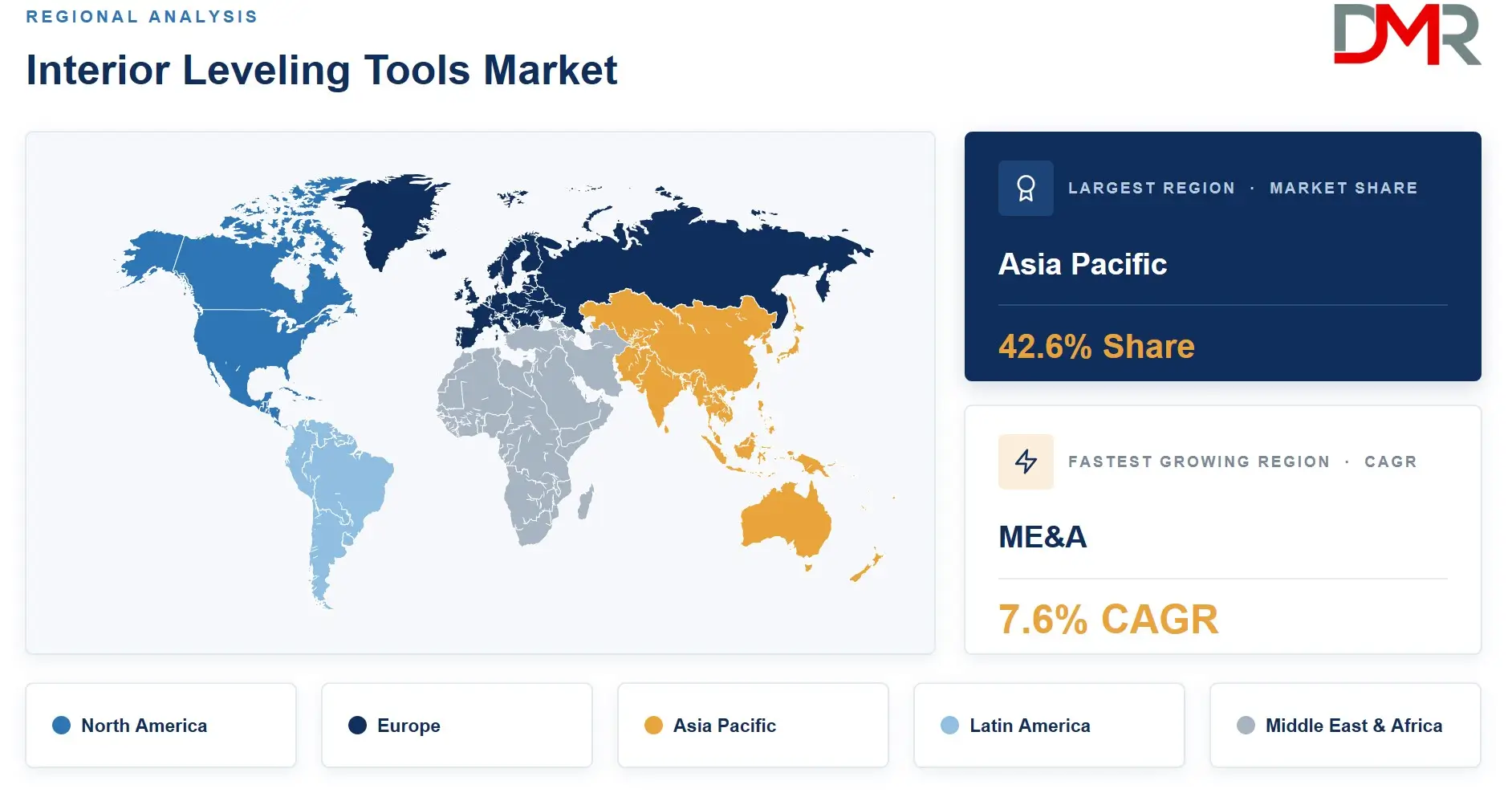
Asia Pacific led the interior leveling tools market with a 42.6% share in 2026.
Asia Pacific
Asia Pacific commands the largest regional share because construction volume across China, India, South Korea, and Southeast Asia has sustained professional tool demand at a scale no other region matches. Commercial interior fit-out activity in China's tier-one and tier-two cities alone generates procurement volumes that set floor prices for mid-range laser levels globally. Johnson Level and Tool's three-beam green laser, specified for total jobsite coverage up to 200 feet, reflects the project-scale expectations that large Asia Pacific fit-outs routinely impose on tool selection. Manufacturers prioritizing Asia Pacific distributor relationships and local inventory positioning hold a structural advantage over those relying on export-only supply models.
North America
North America sits as the second-largest regional market, driven by commercial renovation activity and a professional contractor base that replaces tools on relatively short upgrade cycles. Labor cost pressures in the US push general contractors toward any tool that reduces rework, making self-leveling laser systems a productivity investment rather than a discretionary purchase. Specialty trade contractors in drywall, flooring, and ceiling installation represent the highest-value buyer segment, and their adoption of premium 360° platforms drives revenue per unit sold well above the market average.
ℹ
To learn more about this report –
Download Your Free Sample Report Here
Europe
Europe's strict tile lippage and flooring flatness standards across Germany, France, and the UK create a structural floor for professional-grade laser adoption in finish trades. Renovation of aging commercial stock across Western Europe sustains demand independent of new-build construction cycles, insulating the regional market from sharp downturns when new residential activity softens. German manufacturers retain strong brand equity in the professional tier, though Asian price competition has accelerated the growth of mid-range alternatives across DIY and micro-contractor channels.
Latin America
Latin America presents early-stage professional conversion opportunity, concentrated in Brazil and Mexico where commercial construction pipelines have expanded faster than manual-tool users have converted to laser systems. Price sensitivity across the region limits near-term premium-tier penetration, but entry and mid-range laser formats are gaining ground through e-commerce and DIY superstore channels. Currency volatility remains the primary risk for imported tool brands competing for margin in this market.
Middle East and Africa
The Middle East, particularly GCC countries, drives demand through large-scale hospitality, retail, and residential fit-out programs where ceiling installation and flooring alignment specifications are stringent. Africa remains an early-adoption market where spirit levels and manual instruments still dominate contractor workflows, leaving significant headroom for entry-level laser adoption as construction formalization accelerates in urban centers.
Key Regions and Countries
North America
Europe
- Germany
- France
- The UK
- Spain
- Italy
- Rest of Europe
Asia Pacific
- China
- Japan
- South Korea
- India
- Australia
- Rest of APAC
Latin America
- Brazil
- Mexico
- Rest of Latin America
Middle East & Africa
- GCC
- South Africa
- Rest of MEA
Macroeconomic Impact
Commercial construction starts, which drive the majority of professional interior leveling tool demand, respond directly to interest-rate conditions in the US, EU, and China. Elevated borrowing costs through 2023 and 2024 delayed several large commercial fit-out programs, compressing near-term professional tool procurement budgets even as renovation activity partially offset the shortfall. A reversal in monetary policy across major economies creates the conditions for a fit-out pipeline reacceleration that would pull forward tool upgrade cycles among contractors who deferred replacement during the high-rate period.
Currency movements create asymmetric risk for brands manufacturing in Europe and exporting to Asia Pacific and Latin America. A strengthening euro or Swiss franc raises the landed cost of premium European tools in price-sensitive markets, handing margin advantage to Asian-manufactured alternatives. Manufacturers with multi-region production capacity absorb currency risk more effectively than single-country exporters, a structural advantage that consolidates brand leadership in emerging markets over time.
Market Dynamics
Driver: Commercial Fit-Out Pipelines Demand Rework-Free Interior Layout Accuracy
Commercial interior fit-out contractors incur rework costs that render manual layout methods economically indefensible for projects exceeding a certain floor area threshold. Self-leveling laser systems with extended working ranges address this directly. DeWalt's 20V MAX XR Remote Control 360° Line Laser, specified at ±1/8 inch accuracy at 30 feet with up to 9 hours of runtime per charge, illustrates how a single tool can cover an entire commercial floor plate through a full working shift without a battery swap. Contractors running multi-trade crews on tight handover schedules cannot afford the delays that repeated manual checks introduce.
Milwaukee's M12 Green 360° 3-Plane Laser, with a 125-foot working range extendable through its receiver, enables layout reference across large commercial bays without repositioning the instrument. In March 2025, STABILA launched the LAX 500 G cross-line plus plumb-point laser, providing highly visible green lines up to 40 meters with rapid self-leveling and up to 20 hours of operation, directly targeting multi-trade interior layout workflows. Product launches of this kind confirm that manufacturers are expanding tool capability to match the productivity demands of commercial fit-out buyers rather than simply refreshing cosmetic specifications.
Restraint: Acquisition and Calibration Costs Limit Small-Contractor Conversion
Professional-grade 360° laser systems require upfront capital that falls outside the discretionary budget of many small contractors and sole traders. Calibration, protective case storage, and periodic service add ongoing cost that buyers running a single laser across intermittent projects struggle to recover through productivity gains. Spirit levels and digital angle finders remain the preferred option for tradespeople who operate below the project scale where a laser system pays back within a reasonable number of uses.
Low-cost alternatives from unbranded manufacturers compound the restraint by anchoring buyer price expectations at levels where established brands cannot compete without sacrificing margin. A price-led buyer evaluating a USD 40 unbranded line laser against a USD 300 mid-range professional tool will not upgrade unless a contractor or specifier mandate forces the comparison toward accuracy rather than price. That dynamic limits the addressable market for premium brands in regions where specification enforcement is weak.
Opportunity: Rental Programs and Digital Ecosystems Target Underserved Contractors
Rental-fleet programs for premium 360° leveling systems remove the acquisition cost barrier that stops intermittent-use contractors from accessing professional-grade tools. A contractor who runs two commercial ceiling installations per month cannot economically justify owning a USD 600 three-plane laser. Rental availability through specialist trade channels closes that gap and generates recurring revenue for distributors while exposing buyers to performance benchmarks that convert rental users to owners over time.
Integrated product ecosystems combining tile lippage tools, flooring flatness gauges, and laser layout systems create cross-sell opportunity among finish-trade specialists who currently source these tools from multiple vendors. Private-label e-commerce portfolios targeting value-conscious home-improvement buyers represent a second structural opportunity, particularly in markets where branded product awareness is low and price-per-feature comparison drives purchase decisions.
Porter's Five Forces
The interior leveling tools market carries moderate-to-high competitive intensity driven by entrenched brand loyalty among professional buyers and significant manufacturing scale requirements that slow new entrant penetration at the premium tier. Suppliers of laser diodes, rechargeable lithium-ion cells, and precision optical components hold meaningful bargaining power because the green-beam diode supply chain is concentrated among a small number of Asian manufacturers, leaving tool brands exposed to component cost shocks. Buyers at the professional tier exercise relatively low switching pressure on any single transaction but demonstrate strong lifetime brand loyalty, meaning a lost professional account is structurally difficult to recover. Substitutes in the form of digital angle finders and spirit levels limit the addressable pool of first-time laser buyers rather than threatening existing laser users, as the productivity differential is too large to ignore once a contractor has operated a self-leveling 360° system. Milwaukee's M12 Green 360° platform carries an IP54 enclosure rating, illustrating how Tier-1 brands build environmental protection into their specifications as a barrier that commodity competitors struggle to match without absorbing equivalent engineering cost. Competitive rivalry among the top five brands is intense at the mid-range price tier and somewhat muted at the high-end, where Hilti and Leica Geosystems compete on service network and calibration traceability rather than price.
AI and Gen AI Impact
Artificial intelligence is entering the interior leveling tools market through two distinct pathways. At the product level, Bluetooth-connected and app-enabled platforms use AI-assisted measurement processing to auto-generate floor plans, flag alignment errors in real time, and log layout data for project documentation. At the manufacturing level, AI-driven quality control systems improve laser diode calibration consistency at scale, reducing field-calibration drift that has historically been a professional buyer complaint with mid-range products.
Early movers integrating app connectivity and cloud-based project data export have created a switching cost that extends beyond the tool itself. A contractor whose layout data flows automatically into a project management platform faces real friction when switching to a competitor's tool that breaks that workflow. Laggards selling hardware without digital connectivity risk being commoditized even at specifications that would have commanded a premium five years ago, as buyers increasingly evaluate the full data workflow rather than the physical tool alone.
Market Trends
360° Platforms, Connectivity, and Lithium-Ion Power Converging at the Professional Tier
360° plane lasers are displacing single-line devices in complex interior layout workflows as multi-trade coordination demands a shared reference plane rather than a single axis. STABILA's September 2025 launch of the LD 530 BT laser distance measurer added Bluetooth 5.0 data transfer, a digital target locator with 4× zoom, gesture-controlled measurement, and compatibility with the STABILA Measures app for automatic floor-plan creation, signaling where connected-tool development is heading. Rechargeable lithium-ion platforms, which Milwaukee specifies as 70% brighter than their predecessor in boosted mode, now define the baseline expectation for professional runtime and performance rather than a premium differentiator.
Market Competition Overview
The interior leveling tools market operates as a moderately consolidated professional tier alongside a fragmented entry-level segment. Five to six global brands capture the majority of professional revenue, competing on application-specific system breadth, service network depth, and lithium-ion platform compatibility rather than on single-product feature lists. Manufacturers with proprietary battery platforms create ecosystem lock-in that reduces buyer willingness to switch brands mid-fleet, a structural advantage that smaller competitors cannot replicate without equivalent R&D investment.
Share pressure at the mid-range tier has intensified as Asian manufacturers extended product quality upward from entry-level formats. Private-label and house-brand offerings sold through e-commerce channels now compete directly with established brands in the USD 100–250 band, compressing margin for brands that rely on mid-range volume to subsidize high-end R&D. Brands responding with direct-to-contractor digital channels and rental partnerships are better positioned to defend mid-range revenue than those depending exclusively on traditional distributor relationships.
Pricing Analysis
Entry-tier interior leveling tools below USD 100 compete almost entirely on price visibility, where e-commerce algorithms and review volume determine market share more reliably than brand equity. Mid-range products in the USD 100–450 band face the most complex pricing dynamics, as buyers in this tier compare specifications closely and respond sharply to promotional pricing from competing brands. Premium tools above USD 450 are priced on total cost of ownership, where runtime, calibration warranty, and service access justify the premium over the replacement cycle rather than at point of purchase.
Spectra Precision's LT58G, rated for 25 continuous hours of green-beam operation from a rechargeable lithium-ion battery, illustrates the runtime benchmark that high-end buyers use to evaluate price-per-hour-of-operation rather than unit cost alone. Manufacturers competing at this tier must communicate runtime and durability data in procurement-facing formats rather than consumer-friendly marketing language to win large-contractor and fleet-buyer accounts where total cost of ownership drives the approval decision.
Company Profiles
Bosch Power Tools anchors its interior leveling position around system compatibility, with the GLL300-42GL specified at 1/8-inch accuracy across a 100-foot working range and an IP65 enclosure rating for dust and water resistance. That IP65 rating sits one protection class above Milwaukee's IP54 specification on the M12 platform, giving Bosch a defensible claim in wet-subfloor and concrete-finishing environments where moisture exposure is a real jobsite condition. Bosch's distribution depth across both specialist trade channels and DIY superstores allows a single platform to serve professional and prosumer buyers without requiring separate product lines at the mid-range tier.
Milwaukee Tool has built its interior leveling position on the M12 battery platform, where tool-to-tool runtime compatibility creates fleet loyalty among contractors already invested in M12 infrastructure. The M12 Green 360° 3-Plane Laser achieves ±1/8 inch accuracy at 33 feet, matching the professional standard set by Bosch while differentiating on battery ecosystem integration rather than standalone specification. In June 2026, STABILA launched the LAX 60 G cross-line laser with ±0.3 mm/m leveling accuracy and green lines visible to 30 meters, setting a precision benchmark that raises the minimum specification contractors expect from any new professional-tier entrant in the cross-line category.
Key Players
- Bosch Power Tools
- Hilti Group
- Johnson Level & Tool
- Stanley Black & Decker, Inc.
- Stabila
- Leica Geosystems AG (Part of Hexagon)
- Makita
- Milwaukee Tool
- Fluke Corporation
- RYOBI
Supply Chain and Value Chain Analysis
The interior leveling tools value chain opens with laser diode and optical component manufacturing, concentrated in Japan, South Korea, and China, where specialist suppliers serve both consumer electronics and industrial measurement markets. Diode procurement represents the highest technical barrier in the supply chain, as green-beam diode production requires precision fabrication tolerances that few suppliers outside Asia can match at commercial scale. Tool assembly occurs primarily in China and Eastern Europe, with finished goods flowing through manufacturer-direct distribution, specialist trade networks, wholesalers, and e-commerce platforms before reaching contractor or end-consumer buyers.
Maximum value creation occurs at the brand and distribution layer, where service network coverage, calibration warranties, and battery ecosystem compatibility command the margin that component and assembly stages cannot. The biggest supply risk sits at the laser diode tier, where a concentration of supply among a small number of Asian component makers exposes European and North American tool brands to disruption if trade policy or component allocation shifts adversely. Brands investing in safety stock and dual-source diode supply agreements are better insulated from this risk than those operating on just-in-time component models.
Regulatory Landscape
Interior leveling laser tools sold in the European Union must comply with CE marking requirements covering laser safety classification under EN 60825-1 and electromagnetic compatibility standards. Class 2 and Class 3R laser products, which cover the majority of professional interior leveling tools, carry mandatory warning labeling and output power limits that manufacturers must document before placing products on the EU market. Compliance costs add product development lead time and certification expense that disadvantage smaller manufacturers relative to established brands with existing regulatory infrastructure.
North American markets require compliance with FDA laser product performance standards under 21 CFR Part 1040, administered by the Center for Devices and Radiological Health. Manufacturers entering the US market with new laser specifications must register products and submit compliance documentation before distribution. Australia, Japan, and South Korea maintain equivalent national laser safety frameworks that require separate certification processes, increasing regulatory overhead for brands pursuing simultaneous multi-region launches.
Investment and White Space Analysis
Investment within the interior leveling tools market is concentrating at two structural points. Tier-1 manufacturers are allocating R&D spend toward Bluetooth connectivity, app ecosystem development, and rechargeable lithium-ion platform expansion, where switching cost creation justifies higher upfront development cost. Distributors and private-equity-backed tool rental platforms are directing capital toward fleet acquisition programs that target intermittent-use contractors who cannot economically justify ownership of premium 360° systems.
White space exists most clearly in three areas. Contractor-training and certification programs converting manual-tool users in emerging construction markets in Southeast Asia and Sub-Saharan Africa remain underdeveloped relative to the latent demand. Integrated finish-trade product ecosystems combining laser layout, tile lippage measurement, and flooring flatness tools address a cross-sell gap that no single vendor has fully closed. Private-label e-commerce portfolios serving value-conscious home-improvement buyers in price-sensitive Latin American and Middle Eastern markets represent a third underserved segment where branded products currently leave margin on the table.
Report Details
| Report Characteristics |
| Market Value (2026) |
USD 1.24 Billion |
| Forecast Revenue (2035) |
USD 2.18 Billion |
| CAGR (2026–2035) |
6.4% |
| Historical Data |
2020 – 2024 |
| Forecast Data |
2026 – 2035 |
| Base Year |
2025 |
| Estimate Year |
2026 |
| Report Coverage |
Revenue Forecast, Market Dynamics, Competitive Landscape, Recent Developments |
| Segments Covered |
By Category (Plane/360 Laser Levels, Line Laser Levels, Dot/Point Laser Levels, Combination Laser Levels); By User Type (Professional, DIY); By Price Tier (Entry, Mid-range, High-end/Premium); By Distribution Channel (Manufacturing Direct/Webstore, Wholesaler/Industrial Distributors, Specialist Trade Channel, DIY Super Stores/Trade, E-Commerce); By Application (Ceiling Installation, Flooring & Tiling, Wall Installation & Finishing, Electrical & Plumbing Alignment, Other Applications) |
| Regional Coverage |
North America – US, Canada; Europe – Germany, France, UK, Spain, Italy, Rest of Europe; Asia-Pacific – China, Japan, South Korea, India, Australia, Rest of APAC; Latin America – Brazil, Mexico, Rest of Latin America; Middle East & Africa – GCC, South Africa, Rest of MEA |
| Prominent Players |
Bosch Power Tools, Hilti Group, Johnson Level & Tool, Stanley Black & Decker Inc., Stabila, Leica Geosystems AG (Part of Hexagon), Makita, Milwaukee Tool, Fluke Corporation, RYOBI, and Other Key Players |
| Customization Scope |
Customization for segments and region or country level will be provided. Additional customization can be done based on requirements. |
| Purchase Options |
Three license options: Single User License, Multi-User License (Up to 5 Users), and Corporate Use License (Unlimited Users and Printable PDF) |
Recent Developments
- December 2024 Raimondi S.p.A. completed the acquisition of Donnelly Distribution Inc., acquiring 100% of the distributor's assets and establishing Raimondi USA Corp. as a direct US subsidiary to strengthen its presence in the North American professional tile-installation and leveling tools market.
- January 2025 Raimondi USA Corp. officially began operations following the Donnelly Distribution acquisition, retaining existing management, sales, administrative, and logistics teams while expanding direct service and distribution capability across the North American professional tile-installation channel.
- September 2025 STABILA introduced the LAX 320 G cross-line plus plumb-point laser, a compact tool for interior construction providing green laser lines up to 30 meters, self-leveling capability, up to 20 hours of battery operation, and accessories designed to simplify professional layout and alignment work.
- December 2025 Vitrex, a QEP brand, introduced the Xtreme LASH SPIN tile levelling system, combining a flat interchangeable base with a reusable screw cap to speed large-format floor and wall tile installation while maintaining consistent tile alignment.
- January 2026 Vitrex expanded its tile-leveling portfolio with the LASHSPIN Tile Levelling System, featuring reusable caps, interchangeable 2 mm and 3 mm bases, and a twisting screw mechanism designed to improve speed and precision when installing large-format tiles.
- February 2026 RUBI launched the RESCUE LEVEL SYSTEM, a reusable tile-leveling solution designed to address broken leveling clips after adjacent tiles have already been installed. Its metal-based reusable clip can be used up to approximately 10 times under normal conditions, reducing rework and material waste.
Frequently Asked Questions
What is the biggest investment opportunity in the Interior Leveling Tools market?
▾ Rental-fleet programs for premium 360° leveling systems represent the clearest near-term investment opportunity. Intermittent-use contractors who cannot justify owning a USD 600 three-plane laser represent a large addressable segment that rental models unlock without requiring a change in buyer income or budget. Integrated finish-trade product ecosystems combining laser layout, tile lippage, and flooring flatness tools offer a second high-return opportunity for vendors with the breadth to cross-sell across application categories.
Who are the top companies in the Interior Leveling Tools market?
▾ Bosch Power Tools, Hilti Group, Milwaukee Tool, Stanley Black & Decker, Stabila, Leica Geosystems AG, Makita, Johnson Level & Tool, Fluke Corporation, and RYOBI lead the competitive landscape. Bosch and Milwaukee hold the strongest professional-tier positions, supported by proprietary battery platforms and broad specialist trade distribution. Stabila differentiates through precision engineering heritage and a consistent stream of new product launches targeting interior construction workflows.
Which segment is growing fastest in the in the Interior Leveling Tools market in the Interior Leveling Tools market and why?
▾ Plane/360 Laser Levels are growing fastest at a CAGR of 12.3%, driven by the shift from single-line devices to full-plane coverage in complex interior fit-out workflows. Multi-trade coordination on commercial ceiling and flooring projects demands a shared horizontal reference that only 360° platforms can provide without repositioning. Professional users are growing at 8.3% CAGR as labor scarcity forces contractors to use every productivity advantage available on time-sensitive projects.
Which region is growing fastest in the Interior Leveling Tools market and why?
▾ Asia Pacific leads with a 42.6% regional share and continues to grow fastest, driven by commercial construction volume across China, India, and Southeast Asia that generates professional tool procurement at a scale no other region approaches. Contractor conversion from manual instruments to entry and mid-range laser systems in Southeast Asia has outpaced consensus forecasts, pulling forward demand that analysts had originally modeled for the latter half of the decade. Rising finishing-trade specification standards in GCC construction programs add a secondary growth engine outside the Asia Pacific core.
What is the biggest challenge holding in the Interior Leveling Tools market back?
▾ Acquisition, maintenance, and calibration costs for professional-grade laser systems remain the primary barrier preventing small contractors and DIY buyers from converting away from spirit levels and digital alternatives. A sole trader running infrequent interior layout work cannot recover a USD 300 to USD 600 tool investment within a typical project cycle, making the productivity argument insufficient without a rental or financing pathway. Low-cost unbranded alternatives sold through e-commerce channels compound the problem by anchoring buyer price expectations well below the minimum needed for established brands to compete on margin.