Market Snapshot
- The Global Internal Nasal Dilators Market was valued at USD 528 Million in 2025 and is forecast to reach USD 1,174.14 Million by 2035 at a CAGR of 8.32%.
- By Product Type, Polymer led with a 65.31% share in 2025; Polymer and Alloy is the fastest-growing sub-segment.
- By Usability, Reusable dilators held a 60.32% share in 2025 and are also the fastest-growing category.
- By Application, Snoring accounted for a 43.71% share in 2025; Sleep Apnea is the fastest-growing application.
- By Distribution Channel, Retail Pharmacies led with a 46.62% share in 2025; Online Pharmacies is the fastest-growing channel.
- North America is the dominant region with a 47.32% share; Asia-Pacific is the fastest-growing region.
Market Overview
The internal nasal dilators market covers mechanically acting intranasal devices that physically widen the nasal valve to reduce airway resistance during breathing. The market excludes external nasal strips, pharmacological decongestants, continuous positive airway pressure machines, and surgical nasal interventions. Devices in scope span polymer, alloy, and composite designs sold across retail pharmacy, hospital pharmacy, online, and other distribution channels for applications including snoring, sleep apnea, deviated septum, and nasal congestion.
Among adults surveyed across eight U.S. states and the District of Columbia, 41.1% reported loud snoring and 13.6% reported stopped breathing during sleep, as reported by the CDC. These figures position the addressable population far ahead of current device penetration, making the gap between prevalence and treatment a structural commercial opportunity rather than a speculative one.
In February 2026, RhinoMed's Mute Nasal Dilator was featured by Forbes as one of the leading anti-snoring devices of the year, citing its clinically supported design for increasing nasal airflow. That recognition illustrates how mainstream health media is actively narrowing the distance between clinical evidence and consumer purchase decisions. Vendors with published efficacy data and retail distribution are best positioned to convert that awareness into market share.
Market Size and Forecast
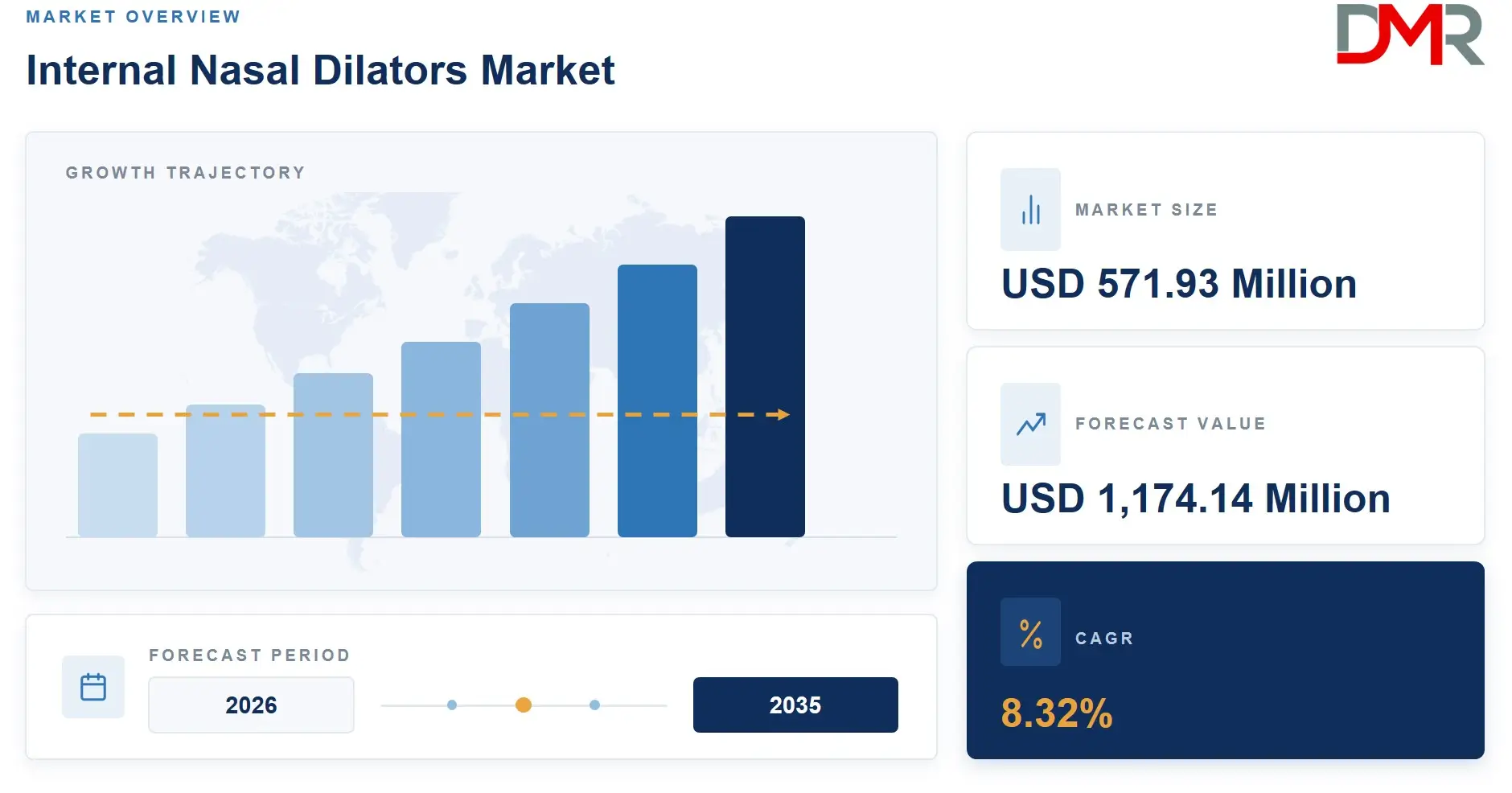
The Global Internal Nasal Dilators Market size is estimated at USD 571.93 Million in 2026 from USD 528 Million in 2025, and is projected to reach USD 1,174.14 Million by 2035, exhibiting a CAGR of 8.32% during the forecast period.
The 8.32% CAGR reflects a market that has moved from niche snoring aids to a recognized category within conservative sleep-health management. Growth is underpinned by rising consumer awareness of non-invasive airway support, the mainstreaming of OTC sleep products, and an expanding evidence base validating dilator use in specific patient cohorts. A 2026 peer-reviewed systematic review and meta-analysis evaluated internal and external nasal dilators across multiple outcomes, confirming symptom improvement in nasal breathing and snoring while clarifying their role as adjunctive rather than definitive obstructive sleep apnea therapy. That clarity removes a commercial ambiguity that previously caused category hesitation among both buyers and retailers.
ℹ
To learn more about this report –
Download Your Free Sample Report Here
Forecast assumptions rest on continued OTC channel expansion, sustained physician recommendation of dilators as first-line conservative options, and accelerating adoption in Asia-Pacific markets. Upside risk exists if prospective clinical trials confirm measurable reductions in apnea-hypopnea index for mild cases, which would unlock physician dispensing as a new revenue channel. Downside risk is bounded by competitive substitution from repositioned oral appliances and digital health monitoring tools that may reduce the perceived need for passive airflow devices.
Product Type Analysis
Polymer led the product type segment with a 65.31% share in 2026.
Polymer devices dominate because they combine cost efficiency with the design flexibility needed to fit a wide range of nasal anatomies. Consumer-grade polymer dilators can be produced at scale with consistent tolerances, enabling price points that support high-volume retail distribution without compromising device integrity. For brand owners, that manufacturing profile also reduces time-to-market for new form factors.
Polymer and Alloy is the fastest-growing sub-segment, driven by clinical and sports-performance product lines that require greater structural rigidity and durability across repeated use cycles. Alloy-reinforced designs command premium pricing and attract a buyer segment willing to invest in longer device lifespans. Other Product Types, including silicone-only and composite materials, occupy a smaller but stable share, primarily serving post-surgical and sensitive-anatomy patient segments where material biocompatibility is the primary purchase criterion.
Usability Analysis
With a 60.32% share in 2026, Reusable dilators outpaced all other usability categories.
Reusable internal nasal dilators lead on both volume share and growth rate, reflecting a consumer shift toward sustainable and cost-effective health devices. ENT clinicians reinforce this preference by recommending reusable formats as practical first-line aids for mild to moderate nasal valve obstruction, lending clinical credibility to a product choice that consumers initially make on cost grounds. Vendors offering durable, easy-to-clean polymer or alloy devices are capturing the highest repeat-purchase rates in the category.
Single-use dilators retain commercial relevance in hospital pharmacy and travel-retail settings where hygiene protocol or convenience takes precedence over unit economics. A growing subset of sleep clinics recommends single-use formats for trial periods before patients commit to a reusable product, creating a structured trial-to-repeat conversion funnel that benefits brands with both format types in their portfolio.
Application Analysis
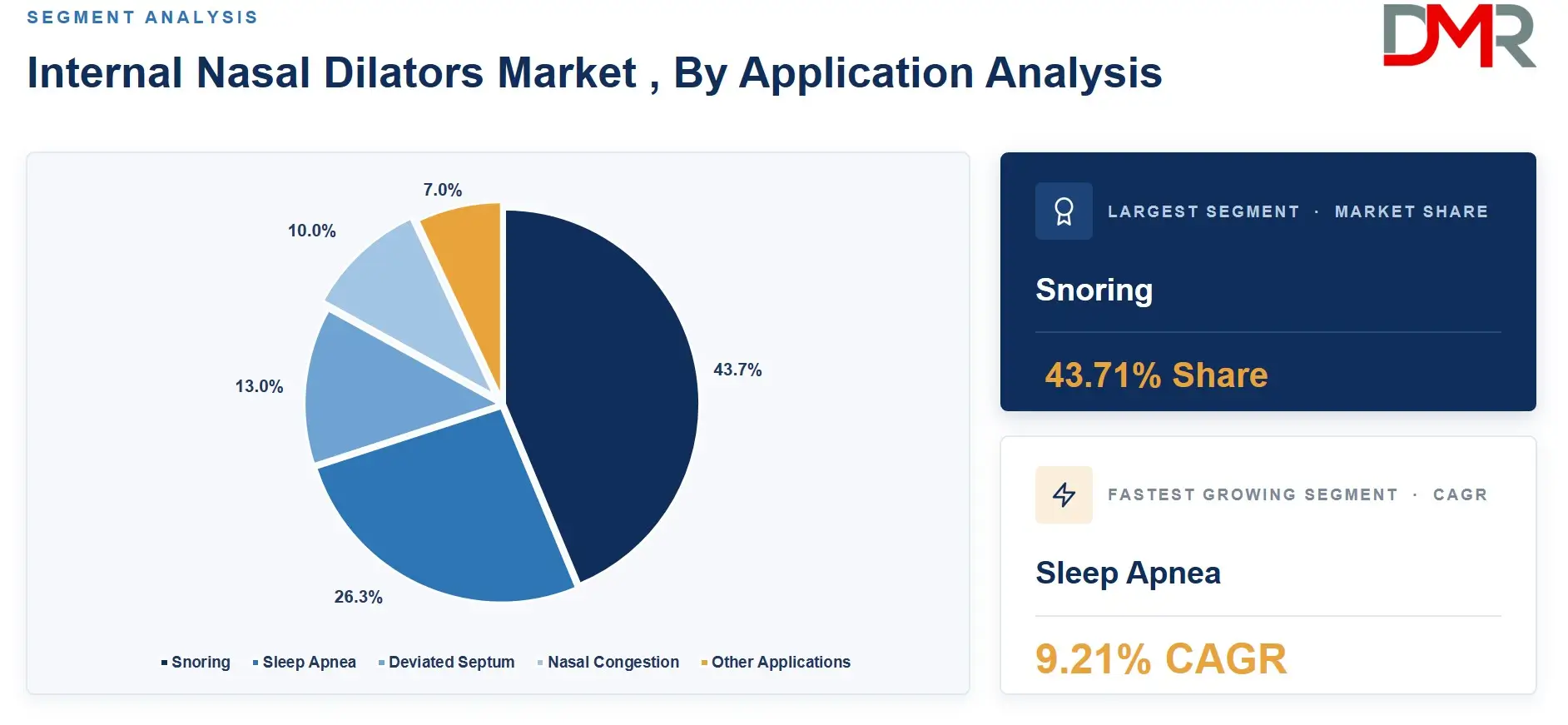
Snoring accounted for 43.71% of application demand in 2026, the highest of any category.
Snoring remains the anchor application because it drives the largest share of self-directed consumer purchases. Patients with primary snoring rarely receive a formal diagnosis, and the OTC positioning of nasal dilators allows them to act without clinical consultation. That direct-to-consumer pathway lowers acquisition cost for brands and removes the physician referral bottleneck that constrains other medical device categories.
ℹ
To learn more about this report –
Download Your Free Sample Report Here
Sleep Apnea is the fastest-growing application, supported by rising diagnosis rates and mounting interest in adjunctive non-invasive options for mild cases. Deviated Septum and Nasal Congestion together represent a clinically referred segment where hospital pharmacy and ENT-dispensed products have a structural advantage over retail competitors. Other Applications, including sports performance and post-operative recovery, are nascent but expanding as new peer-reviewed evidence accumulates in those specific-use contexts.
Distribution Channel Analysis
Retail Pharmacies captured 46.62% of the distribution channel segment in 2026, ahead of all rivals.
Retail pharmacies lead because internal nasal dilators sit naturally alongside established OTC sleep and respiratory categories, benefiting from impulse and adjacency purchase behavior. Pharmacist recommendation at point of sale functions as informal clinical endorsement, which meaningfully increases consumer confidence in a category that buyers may perceive as niche or unproven.
Online Pharmacies is the fastest-growing channel, driven by consumer comfort with repeat health purchases, subscription models, and the ability to access product reviews before buying. Hospital Pharmacies maintain steady volume through clinician-recommended post-operative and trial-use protocols. Other Distribution Channels, including sports retailers and specialty sleep stores, are growing in line with the athlete and performance-use segment, which commands higher average selling prices than the snoring and congestion categories.
Key Market Segments
By Product Type
- Polymer
- Polymer and Alloy
- Other Product Types
By Usability
By Application
- Snoring
- Sleep Apnea
- Deviated Septum
- Nasal Congestion
- Other Applications
By Distribution Channel
- Retail Pharmacies
- Online Pharmacies
- Hospital Pharmacies
- Other Distribution Channels
Regional Analysis
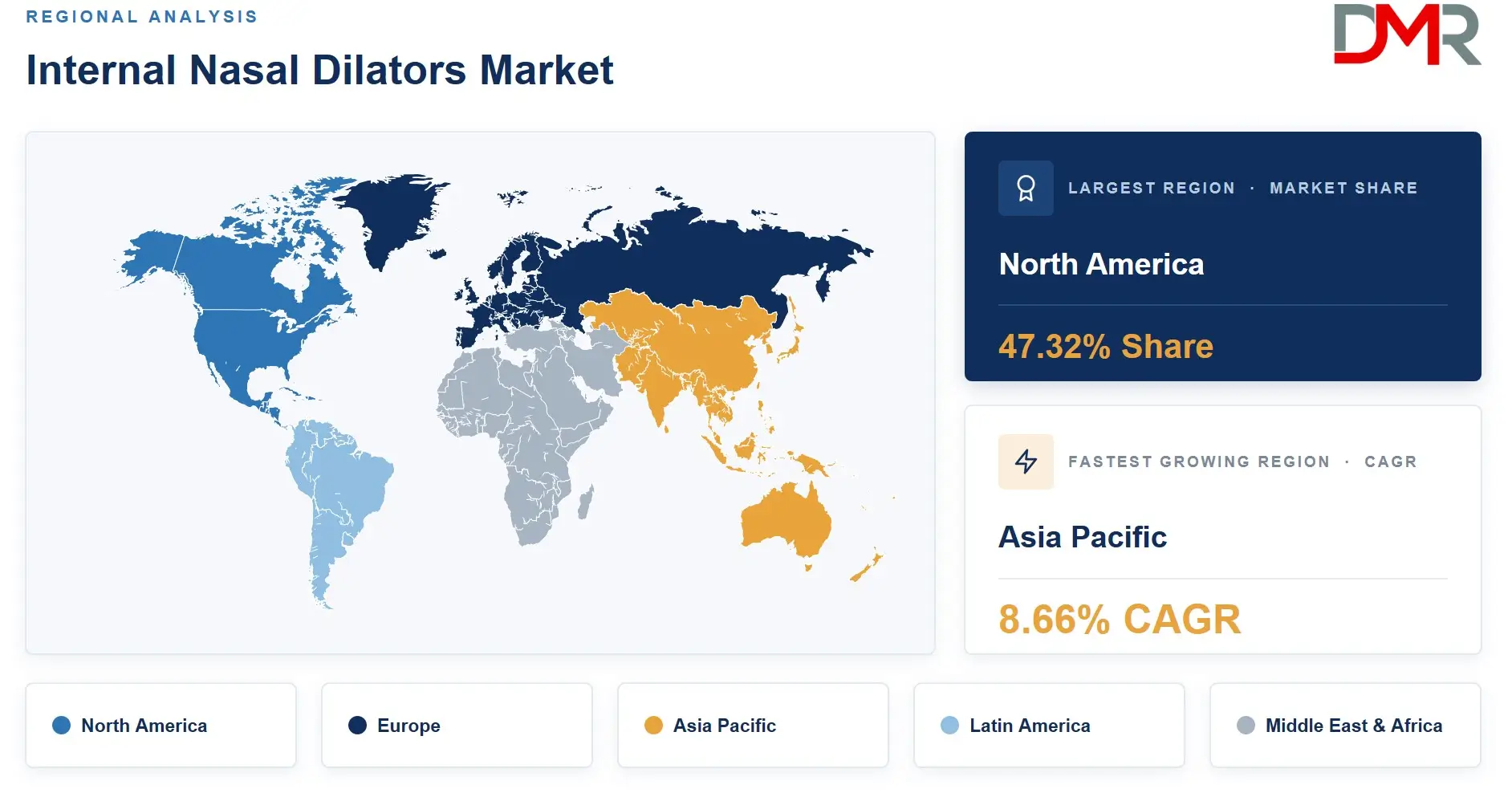
North America led the regional segment with a 47.32% share and a market value of USD 249.98 Million in 2026.
North America dominates because the U.S. combines the highest per-capita healthcare spending on sleep disorders with a mature retail pharmacy infrastructure that gives OTC nasal dilators immediate national reach. Consumer awareness of sleep health in the U.S. market is among the highest globally, supported by decades of sleep-medicine advocacy and broad media coverage of sleep disorder treatments. That combination of awareness, spending power, and channel depth is difficult for other regions to replicate quickly.
ℹ
To learn more about this report –
Download Your Free Sample Report Here
Asia-Pacific is the fastest-growing region, where rising middle-class health awareness and expanding e-commerce infrastructure are pulling OTC sleep products into markets that previously lacked retail access for this category. Europe holds a substantial secondary share, with Germany and the UK showing the highest clinical interest in nasal dilators as conservative options within structured ENT care pathways. Latin America and Middle East and Africa remain nascent markets where growth will hinge on retail pharmacy network expansion and the entry of regional distributors willing to invest in category education.
Key Regions and Countries
North America
Europe
- Germany
- France
- The UK
- Spain
- Italy
- Rest of Europe
Asia Pacific
- China
- Japan
- South Korea
- India
- Australia
- Rest of APAC
Latin America
- Brazil
- Mexico
- Rest of Latin America
Middle East & Africa
- GCC
- South Africa
- Rest of MEA
Market Dynamics
Undiagnosed Sleep Disorders Expand the Non-Invasive Airway Market
Approximately 39 million U.S. adults are estimated to have obstructive sleep apnea, and nearly 80% of moderate-to-severe cases remain undiagnosed, as reported by the American Academy of Sleep Medicine. That undiagnosed population does not wait for a clinical verdict before acting. Consumers experiencing snoring and disrupted sleep actively seek OTC solutions, and internal nasal dilators are a logical first purchase before any diagnostic pathway begins.
The U.S. FDA classifies nasal dilators under Product Code LWF as Class I medical devices and exempts them from Premarket Notification 510(k) requirements, as confirmed by FDA access data. That regulatory designation removes one of the most costly and time-consuming barriers to commercialization. New entrants and existing players introducing design iterations can reach market within months rather than years, sustaining product innovation cycles that keep consumer interest high.
Clinical Ceiling Constrains Standalone Therapeutic Claims
A 2026 systematic review and meta-analysis, published in PMC, found that internal and external nasal dilators improve patient-reported nasal breathing and snoring symptoms but do not produce clinically meaningful improvements in objective OSA severity, sleep architecture, or nocturnal oxygenation. That finding draws a hard boundary around the claims that manufacturers can legitimately make, concentrating the viable market in mild-case and symptom-relief segments.
The National Institutes of Health identifies CPAP as the first-line treatment for moderate-to-severe obstructive sleep apnea, with oral appliances and surgery as established alternatives. Sleep specialists who follow NIH guidance will not substitute nasal dilators for those interventions. Vendors targeting physician-referred channels must design and position products explicitly as adjuncts, not replacements, to maintain clinical credibility and avoid regulatory scrutiny.
Sleep-Deficit Population Creates Scalable Entry Points
According to the 2024 U.S. National Health Interview Survey published by the CDC, 30.5% of U.S. adults slept fewer than 7 hours per night. That data point does not describe a clinical population. It describes a mass consumer segment that perceives poor sleep as a daily quality-of-life problem and is actively open to non-prescription interventions priced within reach of a routine health purchase.
Structured home-based snoring management programs represent a scalable commercial opportunity. Platforms that algorithmically triage patients across nasal dilators, sleep-position adjustments, and behavioral interventions — guided by remote symptom tracking — create recurring engagement and multi-product revenue per user. Brands that position their dilators within those ecosystems capture both the initial device sale and a durable relationship with a high-intent health consumer.
Market Trends
Clinical Validation Broadens Indication Scope and Drives Specialist Adoption
The American Academy of Otolaryngology-Head and Neck Surgery formally recognizes external and internal nasal dilators as conservative treatment options for symptomatic nasal valve dysfunction before surgery is considered, as confirmed by the AAO-HNS position statement. Comparative clinical trials are sharpening understanding of which patient phenotypes respond best to internal versus external devices. ENT-authored guidelines are now actively directing patients toward reusable internal designs as practical first-line aids for mild to moderate nasal valve collapse, embedding dilators within structured clinical pathways rather than leaving them as purely consumer-driven purchases.
Market Competition Overview
The internal nasal dilators market is fragmented, with a large number of branded and generic entrants competing across the same retail, online, and hospital pharmacy channels. No single player holds a commanding share of the global market. Competition centers on device comfort, clinical evidence, brand recognition in OTC sleep health, and pricing architecture across single-use and reusable formats. Established players with broad retail pharmacy distribution and publicized clinical backing maintain consistent shelf presence, while smaller entrants compete primarily on price and digital-channel visibility.
Online pharmacy growth is actively redistributing competitive advantage. Direct-to-consumer brands with strong review profiles and subscription pricing are gaining share against traditional retail-first competitors that lack comparable digital marketing infrastructure. The competitive frontier is shifting toward integrated sleep-health positioning, where nasal dilators are presented as one component of a broader consumer sleep management system rather than a standalone product.
Company Profiles
Rhinomed Limited is the most strategically visible player in the internal nasal dilators market, operating two distinct product lines that address separate consumer segments. The Mute nasal dilator targets the snoring and sleep-health consumer through mainstream retail and online channels, supported by clinical studies on nasal airflow improvement. The Turbine targets athletes and performance-oriented users seeking respiratory efficiency during exertion. In June 2025, Rhinomed Health Corporation crossed above 50% ownership of Rhinomed Limited, consolidating control of both product lines under one corporate structure. That ownership consolidation positions the combined entity to fund coordinated commercial expansion across consumer and sports channels simultaneously.
Key Players
- Rhinomed Limited
- Splintek, Inc.
- SANOSTEC CORP
- Scandinavian Formulas Inc.
- WoodyKnows (M&M Pure Air Systems LLC)
- Airware Labs
- ASO Medical
- Breathewave
- Consumer Sleep Solutions LLC.
- HealthRight Products, LLC
- Hivox Biotek Inc.
- Intake Breathing
- Medline Industries, LP
- Nasaline
- Nasanita
- Quest Products, LLC
- RC Medical Devices
- RespiFacile
- SnoreCare
Regulatory Landscape
The U.S. regulatory framework treats internal nasal dilators as low-risk medical devices. The FDA Class I designation under Product Code LWF and the 510(k) exemption allow manufacturers to commercialize new designs without pre-market review, provided they remain within the established device classification scope. That framework lowers entry barriers and enables design iteration at a pace that other Class II or Class III device categories cannot match.
Outside the United States, European CE marking requirements and national health authority registrations in Asia-Pacific markets impose additional compliance steps, but none represent prohibitive barriers for manufacturers with established quality systems. The AAO-HNS position statement recognizing nasal dilators as a formal conservative treatment option strengthens the clinical basis for regulatory acceptance in markets where specialty society endorsement influences device reimbursement and hospital formulary decisions.
Investment and White Space Analysis
Investment interest is concentrating in three areas: sports and performance-oriented device variants, ENT clinic distribution platforms, and digital home-based snoring management programs that incorporate dilators as a hardware component. The sports segment commands premium pricing and attracts a health-conscious buyer segment with high repeat-purchase intent. ENT clinic distribution opens physician-dispensed revenue that bypasses retail margin compression.
Asia-Pacific represents the clearest geographic white space, combining high sleep disorder prevalence with low current dilator penetration and a rapidly expanding e-commerce infrastructure. Brands entering Asia-Pacific through online pharmacy channels face relatively low distribution setup costs. The fastest entry point for new players is a reusable polymer dilator with peer-reviewed snoring outcome data, priced for OTC purchase, and distributed through online pharmacy and sports retail channels simultaneously.
Recent Developments
- June 2025, Rhinomed Health Corporation advanced its takeover of Rhinomed Limited, with its substantial holding crossing above 50% on June 27, 2025, consolidating ownership of the Mute nasal dilator business under a single controlling entity.
- 2025, Rhinomed continued the international commercialization of its Turbine reusable internal nasal dilator, positioning the product for athletes and active users seeking improved nasal airflow and breathing performance during exertion.
Report Details
| Report Characteristics |
| Market Value (2025) |
USD 528.00 Million |
| Market Value (2026) |
USD 571.93 Million |
| Forecast Revenue (2035) |
USD 1,174.14 Million |
| CAGR (2026–2035) |
8.32% |
| Base Year for Estimation |
2025 |
| Historic Period |
2020 – 2024 |
| Forecast Period |
2026 – 2035 |
| Report Coverage |
Revenue Forecast, Market Dynamics, Competitive Landscape, Recent Developments |
| Segments Covered |
By Product Type (Polymer, Polymer and Alloy, Other Product Types), By Usability (Reusable, Single Use), By Application (Snoring, Sleep Apnea, Deviated Septum, Nasal Congestion, Other Applications), By Distribution Channel (Retail Pharmacies, Online Pharmacies, Hospital Pharmacies, Other Distribution Channels) |
| Regional Analysis |
North America – US, Canada; Europe – Germany, France, UK, Spain, Italy, Rest of Europe; Asia-Pacific – China, Japan, South Korea, India, Australia, Rest of APAC; Latin America – Brazil, Mexico, Rest of Latin America; Middle East & Africa – GCC, South Africa, Rest of MEA |
| Competitive Landscape |
Rhinomed Limited, Splintek Inc., SANOSTEC CORP, Scandinavian Formulas Inc., WoodyKnows, Airware Labs, ASO Medical, Breathewave, Consumer Sleep Solutions LLC, HealthRight Products LLC, Hivox Biotek Inc., Intake Breathing, Medline Industries LP, Nasaline, Nasanita, Quest Products LLC, RC Medical Devices, RespiFacile, SnoreCare |
| Customization Scope |
Customization for segments and region or country level will be provided. Additional customization can be done based on requirements. |
| Purchase Options |
Three license options: Single User License, Multi-User License (Up to 5 Users), Corporate Use License (Unlimited Users and Printable PDF) |
Frequently Asked Questions
What is the biggest investment opportunity in Internal Nasal Dilators Market ?
▾ The largest near-term investment opportunity is in Asia-Pacific, where high sleep-disorder prevalence meets low current device penetration and a growing online pharmacy infrastructure. Reusable internal nasal dilators with peer-reviewed snoring outcome data are the strongest entry format, enabling premium pricing and high repeat-purchase rates in a region with rising health spending.
Who are the top companies in Internal Nasal Dilators Market ?
▾ Rhinomed Limited is the most strategically prominent player, operating the Mute snoring aid and Turbine athletic dilator across consumer and sports channels. Other notable competitors include Splintek Inc., SANOSTEC CORP, Scandinavian Formulas Inc., Airware Labs, Medline Industries LP, and Intake Breathing, among a broader fragmented field of 19-plus branded players.
Which segment is growing fastest in Internal Nasal Dilators Market and why?
▾ The Sleep Apnea application segment is growing fastest, driven by rising diagnosis rates and consumer demand for non-invasive adjunctive options for mild cases. Online Pharmacies is the fastest-growing distribution channel, reflecting the broader consumer shift toward subscription-based health purchases and the ability to compare reviews before buying.
Which region is growing fastest in Internal Nasal Dilators Market and why?
▾ Asia-Pacific is growing fastest, propelled by expanding middle-class health awareness, rising e-commerce infrastructure, and historically low OTC sleep-device penetration that leaves significant volume to capture. Markets such as China, India, and South Korea combine large populations with rapidly growing retail pharmacy networks and increasing consumer interest in non-prescription sleep-health products.
What is the biggest challenge holding Internal Nasal Dilators Market back?
▾ The most binding constraint is the clinical consensus that internal nasal dilators do not produce meaningful improvements in objective obstructive sleep apnea severity, as confirmed by a 2026 systematic review. That boundary limits physician prescription for moderate-to-severe OSA patients, confining the medical channel opportunity to mild-case adjunctive use and forcing most revenue through OTC consumer channels where brand differentiation is harder to sustain.