What is the Internet of Behavior Market Size in 2026?
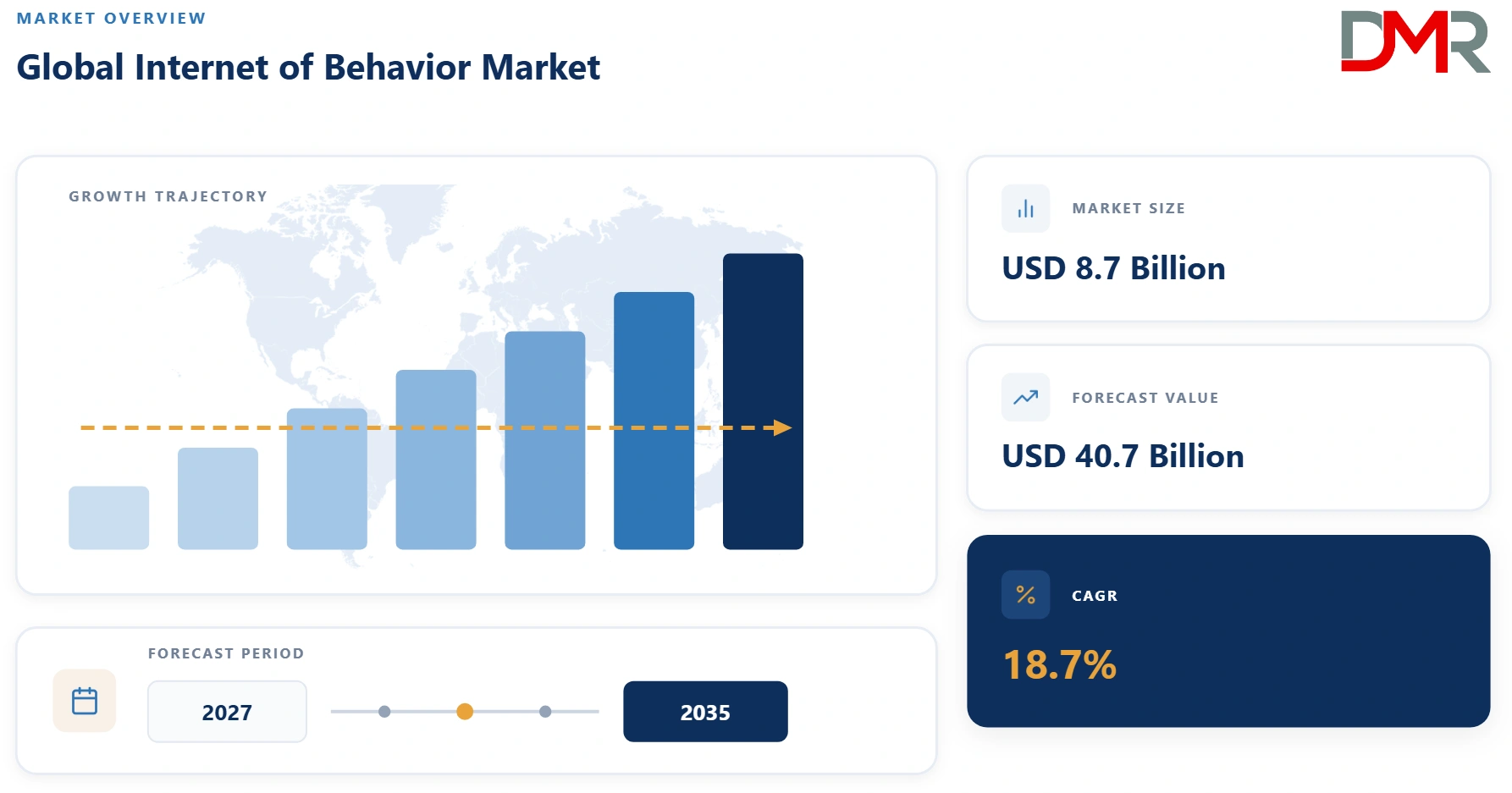
The global internet of behavior market is valued at USD 8.7 billion in 2026 and is projected to reach USD 40.7 billion by 2035, growing at a CAGR of 18.7% from 2027 to 2035. Growth is driven by rising demand for personalized customer experiences, advances in artificial intelligence and big data analytics, the spread of connected devices and wearables, and growing use of behavioral signals in fraud prevention.
ℹ
To learn more about this report –
Download Your Free Sample Report Here
The internet of behavior market comprises platforms, software and services that collect behavioral data from digital interactions, connected devices, transactions and sensors, analyze it with artificial intelligence and behavioral science, and use the resulting insight to predict, influence or authenticate what people do. Typical outputs include next-best-action engines, intent and churn scores, behavioral biometrics for fraud detection, and wellness nudges. Revenue includes software licenses and subscriptions, cloud analytics consumption, integration and managed services. The definition excludes general-purpose business intelligence tools and raw data storage that are not applied to behavioral analysis.
The Internet of Behavior market in this report measures the value of behavioral analytics and decisioning solutions and the services that deploy them, rather than the underlying IoT hardware or generic cloud infrastructure. Demand comes from retailers and consumer brands personalizing engagement, banks and payment networks fighting account takeover and scams, healthcare and insurance organizations running adherence and wellness programs, and employers and fleet operators improving safety. The report covers five segments across five regions, including major national markets in each.
Internet of Behavior Market Snapshot
Internet of Behavior Market Snapshot, 2026-2035
| Metric |
Value |
| Market Size (2026) |
USD 8.7 Billion |
| Forecast Value (2035) |
USD 40.7 Billion |
| CAGR (2027-2035) |
18.7% |
| Largest Region (2026) |
North America, 38.6% share |
| Fastest-Growing Region (2027-2035) |
Asia Pacific, 21.5% CAGR |
| Leading Component (2026) |
Solutions, 64.8% share |
| Leading Application (2026) |
Personalized Marketing and Customer Experience, 37.9% share |
| Key Players |
IBM, Microsoft, Google, Amazon, Salesforce, SAP, Oracle, Cisco, Accenture |
Internet of Behavior Market: Key Takeaways
- Market growth: The market is valued at USD 8.7 billion in 2026 and is expected to reach USD 40.7 billion by 2035, expanding at an 18.7% CAGR from 2027 to 2035.
- Component leader: Solutions hold a 64.8% share of the market in 2026, led by behavioral analytics platforms, customer data and decisioning software, and behavioral biometrics.
- Fastest component: Services are set to grow at a 21.3% CAGR through 2035, ahead of the overall market, as buyers need integration, data engineering, consent management and managed analytics support.
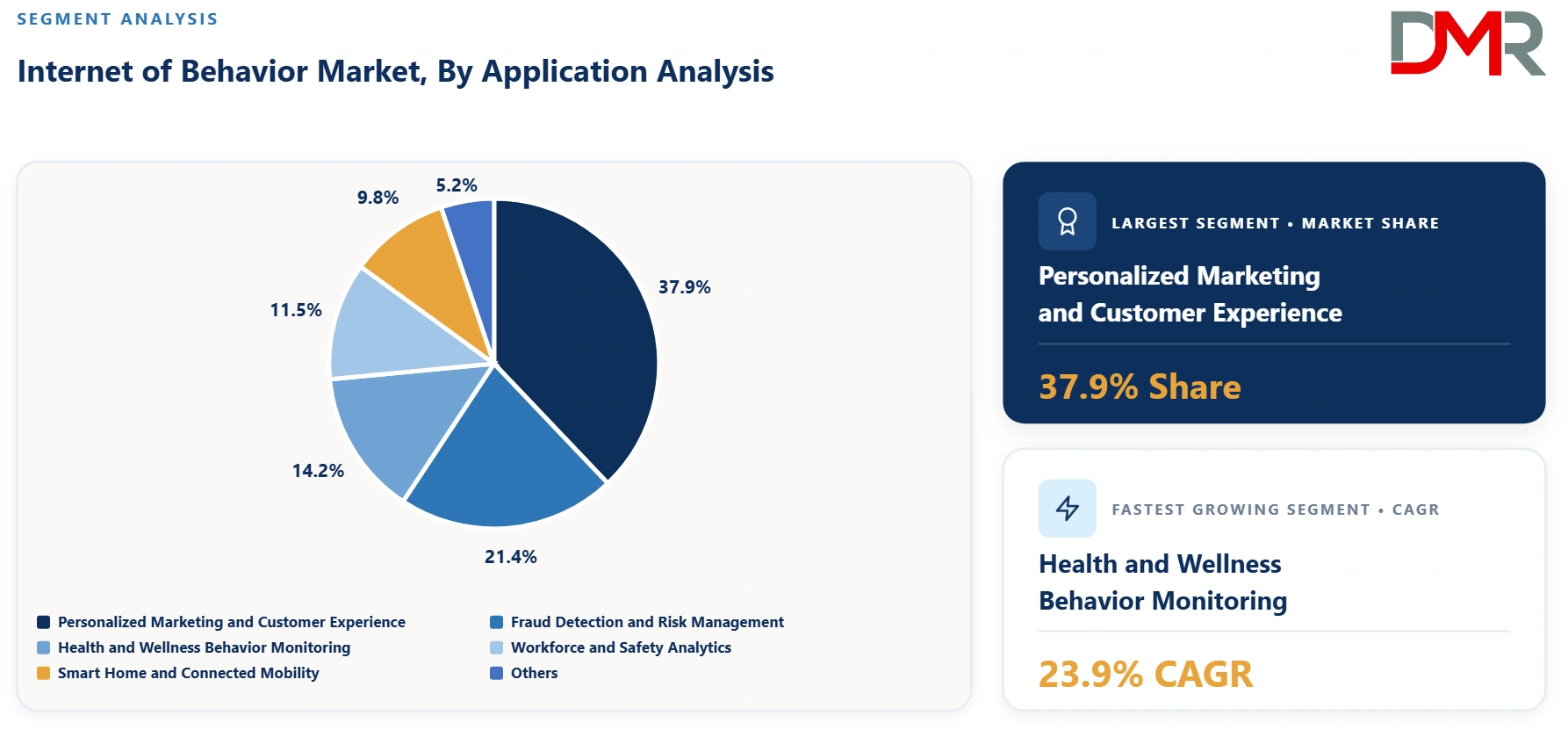
- Application leader: Personalized Marketing and Customer Experience accounts for 37.9% of 2026 demand, as brands act on real-time behavior across web, app, email and messaging channels.
- Fastest application: Health and Wellness Behavior Monitoring is projected to grow at a 23.9% CAGR, supported by wearables, digital therapeutics and insurer-sponsored engagement programs.
- Regional picture: North America leads with a 38.6% share in 2026, while Asia Pacific is the fastest-growing region at a 21.5% CAGR.
What are the Key Use Cases of the Internet of Behavior?
- Hyper-Personalized Marketing and Next-Best-Action: Real-time behavioral signals decide which offer, message, channel and moment will work for each customer, lifting conversion and retention for retailers, media platforms and subscription businesses.
- Behavioral Fraud Detection and Continuous Authentication: Typing rhythm, touch gestures and device handling separate genuine customers from bots, scammers and account-takeover attempts before a payment is made, cutting fraud losses for banks and payment networks.
- Health, Wellness and Adherence Programs: Wearable and app data reveal activity, sleep and medication patterns, letting providers, insurers and employers send timely nudges that improve adherence and lower care costs.
- Safety, Mobility and Workforce Analytics: Telematics and sensor data on driving and work patterns support usage-based insurance, fleet safety coaching and hazard alerts, within limits set by workplace and privacy rules.
How are Foundation Models and Agentic AI Transforming the Internet of Behavior Market?
Foundation models and agentic AI are turning behavioral analytics from static segmentation into continuous, individual-level decisioning. Large models fuse clickstreams, transactions, voice and device signals into a single view of intent, then explain that view in plain language so marketers and analysts can query it directly. AI agents now act on those signals, choosing content, timing and channel for each person without a manual campaign build. Synthetic customer simulations, sometimes called digital twins, let teams test an offer against modeled behavior before releasing it. In fraud prevention, behavioral models are being retrained to separate human sessions from automated agents and AI-assisted scams. Vendors bundle these capabilities into premium tiers, raising revenue per customer and shifting competition toward proprietary behavioral data, model quality and trusted governance. Platforms with large first-party datasets gain a clear edge.
Internet of Behavior Market Dynamics at a Glance
Drivers, Restraints, Opportunities and Trends in the Internet of Behavior Market
| Type |
Factor |
Impact |
| Driver |
Demand for Personalized Customer Experiences |
High |
| Driver |
AI, Big Data Analytics and Connected Device Growth |
High |
| Restraint |
Privacy, Consent and Regulatory Risk |
High |
| Restraint |
Data Quality, Integration Complexity and Ethical Concerns |
Medium |
| Opportunity |
Health, Wellness and Insurance Behavior Programs |
High |
| Opportunity |
Fraud Prevention and Continuous Authentication |
High |
| Trend |
Agentic AI and Customer Simulation |
High |
| Trend |
Privacy-Preserving and First-Party Data Strategies |
Medium |
What is Driving the Growth of the Internet of Behavior Market?
Demand for Personalized Customer Experiences
Customers now expect relevant offers and timely service across every channel, and companies that act on behavior outperform those that rely on broad segments. Retailers, banks, telecom operators and media platforms use behavioral data to tailor recommendations, pricing, content and service interactions, which lifts conversion, loyalty and lifetime value. As acquisition costs rise and tracking of individuals through third parties tightens, brands are investing in first-party behavioral data and the platforms that turn it into action. This keeps spending on analytics, decisioning and engagement software growing across all major regions.
AI, Big Data Analytics and Connected Device Growth
Cheaper cloud analytics, mature machine learning and a rapidly expanding base of smartphones, wearables, vehicles and smart home devices have made behavioral data abundant and usable. Streaming architectures process events in milliseconds, while AI models predict intent, risk and churn with improving accuracy. Cloud vendors and enterprise software providers embed these capabilities in customer, security and health platforms, so organizations can adopt behavioral analytics without building data science teams from scratch. This broader base lifts both software and services revenue.
What are the Key Restraints in the Internet of Behavior Market?
Privacy, Consent and Regulatory Risk
Behavioral data is personal by nature, and its use to predict or influence people draws intense regulatory and public scrutiny. Data protection laws, biometric statutes and AI rules require consent, purpose limits, transparency and, in some settings, outright bans on specific practices, such as emotion recognition in workplaces and schools under the EU AI Act. Compliance raises costs, slows product launches and creates differing obligations by region. Breaches, biased models or perceived manipulation damage brand trust and can trigger fines and litigation. Providers respond with consent tools, anonymization and on-premises options, but the burden is heaviest for smaller vendors and for use cases that touch health, children or employment.
Data Quality, Integration Complexity and Ethical Concerns
Many organizations hold behavioral data in disconnected systems, with inconsistent identifiers, gaps and duplicated records that weaken predictions. Integrating data across web, app, store, contact center and device sources takes engineering effort and specialist skills that are in short supply. Models trained on partial or skewed data can produce biased outcomes, and critics question whether nudging people at scale is ethical. These issues lengthen deployments, raise the cost of proving return on investment and make some buyers cautious about moving beyond pilot projects, particularly small and mid-sized enterprises.
What are the Key Opportunities in the Internet of Behavior Market?
Health, Wellness and Insurance Behavior Programs
Healthcare providers, payers, insurers and employers are adopting behavioral analytics to improve adherence, prevent costly conditions and reward healthy habits. Wearables and connected devices supply continuous data on activity, sleep and routines, while digital therapeutics and coaching apps deliver personalized nudges. Insurers use behavioral signals for usage-based and wellness-linked products, creating a measurable link between behavior change and lower claims. Vendors that handle sensitive data safely, prove clinical or financial outcomes and meet health privacy rules can secure large, recurring contracts with embedded customer bases.
Fraud Prevention and Continuous Authentication
Generative AI has made scams and account takeover cheaper and more convincing, pushing banks, payment networks and e-commerce platforms toward continuous behavioral assessment rather than one-time passwords and checks. Behavioral biometrics add a passive layer that watches how users type, swipe and hold devices, and they increasingly sit alongside device and network intelligence in a single risk engine. Real-time intelligence sharing between institutions strengthens detection. Emerging markets with fast digital payment growth offer large unserved demand, and vendors able to localize models and meet data residency rules can scale quickly.
What are the Latest Trends in the Internet of Behavior Market?
Agentic AI and Customer Simulation
Vendors are moving from dashboards that describe behavior to agents that act on it. Engagement platforms now combine predictive, generative and agentic AI to optimize content, offers, channels and timing for each individual, and large software suites are acquiring specialists to assemble these capabilities. Customer research tools use AI agents to interview people at scale and build simulations grounded in real behavior, shortening the path from question to decision. Expect agentic features to anchor premium subscription tiers and to drive consolidation among platform providers.
Privacy-Preserving and First-Party Data Strategies
Regulation, platform rules and consumer expectations are pushing companies to rely on consented first-party data and to adopt privacy-enhancing techniques. Data clean rooms, federated learning, on-device processing and differential privacy let organizations analyze behavior without moving raw personal data. Consent and preference management is becoming a core layer of the stack, and buyers increasingly ask vendors to show how models were trained and how outputs can be explained. Providers that make privacy a built-in feature can turn trust into a competitive advantage.
Research Scope and Analysis
The report segments the internet of behavior market by component, deployment mode, enterprise size application, and industry vertical across five regions and key countries.
ℹ
To learn more about this report –
Download Your Free Sample Report Here
By Component Analysis
Solutions lead the component segment with a 64.8% share in 2026, covering behavioral analytics platforms, customer data and decisioning software, and behavioral biometrics delivered mostly as cloud subscriptions. Services are the fastest-growing component, expanding at a 21.3% CAGR from 2027 to 2035. Growth comes from integration, data engineering, consent management, model governance and managed analytics, as organizations that lack in-house skills look for partners to move from pilots to production.
By Deployment Mode Analysis
Cloud-Based deployment accounts for 61.7% of 2026 revenue, helped by elastic computing, real-time event processing and simple integration with existing marketing, security and customer platforms. Hybrid deployment grows fastest at a 22.4% CAGR through 2035, as regulated organizations keep sensitive behavioral data on premises or in private environments while using cloud models and analytics for scale. On-premises installations remain relevant in banking, healthcare and government, where data residency and security rules are strict.
By Enterprise Size Analysis
Large Enterprises lead the enterprise size segment with a 68.4% share in 2026 because they own the data volumes, budgets and engineering teams needed to deploy behavioral analytics across many channels. Small and Medium Enterprises are the fastest-growing group at a 22.7% CAGR between 2027 and 2035. Packaged cloud tools, usage-based pricing and embedded AI in everyday marketing, commerce and service software lower the entry barrier for smaller organizations.
By Application Analysis
Personalized Marketing and Customer Experience leads the application segment with a 37.9% share in 2026 because retailers, brands, banks and telecom operators were the earliest and largest buyers of behavioral analytics, and the payoff in conversion and retention is easy to measure. Fraud Detection and Risk Management follows as behavioral biometrics move into mainstream banking. Health and Wellness Behavior Monitoring is the fastest-growing application, expanding at a 23.9% CAGR from 2027 to 2035 as wearables, digital therapeutics and insurer programs scale and as providers seek measurable adherence gains.
By Industry Vertical Analysis
Retail and E-commerce holds the largest share of industry demand at 29.4% in 2026, driven by personalization, recommendation engines, loyalty programs and in-store analytics. BFSI follows, led by fraud prevention and personalized financial services. Healthcare and Life Sciences is the fastest-growing vertical at a 24.6% CAGR from 2027 to 2035, as providers, payers and pharmaceutical companies use behavioral data to improve adherence, engagement and outcomes. IT and Telecommunications, Media and Entertainment, Government and Public Sector and Manufacturing add steady demand.
How is the Internet of Behavior Market Segmented?
By Component
By Deployment Mode
- Cloud-Based
- On-Premises
- Hybrid
By Enterprise Size
- Small and Medium Enterprises
- Large Enterprises
By Application
- Personalized Marketing and Customer Experience
- Fraud Detection and Risk Management
- Health and Wellness Behavior Monitoring
- Workforce and Safety Analytics
- Smart Home and Connected Mobility
- Others
By Industry Vertical
- Retail and E-commerce
- BFSI
- IT and Telecommunications
- Healthcare and Life Sciences
- Media and Entertainment
- Government and Public Sector
- Manufacturing
- Others
Which Region Leads the Internet of Behavior Market?
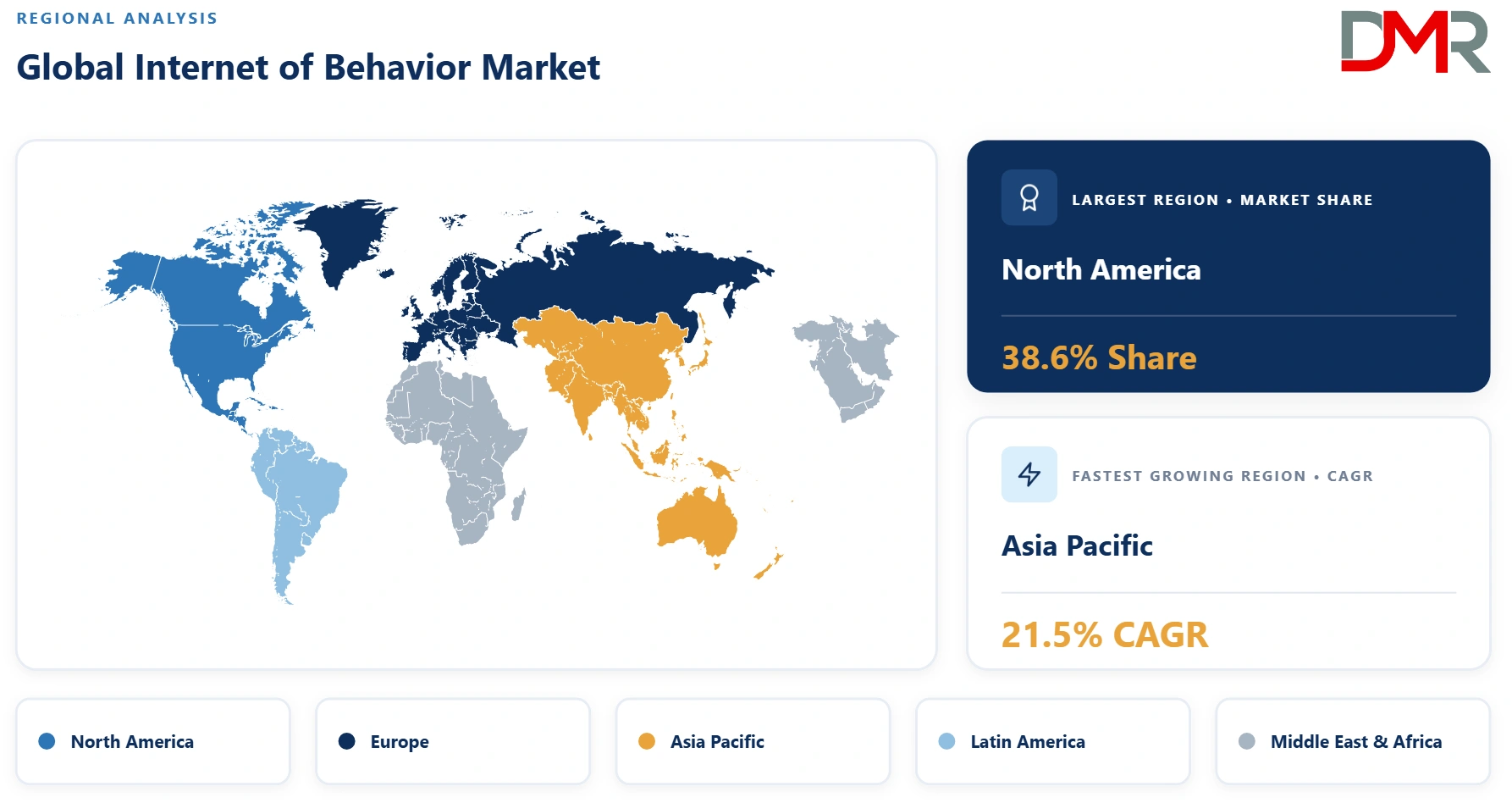
North America leads the internet of behavior market with a 38.6% share in 2026, while Asia Pacific is projected to grow at a 21.5% CAGR from 2027 to 2035.
Region with the Largest Revenue Share
North America accounted for 38.6% of global revenue in 2026, supported by the concentration of leading cloud, analytics and customer platform vendors, high digital advertising and e-commerce spending, and early adoption of behavioral biometrics in banking. The United States dominates regional sales, while Canada adds steady demand from banks, retailers and telecom operators. A patchwork of state privacy laws shapes data practices, but large enterprise budgets sustain growth. The region should keep the largest share despite slower expansion than emerging markets.
Region with the Highest CAGR
Asia Pacific is projected to grow at a 21.5% CAGR from 2027 to 2035, the fastest of any region. China leads regional demand through super-app and e-commerce ecosystems operated by companies such as Alibaba and Tencent, while Japan and South Korea favor advanced personalization in retail, gaming and telecom. India and Australia are expanding quickly as digital payments, mobile commerce and fintech reach new users. Rising smartphone penetration, large digital-native populations and growing insurance and healthcare digitization support adoption through 2035.
Regional Analysis
Europe Internet of Behavior Market
Europe is a mature and heavily regulated market led by Germany, the United Kingdom, France, Italy and Spain. Retailers, banks and telecom operators use behavioral analytics for personalization and fraud control, with strong demand for SAP, local software providers and global cloud platforms. GDPR, the ePrivacy rules and the EU AI Act raise compliance costs and rule out some practices, but they also favor vendors that can prove consent, explainability and data residency. Growth is steady, driven by privacy-preserving analytics, sovereign cloud options and fraud prevention under open banking and instant payment schemes.
ℹ
To learn more about this report –
Download Your Free Sample Report Here
Latin America Internet of Behavior Market
Latin America is an emerging market where fast-growing digital payments, mobile commerce and fintech adoption support demand for personalization and fraud analytics. Brazil and Mexico generate most regional revenue, with Chile, Colombia and Argentina contributing smaller volumes. Global cloud and software vendors compete with regional integrators and marketing technology specialists. Currency volatility, uneven data quality and limited analytics talent slow adoption, yet instant payment systems and expanding broadband are improving access. Growth is expected to be healthy from a small base, led by banking, retail and telecom.
Middle East & Africa Internet of Behavior Market
Middle East and Africa is a smaller but fast-modernizing market led by Saudi Arabia, the UAE and South Africa. National digital transformation programs, smart city projects and growing digital banking drive demand in the Gulf, while South Africa has a developed retail and financial services base adopting behavioral analytics. Data localization rules and a shortage of skilled staff shape deployments. Mobile-first populations and rapid growth in digital payments in other African markets create openings for cloud-delivered and mobile-based solutions.
By Region
North America
Europe
- Germany
- France
- The U.K.
- Italy
- Spain
- Rest of Europe
Asia-Pacific
- China
- Japan
- India
- Australia
- South Korea
- Rest of APAC
Latin America
- Mexico
- Brazil
- Rest of LATAM
Middle East & Africa
- Saudi Arabia
- The UAE
- South Africa
- Rest of MEA
Regulatory Landscape
Regulation shapes what behavioral data can be collected, how it can be used and which applications are allowed. The General Data Protection Regulation, the California Consumer Privacy Act and other US state privacy laws, China's Personal Information Protection Law and India's Digital Personal Data Protection Act set rules on consent, purpose limits, profiling and cross-border transfers, while biometric statutes such as Illinois' Biometric Information Privacy Act govern identifiers like typing and voice patterns. The EU AI Act bans manipulative or deceptive techniques, social scoring and emotion recognition in workplaces and education, with limited exceptions. The Digital Omnibus on AI, Regulation (EU) 2026/1744, entered into force on 27 July 2026 and postponed obligations for stand-alone high-risk AI systems to 2 December 2027. Companies that invest early in consent, explainability and governance can turn trust into a premium advantage.
Investment and White Space Analysis
Capital is flowing toward platforms that combine behavioral data with real-time AI decisioning. Visa agreed in August 2026 to acquire behavioral biometrics provider BioCatch for USD 2.4 billion in cash, and Salesforce agreed in October 2026 to acquire engagement platform Braze for about USD 5.66 billion in enterprise value, signaling strong appetite from payment networks and enterprise software leaders. White space remains in health and wellness programs, insurance-linked behavior products, small-business packaged analytics, privacy-preserving data collaboration and fast-growing digital payment markets in Asia and Latin America. Risks include tightening privacy and AI rules, consent and litigation exposure, model bias, dependence on large platform data and integration of acquired products. Investors should favor assets with proprietary first-party data, recurring revenue and demonstrated compliance.
Who are the Leading Companies in the Internet of Behavior Market?
The internet of behavior market is moderately fragmented, with global cloud and enterprise software leaders competing alongside analytics specialists, customer engagement platforms, fraud and identity vendors, and consulting firms. IBM, Microsoft, Google, Amazon, Salesforce, SAP, Oracle and Cisco offer broad analytics, AI and customer platforms, while Adobe, Braze, Twilio, Qualtrics and Medallia focus on engagement and experience data. Fraud and identity specialists such as BioCatch and Experian supply behavioral risk signals, and Accenture, Cognizant and other integrators deliver deployment services.
- IBM Corporation (Armonk, US): Enterprise analytics, AI and hybrid cloud provider with strong data governance and industry consulting capabilities used to deploy behavioral analytics in regulated sectors.
- Microsoft Corporation (Redmond, US): Supplies Azure cloud and AI services, Azure OpenAI and Dynamics 365 customer data and insight tools that underpin behavioral analytics for large enterprises.
- Salesforce, Inc. (San Francisco, US): Customer 360, Marketing Cloud and Agentforce provider building out real-time behavioral decisioning through 2026 agreements to acquire Braze and Listen Labs.
- SAP SE (Walldorf, Germany): Offers customer experience suites and Business Data Cloud, strengthened by its 2026 acquisition of Reltio, for analytics on unified customer data.
- Alphabet Inc. (Mountain View, US): Combines Google Cloud analytics and AI, advertising measurement and Android and wearable ecosystems that generate large volumes of consented behavioral signals.
Some of the prominent players in the Global Internet of Behavior Market are:
- IBM Corporation
- Microsoft Corporation
- Alphabet Inc. (Google)
- Amazon Web Services, Inc.
- Salesforce, Inc.
- SAP SE
- Oracle Corporation
- Cisco Systems, Inc.
- Accenture plc
- Adobe Inc.
- Meta Platforms, Inc.
- Alibaba Group Holding Limited
- Tencent Holdings Limited
- Baidu, Inc.
- SAS Institute Inc.
- Palantir Technologies Inc.
- Teradata Corporation
- Snowflake Inc.
- Databricks, Inc.
- Twilio Inc. (Segment)
- Qualtrics International Inc.
- Medallia, Inc.
- Braze, Inc.
- Amplitude, Inc.
- Mixpanel, Inc.
- Sprinklr, Inc.
- HubSpot, Inc.
- NICE Ltd.
- Verint Systems Inc.
- Genesys Cloud Services, Inc.
- Informatica Inc.
- Tealium Inc.
- LiveRamp Holdings, Inc.
- Experian plc
- Mastercard Incorporated
- BioCatch Ltd.
- Apple Inc.
- Samsung Electronics Co., Ltd.
- Garmin Ltd.
- Cognizant Technology Solutions Corporation
- Other Key Players
Recent Developments
- In July 2026, the Digital Omnibus on AI (Regulation (EU) 2026/1744) entered into force, postponing obligations for stand-alone high-risk AI systems to 2 December 2027 while keeping bans on practices such as emotion recognition in workplaces and education.
- In August 2026, Visa signed a definitive agreement to acquire behavioral biometrics provider BioCatch for USD 2.4 billion in cash, with closing expected by the end of Visa's fiscal second quarter of 2027, subject to regulatory approvals.
- In October 2026, Salesforce signed a definitive agreement to acquire Listen Labs, an AI-powered customer research and human simulation platform that builds simulations grounded in real customer behavior.
- In October 2026, Salesforce agreed to acquire customer engagement platform Braze for about USD 5.66 billion in enterprise value, adding real-time behavioral personalization and AI decisioning to Marketing Cloud, with closing expected in its fiscal year 2028.
Internet of Behavior Market Report Scope and Research Methodology
Market definition: The internet of behavior covers platforms, software and services that collect behavioral data from digital interactions, connected devices and transactions, analyze it with AI and behavioral science, and use it to predict, influence or authenticate behavior. It excludes general business intelligence tools, raw data storage and underlying IoT hardware not applied to behavioral analysis.
Methodology: Dimension Market Research anchored the headline estimate to published industry sizing for the internet of behavior, then built segment and regional splits from company revenues, product mix and adoption patterns for each application, component, deployment mode, enterprise size and industry vertical, and cross-checked the result top-down against wider analytics, customer experience and fraud prevention spending. Published estimates for this market vary widely with scope, so figures here reflect the definition above. Forecasts apply segment-level growth assumptions for 2026-2035 and are reviewed at each report update.
Internet of Behavior Market Report Details
| Report Characteristics |
Details |
| Market Size (2026) |
USD 8.7 Billion |
| Forecast Value (2035) |
USD 40.7 Billion |
| CAGR (2027-2035) |
18.7% |
| Historical Data |
2021–2026 |
| Forecast Data |
2027–2035 |
| Base Year |
2026 |
| Estimate Year |
2027 |
| Segments Covered |
By Component, By Deployment Mode, By Enterprise Size, By Application, By Industry Vertical |
| Regional Coverage |
North America (The US, Canada); Europe (Germany, France, The UK, Italy, Spain, Rest of Europe); Asia Pacific (China, Japan, India, Australia, South Korea, Rest of APAC); Latin America (Mexico, Brazil, Rest of LATAM); Middle East & Africa (Saudi Arabia, The UAE, South Africa, Rest of MEA) |
Frequently Asked Questions
How big is the Internet of Behavior Market in 2026?
▾ The global internet of behavior market is valued at about USD 8.7 billion in 2026 and is projected to reach USD 40.7 billion by 2035.
What is the growth rate of the Internet of Behavior Market?
▾ The market is expected to grow at a CAGR of 18.7% from 2027 to 2035, driven by personalization demand, AI and big data analytics, connected devices and behavioral fraud prevention.
Which region leads the Internet of Behavior Market?
▾ North America leads with a 38.6% share in 2026, while Asia Pacific is the fastest-growing region at a 21.5% CAGR over 2027 to 2035.
Which component dominates the Internet of Behavior Market?
▾ Solutions dominate the component segment with a 64.8% share in 2026.
Which application is growing fastest in the Internet of Behavior Market?
▾ Health and Wellness Behavior Monitoring is the fastest-growing application at a 23.9% CAGR from 2027 to 2035, as wearables, digital therapeutics and insurer programs scale.
Who are the key players in the Internet of Behavior Market?
▾ Key players include IBM, Microsoft, Google, Amazon, Salesforce, SAP, Oracle, Cisco and Accenture.
What are the main challenges facing the Internet of Behavior Market?
▾ Main challenges include privacy and consent obligations, AI and biometric regulation, data quality and integration complexity, ethical concerns about influencing behavior and a shortage of analytics skills.