Market Snapshot
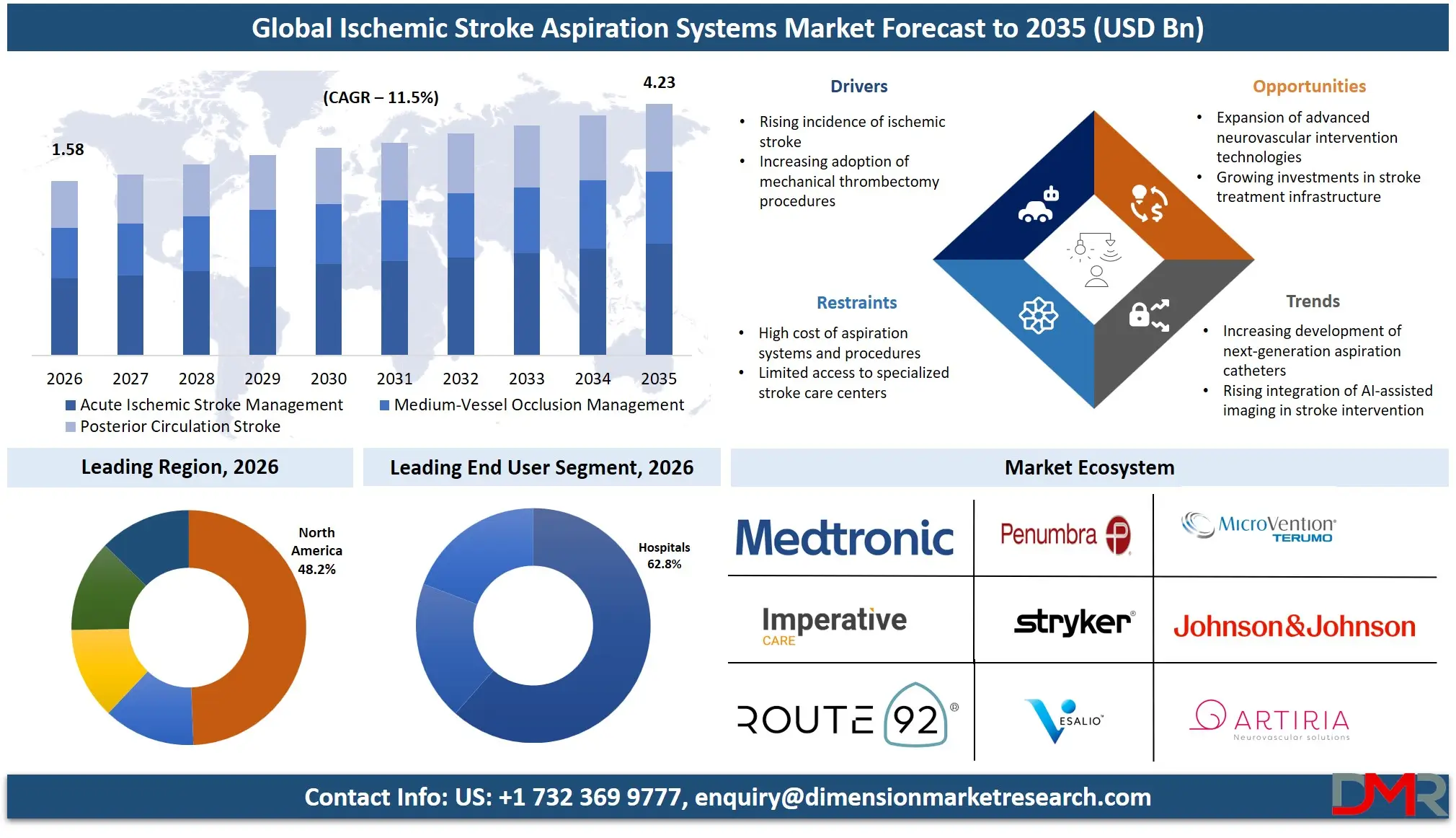
- The market size is USD 1.42 Billion in 2025, reached USD 1.58 Billion in 2026, and is projected to hit USD 4.23 Billion by 2035 at a CAGR of 11.5%.
- Direct Aspiration Solutions leads the By Technology Platform segment with a 58.9% share in 2026.
- Hospitals dominate the By End User segment with a 62.8% share in 2026.
- Aspiration Catheter Systems hold a 42.5% share within the By Product Category segment in 2026.
- Acute Ischemic Stroke Management accounts for a 50.3% share of the By Clinical Application segment in 2026.
- North America holds the dominant regional position with a 48.2% share in 2026.
Market Overview
The Global Ischemic Stroke Aspiration Systems Market covers mechanical thrombectomy devices used to remove clots from occluded cerebral arteries in acute ischemic stroke patients. This includes aspiration catheters, access and navigation devices, aspiration pump systems, and procedure-support components. The market excludes pharmacological thrombolysis drugs, diagnostic imaging systems, and post-acute rehabilitation products. As reported by clinical research published in 2025, mechanical thrombectomy achieved successful recanalization in 72.3% of acute ischemic stroke patients across Southeast Asian centers, confirming procedural efficacy as the benchmark that drives device adoption globally.
ℹ
To learn more about this report –
Download Your Free Sample Report Here
The market sits within the broader neurovascular intervention space, where procedural volumes are shaped by stroke center accreditation rates, neurointerventionalist availability, and time-sensitive treatment protocols. Procurement decisions at hospital level are being restructured by a shift from multi-device workflows to single-vendor reperfusion systems. Operators and hospital administrators now evaluate device platforms on procedural speed as a direct patient outcomes metric, not merely as a purchasing convenience.
Market Size and Forecast
The Global Ischemic Stroke Aspiration Systems Market size is estimated at USD 1.58 Billion in 2026 from USD 1.42 Billion in 2025, and is projected to reach USD 4.23 Billion by 2035, exhibiting a CAGR of 11.5% during the forecast period.
The forecast reflects a market where clinical validation is accelerating procedural adoption at a pace that equipment procurement cycles are beginning to match. The Imperative Trial enrolled patients across 26 U.S. medical centers to evaluate the 0.088" Zoom System, and the AHA/ASA's formal endorsement of extended treatment windows up to 9 hours expands the eligible patient population per stroke event. Manufacturers already holding broad regulatory portfolios are positioned to capture this volume expansion faster than new entrants building regulatory dossiers from scratch. As per SEC filings, Penumbra global thrombectomy revenue reached USD 253.9 million in Q1 2026, with revenue growing 12.1% year-on-year, demonstrating that near-term volume growth is already materializing ahead of full-cycle procurement expansions.
Penumbra, Inc. held 21 FDA 510(k) clearances in neurovascular thrombectomy as of May 2026, per the FDA TPLC database. That breadth of clearances gives multi-clearance holders a structural speed advantage as stroke centers expand formularies. Penumbra's full year 2025 annual financial results, reported February 25, 2026, confirmed the trajectory of international market penetration that underpins the medium-term forecast.
Technology Platform Analysis
Direct Aspiration Solutions led the technology platform segment with a 58.9% share in 2026.
Direct aspiration's dominance reflects a clinical preference for approaches that remove clots without deploying a stent retriever, reducing procedural steps and device-to-vessel contact. Operators prioritize aspiration-first protocols because they shorten procedure time and reduce the risk of clot fragmentation during retrieval. The 58.9% share shows that the majority of stroke centers have already standardized around direct aspiration as their default approach.
Combination and stent retriever-assist platforms hold the remaining share and serve complex cases where aspiration alone fails. Combination systems are growing as a rescue pathway rather than a primary technique, which limits their independent market expansion. Stent retriever platforms face pressure as aspiration-first protocols prove equivalent or superior outcomes in large-vessel occlusion patients, accelerating the share shift toward direct aspiration architectures.
Product Category Analysis
With a 42.5% share in 2026, Aspiration Catheter Systems outpaced all other product category groups.
Aspiration catheters sit at the center of every thrombectomy procedure regardless of technique, making them the highest-volume consumable in the workflow. The 42.5% share reflects both clinical necessity and the frequency of catheter replacement per procedure across high-volume stroke centers. Every new first-pass protocol iteration requires a catheter, not a pump or access device, which insulates catheter revenue from competitive substitution.
Aspiration pump systems and access devices collectively account for the balance of product category revenue. Pump systems face slower replacement cycles as capital equipment, compressing their revenue contribution relative to catheters. Navigation and access devices are expanding as new-generation super-bore catheters require more precise delivery architecture, but they remain secondary procurement decisions following catheter selection.
End User Analysis
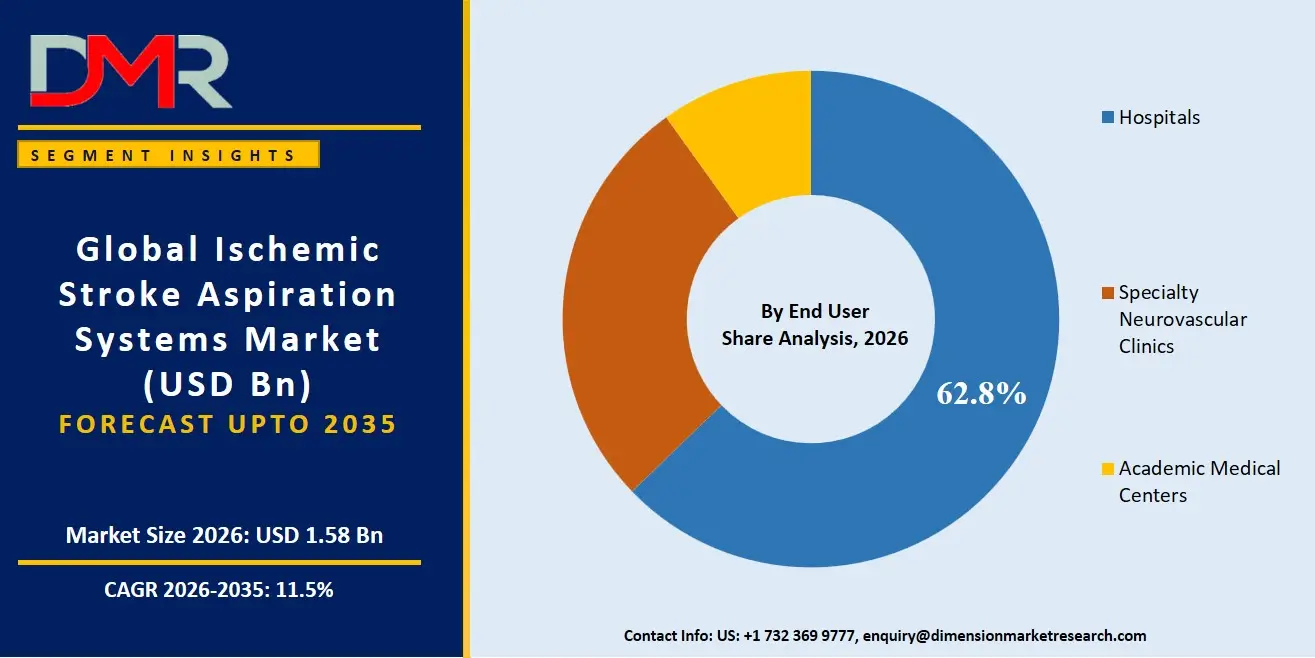
Hospitals accounted for 62.8% of end user demand in 2026, the highest of any category.
ℹ
To learn more about this report –
Download Your Free Sample Report Here
Hospitals dominate because comprehensive stroke centers and thrombectomy-capable stroke centers concentrate procedure volume within credentialed facilities that meet time-to-treatment benchmarks. The 62.8% share underscores that aspiration systems are inpatient emergency devices. Ambulatory or outpatient deployment has no clinical pathway for acute ischemic stroke, structurally protecting hospital-channel revenue from any shift to alternate care settings.
Specialty neurovascular clinics and academic medical centers represent the remaining end-user base. Academic centers drive adoption of next-generation platforms through investigator-initiated trials and protocol development, giving them disproportionate influence over formulary decisions at community hospitals. Specialty clinics are expanding in markets where stroke center accreditation criteria are broadening, though their procedure volumes remain a fraction of those recorded at comprehensive hospital networks.
Clinical Application Analysis
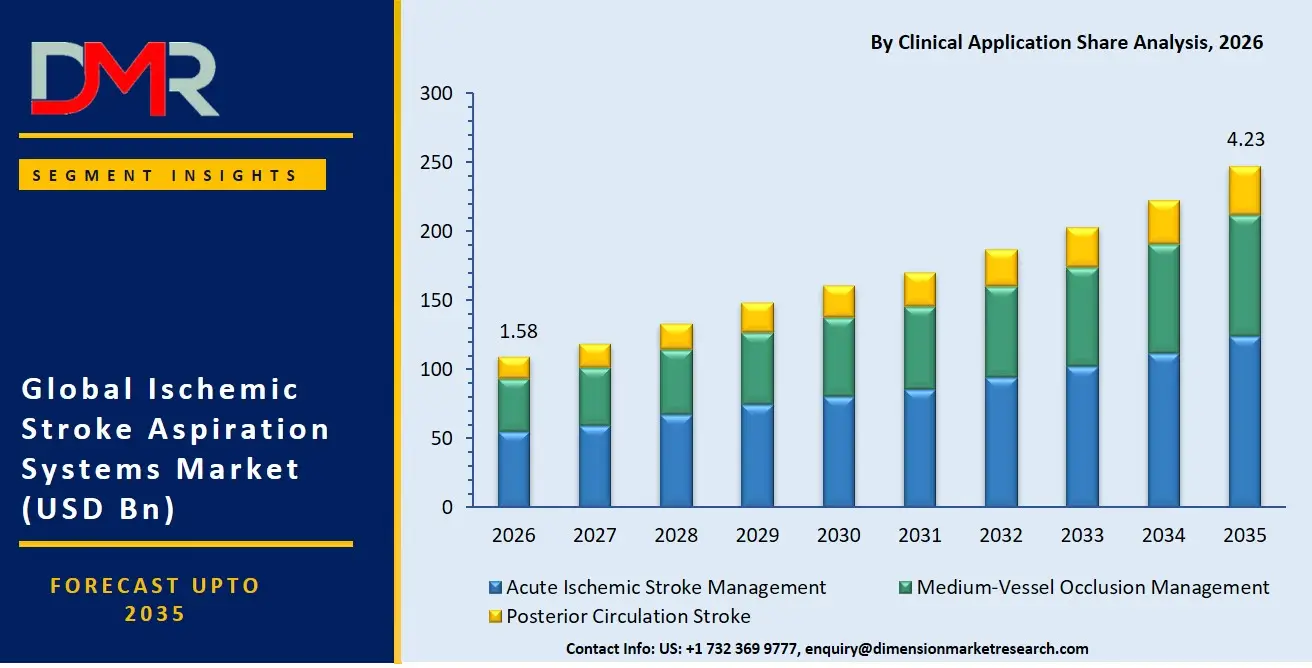
Acute Ischemic Stroke Management captured 50.3% of the clinical application segment in 2026, ahead of all rivals.
ℹ
To learn more about this report –
Download Your Free Sample Report Here
Acute large-vessel occlusion cases define the primary use case for aspiration systems, where time-critical intervention directly determines patient survival and disability outcomes. The 50.3% share reflects the concentration of device utilization in emergency protocols rather than elective or adjunctive procedures. Stroke severity scoring tools and rapid imaging pathways are increasing the proportion of patients who qualify for thrombectomy, which expands procedure volumes without requiring changes to device design.
Medium-vessel occlusion management and posterior circulation stroke represent the emerging clinical application categories. Both are underserved by current large-bore architectures and require miniaturized catheter designs to reach distal or tortuous vessel segments. Procedural volume in these categories will scale as catheter tip engineering advances and clinical protocols mature, eventually redistributing clinical application share away from large-vessel concentration.
Regional Analysis
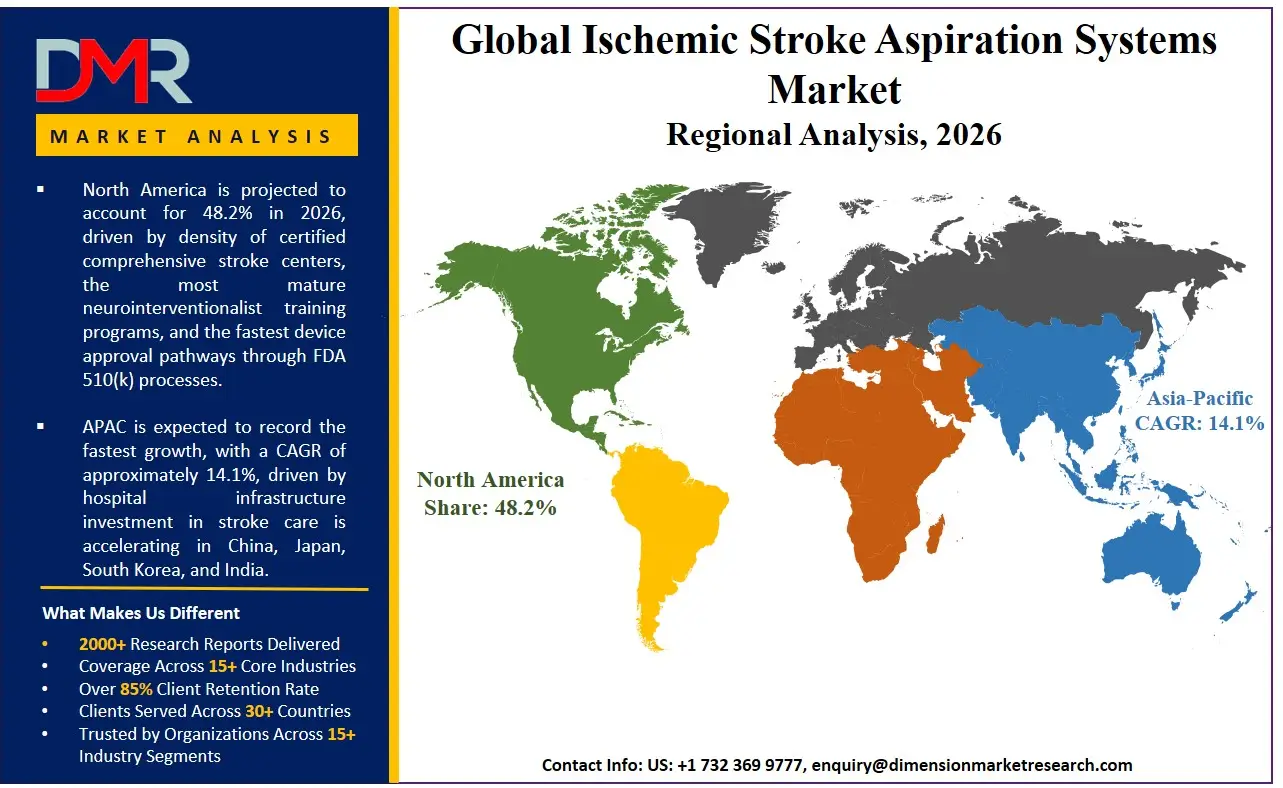
North America held a 48.2% share in 2026, valued at USD 684 Million.
ℹ
To learn more about this report –
Download Your Free Sample Report Here
North America leads because the United States has the highest density of certified comprehensive stroke centers, the most mature neurointerventionalist training programs, and the fastest device approval pathways through FDA 510(k) processes. The 48.2% regional share reflects years of infrastructure investment in time-sensitive stroke care networks, where hospitals are evaluated and reimbursed based on door-to-reperfusion metrics. Reimbursement frameworks that tie payment to procedural efficiency incentivize hospitals to adopt the fastest, most validated aspiration platforms available.
Europe holds the second-largest regional position, supported by expanding CE Mark approvals that are opening previously inaccessible hospital formulary slots for newer platforms. Asia Pacific is the fastest-growing region, where hospital infrastructure investment in stroke care is accelerating in China, Japan, South Korea, and India. Latin America and the Middle East and Africa remain early-stage markets where device access is constrained by reimbursement gaps and neurointerventionalist shortages, but both regions represent meaningful long-run volume as stroke care accreditation programs expand beyond urban centers.
Key Regions and Countries
North America
Europe
- Germany
- France
- The UK
- Spain
- Italy
- Rest of Europe
Asia Pacific
- China
- Japan
- South Korea
- India
- Australia
- Rest of APAC
Latin America
- Brazil
- Mexico
- Rest of Latin America
Middle East & Africa
- GCC
- South Africa
- Rest of MEA
Market Dynamics
Super-Bore Architectures and Clinical Evidence Accelerate First-Pass Adoption
Johnson and Johnson MedTech's launch of the 0.092" CEREGLIDE 92 and Imperative Care's FDA clearance for the 0.088" Zoom System mark a structural shift toward super-large bore catheter architectures. Larger bore diameters generate greater vacuum force, translating directly to higher first-pass recanalization rates in complex clot morphologies. Findings from PMC confirm that functional independence was achieved in 48.3% of mechanical thrombectomy patients in 2025, a metric that hospital procurement teams and payer medical directors treat as direct evidence of procedural value. Research by medRxiv published April 28, 2026 further reported a 50.7% first-pass effect using Carrier delivery-assist catheters across a 211-patient multicenter study, validating that catheter-level engineering improvements translate to measurable outcomes at scale.
The Imperative Trial reported an 83% success rate for first-pass aspiration. That figure gives hospital formulary committees a defensible clinical benchmark when approving capital spend on next-generation platforms. Manufacturers that can attach level-one clinical evidence to specific bore sizes gain a procurement advantage that is difficult for lower-evidence competitors to overcome, regardless of price.
Hemorrhagic Risk and Vascular Tortuosity Limit Device Reach
Symptomatic intracranial hemorrhage remains the most consequential safety concern for super-bore aspiration systems. The FDA mandated an independent safety board to adjudicate the 0.088" Imperative Trial, signaling that regulatory acceptance of larger bore architectures depends on demonstrated hemorrhagic safety profiles. Research by medRxiv reported parenchymal hematoma complications in 11.8% of patients in the Carrier delivery-assist study, a rate that hospital ethics committees and payer medical directors will examine before endorsing broad protocol adoption.
Complex vascular anatomy presents a separate barrier. Conventional large-bore devices fail to navigate extreme tortuosity, which excludes a meaningful subset of stroke patients from aspiration-first approaches. Route 92 Medical's ongoing SUMMIT MAX Trial is designed to prove that alternative anatomical safety profiles exist for these patient populations. Until that data matures, operators in high-tortuosity cohorts rely on workarounds that reduce procedural efficiency and extend procedure time.
European Approvals and Distal Vessel Expansion Open New Revenue Pools
Vesalio's CE Mark for aspiration devices opens European revenue streams that were previously inaccessible, and CE-marked devices can now be positioned on hospital formularies across multiple high-volume European markets simultaneously. MicroVention's SOFAST Study achieving 75% revascularization validates aspiration-first approaches in clinical settings beyond North America, strengthening the commercial argument for European stroke centers investing in dedicated aspiration platforms.
J&J MedTech's expansion into distal medium-vessel occlusion with the Cereglide 42 and 57 systems addresses a patient population previously excluded from thrombectomy protocols entirely. Imperative Care's TRX Tip modification yields a 15% greater clot contact zone without requiring an entirely new catheter platform. Both developments signal that the next revenue expansion layer in Ischemic Stroke Aspiration Systems Market lies in serving smaller vessel anatomies, not in further optimizing large-vessel systems that are already well-addressed.
Market Trends
Single-Vendor Reperfusion Systems Replace Multi-Device Workflows
The market is moving toward complete, single-vendor reperfusion platforms that consolidate what were previously multi-manufacturer workflows into one system. MicroVention's repositioning of the SOFIA 6F Aspiration System as a primary technique rather than a salvage tool reflects a protocol-level shift that changes how frequently catheters are ordered and replaced. The Zoom System's median groin-to-reperfusion time of 19 minutes, as validated by the Imperative Trial, gives procurement teams a hard clinical metric to justify vendor consolidation decisions. Manufacturers with deep, integrated product portfolios gain more from this trend than single-product players, because consolidation decisions reward breadth of platform coverage over individual device performance.
Market Competition Overview
The Ischemic Stroke Aspiration Systems market is moderately consolidated, with a small number of large medical device corporations and a growing tier of specialized neurovascular players competing for formulary position. Scale confers advantages in clinical evidence generation, regulatory portfolio breadth, and hospital system contracting, which raises the effective entry barrier for new participants. Data published by Stryker Corporation confirms MedSurg and Neurotechnology segment net sales reached USD 13.5 billion in full year 2024, reflecting the resource base that large incumbents deploy across neurovascular product lines. Organic net sales in that segment increased 11.1% the same year, as reported by Stryker Corporation, showing that established players are still expanding volume through existing channels rather than ceding share to challengers.
Specialized neurovascular entrants compete on clinical performance metrics rather than portfolio breadth. First-pass recanalization rates, groin-to-reperfusion time, and hemorrhagic complication rates have become the primary competitive differentiators as hospitals move toward evidence-based formulary selection. Companies without published multicenter clinical data face structural disadvantages in hospital procurement processes that now require peer-reviewed performance validation before granting product access.
Company Profiles
Penumbra, Inc. holds the strongest specialized position in the ischemic stroke aspiration systems market, built on the broadest regulatory portfolio among dedicated neurovascular players. As reported by Penumbra, Inc. on February 25, 2026, global thrombectomy revenue reached USD 947.9 million in full year 2025, with U.S. Thrombectomy segment revenue growing 19.3% the same year, driven by stroke center network expansion and new large-bore catheter launches. That combination of domestic channel depth and international penetration creates a compounding revenue base that pure-play competitors and diversified medical device companies both struggle to replicate at equivalent scale.
Stryker Corporation competes through its neurovascular division within a much larger MedSurg and Neurotechnology segment, giving it procurement leverage across multiple hospital departments simultaneously. Stryker's strategy centers on bundled contracting, where neurovascular device access is negotiated alongside broader surgical and imaging equipment deals. That approach protects existing neurovascular market share by embedding aspiration systems into multi-year hospital agreements, though it also means neurovascular performance is partially obscured within aggregate segment reporting rather than disclosed as a standalone competitive signal.
Key Players
- Penumbra, Inc.
- Stryker Corporation
- Johnson & Johnson MedTech
- Medtronic
- MicroVention (Terumo)
- Imperative Care
- Route 92 Medical
- Vesalio
- Artiria Medical
Supply Chain and Value Chain Analysis
The value chain for ischemic stroke aspiration systems flows from specialty polymer and metal component suppliers through catheter manufacturing, sterilization, and regulatory submission, before reaching hospital distribution networks and the catheter lab. Maximum value is created at the catheter design and clinical validation stage, where intellectual property in bore geometry, tip architecture, and aspiration force characteristics translates directly into first-pass performance differentials that hospitals pay a premium to access. Raw material concentration in specialty polymers and braided metal shafts introduces supply risk for manufacturers dependent on single-source suppliers for large-bore catheter construction.
Distribution complexity is highest in markets where hospital formulary approval requires separate country-level regulatory filings alongside commercial agreements. Manufacturers operating across both FDA and CE-regulated markets carry higher compliance infrastructure costs but access a combined patient population that single-jurisdiction players cannot reach. The bottleneck for volume scaling is not manufacturing capacity but neurointerventionalist availability and stroke center certification rates, both of which constrain procedure volume independent of device supply.
Regulatory Landscape
FDA 510(k) clearance governs device entry in the United States, where the substantial equivalence pathway allows manufacturers to bring improved aspiration catheter designs to market without full PMA submission, provided predicate devices exist. The FDA's requirement for an independent safety board to adjudicate the Imperative Trial signals that super-bore architectures above 0.085" now face heightened scrutiny, effectively creating a de facto safety evidence threshold for next-generation large-bore devices. Manufacturers planning bore size increases above this threshold should budget for extended review timelines and independent safety adjudication as standard regulatory cost.
CE Mark certification under the EU Medical Device Regulation framework governs European market access, where clinical evidence requirements have become more stringent following MDR implementation. Vesalio's CE Mark approval and Artiria Medical's Smartguide 014 certification confirm that the pathway remains open for specialized neurovascular entrants willing to meet MDR clinical data standards. Dual FDA and CE clearance holders hold a durable market access advantage in the two largest regulated markets, and that advantage compounds as European stroke center networks expand their formulary scope to include next-generation aspiration platforms.
Investment and White Space Analysis
Investment is flowing toward super-bore catheter development, first-pass clinical evidence generation, and distal medium-vessel occlusion platforms. The distal MeVO segment represents the clearest white space in the current market structure. Large-bore systems address well-characterized large-vessel occlusion patients, but the MeVO patient population has no established standard-of-care device. J&J MedTech's Cereglide 42 and 57 launches are first-mover attempts in this space, but the clinical protocol infrastructure for MeVO thrombectomy is still forming, leaving room for competing platforms that can combine miniaturized catheter delivery with high first-pass performance data.
Asia Pacific presents a regional white space where procedure volume growth is outpacing device market development. Stroke center accreditation programs in China, India, and South Korea are expanding the pool of thrombectomy-capable facilities, but device penetration rates remain well below North American levels. New entrants with CE Mark or FDA clearance that invest early in Asia Pacific distribution infrastructure will gain network effects before the market reaches the consolidation phase that North America has already entered. The combination of growing stroke center density and low current penetration makes Asia Pacific the highest-return near-term geographic investment target in Ischemic Stroke Aspiration Systems Market.
Key Market Segments
By Technology Platform
- Direct Aspiration Solutions
- Combination Systems
- Stent Retriever-Assist Platforms
By Product Category
- Aspiration Catheter Systems
- Aspiration Pump Systems
- Access and Navigation Devices
- Procedure-Support Components
By End User
- Hospitals
- Specialty Neurovascular Clinics
- Academic Medical Centers
By Clinical Application
- Acute Ischemic Stroke Management
- Medium-Vessel Occlusion Management
- Posterior Circulation Stroke
Recent Developments
- February 17, 2026: Medtronic. Financial Results. Neuroscience Portfolio revenue totaled USD 2.558 billion in Q3 fiscal year 2026, as per SEC filings.
- April 28, 2026: Carrier (medRxiv). Clinical Study Publication. Multicenter study of 211 patients reported a 50.7% first-pass effect using Carrier delivery-assist catheters, with parenchymal hematoma complications in 11.8% of patients.
- May 25, 2026: Penumbra, Inc. Regulatory Milestone. FDA TPLC database confirmed 21 FDA 510(k) clearances in neurovascular thrombectomy, the broadest clearance portfolio among specialized neurovascular players.
Report Details
| Report Characteristics |
| Market Value (2025) |
USD 1.42 Billion |
| Market Value (2026) |
USD 1.58 Billion |
| Forecast Revenue (2035) |
USD 4.23 Billion |
| CAGR (2026–2035) |
11.5% |
| Base Year for Estimation |
2025 |
| Historic Period |
2020 – 2024 |
| Forecast Period |
2026 – 2035 |
| Report Coverage |
Revenue Forecast, Market Dynamics, Competitive Landscape, Recent Developments |
| Segments Covered |
By Technology Platform (Direct Aspiration Solutions, Combination Systems, Stent Retriever-Assist Platforms), By Product Category (Aspiration Catheter Systems, Aspiration Pump Systems, Access and Navigation Devices, Procedure-Support Components), By End User (Hospitals, Specialty Neurovascular Clinics, Academic Medical Centers), By Clinical Application (Acute Ischemic Stroke Management, Medium-Vessel Occlusion Management, Posterior Circulation Stroke) |
| Regional Analysis |
North America – US and Canada; Europe – Germany, France, The UK, Spain, Italy, and Rest of Europe; Asia-Pacific – China, Japan, South Korea, India, Australia, and Rest of APAC; Latin America – Brazil, Mexico, and Rest of Latin America; Middle East & Africa – GCC, South Africa, and Rest of MEA |
| Competitive Landscape |
Penumbra, Inc., Stryker Corporation, Johnson & Johnson MedTech, Medtronic, MicroVention (Terumo), Imperative Care, Route 92 Medical, Vesalio, Artiria Medical |
| Customization Scope |
Customization for segments and region or country level will be provided. Additional customization can be done based on requirements. |
| Purchase Options |
Three license options: Single User License, Multi-User License (Up to 5 Users), Corporate Use License (Unlimited Users and Printable PDF). |
Frequently Asked Questions
What is the biggest investment opportunity in Ischemic Stroke Aspiration Systems Market?
▾ Distal medium-vessel occlusion represents the clearest underserved segment, where no established standard-of-care device exists. Asia Pacific offers the highest-return geographic entry point, combining expanding stroke center accreditation with device penetration rates well below North American levels. Both opportunities are accessible to manufacturers holding dual FDA and CE clearances.
Who are the top companies in Ischemic Stroke Aspiration Systems Market?
▾ Penumbra, Inc. and Stryker Corporation hold the leading positions, with Penumbra operating as the most specialized neurovascular player and Stryker competing through bundled contracting within a broader MedSurg and Neurotechnology division. Johnson and Johnson MedTech, Medtronic, MicroVention, and Imperative Care compete for the remaining market share.
Which segment is growing fastest in Ischemic Stroke Aspiration Systems Market and why?
▾ Medium-vessel occlusion management is the fastest-growing clinical application segment as catheter miniaturization extends thrombectomy protocols to patient populations previously excluded from intervention. Direct Aspiration Solutions, holding a 58.9% technology platform share in 2025, continues to expand as aspiration-first protocols replace multi-device workflows across certified stroke centers.
Which region is growing fastest in Ischemic Stroke Aspiration Systems Market and why?
▾ Asia Pacific is the fastest-growing region, where hospital infrastructure investment in stroke care is accelerating across China, India, South Korea, and Japan. Stroke center accreditation programs are expanding the pool of thrombectomy-capable facilities in these markets, pulling forward device demand that was previously constrained by both procedural infrastructure gaps and limited specialist availability.
What is the biggest challenge holding Ischemic Stroke Aspiration Systems Market back?
▾ Hemorrhagic complication risk associated with super-bore architectures is the primary clinical barrier to broad adoption. Parenchymal hematoma complications in a meaningful proportion of patients, combined with mandatory independent safety adjudication requirements for next-generation large-bore devices, extend the timeline from product launch to widespread protocol adoption.