Global IT Financial Management Tool Market Snapshot
- Global IT Financial Management Tool Market Size in 2026: USD 1.6 billion.
- Global IT Financial Management Tool Market Size in 2035: USD 3.9 billion.
- Global CAGR from 2027 to 2035: 10.3%.
- Software is the leading component segment in 2026, accounting for an estimated 72% market share.
- Cloud-Based is the leading deployment mode segment in 2026, accounting for an estimated 61% market share.
- IT Cost Management and Transparency is the leading functionality segment in 2026, accounting for an estimated 31% market share.
- Large Enterprises are the leading organization-size segment in 2026, accounting for an estimated 58% market share.
- IT and Telecommunications is the leading end-user segment in 2026, accounting for an estimated 27% market share.
- Cloud-Based deployment is the fastest-growing deployment segment, with an estimated CAGR of 13.2%.
- Asia-Pacific is the fastest-growing regional market, with an estimated CAGR of 12.6%.
- North America is the leading region in 2026, accounting for an estimated 43% market share.
What is the IT Financial Management Tool, and what is its Market Size?
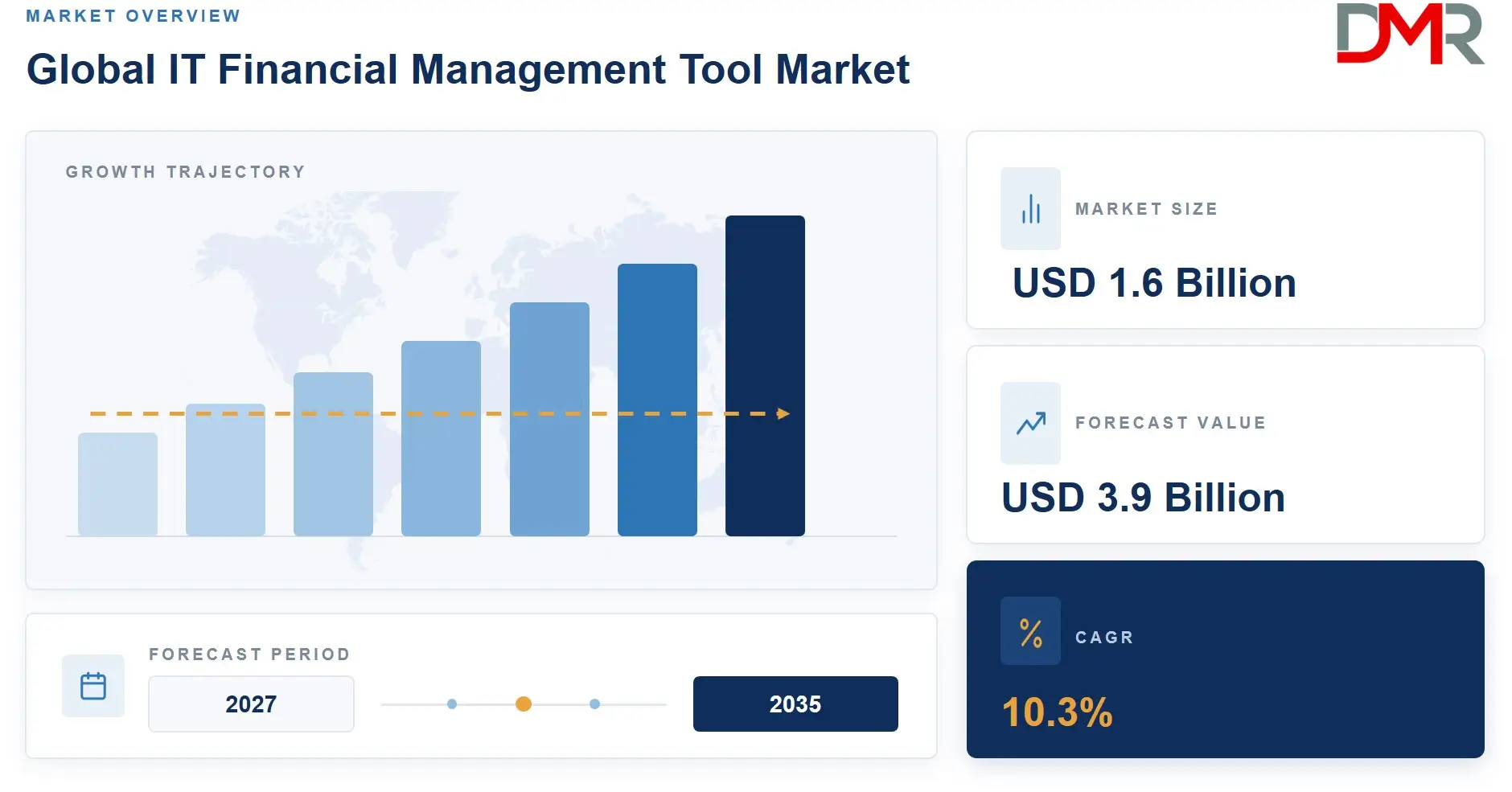
The Global IT Financial Management Tool Market size is projected to be valued at USD 1.6 billion in 2026 and is anticipated to reach approximately USD 3.9 billion by 2035, growing at a CAGR of 10.3% during the forecast period.
ℹ
To learn more about this report –
Download Your Free Sample Report Here
The Global IT Financial Management Tool Market includes software platforms and associated services designed to monitor, manage, allocate, forecast, and optimize enterprise information technology expenditure. These solutions help organizations gain visibility into technology spending across cloud infrastructure, software licensing, IT services, data centers, enterprise applications, and technology procurement. IT financial management platforms enable finance departments, CIOs, CTOs, and procurement teams to coordinate technology budgets, monitor financial performance, and evaluate the return on IT investments.
Market growth is driven by increasing enterprise IT expenditure, growing adoption of cloud computing, expanding software subscription portfolios, and rising demand for financial transparency. Organizations are increasingly moving away from spreadsheet-based financial management toward automated platforms that provide centralized reporting, cost allocation, and predictive budgeting. The growing complexity of hybrid and multicloud environments is further increasing demand for specialized financial management capabilities.
The adoption of artificial intelligence, machine learning, and FinOps practices is also transforming the market. Enterprises are increasingly using intelligent analytics to identify unnecessary expenditure, forecast cloud costs, monitor technology investments, and improve resource utilization. The expansion of AI infrastructure and GPU-intensive workloads is creating additional demand for advanced cost monitoring and financial governance solutions.
North America is expected to remain the largest regional market due to mature enterprise software adoption, established technology vendors, and substantial cloud infrastructure investment. Asia-Pacific is anticipated to record the fastest growth, supported by enterprise digital transformation, expanding IT services industries, and increasing adoption of cloud-based financial management solutions.
Use Cases
- IT Budgeting and Financial Planning: ITFM platforms enable organizations to prepare technology budgets, monitor expenditure against financial targets, forecast future requirements, and identify budget deviations.
- Cloud Cost Optimization: Enterprises use ITFM solutions to monitor cloud consumption, identify inefficient infrastructure utilization, optimize computing resources, and manage multicloud expenditure.
- IT Cost Allocation and Chargeback: Organizations distribute infrastructure, application, and service costs across departments, projects, business units, and individual technology consumers.
- Software License and Vendor Management: Financial management tools monitor software contracts, licensing costs, renewal schedules, procurement expenditure, and vendor performance.
- IT Financial Reporting and Analytics: Centralized dashboards provide financial visibility into technology expenditure, budget performance, infrastructure costs, and business-unit spending patterns.
- Technology Investment Management: Enterprises evaluate technology investments, compare project costs, assess financial returns, and align IT expenditure with strategic business priorities.
Key Takeaways
- Market Value: The Global IT Financial Management Tool Market is estimated at USD 1.6 billion in 2026 and is projected to reach USD 3.9 billion by 2035.
- Market Growth: The market is expected to expand at a CAGR of 10.3% during 2027–2035, supported by increasing enterprise technology expenditure and cloud adoption.
- Technology Trends: AI-powered financial forecasting, automated expenditure classification, predictive analytics, cloud cost optimization, and FinOps integration are shaping product development.
- Market Drivers: Increasing IT spending, growing hybrid-cloud complexity, software subscription proliferation, and demand for technology cost transparency are supporting market expansion.
- Component Analysis: Software is anticipated to dominate the component segment with an estimated 72% market share in 2026, while services benefit from growing implementation and consulting requirements.
- Deployment Analysis: Cloud-Based deployment is expected to lead with a 61% share in 2026 and register the fastest growth, supported by scalability and subscription-based software adoption.
- Functionality Analysis: IT Cost Management and Transparency is projected to hold the largest functionality share, while Cost Allocation and Chargeback is expected to experience strong growth.
- Regional Analysis: North America is expected to lead with 43% of the global market in 2026, while Asia-Pacific is projected to be the fastest-growing region.
How AI/Gen AI is Transforming the IT Financial Management Tool Market?
Artificial intelligence is transforming the IT Financial Management Tool Market by enabling automated expenditure analysis, predictive budgeting, anomaly detection, and intelligent financial reporting. AI-powered platforms analyze historical spending patterns, cloud consumption, vendor contracts, and software licensing information to identify financial inefficiencies and recommend optimization strategies. Generative AI is also enabling natural-language interaction with financial dashboards, allowing executives and finance professionals to retrieve expenditure insights without complex manual reporting.
AI integration improves financial management efficiency by reducing manual reconciliation, accelerating budget preparation, and identifying unexpected spending. Predictive algorithms help organizations anticipate cloud expenditure, identify resource underutilization, and evaluate potential budget overruns. Automated recommendations also support better procurement decisions and improve financial accountability across departments.
The technology is encouraging vendors to transition from traditional IT expenditure reporting platforms toward intelligent financial management ecosystems. Companies are increasingly differentiating their solutions through AI-driven recommendations, automated FinOps capabilities, integration with enterprise financial systems, and real-time expenditure visibility. AI infrastructure cost management is emerging as an additional product opportunity as organizations expand GPU-based computing, generative AI applications, and machine learning workloads.
Key Drivers
Increasing Enterprise IT Expenditure and Demand for Cost Transparency
Increasing investments in cloud infrastructure, enterprise software, cybersecurity, data centers, and digital transformation are driving demand for IT Financial Management Tools. Organizations are managing increasingly complex technology environments involving multiple service providers, subscription-based software applications, and geographically distributed IT operations. These developments are increasing the need for centralized financial monitoring and expenditure allocation. ITFM platforms enable organizations to identify spending inefficiencies, monitor technology budgets, and align financial decisions with corporate objectives. Growing involvement of CFOs, CIOs, and procurement departments in technology investment decisions is further supporting adoption. Enterprises are increasingly treating technology expenditure as a strategic financial consideration, strengthening demand for specialized budgeting, forecasting, and reporting solutions.
Accelerating Cloud Adoption and FinOps Implementation
Increasing adoption of public cloud, private cloud, hybrid infrastructure, and multicloud environments is creating substantial demand for ITFM solutions. Consumption-based cloud pricing makes expenditure forecasting and resource allocation more complicated, particularly for enterprises operating across multiple cloud service providers. ITFM platforms incorporating FinOps capabilities enable organizations to monitor resource utilization, allocate cloud expenditure, and optimize infrastructure commitments. The expansion of artificial intelligence infrastructure is creating additional demand because GPU utilization, model training, and inference workloads introduce new technology cost variables. Organizations are increasingly integrating financial governance into cloud operations to improve cost efficiency and accountability across engineering, finance, and technology departments.
Restraints
High Implementation Costs and Integration Complexity
High implementation costs remain a significant restraint, particularly for small and medium-sized enterprises. Specialized ITFM platforms often require integration with ERP applications, procurement systems, cloud billing environments, IT service management tools, and enterprise data warehouses. Implementing these integrations requires technical expertise, financial data standardization, and organizational coordination. Additional expenses associated with consulting, customization, employee training, and ongoing maintenance can increase the total cost of ownership. Organizations with fragmented technology environments may also experience longer implementation periods. These challenges can discourage adoption among businesses with limited IT budgets and encourage continued reliance on spreadsheets or conventional accounting software.
Data Quality, Security, and Organizational Adoption Challenges
Data quality and security concerns can restrict the adoption of ITFM platforms. Organizations frequently maintain financial information across multiple systems with inconsistent cost classifications, incomplete vendor records, and fragmented cloud expenditure information. These issues can reduce the accuracy of financial reporting and cost allocation. Security requirements also influence deployment decisions because ITFM systems process sensitive financial information, vendor agreements, and infrastructure expenditure records. Furthermore, successful implementation requires cooperation between finance, IT, engineering, procurement, and business departments. Resistance to cost transparency and chargeback practices can delay implementation and reduce the effectiveness of financial management initiatives.
Growth Opportunities
AI-Powered Financial Planning and Predictive Analytics
Artificial intelligence is creating significant opportunities for ITFM vendors through automated financial classification, predictive budgeting, anomaly detection, and expenditure optimization. AI-powered platforms can analyze historical expenditure patterns, identify unusual cloud consumption, forecast future technology requirements, and recommend financial adjustments. Generative AI is also improving access to financial analytics through conversational interfaces and automated report generation. Growing enterprise investment in AI infrastructure is creating additional demand for GPU cost monitoring, model-level expenditure allocation, and AI investment return analysis. Vendors offering integrated predictive analytics and automated optimization capabilities are expected to gain opportunities among enterprises seeking more intelligent financial management systems.
Expansion into Mid-Market Enterprises and Emerging Economies
Increasing cloud adoption among medium-sized enterprises is creating opportunities for affordable and simplified ITFM platforms. Historically, specialized financial management solutions have been concentrated among large organizations with complex IT infrastructure and substantial technology budgets. However, growing SaaS adoption and subscription-based pricing are increasing the need for expenditure monitoring among smaller enterprises. Emerging economies, particularly India, China, Brazil, Saudi Arabia, and Southeast Asian countries, offer additional opportunities as organizations modernize enterprise infrastructure. Vendors can strengthen adoption through localized pricing, modular software, cloud-based subscriptions, simplified implementation, and partnerships with regional systems integrators.
Trends
Convergence of ITFM, FinOps, and Technology Business Management
The convergence of IT Financial Management, FinOps, Technology Business Management, and IT Asset Management is emerging as an important market trend. Enterprises are increasingly seeking integrated platforms that connect cloud infrastructure expenditure, software licensing, technology procurement, and application costs. These solutions provide consolidated financial visibility and improve collaboration between finance and technology departments. Standardized cloud cost reporting, automated allocation, and business-unit financial analytics are becoming important product capabilities. Vendors are increasingly developing platforms that connect operational technology consumption with financial performance and business value.
Increasing Adoption of Real-Time Financial Analytics and Automation
Enterprises are increasingly shifting from periodic financial reporting toward continuous technology expenditure monitoring. Automated data collection, real-time dashboards, predictive alerts, and intelligent expenditure recommendations are becoming important capabilities. Integration with cloud infrastructure, DevOps environments, procurement systems, and enterprise analytics applications is improving financial visibility throughout the technology lifecycle. Organizations are also adopting automated reporting and forecasting to reduce manual financial processes and improve budget accuracy. These developments are encouraging vendors to prioritize platform interoperability, data accuracy, and AI-enabled financial decision-making.
Research Scope and Analysis
The Global IT Financial Management Tool Market is segmented by Component, Deployment Mode, Functionality, Organization Size, and End User, covering Software and Services, Cloud, On-Premises and Hybrid solutions, key IT financial management functions, and industries such as IT, BFSI, Healthcare, Manufacturing, Retail, and Government. Regionally, it spans North America, Europe, Asia-Pacific, Latin America, and the Middle East & Africa.
ℹ
To learn more about this report –
Download Your Free Sample Report Here
By Component Analysis
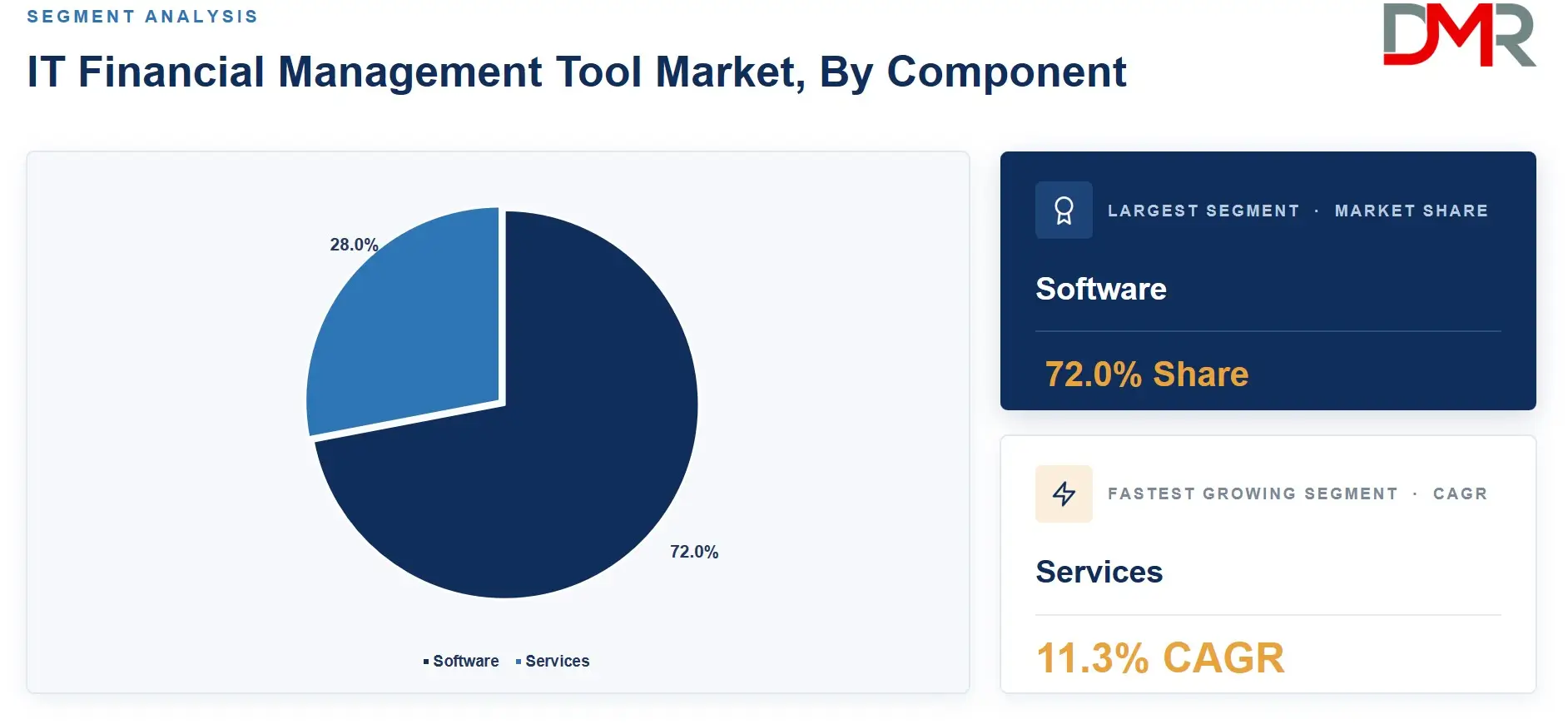
Software is projected to dominate the Component segment in the Global IT Financial Management Tool Market, accounting for an estimated 72% of the total market share in 2026. This dominance is attributed to increasing enterprise demand for centralized IT expenditure monitoring, automated financial reporting, cloud cost optimization, budgeting, forecasting, and technology investment management. Software platforms enable organizations to integrate financial information across IT infrastructure, cloud services, software licenses, and enterprise applications. Their subscription-based business models and expanding AI-powered analytical capabilities further support adoption. Services are expected to account for approximately 28% of the market in 2026, supported by increasing demand for implementation, consulting, customization, system integration, and managed FinOps services. Services are expected to grow at an estimated CAGR of 11.3% during the forecast period as organizations increasingly require specialized expertise to implement enterprise-wide financial management frameworks.
By Deployment Mode Analysis
Cloud-Based deployment is projected to dominate the Deployment Mode segment in the Global IT Financial Management Tool Market, accounting for an estimated 61% market share in 2026. This dominance is attributed to increasing enterprise cloud adoption, scalable infrastructure, subscription-based pricing, simplified software upgrades, and accessibility across geographically distributed organizations. Cloud-based platforms also provide integration with hyperscaler billing environments and support continuous monitoring of technology expenditure across multicloud infrastructure. On-Premises deployment is estimated to account for 25% of the market, primarily supported by financial institutions, government organizations, and enterprises with strict data governance requirements. Hybrid deployment is expected to represent approximately 14%. Cloud-Based deployment is poised to register the highest CAGR of 13.2% during 2027–2035, driven by increasing SaaS adoption, API-based integrations, AI-powered financial analytics, and demand for flexible enterprise financial management platforms.
By Functionality Analysis
IT Cost Management and Transparency is projected to dominate the Functionality segment in the Global IT Financial Management Tool Market, accounting for approximately 31% of the total market share in 2026. Its dominance is attributed to increasing demand for comprehensive visibility into IT infrastructure expenditure, cloud consumption, software subscriptions, data center costs, and technology procurement. Organizations are increasingly implementing cost transparency platforms to identify inefficient spending, monitor departmental expenditure, and improve financial accountability. IT Financial Reporting and Analytics is expected to represent the second-largest category, accounting for approximately 23% of the market. Cost Allocation and Chargeback is poised to register the highest CAGR of approximately 12.4% during the forecast period, driven by expanding multicloud environments, decentralized IT spending, and increasing demand for accurate business-unit cost attribution. Budgeting and Forecasting and IT Spend and Vendor Management will also remain important functionality categories as enterprises prioritize financial planning and procurement optimization.
By Organization Size Analysis
Large Enterprises are projected to dominate the Organization Size segment in the Global IT Financial Management Tool Market, accounting for approximately 58% of the total market share in 2026. This dominance is attributed to complex IT infrastructure, substantial technology budgets, geographically distributed operations, extensive software licensing requirements, and growing adoption of hybrid and multicloud environments. Large organizations require sophisticated financial reporting, automated cost allocation, centralized procurement monitoring, and integration with ERP and IT service management platforms. Medium Enterprises are expected to account for approximately 29% of the market, supported by increasing adoption of cloud infrastructure and demand for improved technology expenditure management. Small Enterprises are estimated to represent approximately 13% of the market. Small Enterprises are poised to register the highest CAGR of approximately 12.8% during 2027–2035, driven by affordable SaaS platforms, simplified implementation, subscription-based pricing, and growing awareness of technology cost optimization.
By End User Analysis
IT and Telecommunications is projected to dominate the End User segment in the Global IT Financial Management Tool Market, accounting for approximately 27% of the total market share in 2026. This dominance is attributed to substantial cloud infrastructure expenditure, complex software ecosystems, data center operations, network management requirements, and continuous investment in digital services. The BFSI segment is expected to represent the second-largest category, accounting for approximately 19% of the market, supported by extensive technology budgets, regulatory compliance requirements, cybersecurity investment, and complex financial reporting needs. Healthcare is expected to experience among the highest growth rates, with an estimated CAGR of 12.1% during the forecast period, driven by digital health investments, electronic health record adoption, cloud-based healthcare infrastructure, and increasing demand for technology expenditure governance. Manufacturing, Retail and E-commerce, Government and Public Sector, and Others will also contribute to market expansion as organizations modernize enterprise applications and increase digital infrastructure investments.
The Global IT Financial Management Tool Market Report is segmented on the basis of the following:
By Component
By Deployment Mode
- Cloud-Based
- On-Premises
- Hybrid
By Functionality
- IT Cost Management and Transparency
- Budgeting and Forecasting
- Cost Allocation and Chargeback
- IT Financial Reporting and Analytics
- IT Spend and Vendor Management
By Organization Size
- Small Enterprises
- Medium Enterprises
- Large Enterprises
By End User
- IT and Telecommunications
- Banking, Financial Services and Insurance (BFSI)
- Healthcare
- Manufacturing
- Retail and E-commerce
- Government and Public Sector
- Others
Regional Analysis
North America is the Leading Region in the Global IT Financial Management Tool Market
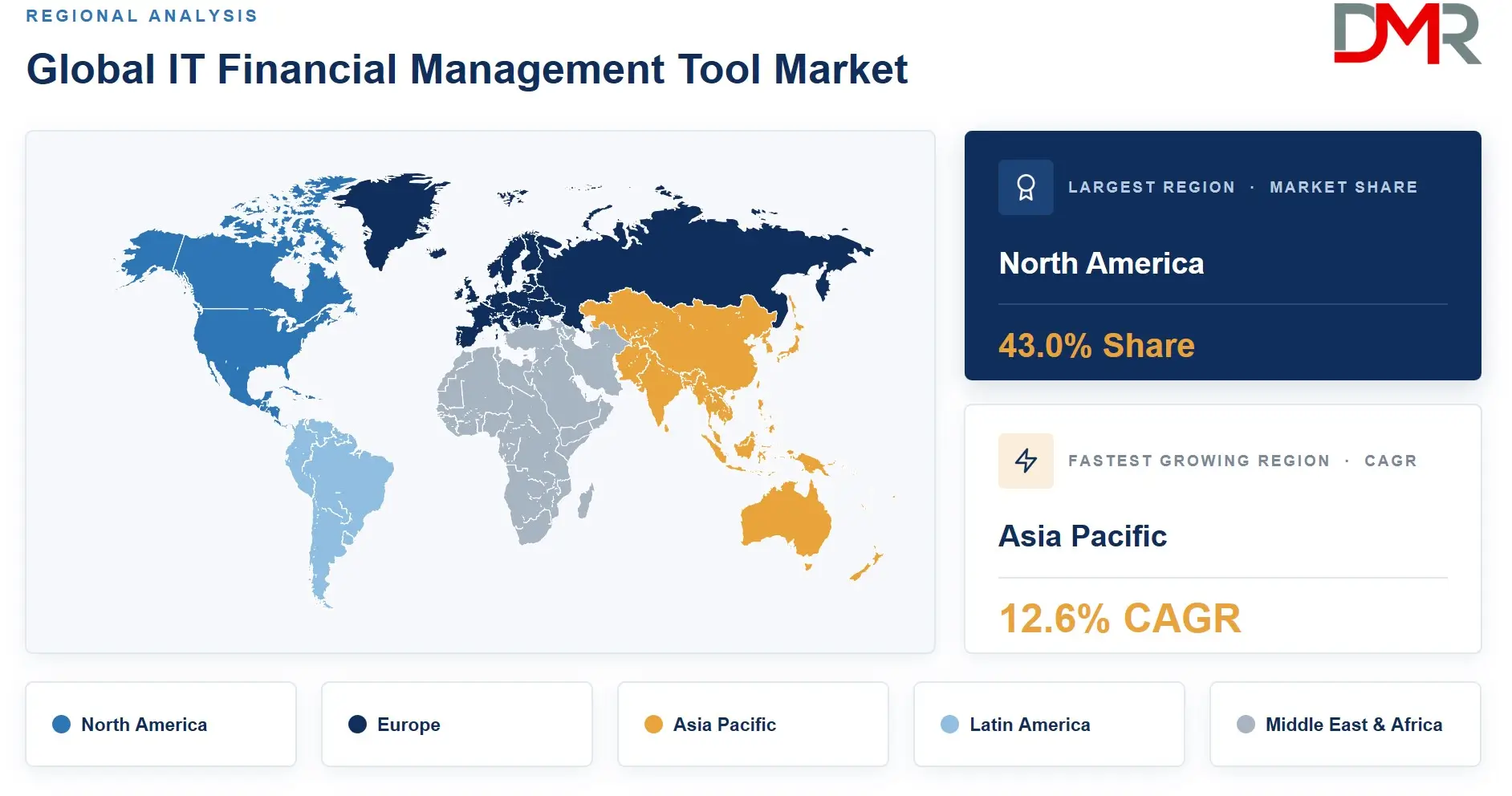
North America is projected to hold the largest regional share in the Global IT Financial Management Tool Market, accounting for approximately 43% in 2026. The regional market is estimated at USD 688 million in 2026 and is projected to reach approximately USD 1.62 billion by 2035. Increasing enterprise IT expenditure, cloud infrastructure investment, and adoption of technology business management frameworks are important growth drivers. The presence of established vendors, including IBM, ServiceNow, Broadcom, and Flexera, supports market development. Growing demand for AI-powered financial analytics, multicloud cost optimization, and automated budgeting is expected to strengthen adoption across technology, financial services, healthcare, and manufacturing industries.
ℹ
To learn more about this report –
Download Your Free Sample Report Here
Asia Pacific is the Fastest-Growing Region in the Global IT Financial Management Tool Market
Asia-Pacific is projected to be the fastest-growing regional market, registering an estimated CAGR of 12.6% during 2027–2035. The regional market is estimated at USD 368 million in 2026 and is projected to reach approximately USD 1.12 billion by 2035. Increasing digital transformation, enterprise cloud migration, expanding IT services industries, and growing technology infrastructure investment are supporting market expansion. China, India, Japan, South Korea, and Australia are major adoption centers. Organizations are increasingly implementing ITFM platforms to manage multicloud expenditure, improve financial accountability, and optimize technology procurement.
The Europe IT Financial Management Tool Market
The Europe IT Financial Management Tool Market is estimated at USD 416 million in 2026 and is projected to reach approximately USD 900 million by 2035, registering an estimated CAGR of 8.9%. Regional growth is supported by increasing enterprise cloud adoption, demand for financial transparency, software licensing governance, and data protection requirements. Germany, the United Kingdom, France, Italy, and the Nordic countries represent important markets. Financial services, manufacturing, telecommunications, and government organizations are increasing investments in IT expenditure management platforms. Demand for integrated financial reporting, secure cloud infrastructure management, and automated technology budgeting is expected to support regional market growth.
Latin America IT Financial Management Tool Market
The Latin America IT Financial Management Tool Market is estimated at USD 80 million in 2026 and is projected to reach approximately USD 155 million by 2035, growing at an estimated CAGR of 7.6%. Brazil and Mexico are expected to remain the principal regional markets due to increasing enterprise digitalization, cloud adoption, financial services modernization, and technology infrastructure investment. Organizations are adopting specialized platforms to improve software expenditure monitoring, cloud cost management, and financial reporting. However, limited IT budgets, implementation costs, and shortages of specialized professionals may constrain adoption among smaller enterprises.
MEA IT Financial Management Tool Market
The Middle East and Africa IT Financial Management Tool Market is estimated at USD 48 million in 2026 and is projected to reach approximately USD 100 million by 2035, registering an estimated CAGR of 8.5%. Regional demand is supported by government digitalization, enterprise cloud migration, smart-city initiatives, and increasing investment in financial technology infrastructure. Saudi Arabia and the UAE are important markets due to digital transformation programs and expanding cloud infrastructure. South Africa and Israel also represent significant opportunities, supported by enterprise software adoption, financial services modernization, and technology investment.
Major Countries Analysis
United States IT Financial Management Tool Market
The United States IT Financial Management Tool Market is estimated at USD 560 million in 2026 and is projected to reach approximately USD 1.19 billion by 2035, growing at an estimated CAGR of 8.7%. Increasing enterprise technology expenditure, widespread cloud adoption, and demand for financial transparency are supporting market expansion. The presence of major technology vendors, growing AI infrastructure investments, and increasing adoption of FinOps practices are further strengthening demand. Banking, healthcare, telecommunications, and technology companies represent important end-user industries.
Japan IT Financial Management Tool Market
The Japan IT Financial Management Tool Market is estimated at USD 90 million in 2026 and is projected to reach approximately USD 195 million by 2035, registering an estimated CAGR of 8.9%. Enterprise digital transformation, cloud migration, manufacturing modernization, and increasing adoption of AI-enabled business applications are supporting growth. Japanese enterprises are increasingly implementing financial management platforms to improve IT expenditure visibility, automate reporting, and optimize software procurement. Banking, automotive manufacturing, telecommunications, and government organizations represent important adoption sectors.
Saudi Arabia IT Financial Management Tool Market
The Saudi Arabia IT Financial Management Tool Market is estimated at USD 25 million in 2026 and is projected to reach approximately USD 57 million by 2035, growing at an estimated CAGR of 9.6%. Vision 2030, government digital transformation, cloud infrastructure investment, and smart-city development are major growth drivers. Increasing technology investments across financial services, telecommunications, energy, and government organizations are creating demand for advanced IT budgeting, financial reporting, and cloud cost optimization platforms.
Regulatory Landscape
The Global IT Financial Management Tool Market operates within a regulatory environment shaped by data privacy, cybersecurity, financial governance, cloud infrastructure security, and enterprise technology risk management requirements. In Europe, the General Data Protection Regulation (GDPR) establishes requirements for protecting personal data, while the Digital Operational Resilience Act (DORA), applicable from January 2025, strengthens ICT risk management, operational resilience, and third-party technology oversight among financial institutions. The NIS2 Directive further introduces cybersecurity risk management and incident reporting obligations for covered digital infrastructure and cloud service providers. In India, the Digital Personal Data Protection Act, 2023, supported by the DPDP Rules, 2025, establishes requirements concerning consent, data processing, security safeguards, and accountability. These regulations indirectly influence ITFM platforms by increasing demand for secure financial data management, audit-ready reporting, vendor expenditure monitoring, access controls, and transparent cloud cost allocation.
Investment Analysis
Investment activity in the Global IT Financial Management Tool Market is increasingly driven by strategic acquisitions, venture capital funding, private equity participation, and corporate investments in enterprise financial management software. Major technology companies are investing in IT financial management and FinOps capabilities to strengthen their cloud cost optimization, technology expenditure monitoring, and enterprise financial planning portfolios. IBM's acquisition of Apptio for USD 4.6 billion in 2023 represents a significant strategic investment, reflecting the growing value of integrated IT financial management platforms. Similarly, Flexera's acquisition of the Spot by NetApp FinOps business in January 2025 and subsequent acquisitions of ProsperOps and Chaos Genius in 2026 demonstrate continued consolidation and capital deployment in cloud financial management technologies. Venture capital investment is also supporting specialized providers, with Finout raising USD 40 million in Series C funding in January 2025, bringing its total funding to USD 85 million. These investments indicate growing investor interest in platforms offering automated cost optimization, multicloud financial visibility, AI expenditure management, and enterprise-wide financial governance.
By Region
North America
Europe
- Germany
- France
- The U.K.
- Italy
- Spain
- Rest of Europe
Asia-Pacific
- China
- Japan
- India
- Australia
- South Korea
- Rest of APAC
Latin America
- Mexico
- Brazil
- Rest of LATAM
Middle East & Africa
- Saudi Arabia
- The UAE
- South Africa
- Rest of MEA
Competitive Landscape
The Global IT Financial Management Tool Market is characterized by competition among established enterprise software vendors, specialized FinOps providers, cloud management companies, and technology consulting organizations. Market participants compete through product innovation, integration capabilities, AI-powered analytics, cloud cost optimization, pricing models, and enterprise customer relationships.
IBM Apptio, ServiceNow, Broadcom, Flexera, Oracle, Microsoft, SAP, CloudBolt, Finout, CloudZero, and DoiT International are among the important companies participating in the broader IT financial management and cloud financial management ecosystem.
Established vendors benefit from their enterprise software portfolios and extensive customer networks, while specialized providers differentiate themselves through cloud cost allocation, multicloud visibility, engineering cost intelligence, and automated FinOps capabilities. Strategic partnerships, acquisitions, product innovation, and expansion into emerging markets remain important competitive strategies.
Some of the prominent players in the Global IT Financial Management Tool Market are:
- IBM
- ServiceNow
- Flexera
- Broadcom
- SAP
- Oracle
- Upland Software
- Planview
- BMC Software
- MagicOrange
- Nicus Software
- Bee360
- Serviceware SE
- DextraData
- ITBMO
- CostPerform
- ClearCost
- Yarken
- Zoho Corporation
- Microsoft
- Hewlett Packard Enterprise
- OpenText
- SoftwareOne
- HCLTech
- Nutanix
- Datadog
- CloudBolt Software
- CloudZero
- Finout
- Vantage
- Harness
- Densify
- nOps
- Zesty
- Anodot
- Fabrix.ai
- Kubex
- Hyperglance
- Pier Cloud
- Cloudshot
- Other Key Players
Recent Developments
- In November 2026, Apptio, an IBM company, announced expanded AI financial management capabilities, including native connections to leading frontier AI systems. The developments enable enterprises to monitor AI consumption, token expenditure, application costs, and technology investments alongside broader IT spending. IBM also introduced integrations with external AI tools to improve financial insights and investment decision-making.
- In August 2026, IBM introduced Apptio AI Value & ROI in public preview, enabling technology and finance executives to connect AI expenditure, including token costs, with measurable business outcomes. The capabilities support tracking AI initiatives across revenue, cost, productivity, speed, and risk, strengthening investment evaluation and financial accountability for enterprise AI adoption.
- In June 2026, Flexera launched AI Cost Management capabilities within its Flexera One platform. The solution provides visibility, governance, and optimization of AI expenditure across applications, agents, models, data platforms, and computing infrastructure. The development reflects growing enterprise demand for monitoring consumption-based AI costs, including tokens and credits, within centralized financial management environments.
- In June 2026, the FinOps Foundation ratified FOCUS 1.4, expanding standardized technology cost and usage reporting. The specification introduced additional datasets, columns, and attributes supporting invoice reconciliation, commitment tracking, cost allocation, and billing data completeness. The development strengthens interoperability between technology providers and financial management platforms, supporting more consistent enterprise cloud expenditure analysis.
- In December 2025, the FinOps Foundation launched FOCUS 1.3, introducing enhanced capabilities for shared-cost allocation, contract commitment tracking, and billing data freshness. The specification also introduced additional reporting dimensions to improve multicloud expenditure transparency. These enhancements support enterprises in standardizing financial data across cloud providers and improving the accuracy of technology cost allocation and forecasting.
- In November 2025, Apptio introduced next-generation FinOps solutions through IBM Cloudability and IBM Kubecost. The developments included Cloudability Governance, designed to help organizations evaluate cloud cost implications and enforce internal policies before infrastructure deployment, alongside enhancements to Kubernetes cost management through Kubecost 3.0. The solutions target financial visibility and optimization across increasingly complex AI-driven cloud environments.
Report Details
| Report Characteristics |
| Market Size (2026) |
USD 1.6 Bn |
| Forecast Value (2035) |
USD 3.9 Bn |
| CAGR (2027–2035) |
10.3% |
| The US Market Size (2026) |
USD 560 Mn |
| Historical Data |
2021 – 2025 |
| Forecast Data |
2027 – 2035 |
| Base Year |
2025 |
| Segments Covered |
By Component, By Deployment Mode, By Functionality, By Organization Size, By End User |
| Regional Coverage |
North America – The US and Canada; Europe – Germany, France, The UK, Italy, Spain, Rest of Europe; Asia-Pacific – China, Japan, India, Australia, South Korea, Rest of APAC; Latin America – Mexico, Brazil, Rest of LATAM; Middle East & Africa – Saudi Arabia, The UAE, South Africa, Rest of MEA |
Frequently Asked Questions
What is the size of the Global IT Financial Management Tool Market?
▾ The Global IT Financial Management Tool Market is estimated to reach USD 1.6 billion in 2026 and is projected to reach USD 3.9 billion by 2035.
What is the expected CAGR of the Global IT Financial Management Tool Market?
▾ The Global IT Financial Management Tool Market is expected to grow at a CAGR of 10.3% during the forecast period 2027–2035.
What are the major factors driving the Global IT Financial Management Tool Market?
▾ Increasing enterprise IT expenditure, accelerating cloud adoption, growing FinOps implementation, and rising demand for IT cost transparency are major growth drivers.
What are the key trends in the Global IT Financial Management Tool Market?
▾ Key trends include AI-powered financial forecasting, real-time expenditure analytics, automation, and convergence of ITFM, FinOps, and Technology Business Management.
Which component dominates the Global IT Financial Management Tool Market?
▾ Software is the leading component segment, accounting for an estimated 72% market share in 2026.
Which deployment mode dominates the Global IT Financial Management Tool Market?
▾ Cloud-Based deployment dominates the market, accounting for an estimated 61% share in 2026.
Which region dominates the Global IT Financial Management Tool Market?
▾ North America is the leading region, accounting for approximately 43% of the global market share in 2026.
Which region is expected to register the fastest growth in the Global IT Financial Management Tool Market?
▾ Asia-Pacific is expected to register the fastest growth, with an estimated CAGR of 12.6% during 2027–2035.
Who are the major players in the Global IT Financial Management Tool Market?
▾ Major players include IBM Apptio, ServiceNow, Broadcom, Flexera, Oracle, Microsoft, SAP, CloudBolt, Finout, CloudZero, and DoiT International.
What are the major opportunities in the Global IT Financial Management Tool Market?
▾ Major opportunities include AI-powered financial management, predictive analytics, SME-focused cloud solutions, automated FinOps, and expansion into emerging economies.
What are the major challenges facing the Global IT Financial Management Tool Market?
▾ High implementation costs, integration complexity, data quality concerns, security requirements, and organizational resistance to cost transparency are key challenges.
How is AI transforming the Global IT Financial Management Tool Market?
▾ AI is enabling automated expenditure classification, predictive budgeting, anomaly detection, cloud cost optimization, and improved financial decision-making.