What is the Italy Electric Vehicle Charging Station Market Size?
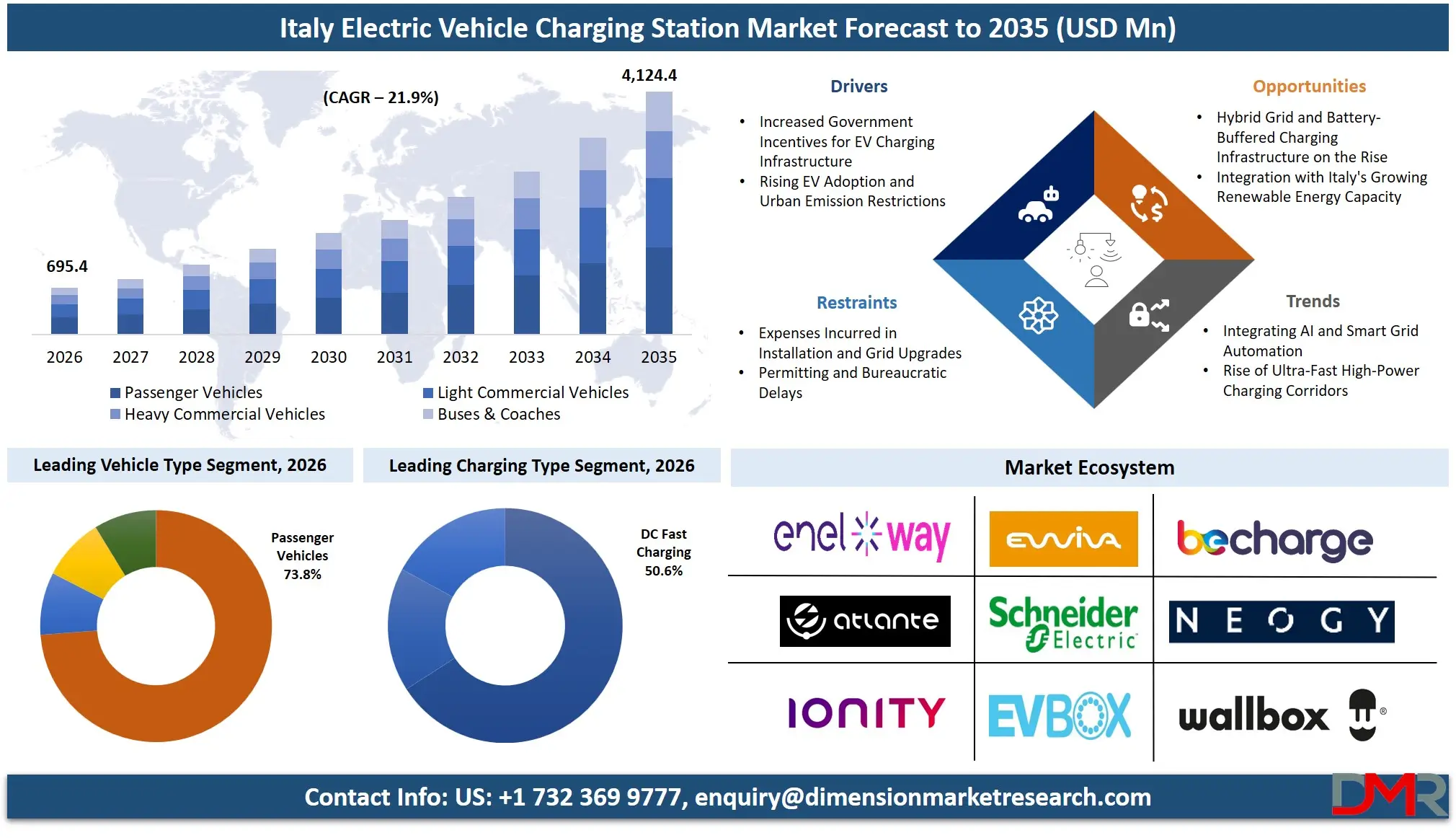
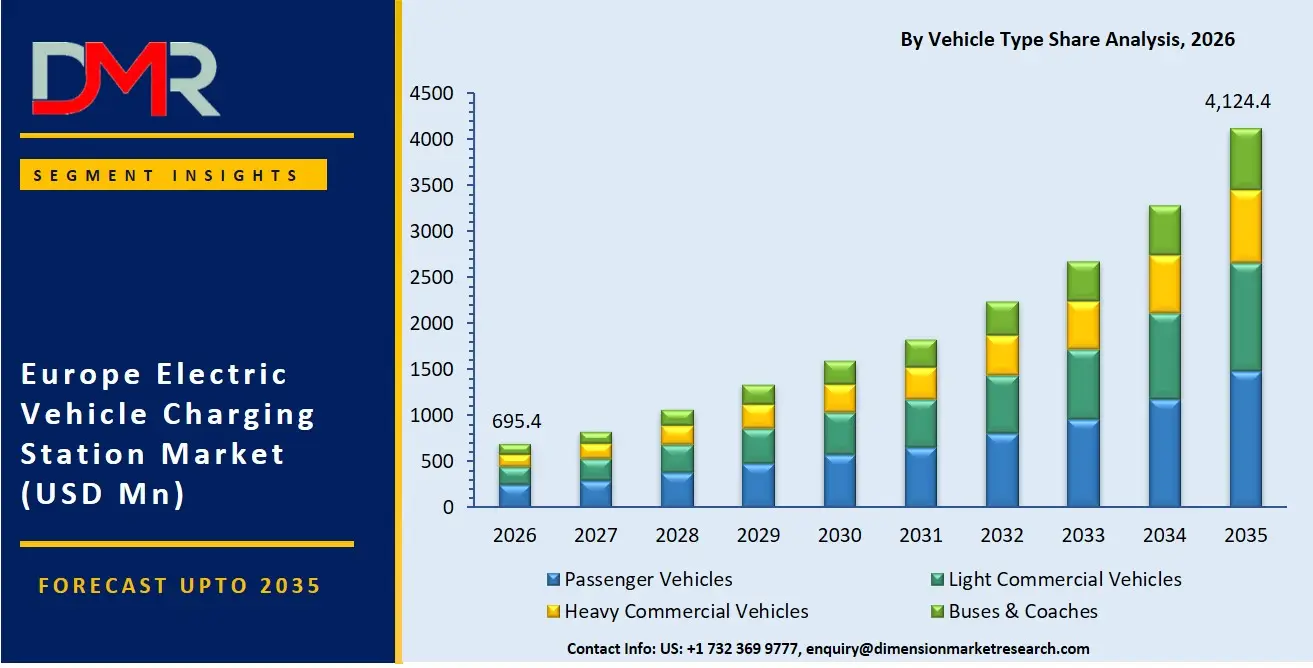
The Italy Electric Vehicle Charging Station Market size is estimated at USD 695.4 million in 2026 and is projected to reach USD 4,124.4 million by 2035, exhibiting a CAGR of 21.9% during the forecast period, as a result of growing awareness about EV incentive programs, government-backed infrastructure developments, and urban air quality regulations.
ℹ
To learn more about this report –
Download Your Free Sample Report Here
The market for electric vehicle charging stations in Italy has been growing consistently due to rising sales of electric vehicles, the implementation of plans for recovery and resilience through funding, and the implementation of advanced charging technologies such as AC charging, DC fast charging, and wireless charging that can be used for safe and accessible management of charging. Growth in the Italian market is being driven by developments in artificial intelligence and cybersecurity-based smart grid optimization technology.
ℹ
To learn more about this report –
Download Your Free Sample Report Here
Key Takeaways
- Market Size & Forecast: The Italy Electric Vehicle Charging Station Market size is projected to reach USD 695.4 million in 2026 and is anticipated to have a value of USD 4,124.4 million in 2035.
- Growth Rate & Outlook: The Italy Electric Vehicle Charging Station Market size is set to grow at a compound annual growth rate of 21.9% during the forecast period of 2026 to 2035.
- Primary Growth Drivers: Some of the major growth drivers in the market include Increased Government Incentives for EV Charging Infrastructure, and more.
- Key Market Trends: Some of the major trends in the market are Integrating AI and Smart Grid Automation, and more.
- By Installation: The Commercial Public Charging segment is anticipated to get the majority share of the Italy Electric Vehicle Charging Station Market in 2026.
- By Vehicle Type: Passenger Vehicles is expected to get the largest revenue share in 2026 in the Italy Electric Vehicle Charging Station Market.
- By Connector Type: CCS2 segment is expected to get the largest revenue share in 2026 in the Italy Electric Vehicle Charging Station Market.
What is Electric Vehicle Charging Station?
The electric vehicle charging stations enable individual users or fleets to charge their electric vehicles with the help of equipment dependent upon electrical grids instead of liquid fuel. Charging stations are dependent on power conversion technology, plug standards, and network connectivity to perform this process effectively. They are commonly utilized in different activities like overnight charging at homes, rapid charging while travelling, and charging in depots. An increase in the application of electric mobility, the zero-emission requirements of governments, and the high number of electric vehicle registrations in today's technology era are some factors which have increased the demand.
Use Cases
- Home and Residential Charging: There is a rising popularity in EV charging stations in use cases where private EVs are being charged overnight. Individuals benefit from lower rates of electricity, timed charging, and home solar integration, not relying heavily on public charging infrastructure.
- Integration with Smart Grid and Renewable Energy: EV charging stations enable utility companies to regulate peak loads, balance renewable power sources, and offer V2G services. Consumers and energy suppliers employ smart charging stations in order to minimize electricity expenses, ensure grid security, and provide safe charging processes in digital environments.
- Fleet and Commercial Depot Charging: Businesses, enterprises, and logistics companies implement EV charging stations for the purposes of charging delivery vehicles and other service cars. It provides them with flexibility in operation and lower costs per mile in comparison to conventional diesel-fueled fleets.
- Public Highway and Urban Fast Charging: With an increased usage of EVs in long-distance transportation, there has been rapid deployment of DC fast charging stations along highways and major city corridors. Users charge their vehicles within 20-30 minutes using CCS2 and CHAdeMO chargers.
How AI Is Transforming the Italy Electric Vehicle Charging Station Market?
The Italy EV Charging Station market is evolving owing to the application of artificial intelligence in optimizing charging schedules, predictive maintenance, and dynamic load balancing across grids. The use of AI in charging networks enables energy distribution by forecasting demand, identifying underutilized chargers, and ensuring that high-priority vehicles receive optimal charging windows.
AI is making it possible for the security of charging networks to be enhanced through intelligent monitoring of grid anomalies, including cyber threats and unauthorized access. Intelligent management of charging stations allows for optimization of energy use, optimal power consumption, and scheduling of maintenance. AI is also playing an important role in user experience through personalized charging recommendations.
Market Dynamics
Key Drivers of the Italy Electric Vehicle Charging Station Market
Increased Government Incentives for EV Charging Infrastructure
One of the principal causes for an increase in electric car charging stations in Italy is the increased usage of PNRR, regional stimuli, and the EU-backed green transition programs. Italy will invest over EUR 750 million in installing charging stations alone, with a target of 50,000 public charging stations installed till 2030. Currently, municipal corporations and businesses are excited about the prospect of setting up electric car charging stations depending on factors like compatibility, ease-of-access, and smooth integration into the power grid system. Policies and laws relating to sustainability and AFIR, which insist on setting up fast charging lanes at intervals of 60 kilometers in TEN-T highways, compel individuals to opt for EV charging systems.
Rising EV Adoption and Urban Emission Restrictions
The dramatic rise in the number of EVs registered in Italy, rising by over 35% even in 2025, driven by substantial financial support in the form of purchasing rebates up to EUR 5,000 per vehicle, has resulted in increased consumer demand for readily available charging solutions. The popularity of electric vehicles amongst Italian households and companies is growing in tandem with the decreasing cost of ownership in comparison with the internal combustion engine, while the increasing number of low-emission areas (ZTLs), including those found in Milan, Rome, Turin, and Bologna, will soon start banning diesel-powered vehicles.
Restraints in the Italy Electric Vehicle Charging Station Market
Expenses Incurred in Installation and Grid Upgrades
Despite many benefits that can be associated with the use of DC fast chargers, destination chargers, and smart charging, expensive investments will be required when installing these systems and connecting them to the grid. The cost of installation of one 350 kW ultra-fast charger alone ranges from EUR 150,000 up to EUR 300,000 without a transformer upgrade. Buying equipment, upgrading the transformer, and other fees associated with permitting will make such a system inaccessible to many residential users and SMEs who have limited financial capabilities. Moreover, even the cost of installation of Level 2 charger at home can range from EUR 1,000 to EUR 3,000. In addition, high power usage demand charges may be too expensive for SMEs and residential users.
Permitting and Bureaucratic Delays
Even with the set national goals and the financial incentives, the local authorization process for setting up a new station is a fragmented process and takes too much time in the case of the country's 7,900 local authorities, each of which must provide authorization for the stations. The disparities in regional laws, the lengthy and slow process that takes six to twelve months on average, and the different distribution system operators dealing with the application for connections all contribute to this delay. The fragmented bureaucracy considerably limits the potential speed with which networks of charging stations are scaled to accommodate more electric vehicle users. As opposed to France or Germany, the country does not have a clear permit process for the nation.
Growth Opportunities in the Italy Electric Vehicle Charging Station Market
Hybrid Grid and Battery-Buffered Charging Infrastructure on the Rise
With the increasing use of battery-assisted charging systems, which incorporate both energy storage and utility power grids, limitless opportunities exist for expansion within the Italian market. Energy is generated during off-peak times, where electricity costs are low and discharged during peak times, cutting down operating costs by 40%. Consumers and operators alike, especially of bus stations and logistics centers, seek a system that enables them to cut down peak-time costs while still maintaining power efficiency without having to invest in new utility grid connections. The introduction of cheap hybrids and battery-based charging systems will lead to great success within Italy, especially in places such as Lombardy and Lazio.
Integration with Italy's Growing Renewable Energy Capacity
With Italy having expanded at such a fast pace both its production of solar PV and wind energy – adding over 6 GW in the year of 2025 alone – there is a good chance that the energy generated in the process could be used in powering EV charging stations. According to the Italian government plans, the country will produce up to 40 percent of its energy consumption needs through renewables by 2030. In addition, solar energy will be very abundant in the southern areas, including Sicily, Puglia, and Calabria. As a result, EV charging stations owners will be able to earn more revenue by selling the stored electricity back into the grid through energy trading.
Italy Electric Vehicle Charging Station Market Trends
Integrating AI and Smart Grid Automation
The deployment of AI-powered systems for charging management is growing in Italy due to their capability to automatically arrange charging operations and load balancing throughout the network. The use of machine learning helps in estimating energy needs according to past patterns of use, meteorological data, and other factors affecting the state of the grid and allows for appropriate changes that avoid the overloading of transformers. The capacity of transformers can be used more efficiently using AI technology, and power can be provided to connected vehicles based on their planned time of departure and level of battery charge. AI-powered systems are able to notice and respond quickly to any disturbances in the grid, be it voltage variations or cyber-attacks.
Rise of Ultra-Fast High-Power Charging Corridors
There is a noticeable trend being established in the main corridors of Italy, which involve the use of ultrafast 350 kW+ charging centers that will allow charging of electric vehicles in just 10-15 minutes. This type of innovation involves corridors such as the A1, A14, and A4 corridors, with charging stations that feature up to 8 to 20 points per station. Companies such as Ewiva (the Enel X-Volkswagen partnership), IONITY, and Atlante are leading the establishment of these corridors, which are aimed at alleviating range anxiety and ensuring that long distance travel by EVs is possible for everyone. The main focus of these corridors is the use of CCS2 chargers, which are considered to be Italy's default chargers.
Research Scope and Analysis
The analysis of the Italy Electric Vehicle Charging Station includes various aspects such as charging type, charging level, installation type, vehicle type, connector type, and adoption trends by verticals. In addition, the report discusses top and emerging segments, latest technologies, artificial intelligence, smart grids, and changing consumer behavior. Growth opportunities in residential charging, commercial public networks, fleet depots, and digital energy management for industries have been considered as well.
ℹ
To learn more about this report –
Download Your Free Sample Report Here
By Charging Type Analysis
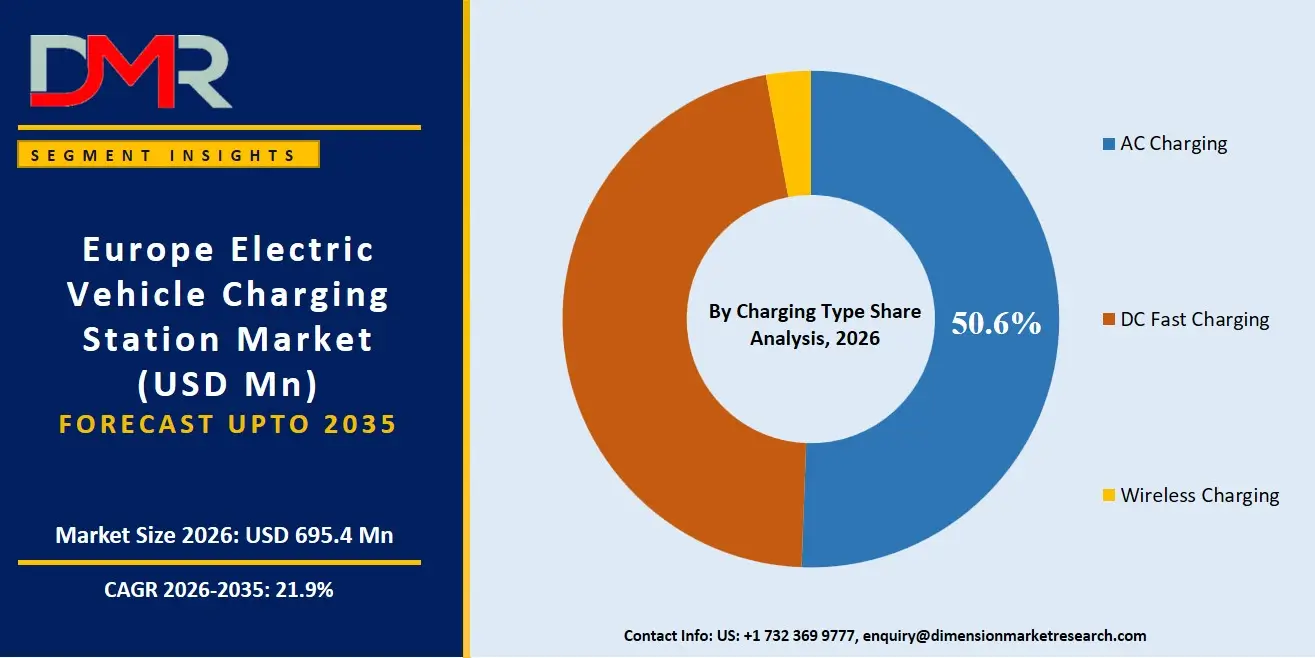
AC Charging is expected to lead the Electric Vehicle Charging Station market of Italy with a projected market share of 50.6% by 2026 as a result of consumers' growing preference for low-cost overnight home and workplace charging. AC charging solutions are more convenient in terms of residential integration and easier to maintain as far as electrical infrastructure goes. DC Fast Charging is likely to occupy the second place with a 46.8% share due to the rising trend in favor of long-distance travel and reduced charging time along Italian highways. Wireless Charging, though currently at a nascent 2.6% share, is expected to grow at the fastest pace as a consequence of increased knowledge about autonomous vehicle integration and automated fleet operations, particularly for taxi ranks and bus depots in cities like Milan and Rome.
By Charging Level Analysis
Level 2 Charging is projected to dominate the Italy Electric Vehicle Charging Station market in 2026 with an estimated share of 57.8%, owing to its widespread adoption in residential garages, workplace parking lots, and public destination charging locations. Italian homeowners and businesses favor Level 2 chargers (typically 7.4 kW to 22 kW) because they balance charging speed with lower installation costs and grid compatibility. Level 3 Charging (DC fast charging, 50 kW to 350 kW) follows with a 33.1% share, driven by highway corridor deployments and urban fast-charging hubs targeting long-distance travelers and ride-hailing fleets. Level 1 Charging (standard household outlets) holds a diminishing 9.1% share, primarily used by early EV adopters and as an emergency backup option, though its convenience for overnight trickle charging remains relevant for low-mileage drivers in rural areas with limited public infrastructure.
By Installation Analysis
The Commercial Public Charging segment is set to dominate the Italy Electric Vehicle Charging Station Market in 2026 with a projected share of 56.2%, thanks to its high utilization rates, government-backed deployment programs, and low complexity for end-users. Commercial public solutions enable roaming interoperability, scalability in charger density, and easy access to fast charging that does not necessitate private parking infrastructure. However, Residential Charging will experience robust growth in coming years because of heightened consumer preference for home convenience and lower electricity tariffs. Smart home energy management systems, affordability of Level 2 chargers, and knowledge about time-of-use rates have spurred residential charging adoption among homeowners and EV owners. Fleet Charging, while smaller at 14.1% share, is growing rapidly as logistics companies and public transport operators electrify their depots.
By Vehicle Type Analysis
The Passenger Vehicles segment will hold the leading position in the Italy Electric Vehicle Charging Station industry in 2026, estimated at roughly 73.8% due to an upsurge in EV registrations, proliferation of affordable EV models like the Fiat 500e and Tesla Model 3, and government purchase incentives of up to EUR 5,000. Individuals use the services offered by the charging station industry for home charging, workplace charging, and urban public charging. The Light Commercial Vehicles segment, especially delivery vans from Amazon, DHL, and Italian poste, is likely to witness fast growth since companies are increasingly looking for solutions for depot charging and route-optimized charging. Heavy Commercial Vehicles and Buses & Coaches, though smaller in unit volume, are seeing dedicated investments in high-power depots and pantograph charging along bus rapid transit routes in cities like Florence and Turin, driven by EU clean vehicle directives.
By Connector Type Analysis
The CCS2 Connector type is expected to lead in the Italy Electric Vehicle Charging Station market by gaining a 68.5% market share by 2026, owing to the rise in adoption of European standard for DC fast charging and regulatory alignment under the AFIR framework. The preference among automakers (Volkswagen, Stellantis, Tesla which has adopted CCS2 in Europe, BMW, Mercedes) and charge point operators is towards CCS2 connectors that deliver higher charging speeds up to 350 kW along with backward compatibility with Type 2 AC charging. CCS2 deployments have continued to prove lucrative for cross-border interoperability with France, Switzerland, and Austria. Type 2 connector holds a 21.4% share for AC destination charging. CHAdeMO continues its decline at 3.2% as Nissan and Mitsubishi transition to CCS2. Pantograph Charging, though only 1.4% share, serves electric buses in Rome and Milan. NACS, GB/T, Type 1, and CCS1 have limited presence in Italy due to European standards dominance.
The Italy Electric Vehicle Charging Station Market Report is segmented based on the following:
By Charging Type
- AC Charging
- DC Fast Charging
- Wireless Charging
By Charging Level
By Installation
- Residential Charging
- Commercial Public Charging
- Fleet Charging
By Vehicle Type
- Passenger Vehicles
- Light Commercial Vehicles
- Heavy Commercial Vehicles
- Buses & Coaches
By Connector Type
- CCS1
- CCS2
- NACS
- GB/T
- CHAdeMO
- Type 1
- Type 2
- Pantograph Charging
Competitive Landscape
The Italy Electric Vehicle Charging Station industry is marked by fierce competition that results from technological advancements in terms of smart grid integration, scalability of power output, and capabilities of renewable energy integration. Participants in the market place a great deal of importance on forging strategic relationships with utility companies, automakers, and energy software vendors to improve network compatibility and foster customer retention. Innovation in the form of investing in technologies such as AI-enabled load management, ultra-fast charging infrastructure, and subscription services constitutes another key strategy for competing firms. The high cost of entry resulting from grid connection and permitting requirements is an advantage for established firms.
Some of the prominent players in the Italy Electric Vehicle Charging Station Market are:
- Enel X Way S.r.l.
- Be Charge S.r.l.
- Ewiva S.r.l.
- IONITY GmbH
- Atlante Energy
- Free To X S.p.A.
- A2A E-Mobility S.r.l.
- Duferco Energia S.p.A.
- Neogy S.r.l.
- ABB E-mobility B.V.
- Siemens AG
- Alpitronic GmbH
- Wallbox Chargers S.L.
- FIMER S.p.A.
- SCAME PARRE S.p.A.
- ChargePoint Holdings, Inc.
- EVBox B.V.
- E.ON Drive Infrastructure GmbH
- Tesla, Inc.
- Compleo Charging Solutions AG
- Other Key Players
Recent Developments
- April 2026: ABB E-mobility B.V. launched its OM M-Series charging platform designed for large-scale fleet and high-power EV charging applications, strengthening its next-generation megawatt-scale charging infrastructure portfolio for commercial and public charging operators.
- March 2026: Ewiva S.r.l. expanded its ultra-fast EV charging infrastructure across Italy by activating 430 new high-power charging points during 2025, surpassing 1,600 charging points across nearly 450 operational locations nationwide, strengthening Italy's HPC charging coverage.
- December 2025: IONITY GmbH expanded interoperability across Europe through its ChargeLeague alliance integration with Atlante, Fastned, and Electra, enabling cross-network EV charging access and strengthening regional ultra-fast charging ecosystem connectivity.
- December 2025: Atlante S.r.l. expanded its Italian motorway charging network by adding 28 new ultra-fast charging points across six strategic highway service areas, surpassing 120 HPC charging points nationwide and strengthening corridor charging coverage across Italy.
Report Details
| Report Characteristics |
| Market Size (2026) |
USD 9.6 Bn |
| Forecast Value (2035) |
USD 52.7 Bn |
| CAGR (2026–2035) |
20.8% |
| The US Market Size (2026) |
USD 3.1 Bn |
| Historical Period |
2021 – 2025 |
| Forecast Period |
2027 – 2035 |
| Base Year |
2025 |
| Estimated Year |
2026 |
| Segments Covered |
By Battery Type, By System Capacity, By Connection Type, By Application, By End User |
| Regional Coverage |
North America – The US and Canada; Europe – Germany, The UK, France, Russia, Spain, Italy, Benelux, Nordic, & Rest of Europe; Asia-Pacific – China, Japan, South Korea, India, ANZ, ASEAN, Rest of APAC; Latin America – Brazil, Mexico, Argentina, Colombia, Rest of Latin America; Middle East & Africa – Saudi Arabia, UAE, South Africa, Turkey, Egypt, Israel, & Rest of MEA |
Frequently Asked Questions
How big is the Italy Electric Vehicle Charging Station Market?
▾ The Italy Electric Vehicle Charging Station Market size is estimated to have a value of USD 695.4 million in 2026 and is expected to reach USD 4,124.4 million by the end of 2035.
What is the CAGR of the Italy Electric Vehicle Charging Station Market from 2026 to 2035?
▾ The market is growing at a CAGR of 21.9% over the forecasted period.
What factors are driving the growth of the Italy Electric Vehicle Charging Station Market?
▾ The market is driven by growing EV adoption rates, growth in the construction of charging stations on highways, regulations requiring low carbon emissions in transportation, and increased government spending on the construction of national charging corridors.
What are the major trends in the Italy Electric Vehicle Charging Station Market?
▾ The key market trends include the deployment of ultra-fast charging corridors, adoption of smart and connected charging platforms, and increasing integration of renewable energy systems with EV charging infrastructure.
Who are the key players in the Italy Electric Vehicle Charging Station Market?
▾ Some of the major key players in the Italy Electric Vehicle Charging Station Market are Enel X Way S.r.l., Be Charge S.r.l., Ewiva S.r.l., IONITY GmbH, ABB E-mobility B.V., and Tesla, Inc., and many others.
How is the Italy Electric Vehicle Charging Station Market segmented?
▾ The market is segmented by charging type, charging level, installation, vehicle type, connector type.