Italy Food Processing Equipment Market Snapshot
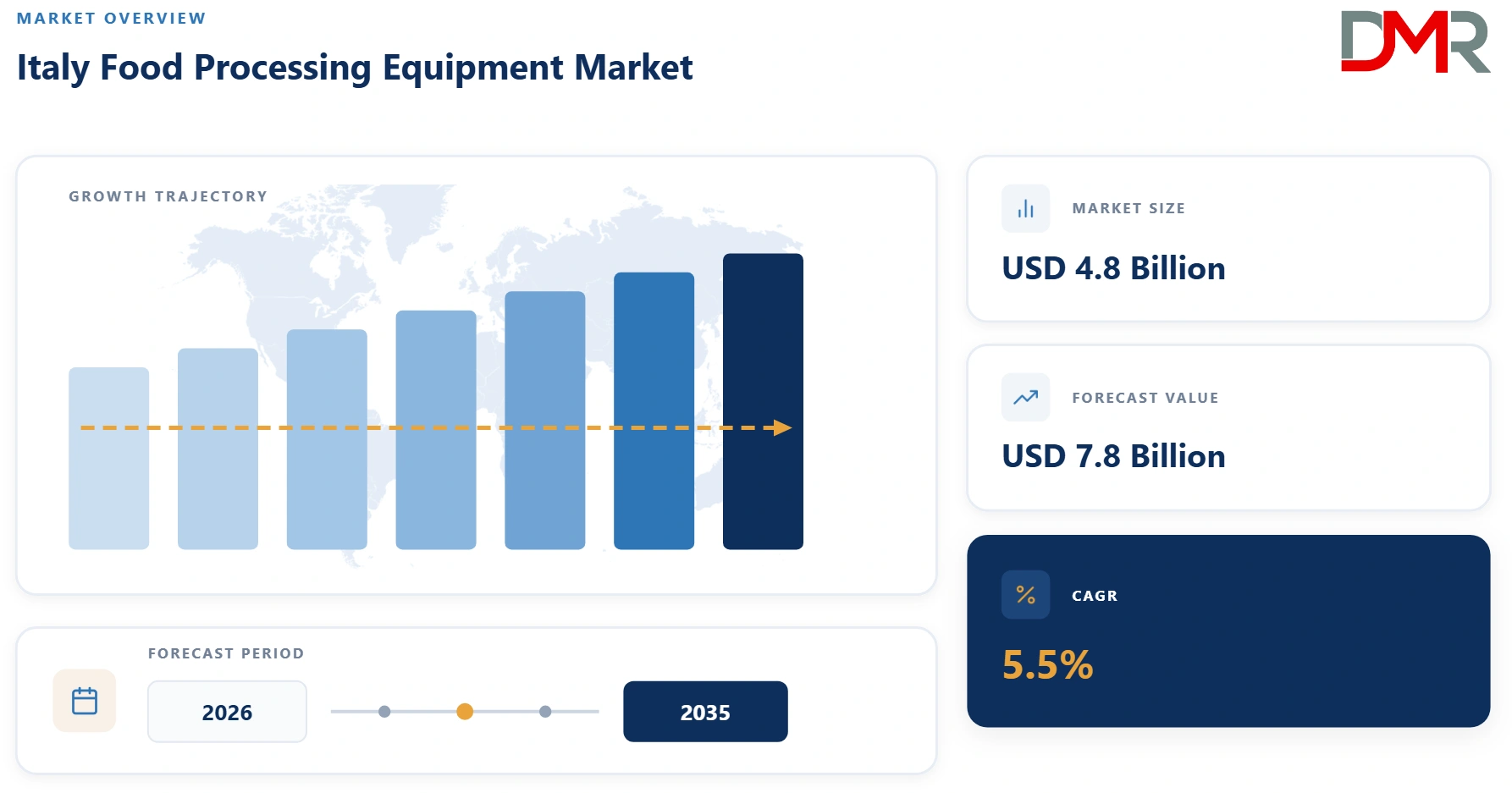
- Italy Food Processing Equipment Market Size in 2026: USD 4.8 Billion
- Italy Food Processing Equipment Market Size in 2035: USD 7.8 Billion
- Italy CAGR from 2026 to 2035: 5.5%
- Processing Equipment is the leading equipment type segment in 2026: 38.6%
- Automatic is the leading mode of operation segment in 2026: 54.7%
- Meat, Poultry and Seafood is the leading food category segment in 2026: 24.8%
- Large-Scale Food Processors is the leading end user segment in 2026: 57.6%
What is the Italy Food Processing Equipment Market and its Market Size?
The Italy Food Processing Equipment Market is projected to be valued at USD 4.8 Billion in 2026 and is expected to reach USD 7.8 Billion by 2035, expanding at a CAGR of 5.5% during the forecast period. Market growth is supported by Italy's large and highly diversified food and beverage manufacturing industry, extensive production of dairy products, pasta, bakery products, processed meat, wine, beverages, fruits, vegetables, and specialty foods, and continued modernization of processing facilities.
ℹ
To learn more about this report –
Download Your Free Sample Report Here
Italy has a particularly strong base of small and medium-sized food manufacturers alongside major industrial processors. Increasing labor costs, stringent hygiene requirements, export-oriented production, and growing demand for consistent product quality are encouraging manufacturers to replace conventional machinery with automated processing and packaging systems.
The modernization of Italian food manufacturing is also being supported by Industry 4.0 technologies, robotics, connected machinery, machine vision, digital monitoring, predictive maintenance, and energy-efficient equipment. Italian equipment manufacturers themselves have strong capabilities in food processing, filling, packaging, bottling, bakery, dairy, and automation technologies, creating a well-developed domestic supplier ecosystem.
Use Cases
- Pasta and Bakery Production Automation: Italian pasta, bread, biscuit, and bakery manufacturers are deploying automated mixing, forming, extrusion, baking, cooling, inspection, and packaging equipment to improve production consistency while supporting higher throughput and reducing dependence on manual production processes.
- Dairy and Cheese Processing Modernization: Italy's extensive cheese and dairy industry requires advanced pasteurization, separation, fermentation, cutting, portioning, filling, and packaging equipment. Modern machinery helps producers maintain strict hygiene standards while preserving the characteristics of premium Italian dairy and cheese products.
- Wine and Beverage Processing: Italian wine, bottled water, soft drink, spirits, and beverage manufacturers utilize automated bottling, filling, labeling, inspection, palletizing, and material handling systems to improve production efficiency and support large domestic and international distribution networks.
- Fruit and Vegetable Processing: Italy's substantial agricultural sector creates demand for washing, sorting, grading, peeling, cutting, freezing, canning, preservation, and packaging equipment used for tomatoes, olives, fruits, vegetables, sauces, and other value-added food products.
Key Takeaways
- Market Size: The Italy Food Processing Equipment Market is anticipated to reach USD 4.8 Billion in 2026 and USD 7.8 Billion by 2035, expanding at a CAGR of 5.5%.
- Growth Outlook: Growth is supported by modernization of Italy's large food manufacturing industry, increasing automation, labor-cost pressures, export-oriented food production, and adoption of advanced processing and packaging technology.
- Primary Growth Drivers: Rising automation requirements, Italy's strong food-processing machinery manufacturing ecosystem, demand for hygienic and energy-efficient machinery, increasing exports of processed foods and beverages, and digital transformation are supporting equipment investment.
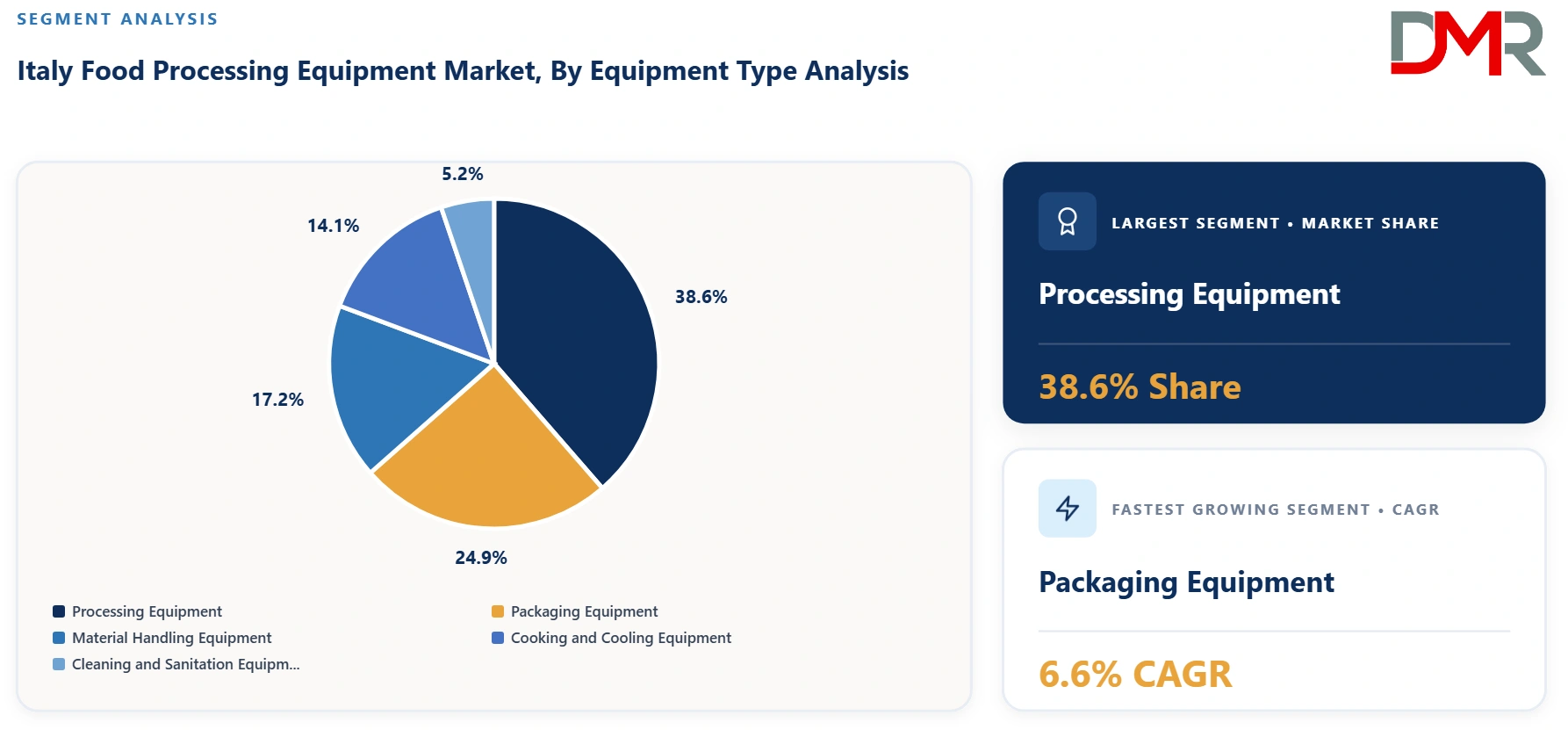
- By Equipment Type Analysis: Processing Equipment is projected to dominate with 38.6% share in 2026. Packaging Equipment is expected to record the highest CAGR of 6.6% through 2035, supported by automation, sustainability requirements, and premium food packaging demand.
- By Mode of Operation Analysis: Automatic equipment is expected to account for 54.7% of the market in 2026 and is also anticipated to record the highest CAGR of 6.8% through 2035.
- By Food Category Analysis: Meat, Poultry and Seafood is expected to lead with 24.8% share in 2026. Beverages are anticipated to record one of the fastest growth rates, supported by Italy's substantial wine, bottled water, spirits, and beverage industries.
- By End User Analysis: Large-Scale Food Processors are projected to account for 57.6% of the market in 2026. Small and Medium-Sized Processors are expected to record the fastest growth as accessible automation solutions enable modernization among Italy's extensive SME food-manufacturing base.
Key Drivers in the Italy Food Processing Equipment Market
Modernization and Automation Across Italian Food Manufacturing
Italian food manufacturers are increasingly investing in automated production equipment to improve productivity, product consistency, hygiene, traceability, and operational efficiency. Labor availability challenges and rising employment costs are strengthening the economic case for automation, particularly for repetitive processes such as cutting, sorting, filling, inspection, packaging, palletizing, and material handling. Automation is particularly important for manufacturers attempting to expand production while maintaining the quality standards associated with Italian food products. Robotics, machine vision, automated quality inspection, connected production lines, and digital control systems are therefore becoming increasingly integrated into equipment investment decisions.
Strong Domestic Food and Beverage Manufacturing Base
Italy has one of Europe's most diversified food and beverage industries, encompassing pasta, bakery products, dairy products, cheese, meat products, wine, olive oil, coffee, confectionery, processed fruits and vegetables, sauces, and specialty foods. The breadth of this manufacturing base creates sustained demand for processing, packaging, cooking, cooling, material handling, and sanitation equipment. Italy's globally recognized food brands and substantial food export sector further encourage manufacturers to invest in modern equipment capable of delivering consistent quality and complying with international food safety requirements.
Restraints in the Italy Food Processing Equipment Market
High Initial Capital Requirements for Advanced Automation
Advanced automated food processing equipment can require substantial upfront investment, creating challenges particularly for Italy's numerous small, family-owned, artisanal, and medium-sized food manufacturers. Beyond equipment acquisition, manufacturers may incur additional expenses for plant modifications, system integration, employee training, software, maintenance, and digital infrastructure. These costs can lengthen investment payback periods and encourage smaller processors to continue operating semi-automatic or legacy equipment.
Fragmented Food Processing Industry
Italy's food manufacturing landscape contains a large number of small and medium-sized enterprises producing regional and specialty products. While this diversity creates equipment demand, it can also restrict large-scale automation adoption. Smaller production volumes, highly customized recipes, seasonal production patterns, limited factory space, and the importance of traditional manufacturing methods can make standardized high-capacity automation less economically attractive for some processors.
Growth Opportunities in the Italy Food Processing Equipment Market
Smart Factory and Industry 4.0 Integration
Growing adoption of digital manufacturing provides opportunities for suppliers offering connected machinery, sensors, automated controls, artificial intelligence, machine vision, predictive maintenance, production analytics, and digital twin technologies. Italian processors can use connected equipment to monitor production performance, identify quality deviations, optimize energy consumption, reduce downtime, improve traceability, and manage preventive maintenance. Equipment suppliers capable of integrating machinery with manufacturing execution and enterprise resource planning platforms are therefore increasingly well positioned.
Energy-Efficient and Sustainable Processing Equipment
Increasing electricity, water, raw-material, and waste-management costs are strengthening demand for energy-efficient processing equipment. Manufacturers are increasingly evaluating machinery based not only on production speed but also on electricity consumption, water utilization, heat recovery, product losses, cleaning requirements, and lifecycle costs. Equipment manufacturers offering high-efficiency motors, optimized thermal systems, water-saving cleaning technology, heat recovery, precision processing, and waste-reduction capabilities have significant opportunities within Italy's sustainability-oriented food industry.
Trends in the Italian Food Processing Equipment Market
Growing Integration of Robotics and Intelligent Automation
Robotics is increasingly being deployed across Italian food manufacturing for product handling, cutting, sorting, inspection, pick-and-place operations, packaging, palletizing, and warehouse activities. Collaborative robots and flexible robotic systems are particularly attractive to manufacturers producing multiple product formats because they can accommodate shorter production runs and frequent product changes. Machine vision and AI-based inspection are further increasing automation capabilities.
Increasing Demand for Flexible Processing and Packaging Lines
Italian food producers frequently manufacture premium, specialty, regional, and seasonal products requiring different recipes, package formats, production volumes, and processing parameters. Equipment manufacturers are therefore developing increasingly modular and flexible systems that enable rapid product changeovers. Flexible equipment is especially valuable for SMEs seeking automation without sacrificing their ability to manufacture diverse product portfolios.
Greater Focus on Hygiene and Food Safety
Hygienic machinery design is becoming increasingly important as manufacturers seek to reduce contamination risks and cleaning downtime. Food processors are adopting equipment featuring stainless-steel construction, accessible components, clean-in-place systems, hygienic conveyors, improved drainage, automated sanitation, and advanced contamination detection systems.
Research Scope and Analysis
The Italy Food Processing Equipment Market is segmented by equipment type, mode of operation, food category, and end user, covering processing equipment, packaging equipment, material handling equipment, cooking and cooling equipment, and cleaning and sanitation equipment serving meat, dairy, bakery, beverage, fruit, vegetable, and specialty food processing operations throughout Italy.
ℹ
To learn more about this report –
Download Your Free Sample Report Here
By Equipment Type Analysis
Processing Equipment is projected to dominate the Italy Food Processing Equipment Market with 38.6% share in 2026, reflecting extensive requirements for mixing, cutting, forming, cooking, extrusion, separation, pasteurization, homogenization, and other processing operations across Italy's diverse food industry. Packaging Equipment is expected to register the highest CAGR of 6.6% during 2026-2035, supported by increasing automation of filling, sealing, wrapping, labeling, inspection, case packing, and palletizing operations. Sustainability requirements and growing demand for recyclable and lightweight packaging formats are also encouraging manufacturers to invest in machinery capable of handling new packaging materials.
By Mode of Operation Analysis
Automatic equipment is anticipated to dominate the Italy Food Processing Equipment Market with 54.7% share in 2026. Automatic equipment is also projected to register the highest CAGR of 6.8% during 2026-2035, supported by labor-cost pressures, productivity requirements, increasing production volumes, and greater adoption of Industry 4.0 manufacturing technologies. Large processors are increasingly deploying fully integrated automated production lines, while smaller processors are adopting modular automation to reduce manual labor without completely redesigning existing facilities.
By Food Category Analysis
Meat, Poultry and Seafood is expected to lead the Italy Food Processing Equipment Market with 24.8% share in 2026. The segment generates demand for cutting, slicing, grinding, mixing, portioning, cooking, cooling, inspection, packaging, and sanitation equipment. Beverages are expected to register the fastest CAGR of 6.4% during 2026-2035, supported by continued equipment investment across Italy's wine, spirits, bottled water, soft drinks, juices, coffee beverages, and other beverage industries.
By End User Analysis
Large-Scale Food Processors are projected to dominate the Italy Food Processing Equipment Market with 57.6% share in 2026, supported by their greater capital availability and ability to implement comprehensive automated production systems. Small and Medium-Sized Processors are anticipated to register the highest CAGR of 7.0% through 2035. Growth is being supported by increasingly affordable automation, modular machinery, digital manufacturing solutions, and demand among Italian SMEs to increase productivity while maintaining the quality and flexibility associated with specialty food production.
The Italy Food Processing Equipment Market Report is segmented based on the following:
By Equipment Type
- Processing Equipment
- Packaging Equipment
- Material Handling Equipment
- Cooking and Cooling Equipment
- Cleaning and Sanitation Equipment
By Mode of Operation
- Automatic
- Semi-Automatic
- Manual
By Food Category
- Meat, Poultry and Seafood
- Dairy Products
- Bakery and Confectionery
- Beverages
- Fruits and Vegetables
- Others
By End User
- Large-Scale Food Processors
- Small and Medium-Sized Processors
- Artisanal and Specialty Food Producers
Technology Analysis
Technology development is becoming central to the Italy Food Processing Equipment Market as manufacturers adopt robotics, AI-based process optimization, machine vision, connected sensors, automated inspection, predictive maintenance, and digitally controlled processing systems. Industry 4.0 technologies allow equipment to communicate across production lines and provide manufacturers with real-time information on throughput, product quality, temperature, pressure, energy consumption, maintenance requirements, and equipment performance. Robotic systems are becoming particularly important in packaging, palletizing, product handling, cutting, sorting, and inspection applications. Machine vision systems are supporting automated quality control by identifying product defects, incorrect labeling, packaging damage, contamination risks, and inconsistent product dimensions.
Investment and White Space Analysis
Investment opportunities in the Italy Food Processing Equipment Market are expanding as food manufacturers modernize production facilities and increase automation. Significant white-space opportunities exist in flexible automation solutions designed specifically for small and medium-sized food processors. Italy's highly fragmented food manufacturing sector creates substantial potential for modular machinery that provides automation benefits without requiring complete factory redesign. Another important opportunity exists in specialized equipment for premium Italian food categories, including pasta, cheese, bakery products, processed meats, wine, olive oil, coffee, confectionery, and processed fruits and vegetables.
Competitive Landscape
The Italy Food Processing Equipment Market is moderately fragmented and highly competitive, comprising major Italian machinery manufacturers, multinational processing technology companies, packaging equipment suppliers, and specialized regional engineering companies. Competition centers on equipment reliability, production efficiency, hygienic design, automation capability, flexibility, energy consumption, digital integration, and after-sales support. Italy possesses a strong domestic food machinery and packaging equipment manufacturing ecosystem, particularly across Emilia-Romagna and northern industrial regions. Italian manufacturers maintain strong capabilities in pasta, bakery, dairy, beverage, filling, packaging, and automated production technologies. International companies compete through extensive product portfolios, global service networks, advanced processing technologies, and large-scale automation capabilities. Digital connectivity, robotics, sustainable machinery design, flexible production systems, and lifecycle services are becoming increasingly important competitive differentiators.
Some of the prominent players in the Italy Food Processing Equipment Market are:
- IMA Group
- SACMI
- Coesia
- Marchesini Group
- Sidel
- OCME
- AROL Group
- CFT Group
- PFM Group
- GEA Group
- Tetra Pak
- Alfa Laval
- JBT Marel
- Bühler Group
- MULTIVAC Group
- Syntegon Technology
- Krones AG
- KHS Group
- SPX FLOW
- The Middleby Corporation
- Heat and Control
- BAADER
- Clextral
- Fenco Food Machinery
- Bertuzzi Food Processing
- Turatti Group
- Navatta Group
- Tropical Food Machinery
- FBR-ELPO
- Pieralisi
- Fava S.p.A.
- Gorreri
- Minipan
- Polin
- Storci
- Pavan
- Roboqbo
- Bondani
- SMI Group
- Omag
- Other Key Players
Recent Developments
- January 2026: IMA Group expanded its focus on automated, digitally connected, and energy-efficient processing and packaging technologies to improve production flexibility, efficiency, and resource utilization.
- September 2025: SACMI strengthened its food and beverage processing and packaging solutions with greater emphasis on integrated automation, digital production monitoring, advanced controls, and efficient manufacturing systems.
- May 2025: MULTIVAC showcased advanced food processing and packaging solutions at IFFA 2025, emphasizing automation, connected production lines, sustainable packaging, and technologies for meat and alternative proteins.
- March 2025: CFT Group continued developing flexible food and beverage processing solutions focused on production automation, efficient changeovers, quality control, energy efficiency, and integration of processing and packaging operations.
Report Details
| Report Characteristics |
| Market Size (2026) |
USD 4.8 Bn |
| Forecast Value (2035) |
USD 7.8 Bn |
| CAGR (2026–2035) |
5.5% |
| Historical Data |
2021 – 2025 |
| Forecast Data |
2026 – 2035 |
| Base Year |
2025 |
| Segments Covered |
By Equipment Type, By Mode of Operation, By Food Category, and By End User |
| Country Coverage |
Italy |
Frequently Asked Questions
How big is the Italy Food Processing Equipment Market?
▾ The Italy Food Processing Equipment Market is estimated at USD 4.8 Billion in 2026 and is projected to reach USD 7.8 Billion by 2035, supported by modernization, automation, digitalization, and sustained investment across Italy's extensive food and beverage manufacturing industry.
What is the CAGR of the Italy Food Processing Equipment Market from 2026 to 2035?
▾ The Italy Food Processing Equipment Market is projected to expand at a CAGR of 5.5% from 2026 to 2035, driven by automation, labor-cost pressures, increasing food exports, digital manufacturing adoption, and investment in energy-efficient processing technologies.
What factors are driving the growth of the Italy Food Processing Equipment Market?
▾ Major growth drivers include modernization of Italian food manufacturing facilities, increasing adoption of automated equipment, strong production of pasta, dairy, bakery, meat, beverages, fruits and vegetables, rising labor costs, stringent food safety standards, export-oriented manufacturing, and growing Industry 4.0 adoption.
What are the major trends in the Italy Food Processing Equipment Market?
▾ Major trends include increasing robotics adoption, Industry 4.0 integration, machine vision, predictive maintenance, AI-enabled process control, flexible and modular production equipment, hygienic machinery design, energy-efficient processing technology, and increasing integration between processing and packaging lines.
Which equipment type holds the largest share of the Italy Food Processing Equipment Market?
▾ Processing Equipment is projected to hold the largest share, accounting for 38.6% of the Italy Food Processing Equipment Market in 2026, supported by extensive processing requirements across meat, dairy, pasta, bakery, beverage, fruit, and vegetable manufacturing.
Which mode of operation dominates the Italy Food Processing Equipment Market?
▾ Automatic equipment is expected to dominate with a 54.7% share in 2026 and is also projected to register the fastest growth through 2035 as Italian processors increase investment in robotics and automated production systems.
Who are the key players in the Italy Food Processing Equipment Market?
▾ Key market participants include IMA Group, SACMI, Coesia, Marchesini Group, Sidel, OCME, CFT Group, PFM Group, GEA Group, Tetra Pak, Alfa Laval, JBT Marel, Bühler Group, MULTIVAC Group, Syntegon Technology, Krones AG, and SPX FLOW, alongside numerous specialized Italian food-processing machinery manufacturers.
How is the Italy Food Processing Equipment Market segmented?
▾ The Italy Food Processing Equipment Market is segmented by equipment type, mode of operation, food category, and end user. Equipment categories include processing, packaging, material handling, cooking and cooling, and cleaning and sanitation equipment. Major demand centers are concentrated across Italy's principal food-manufacturing regions, particularly Emilia-Romagna, Lombardy, Veneto, Piedmont, and Campania.