Italy Medical Devices Market Snapshot
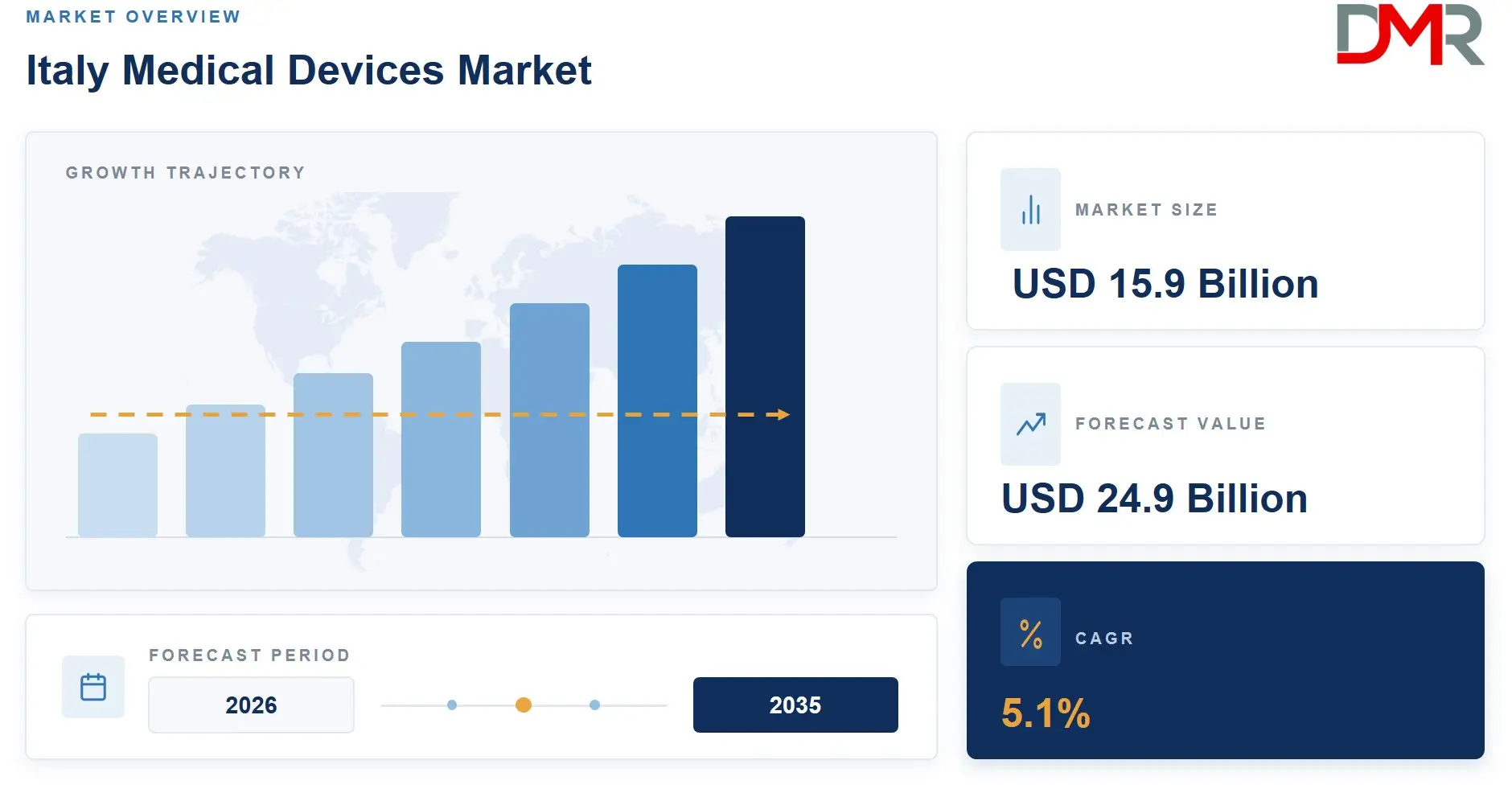
- Italy Medical Devices Market Size in 2026: USD 15.9 Billion
- Italy Medical Devices Market Size in 2035: USD 24.9 Billion
- Italy CAGR from 2026 to 2035: 5.1%
- Diagnostic Devices is the leading product type segment in 2026: 35.5%
- Class II Medical Devices is the leading device class segment in 2026: 44.5%
- Conventional Medical Devices is the leading technology segment in 2026: 46.0%
- Cardiology is the leading application segment in 2026: 19.8%
- Hospitals is the leading end-user segment in 2026: 51.2%
What is the Italy Medical Devices and its Market Size?
The Italy Medical Devices Market was valued at USD 15.9 billion in 2026 and is projected to reach USD 24.9 billion by 2035, expanding at a CAGR of 5.1% during the forecast period. As Europe’s third-largest medical device market, after Germany and France, Italy benefits from a rapidly ageing population, universal healthcare coverage through the decentralized Servizio Sanitario Nazionale (SSN), and substantial public investment under the Piano Nazionale di Ripresa e Resilienza (PNRR). This funding is accelerating hospital modernization, the development of community health centres (Case della Comunità), and the expansion of digital healthcare infrastructure.
ℹ
To learn more about this report –
Download Your Free Sample Report Here
The market is also being reshaped by the implementation of the EU Medical Device Regulation (MDR) 2017/745, incorporated into Italy’s national framework through Legislative Decree No. 137 of 2022. Oversight is led by the Ministry of Health, supported by institutions such as the Istituto Superiore di Sanità (ISS) and notified bodies including IMQ and TÜV Italia. More stringent requirements for clinical evidence, traceability, quality management and post-market surveillance are strengthening patient safety and product quality. However, the resulting compliance costs and certification demands are placing considerable pressure on Italy’s many small and medium-sized medical device manufacturers.
Use Cases
- Regional Teleconsultation Networks for Cardiology in Southern Italy and the Islands: Connected ECG and remote cardiac monitoring devices link peripheral hospitals in Calabria, Sicily, and Sardinia to specialist cardiology hubs in Milan, Rome, and Naples, reducing the need for long-distance patient transfers and addressing persistent north-south disparities in specialist access.
- AI-Assisted Breast and Lung Cancer Screening Programs: Regional screening programs coordinated through AGENAS and regional health authorities deploy AI-enabled mammography and low-dose CT reading software to support radiologists amid a national shortage of specialists, particularly across Lombardy, Lazio, and Veneto.
- Robotic-Assisted Urological and General Surgery in University Hospitals: Leading centers including Policlinico Universitario Agostino Gemelli in Rome, San Raffaele Hospital in Milan, and Careggi University Hospital in Florence are expanding robotic-assisted surgical programs for prostatectomy, colorectal, and gynecological procedures.
- Point-of-Care Diagnostics in Case della Comunità (Community Health Houses): PNRR-funded community health hubs are deploying portable diagnostic and point-of-care testing devices to shift chronic disease monitoring and minor diagnostics closer to home, particularly in underserved rural and inland areas.
Key Takeaways
- Market Size: The Italy Medical Devices Market was valued at USD 15.9 billion in 2026 and is forecast to reach USD 24.9 billion by 2035, expanding at a CAGR of 5.1%, slightly ahead of the broader European average of 5.0%.
- Growth Outlook: Market expansion is sustained by Italy's position as one of the world's most aged societies, a rising burden of cardiovascular disease, cancer, and diabetes, and a historic public-investment cycle under the PNRR aimed at modernizing hospital infrastructure and expanding home- and community-based care.
- Primary Growth Drivers: Strict implementation of the EU MDR, PNRR-funded digitization of the SSN (including the Fascicolo Sanitario Elettronico electronic health record), growing demand for home-based and community care to offset regional hospital-bed shortages, and the international competitiveness of Italy's diagnostics and imaging manufacturing base are key forces accelerating investment.
- By Product Type Analysis: Diagnostic Devices is projected to lead with a 35.5% share in 2026, supported by high utilization of ultrasound, CT, and in-vitro diagnostics across the SSN's extensive screening programs, while Patient Monitoring Devices is expected to post the highest CAGR at 9.4%, driven by remote cardiac and chronic-disease monitoring for an aging, geographically dispersed population.
- By Device Class Analysis: Class II Medical Devices is expected to dominate with a 44.5% share in 2026, reflecting the broad installed base of imaging systems, infusion pumps, and monitoring equipment; Class III Medical Devices is anticipated to grow fastest at a 9.6% CAGR, driven by next-generation implantables and AI-based diagnostic software classified as high-risk under MDR.
- By Technology Analysis: Conventional Medical Devices is poised to hold a 46.0% share in 2026, forming the backbone of a healthcare system still catching up on digitization relative to Germany and France, while AI-Enabled Medical Devices is projected to register the highest CAGR at 13.2%, as regional health authorities scale AI-supported screening and diagnostic imaging.
- By Application Analysis: Cardiology is forecast to command a 19.8% share in 2026, reflecting Italy's high cardiovascular disease burden among its elderly population, while Oncology is expected to register the highest CAGR at 10.1%, propelled by AI-integrated imaging and expanding national cancer screening programs.
- By End-User Analysis: Hospitals are projected to lead with a 51.2% share in 2026, given the SSN's hospital-centric acute-care model, while Home Healthcare Settings is the fastest-growing segment at a 10.9% CAGR, accelerated by PNRR-funded telemonitoring initiatives and the national push to manage chronic disease outside hospital walls.
How AI/Gen AI is Transforming the Medical Devices Market?
Artificial intelligence is reshaping Italy's medical device landscape by shifting AI-enabled software from assistive tools toward autonomous triage and diagnostic support, closely monitored under the EU MDR's software classification rules and guidance from the Ministero della Salute and ISS. Generative AI is being piloted to synthesize training data for rare pathologies, support multi-center research collaboration across Italy's university hospital network, and auto-generate structured radiology reports from unstructured clinical notes, helping ease pressure on a healthcare workforce facing well-documented specialist shortages, particularly in radiology and emergency medicine. AI-enabled software as a medical device (SaMD) is increasingly used in stroke-imaging triage, automatically flagging large vessel occlusions on CT angiography to accelerate treatment at Italy's network of certified stroke units concentrated in Lombardy, Lazio, and Emilia-Romagna.
Key Drivers in the Italy Medical Devices Market
Aging Demographic Profile and Chronic Disease Burden
Italy has one of the oldest populations in the world, with a rising share of residents over 65 and a shrinking working-age base. This demographic profile, combined with a high prevalence of cardiovascular disease, diabetes, cancer, and osteoarticular conditions, is driving sustained demand for diagnostic imaging, cardiac devices, orthopedic implants, diabetes care devices, and home monitoring solutions. Regional health authorities are increasingly prioritizing early diagnosis and preventive screening to manage costs within SSN budgets that vary significantly by region.
PNRR-Funded Modernization and Expansion of Community and Home Care
Italy's National Recovery and Resilience Plan (PNRR) is directing substantial public investment into hospital equipment renewal, digital health infrastructure, and a new network of Case della Comunità and Ospedali di Comunità intended to shift chronic-disease management closer to patients. This is accelerating procurement of diagnostic, monitoring, and connected-care devices across both well-funded northern regions and historically underinvested southern and inland areas, while supporting Italy's broader digital health strategy centered on the Fascicolo Sanitario Elettronico.
Restraints in the Italy Medical Devices Market
Stringent Regulatory Requirements and Notified Body Capacity Constraints
Italy's device market is governed by the EU MDR as transposed through Legislative Decree 137/2019, with oversight from the Ministero della Salute and certification through notified bodies such as IMQ and TÜV Italia. Compliance obligations around clinical evaluation, UDI traceability, and post-market surveillance are particularly burdensome for Italy's large base of small and mid-sized device manufacturers, many concentrated in medical imaging, diagnostics, and orthopedics. Constrained notified body capacity can delay product certification and market entry for smaller domestic players.
Regional Budget Disparities and SSN Cost Pressures
Italy's regionally devolved health system creates significant disparities in procurement capacity between wealthier northern regions such as Lombardy and Veneto and more budget-constrained southern regions. Centralized regional procurement consortia and aggressive tendering practices often prioritize cost efficiency over premium technology adoption, extending replacement cycles for capital-intensive imaging and robotic surgical systems, particularly outside major urban centers.
Growth Opportunities in the Italy Medical Devices Market
Expansion of Connected Care and Home Healthcare Solutions
The PNRR-driven shift toward decentralized care is creating substantial opportunities for connected, wearable, and home-use medical devices, particularly for remote cardiac, glucose, and respiratory monitoring. Demand is strongest among Italy's large elderly population and in regions with dispersed rural populations where hospital access is limited, supporting continued expansion of telemonitoring platforms tied into the national electronic health record.
Growth of Advanced Diagnostics and Regional Cancer Screening Programs
Italy's well-established national cancer screening infrastructure, combined with strong research institutions such as the Istituto Nazionale dei Tumori in Milan and the IRCCS network of scientific research hospitals, is creating demand for molecular diagnostics, digital pathology, and AI-supported imaging tools that can extend early-detection capacity to underserved regions.
Trends in the Italy Medical Devices Market
Integration of Artificial Intelligence in Medical Imaging
AI adoption is accelerating across Italian diagnostic imaging, particularly in oncology and stroke care, as regional health authorities look to AI-enabled triage and workflow tools to offset radiologist and specialist shortages. Investment in digital infrastructure under the PNRR is expected to further support AI-integrated imaging and monitoring platforms.
Increasing Adoption of Robotic and Minimally Invasive Surgery
Robotic-assisted surgery is expanding across Italian university hospitals and private hospital groups such as Gruppo San Donato, GVM Care & Research, and Humanitas, particularly in urology, gynecology, and general surgery, as providers seek to reduce complication rates and hospital stays amid ongoing surgical workforce constraints.
Research Scope and Analysis
The Italy Medical Devices Market is segmented by product type into diagnostic, therapeutic, surgical, patient monitoring devices, and medical consumables, and is further analyzed by device class, technology, application, and end user across hospitals, clinics, diagnostic centers, ASCs, home healthcare, and research institutes.
By Product Type Analysis
Diagnostic Devices are expected to dominate the Italy Medical Devices Market, accounting for 35.5% share in 2026, supported by widespread ultrasound and in-vitro diagnostics use across the SSN's screening infrastructure, with Imaging Devices as the largest sub-category. Patient Monitoring Devices are projected to record the highest growth rate at a 9.4% CAGR through 2035, driven by expansion of telehealth for aging chronic patients.
By Device Class Analysis
Class II Medical Devices are anticipated to hold the largest share at 44.5% in 2026, covering infusion pumps, diagnostic imaging equipment, and monitoring systems widely used across SSN facilities. Class III Medical Devices are forecast to expand fastest at a 9.6% CAGR, linked to growing demand for implantable and advanced therapeutic devices, including next-generation pacemakers and neurostimulation systems.
By Technology Analysis
Conventional Medical Devices are projected to remain dominant with a 46.0% share in 2026, reflecting the SSN's still-substantial reliance on standard diagnostic, therapeutic, and surgical equipment. AI-Enabled Medical Devices are expected to register the highest CAGR at 13.2%, as AI integration into imaging interpretation and clinical decision support scales across regional health systems.
ℹ
To learn more about this report –
Download Your Free Sample Report Here
By Application Analysis
Cardiology is expected to dominate by application, capturing 19.8% of market revenue in 2026, given Italy's high cardiovascular disease prevalence among its elderly population. Oncology is projected to witness the fastest growth at a 9.9%–10.1% CAGR, driven by national screening program expansion and AI-integrated diagnostic imaging.
By End User Analysis
Hospitals are anticipated to hold the largest share at 51.2% in 2026, reflecting the SSN's hospital-centric model for acute and specialist care concentrated in major centers such as Milan, Rome, Turin, and Naples. Home Healthcare Settings are expected to grow fastest at a 10.9% CAGR, propelled by PNRR-funded telemonitoring and community-care initiatives.
The Italy Medical Devices Market Report is segmented based on the following:
- Diagnostic Devices
- Imaging Devices
- X-ray Systems
- Magnetic Resonance Imaging (MRI) Systems
- Computed Tomography (CT) Scanners
- Ultrasound Systems
- Nuclear Imaging Systems
- Others
- In-Vitro Diagnostic (IVD) Devices
- Clinical Chemistry
- Immunoassay
- Molecular Diagnostics
- Hematology
- Microbiology
- Others
- Therapeutic Devices
- Cardiovascular Devices
- Orthopedic Devices
- Respiratory Devices
- Diabetes Care Devices
- Wound Care Devices
- Ophthalmic Devices
- Others
- Surgical Devices
- General Surgical Instruments
- Electrosurgical Devices
- Endoscopic Devices
- Robotic-Assisted Surgical Systems
- Minimally Invasive Surgical Devices
- Others
- Patient Monitoring Devices
- Vital Signs Monitoring
- Cardiac Monitoring
- Neurological Monitoring
- Fetal & Neonatal Monitoring
- Others
- Medical Consumables
- Syringes & Needles
- Catheters
- Bandages & Dressings
- Disposable Gloves
- Others
- Class I (low risk)
- Class II (moderate risk)
- Class III (high risk)
- Class IV (highest risk)
- Conventional Medical Devices
- Connected Medical Devices
- Smart Wearable Medical Devices
- AI-Enabled Medical Devices
- Robotic Medical Devices
- Portable Medical Devices
- Cardiology
- Orthopedics
- Neurology
- Oncology
- Respiratory Care
- Gastroenterology
- Ophthalmology
- Obstetrics & Gynecology
- Others
- Hospitals
- Ambulatory Surgical Centers (ASCs)
- Diagnostic Centers
- Specialty Clinics
- Home Healthcare Settings
- Academic & Research Institutes
- Others
Regulatory Landscape
Italy's medical device regulatory framework operates under the EU Medical Device Regulation (MDR) 2017/745, transposed nationally through Legislative Decree 137/2019, with oversight from the Ministero della Salute's Directorate General for Medical Devices and Pharmaceutical Service. The Istituto Superiore di Sanità (ISS) supports health technology assessment, while notified bodies including IMQ and TÜV Italia handle conformity certification. Regional health authorities (Regioni), coordinated through AGENAS, retain significant autonomy over procurement and reimbursement, creating a more fragmented purchasing landscape than in Germany. This raises certification costs and documentation burdens for Italy's large base of small and mid-sized device manufacturers, while creating opportunities for regulatory consulting and clinical-data service providers.
Investment and White Space Analysis
Italy's medical devices market offers meaningful white-space opportunities in home healthcare, remote monitoring, AI-supported diagnostics, and scalable solutions for underserved southern and inland regions where healthcare infrastructure lags the more developed north. Investment is increasingly directed toward connected devices supporting chronic disease management, aligned with PNRR-funded digital health infrastructure and the national Fascicolo Sanitario Elettronico rollout. Investors must weigh regional budget disparities, regulatory complexity, and long public-tender cycles within the SSN, but companies addressing north-south access gaps and community-care digitization are well positioned for growth.
Competitive Landscape
The Italian Medical Devices Market features a mix of strong domestic diagnostics and imaging specialists alongside major multinational players operating within the EU MDR framework. DiaSorin, headquartered in Saluggia, is a global leader in in-vitro diagnostics and immunoassay technology. Bracco Imaging, based in Milan, holds a leading position in diagnostic contrast media and imaging agents. Esaote, headquartered in Genoa, is a prominent domestic manufacturer of ultrasound and dedicated MRI systems. LivaNova, with strong roots in Milan, maintains a significant global position in cardiac rhythm management and neuromodulation. International players including Medtronic, Siemens Healthineers, GE HealthCare, Philips, Johnson & Johnson MedTech, and Abbott Laboratories maintain substantial commercial operations to compete across this large and technologically engaged market.
Some of the prominent players in the Italy Medical Devices Market are:
- Medtronic
- Abbott Laboratories
- Boston Scientific Corporation
- GE HealthCare
- Siemens Healthineers
- Philips
- Becton, Dickinson and Company
- B. Braun
- Fresenius Medical Care
- Johnson & Johnson MedTech
- Stryker Corporation
- Zimmer Biomet
- Baxter International
- Edwards Lifesciences
- Terumo Corporation
- Smith+Nephew
- Roche Diagnostics
- Danaher Corporation
- Alcon
- EssilorLuxottica
- Carl Zeiss Meditec
- Canon Medical Systems
- Fujifilm Healthcare
- Olympus Corporation
- Drägerwerk
- Getinge
- ResMed
- Intuitive Surgical
- Cook Medical
- Teleflex
- Coloplast
- Convatec
- Mölnlycke Health Care
- Vygon
- bioMérieux
- Guerbet
- Thuasne
- Air Liquide Medical Systems
- Mauna Kea Technologies
- Balt Group
- Other Key Players
Recent Developments
- May 2026: Siemens Healthineers extended availability of its AI Contouring for Eclipse radiation-therapy planning solution across European oncology centers, with early adoption expected among Italy's IRCCS oncology research hospitals.
- February 2026: Italy issued further implementing guidance under Legislative Decree 137/2019 clarifying notified body coordination and reprocessing rules for single-use devices, aligning national practice with EU MDR requirements.
- April 2026: Medtronic announced CE Mark approval for the Stealth AXiS Surgical System, an AI-enabled surgical planning, navigation, and robotic guidance platform for spine, cranial, and ENT procedures, with early adoption anticipated at leading Italian university hospitals.
Report Details
| Report Characteristics |
| Market Size (2026) |
USD 15.9 Billion |
| Forecast Value (2035) |
USD 24.9 Billion |
| CAGR (2026–2035) |
5.1% |
| Historical Data |
2021 – 2025 |
| Forecast Data |
2026 – 2035 |
| Base Year |
2025 |
| Segments Covered |
By Product Type, By Device Class, By Technology, By Application, and By End User |
| Country Coverage |
Italy |
Frequently Asked Questions
How big is the Italy Medical Devices Market?
▾ The Italy Medical Devices Market is estimated at USD 15.9 billion in 2026 and is projected to reach USD 24.9 billion by 2035, reflecting steady demand for diagnostic, therapeutic, and monitoring technologies within Italy's universal SSN system, positioning it as one of the largest medical device markets in Europe.
What is the CAGR of the Italy Medical Devices Market from 2026 to 2035?
▾ The market is projected to expand at a CAGR of approximately 5.1% between 2026 and 2035, modestly ahead of the broader European Medical Devices Market's 5.0% CAGR (from USD 157.7 billion in 2026 to USD 244.4 billion by 2035), supported by an aging population, PNRR-funded modernization, and MDR-driven quality upgrades.
What factors are driving the growth of the Italy Medical Devices Market?
▾ Growth is driven by Italy's aging demographic profile, the rising burden of cardiovascular disease and cancer, PNRR-funded expansion of community and home-based care, and growing adoption of AI-enabled diagnostic platforms to address specialist shortages.
What are the major trends in the Italy Medical Devices Market?
▾ Major trends include AI-enabled imaging triage adoption, expansion of robotic-assisted surgery in private and academic hospital groups, growth of regional cancer screening programs, and PNRR-driven digitization of home and community care.
Who are the key players in the Italy Medical Devices Market?
▾ Key participants include domestic specialists such as DiaSorin, Bracco Imaging, Esaote, and LivaNova, alongside major multinational players including Medtronic, Siemens Healthineers, Philips, Abbott, and Johnson & Johnson MedTech.
How is the Italy Medical Devices Market segmented?
▾ The market is segmented by product type, device class, technology, application, and end user, reflecting Italy's SSN-driven, regionally administered healthcare economy and its diagnostics- and imaging-focused domestic manufacturing base.