Market Snapshot
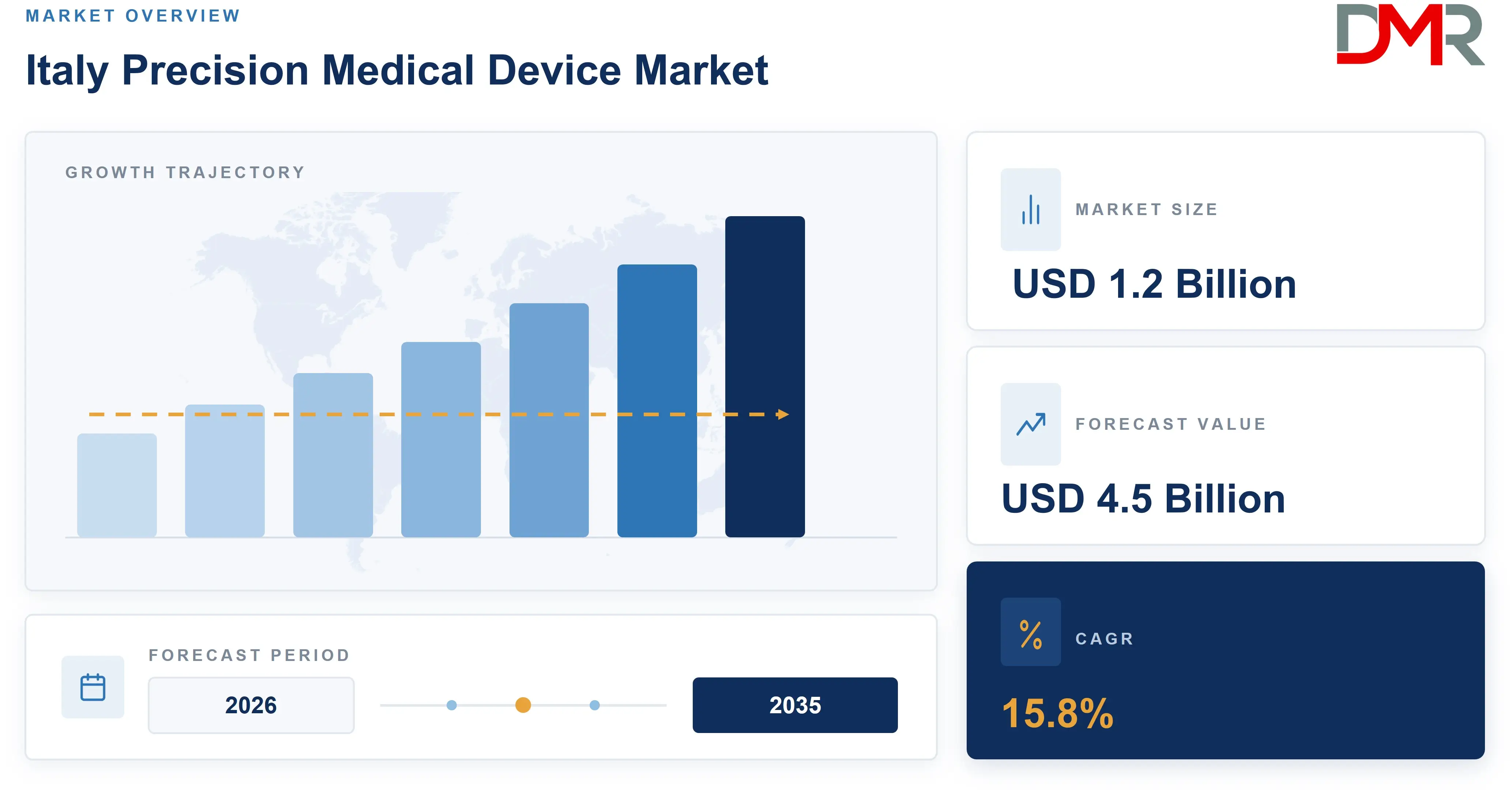
- Market Size (2026): USD 1.2 Bn
- Forecast Value (2035): USD 4.5 Bn
- CAGR (2026-2035): 15.8%
- Leading Product Type (2026): Precision Surgical Instruments, approximately 29%
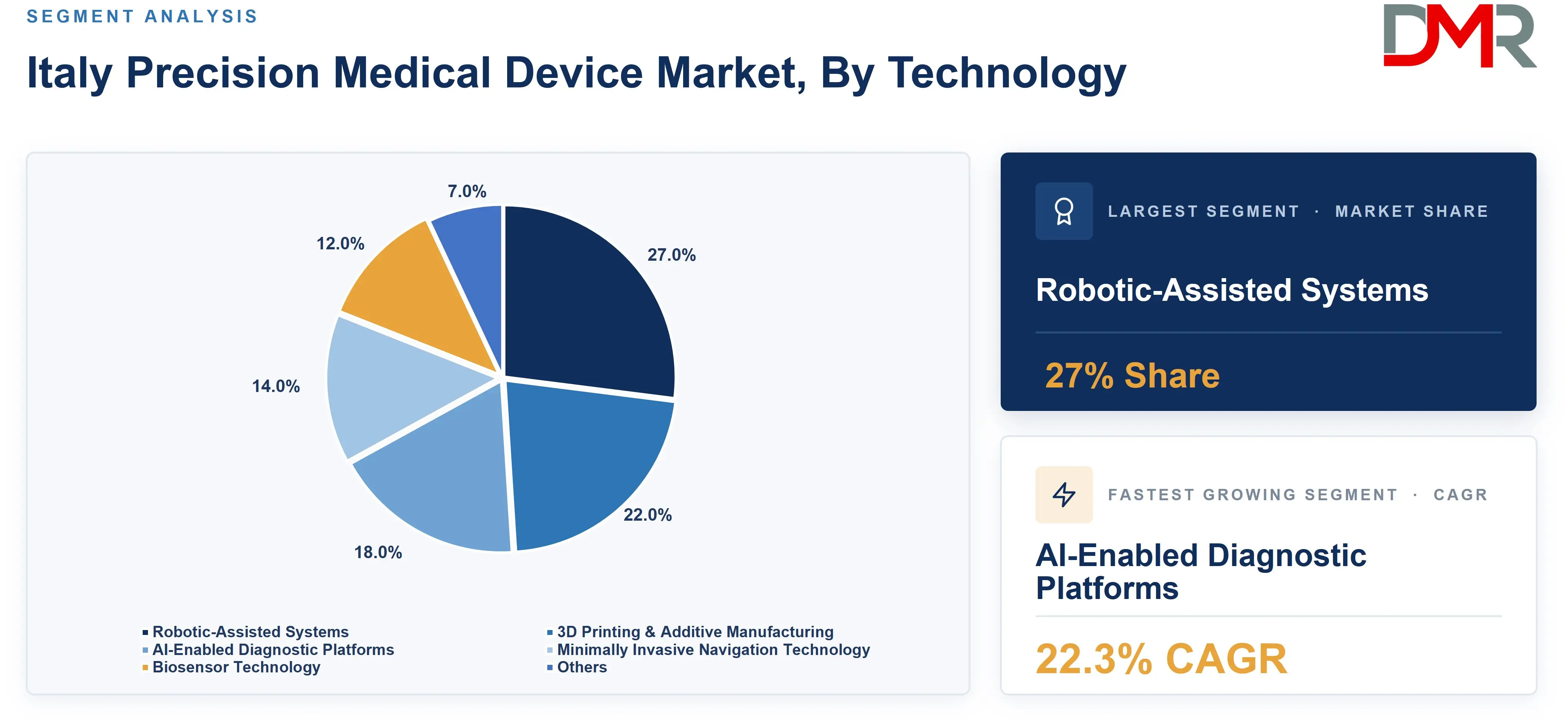
- Leading Technology (2026): Robotic-Assisted Systems, around 27%
- Key Players: Medtronic, Esaote, LivaNova and others
What is Italy Precision Medical Device Market and its Market Size?
The Italy Precision Medical Device Market size is estimated to reach USD 1.2 Bn in 2026 and is further anticipated to reach USD 4.5 Bn by 2035, at a CAGR of 15.8%. The figures quantify demand for precision medical devices consumed inside Italy, not the worldwide revenue booked by device makers headquartered in the country, since several Italian manufacturers sell most of their output abroad.
ℹ
To learn more about this report –
Download Your Free Sample Report Here
Precision medical devices cover instruments, implants and diagnostic systems engineered around patient-specific anatomy, genomic markers or real-time imaging feedback rather than a single standardised design. The category spans robotic-assisted surgical platforms, image-guided navigation systems, 3D-printed orthopedic and cranio-maxillofacial implants, companion diagnostic assays paired with targeted therapies, and wearable sensors that feed continuous physiological data into a treatment plan. What separates a precision device from a conventional one is the closed loop between diagnosis, device configuration and outcome tracking; the device becomes an input to a personalised care pathway rather than a fixed tool.
Buyers cluster around public and private hospital networks, regional health authorities that run centralised tenders, and the ambulatory surgical centres that have absorbed a growing share of orthopedic and ophthalmic procedures once performed on an inpatient basis. Purchasing decisions increasingly sit with clinical procurement committees rather than individual surgeons, since reimbursement now often depends on documented outcome data the device itself must generate. Diagnostic laboratories and academic hospitals with genomic sequencing capacity form a smaller but higher-margin buyer group for companion diagnostic hardware.
Structurally, three forces are reshaping the market: the phased tightening of the EU Medical Device Regulation, which has pushed smaller domestic manufacturers toward consolidation or contract manufacturing partnerships; the maturing of Italy's additive manufacturing supply base around Lombardy and Emilia-Romagna, which has cut lead times for patient-specific implants; and a national digital health push steering hospital capital budgets toward devices that integrate with electronic health record systems rather than standalone hardware.
Use Cases
- Regional Hospital Robotic Orthopedic Suites: Public hospital networks in Lombardy and Veneto deploy robotic-assisted knee and hip replacement platforms to standardise implant placement across surgeons of varying experience, shortening revision rates and letting a single surgical team handle higher case volumes without adding operating room time.
- Community Oncology Companion Diagnostics: Regional cancer centres pair companion diagnostic testing hardware with targeted therapy protocols so treatment selection follows a documented biomarker result rather than clinical judgement alone, a shift that has cut inappropriate prescribing in several Emilia-Romagna oncology units.
- Cranio-Maxillofacial 3D-Printed Implant Workshops: University hospital maxillofacial units in Milan and Bologna work with local additive manufacturing bureaus to turn CT scans into patient-matched titanium implants within days, cutting reliance on imported stock implants that previously extended surgical scheduling by several weeks.
- Ambulatory Cardiac Monitoring Deployment: Private cardiology clinics fit wearable diagnostic patches to outpatients discharged after arrhythmia events, a segment that already accounts for close to 11% of 2026 product-type demand and is expanding as insurers reimburse remote monitoring in place of overnight hospital observation.
Key Takeaways
- Market Size & Share: The market is valued at approximately USD 1.2 Bn in 2026 and is set to reach USD 4.5 Bn by 2035.
- Product Type Analysis: Precision Surgical Instruments remain the leading product-type category in 2026, while Wearable Diagnostic & Monitoring Devices post the fastest growth at a CAGR of 19.6% through 2035.
- Demand Concentration: Northern Italy's hospital and manufacturing clusters in Lombardy, Veneto and Emilia-Romagna account for the majority of national procurement, reflecting the concentration of both tertiary hospitals and device production capacity in the region.
- Regulatory Position: Full application of the EU Medical Device Regulation is expected to keep raising compliance costs for domestic manufacturers through the back half of the decade.
- Technology Shift: Robotic-assisted platforms anchor hospital capital budgets around long-term service and consumable contracts, while AI-enabled diagnostic platforms are expanding fastest, projected at a CAGR of 22.3% through 2035.
- Growth Trajectory: Sustained hospital capital investment and regulatory modernisation are expected to keep the market on a double-digit annual growth path through 2035, outpacing Italy's broader medical device sector.
How AI/Gen AI is Transforming the Italy Precision Medical Device Market?
Artificial intelligence is entering the Italian precision device market mainly through diagnostic image interpretation and surgical planning software bundled with hardware sales, rather than as a standalone product category. Vendors selling into Italian hospital tenders increasingly bundle computer vision models trained to flag anomalies on CT and MRI scans with the imaging hardware itself, shortening radiologist review time in networks that already face reporting backlogs.
Generative design tools are also reshaping how patient-specific implants move from scan to surgery, compressing a design cycle that once required a specialist engineer into a workflow a hospital's own biomedical team can run. Robotic surgical platforms are adding reinforcement-learning-based motion assistance that adjusts instrument trajectories in real time, a capability Italian teaching hospitals are testing ahead of wider clinical rollout.
- Computer Vision Triage: Automated flagging of suspicious findings on radiology and pathology images ahead of specialist review.
- Generative Implant Design: Algorithmic conversion of patient CT data into manufacturable, patient-matched implant geometries.
- Digital Twin Surgical Planning: Pre-operative simulation of implant fit and joint mechanics before a device reaches the operating room.
- Predictive Maintenance Scheduling: Machine learning models that flag robotic platform components approaching failure before they interrupt a surgical list.
Key Drivers in the Italy Precision Medical Device Market
Two forces are pulling most strongly on device demand across Italian hospitals and clinics.
- Ageing Population and Rising Orthopedic Burden: Italy carries one of Europe's oldest population profiles, and the resulting rise in degenerative joint disease and osteoporotic fracture has pushed regional health authorities to expand orthopedic surgical capacity faster than general hospital budgets. Because revision surgery is markedly more expensive than a well-placed primary implant, procurement committees have shifted budget toward robotic-assisted and image-guided systems that improve first-time placement accuracy, even where the upfront device cost runs well above a conventional instrument set. This dynamic underpins Precision Surgical Instruments' position as the leading product-type category in 2026 procurement, a lead that continues to widen as hip and knee procedure volumes rise faster than the surgeon workforce.
- National Digital Health Investment: Italy's National Recovery and Resilience Plan has channelled capital toward hospital digitisation, and regional health authorities increasingly condition device tenders on interoperability with electronic health record systems. Devices that can feed structured outcome data back into a patient record score higher in procurement scoring than functionally similar hardware that cannot, which has accelerated replacement cycles for older diagnostic and monitoring equipment across public hospital networks. The effect is most visible in wearable and remote monitoring categories, where reimbursement increasingly depends on demonstrating a documented reduction in avoidable hospital contact.
Restraints in the Italy Precision Medical Device Market
Two structural brakes temper the pace of adoption.
- Regulatory Compliance Cost Under the EU MDR: The phased tightening of the EU Medical Device Regulation has raised the cost and time required to bring a Class IIb or III precision device to the Italian market, particularly for smaller domestic manufacturers that make up a large share of the country's orthopedic implant base. Several lack the in-house regulatory affairs capacity that larger multinational suppliers maintain, forcing them toward notified-body queues that can stretch approval timelines by a year or more. The result is a consolidation pressure thinning the number of independent domestic implant makers even as clinical demand grows.
- Regional Fragmentation in Procurement: Italy's twenty-one regional health systems run largely independent tender processes, forcing device makers to requalify products and pricing region by region rather than negotiating a single national contract. This fragmentation raises the cost of market entry for smaller specialists and slows the diffusion of newer precision technologies from the wealthier northern regions, where most tertiary hospitals sit, into the south, where capital budgets are tighter and replacement cycles longer.
Growth Opportunities in the Italy Precision Medical Device Market
Two areas of white space stand out for suppliers willing to build local relationships.
- Southern Italy Capacity Build-out: Public investment earmarked for southern regional hospitals under national cohesion funding is starting to close a long-standing capital equipment gap with the north, creating a window for device makers to establish reference sites in Puglia, Campania and Sicily before larger competitors move in. Vendors offering financing or managed-equipment models suited to smaller regional hospital budgets are positioned to capture share in a geography that has historically been underserved.
- Ambulatory Surgical Centre Channel: The shift of orthopedic and ophthalmic procedures out of inpatient hospitals and into private ambulatory surgical centres is opening a distribution channel with different purchasing behaviour, faster decision cycles and less exposure to regional tender bureaucracy. Device makers building direct sales relationships with this channel, rather than routing exclusively through hospital tenders, can capture demand that is growing faster than the inpatient base it is drawing volume from.
Trends in the Italy Precision Medical Device Market
Beyond the demand drivers, the way devices are bought and used is itself shifting.
- Outcome-Linked Procurement: Regional health authorities are experimenting with contracts that tie a portion of device payment to documented clinical outcomes rather than a fixed unit price, pushing vendors to invest in the data infrastructure needed to prove performance rather than compete on list price alone.
- Consolidation Among Domestic Implant Makers: Smaller Italian orthopedic and dental implant manufacturers are increasingly entering distribution or manufacturing partnerships with larger multinational suppliers to absorb MDR compliance costs, a trend quietly concentrating a historically fragmented domestic supplier base.
Research Scope and Analysis
Segment performance across the market is assessed along five axes: product type, technology, application, end user and distribution channel. Each axis identifies the sub-segment holding the largest share of 2026 demand and the one expanding fastest through 2035, along with the commercial logic behind each position.
ℹ
To learn more about this report –
Download Your Free Sample Report Here
By Product Type
Precision Surgical Instruments hold the largest share of 2026 demand, accounting for close to 29% of product-type revenue, since every robotic-assisted or image-guided procedure still requires a matched set of surgeon-facing instruments that cannot be substituted with generic equivalents and that hospitals replace on a fixed sterilisation-driven cycle. Growth, however, is concentrated in Wearable Diagnostic & Monitoring Devices, expanding at a CAGR of 19.6% between 2026 and 2035 as reimbursement policy shifts toward remote monitoring for post-discharge cardiac and orthopedic patients. Falling sensor costs and the spread of smartphone-linked monitoring platforms are pulling this sub-segment into mainstream ambulatory care faster than any other product category, even as instrument sales remain the larger revenue base.
By Technology
Robotic-Assisted Systems account for the largest share of 2026 technology revenue at approximately 27%, reflecting the capital hospitals have already committed to platform installations that lock in years of consumable and service revenue. The steeper trajectory sits with AI-Enabled Diagnostic Platforms, forecast to grow at a CAGR of 22.3% through 2035 as image-analysis software increasingly ships bundled with, rather than separate from, diagnostic imaging hardware. Regional health authorities' push toward interoperable, data-generating equipment is accelerating replacement of legacy diagnostic systems that cannot support structured data export, favouring vendors with a clear AI-enabled upgrade path.
By Application
Orthopedics and musculoskeletal indications lead 2026 application demand with a share of around 26%, underpinned by Italy's ageing population and the resulting volume of joint replacement and fracture-fixation procedures. Growth is steepest in neurology applications, however, set to expand at a CAGR of 20.9% between 2026 and 2035 as image-guided navigation and neurostimulation devices move from a handful of specialist centres into broader tertiary hospital use. Rising diagnosis rates for movement disorders and an expanding base of trained neurosurgical teams are widening the addressable base for these devices faster than orthopedic volumes are growing.
By End User
Hospitals and specialty clinics remain the dominant 2026 end user, holding close to 48% of demand, since major capital equipment purchases and complex procedures continue to route through inpatient and tertiary care settings with the infrastructure to support them. The fastest growth, though, sits with ambulatory surgical centres, projected to post a CAGR of 21.5% through 2035 as reimbursement policy and patient preference continue shifting eligible orthopedic and ophthalmic procedures out of hospital settings. Centres able to demonstrate outcome parity with inpatient care are winning a growing share of regional tender volume once reserved for hospitals.
By Distribution Channel
Direct tender and institutional sales account for the largest share of 2026 channel revenue at approximately 54%, reflecting how regional health authorities centralise purchasing for capital equipment and high-value implants. Online and digital procurement platforms, while still a small base, are the fastest-growing channel, expanding at a CAGR of 24.1% through 2035 as consumable and lower-value diagnostic accessory reordering migrates to hospital e-procurement systems. This shift is freeing clinical procurement staff to focus negotiating capacity on the larger capital contracts that still move through direct tender.
The Italy Precision Medical Device Market Report is Segmented Based on the Following
By Product Type
- Precision Surgical Instruments
- Image-Guided Systems
- Personalized Implants & Prosthetics
- Companion Diagnostic Devices
- Wearable Diagnostic & Monitoring Devices
- Others
By Technology
- Robotic-Assisted Systems
- 3D Printing & Additive Manufacturing
- AI-Enabled Diagnostic Platforms
- Minimally Invasive Navigation Technology
- Biosensor Technology
- Others
By Application
- Orthopedics & Musculoskeletal
- Oncology
- Cardiovascular
- Neurology
- Diagnostics & Screening
- Others
By End User
- Hospitals & Specialty Clinics
- Diagnostic & Imaging Centers
- Ambulatory Surgical Centers
- Academic & Research Institutes
- Others
By Distribution Channel
- Direct Tender / Institutional Sales
- Distributors & Value-Added Resellers
- Online / Digital Procurement Platforms
- Others
Regulatory Landscape
Italy applies the EU Medical Device Regulation directly, administered nationally through the Ministry of Health alongside regional health authority procurement rules that add a further compliance layer on top of CE marking. Notified-body capacity has expanded since the regulation's roughest transition years, but queues remain long enough to delay launch timelines for smaller domestic manufacturers. The commercial opening sits with contract manufacturers and regulatory consultancies that can shepherd a device through certification faster than an in-house team, a service segment growing alongside device volumes. The principal risk is further delay to notified-body throughput, which would keep pushing smaller implant makers toward consolidation and could slow the domestic supply of patient-specific implants precisely as hospital demand for them accelerates.
Technology Analysis
Robotic-assisted platforms and 3D-printing bureaus have moved from pilot installations to routine hospital infrastructure across northern Italy's teaching hospitals, while AI-enabled image analysis is shifting from a research tool to a bundled feature of new diagnostic imaging purchases. What is changing now is the integration layer: hospitals are pushing vendors to make devices interoperable with electronic health record systems rather than accepting standalone platforms, favouring suppliers with strong software development capacity over pure hardware manufacturers. This opens commercial space for domestic additive manufacturing bureaus able to plug directly into hospital scan-to-print workflows. The risk is a widening capability gap between well-capitalised teaching hospitals and smaller regional facilities, which could concentrate technology adoption in a handful of northern clusters and leave southern hospitals reliant on older equipment for longer.
Competitive Landscape
The market is moderately concentrated at the technology-platform level, where a small number of multinational suppliers control robotic surgical systems and advanced imaging hardware, but fragmented at the implant and instrument level, where dozens of domestic manufacturers compete on regional tender price and delivery speed. Competition centres on three levers: platform installation and service contracts that lock hospitals into a vendor's consumable ecosystem for years, regulatory and clinical evidence capacity that determines how quickly a device clears both EU MDR certification and regional tender scoring, and the ability to demonstrate interoperability with hospital data systems. Multinational suppliers compete primarily on platform breadth and service network reach, while domestic manufacturers compete on price, delivery lead time and proximity to regional procurement offices, a dynamic pushing many toward partnership or acquisition by larger players seeking a local manufacturing and distribution footprint.
Some of the Prominent Players in the Italy Precision Medical Device Market Are
- Medtronic
- Stryker
- Johnson & Johnson MedTech
- Siemens Healthineers
- GE HealthCare
- Koninklijke Philips
- Boston Scientific
- Zimmer Biomet
- Abbott Laboratories
- Becton Dickinson
- Intuitive Surgical
- Smith & Nephew
- B. Braun Melsungen
- Olympus Corporation
- Karl Storz
- Brainlab
- Materialise
- Globus Medical
- Hologic
- Elekta
- Dentsply Sirona
- Terumo Corporation
- Esaote
- El.En. Group
- LivaNova
- Amplifon
- DiaSorin
- Tecres
- Intrauma
- Adler Ortho
- Permedica
- Citieffe
- Bioteck
- SIFI
- Cefla
- Villa Sistemi Medicali
- IMS Internazionale Medico Scientifica
- Mectron
- Quanta System
- Deka M.E.L.A.
- Other Key Players
Recent Developments
- In February 2026, Esaote launched a compact MRI system tailored for outpatient orthopedic imaging in regional Italian clinics, extending diagnostic capacity into facilities that previously referred patients to hospital radiology departments.
- In May 2026, Amplifon expanded its precision hearing diagnostics network across northern Italy, integrating AI-assisted fitting software into more than 200 domestic retail centres.
- In September 2025, LivaNova opened an expanded neuromodulation device manufacturing line at its Saluggia facility to meet rising demand from Italian and broader European hospital networks.
- In April 2025, Tecres partnered with a regional hospital network in Veneto to pilot antibiotic-eluting bone cement formulations for joint revision surgery, aiming to cut post-operative infection rates.
- In November 2024, Cefla's medical equipment division introduced an upgraded dental imaging platform with integrated AI caries detection for distribution through Italian dental clinic networks.
Report Details
| Report Characteristics |
| Market Size (2026) |
USD 1.2 Bn |
| Forecast Value (2035) |
USD 4.5 Bn |
| CAGR (2026-2035) |
15.8% |
| Historical Data |
2021 - 2025 |
| Forecast Data |
2026 - 2035 |
| Base Year |
2025 |
| Segments Covered |
By Product Type, By Technology, By Application, By End User and By Distribution Channel |
| Regional Coverage |
Italy |
Frequently Asked Questions
How big is the Italy Precision Medical Device Market?
▾ The Italy Precision Medical Device Market size is estimated at approximately USD 1.2 Bn in 2026 and is projected to reach USD 4.5 Bn by 2035, reflecting sustained hospital investment in robotic-assisted, image-guided and patient-specific device categories across the country's public and private healthcare networks.
What is the growth rate of the Italy Precision Medical Device Market?
▾ The market is forecast to grow at a CAGR of 15.8% between 2026 and 2035, a pace driven by ageing-population orthopedic demand, national digital health investment and the ongoing shift of eligible procedures into ambulatory surgical settings across Italian regional health systems.
What is driving demand in the Italy Precision Medical Device Market?
▾ Demand is driven principally by Italy's ageing population, which is raising orthopedic and cardiovascular procedure volumes, and by national digital health investment steering hospital capital budgets toward devices able to feed structured outcome data back into electronic health record systems, accelerating replacement of older equipment.
Who are the key players in the Italy Precision Medical Device Market?
▾ Key players active in the market include Medtronic, Siemens Healthineers, Esaote, LivaNova, Amplifon, Stryker and Boston Scientific, alongside a broader base of domestic Italian manufacturers supplying orthopedic implants, diagnostic imaging equipment and surgical instrumentation to the country's regional hospital networks.
Which product type leads the Italy Precision Medical Device Market?
▾ Precision Surgical Instruments lead the market's product-type segmentation, accounting for approximately 29% of 2026 demand, reflecting the recurring, sterilisation-driven replacement cycle hospitals maintain for instrument sets used alongside robotic-assisted and image-guided surgical platforms.
Which technology holds the largest share of the Italy Precision Medical Device Market?
▾ Robotic-Assisted Systems hold the largest share of the technology segment, accounting for close to 27% of 2026 revenue, as hospitals continue committing capital to platform installations that anchor years of consumable and service spending.
What is the outlook for the Italy Precision Medical Device Market through 2035?
▾ The Italy Precision Medical Device Market is expected to sustain double-digit growth through 2035 as regulatory modernisation, additive manufacturing capacity and digital health integration continue reshaping how Italian hospitals procure and deploy precision surgical, diagnostic and monitoring devices.