Italy Precision Medicine Market Snapshot
- Italy Precision Medicine Market Size in 2026: USD 2.6 Billion
- Italy Precision Medicine Market Size in 2035: USD 7.1 Billion
- Italy CAGR from 2026 to 2035: 11.8%
- Services is the leading Product segment in 2026: 43.6%
- Gene Sequencing is the leading Technology segment in 2026: 28.9%
- Oncology is the leading Indication segment in 2026: 45.7%
- Diagnostics is the leading Application segment in 2026: 57.2%
- Clinical Laboratories is the leading End User segment in 2026: 47.8%
What is the Italy Precision Medicine and its Market Size?
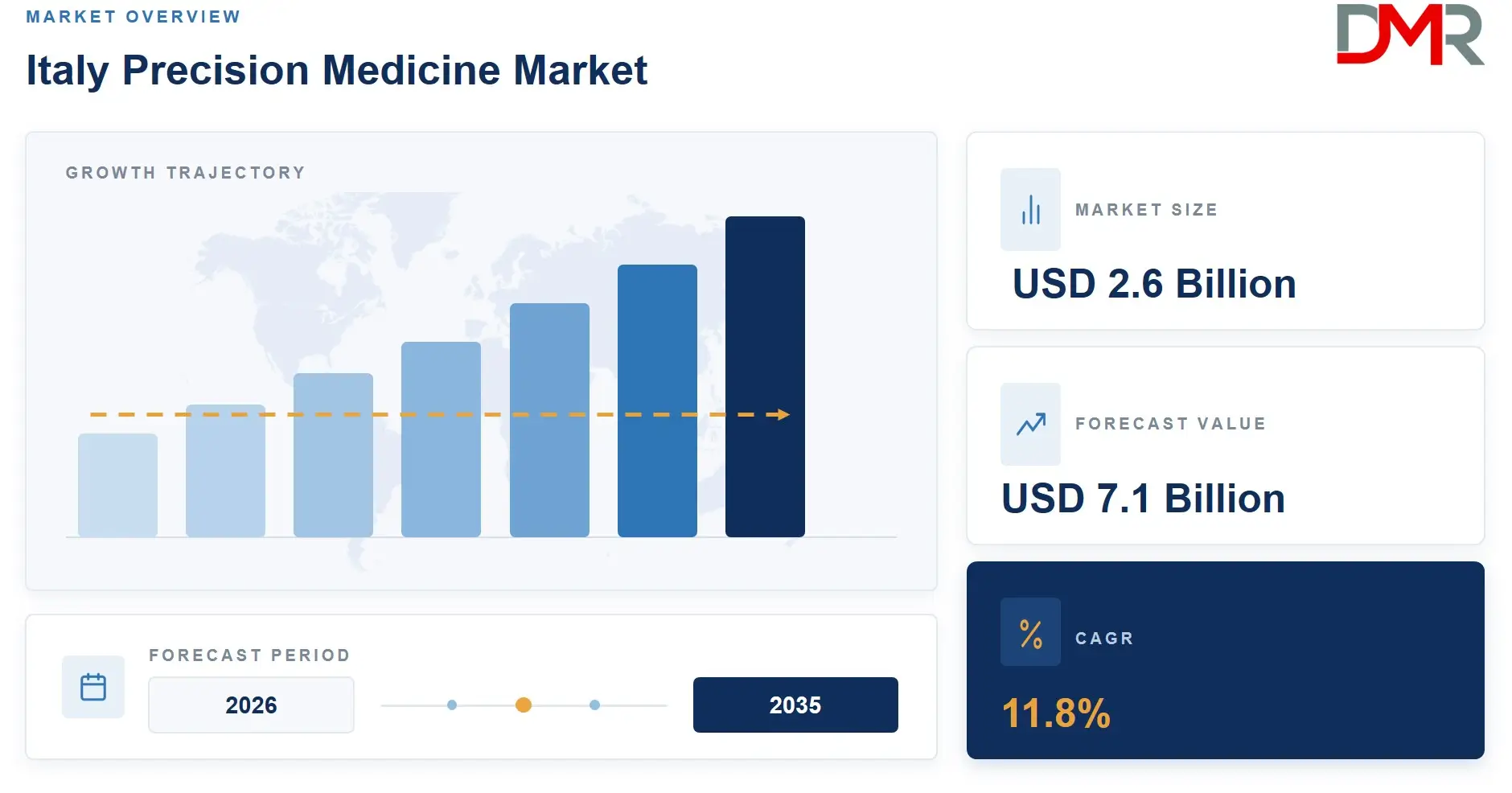
The Italy Precision Medicine Market is projected to be valued at an estimated USD 2.6 billion in 2026 and is projected to reach USD 7.1 billion by 2035, expanding at a CAGR of 11.8% by 2035. Italy's precision medicine ecosystem is anchored by a strong academic and clinical research base, including the Human Technopole genomics and life sciences institute in Milan, the Fondazione IRCCS Istituto Nazionale dei Tumori, leading IRCCS (Istituti di Ricovero e Cura a Carattere Scientifico) research hospitals, and long-standing genetic disease research funded through organizations such as Fondazione Telethon. Growth is being accelerated by national genomics infrastructure investment under the PNRR, expanding oncology biomarker and companion diagnostic adoption within the Servizio Sanitario Nazionale (SSN), and Italy's participation in the broader EU push toward a shared European genomic data infrastructure. The market operates under the EU In Vitro Diagnostic Regulation (IVDR) 2017/746 for genetic tests, companion diagnostics, and biomarker assays, and the EU Medical Device Regulation (MDR) 2017/745 for related instruments, both enforced domestically through the Ministero della Salute.
ℹ
To learn more about this report –
Download Your Free Sample Report Here
Use Cases
- Companion Diagnostic-Guided Oncology Treatment Selection: Italian comprehensive cancer centers use companion diagnostic testing to match breast, lung, and colorectal cancer patients to targeted therapies and monoclonal antibody or inhibitor drug regimens, supported by expanding SSN reimbursement for biomarker-driven treatment pathways.
- Genomic Sequencing for Rare and Genetic Disease Diagnosis: University hospitals and IRCCS research centers use gene sequencing technologies to diagnose rare genetic diseases such as cystic fibrosis and hemophilia, supported by Italy's long-standing genetic disease research and patient advocacy infrastructure built around organizations like Fondazione Telethon.
- Biomarker Testing in CNS Disease Diagnosis and Trial Enrollment: Neurology centers increasingly use biomarker and genetic testing to support earlier and more precise diagnosis of Alzheimer's disease, Parkinson's disease, and multiple sclerosis, and to identify patients eligible for emerging targeted and disease-modifying therapies.
- Direct-to-Consumer and Esoteric Genetic Testing: A growing, though still comparatively small, segment of Italian consumers purchase direct-to-consumer genetic tests for ancestry, carrier screening, and wellness-related insights, typically through private laboratories rather than SSN-reimbursed channels.
Key Takeaways
- Market Size: The Italy Precision Medicine Market is estimated at USD 2.6 billion in 2026 and forecast to reach USD 7.1 billion by 2035, expanding at a CAGR of 11.8%, modestly ahead of the global market's 11.6% CAGR.
- Growth Outlook: Growth is sustained by national genomics infrastructure investment under the PNRR, expanding SSN reimbursement for biomarker-driven oncology care, Italy's strong IRCCS research hospital network, and rising adoption of companion diagnostics and genetic testing across both public and private healthcare channels.
- Primary Growth Drivers: Rising cancer incidence and biomarker-guided treatment adoption, expansion of national genomic sequencing infrastructure, growing integration of bioinformatics and big data analytics into clinical research, and increasing patient and physician awareness of genetic and genomic testing options.
- By Product Analysis: Services is projected to lead with a 43.6% share in 2026, reflecting the dominance of sequencing, testing, and bioinformatics analysis services over capital equipment purchases, while Consumables is expected to post the highest CAGR at 13.6%, driven by recurring reagent and assay kit demand tied to rising testing volumes.
- By Technology Analysis: Gene Sequencing is projected to lead with a 28.9% share in 2026, while Companion Diagnostics is expected to see the fastest growth at 14.3% CAGR, driven by expanding targeted oncology therapy adoption.
- By Indication Analysis: Oncology is projected to dominate with a 45.7% share in 2026, while CNS Disorders is expected to be the fastest-growing indication category at 13.4% CAGR, driven by advancing Alzheimer's disease biomarker diagnostics and disease-modifying therapy development.
- By Application Analysis: Diagnostics is projected to lead with a 57.2% share in 2026, while Therapeutics, particularly Cell & Gene Therapy, is expected to post the fastest CAGR at 15.1%.
- By End-User Analysis: Clinical Laboratories is projected to lead with a 47.8% share in 2026, while Home Care is expected to be the fastest-growing end-user segment at 14.2% CAGR, driven by rising direct-to-consumer and at-home sample collection testing models.
How AI/Gen AI is Transforming the Precision Medicine Market?
Artificial intelligence is playing an increasingly central role in Italian precision medicine, particularly in bioinformatics pipelines used to interpret genomic sequencing data, where AI-assisted variant calling and annotation tools help researchers and clinicians identify clinically actionable mutations more quickly and consistently. AI-enabled image analysis is increasingly paired with digital pathology and radiomics data to support biomarker discovery in oncology, while machine learning models trained on large clinical and genomic datasets supported by national data infrastructure investment through Human Technopole and PNRR-funded initiatives are being used to identify patient subgroups likely to respond to specific targeted therapies. Generative AI is also beginning to support literature review and evidence synthesis for precision oncology tumor board decision-making, helping Italian multidisciplinary teams process the rapidly expanding volume of biomarker and targeted therapy research.
Key Drivers in the Italy Precision Medicine Market
Rising Cancer Incidence and Biomarker-Guided Treatment Adoption
Italy’s ageing population and increasing cancer burden are strengthening demand for companion diagnostics and biomarker testing used to select targeted treatments. Adoption is particularly strong in breast, lung, colorectal, and hematological cancers, where molecular profiles increasingly influence therapeutic decisions. Expanding SSN reimbursement for biomarker-guided therapies and wider deployment of next-generation sequencing panels at comprehensive cancer centres support market growth. Pharmaceutical companies are also incorporating companion diagnostics into clinical development and commercialization strategies. However, testing availability and turnaround times vary regionally. Continued guideline adoption, laboratory standardization, and reimbursement expansion should reinforce oncology as the largest application and a central driver of precision medicine investment.
National Genomics Infrastructure Investment
Italy is expanding its genomics and life sciences infrastructure through institutions such as Human Technopole in Milan and research programs supported by the National Recovery and Resilience Plan. Investments in sequencing platforms, biobanks, interoperable clinical databases, and bioinformatics capabilities are strengthening the country’s precision medicine ecosystem. Greater infrastructure capacity could reduce genomic testing costs, shorten turnaround times, and improve access to clinically actionable information. It also creates collaboration opportunities for diagnostic companies, biotechnology developers, hospitals, and research institutions. Challenges include data interoperability, cybersecurity, workforce shortages, and regional implementation differences. Successful coordination could accelerate genomic research and translate discoveries into routine clinical applications nationwide.
Strong Academic and IRCCS Research Hospital Network
Italy’s network of IRCCS research hospitals, university medical centres, and comprehensive cancer institutions provides a strong foundation for precision medicine development and adoption. These organizations combine clinical care with translational research, enabling biomarker discovery, genomic testing, patient stratification, and enrollment in trials for targeted therapies and cell and gene treatments. Their specialist expertise supports evidence generation and the validation of new diagnostic technologies. Partnerships with pharmaceutical, biotechnology, and diagnostic companies create additional commercialization opportunities. However, research capacity remains geographically concentrated, and translating findings into routine regional practice can be slow. Stronger data sharing and multicentre collaboration could broaden precision medicine adoption across the SSN.
Restraints in the Italy Precision Medicine Market
Regional Variation in Access to Advanced Diagnostic Testing
Access to advanced genomic sequencing, molecular pathology, and companion diagnostic testing varies substantially across Italy. Leading infrastructure and specialist expertise are concentrated in northern and central university hospitals, IRCCS institutions, and comprehensive cancer centres, while patients in southern and island regions may encounter longer waiting times, fewer testing options, and additional travel requirements. Differences in regional healthcare budgets, procurement practices, laboratory capacity, and reimbursement policies reinforce these inequalities. This fragmentation can delay diagnosis and biomarker-guided treatment selection. Expanding referral networks, telepathology, regional sequencing hubs, and standardized national eligibility criteria would improve access and create a more consistent market for precision diagnostic technologies across Italy.
Reimbursement and Regulatory Complexity Under IVDR
Companion diagnostics, genetic tests, and biomarker assays are regulated under the EU In Vitro Diagnostic Regulation 2017/746, which imposes stricter requirements for clinical evidence, performance evaluation, quality management, and notified-body certification. These obligations can extend development timelines, increase compliance expenditure, and create market-entry barriers, particularly for smaller diagnostic companies and laboratory-developed tests. Manufacturers must also navigate Italy’s national and regional health technology assessment, procurement, and reimbursement processes. Delays in reimbursement decisions may restrict patient access even after regulatory authorization. Companies offering robust clinical utility evidence, cost-effectiveness data, compliant quality systems, and stakeholder engagement strategies will be better positioned to achieve adoption within the SSN.
Growth Opportunities in the Italy Precision Medicine Market
Expansion of National Sequencing and Biobanking Infrastructure
Continued investment in genomic sequencing, biobanking, and integrated clinical data systems creates substantial opportunities for Italy’s precision medicine market. Expanded capacity can support population research, rare disease diagnosis, oncology profiling, pharmacogenomics, and development of clinically validated biomarkers. Public institutions may partner with diagnostic laboratories, technology companies, cloud providers, and bioinformatics specialists to establish scalable testing and analysis networks. Regional sequencing hubs could reduce access disparities and improve turnaround times for underserved populations. Key challenges include standardized consent, sample quality, data interoperability, cybersecurity, and sustainable funding after PNRR programs conclude. Effective national coordination could transform research infrastructure into routine diagnostic capacity and accelerate personalized treatment adoption.
Growth of Cell and Gene Therapy and Targeted Oncology Pipelines
Italy’s participation in European and international clinical development for targeted medicines, cell therapies, and gene therapies creates significant opportunities for precision diagnostics. These treatments frequently require genomic profiling, companion testing, patient stratification, and longitudinal monitoring to identify eligible patients and assess therapeutic response. Growing SSN acceptance of high-cost therapies for clearly defined biomarker-positive populations could support adoption, particularly in oncology, hematology, and rare diseases. Opportunities extend to sequencing laboratories, assay developers, bioinformatics companies, biobanks, and specialized treatment centres. Nevertheless, complex manufacturing, uncertain long-term outcomes, affordability concerns, and outcome-based reimbursement requirements could limit commercialization unless developers demonstrate durable clinical and economic value.
Trends in the Italy Precision Medicine Market
Integration of Bioinformatics and Big Data Analytics into Clinical Care
Italian research hospitals and diagnostic laboratories are increasingly incorporating bioinformatics, artificial intelligence, and big data analytics into routine precision medicine workflows. These tools help interpret sequencing results, identify clinically relevant variants, integrate molecular and clinical information, and support treatment recommendations in oncology and rare diseases. Multidisciplinary molecular tumour boards are becoming important users of these capabilities. Opportunities exist for interoperable software, secure cloud infrastructure, automated reporting, and clinical decision-support platforms. Major risks include algorithmic bias, inconsistent data quality, limited explainability, cybersecurity exposure, and shortages of trained bioinformaticians. Clinical validation and human oversight will remain essential as data-driven tools move beyond research applications.
Rising Adoption of Direct-to-Consumer and Home-Based Testing Models
Direct-to-consumer genetic testing and home-based sample collection are gradually gaining interest in Italy, reflecting demand for convenient access to ancestry, wellness, disease-risk, reproductive health, and pharmacogenomic information. Digital platforms and mailed saliva or blood collection kits can broaden participation beyond specialist centres and generate new commercial channels for laboratories. Nevertheless, clinical adoption remains limited by privacy concerns, uncertain analytical quality, misleading interpretations, limited genetic counselling, and unclear pathways for integrating consumer results into medical records. Providers that offer validated assays, GDPR-compliant data handling, transparent limitations, physician involvement, and access to qualified counselling can build trust and support responsible market expansion.
Research Scope and Analysis
Market is segmented by product into consumables, instruments, and services; by technology into bioinformatics, drug discovery, big data analytics, gene sequencing, companion diagnostics, and others; by indication; by application into therapeutics and diagnostics; and by end user into laboratories, home care settings, hospitals, and others.
By Product Analysis
Services is projected to lead the product segmentation with an estimated 43.6% share in 2026, reflecting the dominance of sequencing services, laboratory testing services, and bioinformatics analysis services over standalone capital equipment or consumable sales, consistent with the broader global pattern in which most healthcare providers and research institutions outsource complex sequencing and analysis work to specialized service providers rather than building in-house capacity. Consumables, including reagents, sequencing kits, and assay components, is projected to post the fastest CAGR among product categories at 13.6%, driven by recurring, volume-linked demand as testing throughput expands across both research and clinical care settings.
By Technology Analysis
Gene Sequencing is projected to lead the technology segmentation with an estimated 28.9% share in 2026, reflecting its foundational role across oncology, rare disease, and pharmacogenomic testing applications. Within gene sequencing, Sequencing by Synthesis remains the dominant sub-technology given its established clinical validation and widespread platform availability, while Nanopore Sequencing is expected to be the fastest-growing sequencing sub-technology as its long-read capabilities gain clinical traction for structural variant and complex genomic rearrangement detection. Companion Diagnostics is projected to post the fastest overall technology-segment CAGR at 14.3%, directly tied to the expansion of targeted oncology therapy approvals requiring biomarker-based patient selection.
ℹ
To learn more about this report –
Download Your Free Sample Report Here
By Indication Analysis
Oncology is projected to dominate the indication segmentation with an estimated 45.7% share in 2026, with Breast Cancer representing the largest individual oncology sub-indication given Italy's well-established national breast cancer screening infrastructure and correspondingly high biomarker testing volume, followed by Lung Cancer and Colorectal Cancer, both of which have seen substantial growth in companion diagnostic and targeted therapy adoption in recent years. CNS Disorders, encompassing Alzheimer's Disease, Parkinson's Disease, and Multiple Sclerosis, is projected to be the fastest-growing indication category at 13.4% CAGR, driven by advancing biomarker diagnostics for earlier and more precise Alzheimer's disease diagnosis and a growing pipeline of disease-modifying neurological therapies requiring biomarker-based patient selection.
By Application Analysis
Diagnostics is projected to lead the application segmentation with an estimated 57.2% share in 2026, reflecting the market's current concentration in genetic tests, biomarker testing, and esoteric testing used to guide diagnosis and treatment selection, rather than the therapeutics themselves. Within diagnostics, Biomarker Testing and Genetic Tests represent the largest sub-application categories, while Direct-to-Consumer Test remains a smaller but growing niche. Therapeutics, comprising Inhibitor Drugs, Monoclonal Antibodies, Cell & Gene Therapy, and Antiviral & Antiretroviral Drugs, represents the smaller but faster-growing application category overall, with Cell & Gene Therapy specifically projected to be the fastest-growing therapeutic sub-application at 15.1% CAGR, reflecting Italy's growing participation in advanced therapy clinical development and expanding SSN reimbursement willingness for high-cost, biomarker-selected cell and gene therapies.
By End User Analysis
Clinical Laboratories are projected to lead end-user segmentation with an estimated 47.8% share in 2026, reflecting their central role in processing the large majority of genetic, biomarker, and companion diagnostic testing volume across both SSN-affiliated and private laboratory networks. Hospitals represent the second-largest end-user segment, particularly IRCCS research hospitals and university medical centers with integrated genomics and precision oncology programs. Home Care is projected to be the fastest-growing end-user segment at 14.2% CAGR, driven by expanding at-home sample collection models supporting both direct-to-consumer genetic testing and remote biomarker monitoring for chronic disease management, an application area benefiting from Italy's broader PNRR-funded shift toward home- and community-based care delivery.
The Italy Precision Medicine Market Report is segmented based on the following:
By Product
- Consumables
- Instruments
- Services
By Technology
- Bioinformatics
- Drug Discovery
- Big Data Analytics
- Gene Sequencing
- Sequencing by Synthesis
- Ion Semiconductor Sequencing
- Sequencing by Ligation
- Pyrosequencing
- Single-Molecule Real-Time Sequencing
- Chain-Termination Sequencing
- Nanopore Sequencing
- Companion Diagnostics
- Other Technologies
By Indication
- Oncology
- Breast Cancer
- Lung Cancer
- Colorectal Cancer
- Central Nervous System Disorders
- Alzheimer’s Disease
- Parkinson’s Disease
- Multiple Sclerosis
- Respiratory Diseases
- Asthma
- Chronic Obstructive Pulmonary Disease
- Skin Diseases
- Immunological Diseases
- Autoimmune Disorders
- Inflammatory Diseases
- Genetic Diseases
- Cystic Fibrosis
- Hemophilia
- Other Indications
By Application
- Therapeutics
- Inhibitor Drugs
- Monoclonal Antibodies
- Cell and Gene Therapy
- Antiviral and Antiretroviral Drugs
- Other Therapeutics
- Diagnostics
- Genetic Tests
- Direct-to-Consumer Tests
- Esoteric Tests
- Biomarker Testing
- Other Diagnostics
By End User
- Clinical Laboratories
- Home Care Settings
- Hospitals
- Other End Users
Regulatory Landscape
Italy’s precision medicine market is shaped by the EU In Vitro Diagnostic Regulation, General Data Protection Regulation, clinical trial requirements, and national and regional reimbursement frameworks. Increasing evidence standards for companion diagnostics, genetic tests, and biomarker assays are improving reliability but extending approval timelines and raising development costs. Opportunities exist for companies offering clinically validated tests, compliant data platforms, and robust post-market surveillance. However, fragmented regional procurement, complex health technology assessments, data-sharing restrictions, and limited reimbursement for novel diagnostics may constrain adoption. Companies that demonstrate clinical utility, cost-effectiveness, interoperability, and regulatory compliance can secure stronger partnerships with SSN hospitals, research institutions, pharmaceutical developers, and diagnostic laboratories across Italy.
Technology Analysis
Italy’s precision medicine market is advancing through next-generation sequencing, companion diagnostics, bioinformatics, artificial intelligence, digital pathology, and integrated clinical data platforms. These technologies enable biomarker discovery, patient stratification, targeted therapy selection, and monitoring across oncology, rare diseases, neurology, and immunology. PNRR-supported infrastructure and Italy’s IRCCS research network create opportunities for scalable sequencing, decentralized testing, molecular tumor boards, and public-private research partnerships. Key risks include inconsistent data quality, limited interoperability, cybersecurity threats, algorithmic bias, specialist workforce shortages, and high implementation costs. Providers combining validated analytics, explainable AI, secure cloud architecture, and clinician oversight can reduce diagnostic turnaround times, improve treatment precision, expand testing access, and strengthen competitive differentiation
.Competitive Landscape
The Italy Precision Medicine Market features a mix of multinational diagnostics, sequencing, and pharmaceutical companies alongside Italian academic and research institutions that play an outsized role in the market given the country's IRCCS-centered research hospital model. Multinational players including Roche Diagnostics, Illumina, Thermo Fisher Scientific, QIAGEN, Agilent Technologies, and Bio-Rad Laboratories maintain significant commercial operations supplying sequencing platforms, companion diagnostic assays, and bioinformatics tools to Italian research and clinical laboratories. Domestic and Italy-linked contributors include Human Technopole, leading IRCCS research hospitals such as Istituto Nazionale dei Tumori and Ospedale San Raffaele, and genetic disease research organizations such as Fondazione Telethon, which play a central role in both clinical adoption and translational research supporting the broader precision medicine ecosystem.
Some of the prominent players in the Italy Precision Medicine Market are:
- Roche
- Novartis
- Pfizer
- AstraZeneca
- Merck & Co.
- Bristol Myers Squibb
- Eli Lilly and Company
- AbbVie
- Amgen
- Bayer
- Sanofi
- GSK
- Janssen Pharmaceuticals
- Takeda Pharmaceutical
- Illumina
- Thermo Fisher Scientific
- QIAGEN
- Abbott Laboratories
- Agilent Technologies
- Bio-Rad Laboratories
- Danaher Corporation
- Siemens Healthineers
- GE HealthCare
- DiaSorin
- Menarini Group
- Foundation Medicine
- Guardant Health
- Exact Sciences
- Myriad Genetics
- SOPHiA GENETICS
- Igenomix
- Dante Omics
- GenomSys
- Eurofins Scientific
- Synlab
- Cerba HealthCare
- TOMA Advanced Biomedical Assays
- Genenta Science
- Altheia Science
- Netgenomics
- Other Key Players
Recent Developments
- December 2025: Guardant Health and Policlinico Gemelli launched FPG 360, an in-house liquid-biopsy testing service in Rome based on Guardant360 CDx technology. The facility expands local access to comprehensive genomic profiling for precision oncology and reduces reliance on overseas sample processing.
- December 2025: HEAL Italia launched the pilot network of Digital Precision Medicine Centers, supported by more than 600 researchers and clinicians across 21 regions, over 250 studies, biobanks, advanced laboratories, and artificial-intelligence platforms.
- September 2025: Results from Italy’s nationwide ROME trial showed that genomic profiling and molecular-tumor-board-guided therapy improved response rates and progression-free survival compared with standard care in patients with advanced solid tumors.
Report Details
| Report Characteristics |
| Market Size (2026) |
USD 15.9 Billion |
| Forecast Value (2035) |
USD 24.9 Billion |
| CAGR (2026–2035) |
5.1% |
| Historical Data |
2021 – 2025 |
| Forecast Data |
2026 – 2035 |
| Base Year |
2025 |
| Segments Covered |
By Product Type, By Device Class, By Technology, By Application, and By End User |
| Country Coverage |
Italy |
Frequently Asked Questions
How big is the Italy Precision Medicine Market?
▾ The Italy Precision Medicine Market is estimated at USD 2.6 billion in 2026 and is projected to reach USD 7.1 billion by 2035, growing modestly faster than the global precision medicine market as Italy expands national genomics infrastructure and biomarker-driven oncology care.
What is the CAGR of the Italy Precision Medicine Market from 2026 to 2035?
▾ The market is projected to expand at a CAGR of 11.8% between 2026 and 2035, broadly in line with the global precision medicine market's 11.6% CAGR (global market projected to grow from USD 83.9 billion in 2024 to USD 225.7 billion by 2033), supported by rising cancer incidence, PNRR-funded genomics infrastructure investment, and Italy's strong IRCCS research hospital network.
What factors are driving the growth of the Italy Precision Medicine Market?
▾ Growth is driven by rising cancer incidence and biomarker-guided treatment adoption, national genomics infrastructure investment through Human Technopole and the PNRR, Italy's strong academic and IRCCS research hospital network, and growing integration of bioinformatics and big data analytics into clinical care.
What are the major trends in the Italy Precision Medicine Market?
▾ Major trends include growing integration of bioinformatics and big data analytics directly into clinical workflows, and rising adoption of direct-to-consumer and home-based genetic and biomarker testing models.
Who are the key players in the Italy Precision Medicine Market?
▾ Key participants include multinational diagnostics and sequencing companies such as Roche Diagnostics, Illumina, Thermo Fisher Scientific, and QIAGEN, alongside Italian research institutions including Human Technopole and leading IRCCS research hospitals.
How is the Italy Precision Medicine Market segmented?
▾ The market is segmented by product, technology, indication, application, and end user, with oncology-focused biomarker testing and companion diagnostics forming the largest and most established segments within Italy's SSN-anchored healthcare system.