Market Overview
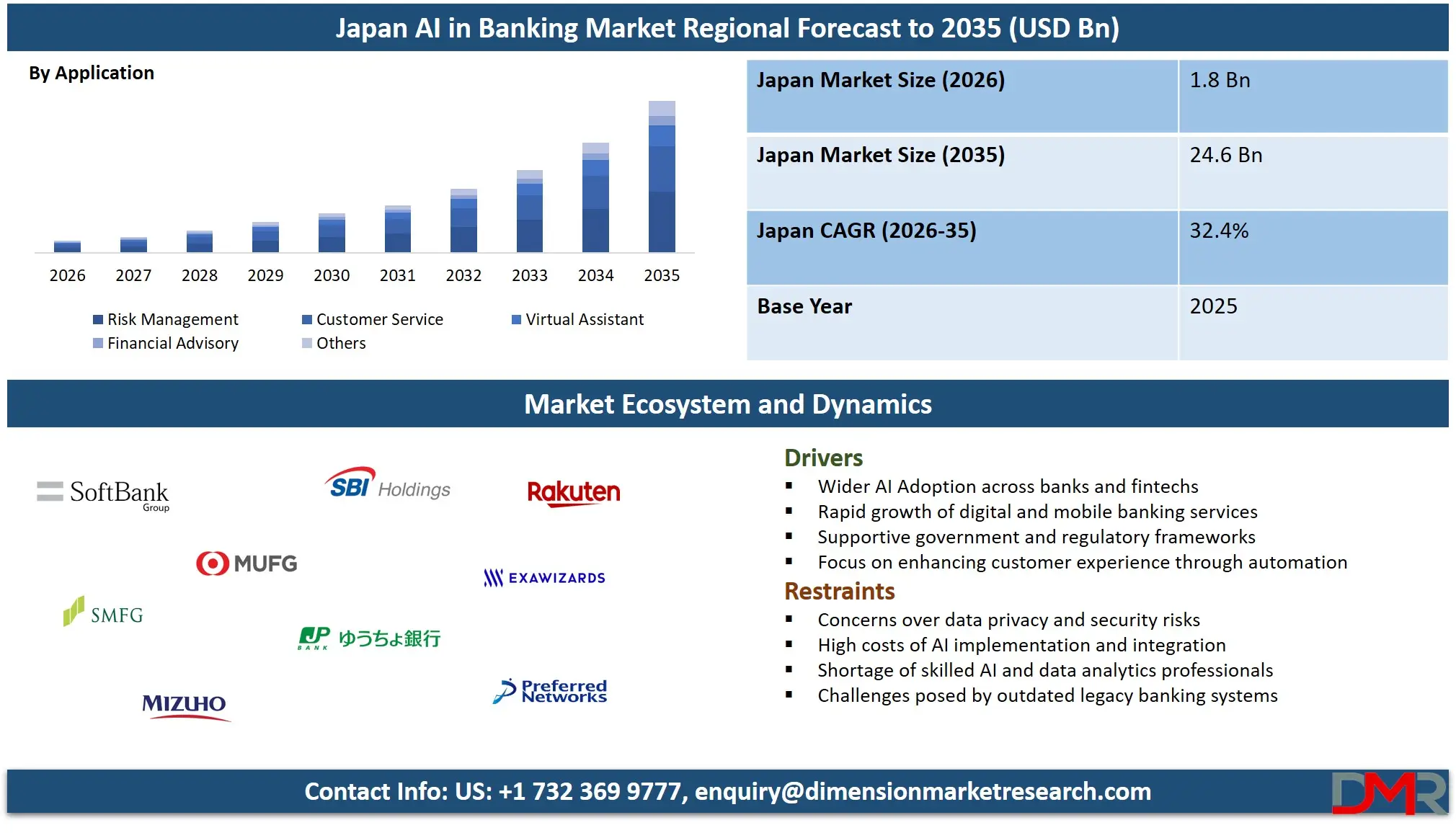
The Japan AI in banking market is forecasted to reach USD 1.8 billion in 2026 and expand at a robust CAGR of 34.2%, driven by increasing adoption of intelligent automation, AI-powered analytics, digital banking solutions, and fintech innovations, reaching an estimated market size of USD 24.6 billion by 2035.
ℹ
To learn more about this report –
Download Your Free Sample Report Here
Artificial intelligence in banking refers to the integration of advanced machine learning algorithms, natural language processing, robotic process automation, and predictive analytics into banking operations to improve efficiency, accuracy, and customer engagement. It enables financial institutions to automate routine tasks such as transaction processing, fraud detection, credit scoring, and compliance monitoring while providing personalized financial advice, chat-based customer support, and intelligent risk management solutions. By leveraging AI, banks can enhance decision-making, optimize operational costs, detect anomalies in real-time, and deliver more responsive and tailored services to meet the evolving expectations of customers in an increasingly digital financial ecosystem.
The Japan AI in banking market is experiencing rapid expansion as traditional financial institutions and fintech startups adopt intelligent automation and cognitive computing solutions to transform their services. The market encompasses a wide range of applications including customer service optimization, fraud detection, credit assessment, risk management, and digital payment solutions. Major players are investing heavily in research and development to integrate artificial intelligence into mobile banking platforms, virtual assistants, and predictive analytics tools, allowing them to respond proactively to consumer behavior and regulatory requirements.
ℹ
To learn more about this report –
Download Your Free Sample Report Here
The growth of the market is supported by increasing smartphone penetration, the rising adoption of cashless payments, and a strong government push towards digital transformation within the financial sector. Japanese banks are also leveraging AI-driven analytics to improve portfolio management, detect financial crimes, and enhance operational efficiency, while collaborations between technology providers and financial institutions are accelerating innovation in areas such as blockchain-based payments and AI-powered investment advisory services. The combination of robust technological infrastructure and a progressive regulatory environment positions Japan as a key market for AI in banking solutions across Asia.
Japan AI in Banking Market: Key Takeaways
- Rapid Market Expansion: The Japan AI in banking market is projected to grow from USD 1.8 billion in 2026 to USD 24.6 billion by 2035, reflecting strong adoption of AI-driven solutions across financial institutions.
- High Adoption among Large Enterprises: Large banks are expected to capture 67% of the market share in 2026, highlighting their ability to invest in advanced AI platforms and scale implementations across multiple operations.
- Solution Components Lead: Solution-type AI applications dominate the market with a 59% share in 2026, indicating banks’ preference for software and platforms that automate risk management, credit scoring, and investment advisory.
- NLP Dominance in Technology: Natural language processing accounts for 41% of the technology segment, showing widespread deployment in customer service automation, virtual assistants, and compliance monitoring.
- Growing AI Utilization in Operations: By 2025, over 70% of Japanese financial firms were engaged in AI adoption, including pilots and active implementations, demonstrating rapid integration of machine learning, predictive analytics, and intelligent automation.
Japan AI in Banking Market: Use Cases
- Fraud Detection and Risk Management: AI-driven systems help Japanese banks identify suspicious transactions, prevent financial crimes, and assess credit and operational risks in real-time. Machine learning models analyze large datasets to detect anomalies and reduce potential losses, enhancing overall security and compliance.
- Customer Service Automation: Banks in Japan are deploying AI-powered chatbots and virtual assistants to provide instant support, answer queries, and guide users through digital banking platforms. This improves customer engagement, reduces response times, and lowers operational costs.
- Credit Scoring and Loan Management: Artificial intelligence enables precise credit assessment by analyzing financial histories, behavioral patterns, and alternative data sources. This helps lenders make faster, more accurate loan decisions while reducing default risks.
- Personalized Banking and Investment Solutions: AI algorithms analyze customer behavior and transaction data to offer tailored financial advice, investment recommendations, and personalized product offerings. This enhances customer satisfaction and drives digital banking adoption.
Japan AI in Banking Market: Stats & Facts
- Bank of Japan — Financial System Reports & Surveys
- In 2025, 50.3% of Japanese banks and credit unions reported actively using generative AI technology in operations, up from 31.0% in 2024.
- When including institutions trialing AI, over 70% of financial firms were engaged with AI use as of the 2025 survey period.
- A 2025 Bank of Japan survey on generative AI covered responses from 153 financial institutions.
- The 2025 survey was the second consecutive annual survey on generative AI use, with the first conducted in 2024.
- National Cashless / Payment Transition Data
- The cashless payment ratio in Japan rose to 39.3% in 2023.
- Cashless payment ratio further increased to 42.8% in 2024, surpassing the government’s 40% target.
- In 2024, the proportion of cashless payments exceeded 50% of personal consumption, excluding imputed rent.
Japan AI in Banking Market: Market Dynamic
Driving Factors in the Japan AI in Banking Market
Rising Digital Banking Adoption
The growing use of mobile banking and online financial services in Japan is accelerating AI implementation. Banks are leveraging machine learning, predictive analytics, and intelligent automation to deliver seamless digital experiences, reduce operational costs, and improve service efficiency.
Advanced AI and Analytics Infrastructure
The availability of sophisticated AI platforms, cloud computing, and big data analytics tools enables Japanese financial institutions to deploy predictive models, real-time fraud detection systems, and personalized banking solutions, driving market expansion and technology integration.
Restraints in the Japan AI in Banking Market
Data Privacy and Security Concerns
Stringent regulations around customer data and increasing cyber threats create challenges for AI adoption. Banks must invest heavily in secure AI platforms, encryption technologies, and compliance measures to maintain trust while leveraging data-driven insights.
High Implementation and Maintenance Costs
Deploying AI solutions requires significant capital for infrastructure, software, and skilled personnel. Smaller banks and fintech startups may face barriers due to budget constraints, slowing the widespread adoption of AI-driven banking solutions.
Opportunities in the Japan AI in Banking Market
Expansion of AI-Driven Fintech Solutions
The collaboration between Japanese banks and AI-focused fintech startups presents opportunities for innovative payment solutions, robo-advisory services, and digital lending platforms. Leveraging AI for financial inclusion can unlock new customer segments.
Integration with Emerging Technologies
Combining AI with blockchain, IoT, and cloud-based analytics can enhance transaction security, improve real-time decision-making, and optimize banking operations. These integrations open pathways for next-generation digital banking services in Japan.
Trends in the Japan AI in Banking Market
Proliferation of AI-Powered Chatbots
Banks in Japan are increasingly using AI chatbots and virtual assistants to automate customer interactions, streamline support processes, and provide personalized recommendations, enhancing digital engagement and service efficiency.
Predictive Analytics for Customer Insights
Financial institutions are adopting predictive analytics to analyze transaction histories, spending patterns, and market trends. This trend helps in designing targeted products, improving risk management, and enhancing overall decision-making capabilities.
Japan AI in Banking Market: Research Scope and Analysis
By Component Analysis
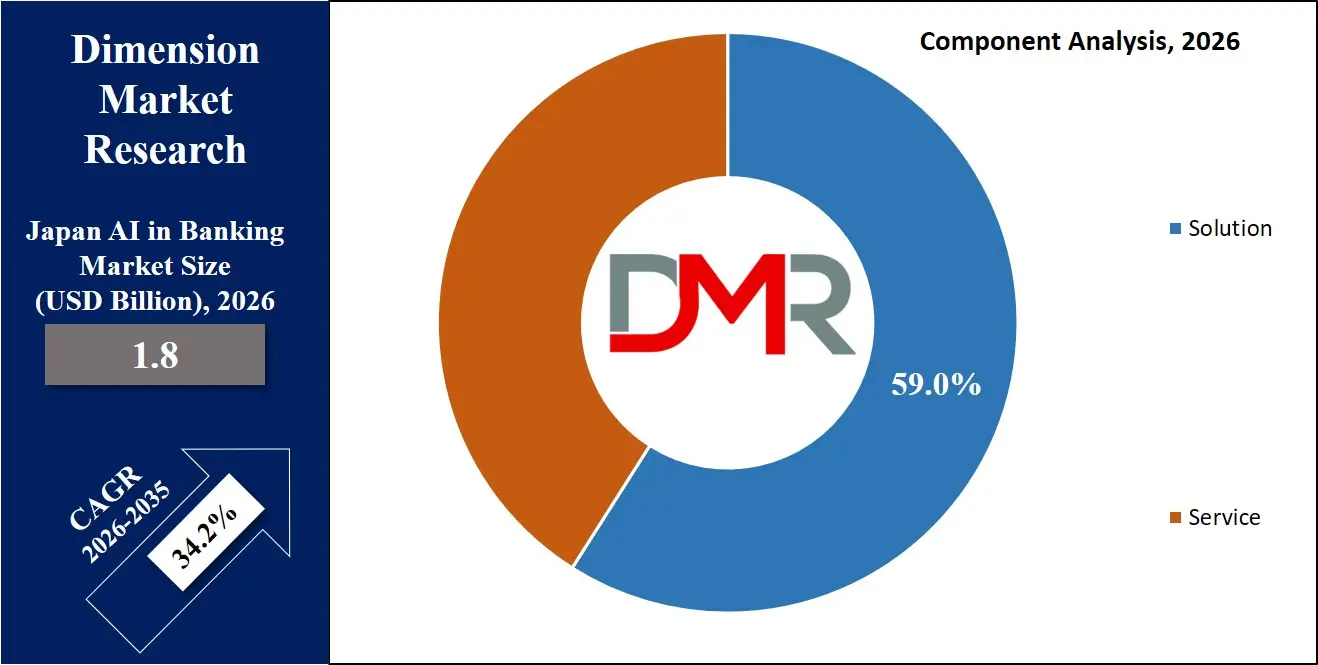
In the component type segment of the Japan AI in banking market, solution type components are projected to dominate, capturing approximately 59.0% of the market share in 2026. Solution components encompass AI-powered software applications, platforms, and tools that enable banks to integrate machine learning, natural language processing, and predictive analytics into their operations. These solutions are designed to automate core banking processes, enhance decision-making, improve fraud detection, and deliver personalized customer experiences. Solutions such as AI-driven risk management platforms, intelligent credit scoring systems, and automated investment advisory tools are increasingly adopted by financial institutions to gain a competitive edge, reduce operational inefficiencies, and respond proactively to market trends. The dominance of solution components reflects the strategic focus of Japanese banks on leveraging technology to drive digital transformation and operational optimization.
ℹ
To learn more about this report –
Download Your Free Sample Report Here
Services components in this segment play a complementary role by supporting the deployment, customization, and maintenance of AI solutions. These services include consulting, system integration, training, and technical support, enabling banks to implement AI effectively without disruption to their existing infrastructure. Consulting services assist in identifying key areas where AI can provide maximum impact, while integration services ensure seamless connectivity between AI applications and legacy banking systems. Training and support services equip banking staff with the necessary skills to manage AI platforms and interpret insights generated by these technologies. By combining solutions with professional services, banks in Japan can accelerate adoption, optimize performance, and continuously enhance the capabilities of AI systems to meet evolving customer needs and regulatory requirements.
By Technology Analysis
In the technology type segment of the Japan AI in banking market, natural language processing technologies are expected to consolidate a significant position, capturing around 41.0% of the market share in 2026. NLP technologies enable banks to process and understand human language, facilitating advanced customer interactions through chatbots, virtual assistants, and automated support systems. These solutions help financial institutions efficiently manage high volumes of customer queries, provide real-time responses, and offer personalized guidance, enhancing user satisfaction and engagement. Additionally, NLP supports sentiment analysis, regulatory compliance monitoring, and automated document processing, allowing banks to reduce operational costs while improving accuracy and service quality. The widespread adoption of NLP reflects the increasing emphasis on intelligent, conversational, and automated customer experiences in Japan’s banking sector.
The machine learning and deep learning subsegment is another critical technology within the Japan AI in banking market. Machine learning algorithms enable predictive analytics, anomaly detection, and data-driven decision-making by analyzing historical financial data and identifying patterns that inform credit risk, fraud prevention, and investment strategies. Deep learning, a subset of machine learning, leverages neural networks to process complex datasets, supporting advanced applications such as image recognition for document verification, behavioral analytics, and high-frequency trading models. These technologies allow banks to optimize operational efficiency, improve risk assessment accuracy, and deliver highly personalized financial products. The integration of machine learning and deep learning into banking operations drives innovation and positions Japanese financial institutions to meet evolving customer expectations and regulatory requirements while maintaining a competitive edge.
By Enterprise Size Analysis
In the enterprise type segment of the Japan AI in banking market, large enterprises are expected to maintain a dominant position, capturing approximately 67.0% of the total market share in 2026. Large banks and financial institutions have the resources and infrastructure to invest heavily in AI technologies, including advanced analytics platforms, predictive modeling tools, and AI-driven automation systems. These enterprises leverage AI to streamline complex operations, enhance regulatory compliance, and deliver personalized services across multiple channels. Their scale allows for comprehensive deployment of AI solutions across departments such as risk management, fraud detection, customer service, and investment advisory, enabling them to achieve higher operational efficiency and improved decision-making capabilities. The dominance of large enterprises reflects their capacity to adopt cutting-edge technologies at a faster pace and integrate them across wide-ranging banking operations.
The SMEs subsegment, while smaller in market share, is increasingly adopting AI to enhance competitiveness and efficiency. Small and medium-sized banks, regional financial institutions, and niche fintech firms are using AI solutions for targeted applications such as automated customer support, credit scoring, and transaction monitoring. These organizations benefit from scalable AI-as-a-service platforms, which reduce the need for heavy upfront investments in hardware and software infrastructure. By utilizing cloud-based AI services and analytics tools, SMEs can implement intelligent automation, gain actionable insights from financial data, and improve customer engagement. The growing adoption of AI among SMEs highlights the trend toward democratizing advanced banking technologies, allowing smaller enterprises to optimize operations and compete effectively with larger institutions.
By Application Analysis
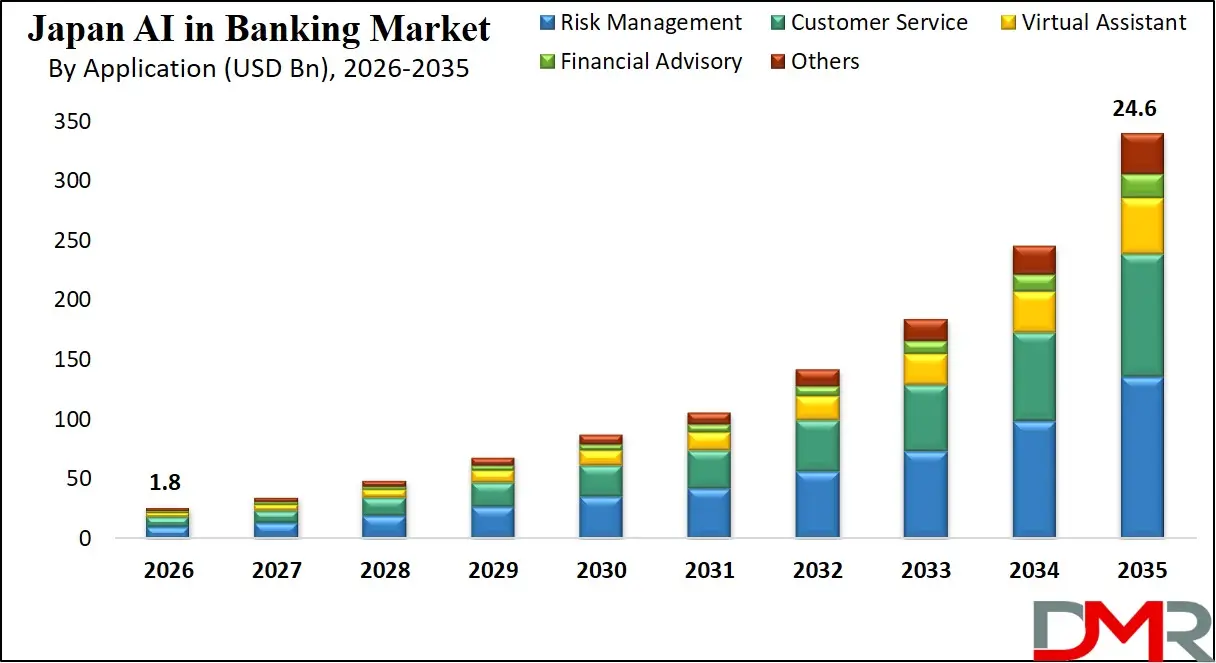
In the application type segment of the Japan AI in banking market, risk management applications are projected to remain the leading segment, accounting for around 40.0% of the total market share in 2026. AI-powered risk management solutions help financial institutions analyze vast volumes of transactional and behavioral data to identify potential threats, assess creditworthiness, and predict market fluctuations. These applications enable proactive detection of fraudulent activities, reduce exposure to non-performing assets, and enhance regulatory compliance by automating reporting and monitoring processes. The use of predictive analytics and intelligent modeling allows banks to make data-driven decisions, optimize capital allocation, and safeguard financial stability, making risk management a critical focus area for AI adoption in Japan’s banking sector.
Customer service applications represent another significant subsegment within the Japan AI in banking market. AI technologies are being deployed to improve client engagement and streamline support operations through chatbots, virtual assistants, and automated query resolution systems. These solutions provide real-time responses to customer inquiries, assist with transaction guidance, and offer personalized recommendations based on user behavior and account activity. By automating routine interactions, banks can reduce operational costs, increase response efficiency, and enhance the overall customer experience. The adoption of AI in customer service also enables multilingual support, sentiment analysis, and continuous learning capabilities, allowing institutions to respond more effectively to evolving consumer expectations in the digital banking landscape.
The Japan AI in Banking Market Report is segmented on the basis of the following:
By Component
By Technology
- Natural Language Processing (NLP)
- Machine Learning & Deep Learning
- Computer Vision
- Others
By Enterprise Size
By Application
- Risk Management
- Customer Service
- Virtual Assistant
- Financial Advisory
- Others
Japan AI in Banking Market: Competitive Landscape
The competitive landscape of the Japan AI in banking market is characterized by intense innovation and strategic investments in advanced technologies. Financial institutions and technology providers are focusing on developing AI-driven solutions for risk management, customer engagement, fraud detection, and personalized financial services.
ℹ
To learn more about this report –
Download Your Free Sample Report Here
Collaboration between banks and fintech startups, along with the integration of cloud computing, big data analytics, and machine learning platforms, is accelerating the deployment of intelligent automation across the sector. Companies are also prioritizing scalable solutions, regulatory compliance, and cybersecurity measures to maintain trust and operational efficiency. The market is increasingly shaped by continuous technological advancements, strategic partnerships, and a strong emphasis on enhancing digital banking experiences.
Some of the prominent players in the Japan AI in Banking Market are:
- SoftBank Group Corporation
- Mitsubishi UFJ Financial Group
- Sumitomo Mitsui Financial Group
- Mizuho Financial Group
- SBI Holdings
- Japan Post Bank
- Rakuten
- Digital Wallet Group
- ExaWizards
- Preferred Networks
- Sakana AI
- GVE Limited
- Tokyo FinTech
- Smooth FinTech
- Funds Incorporated
- WealthPark Corporation
- SmartBank
- Money Forward
- LINE Corporation
- PayPay
- Other Key Players
Recent Developments in the Japan AI in Banking Market
- February 2026: Rakuten Group integrated an AI agent into its financial app to provide personalized spending insights and conversational transaction analysis for cardholders, marking a new step in embedded AI services for customer engagement.
- February 2026: SIGQ, a Japanese developer of autonomous AI solutions for enterprise operations, secured approximately JPY 123 million (around USD 820,000) in a Pre‑Series A funding round to accelerate market deployment of its flagship AI platform.
- January 2026: au Jibun Bank launched an AI‑driven fraud detection system called “AI Zero Fraud” to strengthen online banking security by monitoring and blocking high‑risk transfers using real‑time artificial intelligence models.
Report Details
| Report Characteristics |
| Market Size (2026) |
USD 1.8 Bn |
| Forecast Value (2035) |
USD 24.6 Bn |
| CAGR (2026–2035) |
34.2% |
| Historical Data |
2021 – 2025 |
| Forecast Data |
2027 – 2035 |
| Base Year |
2025 |
| Estimate Year |
2026 |
| Report Coverage |
Market Revenue Estimation, Market Dynamics, Competitive Landscape, Growth Factors and etc. |
| Segments Covered |
By Component (Solution, Service), By Technology (Natural Language Processing (NLP), Machine Learning & Deep Learning, Computer Vision, Others), By Enterprise Size (Large Enterprise, SMEs), and By Application (Risk Management, Customer Service, Virtual Assistant, Financial Advisory, Others). |
| Country Coverage |
Japan |
| Prominent Players |
SoftBank Group Corporation, Mitsubishi UFJ Financial Group, Sumitomo Mitsui Financial Group, Mizuho Financial Group, SBI Holdings, Japan Post Bank, Rakuten, Digital Wallet Group, ExaWizards, Preferred Networks, Sakana AI, GVE Limited, Tokyo FinTech, Smooth FinTech, Funds Incorporated, WealthPark Corporation, SmartBank, Money Forward, LINE Corporation, PayPay, and Other Key Players |
| Purchase Options |
We have three licenses to opt for: Single User License (Limited to 1 user), Multi-User License (Up to 5 Users) and Corporate Use License (Unlimited User) along with free report customization equivalent to 0 analyst working days, 3 analysts working days and 5 analysts working days respectively. |
Frequently Asked Questions
How big is the Japan AI in Banking Market?
▾ The Japan AI in Banking Market size is estimated to have a value of USD 1.8 billion in 2026 and is expected to reach USD 24.6 billion by the end of 2035.
What is the growth rate in the Japan AI in Banking Market in 2026?
▾ The market is growing at a CAGR of 34.2% over the forecasted period of 2026.
Who are the key players in the Japan AI in Banking Market?
▾ Some of the major key players in the Japan AI in Banking Market are SoftBank Group Corporation, Mitsubishi UFJ Financial Group, Sumitomo Mitsui Financial Group, Mizuho Financial Group, SBI Holdings, Japan Post Bank, Rakuten, Digital Wallet Group, ExaWizards, Preferred Networks, Sakana AI, GVE Limited, Tokyo FinTech, and many others.