Market Overview
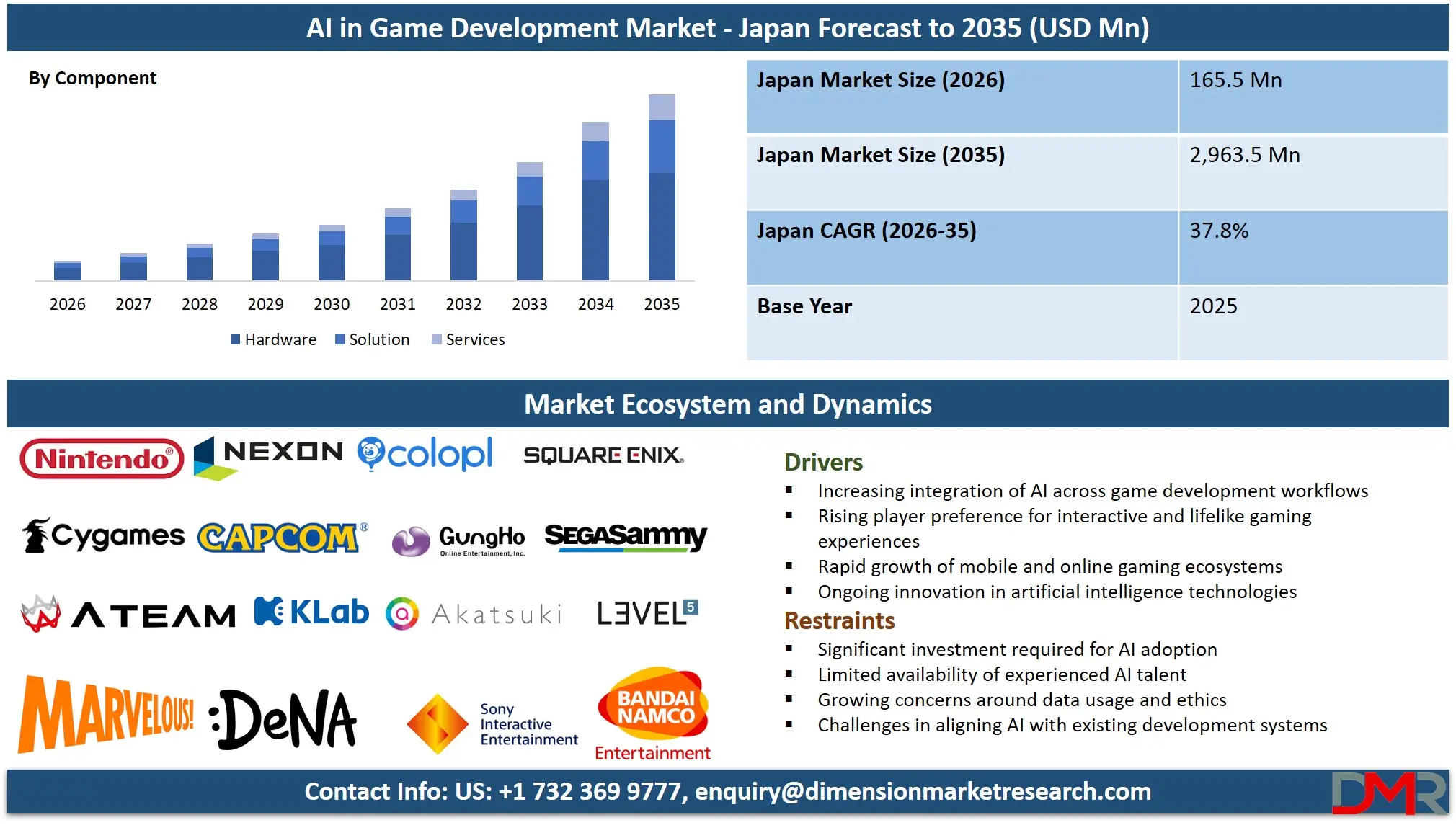
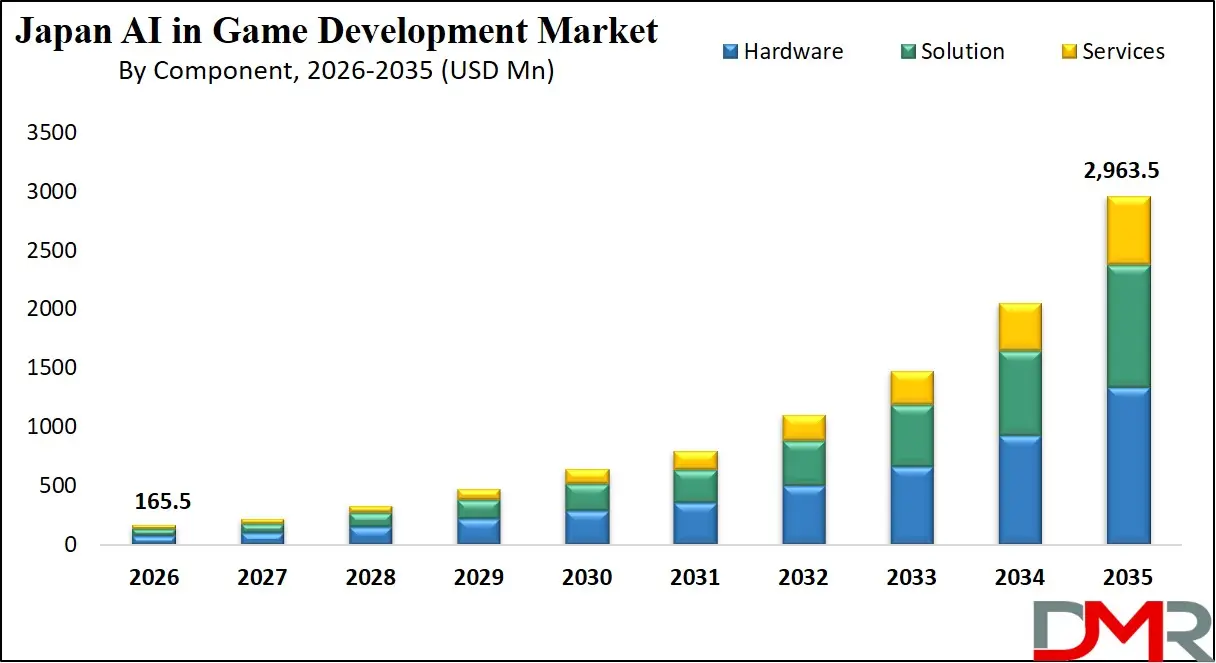
Japan AI in game development market is anticipated to be valued at USD 165.6 million in 2026, and is further projected to reach nearly USD 2,963.5 million by 2035, registering a compound annual growth rate (CAGR) of 37.8% during the forecast timeline.
ℹ
To learn more about this report –
Download Your Free Sample Report Here
Japan represents one of the most technologically advanced and culturally influential gaming ecosystems globally. With innovation hubs centered in Tokyo, Osaka, Kyoto, and Yokohama, the country continues to lead in integrating artificial intelligence into creative industries, particularly game development. Backed by globally recognized publishers and a deeply rooted gaming culture, Japan is uniquely positioned to accelerate AI-driven transformation in game production.
Artificial intelligence is rapidly transitioning from an experimental capability to a foundational pillar in Japanese game development workflows. Developers are increasingly embedding AI technologies to enhance production efficiency, reduce manual workloads, and introduce sophisticated gameplay mechanics. AI-powered tools are enabling studios to build more immersive, responsive, and emotionally engaging experiences that align with evolving player expectations.
The Japanese market is experiencing a structural shift driven by advancements in deep learning, natural language processing, and computer vision. Techniques such as neural networks, reinforcement learning, and generative adversarial networks (GANs) are being widely implemented to enable intelligent non-player characters (NPCs), automate asset creation, and streamline testing processes. Furthermore, cloud-based AI services are providing scalable infrastructure, allowing developers to deploy advanced features without significant capital investment.
The growing diversity of gaming platforms including mobile devices, consoles, PCs, and emerging AR/VR environments is further accelerating AI adoption. Established companies such as Sony Interactive Entertainment, Nintendo, and Square Enix are investing heavily in AI-driven R&D initiatives. The transition toward live-service models and persistent online worlds has intensified the need for AI systems capable of real-time updates, player analytics, and personalized content delivery.
ℹ
To learn more about this report –
Download Your Free Sample Report Here
Operational efficiency and sustainability are also gaining prominence, as developers leverage AI to optimize resource utilization, minimize production costs, and accelerate time-to-market. The increasing availability of AI-as-a-service platforms is lowering entry barriers, enabling smaller studios and independent developers to compete with larger enterprises.
Despite these advancements, the market faces several constraints, including shortages of skilled AI professionals, ethical and legal concerns regarding generative AI, and challenges associated with integrating AI into legacy development pipelines. Nonetheless, Japan's AI in game development market continues to demonstrate strong growth potential, characterized by rapid innovation, expanding applications, and increasing investment activity.
Japan AI in Game Development Market: Key Takeaways
- Growth Outlook: The market is projected to grow from USD 165.6 million in 2026 to USD 2,963.5 million by 2035, reflecting strong expansion driven by AI adoption across development stages.
- Component Leadership: Solutions, including AI-enabled engines, middleware, and development platforms, dominate due to widespread accessibility and integration capabilities.
- Genre Dynamics: Role-playing games (RPGs) and action-adventure genres lead the market, reflecting Japan's historical strength in narrative-rich and character-driven gaming experiences.
- Platform Trends: Mobile gaming remains dominant due to its extensive user base, while console gaming continues to maintain strong relevance due to Japan's hardware leadership.
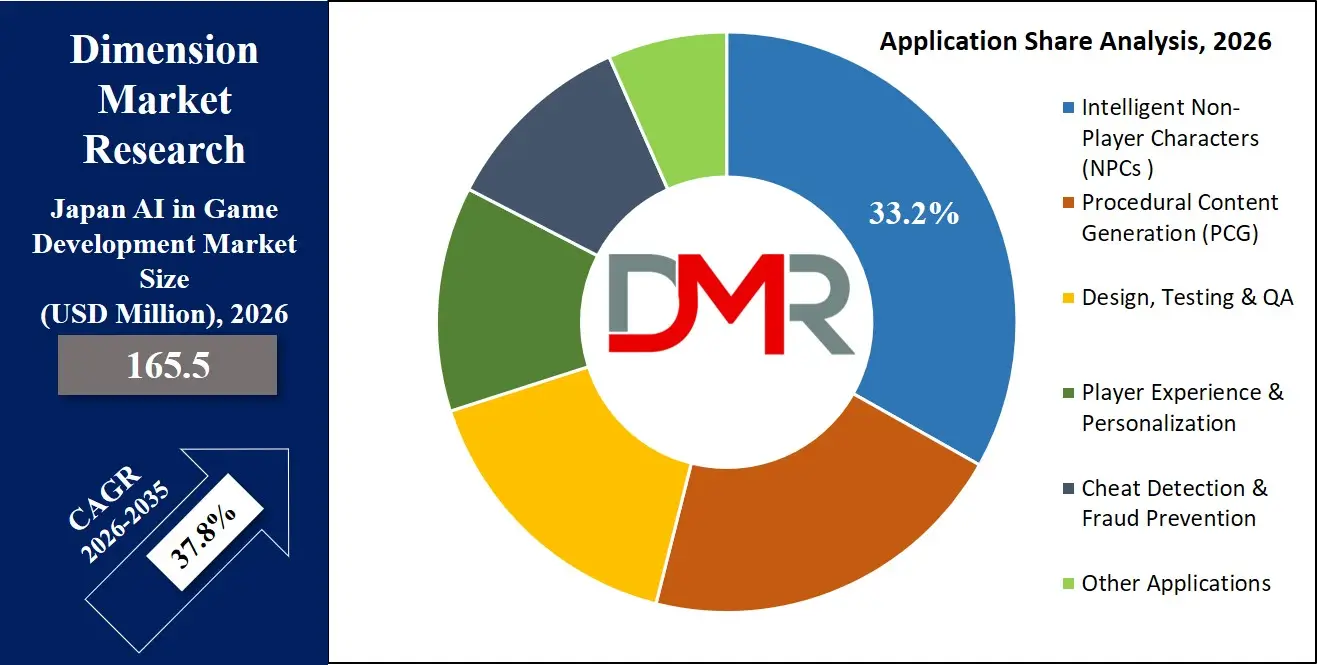
- Application Focus: AI applications such as intelligent NPCs and procedural content generation hold the largest share, driven by demand for immersive and replayable environments.
- Key Players Insights: Major market participants include Unity Technologies, Epic Games, NVIDIA Corporation, Microsoft Corporation (Xbox), Sony Interactive Entertainment, Electronic Arts, and other key players.
Impact of Iran Conflict on Japan AI in Game Development Market
- Semiconductor Supply Risks: Japan's dependency on imported semiconductor materials makes it vulnerable to disruptions caused by geopolitical tensions around the Strait of Hormuz, potentially delaying GPU and AI hardware availability.
- R&D Investment Sensitivity: Global instability may influence Japanese corporations to adopt a more cautious investment approach, slowing funding for experimental AI gaming technologies.
- Cybersecurity Pressure: Rising geopolitical tensions increase cyberattack risks, pushing gaming firms to allocate higher budgets toward digital security instead of AI innovation.
- Talent Mobility Constraints: Global tensions may affect international collaboration and talent exchange, limiting access to specialized AI researchers and engineers.
Japan AI in Game Development Market: Use Cases
- Advanced NPC Intelligence and Emotional AI: Japanese developers are integrating AI systems capable of delivering emotionally responsive characters, aligning with Japan's strong focus on narrative depth and player immersion.
- Procedural World Creation for Expansive Universes: AI-driven content generation is enabling large-scale game worlds, particularly in RPGs, reducing manual workload while maintaining creative quality.
- AI-Based Game Testing and Optimization: Automation tools are improving testing efficiency by simulating player behavior, reducing time-to-market and enhancing gameplay balance.
- Personalized Gameplay Experiences: AI analytics are being used to tailor gameplay difficulty, story progression, and monetization strategies based on player behavior patterns.
Japan AI in Game Development Market: Stats & Facts
Computer Entertainment Supplier's Association (CESA) / Tokyo Game Show
- 51% of Japanese game companies are using AI or generative AI in game development
- 32% of companies are using AI to develop their own game engines
From Computer Entertainment Supplier's Association (CESA):
- Japan has over 75 million active gamers, representing a significant portion of the population.
- Mobile gaming accounts for more than 50% of total gaming revenue.
- Console gaming remains strong due to global brands like Nintendo and Sony.
- The average gamer age in Japan is approximately 34–36 years, reflecting a mature user base.
Japan AI in Game Development Market: Market Dynamic
Driving Factors in the Japan AI in Game Development Market
Rising Demand for Immersive and Story-Driven Gaming Experiences
The evolution of player expectations in Japan is significantly driving the adoption of artificial intelligence in game development. Japanese gamers traditionally value deep storytelling, character development, and immersive gameplay, which has intensified the demand for intelligent NPCs, adaptive narratives, and responsive environments. Companies such as Nintendo and Square Enix are leveraging AI to enhance emotional engagement and realism in their titles. The growth of live-service games, mobile gaming, and online multiplayer ecosystems in Japan further accelerates the need for AI-driven content updates and real-time interaction systems. Additionally, the influence of anime-style storytelling and character-driven franchises pushes developers to integrate advanced AI capabilities that can deliver personalized and evolving gameplay experiences aligned with player preferences.
Advancements in Generative AI and Machine Learning Technologies
Technological progress in generative AI, machine learning, and neural networks is transforming Japan's game development ecosystem. Developers are increasingly utilizing AI tools for asset generation, including character design, animation, voice synthesis, and environment creation, significantly reducing production time and costs. Large language models are enabling more natural and context-aware dialogue systems, enhancing narrative depth in role-playing and adventure games. Companies like Sony are investing in AI technologies to support next-generation gaming experiences. Reinforcement learning techniques are also improving enemy AI and gameplay adaptability, allowing games to dynamically adjust to player skill levels. These advancements are enabling Japanese developers to maintain their global leadership in creativity while improving development efficiency and scalability.
Restraints in the Japan AI in Game Development Market
Talent Shortages and Skills Gap
Japan faces a growing shortage of skilled professionals with expertise in both artificial intelligence and game development, which acts as a major restraint on market growth. While the country has a strong legacy in game design, the integration of advanced AI systems requires specialized knowledge in machine learning, data science, and software engineering. Many studios, particularly small and mid-sized developers, struggle to recruit and retain talent capable of implementing complex AI solutions. Larger companies such as Bandai Namco Entertainment have greater resources to invest in talent development, but the overall talent pool remains limited. This gap forces companies to invest heavily in training programs, academic collaborations, and international hiring, increasing operational costs and slowing down AI adoption across the industry.
Intellectual Property and Ethical Considerations
The adoption of generative AI in Japan's game development market introduces complex intellectual property and ethical challenges. Questions around ownership of AI-generated assets, use of copyrighted training data, and originality of content create legal uncertainties for developers. Japanese companies, known for their strong emphasis on creative integrity and intellectual property protection, must carefully navigate these issues. Additionally, concerns about the impact of AI on creative roles such as artists, writers, and designers are gaining attention within the industry. Developers like Capcom are taking cautious approaches to AI implementation to balance efficiency with ethical responsibility. These challenges require clear regulatory frameworks, transparent AI usage policies, and ongoing collaboration with creative communities.
Opportunities in the Japan AI in Game Development Market
AI-Powered Personalization and Player Engagement Platforms
AI-driven personalization presents significant growth opportunities in Japan's game development market. Machine learning models can analyze player behavior to deliver tailored gameplay experiences, including adaptive difficulty levels, personalized storylines, and targeted in-game rewards. This is particularly relevant in Japan's mobile and live-service gaming segments, where player retention and monetization are critical. Companies like GungHo Online Entertainment are leveraging AI to optimize engagement strategies and enhance user experiences. As player data becomes more accessible and analytics tools more advanced, developers can create highly customized gaming environments that cater to individual preferences, increasing player satisfaction and lifetime value.
Cross-Platform Development and Cloud AI Integration
The expansion of cross-platform gaming and cloud-based AI services is creating new opportunities for innovation in Japan. Developers are increasingly required to deliver seamless gaming experiences across mobile, console, PC, and emerging AR/VR platforms. Cloud AI platforms enable access to advanced machine learning capabilities without heavy infrastructure investments, making them particularly beneficial for smaller studios. Companies such as Sony Interactive Entertainment are exploring cloud-based gaming ecosystems that leverage AI for real-time processing and enhanced gameplay. These advancements allow developers to implement features such as server-side AI processing, dynamic content generation, and large-scale multiplayer interactions, expanding the possibilities of game design beyond traditional hardware limitations.
Trends in the Japan AI in Game Development Market
Generative AI Integration Across Production Pipelines
Generative AI is becoming a core component of game development workflows in Japan, enabling faster and more efficient content creation. AI-powered tools for character design, animation, environment generation, and audio production are helping developers reduce manual effort while maintaining high-quality output. Studios are increasingly adopting technologies such as text-to-3D modeling, AI-assisted animation, and automated voice synthesis to streamline production processes. Companies like Konami are integrating these tools to enhance development efficiency and creative output. This trend is particularly valuable in large-scale game projects and live-service models, where continuous content updates are required. As generative AI technologies mature, they are expected to become standard components of Japan's game development ecosystem.
AI-Driven Quality Assurance and Automated Testing
AI-powered testing and quality assurance solutions are transforming game development practices in Japan by improving efficiency and reducing time-to-market. Machine learning models can simulate player behavior, identify bugs, and test multiple gameplay scenarios at scale, significantly reducing reliance on manual testing. This is especially important for complex games with open-world environments and multiplayer interactions. Companies such as Sega Sammy Holdings are increasingly investing in AI-driven QA systems to enhance product quality and streamline development cycles. These systems enable faster detection of performance issues, gameplay imbalances, and technical glitches, ensuring smoother game launches. As competition intensifies, AI-driven QA is becoming a critical tool for maintaining high standards and delivering seamless gaming experiences.
Japan AI in Game Development Market: Research Scope and Analysis
By Component Analysis
Solutions are expected to dominate the Japan AI in game development market due to the country's advanced gaming ecosystem and strong integration of AI within development tools and engines. Japan is home to globally recognized gaming companies such as Nintendo and Sony, which increasingly adopt AI-powered solutions to enhance gameplay design, animation, and storytelling. AI-enabled engines and middleware tools are widely utilized to simplify development processes, allowing studios to integrate features such as intelligent NPC behavior, automated testing, and real-time content generation without requiring deep expertise in machine learning. Subscription-based AI software models are gaining traction, especially among mid-sized and independent studios seeking cost-effective scalability.
Hardware continues to play a vital supporting role, with high-performance GPUs and AI accelerators enabling complex computations required for realistic graphics and immersive gameplay. Japanese developers often focus on high-quality console and handheld gaming, which necessitates robust hardware capabilities. Services are also expanding as a key component, with growing demand for AI consulting, system integration, and custom model development. As AI applications become more sophisticated, studios increasingly rely on specialized service providers to implement and optimize AI solutions. The synergy between software solutions, hardware infrastructure, and professional services creates a well-integrated ecosystem that supports innovation and efficiency in Japan's game development landscape.
By Game Genre Analysis
Action and adventure games are anticipated to dominate the Japan AI in game development market, reflecting the country's strong legacy in immersive storytelling and character-driven gameplay. Japanese developers have long been pioneers in creating engaging narratives and dynamic environments, and AI enhances these experiences by enabling more responsive non-player characters, adaptive combat systems, and interactive world-building. Franchises developed by companies like Capcom and Square Enix showcase how AI-driven mechanics can elevate gameplay depth and realism.
Role-playing games remain a cornerstone of Japan's gaming industry, with AI playing a critical role in procedural storytelling, dialogue systems, and player-driven narrative evolution. These systems allow developers to create expansive worlds that react dynamically to player decisions, enhancing replayability and engagement. Simulation and strategy games also leverage AI for resource management, opponent intelligence, and decision-making algorithms. Additionally, mobile-centric genres, including casual and gacha-based games, utilize AI for personalization, player retention, and monetization optimization. The diversity of genres in Japan highlights the adaptability of AI technologies in catering to both traditional console experiences and modern mobile gaming trends, reinforcing AI's importance in shaping genre-specific innovation.
By Platform Analysis
Mobile gaming is projected to lead the Japan AI in game development market, supported by the country's high smartphone penetration and strong preference for on-the-go entertainment. Japanese consumers активно engage with mobile games, particularly those featuring live-service models and frequent content updates. AI is extensively used in mobile platforms for personalization, dynamic event management, and monetization strategies, enabling developers to optimize user engagement and retention. Companies like GungHo Online Entertainment and Mixi have successfully leveraged AI to enhance mobile gaming experiences.
Console gaming remains a significant segment, driven by platforms such as PlayStation and Nintendo systems, where AI enables advanced graphics, realistic physics, and complex NPC interactions. PC gaming also contributes to the market, particularly in online and multiplayer environments where AI supports matchmaking, anti-cheat systems, and player behavior analysis. Emerging platforms such as AR and VR are gaining traction in Japan, with AI playing a key role in spatial recognition, gesture tracking, and immersive interactions. Cloud gaming is another growing area, utilizing server-side AI processing to deliver high-quality experiences without reliance on local hardware. The platform diversity reflects Japan's ability to integrate AI across multiple gaming ecosystems effectively.
By Application Analysis
Intelligent NPCs and procedural content generation are expected to dominate the Japan AI in game development market, aligning with the country's emphasis on immersive storytelling and rich gameplay experiences. AI-driven NPCs enhance realism by enabling characters to respond dynamically to player actions, exhibit emotional intelligence, and adapt to changing game scenarios. This is particularly important in Japanese games, which often prioritize narrative depth and character development. Procedural content generation allows developers to create expansive environments, quests, and items efficiently, supporting large-scale game worlds while reducing development time and costs.
ℹ
To learn more about this report –
Download Your Free Sample Report Here
AI applications in testing and quality assurance are rapidly expanding, as developers seek to improve efficiency and reduce time-to-market. Automated testing tools can simulate gameplay scenarios, identify bugs, and optimize game balance, ensuring a smoother player experience. Player personalization is another critical application, with AI analyzing user behavior to tailor difficulty levels, in-game rewards, and content recommendations. Additionally, AI is increasingly used for voice synthesis, localization, and art generation, enabling studios to streamline production processes. The wide range of applications demonstrates AI's transformative impact across the entire game development lifecycle in Japan.
Japan AI in Game Development Market Report is segmented on the basis of the following:
By Component
- Hardware
- Solution
- Services
By Game Genre
- Action and Adventure
- Role-Playing Games (RPGs)
- Shooter (FPS/TPS)
- Simulation and Strategy
- Sports and Racing
- Other Games
By Platform
- Mobile
- PC
- Console
- AR/VR
- Cloud and Streaming Gaming
By Application
- Intelligent Non-Player Characters (NPCs)
- Procedural Content Generation (PCG)
- Design, Testing & QA
- Player Experience & Personalization
- Cheat Detection & Fraud Prevention
- Other Applications
Japan AI in Game Development Market: Competitive Landscape
The Japan AI in game development market is highly competitive, driven by the strong presence of established domestic gaming leaders, global technology providers, and a growing ecosystem of innovative startups. Major Japanese companies such as Sony Interactive Entertainment, Nintendo, Bandai Namco Entertainment, Capcom, and Konami dominate the market with their strong intellectual property portfolios and continuous investment in proprietary AI technologies. These companies leverage AI to enhance gameplay realism, optimize development pipelines, and deliver highly immersive gaming experiences, thereby maintaining a competitive edge both domestically and globally.
ℹ
To learn more about this report –
Download Your Free Sample Report Here
At the same time, global technology providers such as Unity Technologies, Epic Games, and NVIDIA play a critical role in shaping the competitive landscape by offering advanced AI tools, development platforms, and hardware infrastructure. Their solutions enable Japanese developers to integrate AI capabilities efficiently, reducing development complexity and accelerating innovation cycles.
Furthermore, startups and mid-sized firms are increasingly contributing to market dynamism by introducing specialized AI solutions, including procedural content generation, AI-driven analytics, and automation tools. These players often focus on niche applications and collaborate with larger studios, fostering innovation and technological advancement. This multi-layered competitive environment, combining strong domestic leadership, global technological support, and agile innovation from smaller firms, ensures continuous evolution and rapid adoption of AI across Japan's game development industry.
Some of the prominent players in Japan AI in Game Development Market are:
- Nintendo Co., Ltd.
- Sony Interactive Entertainment
- Bandai Namco Entertainment
- Square Enix Holdings Co., Ltd.
- Sega Sammy Holdings Inc.
- Capcom Co., Ltd.
- Konami Group Corporation
- Koei Tecmo Holdings Co., Ltd.
- Level-5 Inc.
- CyberAgent Inc. (Cygames)
- GungHo Online Entertainment, Inc.
- DeNA Co., Ltd.
- Colopl, Inc.
- Akatsuki Inc.
- KLab Inc.
- Nexon Co., Ltd.
- Marvelous Inc.
- Ateam Inc.
- Drecom Co., Ltd.
- Natsume Atari Inc.
- Other Key Players
Recent Developments in Japan AI in Game Development Market
- March 2026: Sony Interactive Entertainment announced advancements in AI-driven frame generation technology for future PlayStation platforms, aiming to enhance visual performance and realism through machine learning-based rendering techniques.
- March 2026: Capcom outlined its strategy to utilize generative AI to improve development efficiency in areas such as coding, design, and audio production, while maintaining a policy of not directly using AI-generated assets in final game content.
- March 2026: Square Enix announced a collaboration with a global technology partner to integrate generative AI into its game titles, enabling real-time interactive characters and enhanced player engagement experiences.
- February 2026: A major AI-focused gaming conference titled "AI x Games: Revolutionizing Game Development and Game Experience" was held in Tokyo, bringing together developers, researchers, and industry leaders to explore AI applications in gaming.
- November 2025: Sony supported the launch of an AI-powered game development platform through its innovation initiatives, aimed at enabling users to create games with minimal coding requirements.
- November 2025: Unity Technologies introduced an AI integration framework designed to securely incorporate third-party AI tools into development workflows, enhancing flexibility and productivity for developers.
- June 2025: Square Enix announced plans to implement AI-driven automation in quality assurance processes to improve efficiency, reduce development timelines, and optimize testing workflows across its game portfolio.
Report Details
| Report Characteristics |
| Market Size (2026) |
USD 165.5 Mn |
| Forecast Value (2035) |
USD 2,963.5 Mn |
| CAGR (2026–2035) |
37.8% |
| Historical Data |
2021 – 2025 |
| Forecast Data |
2027 – 2035 |
| Base Year |
2025 |
| Estimate Year |
2026 |
| Report Coverage |
Market Revenue Estimation, Market Dynamics, Competitive Landscape, Growth Factors and etc. |
| Segments Covered |
By Component (Hardware, Solution, and Services), By Game Genre (Action and Adventure, Role-playing games (RPGs), Shooter(FPS/TPS), Simulation and Strategy, Sports and Racing, and Other Games), By Platform (Mobile, PC, Console, AR/VR, and Cloud and Streaming Gaming), and By Application (Intelligent Non-Player Characters (NPCs), Procedural Content Generation (PCG), Design, Testing & QA, Player Experience & Personalization, Cheat Detection & Fraud Prevention, and Other Application) |
| Country Coverage |
Japan |
| Prominent Players |
Nintendo Co., Ltd., Sony Interactive Entertainment, Bandai Namco Entertainment, Square Enix Holdings Co., Ltd., Sega Sammy Holdings Inc., Capcom Co., Ltd., Konami Group Corporation, Koei Tecmo Holdings Co., Ltd., Level-5 Inc., CyberAgent Inc. (Cygames), GungHo Online Entertainment, Inc., DeNA Co., Ltd., Colopl, Inc., Akatsuki Inc., KLab Inc., Nexon Co., Ltd., Marvelous Inc., Ateam Inc., Drecom Co., Ltd., Natsume Atari Inc., and Other Key Players |
| Purchase Options |
We have three licenses to opt for: Single User License (Limited to 1 user), Multi-User License (Up to 5 Users) and Corporate Use License (Unlimited User) along with free report customization equivalent to 0 analyst working days, 3 analysts working days and 5 analysts working days respectively. |
Frequently Asked Questions
How big is the Japan AI in Game Development Market?
▾ The Japan AI in Game Development Market size is estimated to have a value of USD 165.5 million in 2026 and is expected to reach USD 2,863.5 million by the end of 2035.
Who are the key players in the Japan AI in Game Development Market?
▾ Some of the major key players in the Japan AI in Game Development Market are Unity Technologies, Epic Games, NVIDIA Corporation, Microsoft Corporation (Xbox), Sony Interactive Entertainment, Electronic Arts, and many others.
What is the growth rate in the Japan AI in Game Development Market?
▾ The market is growing at a CAGR of 37.8 percent over the forecasted period.