What is the Japan AI Recruitment Market Size?
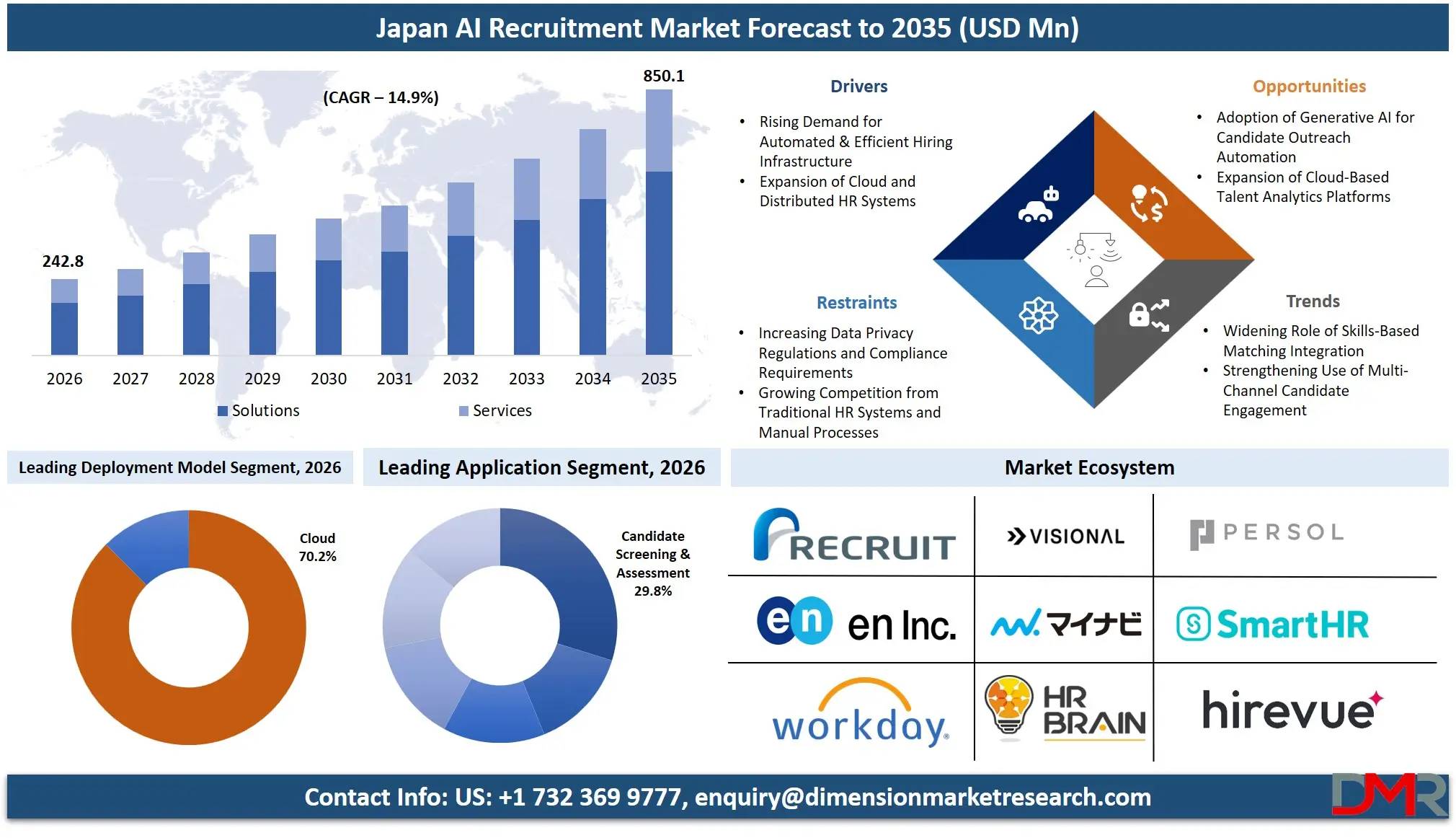
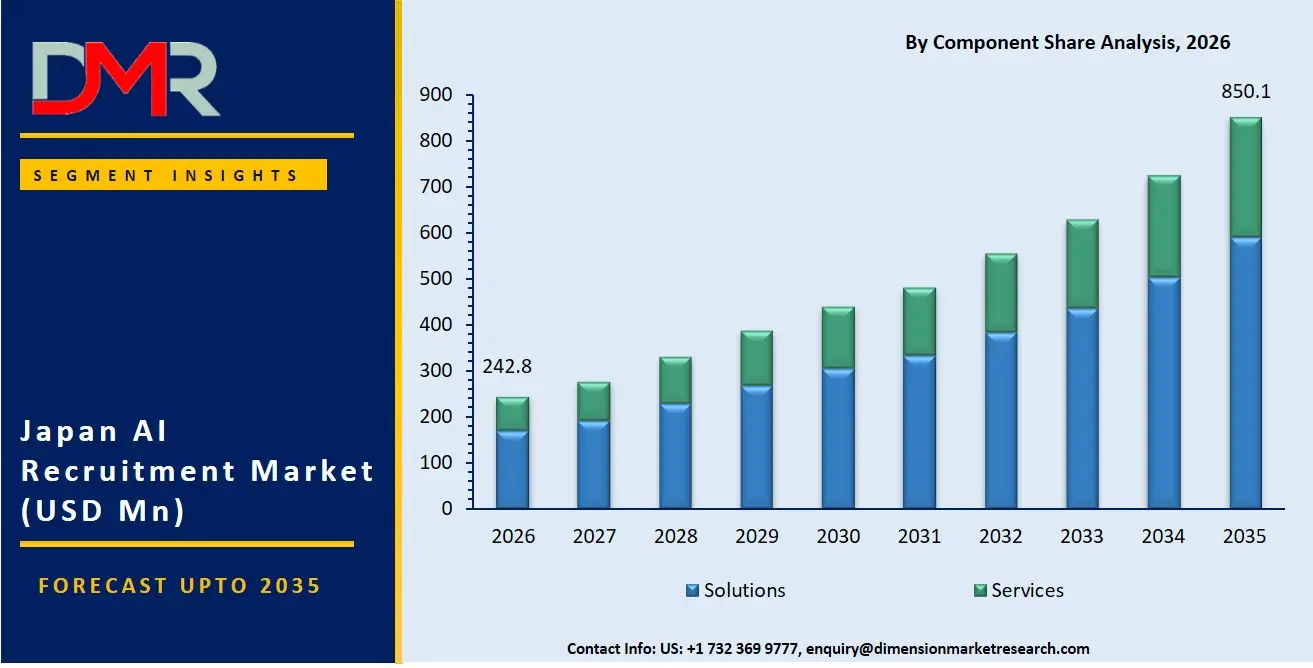
The Japan Artificial Intelligence (AI) Recruitment Market size is expected to reach USD 242.8 million in 2026 and is likely to grow to USD 850.1 million by 2035, progressing at a CAGR of 14.9% during the forecast period.
ℹ
To learn more about this report –
Download Your Free Sample Report Here
The AI recruitment market has been showing consistent growth due to Japan's acute labor shortages, aging workforce, and rising corporate demand for faster, more efficient hiring processes. This includes several AI-powered recruitment platforms and expert services that help enterprises and government bodies deploy intelligent talent acquisition solutions for financial, commercial, and industrial purposes.
There has been a growing need for professional services to implement secure AI screening systems, ensure data privacy compliance, and deliver high-performance recruitment analytics to customers. Large enterprises have emerged as the largest consumer segment for AI recruitment services, with solutions being the most popular choice due to their wide availability and ease of deployment, while there has been rapid growth in integration and implementation services.
ℹ
To learn more about this report –
Download Your Free Sample Report Here
Key Takeaways
- Market Size & Forecast: The Japan AI Recruitment market is forecasted to be valued at USD 242.8 million in 2026, growing incrementally to USD 850.1 million by 2035, due to the joint efforts of digital transformation strategy deployment on the part of enterprises as well as the mandatory deployment of secure and compliant AI hiring technologies.
- Growth Rate & Outlook: Japan market is expected to grow at 14.9% CAGR, propelled by the urgent need to mitigate emerging talent acquisition inefficiencies, alongside increasing challenges in managing multi-channel candidate data flows from banking recruitment, retail platforms, and industrial skill databases.
- Primary Growth Drivers: Major driving factors comprise the transition from traditional manual resume screening towards modern AI-first talent matching systems, the necessity to deploy efficient and scalable candidate communication networks, as well as the implementation of AI recruitment governance frameworks necessitating unique platform and services expertise.
- Key Market Trends: Major trends encompass the introduction of generative AI for automated job description creation and candidate outreach, usage of machine learning for predictive candidate success modeling and reducing time-to-hire, and increased focus on bias mitigation amidst rising diversity and inclusion considerations of regulators.
- By Component Analysis: The solutions segment is projected to dominate the Japan AI Recruitment Market with an estimated 69.1% share in 2026 due to high demand for AI-powered screening and talent analytics platforms by large enterprises, with capabilities like resume parsing, candidate ranking, and skills matching, which offer daily recruitment operations, regional talent mapping, and real-time performance monitoring activities within recruitment management.
- By Deployment Model Analysis: The cloud-based segment is projected to dominate the Japan AI Recruitment Market with an estimated 70.2% share in 2026 due to its high scalability, lower upfront costs, capability for remote access, and use in digital banking hiring, e-government recruitment, and smart manufacturing talent acquisition for metropolitan areas, industrial zones, and government infrastructure.
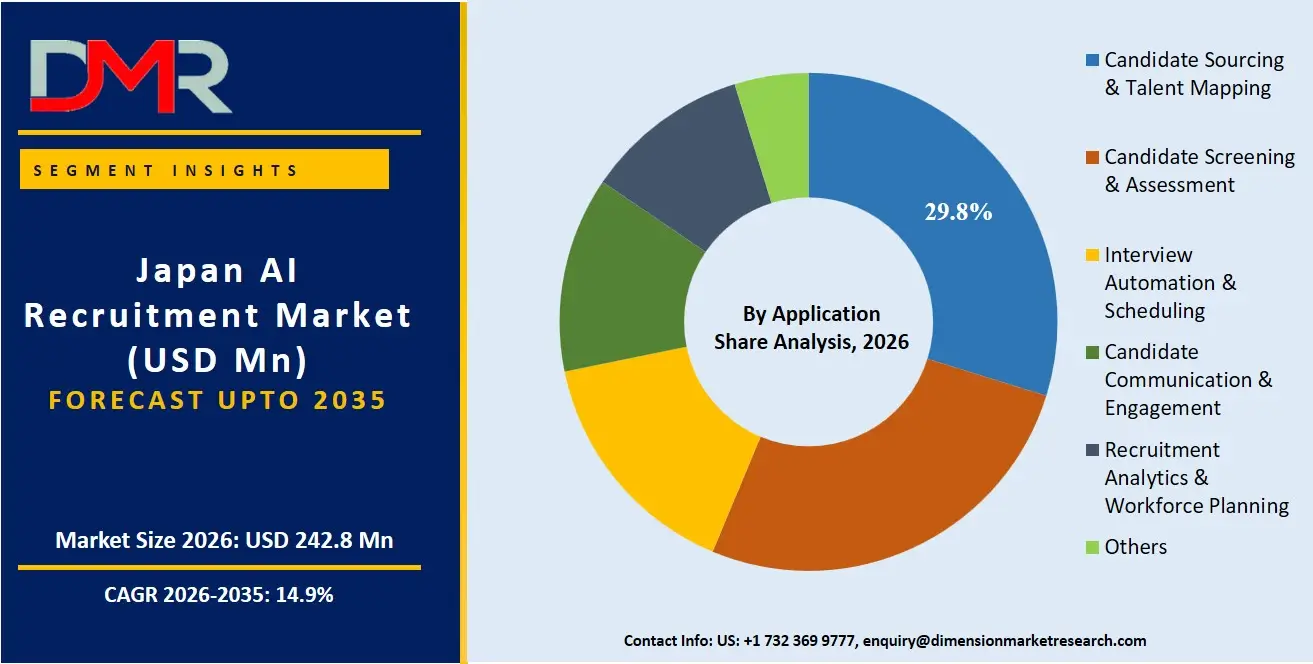
- By Application Analysis: The candidate screening & assessment segment is anticipated to dominate in the Japan AI Recruitment Market as enterprises adopt systems that are scalable, flexible, efficient, accessible for real-time candidate evaluation, provide AI-based candidate ranking, open talent integration, business continuity, and hiring operations at a higher resolution.
What are AI Recruitments?
AI Recruitment involves the application of artificial intelligence to make the recruiting process more efficient and automated. It enables businesses to evaluate and interact with their candidates effectively by implementing technologies like machine learning, NLP, and predictive analytics. AI-based recruiting systems enable companies to automate activities like candidate assessment, screening, interviewing, and recruiting data analysis, which allows them to make better and faster hiring decisions and cut down on recruitment costs. With businesses struggling with talent shortages and stiff competition for talent, AI recruitment has become necessary.
Use Cases
- Financial Talent Sourcing: Banks employ AI Recruitment Services for the installation of automated resume screening solutions that include real-time candidate verification and compliance notifications to avoid hiring delays and increase operational trust.
- Hospital Nurse Recruitment: Hospital networks rely on AI Recruitment Platforms for deploying secure candidate matching, ensuring stable, uninterrupted operation, and maintaining compliance with regional health staffing mandates in Japan.
- Public Sector Workforce Planning: Municipal authorities incorporate AI recruitment analytics dashboards in order to push hiring schedules and candidate status notifications to central control centers in real-time.
- Manufacturing Skill Gap Analysis: Manufacturing organizations leverage AI recruitment analytics platforms to identify skill shortages and initiate targeted candidate sourcing during peak hiring seasons.
How AI is Transforming the AI Recruitment Market?
AI is revolutionizing the recruitment industry through automated resume parsing and predictive candidate success modeling. The analytics platform suite includes AI-based systems that detect candidate drop-off points and recruitment inefficiencies in order to resolve them instantaneously, thereby preventing any financial losses and operational damage. In addition, the AI-driven functions of recruitment engagement services help organizations assess candidate behavior, determine optimal outreach timing, and customize their hiring planning. AI forms an essential part of governance and candidate trust initiatives. Professional services involve intelligent agents that monitor compliance and keep recruitment logs free of any non-compliant entries while ensuring that all operations comply with regulations and the stringent data privacy protocols in Japan.
Market Dynamics
Key Drivers in the Japan AI Recruitment Market
Rising Demand for Automated & Efficient Hiring Infrastructure
AI is increasingly influencing the recruitment industry through improved resume parsing and predictive candidate matching capabilities. The analytics platform suite includes AI-based systems that detect sourcing inefficiencies and recruitment bottlenecks to address them in near real time, thereby reducing potential financial losses and operational disruptions. In addition, AI-driven features in candidate engagement services help organizations analyze application behavior, define optimal follow-up schedules, and improve hiring planning strategies. AI is becoming an important part of governance, compliance, and candidate trust initiatives. Professional services also include intelligent monitoring tools that help track compliance and maintain recruitment logs, ensuring adherence to operational policies and Japan's stringent data privacy and regulatory frameworks.
Expansion of Cloud and Distributed HR Systems
The rapid expansion of cloud integration in Japan is driving strong demand across sectors such as retail banking, logistics, industrial manufacturing, and smart infrastructure systems. The recruitment process has been greatly impacted by AI in relation to enhanced capabilities for resumes and candidate matching. The analytic system suite uses AI systems that will be able to identify inefficiencies in the sourcing and recruitment processes. These processes would ensure that there is no loss in terms of money or operations since any inefficiency can be fixed instantly. The AI-powered systems will also provide insights into follow up procedures.
Restraints in the Japan AI Recruitment Market
Increasing Data Privacy Regulations and Compliance Requirements
The stringent regulations on privacy regarding the recruitment of AI and the personal information protection law (APPI) in Japan are posing operational difficulties for both AI recruitment solution providers and enterprise organizations. Regulators are imposing tight rules regarding candidate data processing, consent management, and transparency of algorithms to minimize privacy risk exposure. The enterprises need to operate in line with tight operational frameworks, and this will make the implementation difficult and costly. Failure to adhere to such requirements may result in penalties, delays, and reputational risks.
Growing Competition from Traditional HR Systems and Manual Processes
The ongoing dependence on the conventional HR framework coupled with minimal utilization of AI technologies is one of the factors that is hampering the adoption of AI recruitment in Japan. Conventional frameworks are preferred in some enterprises owing to the fact that they cost less to implement compared to more advanced methods. Furthermore, some enterprises have continued to rely on manual resume sorting in their hiring activities. In this regard, such frameworks are considered easy to manage within stable settings as opposed to migrating to more advanced systems. Traditional recruitment practices therefore continue to rival AI recruitment systems.
Growth Opportunities in the Japan AI Recruitment Market
Adoption of Generative AI for Candidate Outreach Automation
Japan offers substantial prospects for growth by leveraging generative AI to automate the outreach process for recruiting candidates. Such technology allows for automating the process of creating job descriptions, sending messages to candidates, and managing campaigns across multiple channels, minimizing the need for human intervention. The advantages of using generative AI include better engagement of candidates, faster outreach, and cost savings. Japanese banks have started to investigate the possibility of recruitment automation as a way to improve their digital talent acquisition capabilities.
Expansion of Cloud-Based Talent Analytics Platforms
The integration of cloud computing into talent analytics platforms is creating strong growth opportunities in Japan. Companies are now opting for the analytics systems offered by the cloud, which include automation for monitoring candidates, tracking the effectiveness of sources, and predictive hiring. The power of artificial intelligence and machine learning helps firms analyze their candidates, channelize their efforts to the right source, and prepare themselves for future vacancies. There is an increasing need for AI-powered recruitment systems in the BFSI, retail, and manufacturing industries.
Trends in the Japan AI Recruitment Market
Widening Role of Skills-Based Matching Integration
Skills-based matching is increasingly being incorporated by Japanese businesses into their AI-based recruitment systems to boost scalability and automation. Data based on skills facilitates smooth connections among candidates, roles, and the recruitment process without any need for massive changes in the process. This helps in real-time analysis of skill gaps, performance of recruitment processes, and better coordination within multiple departments. With more and more efforts being made towards industrial automation and digital transformation, there has been an increased trend towards incorporating skills-based recruitment.
Strengthening Use of Multi-Channel Candidate Engagement
Japanese companies are increasingly moving toward multi-channel recruitment architecture, which is a combination of job boards, social media, corporate careers sites, and AI-driven routing tools. There has been an emphasis on creating comprehensive recruitment environments that allow for consistency in terms of candidate experience and effective data transfer among channels. The use of AI recruitment solutions is essential to achieve visibility, governance, and engagement measurement in multi-channel recruitment systems. Retail banks, manufacturers, and government agencies are examples of industries adopting multi-channel recruitment techniques.
Research Scope and Analysis
The Japan AI Recruitment Market is segmented by component, deployment model, organization size, application, and end-user industry. The market supports financial services, retail integration, industrial automation, and government infrastructure across individual developers, large enterprises, public authorities, and technology companies through cloud-based and on-premise AI recruitment solutions.
ℹ
To learn more about this report –
Download Your Free Sample Report Here
By Component Analysis
Solutions are expected to lead the Japan AI Recruitment Market in 2026 with a projected market share of 69.1% as a result of large enterprises' growing preference for AI-powered screening and talent analytics platforms. Japanese enterprises have developed a preference for AI matching engines, resume parsing tools, and analytics for performing such functions as candidate ranking, skill detection, and real-time pipeline tracking. Services are likely to occupy the second place due to the rising trend in favor of AI-driven analytics and recruitment optimization across digital ecosystems. Integration & implementation, consulting, and support & maintenance services are expected to grow steadily as a consequence of increased knowledge about system integration and ongoing maintenance requirements, particularly for digital modernization projects in Tokyo, Osaka, and Nagoya.
By Deployment Model Analysis
Cloud-based deployment is projected to dominate the Japan AI Recruitment Market in 2026, with an estimated share of 70.2%, owing to its widespread adoption in open talent banking, e-government hiring, and retail e-commerce recruitment. Japanese enterprises and IT aggregators favor cloud-based deployment because it provides reliable remote access along with high scalability and lower total cost of ownership. On-premises deployment follows it, driven by increasing recruitment data security requirements in financial institutions and localized data sovereignty programs targeting regional banks and government agencies. Cloud-based solutions are primarily used by large enterprises with multi-region operations and agile development teams. Hybrid approaches are growing rapidly due to increased security requirements for candidate data protection and distributed hiring processes in rural and semi-urban areas with limited existing infrastructure.
By Organization Size Analysis
Large enterprises are set to dominate the Japan AI Recruitment Market in 2026 with a projected share of 64.1%, thanks to their high AI deployment penetration, government-backed digitalization programs, and larger recruitment volumes. AI recruitment solutions enable real-time integration, remote access capabilities, and granular recruitment analytics that do not necessitate additional hardware investment. Small and Medium-sized Enterprises (SMEs) will experience robust growth in the coming years because of heightened preference for affordable AI recruitment solutions and digital service reliability. The affordability of cloud-based recruitment platforms and knowledge about AI-first hiring benefits have spurred AI recruitment adoption among regional SMEs.
By Application Analysis
The candidate screening & assessment segment is projected to continue dominating the AI Recruitment Market of Japan, with an expected market share of 29.8% in 2026, owing to high application volumes for shinsotsu (new graduate) recruitment programs, digital hiring mandates, and heavy reliance on real-time candidate quality and assessment management solutions. Businesses in the candidate screening segment are increasingly adopting AI recruitment technologies due to the benefits offered by such systems, including lower hiring costs, faster resume processing, and regulatory compliance with data protection mandates. The candidate sourcing & talent mapping segment is expected to experience the fastest growth, thanks to the increasing deployment of skills-based matching, talent analytics, and recruitment automation funded by digital infrastructure incentives. Other significant applications include interview automation & scheduling with AI-driven coordination, candidate communication & engagement for omnichannel outreach, recruitment analytics & workforce planning for smart workforce forecasting, and others.
By End-User Industry Analysis
The IT & Telecommunications segment is projected to continue dominating the AI Recruitment Market of Japan, with an expected market share of 46.9% in 2026, owing to robust digital hiring mandates, chronic skill shortages, and heavy reliance on real-time candidate quality and assessment management solutions. Businesses in the IT & Telecom segment are increasingly adopting AI recruitment technologies due to the benefits offered by such systems, including lower hiring costs, faster time-to-fill, and regulatory compliance with data protection mandates. The Manufacturing segment is expected to experience the fastest growth, thanks to the increasing deployment of industrial skill gap analysis, workforce planning integration, and recruitment automation funded by digital infrastructure incentives. Other significant industry verticals include BFSI with open talent and compliance recruitment, Healthcare with clinical staffing and nurse recruitment, Retail & E-Commerce with seasonal and omnichannel hiring, Education with faculty and administrative recruitment, Government with public sector workforce services, and others, including travel, transportation, media, and entertainment.
The Japan AI Recruitment Market Report is segmented based on the following:
By Component
By Deployment Model
By Organization Size
- Large Enterprises
- Small and Medium-sized Enterprises (SMEs)
By Application
- Candidate Sourcing & Talent Mapping
- Candidate Screening & Assessment
- Interview Automation & Scheduling
- Candidate Communication & Engagement
- Recruitment Analytics & Workforce Planning
- Others
By End-User Industry
- IT & Telecommunications
- Manufacturing
- BFSI
- Healthcare
- Retail & E-Commerce
- Education
- Government
- Others
Competitive Landscape
The dynamics of competition in the Japan AI Recruitment marketplace have developed to become increasingly dynamic, with a wide range of multinational technology providers, Japanese HR software aggregators, and niche recruitment analytics players specializing in various AI recruitment functions. The essential ingredient for success is found in deep-seated strategic partnerships with local staffing firms and enterprise HR departments in Japan, which open up high-quality talent supply chains and allow premium recruitment services to be sold alongside software solutions. Market consolidation trends are moving rapidly ahead, with established players in the world of enterprise HR software and cloud providers taking on acquisitions of specialized AI recruitment platform providers to leverage their predictive analytics functionalities. Proprietary intellectual property rights, with AI-based candidate matching algorithms and skill extraction engines, hold increasing importance compared to just competitive recruitment platform pricing and distribution networks.
Some of the prominent players in the Japan AI Recruitment Market are:
- Recruit Holdings Co., Ltd.
- Persol Holdings Co., Ltd.
- Visional, Inc.
- en Japan Inc.
- Mynavi Corporation
- DIP Corporation
- Pasona Group Inc.
- JAC Recruitment Co., Ltd.
- SmartHR, Inc.
- HRBrain, Inc.
- TalentX, Inc.
- Wantedly, Inc.
- Works Human Intelligence Co., Ltd.
- Neo Career Co., Ltd.
- Plus Alpha Consulting Co., Ltd.
- SAP SE
- Workday, Inc.
- Oracle Corporation
- HireVue, Inc.
- ExecutiveSearch.AI K.K.
- Other Key Players
Recent Developments
- April 2026: SAP SE announced the SAP SuccessFactors 1H 2026 Release, expanding suite-wide agentic AI capabilities across recruiting, onboarding, workforce administration, learning, and talent management. The release also strengthened integration between SAP SuccessFactors and SmartRecruiters, enabling AI-powered recruiting workflows, intelligent candidate matching, automated scheduling, and connected hiring experiences.
- April 2026: SmartHR, Inc. launched SmartHR AI Chat Support, a generative AI-powered support capability that automatically responds to customer inquiries and expands the company's use of AI across HR technology and workforce management solutions.
- March 2026: HireVue, Inc. acquired the technology assets of Hireguide to accelerate its agentic AI hiring strategy. The acquisition enhances HireVue's conversational AI recruiting capabilities and supports the development of AI-powered interview, screening, and candidate qualification agents for enterprise hiring workflows.
- March 2026: Workday, Inc. launched Sana for Workday, a new conversational AI platform featuring AI agents that automate HR workflows, employee self-service, talent management, and recruiting-related processes. The platform is designed to provide AI-driven assistance across enterprise workforce management functions.
Report Details
| Report Characteristics |
| Market Size (2026) |
USD 242.8 Mn |
| Forecast Value (2035) |
USD 850.1 Mn |
| CAGR (2026–2035) |
14.9% |
| Historical Data |
2021 – 2025 |
| Forecast Data |
2027 – 2035 |
| Base Year |
2025 |
| Estimate Year |
2026 |
| Segments Covered |
By Component, By Deployment Type, By Organization Size, By Application, By End-User Industry |
| Country Coverage |
Japan |
Frequently Asked Questions
How big is the Japan AI Recruitment Market?
▾ The Japan AI Recruitment Market is poised to be valued at USD 242.8 million in 2026 and is projected to reach USD 850.1 million by 2035.
What is the CAGR of the Japan AI Recruitment Market from 2026 to 2035?
▾ The market is expected to grow at a CAGR of 14.9% from 2026 to 2035, reflecting the maturing nature of the AI recruitment market and the accelerating complexity of multi-channel, interactive talent integration strategies.
What factors are driving the growth of the Japan AI Recruitment Market?
▾ Key drivers include Japan's acute labor shortages and aging workforce, the need to modernize legacy HR systems, the management complexity of multi-channel talent sourcing, and the surge in demand for recruitment automation amid evolving data privacy laws.
What are the major trends in the Japan AI Recruitment Market?
▾ Major trends include the integration of generative AI into candidate outreach and job description creation, the rise of skills-based matching and assessment automation, the demand for vertical-specific analytics solutions, and the focus on bias mitigation and fair hiring practices.
Who are the key players in the Japan AI Recruitment Market?
▾ Key players include Recruit Holdings Co., Ltd., Persol Holdings Co., Ltd., Visional, Inc., SmartHR, Inc., HRBrain, Inc., SAP SE, Workday, Inc., HireVue, Inc., and many more.
How is the Japan AI Recruitment Market segmented?
▾ The market is segmented by component, deployment model, organization size, application, and end-user industry.