Market Overview
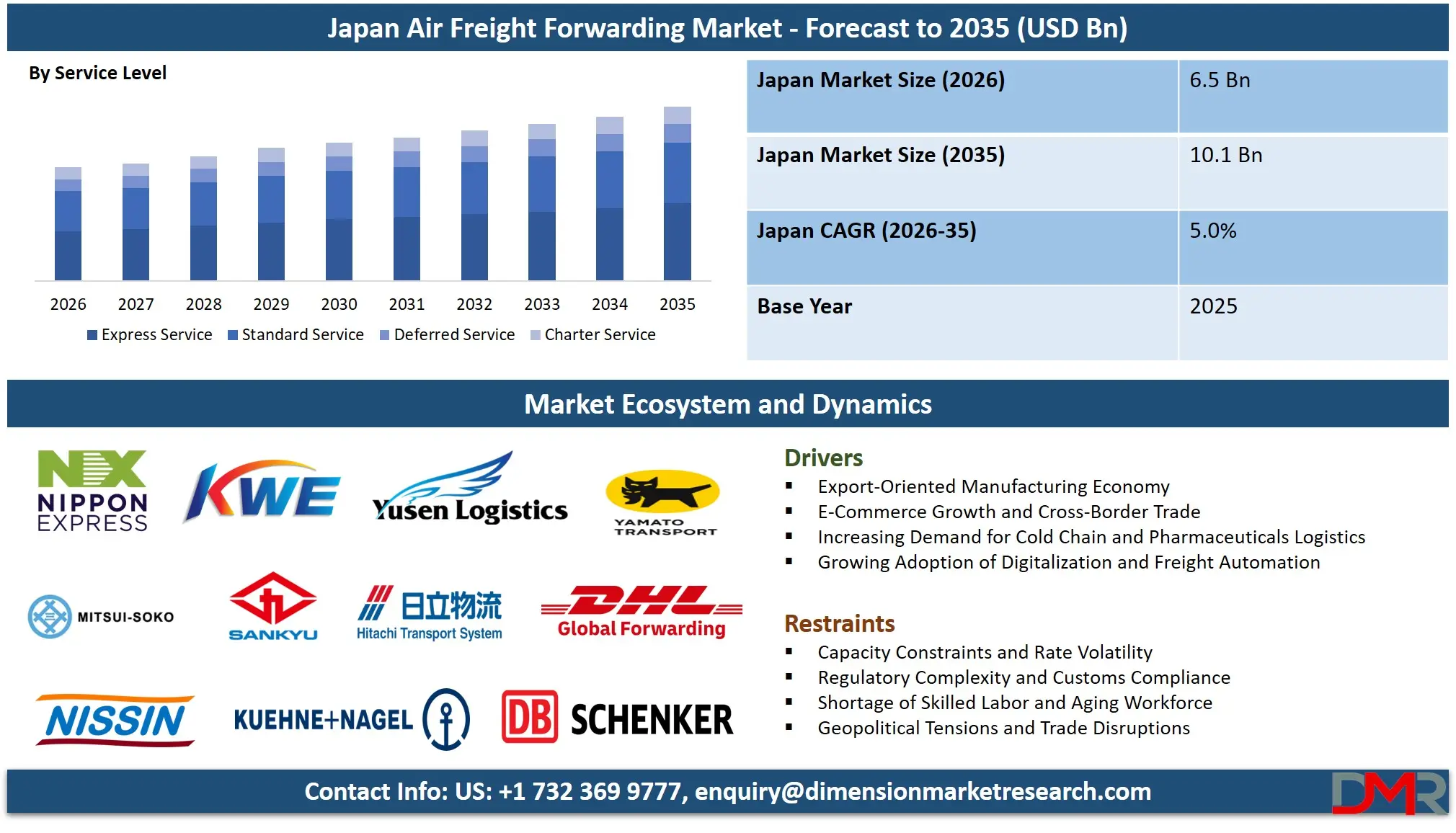
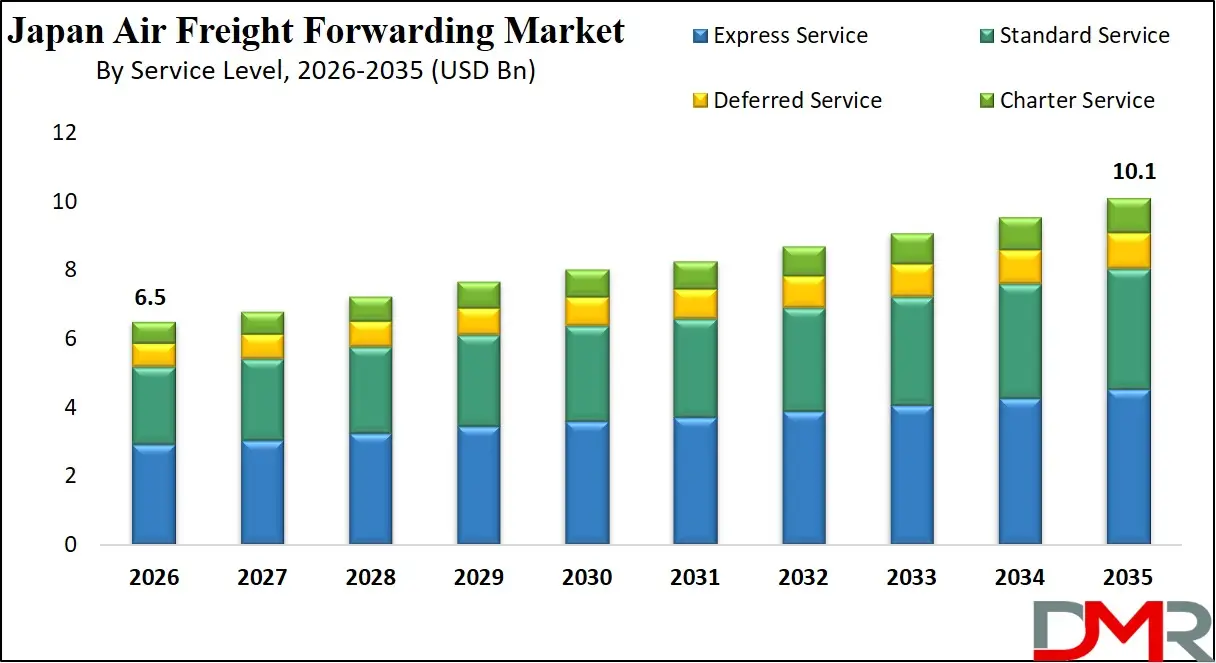
The Japan Air Freight Forwarding Market is projected to attain a valuation of USD 6.5 billion in 2026 and is expected to expand significantly, reaching USD 10.1 billion by 2035, advancing at a robust compound annual growth rate (CAGR) of 5.0% during the forecast period.
ℹ
To learn more about this report –
Download Your Free Sample Report Here
This growth reflects Japan's strategic position as a major global trading hub, advanced logistics infrastructure, and increasing cross-border e-commerce activities. The demand for time-sensitive air freight solutions, cold chain logistics, and specialized cargo handling is accelerating across industries including automotive, healthcare, high-tech electronics, and retail.
Japan has historically maintained one of the most sophisticated logistics networks in Asia, with world-class airports including Narita International Airport, Haneda Airport, and Kansai International Airport serving as major air cargo gateways. The integration of digital freight platforms, real-time tracking systems, and automated warehousing solutions is becoming central to the country's next-generation logistics transformation. Japan's export-oriented economy, strong manufacturing base, and growing e-commerce sector are pushing industries to adopt advanced air freight forwarding services at an unprecedented pace.
Government initiatives such as the Logistics Innovation Policy, the Smart Logistics Initiative, and the Digital Transformation Strategy for Logistics aim to position Japan as a leader in efficient, sustainable, and technologically advanced freight forwarding services. These programs promote investment in automated cargo handling systems, cold chain infrastructure, and digital customs clearance platforms, creating a favorable ecosystem for air freight forwarding innovation.
Japan's trade relationships also strongly support market growth. According to Ministry of Finance trade statistics, Japan maintains robust export and import volumes with key trading partners including China, the United States, South Korea, and ASEAN countries. The country's position as a major exporter of automotive components, semiconductor equipment, precision machinery, and high-tech electronics creates sustained demand for reliable air freight forwarding services capable of meeting strict delivery timelines and handling requirements.
The healthcare and pharmaceutical sector represents another major growth pillar. Japan's aging population and advanced medical infrastructure drive demand for temperature-controlled pharmaceutical logistics, urgent medical device shipments, and cold chain solutions for biologics and vaccines. Air freight forwarders are developing specialized capabilities in GDP-compliant transportation, real-time temperature monitoring, and regulatory documentation to serve this expanding segment.
ℹ
To learn more about this report –
Download Your Free Sample Report Here
In e-commerce and retail sectors, air freight forwarding is transforming cross-border trade through express delivery services, last-mile integration, and seamless customs clearance solutions. The rapid growth of Japanese e-commerce platforms and international marketplaces increases demand for reliable air cargo capacity and efficient distribution networks.
Japan's unique combination of advanced logistics infrastructure, strong trade flows, technological leadership, and government-backed innovation programs positions the country as one of the most significant air freight forwarding markets in the Asia-Pacific region.
Japan Air Freight Forwarding Market: Key Takeaways
- Market Size Insights: The Japan Air Freight Forwarding Market is estimated at USD 6.5 billion in 2026 and is expected to reach USD 10.1 billion by 2035.
- Market Growth Rate: The market is projected to grow at a CAGR of 5.0% from 2026 to 2035.
- Key Players: Major players in the Japan Air Freight Forwarding Market include Nippon Express, Kintetsu World Express, Yusen Logistics, Yamato Holdings, DHL Japan, FedEx Express Japan, Hitachi Transport System, Sankyu Inc., Nissin Corporation, and Hankyu Hanshin Express.
- Special Cargo as a Core Growth Driver: Special cargo including pharmaceuticals, perishables, and hazardous materials is expected to dominate the Japanese air freight forwarding market due to stringent handling requirements and growing demand for temperature-controlled logistics.
- International Destination as the Leading Segment: Japan's export-oriented economy ensures that international air freight forwarding represents the largest destination segment, driven by strong trade flows with North America, Europe, and Asia.
- Government Policy as a Catalyst: Programs such as Smart Logistics Initiative and Digital Transformation Strategy for Logistics promote logistics innovation and accelerate the adoption of advanced freight forwarding technologies.
Impact of the Iran Conflict on the Japan Air Freight Forwarding Market
- Rising Fuel Costs Affecting Air Freight Rates: The Iran conflict has triggered volatility in global oil markets, with jet fuel prices increasing due to disruptions in Middle Eastern supply routes and concerns about Strait of Hormuz stability. Higher fuel costs directly impact air freight forwarding operational expenses, leading to increased freight rates and fuel surcharges for shippers. This can affect trade volumes and margin structures for freight forwarders operating in Japan.
- Airspace and Route Diversions: Geopolitical tensions in the Middle East have prompted some airlines to reroute flights to avoid conflict zones, potentially extending flight times and affecting cargo delivery schedules. For Japan-based freight forwarders handling shipments to and from Europe and the Middle East, these route adjustments can impact transit times, capacity availability, and operational planning.
- Insurance and Risk Premium Increases: The conflict has led to higher insurance premiums for air cargo shipments passing through or near conflict-affected regions. Freight forwarders must navigate increased costs for war risk insurance and cargo coverage, potentially passing these expenses to customers or absorbing margin compression.
- Supply Chain Diversification Strategies: Geopolitical uncertainties often accelerate corporate strategies to diversify supply chains and reduce dependence on specific regions. This could benefit Japan's air freight forwarding market as companies explore alternative sourcing locations and manufacturing bases in Southeast Asia, increasing air cargo volumes between Japan and alternative production hubs.
- Increased Demand for Secure Logistics: Heightened security concerns may increase demand for premium, secure logistics services, including enhanced tracking, tamper-evident packaging, and specialized handling for high-value or sensitive shipments, creating opportunities for forwarders offering value-added security solutions.
Japan Air Freight Forwarding Market: Use Cases
- Pharmaceutical Cold Chain Logistics Supporting Healthcare: Japan's aging population and advanced healthcare system are significantly accelerating the deployment of specialized pharmaceutical logistics in air freight forwarding. Temperature-controlled air freight solutions enable the safe transportation of vaccines, biologics, and temperature-sensitive medications between international manufacturing sites and Japanese healthcare facilities. Air freight forwarders equipped with GDP-certified cold chain capabilities ensure pharmaceutical shipments maintain strict temperature requirements throughout the logistics process, with real-time monitoring systems providing continuous visibility.
- Automotive Parts Distribution for Just-in-Time Manufacturing: Japan's globally recognized automotive manufacturing sector relies heavily on air freight forwarding for time-critical component deliveries. Automotive manufacturers and suppliers utilize express air freight services to transport essential parts, prototype components, and emergency production materials between international facilities and Japanese assembly plants. Air freight forwarders provide specialized automotive logistics solutions including sequencing services, consolidation programs, and urgent parts distribution that support lean manufacturing operations.
- High-Tech Electronics and Semiconductor Logistics: Japan's position as a major producer and consumer of high-tech electronics and semiconductor equipment creates substantial demand for specialized air freight services. Semiconductor manufacturing equipment, electronic components, and finished electronics require careful handling, electrostatic discharge protection, and expedited transportation to meet production schedules and market demands. Air freight forwarders with technical expertise in high-tech logistics provide specialized packaging, customs documentation, and time-definite delivery services.
- Perishable Food and Agricultural Product Exports: Japan's agricultural exports including premium beef, seafood, fresh produce, and prepared foods require rapid, temperature-controlled air freight solutions to reach international markets in optimal condition. Air freight forwarders specializing in perishable logistics provide pre-cooling services, temperature-monitored containers, and expedited customs clearance that enable Japanese food exporters to access global markets while maintaining product quality and shelf life.
- E-Commerce Cross-Border Fulfillment: The rapid growth of cross-border e-commerce has transformed air freight forwarding requirements for Japanese retailers and global marketplaces serving Japanese consumers. Air freight forwarders provide integrated solutions including consolidation services, express delivery options, and last-mile coordination that enable efficient cross-border e-commerce operations. These services help Japanese businesses access international customers while allowing global e-commerce platforms to serve the Japanese market effectively.
Japan Air Freight Forwarding Market: Stats & Facts
Ministry of Land, Infrastructure, Transport and Tourism (MLIT)
- Japan's air cargo volume handled at major international airports exceeds 2.5 million tons annually, with Narita International Airport handling approximately 2 million tons of international cargo each year.
- The Smart Logistics Initiative aims to create digitally connected logistics infrastructure through IoT integration, automated cargo handling, and real-time tracking systems.
- Air freight forwarding and logistics services are key components of Japan's national supply chain resilience strategy and trade competitiveness agenda.
Narita International Airport Corporation
- Narita Airport serves as Japan's premier international air cargo hub, handling approximately 80% of Japan's international air freight.
- The airport connects to over 100 international cities across more than 40 countries, providing extensive global network coverage for air freight forwarders.
Japan Customs
- Japan processes over 10 million customs declarations annually for air cargo imports and exports, with increasing adoption of automated customs clearance systems and digital documentation.
- The NACCS (Nippon Automated Cargo and Port Consolidated System) handles the majority of air cargo customs documentation, reducing processing times and improving clearance efficiency.
World Bank
- Japan ranks among the top countries globally for logistics performance, with particularly strong scores in logistics infrastructure, shipment tracking, and customs efficiency.
- The country's trade-to-GDP ratio exceeds 35%, reflecting the importance of international trade and freight forwarding services to the national economy.
International Air Transport Association (IATA)
- Japan represents one of the largest air cargo markets in the Asia-Pacific region, accounting for approximately 8% of global air freight traffic.
- The average air freight load factor on routes to and from Japan consistently exceeds 60%, indicating strong demand for cargo capacity.
Japan Freight Forwarders Association (JIFFA)
- Japan hosts over 200 licensed freight forwarding companies providing comprehensive air freight services to domestic and international customers.
- The association reports steady growth in specialized air freight services including pharmaceutical logistics, perishable cargo handling, and high-value electronics transportation.
Japan Air Freight Forwarding Market: Market Dynamics
Driving Factors in the Japan Air Freight Forwarding Market
Export-Oriented Manufacturing Economy
Japan's position as a leading global exporter of high-value manufactured goods is one of the strongest drivers for air freight forwarding demand. Major industries including automotive manufacturing, semiconductor production, precision machinery, and consumer electronics rely on air freight to transport time-sensitive components and finished products to international markets. The high value-to-weight ratio of many Japanese exports makes air freight economically viable, particularly for shipments requiring rapid delivery or specialized handling. As Japanese manufacturers maintain global supply chains and production networks, air freight forwarders provide essential services connecting Japanese factories with customers, assembly plants, and distribution centers worldwide.
E-Commerce Growth and Cross-Border Trade
The rapid expansion of e-commerce, particularly cross-border online retail, has significantly increased demand for air freight forwarding services in Japan. Japanese consumers increasingly purchase goods from international online retailers, requiring efficient air freight solutions for last-mile delivery. Simultaneously, Japanese e-commerce businesses seek to access global markets, relying on air freight forwarders to manage international shipping, customs clearance, and final delivery. The growth of business-to-consumer (B2C) shipments alongside traditional business-to-business (B2B) freight creates new opportunities for forwarders offering integrated e-commerce logistics solutions, including consolidation services, express delivery options, and seamless returns management.
Restraints in the Japan Air Freight Forwarding Market
Capacity Constraints and Rate Volatility
The air freight forwarding market in Japan faces ongoing challenges related to capacity availability and rate fluctuations. Passenger belly cargo capacity, which traditionally provides significant air freight lift, remains variable based on airline schedules and passenger demand patterns. During peak seasons or periods of strong trade activity, capacity shortages can occur, leading to rate increases and service limitations for shippers. Freight forwarders must navigate these capacity constraints while managing customer expectations and maintaining service reliability. Rate volatility, influenced by fuel costs, capacity availability, and global economic conditions, creates uncertainty for both forwarders and their customers in budgeting and pricing.
Regulatory Complexity and Customs Compliance
International air freight forwarding involves navigating complex regulatory requirements across multiple jurisdictions. Japanese forwarders must ensure compliance with export controls, customs regulations, safety and security requirements, and documentation standards for shipments to diverse international destinations. Specialized cargo categories including pharmaceuticals, dangerous goods, and perishables face additional regulatory scrutiny and handling requirements. The complexity of maintaining compliance while ensuring efficient shipment processing can strain forwarder resources and create potential delays or penalties. Changes in trade policies, tariff structures, or customs procedures in key markets add further complexity to international air freight operations.
Opportunities in the Japan Air Freight Forwarding Market
Expansion of Pharmaceutical Cold Chain Logistics
Japan's aging population, advanced healthcare system, and growing pharmaceutical sector create substantial opportunities for specialized cold chain air freight services. The increasing volume of temperature-sensitive pharmaceutical products, including biologics, vaccines, and specialty medications, requires sophisticated logistics solutions maintaining strict temperature control throughout the supply chain. Air freight forwarders investing in GDP-certified facilities, temperature-monitored containers, and real-time tracking systems can capture growing demand from pharmaceutical manufacturers, healthcare providers, and clinical research organizations. The expansion of biologic drug development and personalized medicine further increases requirements for reliable, temperature-controlled air freight services connecting Japan with global pharmaceutical supply chains.
Digital Transformation and Visibility Solutions
The ongoing digital transformation of logistics operations presents significant opportunities for forwarders offering advanced technology solutions. Japanese shippers increasingly demand real-time visibility into shipment status, proactive exception management, and seamless integration between freight forwarding systems and their own supply chain platforms. Air freight forwarders investing in digital freight platforms, API connectivity, and advanced tracking capabilities can differentiate their services while improving operational efficiency. The integration of IoT sensors for condition monitoring, blockchain for documentation security, and AI for route optimization creates opportunities for forwarders to offer premium visibility and control services that justify higher margins and strengthen customer relationships.
Trends in the Japan Air Freight Forwarding Market
Sustainability and Green Logistics Initiatives
Japan's commitment to carbon neutrality and environmental sustainability is increasingly influencing air freight forwarding operations and customer preferences. Shippers are placing greater emphasis on measuring and reducing the carbon footprint of their logistics activities, creating demand for forwarders offering sustainable transport options. Air freight forwarders are responding with carbon offset programs, sustainable aviation fuel initiatives, and optimized routing strategies that reduce emissions. The development of more fuel-efficient aircraft and operational improvements in ground handling and warehousing further support sustainability goals. Forwarders that can demonstrate measurable environmental performance improvements and offer green logistics solutions gain competitive advantage with environmentally conscious customers and corporate sustainability programs.
Integration of Air Freight with Multimodal Solutions
Air freight forwarders in Japan are increasingly developing integrated multimodal solutions that combine air transport with other modes to optimize cost, transit time, and reliability. Rather than viewing air freight in isolation, forwarders design comprehensive supply chain solutions that may include air freight for time-sensitive segments combined with ocean, rail, or truck transport for other components. This trend reflects growing customer demand for flexible, customized logistics solutions that balance competing priorities of speed, cost, and sustainability. Forwarders with multimodal capabilities can offer optimal routing recommendations based on specific shipment requirements, strengthening their position as strategic logistics partners rather than simple transport providers.
Japan Air Freight Forwarding Market: Research Scope and Analysis
By Cargo Type Analysis
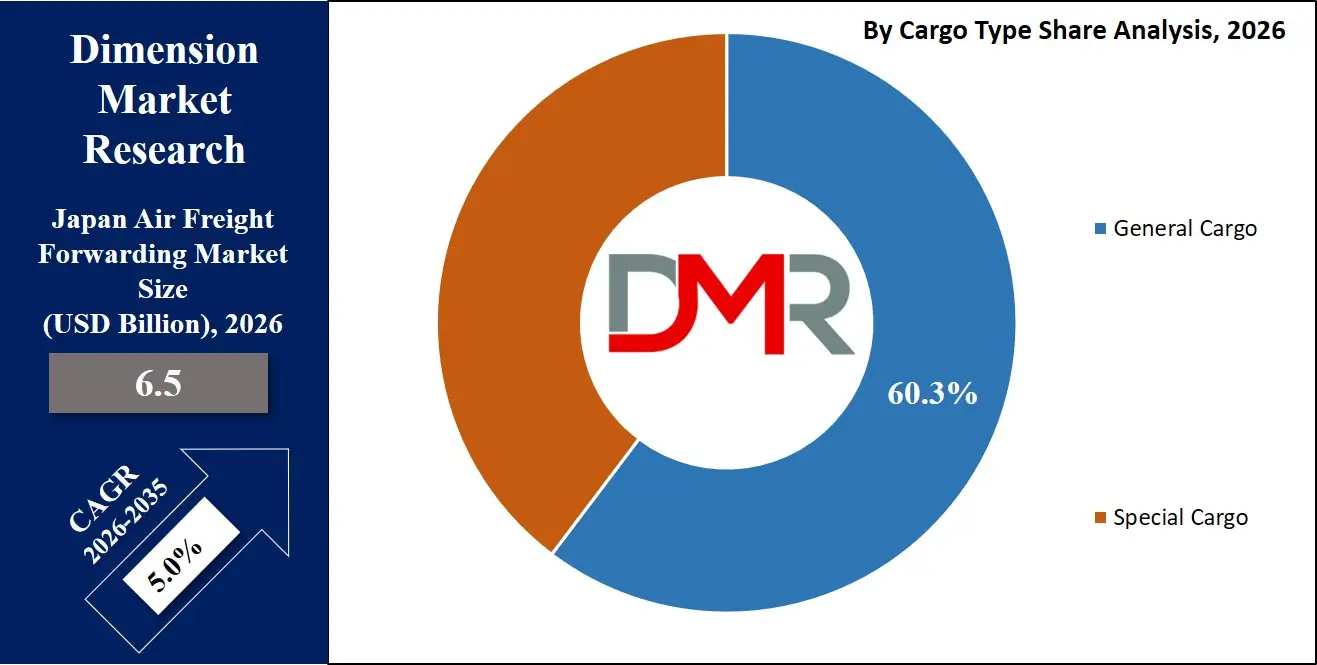
Special cargo is projected to dominate the Japan Air Freight Forwarding Market, holding approximately 55.0% of market share in 2026. This dominance is driven by Japan's position as a global leader in high-value manufacturing and advanced healthcare infrastructure, requiring specialized handling for pharmaceuticals, semiconductor equipment, and perishable goods. Pharmaceutical logistics demand GDP-certified cold chain facilities and temperature-controlled containers to serve Japan's aging population with temperature-sensitive medications. Government initiatives such as the Smart Logistics Initiative emphasize specialized handling capabilities for maintaining Japan's competitive position in global trade. International trade compliance and product integrity depend on this specialized infrastructure, ensuring sustained demand for premium special cargo services.
ℹ
To learn more about this report –
Download Your Free Sample Report Here
General cargo, while representing substantial volume, continues to serve routine shipments where specialized handling is not required. This segment faces intense price competition and generates lower revenue per kilogram compared to special cargo. However, general cargo remains essential for everyday commercial shipments of non-perishable goods and standard manufactured products. The efficiency of Japan's freight forwarding networks ensures reliable service for general cargo customers, maintaining this segment's importance despite its lower margin profile.
By Destination Analysis
International destinations are projected to dominate the Japan Air Freight Forwarding Market. This dominance is driven by Japan's export-oriented economy and strong global trade relationships with major economies including China, the United States, and ASEAN countries. Manufacturers rely on air freight networks to transport automotive components, semiconductor equipment, and precision machinery to global customers requiring strict delivery timelines. Export shipments support just-in-time manufacturing operations worldwide, while import shipments bring components and consumer goods to Japan. Government-backed trade facilitation programs advocate automated clearance systems and digital documentation to reduce transit times.
Domestic air freight within Japan serves important time-sensitive needs including overnight express services and perishable distribution to remote islands. The efficiency of Japan's surface transportation network means most domestic freight moves by truck, with air freight reserved for urgent shipments. Domestic routes connecting major cities with remote islands maintain essential supply chains for time-critical medical supplies and perishable goods. While smaller than international volumes, domestic air freight remains vital for specific time-sensitive applications.
By Customer Type Analysis
Business-to-Business (B2B) services are anticipated to dominate the customer type segment of the Japan Air Freight Forwarding Market. This dominance is driven by Japan's manufacturing-driven economy and the predominance of industrial supply chains requiring reliable freight forwarding solutions. Major industries including automotive manufacturing, semiconductor production, and precision machinery depend on B2B air freight for transporting components and finished goods across global supply chains. Japan's just-in-time manufacturing practices create sustained demand for reliable B2B services meeting strict delivery windows.
Business-to-Consumer (B2C) services are expanding rapidly due to growth in cross-border e-commerce and direct-to-consumer shipments. Japanese consumers increasingly purchase goods from international online retailers, while Japanese e-commerce businesses seek to access global markets. B2C shipments require integrated solutions including consolidation services, express delivery options, and seamless returns management. The growth of online retail continues to drive expansion in this segment, though B2B volumes remain dominant.
By Service Level Analysis
Standard service is projected to dominate the service level segment of the Japan Air Freight Forwarding Market. This dominance is driven by its cost-effectiveness and suitability for regular commercial shipments where immediate delivery is not critical. Many Japanese manufacturers and trading companies utilize standard air freight for routine exports and imports, balancing transit time requirements with transportation costs. The efficiency of Japan's major international airports and well-established freight forwarding networks ensures consistent service levels for standard shipments.
Express service represents a growing segment for urgent shipments requiring expedited handling and faster transit times. Time-critical automotive parts, medical supplies, and e-commerce deliveries drive demand for express services. Charter service addresses specialized requirements for oversized cargo, hazardous materials, or shipments needing dedicated aircraft capacity. While smaller than standard service, these specialized service levels provide essential options for time-sensitive and complex logistics requirements.
By Core Service Offering Analysis
Freight transportation is projected to dominate the core service offering segment of the Japan Air Freight Forwarding Market. This dominance is driven by its fundamental role in moving goods between origin and destination points across international borders. Air freight forwarders primarily generate revenue through transportation services, arranging cargo space on commercial and cargo aircraft serving Japan's major airports. Japan's position as a major trading nation generates substantial air freight volumes requiring professional transportation management.
Warehousing and distribution services provide essential support for freight forwarding operations, enabling consolidation, temporary storage, and inventory management. Customs brokerage ensures compliance with complex import and export regulations, with digital platforms streamlining documentation processes. Value-added logistics services including packaging, labeling, and supply chain consulting enhance forwarder capabilities and customer relationships. While freight transportation dominates, these supporting services contribute significantly to forwarder profitability and service differentiation.
By End-Use Industry Analysis
High-Tech & Electronics is projected to dominate the end-use industry segment of the Japan Air Freight Forwarding Market. This dominance is driven by Japan's position as a global leader in semiconductor manufacturing, consumer electronics, and precision technology production. Semiconductor equipment and electronic components require expedited air freight to meet production schedules and product launch timelines. The high value-to-weight ratio of electronics makes air freight economically viable, while time-sensitive product lifecycles demand rapid market delivery.
Automotive represents another major end-use industry, with just-in-time manufacturing requiring reliable air freight for critical components. Healthcare and pharmaceutical shipments demand specialized cold chain capabilities for temperature-sensitive medications and medical devices. Retail and e-commerce continue growing as cross-border online shopping expands. Industrial manufacturing, aerospace, and food and beverage sectors contribute additional volume, creating diverse demand across multiple industries served by Japan's air freight forwarding market.
The Japan Air Freight Forwarding Market Report is segmented on the basis of the following:
By Cargo Type
- General Cargo
- Special Cargo
By Destination
By Customer Type
- Business-to-Business (B2B)
- Business-to-Consumer (B2C)
By Service Level
- Standard Service
- Express Service
- Deferred Service
- Charter Service
By Core Service Offering
- Freight Transportation
- Warehousing & Distribution
- Customs Brokerage
- Freight Consolidation
- Value-Added Logistics Services
By End-Use Industry
- Healthcare
- Food & Beverage
- High-Tech & Electronics
- Automotive
- Retail & E-commerce
- Aerospace & Defense
- Agriculture
- Industrial Manufacturing
Japan Air Freight Forwarding Market: Competitive Landscape
The competitive landscape of the Japan Air Freight Forwarding Market is characterized by the presence of globally recognized logistics providers, specialized freight forwarders, and integrated express carriers that are continuously advancing service capabilities and technological solutions. Japan has one of the most sophisticated logistics markets in Asia, supported by world-class infrastructure, strong trade relationships, and demanding customer requirements across multiple industries.
ℹ
To learn more about this report –
Download Your Free Sample Report Here
Leading Japanese logistics companies such as Nippon Express, Kintetsu World Express, Yusen Logistics, and Sagawa Express dominate the market through extensive networks, long-standing customer relationships, and comprehensive service portfolios. These organizations combine air freight forwarding with ocean freight, trucking, warehousing, and supply chain solutions, offering integrated logistics services to major Japanese corporations and international customers. Their deep understanding of Japanese business practices, regulatory requirements, and customer expectations provides competitive advantages in serving domestic shippers.
Global logistics providers including DHL, FedEx, UPS, Kuehne+Nagel, and DB Schenker maintain strong positions in the Japanese market through international networks, specialized capabilities, and technology platforms. These companies bring global best practices, advanced tracking systems, and expertise in complex international shipments, serving multinational customers and Japanese companies with global operations. Their investments in pharmaceutical logistics, e-commerce solutions, and digital platforms strengthen their competitive positioning. Overall, Japan's competitive landscape combines established logistics leaders with specialized niche players, creating a highly dynamic market that supports innovation, service differentiation, and continuous improvement in air freight forwarding capabilities across multiple sectors.
Some of the prominent players in the Japan Air Freight Forwarding Market are:
- Nippon Express
- Kintetsu World Express
- Yusen Logistics
- Mitsui-Soko Group
- Sankyu Inc.
- Hitachi Transport System
- Yamato Transport
- DHL Global Forwarding
- Kuehne + Nagel
- DB Schenker
- DSV A/S
- Expeditors International
- CEVA Logistics
- GEODIS
- Hellmann Worldwide Logistics
- Nissin Corporation
- Sojitz Logistics
- Kamigumi Co. Ltd.
- Aramex Japan
- FedEx Logistics
- Other Key Players
Recent Developments in the Japan Air Freight Forwarding Market
- December 2025: According to freight volume rankings for Japan’s air cargo market, Nippon Express, Kintetsu World Express, and Yusen Logistics continue to dominate air forwarding volumes, validating their frontline operational roles in Japan’s air freight forwarding market through 2025.
- October 2025: Nippon Cargo Airlines and ANA launched freighter codeshare services connecting Japan with Europe and North America, enhancing cargo capacity availability and improving connectivity for freight forwarders operating in Japan.
- October 2025: DHL Global Forwarding partnered with Nippon Cargo Airlines to execute dedicated charter flights transporting semiconductor manufacturing equipment from Europe to Japan, strengthening air freight capacity and supporting the country’s rapidly growing semiconductor industry.
- August 2025: DHL Express and Cathay Group signed a new sustainable aviation fuel (SAF) partnership to supply SAF for international flights departing from Tokyo Narita International Airport (among other Asian hubs), strengthening green air freight operations directly relevant to forwarders operating on Japan trade lanes.
- July 2025: China’s market regulator approved ANA Holdings’ acquisition of Nippon Cargo Airlines with conditions, clearing a key regulatory hurdle and potentially affecting capacity planning and freight forwarding partnerships for Japan’s international air cargo ecosystem.
Report Details
| Report Characteristics |
| Market Size (2026) |
USD 6.5 Bn |
| Forecast Value (2035) |
USD 10.1 Bn |
| CAGR (2026–2035) |
5.0% |
| Historical Data |
2021 – 2025 |
| Forecast Data |
2027 – 2035 |
| Base Year |
2025 |
| Estimate Year |
2026 |
| Report Coverage |
Market Revenue Estimation, Market Dynamics, Competitive Landscape, Growth Factors and etc. |
| Segments Covered |
By Cargo Type (General Cargo and Special Cargo), By Destination (Domestic and International), By Customer Type (Business-to-Business (B2B) and Business-to-Consumer (B2C)), By Service Level (Standard Service, Express Service, Deferred Service, Charter Service), By Core Service Offering (Freight Transportation, Warehousing & Distribution, Customs Brokerage, Freight Consolidation, and Value-Added Logistics Services), By End-Use Industry (Healthcare, Food & Beverage, High-Tech & Electronics, Automotive, Retail & E-commerce, Aerospace & Defense, Agriculture, and Industrial Manufacturing) |
| Country Coverage |
Japan |
| Prominent Players |
Nippon Express, Kintetsu World Express, Yusen Logistics, Mitsui-Soko Group, Sankyu Inc., Hitachi Transport System, Yamato Transport, DHL Global Forwarding, Kuehne + Nagel, DB Schenker, DSV A/S, Expeditors International, CEVA Logistics, GEODIS, Hellmann Worldwide Logistics, Nissin Corporation, Sojitz Logistics, Kamigumi Co. Ltd., Aramex Japan, FedEx Logistics, and Other Key Players |
| Purchase Options |
We have three licenses to opt for: Single User License (Limited to 1 user), Multi-User License (Up to 5 Users), and Corporate Use License (Unlimited User) along with free report customization equivalent to 0 analyst working days, 3 analysts working days and 5 analysts working days respectively. |
Frequently Asked Questions
How big is the Japan Air Freight Forwarding Market?
▾ The Japan Air Freight Forwarding Market size is estimated to have a value of USD 6.5 billion in 2026 and is expected to reach USD 10.1 billion by the end of 2035.
What is the growth rate in the Japan Air Freight Forwarding Market in 2026?
▾ The market is growing at a CAGR of 5.0% over the forecasted period of 2026.
Who are the key players in the Japan Air Freight Forwarding Market?
▾ Some of the major key players in the Japan Air Freight Forwarding Market are Nippon Express, Kintetsu World Express, Yusen Logistics, Yamato Holdings, DHL Japan, FedEx Express Japan, Hitachi Transport System, Sankyu Inc., and many others.