What is the Japan Anime Market Size?
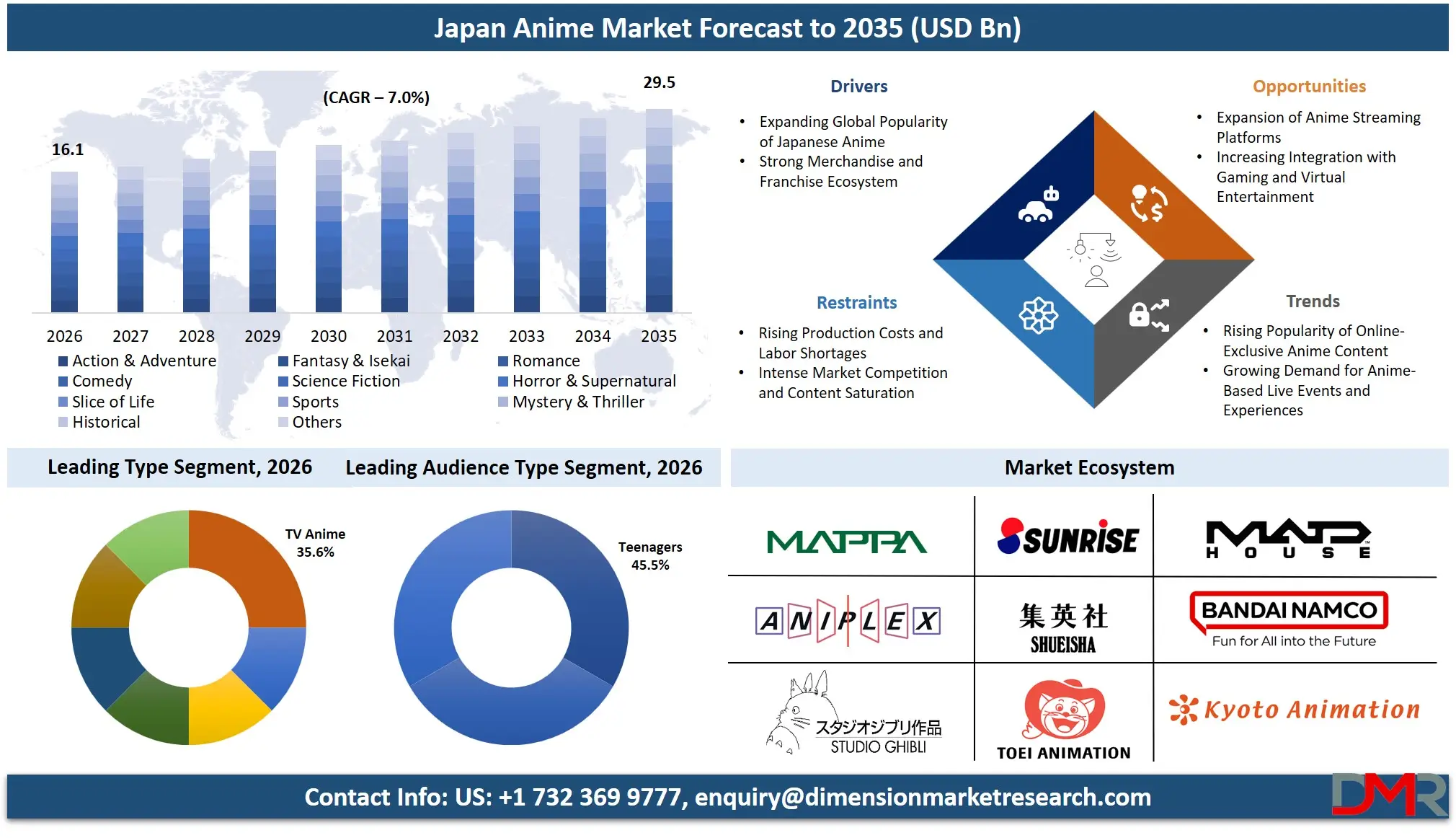
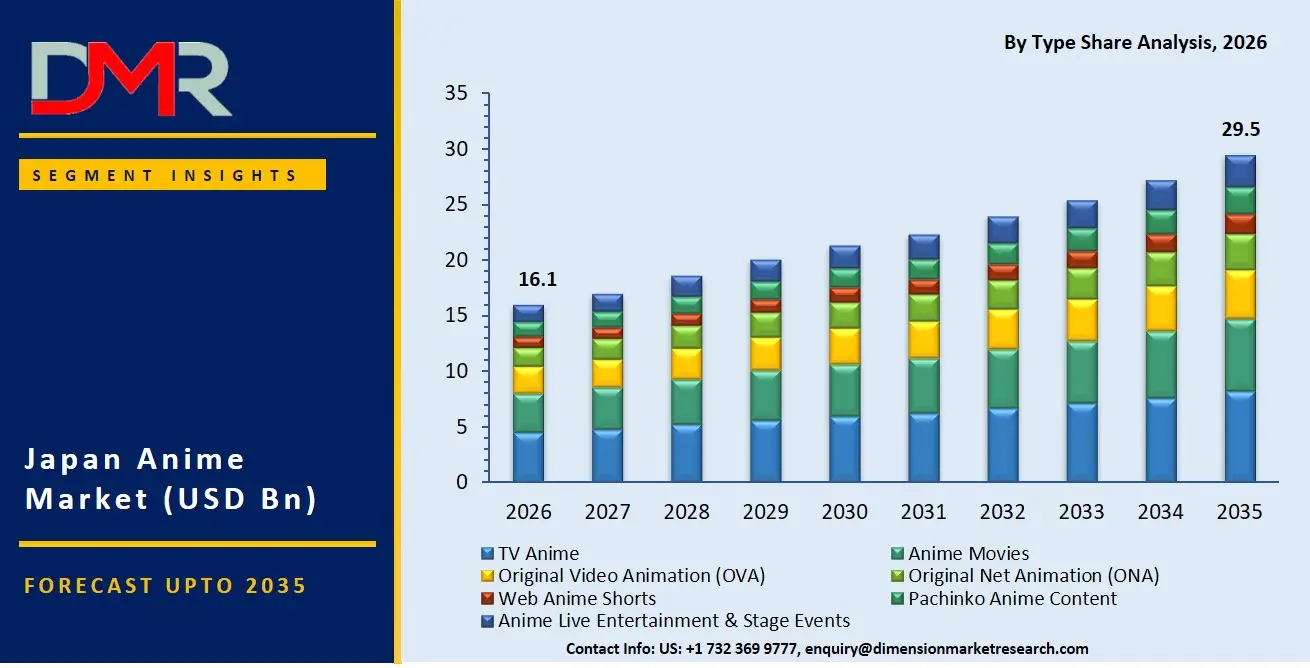
The Japan Anime Market is expected to reach a value of USD 16.1 billion in 2026, and it is further anticipated to reach USD 29.5 billion by 2035, growing at a CAGR of 7.0% during the forecast period.
ℹ
To learn more about this report –
Download Your Free Sample Report Here
In addition to being rapidly growing, the Japan anime market is also characterized by an increased rate of consumers' interest in acquiring content at a high pace and discarding conventional modes of distribution in favor of digital ones. Such a niche includes television series, movies, OVAs, streaming platforms and a lot of merchandise and event-based activities, which form a part of the strategy of engagement with fans.
In particular, there is a growing necessity for content producers to implement models of simulcasting, remake and enhance the quality of media products to 4K, create transmedia narrative structures and use AI to assist in production, all of which require an experienced team to produce and license the aforementioned type of content. The most active distributors of the discussed type of entertainment are typically represented by the distributors of streaming services and the merchandising of the content, which generates maximum revenue due to its relative cheapness and effectiveness.
ℹ
To learn more about this report –
Download Your Free Sample Report Here
Key Takeaways
m
- Market Size & Forecast: It is projected that the Japan Anime Market will have a valuation worth USD 16.1 billion in 2026 and is further forecasted to reach the market value of USD 29.5 billion in 2035 due to increased global demand, increased streams, and revenue generation by merchandise.
- Growth Rate & Outlook: The market is expected to grow at a CAGR of 7.0% between 2026-2035 fueled by high demand for anime content on digital streaming sites, mobile applications, and movies.
- Primary Growth Drivers: The major growth drivers include the rise of anime culture among Japan globally, increase in streams, partnerships in games, and increasing sales in merchandise such as figures, collectibles, and cosplays.
- Key Market Trends: Some of the major trends are a quick switch to ONA (Original Net Animation), investments in fantasy and isekai genres, AI-based animations, anime performances gaining popularity worldwide, and global licensing.
- By Type Analysis: TV anime is poised to lead this segment in the Japan anime market due to its broad audience appeal, continuous production model, and franchise potential. TV anime brings in revenues from ads, licensing, streaming, video games, and merchandising while retaining an audience over time and increasing anime popularity around the globe.
- By Genre Analysis: Action and adventure genres are anticipated to dominate in the Japanese anime market thanks to its wide audience base at home and abroad. These genres help boost TV ratings, streaming, movies, merchandising, and licensing revenues while helping long-running series that bring in profits for animation studios.
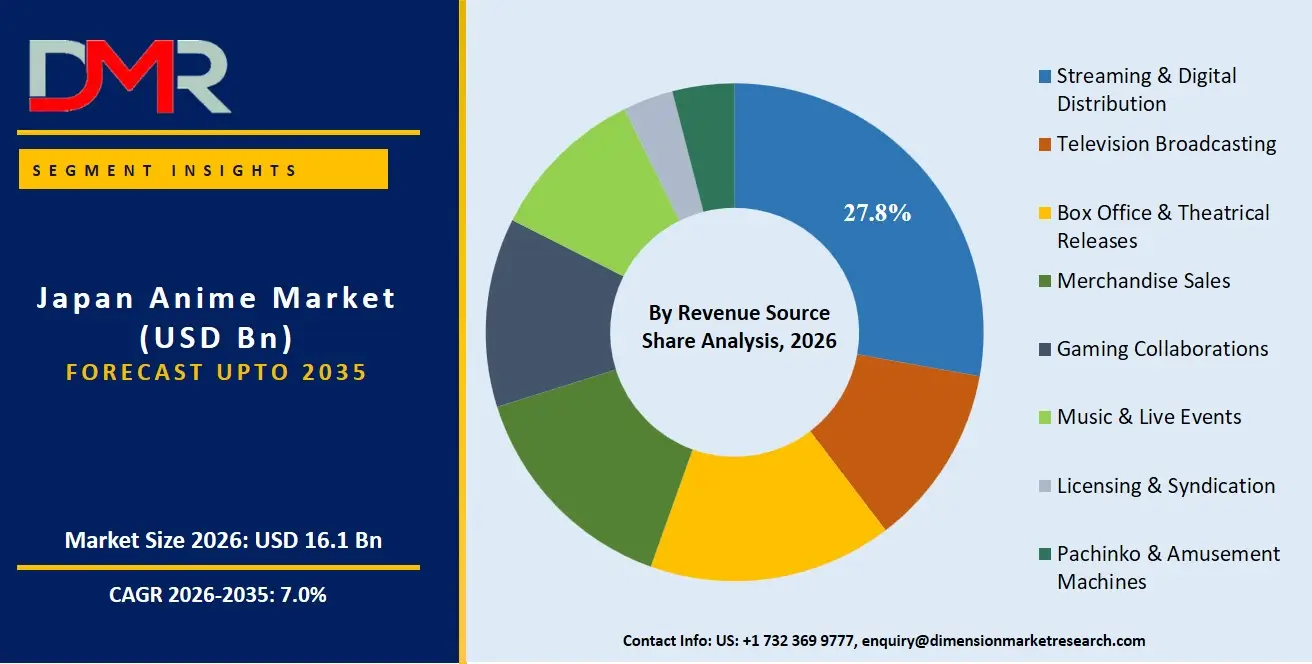
- By Revenue Source Analysis: Merchandise sales are expected to dominate the Japan anime market due to high consumer demand for collectibles, figurines, clothing, cards, and licensed goods. The top franchises make money off merchandising over long periods via conventions, collaborations, limited editions, and dedicated fan bases that keep buying beyond a series lifecycle.
What is the Anime?
Animes are the types of entertainments that have been generated from the nation of Japan to become one of the popular cultures in the world. Animes can be in the form of anime shows, films, web series, original videos of all kinds of genres like action, fantasy, romantic, science fiction, comedy, horror, and slice-of-life. Anime has brought certain features within it like the way visuals are created, character development, emotions and fictional world within stories. On the other hand, regular cartoons only concentrate on entertaining children whereas animes appeal to the teenage and adult age groups. Anime follows various models of earning through various methods.
Use Cases
- Growth of Streaming Websites: Anime websites acquire exclusive rights to stream anime and create anime original video (ONA) content on their websites to earn subscribers globally.
- Association with the Game Industry: The association with the game industry through anime franchises that have their anime character included in the games is an example of generating revenues from fan activity.
- Development of the Merchandising System: Animation production studios generate other sources of revenue from their intellectual property rights by means of creating figures, collectible toys, costumes, and trading cards.
- Expansion of Tourism with the Help of Anime Performances: Performances and tours featuring animated character help expand tourism as well as the influence of the anime culture on viewers.
How AI is Transforming the Anime Market?
AI has played a significant role in changing the way animes are produced in the present-day world. The process includes assistance in the production of content using animation in-betweens, background creation, sound mixing, and coloring of the content. This makes it easier for the studio to produce its content much more quickly, saving labor which can then be utilized for other creative processes because of the shortage of animators. Artificial intelligence has also proven useful in coming up with stories, translation of scripts, creating subtitles, and dubbing their productions in different languages.
Market Dynamics
Key Drivers in the Japan Anime Market
Expanding Global Popularity of Japanese Anime
The increasing international appreciation of anime in Japan is one of the key factors driving the growth of the Japan anime market. The anime genre has achieved mainstream status in North America, Europe, Southeast Asia, and Latin America thanks to online viewing, social media presence, and international fans' communities. Popular series are now capable of bringing considerable revenues from foreign markets via licensing, distribution, merchandising, and video games. Foreign demand motivates domestic studios to produce more episodes in various forms. Furthermore, international collaboration between streaming companies and entertainment companies is contributing to anime exports, allowing Japan to grow its presence in the international entertainment industry.
Strong Merchandise and Franchise Ecosystem
The extensive anime merchandise industry in Japan largely influences the growth of the market since they create lasting commercial benefits for companies apart from content distribution. Anime is known for making money through collectibles, apparels, game collaborations, card games, concerts, and character branding. Fan bases help boost limited-edition products and collaboration efforts, hence consistent consumer interest. Popular anime shows tend to develop into full-fledged entertainment franchises that involve money-making processes like movies and mobile games. Besides that, consumers are always motivated to spend money due to the emotional connection they have with anime characters.
Restraints in the Japan Anime Market
Rising Production Costs and Labor Shortages
Rising production and personnel cost levels represent important restrictions in the Japanese anime market. The industry experiences increasing costs caused by rising labor rates, investments in digital technologies, and tight timelines, which increase financial stress on companies. Furthermore, the market experiences a shortage of experienced animators, authors, and specialists, who have been reluctant to join due to poor working conditions and low salaries for beginners. This restriction affects small businesses more than large enterprises. It is likely to lead to lower-quality productions and difficulties in addressing the growing global demand for Japanese animation.
Intense Market Competition and Content Saturation
The Japan anime industry is now highly competitive because there is an increase in the number of anime productions along with the growth of digital streaming companies. Hundreds of anime products are produced each year, resulting in overcrowded anime content and making it challenging to get new anime programs with high viewer ratings. Small animation companies find it difficult to compete with popular and well-established anime products. Competitive streaming companies spend a lot of money licensing anime programs. The oversupply of anime can lower the retention rates of viewers, making the anime less profitable.
Growth Opportunities in the Japan Anime Market
Expansion of Anime Streaming Platforms
There is an emerging business opportunity for the Japan anime industry due to the exponential rise in streaming services that target anime consumers. Anime content providers have found it easier to access global markets by online channels compared to conventional broadcast media. The increasing uptake of mobile phones together with the advancement in internet connectivity and the growing popularity of streaming has led to the increase in anime streaming viewership around the globe. Moreover, many anime streaming companies are allocating more resources towards exclusive anime production and simulcasting to draw more customers to their platforms.
Increasing Integration with Gaming and Virtual Entertainment
The increasing overlap between anime and the gaming, virtual reality, and digital entertainment industries presents considerable potential for growth in the market. Anime is seeing greater use in mobile games, console games, the metaverse, and virtual concerts, providing a new way for anime producers to generate revenues and improve their interaction with fans. Popular anime intellectual property is known for having high crossover appeal within the gaming industry, especially among younger audiences. Moreover, the development of technologies that facilitate immersive content, as well as AI-powered animation techniques, will foster innovation in the field and enhance the entertainment experience.
Trends in the Japan Anime Market
Rising Popularity of Online-Exclusive Anime Content
One of the major developments happening within the Japan anime industry is the increased creation of anime that is exclusive to online services. Several online video streamers have started ordering original net animations (ONAs) and other unique shows as a way of differentiating themselves from others in terms of the content offered by their respective platforms and to help gain more subscribers. There is a gradual move away from TV-based broadcasting to focus on creating online anime that can experiment with storytelling and genres. With the availability of several languages, the anime can also be broadcast internationally at once.
Growing Demand for Anime-Based Live Events and Experiences
Live entertainment events that are themed after anime have become a trend within the Japan anime market. This can be seen as more fans are engaging in activities like anime concerts, anime theater performances, anime exhibits, cosplay events, anime cafés, and immersive experience venues based on famous anime titles. In doing so, they develop stronger emotional attachment to the IP while helping to create extra income for the producers outside of media production and distribution. Tourism involving anime culture is increasing because there are now people from within and outside Japan coming to participate in activities associated with anime.
Research Scope and Analysis
The Japan anime market is distributed through multiple channels, including online streaming platforms, television networks, theatrical releases, physical media such as DVD/Blu-ray, mobile applications, and anime events & exhibitions. Streaming platforms dominate due to rising digital consumption, while theaters, television, and live events continue supporting fan engagement and franchise expansion across Japan.
ℹ
To learn more about this report –
Download Your Free Sample Report Here
By Type Analysis
The TV anime format is expected to dominate this segment in the Japan anime market because of its long-standing legacy, wide reach of audiences, and constant production cycle. The television anime is at the core of the Japanese anime industry, allowing creators to develop a franchise that will grow into a movie, products, games, and streaming releases. Regular airing of shows helps keep viewers engaged and generates additional revenue from advertisements and licensing deals. Top anime aired on television can increase foreign fans' interest via simulcast on online platforms. Studios prefer TV anime format over the other two types because of their better potential for earning profits.
By Genre Analysis
Action & Adventure is poised to be the dominant genre in the anime market in Japan due to its broad appeal to both local and foreign viewers. Franchises involving fierce confrontations and adventures create highly rated television programs, high numbers of streaming views, revenues from movies, and lucrative sales from merchandise. The genre is particularly appealing to young people, which makes it a commercial draw for sponsorship and licensing. Anime in the action genre tends to do very well in overseas markets as well, which improves export revenues for Japanese anime studios. Moreover, the genre enables the creation of franchises that earn revenues through their longevity.
By Revenue Source Analysis
Merchandise sales are anticipated to represent the dominant revenue source in Japan's anime market because of the robust fan base for collectibles, figurines, clothes, cards, and other merchandise related to characters. The popularity of an anime franchise ensures that merchandise will bring more profits in the long run than just airing shows on television. Fans in Japan attend anime conventions, release events for limited items, and collaborate with brands to ensure steady consumer spending on merchandising. Anime merchandise can even continue generating revenues for a product line after a show's cancellation.
By Audience Type Analysis
Teenagers is projected to dominate the audience segment in Japan's anime market since they form the consumer base of the anime industry through watching mainstream anime, using streaming channels, buying manga versions, and purchasing the anime merchandise. The shonen and shojo anime styles are particularly made with teenagers in mind to attract them as their interests lie with these genres of anime. This category of people plays a major role within the anime industry in terms of their participation in online forums, social media, gaming, and events regarding anime.
By Merchandise Type Analysis
The category of figures & collectibles is expected to leading among all other merchandise types since anime fans living in Japan attach much cultural and emotional significance to collectibles featuring anime characters. Sales generated by premium figures, limited edition statues, and model collectibles are significant due to high demand from anime fans and collectors. Anime production companies often launch exclusive collectibles in connection with a season opening, movie premiere, or anniversary event, ensuring continuous buying behavior. High export sales are seen as another advantage of this category. Collectibles tend to yield better margins than regular merchandise, which makes them an appealing product type to market.
By Production Studio Size Analysis
Large studios are anticipated to dominate the anime market in Japan since they have more capital, sophisticated facilities, intellectual property, and distribution networks. These organizations always get high budget projects, license agreements with foreign countries, and deal with major streaming sites and television broadcasters. Their capability to handle big projects, hire talented individuals, and maintain a global following provides them with an edge over their competitors. Moreover, large anime studios have different sources of income which include their films being shown in theaters, product placement, games, and even international rights to their works. Large anime studios can easily remain at the top of their game due to their connections with production committees and advertisers.
By Distribution Channel Analysis
Online streaming platforms are expected to dominate the distribution channel segment because of the digitalization of anime consumption, especially in Japan and other countries where there is demand for anime. Most consumers now favor streaming platforms as a means of consuming their favorite content since most of the content that is broadcast through television is not readily available anymore. There are multiple reasons behind the increase in popularity of online anime streaming including easy availability, quick access to large libraries, simultaneous release of episodes from the Japanese language, multilingual subtitles.
The Japan Anime Market Report is segmented on the basis of the following:
By Type
- TV Anime
- Anime Movies
- Original Video Animation (OVA)
- Original Net Animation (ONA)
- Web Anime Shorts
- Pachinko Anime Content
- Anime Live Entertainment & Stage Events
By Genre
- Action & Adventure
- Fantasy & Isekai
- Romance
- Comedy
- Science Fiction
- Horror & Supernatural
- Slice of Life
- Sports
- Mystery & Thriller
- Historical
- Others
By Revenue Source
- Streaming & Digital Distribution
- Television Broadcasting
- Box Office & Theatrical Releases
- Merchandise Sales
- Gaming Collaborations
- Music & Live Events
- Licensing & Syndication
- Pachinko & Amusement Machines
By Audience Type
- Children
- Teenagers
- Adults
By Merchandise Type
- Figures & Collectibles
- Apparel & Accessories
- Manga & Printed Media
- Toys & Games
- Posters & Home Decor
- Trading Cards
- Cosplay Products
- Others
By Production Studio Size
- Major Studios
- Mid-Sized Studios
- Independent Studios
By Distribution Channel
- Online Streaming Platforms
- Television Networks
- Theatrical Distribution
- Physical Media (DVD/Blu-ray)
- Mobile Applications
- Anime Events & Exhibitions
Competitive Landscape
The competitive environment in the Japanese anime industry is fragmented with many players involved in the business including animation studios, streaming websites, production studios, merchandise makers, and games developers. The most renowned animation studios keep growing in size by way of licensing their products outside of the region through cinemas and streaming websites.
The focus on competition now has been put on IP control, high-quality animation production, distribution worldwide, and franchise monetization. At the same time, streaming websites have been making efforts to develop exclusive anime series and net animations in order to increase subscription base. Production studios are trying to diversify revenues through merchandising, live entertainment performances, games, and licensing.
Some of the prominent players in the Japan Anime Market are:
- Toei Animation
- Studio Ghibli
- MAPPA
- Sunrise
- Kyoto Animation
- Madhouse
- Bones
- A-1 Pictures
- Production I.G
- Pierrot
- Aniplex
- Bandai Namco Filmworks
- TMS Entertainment
- Shueisha
- Kadokawa Corporation
- Toho
- Nippon Animation
- CloverWorks
- Wit Studio
- OLM
- Other Key Players
Recent Developments
- January 2026: Netflix increased investment in original net animation (ONA) works by partnering with anime studios in Japan. The move sought to boost exclusive anime content, foster subscriber growth in other regions, facilitate localization, and expand distribution of streaming anime works worldwide.
- November 2025: Crunchyroll launched strategies for increasing simulcasting of new fantasy and isekai anime works. The focus was to provide fast global availability of anime episodes to audiences, encourage subscriptions, and enhance multilingual availability of anime works for global audiences.
- October 2025: Toei Animation planned to employ AI-based animation software for production. The aim was to optimize production processes, eliminate production bottlenecks, assist animators in repetitive tasks, and increase the speed of completion of anime projects.
Report Details
| Report Characteristics |
| Market Size (2026) |
USD 16.1 Bn |
| Forecast Value (2035) |
USD 29.5 Bn |
| CAGR (2026–2035) |
7.0% |
| Historical Data |
2021 – 2025 |
| Forecast Data |
2027 – 2035 |
| Base Year |
2025 |
| Estimate Year |
2026 |
| Segments Covered |
By Type, By Genre, By Revenue Source, By Audience Type, By Merchandise Type, By Production Studio Size, and By Distribution Channel |
| Country Coverage |
Japan |
Frequently Asked Questions
How big is the Japan Anime Market?
▾ The Japan Anime Market is projected to be valued at USD 16.1 billion in 2026 and is expected to reach USD 29.5 billion by 2035 due to increasing global streaming demand, merchandise expansion, and international licensing growth.
What is the CAGR of the Japan Anime Market from 2026 to 2035?
▾ The market is anticipated to grow at a CAGR of 7.0% during the forecast period from 2026 to 2035.
What factors are driving the growth of the Japan Anime Market?
▾ Major growth drivers include rising global popularity of anime, expansion of streaming & digital distribution, growing merchandise sales, increasing gaming collaborations, and international licensing opportunities.
Which genre dominates the Japan Anime Market?
▾ Fantasy & Isekai is projected to currently dominates the market because of its strong popularity among teenagers and adults on global streaming platforms.
Which revenue source holds the largest share in the Japan Anime Market?
▾ Streaming & Digital Distribution is expected to hold the largest market share due to rising online anime consumption and international streaming expansion.
What are the major trends in the Japan Anime Market?
▾ Major trends include the rise of original net animation (ONA), increasing anime live entertainment events, AI-assisted animation production, and expansion of fantasy & isekai content.
Who are the key players in the Japan Anime Market?
▾ Key players in the Japan Anime Market include Toei Animation, Studio Ghibli, MAPPA, Crunchyroll, Netflix and many other regional and international players.