Market Overview
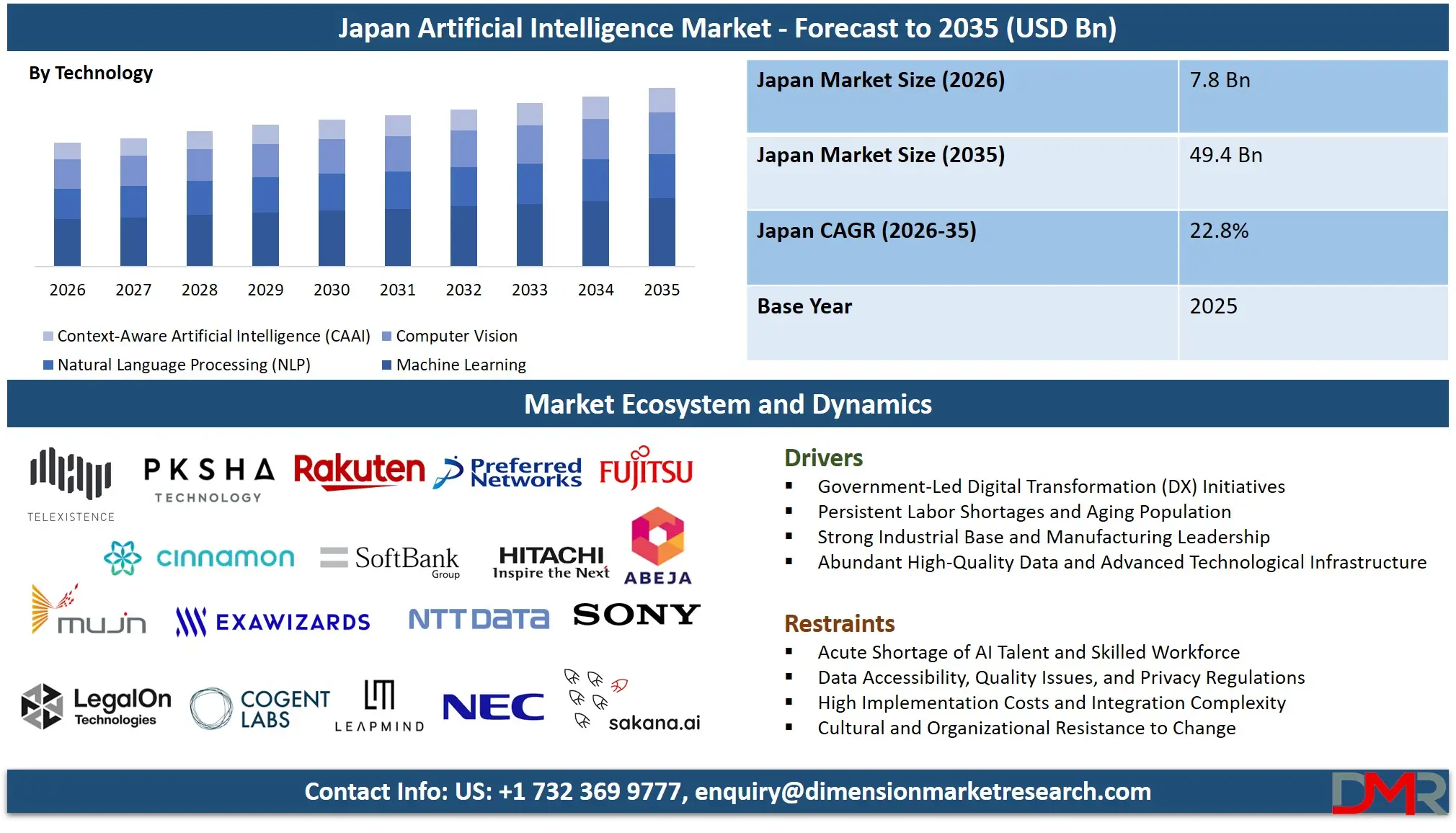
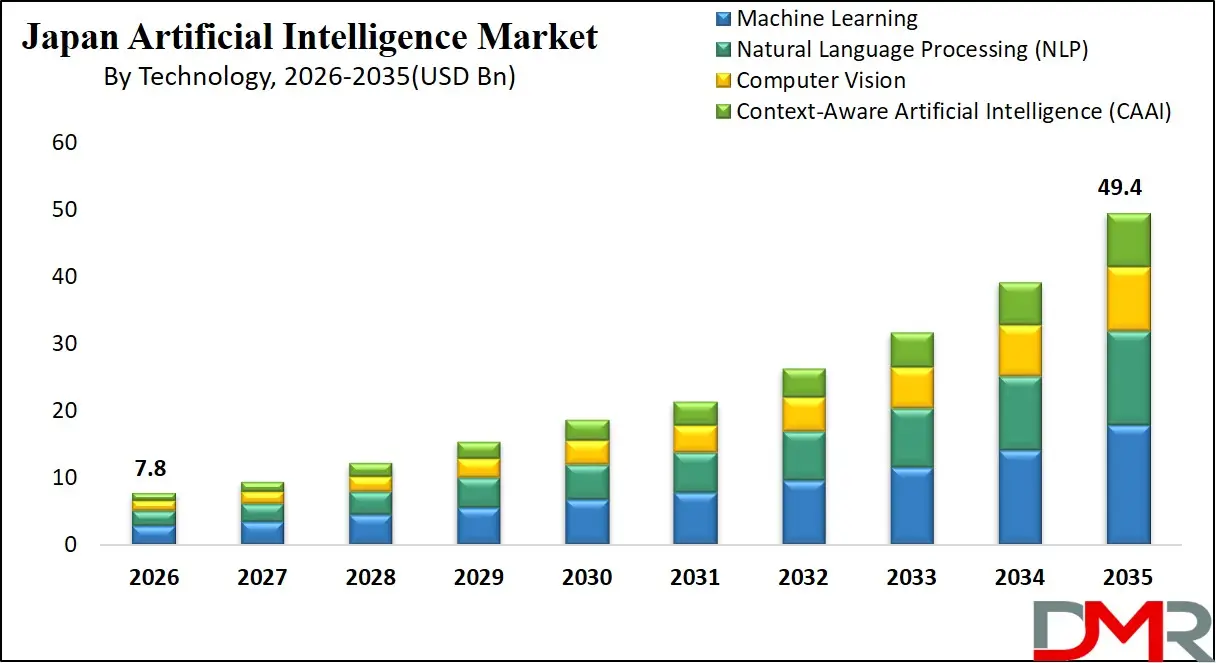
Japan Artificial Intelligence (AI) Market is projected to reach USD 7.8 billion in 2026, and it is further anticipated to expand significantly, attaining a market value of USD 49.4 billion by 2035, registering an impressive CAGR of 22.8% during the forecast period.
ℹ
To learn more about this report –
Download Your Free Sample Report Here
Japan’s Artificial Intelligence (AI) market is emerging as a key pillar of the country’s digital economy, supported by strong government initiatives, advanced technological capabilities, and increasing enterprise adoption. This growth is closely aligned with Japan’s “Society 5.0” vision, which aims to integrate digital technologies such as AI, big data, IoT, and robotics into everyday economic and social systems. As one of the world’s most technologically advanced nations, Japan is leveraging artificial intelligence to address structural challenges including an aging population, labor shortages, and the need to enhance industrial productivity and global competitiveness.
The Japanese AI ecosystem spans multiple segments, including machine learning platforms, natural language processing (NLP), computer vision technologies, AI-powered analytics, and intelligent automation solutions. These technologies are increasingly deployed across critical industries such as manufacturing, automotive, healthcare, finance, retail, and transportation. In manufacturing, AI-driven predictive maintenance, quality inspection, and supply chain optimization are improving operational efficiency. Similarly, in healthcare, AI-enabled diagnostics and medical data analysis are supporting faster and more accurate clinical decision-making.
A major trend shaping the market is the integration of AI with emerging technologies such as 5G, cloud computing, and the Internet of Things (IoT). This convergence enables real-time data processing, advanced predictive analytics, and smarter automation across industrial and urban systems. Japan is also witnessing rising adoption of generative AI, edge AI, and AI-driven robotics, particularly in smart factories, autonomous vehicles, and smart city projects.
ℹ
To learn more about this report –
Download Your Free Sample Report Here
Government investments in supercomputing infrastructure, AI research laboratories, and digital innovation hubs are further strengthening the country’s technological foundation. However, challenges remain, including a shortage of skilled AI engineers and data scientists, as well as regulatory concerns related to data governance, privacy protection, and ethical AI development.
Despite these constraints, Japan’s strong industrial base, high technological literacy, and expanding startup ecosystem position the country as a global leader in AI innovation, with significant opportunities for long-term growth and digital transformation.
Japan Artificial Intelligence Market: Key Takeaways
- Market Value: The Japan Artificial Intelligence (AI) Market size is estimated to have a value of USD 7.8 billion in 2026 and is expected to reach USD 49.4 billion by the end of 2035.
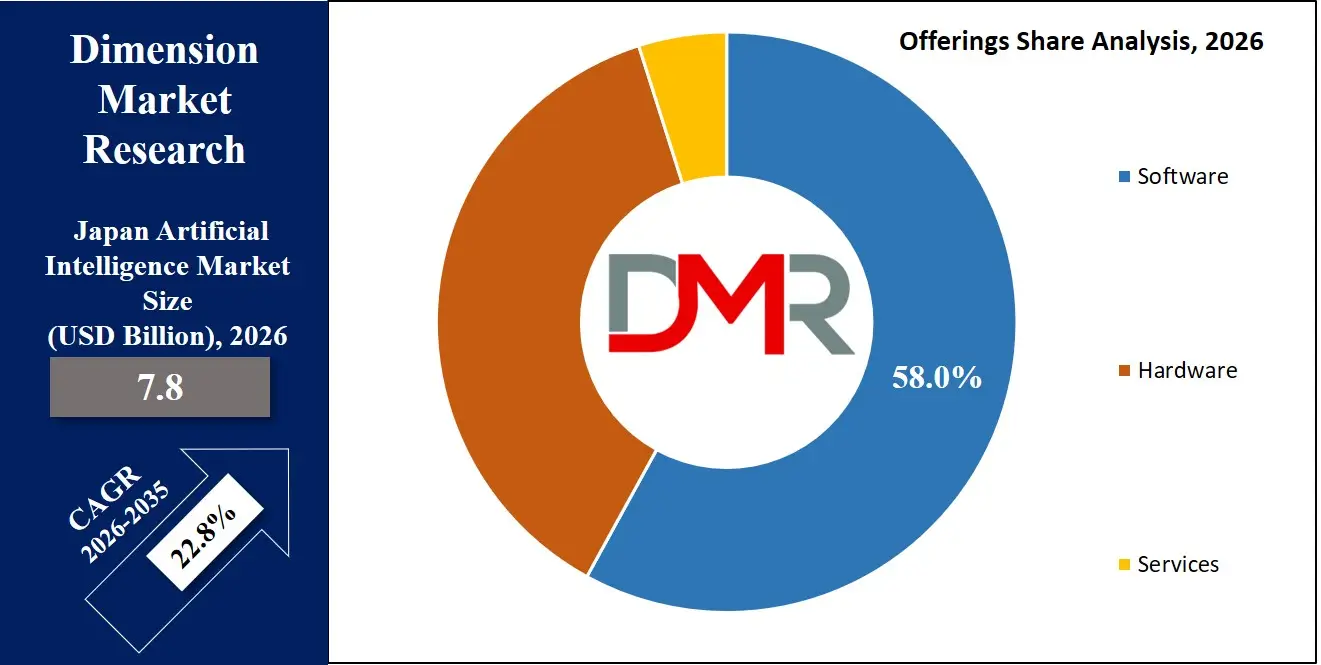
- By Offerings Segment Analysis: Software is anticipated to dominate this segment in this market as it will hold 58.0% of the market share in 2026.
- By Technology Segment Analysis: Machine Learning is projected to dominate the technology segment in the Japan AI Market with the highest market share in 2026.
- By Business Function Segment Analysis: The Operations function is anticipated to dominate the Japan AI market with a major market share in 2026.
- By Application (Business Function) Segment Analysis: Operations management and optimization is projected to hold the leading position within the business functions of this market in 2026.
- By Industry Vertical Segment Analysis: The manufacturing sector is projected to dominate the industry vertical segment in the Japan AI market in 2026.
- Key Players: Some of the major key players in the Japan Artificial Intelligence (AI) Market are Preferred Networks, Inc., NEC Corporation, Fujitsu, Hitachi, Ltd., Toshiba Corporation, Sony Group Corporation, Google LLC, Microsoft Corporation, and many others.
- Market Growth Rate: The market is growing at a CAGR of 22.8 percent over the forecasted period.
Impact of Iran Conflict on the Japan Artificial Intelligence Market
- Rising Energy Prices Increasing AI Infrastructure Costs: The Iran conflict has caused major disruptions in global oil and gas supplies, especially through the Strait of Hormuz, which handles around 20% of global oil shipments. AI infrastructure such as data centers, high-performance computing systems, and semiconductor fabrication plants require large amounts of electricity, so rising energy costs can increase operational expenses for Japanese AI companies and cloud providers.
- Semiconductor Supply Chain Risks Affecting AI Development: The conflict has also raised concerns about disruptions to global semiconductor supply chains, including shortages of critical materials such as helium used in chip manufacturing. Semiconductor production is essential for AI processors, GPUs, and data-center hardware, and any disruption can slow AI hardware production and delay AI infrastructure expansion.
- Economic Uncertainty Reducing Technology Investment: Higher oil prices and inflation caused by the conflict could slow economic growth in Japan. Analysts estimate that prolonged disruptions could reduce Japan’s GDP by around 0.18 percentage points while increasing inflation, creating a challenging environment for corporate investment. During periods of economic uncertainty, companies may delay spending on advanced technologies such as AI platforms, digital transformation projects, and enterprise AI adoption.
- Cybersecurity Threats Increasing Demand for AI Solutions: The conflict has also expanded cyberwarfare activities, with multiple cyberattacks and digital operations reported during the war. As cyber threats increase globally, governments and companies may invest more in AI-driven cybersecurity, threat detection, and intelligence systems. This could create new growth opportunities for Japanese AI firms specializing in cybersecurity analytics, defense technology, and automated threat monitoring.
- Acceleration of AI for Energy Optimization and Automation: The energy shock caused by the conflict may push Japanese industries to adopt AI-based energy optimization, predictive maintenance, and automation technologies to reduce operational costs. AI tools that improve energy efficiency in manufacturing, logistics, and smart infrastructure could become more valuable as companies seek to offset higher energy expenses.
Japan Artificial Intelligence Market: Use Cases
- Manufacturing Automation & Quality Control: This involves using computer vision and machine learning on factory floors for real-time defect detection, predictive maintenance of machinery, and optimizing robotic production lines to enhance efficiency and reduce waste.
- Financial Services (BFSI): Deployment of AI algorithms for algorithmic trading, fraud detection and prevention, credit risk assessment, and personalized financial advisory services (robo-advisors) for customers.
- Healthcare & Life Sciences: Accelerating drug discovery through AI-powered analysis, assisting radiologists with medical image diagnostics, and creating personalized treatment plans based on patient data to improve outcomes.
- Automotive & Transportation: Development of AI for autonomous driving systems (ADAS), optimization of traffic flow in smart cities, and enabling predictive maintenance for public and private transport fleets.
Japan Artificial Intelligence Market: Stats & Facts
Ministry of Internal Affairs and Communications (MIC) – Japan
- Only 9.1% of individuals in Japan used generative AI tools in 2024.
- Generative AI adoption in Japan remains lower than in many advanced economies, indicating strong future growth potential.
- Government surveys show increasing emphasis on AI adoption and digital transformation across industries.
Japan Science and Technology Agency (JST)
- The agency provided approximately USD 66.7 million in grants for AI research and development projects in 2023.
- Around 200 AI research projects received funding through JST programs.
- JST supports AI innovation in robotics, healthcare diagnostics, and advanced manufacturing technologies.
Ministry of Education, Culture, Sports, Science and Technology (MEXT)
- The ministry launched an AI human resource development program worth about USD 20 million in 2023.
- The initiative aims to train around 5,000 AI specialists and data science professionals.
- Universities across Japan are expanding AI and data science education programs to meet growing demand for skilled professionals.
Japan National AI Strategy Programs
- The Japanese government allocated approximately USD 333 million to national AI strategy initiatives in 2023.
- Government programs focus on AI research, workforce development, and industrial adoption.
- Japan is investing heavily in AI infrastructure including supercomputing and large-scale data platforms.
National Institute of Advanced Industrial Science and Technology (AIST)
- The ABCI AI supercomputing infrastructure includes approximately 6,128 GPUs used for AI research and development.
- The system achieves about 6.22 exaflops of peak AI computing performance.
- The upgraded infrastructure is 7–13 times faster than earlier AI computing systems.
Japanese Patent Office (JPO)
- Japan granted approximately 12,000 AI-related patents in 2023.
- The country ranked third globally in AI patent filings after the United States and China.
AI Workforce and Research Ecosystem
- Japan had approximately 30,000 AI researchers in 2023 working in academia and industry.
- The total AI workforce in Japan reached around 150,000 professionals in 2023.
- The workforce includes roughly 40,000 data scientists and about 35,000 AI engineers.
Enterprise AI Adoption in Japan
- Around 75% of large enterprises in Japan have adopted AI technologies.
- Approximately 90% of these companies plan to increase AI investments by 2025.
- About 22% of small and medium enterprises (SMEs) in Japan use AI solutions.
- Around 18% of manufacturing SMEs apply AI for predictive maintenance and quality control.
AI Data and Infrastructure
- Japan’s AI training data market reached approximately USD 1.3 billion in 2023.
- Around 60% of datasets used in AI development come from government and public data sources.
Japan Artificial Intelligence Market: Market Dynamics
Trends in the Japan Artificial Intelligence Market
Proliferation of Generative AI (GenAI)
The AI sector in Japan is also becoming a hub of innovation due to the rapid adoption of Generative AI. Following global trends, Japanese enterprises are beginning to leverage GenAI for a wide range of applications, from automating content creation and marketing copy to accelerating software development and drug discovery. Companies are experimenting with large language models (LLMs) adapted for the Japanese language to improve internal knowledge management, enhance customer service chatbots, and streamline complex report generation. This trend significantly improves productivity and creativity, besides being in tune with global AI practices, and cements Japan's status as a hub for technological innovation.
Focus on "Society 5.0" and AI for Social Good
Japan's "Society 5.0" initiative, which aims to create a human-centered society that balances economic advancement with the resolution of social problems, is a major trend driving AI adoption. AI is being deployed to tackle specific national challenges, such as developing systems to support the aging population (e.g., caregiving robots, remote health monitoring), making agriculture more efficient through automation, and optimizing energy grids. This focus on "AI for social good" is producing real investment not only in core AI technologies but also in the infrastructure and ethical frameworks needed for their responsible deployment.
Growth Drivers in the Japan Artificial Intelligence Market
Government-Led Digital Transformation (DX) Initiatives
Japan's national strategy, centered on "Society 5.0" and overseen by the newly created Digital Agency, underlines the push for DX across all sectors of the economy and society. Huge investments are being channeled into R&D for next-generation AI, support for AI startups, and the digitalization of government services. In addition, favorable policies and subsidies encourage small and medium-sized enterprises (SMEs) to adopt AI and cloud technologies to improve their productivity. This helps strengthen the nation's standing as a leading technology hub in Asia.
Persistent Labor Shortages and Efficiency Needs
Japan is actively seeking technological solutions to address its declining working-age population and chronic labor shortages. AI presents a critical tool for automating routine tasks, augmenting human capabilities, and driving productivity gains across industries. From automated checkout systems in retail to predictive maintenance in manufacturing, the economic imperative to do more with less is a powerful driver for AI adoption. All these growth drivers increase the competitiveness of Japanese industry and ensure the prosperity of the AI sector.
Growth Opportunities in the Japan Artificial Intelligence Market
Integration of AI with IoT and 5G in "Smart Manufacturing"
The combination of AI with data from Internet of Things (IoT) sensors and high-speed 5G networks presents an excellent opportunity for optimizing manufacturing, a cornerstone of the Japanese economy. This "smart manufacturing" or "Industry 4.0" approach enables predictive analytics to foresee equipment failures, automated quality control, and fully optimized production lines. This offers an excellent opportunity for technology providers and system integrators to deliver high-value solutions to the industrial sector.
Expansion of Edge AI Solutions
With growing concerns over data privacy, latency, and bandwidth, there is an increasing demand for processing AI algorithms on local devices ("at the edge") rather than in the cloud. This is particularly relevant for applications like autonomous vehicles, industrial robots, and real-time video analytics. The development of specialized, low-power AI hardware and software for edge computing is growing at a very fast pace and opens doors for innovative companies to design solutions for this emerging segment.
Restraints in the Japan Artificial Intelligence Market
Acute Shortage of AI Talent
The development and deployment of advanced AI solutions require a highly skilled workforce, including data scientists, machine learning engineers, and AI ethicists. Japan faces a significant shortage of such professionals, a challenge that goes beyond general IT skills. This talent gap can impede market growth, slow down project timelines, and increase costs for companies as they compete for a limited pool of experts. Getting over this restraint will involve considerable investments in education, university programs, and corporate training to build a local pool of talent.
Data Accessibility and Quality Issues
AI models are only as good as the data they are trained on. Many Japanese organizations, particularly in traditional sectors, struggle with data silos, poor data quality, and a lack of digitized historical records. Furthermore, stringent data privacy regulations and cultural sensitivities around data sharing can make it difficult to access the large, high-quality datasets needed to build effective AI systems. Overcoming these data-related challenges is a significant hurdle for many companies.
Japan Artificial Intelligence Market: Research Scope and Analysis
By Offerings Analysis
Software is projected to dominate the offerings segment in this market as it will hold 58.0% of the market share in 2026. The dominance of software in the offerings segment of the Japan AI Market is owing to the widespread adoption of AI platforms, libraries, and applications across industries. Businesses in Japan are increasingly investing in software that provides the "brains" for their AI initiatives, ranging from machine learning development platforms and pre-trained models to specialized applications for computer vision, natural language processing, and predictive analytics. Japan's Society 5.0 initiative underlines the emphasis on integrating software-based intelligence to solve complex social and business problems. It therefore raises demand for AI software that helps in automating tasks, generating insights, and optimizing decision-making, which is critical to maintaining competitiveness in a rapidly digitizing world. The explosion of interest in generative AI is further fueling demand for new software solutions and platforms.
ℹ
To learn more about this report –
Download Your Free Sample Report Here
This software forms the core logic and analytical engine, making its future in the market indispensable. Its value is derived from its ability to turn raw data into actionable intelligence. Hardware and services, while essential, exist largely to support and enable the deployment and functioning of this software. Growth in the digital transformation of SMEs also adds to the contribution of user-friendly, cloud-based AI software-as-a-service (SaaS) solutions that lower the barrier to entry. Government-backed DX initiatives advocate Japane of the latest available software tools to reduce operational bottlenecks, thus supporting the market for AI software. Hence, software remains an integral factor as it provides the core "intelligence" for modern AI applications in Japan.
By Technology Analysis
Machine Learning (ML) leads in the Japan AI Market due to it being the foundational technology for a vast majority of current AI applications. Its highly transformative effect in achieving operational optimizations and generating predictive insights is unmatched. These technologies power real-time analytics, recommendation engines, and, most importantly, automation in solving the complexity brought along by modern business data. Japan's Society 5.0 focuses on incorporating these advanced computational techniques into its industrial and social infrastructure. All these objectives align with ML applications focused on improved quality control, demand forecasting, and customer behavior analysis. Firms utilize ML-powered tools to identify inefficiencies, reduce costs, and create better decision-making.
Manufacturing and finance have a long history of data analysis in Japan, thus creating a natural pathway for the adoption of advanced ML techniques. For example, machine learning algorithms predict equipment failure in factories and detect fraudulent transactions in banking. The increasing availability of big data and cloud computing resources further fuels ML adoption. These are increasingly being integrated into smart factories and autonomous systems, packaging what is to be expected in the future. Having already proven their potential through improvement in accuracy, speed, and scalability, Machine Learning remains among the major technologies that will still dominate in the Japanese AI sector.
By Business Function Analysis
Operations is projected to hold the leading position with 30.5% of the market share in the business function segment of the Japan AI Market in 2026, as this function is the core of efficiency and productivity for most industries. With the continued focus on "monozukuri" (manufacturing craftsmanship) and process optimization in Japan, the demand for AI solutions that can streamline production, manage supply chains, and ensure quality control is paramount. AI systems enable businesses under Society 5.0 to attain the goal of global competitiveness by ensuring optimized workflows with minimum waste and improved output quality. Advanced AI solutions for operations integrate machine learning, computer vision, and IoT to offer real-time monitoring of production lines, predictive maintenance schedules, and automated adjustments that minimize downtime, optimize resource utilization, and improve overall supply chain visibility. The increasing adoption of AI-powered robots in warehouses and factories underlines the importance of this segment all the more.
Further, this segment ensures dominance through the development of complex logistics and supply chains. Most advanced operational systems have their dependence on AI for managing everything from inventory to distribution. Supporting the market's demand are also government initiatives towards promoting "connected industries." Due to its immediate effects relating to cost economy, efficiency within operations, and satisfaction on the customer facet, the operations function keeps its superiority in the market.
By Industry Vertical Analysis
The manufacturing sector is projected to dominate the industry vertical segment in the Japan AI market. This dominance is due to the sector's foundational role in the Japanese economy and its high dependence on efficient, high-quality production processes. Japan is a global leader in advanced manufacturing, including automotive, electronics, and heavy machinery, creating a persistent and sophisticated demand for AI-powered optimization. Japan's Society 5.0 emphasizes the creation of "smart factories" where AI, IoT, and robotics converge. Further, these verticals need the implementation of high-tech AI solutions to guarantee speed, precision, and flexibility impacting everything from supply chain management and predictive maintenance to visual inspection for quality assurance, as global competition intensifies day by day. Heavy investments in AI have been made not only by global giants like Toyota and Sony but also by a vast network of specialized SMEs that are the backbone of the manufacturing supply chain.
The government's support in enhancing the digital transformation of SMEs and establishing AI research hubs further improves the ability of manufacturing companies to adopt AI. Because this industry is considered a major contributor to Japan's GDP and global brand reputation, it is considered one of the most dominant end-users. The manufacturing industry continues to lead with the latest technologies in shaping the country's AI ecosystem.
The Japan Artificial Intelligence Market Report is segmented on the basis of the following:
By Offerings
- Software
- Hardware
- Services
By Technology
- Machine Learning
- Natural Language Processing (NLP)
- Computer Vision
- Context-Aware Artificial Intelligence (CAAI)
By Business Function
- Marketing & Sales
- Human Resources
- Finance & Accounting
- Operations
- Cybersecurity
By Industry Vertical
- BFSI
- Retail & E-commerce
- Manufacturing
- Government & Defense
- Healthcare & Life Sciences
- Telecommunication
- Energy & Utilities
- Automotive, Transportation & Logistics
- Agriculture
- IT/ITES
- Media & Entertainment
- Other Industry Verticals
Japan Artificial Intelligence Market: Competitive Landscape
The competitive landscape is fueled by participation, both domestic and international, in the Japan Artificial Intelligence Market, with dissimilar capabilities across software, hardware, and services. Major companies, therefore, strategize to develop advanced AI technologies and form strategic partnerships to enhance their offerings and better their competitiveness. The leading players are global technology giants like Google, Microsoft, and AWS, alongside powerful domestic corporations such as NEC Corporation, Fujitsu, and Hitachi, which leverage their deep industry knowledge and customer relationships. Specialized AI firms like Preferred Networks, Inc. are also prominent, particularly in areas like deep learning and autonomous systems. These companies leverage Japan's Society 5.0 initiatives by aligning their offerings with government priorities meant to attract investments and improve societal outcomes. It addresses both growing industrial automation and healthcare sectors where these focus more on niche capabilities: computer vision and edge AI, while IT service giants provide end-to-end solutions in AI integration and digital transformation.
ℹ
To learn more about this report –
Download Your Free Sample Report Here
Mergers, acquisitions, and partnerships are common strategies that allow companies to expand service portfolios and reach. For instance, global tech companies partnering with Japanese system integrators enhance the deployment of cloud-based AI solutions to local enterprises. While the leading companies are competitive, innovation in the fields of generative AI, automation, and predictive analytics separates the leaders. These opportunities are likely to come along with an intense competitive landscape for both established players and new entrants, with strong governmental support for developing technological innovation zones.
Some of the prominent players in Japan Artificial Intelligence Market are:
- SoftBank Group
- Fujitsu
- NEC Corporation
- Hitachi
- Sony Group Corporation
- NTT Data
- Rakuten Group
- Preferred Networks
- ABEJA
- LeapMind
- Sakana AI
- ExaWizards
- Cogent Labs
- Cinnamon AI
- PKSHA Technology
- LegalOn Technologies
- Mujin
- Tier IV
- SmartNews
- Telexistence
- Other Key Players
Recent Developments in Japan Artificial Intelligence Market
- December 2025: Rakuten Group acquired a Tokyo-based AI startup specializing in recommendation algorithms for e-commerce, aiming to enhance its personalized marketing capabilities across its online marketplace and financial services.
- November 2025: NTT Corporation launched a joint research initiative with Stanford University focused on energy-efficient AI architectures, committing USD 20 million over three years to develop sustainable computing technologies.
- October 2025: Mitsubishi Electric invested USD 15 billion to establish an AI research center in Fukuoka, focused on developing computer vision and robotics technologies for factory automation and smart manufacturing applications.
- September 2025: Google Cloud announced a collaboration with the Japanese government's Digital Agency to provide AI training programs for 100,000 public sector employees, aimed at improving digital literacy and AI adoption in government services.
- August 2025: Preferred Networks, Inc. secured USD 200 million in funding from a consortium of Japanese banks and trading companies to accelerate the development of its next-generation deep learning platform and expand its semiconductor design capabilities.
- July 2025: The International AI Summit Tokyo 2025 brought together policymakers and industry leaders from 30 countries to discuss global AI governance frameworks, with Japan proposing new standards for trustworthy AI in healthcare applications.
- June 2025: Fujitsu and RIKEN announced a strategic collaboration to develop a new supercomputer specifically optimized for AI workloads, scheduled for completion in 2027 and designed to support Japan's foundational language model initiatives.
- May 2025: SoftBank Corp. invested USD 50 million in a French generative AI startup, securing exclusive rights to distribute its enterprise AI tools in the Japanese market, particularly targeting customer service automation solutions.
- April 2025: Toyota Motor Corporation announced a merger of its AI research subsidiaries, Toyota Research Institute-Advanced Development and Woven Planet Holdings, to create a unified organization focused on autonomous driving and smart city AI technologies.
- March 2025: AWS opened its second cloud region in Japan, located in Osaka, with a specific focus on providing low-latency AI and machine learning services to manufacturing and logistics companies in western Japan.
- February 2025: NEC Corporation partnered with Okinawa Institute of Science and Technology to establish a joint research laboratory focused on neuromorphic computing and brain-inspired AI architectures.
Report Details
| Report Characteristics |
| Market Size (2026) |
USD 7.8 Bn |
| Forecast Value (2035) |
USD 49.4 Bn |
| CAGR (2026–2035) |
22.8% |
| Historical Data |
2021 – 2025 |
| Forecast Data |
2027 – 2035 |
| Base Year |
2025 |
| Estimate Year |
2026 |
| Report Coverage |
Market Revenue Estimation, Market Dynamics, Competitive Landscape, Growth Factors and etc. |
| Segments Covered |
By Offerings (Software, Hardware, and Services), By Technology (Machine Learning, Natural Language Processing (NLP), Computer Vision, and Context-Aware Artificial Intelligence), By Business Function (Marketing & Sales, Human Resources, Finance & Accounting, Operations, and Cybersecurity), By Industry Vertical (BFSI, Retail & E-commerce, Manufacturing, Government & Defense, Healthcare & Life Sciences, Telecommunication, Energy & Utilities, Automotive, Transportation & Logistics, Agriculture, IT/ITES, Media & Entertainment, and Other Industry Verticals) |
| Country Coverage |
Japan |
| Prominent Players |
SoftBank Group, Fujitsu, NEC Corporation, Hitachi, Sony Group Corporation, NTT Data, Rakuten Group, Preferred Networks, ABEJA, LeapMind, Sakana AI, ExaWizards, Cogent Labs, Cinnamon AI, PKSHA Technology, LegalOn Technologies, Mujin, Tier IV, SmartNews, Telexistence, and Other Key Players |
| Purchase Options |
We have three licenses to opt for: Single User License (Limited to 1 user), Multi-User License (Up to 5 Users), and Corporate Use License (Unlimited User) along with free report customization equivalent to 0 analyst working days, 3 analysts working days and 5 analysts working days respectively. |
Frequently Asked Questions
How big is Japan Artificial Intelligence Market?
▾ Japan Artificial Intelligence Market size is estimated to have a value of USD 7.8 billion in 2026 and is expected to reach USD 49.4 billion by the end of 2035.
What is the growth rate in Japan Artificial Intelligence Market in 2026?
▾ The market is growing at a CAGR of 22.8 percent over the forecasted period of 2026.
Who are the key players in Japan Artificial Intelligence Market?
▾ Some of the major key players in Japan Artificial Intelligence Market are OpenAI, Google DeepMind, IBM Watson, Microsoft Azure AI, NVIDIA, AWS AI, and many others.