Japan Aseptic Food Packaging Market Snapshot
- Market Size in 2026: USD 1.34 billion
- Market Size in 2035: USD 2.59 billion
- CAGR, 2026-2035: 7.6%
- Leading Packaging Type: Cartons, 72% share
- Leading Material: Paper & Paperboard, 63% share
- Leading Product Type: Dairy Products, 38% share
- Fastest-Growing Segment: Aseptic Blow-Fill-Seal, 10.2% CAGR
What is the Japan Aseptic Food Packaging and its Market Size?
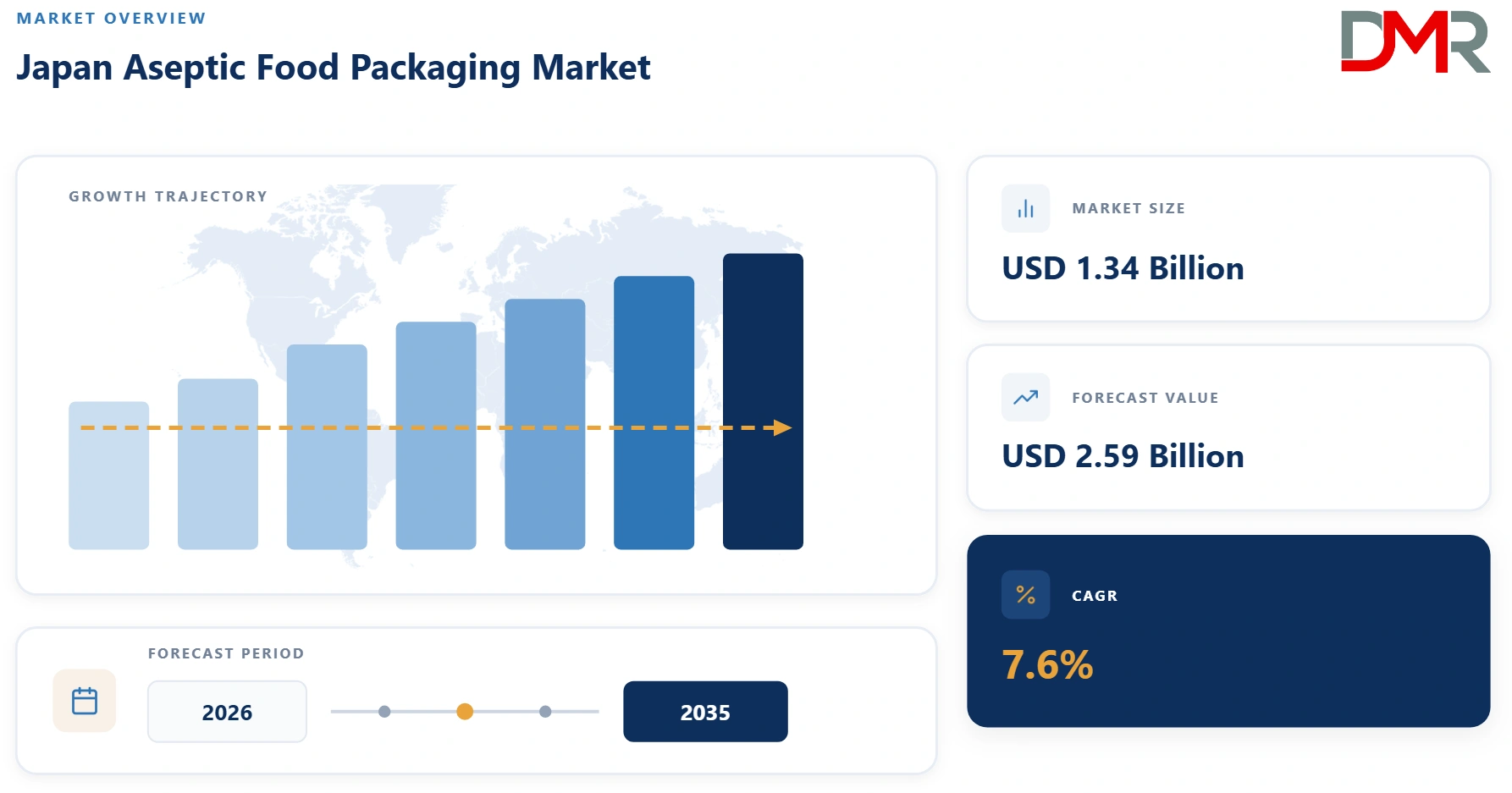
The Japan aseptic food packaging market is estimated at USD 1.34 billion in 2026 and is projected to reach approximately USD 2.59 billion by 2035, representing a 7.6% CAGR.
ℹ
To learn more about this report –
Download Your Free Sample Report Here
Japan aseptic food packaging comprises packaging materials, containers, closures, sterilization systems and filling technologies used to commercially sterilize or aseptically fill food products so they can remain microbiologically stable for extended periods without conventional refrigeration. The market covers cartons, bottles, pouches, bags, cups and trays using paperboard, plastic, aluminum, glass and multilayer structures. Applications include milk, dairy desserts, plant-based beverages, juices, purees, soups, sauces, ready-to-drink foods, infant nutrition and liquid food ingredients. Its principal value proposition is the combination of food safety, extended shelf life, reduced dependence on cold-chain logistics, convenient distribution and lower food waste. Aseptic systems can enable products to remain shelf-stable for months while retaining quality and nutritional characteristics.
Use Cases
- Long-life dairy: Enables milk, cream and dairy beverages to be stored and distributed without continuous refrigeration.
- Plant-based beverages: Supports shelf-stable soy, oat, almond and emerging fermentation-derived milk alternatives.
- Juices and purees: Protects fruit and vegetable products while extending distribution reach and reducing spoilage.
- Ready-to-drink nutrition: Supports shelf-stable protein, sports-nutrition and functional beverages in convenient single-serve formats.
- Soups and sauces: Provides commercially sterile packaging for ambient distribution of liquid and semi-liquid foods.
- Foodservice ingredients: Enables efficient bulk distribution of sauces, concentrates, dairy ingredients and purees.
Key Takeaways
- Market size: Japan's aseptic food packaging market is estimated at USD 1.34 billion in 2026, reaching USD 2.59 billion by 2035.
- Growth: The market is forecast to expand at a 7.6% CAGR, substantially faster than Japan's broader food-packaging market.
- Primary drivers: Convenience, cold-chain cost reduction, shelf-life extension, food-loss reduction, labor constraints and premium nutrition products.
- Segment dominance: Cartons, paper & paperboard, and dairy products remain the leading segments.
- Fastest growth: Aseptic blow-fill-seal is estimated to grow at approximately 10.2% CAGR, supported by flexible small-format packaging and new liquid-food applications.
- Strategic direction: Sustainability, recyclable structures, aluminum reduction, lightweighting and digitally enabled filling systems are becoming central competitive differentiators.
How AI/Gen AI is Transforming the Japan Aseptic Food Packaging Market?
AI, IoT and industrial automation are increasingly integrated into aseptic filling lines for predictive maintenance, real-time process monitoring, quality control, automated cleaning verification and production optimization. Sensors can continuously monitor temperature, pressure, flow, sterilization parameters and filling accuracy, while machine-learning systems identify abnormal operating conditions before they generate quality failures. Japan's food-processing sector is particularly receptive because manufacturers face labor shortages and increasing pressure to automate production. At FOOMA JAPAN 2026, Japan Tetra Pak highlighted labor-saving, automation and AI-enabled food-manufacturing solutions.
Key Drivers in the Japan Aseptic Food Packaging Market
Demand for Shelf Stability, Convenience and Cold-Chain Efficiency
Japan's demographic and geographic structure makes shelf-stable food particularly valuable. Aging consumers, smaller households, dual-income families and labor shortages increase demand for convenient products that require minimal preparation and can be stored easily. Aseptic packaging extends shelf life without conventional refrigeration, allowing manufacturers and retailers to reduce dependence on refrigerated storage and transport. This is especially relevant for milk, plant-based beverages, juices, soups, sauces and functional nutrition products. Japan's ready-made-meal market is expected to continue benefiting from convenience and changing household structures, reinforcing demand for technologies that extend product usability and simplify distribution.
Sustainability and Food-Waste Reduction
Sustainability is becoming a commercial rather than purely environmental requirement. Aseptic packaging can reduce food waste by extending shelf life and can reduce energy requirements associated with refrigeration and cold-chain transportation. Packaging suppliers are simultaneously reducing aluminum content, increasing paper content, developing renewable-polymer systems and improving recyclability. SIG, for example, reports that its aluminum-free full-barrier aseptic carton can contain up to 81% paper and can reduce carbon footprint by up to 61% when combined with renewable forest-based polymers.
Restraints in the Japan Aseptic Food Packaging Market
High Capital Intensity and Supplier Dependence
Aseptic packaging requires specialized filling equipment, sterilization systems, validated processes and compatible packaging materials. Equipment installation can require substantial capital expenditure, plant modification and lengthy validation before commercial production. Smaller Japanese food manufacturers may therefore continue using conventional chilled, retort or hot-fill formats where volumes are insufficient to justify dedicated aseptic equipment. The packaging-machine ecosystem also creates switching costs because customers often optimize formulations, package specifications and production processes around a particular filling platform.
Recycling Complexity and Multilayer Structures
Aseptic cartons and other high-barrier packages commonly combine paperboard with polymer layers and, for some structures, aluminum. Although these structures deliver excellent barrier performance and lightweighting, material separation can complicate recycling. Japan has a mature regulatory framework for containers and packaging recycling, but collection economics and regional recycling infrastructure remain important constraints. The Containers and Packaging Recycling Act establishes responsibilities for consumers, municipalities and business operators and covers paper cartons, paper packaging, plastics, cans and glass.
Growth Opportunities in the Japan Aseptic Food Packaging Market
Flexible Aseptic Pouches and Small-Format Nutrition
Flexible aseptic pouches represent an important white-space opportunity because they combine low material consumption, portability, high product evacuation and convenient dispensing. Their potential extends beyond beverages into fruit purees, yogurt drinks, sauces, baby food, functional nutrition and foodservice concentrates. SIG has been extending aseptic technology into spouted pouches, including systems capable of inline pouch sterilization.
Recyclable, Low-Carbon Aseptic Cartons
Japan offers considerable potential for next-generation cartons that retain high oxygen and light barriers while reducing aluminum and fossil-based plastics. Collection pilots and recycling partnerships can accelerate market acceptance. In 2025, Oji Holdings, Nihon Tetra Pak and Gold Pack announced Japan's first commercialization initiative to convert used aseptic cartons into corrugated packaging, with recycled material used for packaging at Expo 2025 Osaka.
Trends in the Japan Aseptic Food Packaging Market
Shift Toward Paper-Based and Aluminum-Free Structures
The Japanese market is moving toward lower-carbon packaging while preserving aseptic barrier performance. Paper-based barriers, aluminum-free cartons and renewable polymer solutions are becoming important innovation areas. This reflects both regulatory pressure and brand-owner commitments to reduce packaging carbon footprints. SIG reported 24% year-over-year growth in sales of its aluminum-layer-free aseptic cartons in 2025, demonstrating broader commercial traction for the technology.
Premiumization and Portion Control
Aseptic packaging is increasingly moving beyond conventional long-life milk toward premium functional beverages, sports nutrition, plant-based alternatives, fruit preparations and specialized foods. Smaller packs support convenience, controlled consumption and on-the-go usage. Japanese packaging research also identifies smaller packs, recyclable materials and design differentiation as important developments in plant-based packaging.
Research Scope and Analysis
The Japan aseptic food packaging market is segmented by Packaging Type, Material, Packaging Technology, Product Type and End-Use Industry. Estimates reflect revenue generated from packaging materials, aseptic containers and associated packaging-system value attributable to food applications.
ℹ
To learn more about this report –
Download Your Free Sample Report Here
By Packaging Type Analysis
Cartons are the dominant packaging type, estimated at 72% share in 2026, because they offer a highly developed combination of barrier performance, lightweighting, efficient palletization, branding surface and compatibility with established aseptic filling systems. Cartons are especially important in dairy, juices, plant-based beverages and liquid food applications. Pouches represent the second-largest format at approximately 12%, benefiting from low material use, portability and strong product evacuation. Aseptic blow-fill-seal and flexible pouch formats are expected to be the fastest-growing packaging-format opportunities, with an estimated CAGR of over 10%, as suppliers address functional nutrition, baby food, purees and portion-controlled foods. Bottles account for approximately 9%, supported by selected dairy and nutrition applications, while bags and other formats remain smaller. The market's long-term format mix is expected to gradually diversify away from cartons as pouch technology improves and customers seek lower material intensity and new consumer experiences.
By Material Analysis
Paper & Paperboard leads with an estimated 63% market share in 2026, primarily because liquid aseptic cartons dominate the Japanese market and paperboard provides a favorable combination of rigidity, printability, low weight and renewable-material credentials. The second-largest category is plastic, at approximately 25%, driven by pouches, bottles, closures and multilayer flexible structures. Plastic-based aseptic packaging is likely to remain important where flexibility, toughness and product evacuation are priorities. Multilayer composite structures represent approximately 7%, retaining relevance because high-barrier performance remains essential for sensitive products. Glass and aluminum collectively account for about 5% and are primarily used in specialized applications rather than mainstream aseptic food packaging. The fastest growth is expected in recyclable or reduced-aluminum composite structures, supported by sustainability initiatives and investment in collection infrastructure. SIG's aluminum-free full-barrier technology illustrates the direction of material innovation.
By Packaging Technology Analysis
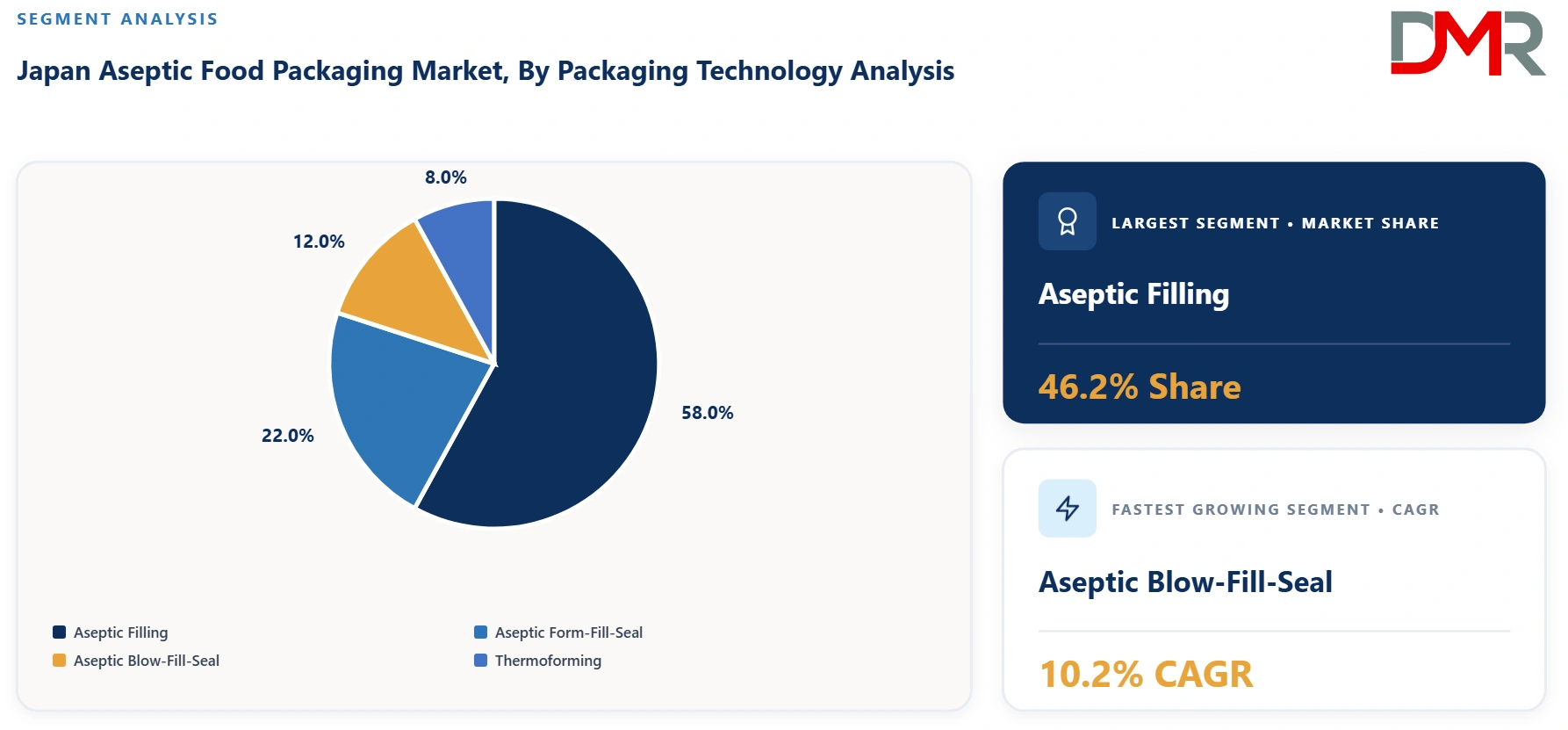
Aseptic Filling remains the leading technology, accounting for approximately 58% of 2026 market revenue, reflecting the established carton-filling installed base and mature dairy and beverage applications. Aseptic Form-Fill-Seal ranks second at roughly 22%, supported by flexible packaging and applications requiring efficient material utilization. Aseptic Blow-Fill-Seal accounts for approximately 12% but is forecast to be the fastest-growing technology at 10.2% CAGR, reflecting demand for lightweight bottles and specialized small-format applications. Thermoforming represents approximately 8%, with opportunities in portion-controlled foods, desserts and selected ready-to-eat products. Technology competition is increasingly focused on sterilization efficiency, line speed, low product loss, digital monitoring and compatibility with sustainable packaging materials. New systems that reduce third-party sterilization requirements or enable inline sterilization can improve economics and broaden adoption.
By Product Type Analysis
Dairy Products are estimated to hold the largest product share at 38% in 2026, driven by long-life milk, cream, yogurt-related beverages and dairy desserts. Japan's established consumption of shelf-stable milk and dairy products provides a strong installed demand base. Fruit & Vegetable Products rank second at approximately 22%, supported by juices, nectars, purees and processed fruit products. Ready-to-Eat & Ready-to-Drink Foods account for about 14% and are expected to grow faster than the market as convenience and functional nutrition expand. Soups, Sauces & Dressings represent approximately 10%, while Plant-Based Products account for around 9%. Although plant-based dairy packaging experienced a 4% volume decline in Japan in 2024 and is projected to face maturity pressures, niche innovation in fermentation-derived beverages and functional products creates pockets of growth.
By End Use Industry Analysis
Food & Beverage Processing represents approximately 37% of the 2026 market, reflecting broad utilization of aseptic formats across beverages, juices, prepared foods and sauces. Dairy Processing follows at 32%, supported by the established long-life milk category and sophisticated Japanese dairy-processing infrastructure. Food Ingredients & Industrial Processing account for approximately 14%, with bulk aseptic packaging increasingly attractive for concentrates, purees, sauces and ingredients where cold-chain costs are material. Infant Food & Nutrition represents around 9%, but is expected to grow above the market average because of strict hygiene requirements, premium nutrition positioning and portion-controlled formats. Foodservice & Institutional accounts for approximately 8%, with opportunities in bulk dispensing, schools, hospitals and institutional kitchens. Long-life milk's use in regional school-meal and disaster-preparedness applications illustrates the strategic value of aseptic food packaging beyond conventional retail.
The Japan Aseptic Food Packaging Market Report is segmented on the basis of the following:
By Packaging Type
- Cartons
- Bottles
- Pouches
- Cups
- Bags
- Trays
By Material
- Paper & Paperboard
- Plastic
- Aluminum
- Glass
- Multilayer Composite
By Packaging Technology
- Aseptic Filling
- Aseptic Form-Fill-Seal
- Aseptic Blow-Fill-Seal
- Thermoforming
By Product Type
- Dairy Products
- Milk
- Cream
- Yogurt & Dairy Desserts
- Plant-Based Products
- Plant-Based Milk
- Plant-Based Creamers
- Other Plant-Based Products
- Fruit & Vegetable Products
- Juices & Nectars
- Purees
- Other Processed Products
- Soups, Sauces & Dressings
- Ready-to-Eat & Ready-to-Drink Foods
- Liquid Food Ingredients
By End-Use Industry
- Dairy Processing
- Food & Beverage Processing
- Infant Food & Nutrition
- Foodservice & Institutional
- Food Ingredients & Industrial Processing
Regulatory Landscape
Japan's aseptic food-packaging industry operates within a stringent food-safety and packaging-compliance environment, with increasing attention to material safety, recycling and environmental performance. The Containers and Packaging Recycling Act establishes a shared framework for collection and recycling, while Japan's positive-list approach to food-contact materials increases the importance of validated materials and traceability.
The principal market impact is rising compliance expenditure and stronger demand for recyclable structures. The regulatory environment creates risk for complex multilayer materials but opportunity for paper-based, aluminum-free and mono-material designs. Suppliers able to demonstrate food-contact compliance, recycling pathways, lifecycle performance and consistent supply will gain procurement advantages.
Investment and White Space Analysis
Investment opportunities are concentrated in recyclable aseptic cartons, aluminum-free barrier films, flexible aseptic pouches, digital filling systems and localized recycling infrastructure. The largest white space lies between conventional cartons and emerging flexible formats: suppliers can target functional nutrition, elderly nutrition, baby food, sauces and premium ready-to-drink products with smaller, easier-to-use packages. Recycling partnerships also represent an attractive investment theme, as demonstrated by the Oji-Tetra Pak-Gold Pack collaboration.
Additional opportunities exist in regional production and co-packing, where food brands can access aseptic technology without building dedicated filling capacity. Companies that combine packaging materials, filling equipment, software and technical service should be best positioned to capture recurring revenue.
Competitive Landscape
The Japanese aseptic food-packaging market is moderately concentrated in high-value carton and filling-system applications, with global technology leaders competing alongside Japanese paper, packaging and food-industry companies. The strongest competitive positions are built around installed filling equipment, long-term customer relationships, proprietary package designs, food-safety validation and technical-service networks. Tetra Pak has a particularly deep Japanese installed base, while SIG competes through cartons, pouches, flexible filling systems and sustainability-focused structures. Japanese companies such as Oji Holdings provide domestic paper and packaging capabilities and are increasingly active in circular packaging.
Some of the prominent players in the Japan Aseptic Food Packaging Market are:
- Tetra Pak
- SIG
- Dai Nippon Printing (DNP)
- TOPPAN
- Toyo Seikan Group Holdings
- Nippon Paper Industries
- Shikoku Kakoki
- Rengo
- Fujimori Kogyo
- Oji Holdings
- Sumitomo Bakelite
- Nihon Canpack
- Mitsubishi Corporation Packaging
- IPI S.r.l.
- Elopak
- Amcor
- UFlex
- Greatview Aseptic Packaging
- Mondi
- Sealed Air
- Dai Nippon Printing Aseptic Systems
- Toyo Seikan Kaisha
- Nippon Paper Industries Packaging
- Toppan Packaging
- Oji Packaging
- Nippon Hoso-kikai
- PACRAFT
- Kyowa Automatic Machinery
- Fuji Machinery
- Shibuya Corporation
- Shikoku Kakoki Engineering
- Ishida
- Krones
- IMA Group
- Syntegon Technology
- Coesia
- JBT Corporation
- Sidel
- KHS
- Serac
- Other Key Players
Recent Developments
- June 2026: Tetra Pak introduced its Tetra Prisma Aseptic 300ml Edge DreamCap package in Japan, with Meiji adopting the format for its new SAVAS BIOPRO yogurt-flavored product, demonstrating expansion into functional nutrition.
- June 2026: Japan Tetra Pak began a demonstration with Yoron Town using long-life milk for school meals and disaster stockpiling, highlighting aseptic packaging's role in resilient food distribution.
- May 2026: Japan Tetra Pak expanded aluminum-containing carton collection pilots through retail locations in Aichi, Gifu and Okinawa, strengthening the recycling ecosystem for aseptic cartons.
- December 2025 : Asahi Group Japan launched its first yeast-based milk-like beverage, LIKE MILK, using SIG SmallBloc aseptic cartons and SIG Small 12 Aseptic filling technology through selected supermarkets and e-commerce channels.
- May 2025: Oji Holdings, Tetra Pak and Gold Pack announced Japan's first commercial recycling technology converting used aseptic cartons into corrugated containers, with recycled material deployed at Expo 2025 Osaka.
Report Details
| Report Characteristics |
| Market Size (2026) |
USD 1.34 Bn |
| Forecast Value (2035) |
USD 2.59 Bn |
| CAGR (2026–2035) |
7.6% |
| Historical Data |
2021 – 2025 |
| Forecast Data |
2026 – 2035 |
| Base Year |
2025 |
| Segments Covered |
By Packaging Type, By Material, By Packaging Technology, By Product Type, By End-Use Industry |
| Country Coverage |
Japan |
Frequently Asked Questions
What is the Japan Aseptic Food Packaging market size in 2026?
▾ The Japan Aseptic Food Packaging market is estimated at USD 1.34 billion in 2026, based on market triangulation and industry estimates.
What will the Japan Aseptic Food Packaging market size be by 2035?
▾ The Japan Aseptic Food Packaging market is projected to reach approximately USD 2.59 billion by 2035, supported by growing demand for shelf-stable foods.
What is the CAGR of the Japan Aseptic Food Packaging market?
▾ The Japan Aseptic Food Packaging market is expected to grow at approximately 7.6% CAGR from 2026 to 2035.
What are the key growth drivers of the Japan Aseptic Food Packaging market?
▾ Major drivers include convenience demand, longer shelf life, cold-chain cost reduction, food-waste reduction, labor shortages, aging demographics and functional nutrition.
Which segment dominates the Japan Aseptic Food Packaging market?
▾ Cartons dominate the Japan Aseptic Food Packaging market, accounting for an estimated 72% share in 2026, supported by dairy and beverage applications.
Which is the fastest-growing segment in the Japan Aseptic Food Packaging market?
▾ Aseptic Blow-Fill-Seal is projected to be the fastest-growing segment in the Japan Aseptic Food Packaging market, with an estimated 10.2% CAGR.
What are the major trends in the Japan Aseptic Food Packaging market?
▾ Major trends include aluminum-free cartons, recyclable packaging, lightweight structures, flexible aseptic pouches, automation, digital filling systems and portion-controlled formats.
Who are the key players in the Japan Aseptic Food Packaging market?
▾ Key participants include Tetra Pak, SIG, Oji Holdings, Amcor, Elopak, Greatview Aseptic Packaging, Dai Nippon Printing and Nippon Paper Industries.