What is the Japan Augmented Reality Market Size?
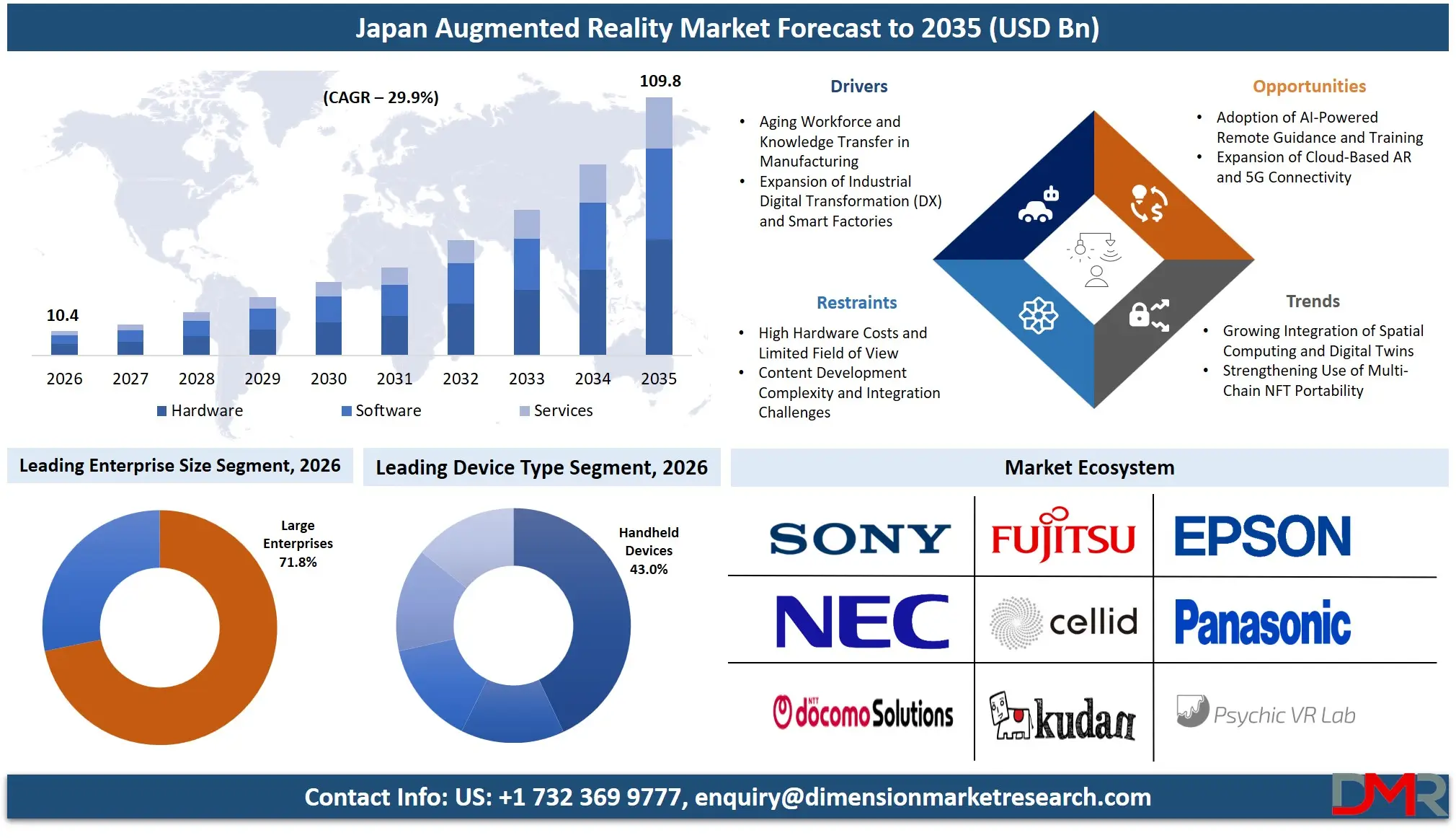
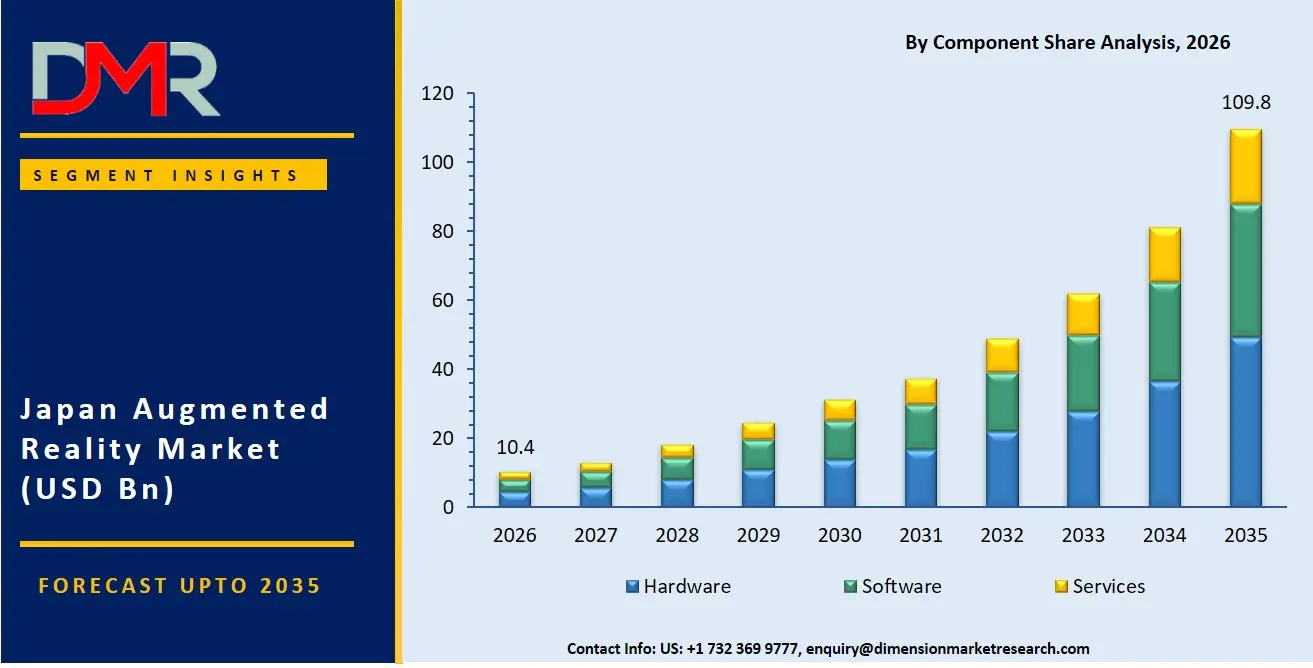
The Japan Augmented Reality Market is expected to reach a value of USD 10.4 billion in 2026, and it is further anticipated to reach USD 109.8 billion by 2035, growing at a CAGR of 29.9% during the forecast period.
ℹ
To learn more about this report –
Download Your Free Sample Report Here
The augmented reality market has been showing consistent growth due to Japan's rising dependence on immersive spatial computing solutions that overlay digital content onto the physical world for real-time interaction and visualization. This includes several hardware components, software platforms, and professional services that help consumers and enterprises deploy AR for residential, commercial, and industrial purposes.
There has been a rising need for custom AR development owing to the requirements for implementing advanced computer vision algorithms, securing operational continuity in manufacturing, and delivering high-performance 3D visualization systems to customers. Large enterprises have emerged as the largest enterprise size segment for AR services, with handheld devices being the most popular device type due to their widespread smartphone penetration, while there has been rapid growth in markerless AR technologies and cloud-based analytics services.
ℹ
To learn more about this report –
Download Your Free Sample Report Here
Key Takeaways
- Market Size & Forecast: The Japan Augmented Reality market is forecasted to be valued at USD 10.4 billion in 2026, growing incrementally to USD 109.8 billion by 2035, due to the joint efforts of digital transformation deployment on the part of enterprises as well as the mandatory adoption of spatial computing and AI-powered visualization technologies.
- Growth Rate & Outlook: Japan market is expected to grow at 29.9% CAGR, propelled by the urgent need to mitigate emerging workforce aging vulnerabilities in industrial maintenance, alongside increasing challenges in transferring tacit knowledge from retiring skilled workers to new employees across manufacturing floors, healthcare facilities, and logistics centers.
- Primary Growth Drivers: Major driving factors comprise the transition from traditional 2D screens toward modern spatial AR interfaces, the necessity to deploy hands-free remote assistance for field service and factory maintenance, as well as the adoption of AI-powered object recognition and 3D mapping for industrial and retail applications.
- Key Market Trends: Major trends encompass the introduction of AI-driven remote guidance through 5G networks, usage of simultaneous localization and mapping (SLAM) within industrial environments for asset tracking and workflow optimization, and increased focus on lightweight, ergonomic AR glasses amidst rising enterprise safety considerations.
- By Component Analysis: The hardware segment is projected to dominate the Japanese augmented reality market due to high demand for optical displays, sensors, and processors by enterprise users, with capabilities like real-time tracking, spatial mapping, and remote visualization, which offer daily operations, quality control, and real-time performance monitoring activities within digital workflow management.
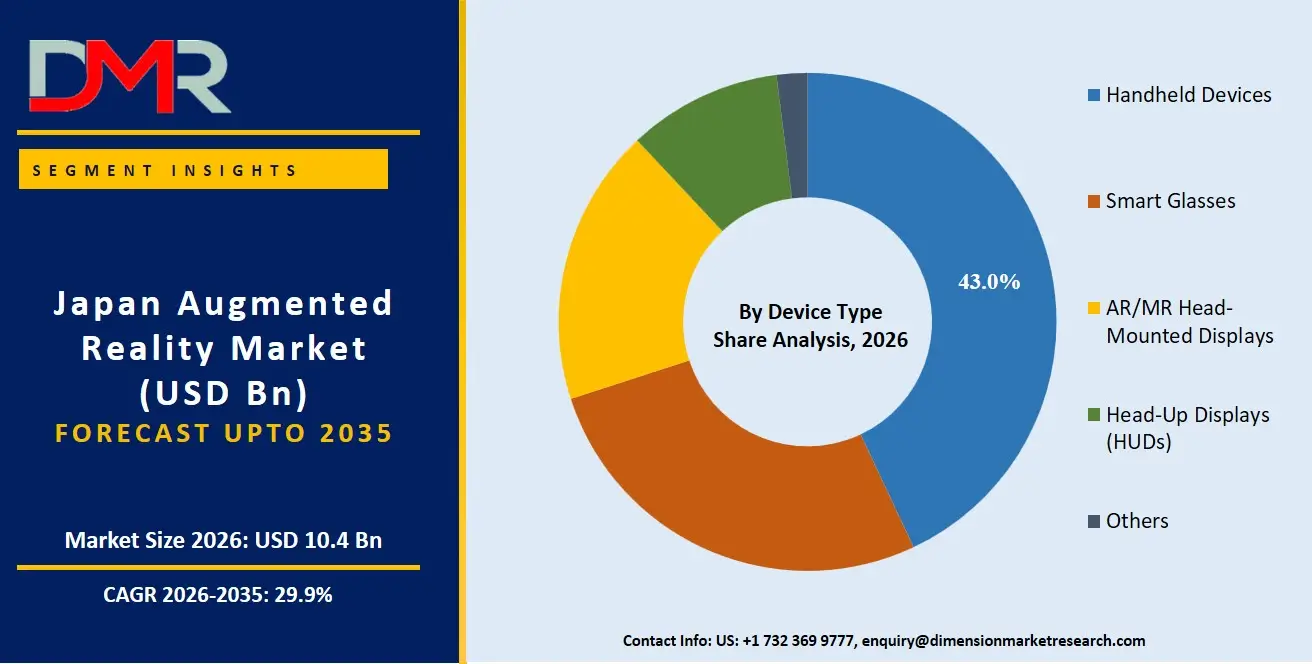
- By Device Type Analysis: The Handheld Devices segment is projected to dominate the Japan Augmented Reality Market in 2026 with a 43% share due to its high smartphone penetration, low barrier to entry, and use in retail virtual try-ons, location-based AR games, and enterprise inventory management.
- By End-Use Industry Analysis: The Manufacturing & Industrial segment is anticipated to dominate in the Japan Augmented Reality Market as Japanese factories adopt systems that are scalable, flexible, and efficient for assembly line guidance, remote expert support, and quality assurance, addressing the aging workforce and knowledge retention challenges unique to Japan.
What is Augmented Reality?
Augmented reality is the technology used to place digital objects, including 3D models, text, pictures, and animations, into the physical world in real-time. In contrast to VR, AR creates a better experience by enhancing the real-life environment using digital objects, while VR tries to substitute the user's environment entirely. Augmented reality technologies require computer vision, SLAM algorithms, depth perception, and sensor fusion for aligning digital content with physical spaces. The most important parts include AR-capable devices such as smartphones, smart glasses, and head-mounted display systems, AR software platforms like AR SDKs and AR content management systems, and expert services for custom development, AR integration, and maintenance.
Use Cases
- Industrial Remote Assistance: Industrial companies use AR Smart Glasses for remote support systems involving real-time identification of faults and providing instructions through AR overlays by distant specialists, thus minimizing downtime and costly travel across Japan's dispersed factories.
- Hospital Surgical Guidance: Hospitals use AR/MR Head Mounted Displays to project a 3D model of an organ for precise surgical assistance in tumor localization and vessel navigation in line with the health and safety regulations within Japan.
- Retail Virtual Try-On: Online stores make use of smartphone AR without markers to display how certain objects like furniture will fit into customers' rooms and what a certain cosmetic product looks like on their faces, decreasing returns and improving conversion ratios.
- Automotive Head-Up Displays: Automobile firms use Head-Up Displays based on AR technology to project vital navigational instructions, alerts for collisions, and lane departures while keeping drivers' eyes fixed on the road amidst dense traffic in urban highways.
How AI is Transforming the Augmented Reality Market?
AI is revolutionizing the augmented reality industry through improved object recognition, scene understanding, and predictive interaction capabilities. The AR software suite includes AI-based systems that detect real-world surfaces, track user gestures, and recognize physical objects in order to overlay digital content instantaneously, thereby preventing any registration errors and visual discontinuities. In addition, the AI-driven functions of AR platforms help organizations assess user gaze behavior, determine optimal content placement, and customize their training modules. AI forms an essential part of governance and user experience initiatives. Professional services involve intelligent agents that monitor AR session logs and keep device calibration data free of any non-compliant entries while ensuring that all visualizations comply with safety regulations and the stringent quality standards in Japan.
Market Dynamics
Key Drivers in the Japan Augmented Reality Market
Aging Workforce and Knowledge Transfer in Manufacturing
Manufacturing industries in Japan are witnessing a severe shortage of skilled professionals owing to the demographic problem and retiring technicians. The issue is tackled using augmented reality technology as it offers the ability to capture expert knowledge and provide hands-free step-by-step directions to young or unskilled employees. Smart glasses and HMDs facilitate real-time guidance from retired experts at remote locations to on-the-ground personnel involved in repair and maintenance processes. Toyota, Hitachi, and Mitsubishi Electric use AR technology to save knowledge and cut down the time required for training by 40%. It has been seen that AR-assisted guidance minimizes errors in highly sensitive situations. Since Japanese companies are known for maintaining strict quality standards, such technology is being quickly embraced by many automotive, electronics, and mechanical industries.
Expansion of Industrial Digital Transformation (DX) and Smart Factories
AR and the creation of smart factories through industrial DX represent one of the major drivers of market growth in the augmented reality space in Japan. In today's world, AR becomes an integral part of Industry 4.0 systems that allow AR glasses, mobile scanners, and AR workstations to interact with IoT sensors, digital twins, and MES systems to provide data visualization and automation. The use of AR technology can prove to be advantageous particularly in the context of the need for paperless processes and real-time quality control in the factories in Japan. In addition, due to government support through METI in the form of subsidies for DX projects, companies tend to choose AR solutions as compared to document management systems.
Restraints in the Japan Augmented Reality Market
High Hardware Costs and Limited Field of View
Japan is one of the highly developed AR markets, however, high costs associated with the development and production of hardware of a high-quality AR/MR headset and smart glasses (costing more than USD 3,000 for each unit) limit SME penetration into the market. Most SMEs find it unprofitable to invest in such high-priced AR devices due to the relatively narrow field of vision (40 to 60 degrees) as well as low battery life (less than 3 hours). These factors make it hard for AR manufacturers to gain entry into the wide SME sector in Japan, which represents more than 99% of total enterprises in the country. Other devices experience issues of discomfort during extended use, making them unsuitable for industrial purposes.
Content Development Complexity and Integration Challenges
Creation of customized AR material tailored to a specific workflow process or application, be it in industry, medicine, or for training, involves specific expertise in 3D modeling, computer vision, and spatial computing. Many firms in Japan do not have in-house capabilities for developing AR solutions, thus making them dependent on expensive outsourced help. The integration of AR solutions into the ERP and MES system or older legacy systems will entail technical complexities and delays. Moreover, there being no standard AR ecosystem, content made for one device platform, such as the HoloLens platform, may not run on other devices like the smart glasses made by Epson or Sony.
Growth Opportunities in the Japan Augmented Reality Market
Adoption of AI-Powered Remote Guidance and Training
The guidance and training process enabled via the application of AI-based technologies can be considered as another promising growth driver for the Japan AR market. The emergence of enterprise-level implementations of intelligent systems enabling the remote support of workers by experts in the execution of challenging activities like maintenance and assembly operations with the help of AR glasses or handheld devices shows the trend towards efficient and cost-effective knowledge transmission. As for Japan, its specific labor market and distribution of industrial facilities makes it even more interesting to implement AR remote guidance. Besides, innovations in the field of artificial intelligence and gesture recognition allow achieving error correction and workflow validation autonomously.
Expansion of Cloud-Based AR and 5G Connectivity
AR ecosystems based on cloud technology present one of the future areas of opportunities within the augmented reality industry in Japan. The modern gadgets such as smart glasses, head-mounted displays, and handheld AR devices have been connected to cloud-based systems capable of delivering real-time streaming of 3D models, persisting spatial anchors, and constant software updates. This approach helps to decrease the demand for processing performed by the device, increase its battery life, and enables shared AR experiences among multiple users. Connection to edge computing devices via Japan's 5G network can provide sub-10 milliseconds of latency for critical industrial operations requiring guidance through augmented reality. The ability to integrate smoothly with the current cloud ecosystem is highly valued by Japanese enterprises, making the AR ecosystem based on cloud technology especially popular.
Trends in the Japan Augmented Reality Market
Growing Integration of Spatial Computing and Digital Twins
The introduction of technologies such as spatial computing and digital twin are very essential and are some of the key elements behind the growth of the augmented reality market in Japan. Companies have been utilizing AR systems in order to synchronize their digital twin information with actual machinery where through the AR devices, the maintenance workers are able to view the status of components inside, temperatures and vibrations. Through the SLAM technology, there have been persistent AR annotations that stick to actual physical locations and this has helped increase efficiency when dealing with industrial equipment. In Japan, due to the fact that they have advanced manufacturing processes and technology utilization by engineers has led to faster adoption of spatial computing in the enterprise augmented reality market.
Strengthening Use of Multi-Chain NFT Portability
A significant trend within the augmented reality market in Japan is the growing demand for markerless AR solutions. Nowadays, companies prefer a solution where augmented reality can be attached to any surface and object without using printed QR codes or fiduciary markers. With six degrees of freedom (6-DoF) technology, users are allowed to move freely and examine the virtual object from any perspective, a function vital when conducting reviews, surgery preparations, and visualizing architectures. Major players in AR platforms are taking advantage of markerless SLAM technology in order to help their enterprise clients implement augmented reality without making any changes to their surrounding environment. The trend is highly dominant within the Japanese augmented reality market due to the preference for easy implementation amongst Japanese enterprises.
Research Scope and Analysis
The Japan Augmented Reality Market is segmented by component, device type, technology, enterprise size, and end-use industry. The market supports industrial maintenance, commercial remote assistance, enterprise training, and public sector applications across manufacturing, healthcare, retail, automotive, and education through cloud-based and on-premise AR deployment models.
ℹ
To learn more about this report –
Download Your Free Sample Report Here
By Component Analysis
Hardware is expected to lead the Japan Augmented Reality Market in 2026 with a projected market share of 48.2% as a result of enterprises' growing preference for high-performance optical displays, sensors, and processors. Japanese enterprises have developed a preference for handheld devices (smartphones/tablets), smart glasses, and AR/MR head-mounted displays for performing such functions as quality inspection, remote guidance, and real-time data visualization. Software is likely to occupy the second place due to the rising trend in favor of AI-driven spatial mapping and cross-platform AR content management. Services, though currently growing steadily, is expected to continue its growth as a consequence of increased demand for custom AR application development and ongoing integration support, particularly for digital transformation projects in Tokyo, Osaka, and Nagoya.
By Device Type Analysis
Handheld Devices (smartphones and tablets) are projected to dominate the Japan Augmented Reality Market in 2026, with an estimated share of 43.0%, owing to their ubiquitous penetration, low cost, and ease of use for retail try-ons, location-based AR games, and enterprise inventory scanning. Smart Glasses follow, driven by industrial hands-free requirements for remote expert support and assembly line guidance in automotive and electronics manufacturing. AR/MR Head-Mounted Displays (HMDs) are used primarily for specialized training simulations, medical visualization, and engineering design review, where high fidelity is required. Head-Up Displays (HUDs) are driven by automotive aftermarket and premium vehicle integration. Other device types include AR contact lenses and projection-based AR systems.
By Technology Analysis
Markerless AR is expected to lead with 44.8% share in 2026, driven by strong demand for flexible, scalable, and location-independent AR experiences. Enterprises prefer markerless AR for industrial training, remote maintenance, and retail applications as it does not require physical markers and allows for greater freedom of movement using SLAM and depth sensing. Demand is concentrated in major industrial hubs such as Tokyo, Osaka, and Nagoya, where advanced manufacturing supports adoption. Marker-Based AR follows, supported by enterprises seeking high-precision tracking for quality control and assembly line guidance, where standardized markers are feasible. Projection-Based AR is used in shared workspaces and interactive displays. Superimposition-Based AR is primarily for medical overlays and product assembly, where object replacement is needed.
By Enterprise Size Analysis
Large Enterprises are anticipated to dominate the Japan Augmented Reality Market in 2026 with an estimated share of 71.8%, owing to their significant investment capacity, bulk procurement for factory automation, remote work infrastructure, and enterprise-wide AR deployment across corporate campuses and production sites. Small & Medium-Sized Enterprises (SMEs) are expected to grow at a rapid rate, driven by the expansion of affordable smartphone-based AR solutions, cloud-based AR platforms with pay-as-you-go pricing, and increasing digital literacy among younger Japanese business owners, as well as the need for cost-effective remote maintenance and training solutions without expensive hardware.
By End-Use Industry Analysis
Manufacturing & Industrial is set to dominate the Japan Augmented Reality Market in 2026 with a projected share of 34.2%, thanks to its high deployment penetration, government-backed DX subsidy programs, and the urgent need to address the aging skilled workforce. AR enables real-time assembly guidance, remote quality control, and granular production analytics that do not necessitate additional hardware investment beyond existing smart devices. Media & Entertainment will experience robust growth in the coming years because of heightened preference for immersive location-based AR attractions and virtual idol concerts unique to Japan. Healthcare is driven by AR adoption for surgical navigation and medical training across major university hospitals. Retail & E-Commerce benefits from virtual try-on and furniture visualization. Education & Training is growing rapidly as vocational schools adopt AR under Japan's digital education initiatives. Automotive primarily deploys AR HUDs and maintenance guidance in densely populated prefectures to improve driver safety and operational efficiency.
The Japan Augmented Reality Market Report is segmented based on the following:
By Component
- Hardware
- Software
- Services
By Device Type
- Smart Glasses
- AR/MR Head-Mounted Displays
- Handheld Devices
- Head-Up Displays (HUDs)
- Others
By Technology
- Marker-Based AR
- Markerless AR
- Projection-Based AR
- Superimposition-Based AR
By Enterprise Size
- Large Enterprises
- Small & Medium-Sized Enterprises (SMEs)
By End-Use Industry
- Media & Entertainment
- Manufacturing & Industrial
- Retail & E-Commerce
- Healthcare
- Education & Training
- Automotive
- Others
Competitive Landscape
The dynamics of competition in the Japan Augmented Reality marketplace have developed to become increasingly dynamic, with a wide range of global AR platform providers and specialized Japanese AR software companies focusing on spatial computing, SLAM algorithms, and markerless tracking. The essential ingredient for success is found in deep-seated strategic partnerships with industrial manufacturers, retail distributors, and telecom carriers (e.g., NTT DOCOMO) in Japan, which strengthen go-to-market capabilities and enable enterprise AR services to be delivered alongside core hardware. Market consolidation trends are moving rapidly ahead, with established Japanese electronics companies partnering with or acquiring specialized AR software and spatial mapping startups to enhance their AR device functionality. Proprietary intellectual property rights, with AI-based SLAM algorithms and cross-platform AR frameworks, hold increasing importance compared to just hardware pricing and standalone device performance.
Some of the prominent players in the Japan Augmented Reality Market are:
- Sony Group Corporation
- Seiko Epson Corporation
- Panasonic Holdings Corporation
- Fujitsu Limited
- NEC Corporation
- NTT Docomo Solutions, Inc.
- Kudan Inc.
- Cellid Inc.
- Pretia Technologies Inc.
- Psychic VR Lab Co., Ltd.
- Mawari Inc.
- MESON, Inc.
- OnePlanet Inc.
- meleap Inc.
- Tyffon Inc.
- Apple Inc.
- Google LLC
- Microsoft Corporation
- Snap Inc.
- Niantic Spatial, Inc.
- Other Key Players
Recent Developments
- March 2026: NTT Docomo Solutions, Inc., successfully demonstrated a new immersive live-viewing technology utilizing IOWN networking infrastructure and AI, enabling simultaneous real-time streaming of 3D and augmented reality (AR) content for sports events and live entertainment. The technology is designed to support next-generation remote immersive experiences across multiple viewing environments.
- January 2026: Sony Group Corporation announced a collaboration with Ameria to launch an integrated gesture-controlled 3D visualization solution combining Sony's Spatial Reality Display technology with Ameria's touch-free interaction platform. The solution targets retail, education, and enterprise applications and strengthens Sony's position in immersive AR and spatial computing ecosystems.
- April 2025: Cellid Inc. raised approximately USD 7.5 million through a Series C Extension financing round to accelerate the development of AR display technologies, including waveguides and micro-projectors for next-generation AR glasses. The funding also supports talent acquisition and global expansion initiatives.
- March 2025: Niantic Spatial, Inc. was established as an independent geospatial AI and spatial computing company following the sale of Niantic's gaming business to Scopely. The new company launched with USD 250 million in funding to advance spatial intelligence, AR mapping technologies, and real-world AI applications, strengthening its focus on enterprise and consumer AR ecosystems.
Report Details
| Report Characteristics |
| Market Size (2026) |
USD 10.4 Bn |
| Forecast Value (2035) |
USD 109.8 Bn |
| CAGR (2026–2035) |
29.9% |
| Historical Data |
2021 – 2025 |
| Forecast Data |
2027 – 2035 |
| Base Year |
2025 |
| Estimate Year |
2026 |
| Segments Covered |
By Component, By Device Type, By Technology, By Enterprise Size, By End-Use Industry |
| Country Coverage |
Japan |
Frequently Asked Questions
How big is the Japan Augmented Reality Market?
▾ The Japan Augmented Reality Market is poised to be valued at USD 10.4 billion in 2026 and is projected to reach USD 109.8 billion by 2035.
What is the CAGR of the Japan Augmented Reality Market from 2026 to 2035?
▾ The market is projected to grow at a CAGR of around 29.9% from 2026 to 2035, supported by industrial digital transformation, 5G-enabled remote assistance, and consistent enterprise replacement cycles.
What factors are driving the growth of the Japan Augmented Reality Market?
▾ Growth is driven by the aging workforce and knowledge transfer needs in manufacturing, rising demand for hands-free remote assistance, expansion of smart factory initiatives, and government DX subsidies. Japan's strong industrial base and preference for high-precision technology also support enterprise-driven market expansion.
What are the major trends in the Japan Augmented Reality Market?
▾ Key trends include spatial computing with digital twins, markerless AR and 6-DoF tracking, AI-powered remote guidance, and expansion of 5G-connected cloud AR. Enterprises prefer seamless integration across handheld devices, smart glasses, HMDs, and automotive HUDs.
Who are the key players in the Japan Augmented Reality Market?
▾ Key players include Sony Group Corporation, Seiko Epson Corporation, Panasonic Holdings Corporation, Fujitsu Limited, NEC Corporation, NTT DOCOMO, Inc., Kudan Inc., and many more.
How is the Japan Augmented Reality Market segmented?
▾ The market is segmented by component, device type, technology, enterprise size, and end-use industry.