Market Overview
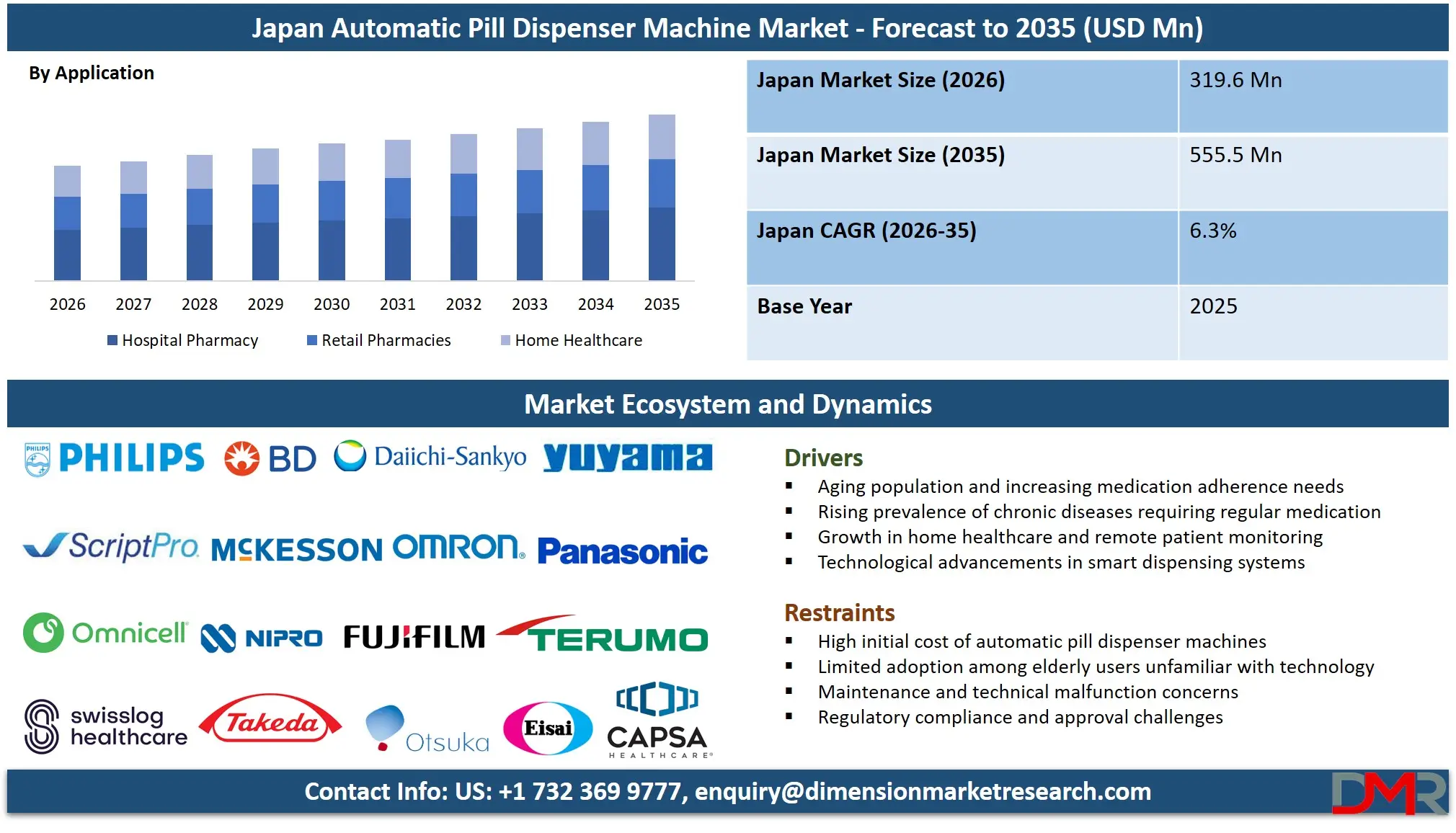
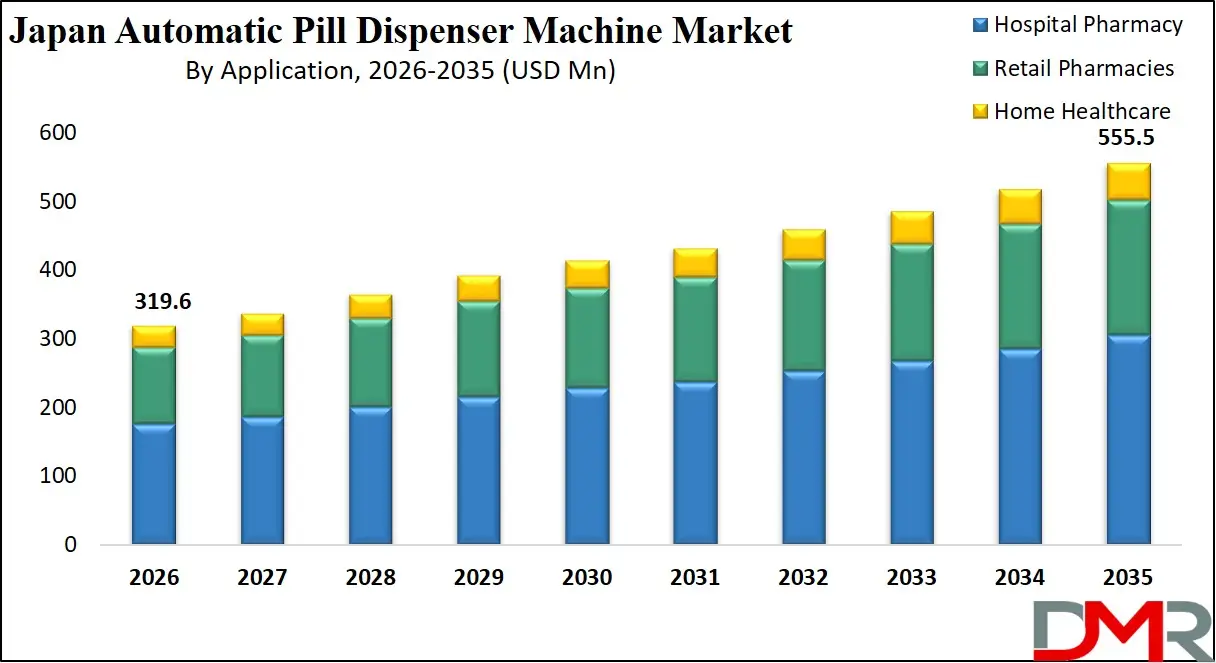
The Japan Automatic Pill Dispenser Machine Market size is expected to reach a value of USD 319.6 million in 2026, and it is further anticipated to reach a Market value of USD 555.5 million by 2035 at a CAGR of 6.3%.
ℹ
To learn more about this report –
Download Your Free Sample Report Here
The Japan Automatic Pill Dispenser Machine Market is undergoing structural growth due to the fact that Japan is a Super-Aged society, with a higher percentage of the population aged over 65 years, and a national healthcare policy highly focused on community-based integrated care systems. Their implementation is essential in pharmacies of hospitals, health insurance pharmacies (hoken yakkyoku) and in the quickly growing home nursing care industry as the nation attempts technological responses to an acute nursing labor shortage and pharmaceutical care shortage. The market is also supported by the strategic drive of the government towards Society 5.0 and digital transformation (DX) in medical care, namely, medication adherence and leftover drugs (nokori-yaku) reduction.
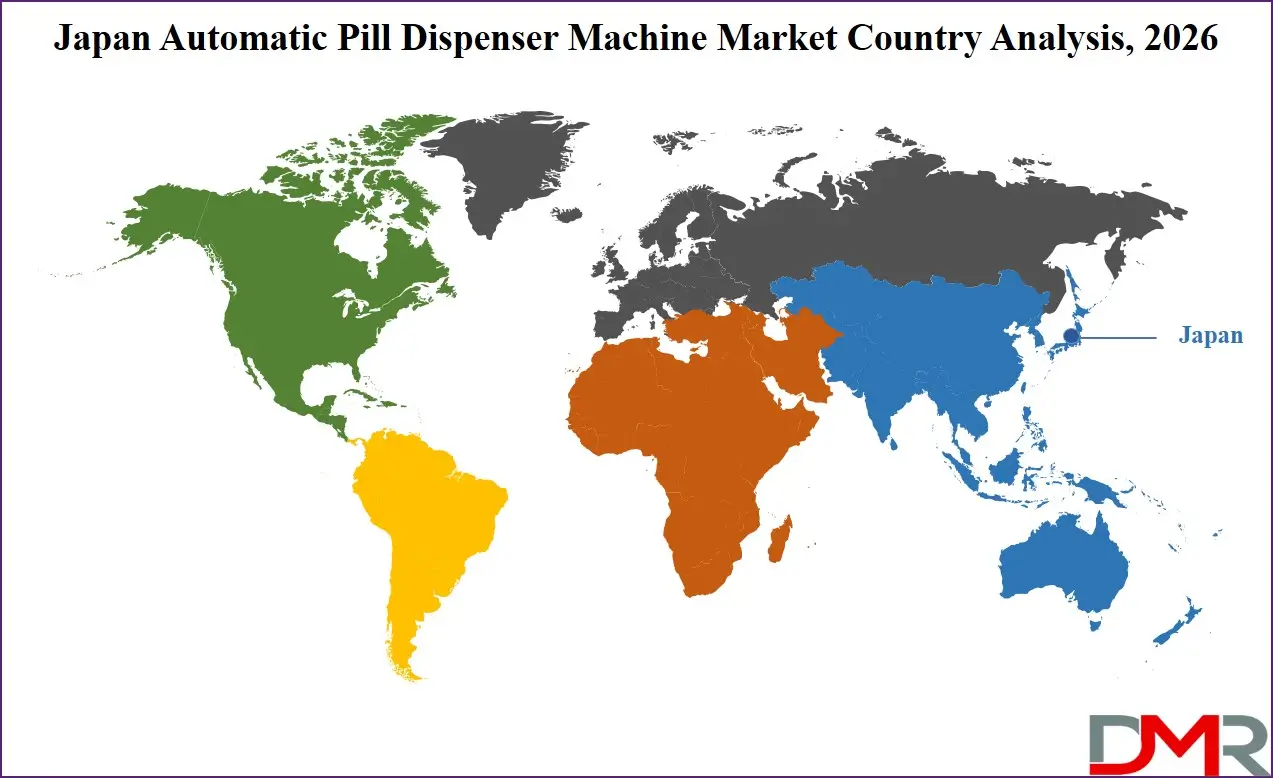
Japanese national electronic prescription network and My Number health insurance card system are being integrated with technologies such as image recognition and robotic picking arms. Kanto and Kansai regions command majority of the market share because of the high population in urban areas and the high density of hospitals. Major prefectures at the forefront of adoption are Tokyo, Osaka and Aichi. The depopulated regions and cities of the region are the most important growth frontier since the government subsidizes telehealth and remote medication management technologies to preserve healthcare access among rural population groups. The key companies that are engaged in this industry are Yuyama Co., Ltd., Panasonic Holdings Corporation and Tosho Inc.
ℹ
To learn more about this report –
Download Your Free Sample Report Here
Japan Automatic Pill Dispenser Machine Market: Key Takeaways and Other Influencing Factors
- Japan Market Value: The Japan Automatic Pill Dispenser Machine Market was valued at USD 319.6 million in 2026 and is anticipated to reach USD 555.5 million by 2035, underpinned by the refinement of robotic dispensing robotics tailored to Japanese pharmaceutical packaging norms and the critical societal imperative to support independent living for the elderly cohort.
- Japan Growth Rate: The Japanese automatic pill dispenser machine market is expected to grow by a compound annual growth rate (CAGR) of 6.3%, driven by the digitalization of medication notebooks (okusuri techo) and the national requirement to enhance the accuracy of dispensing amidst the already dwindling number of board-certified specialists in the pharmacy field.
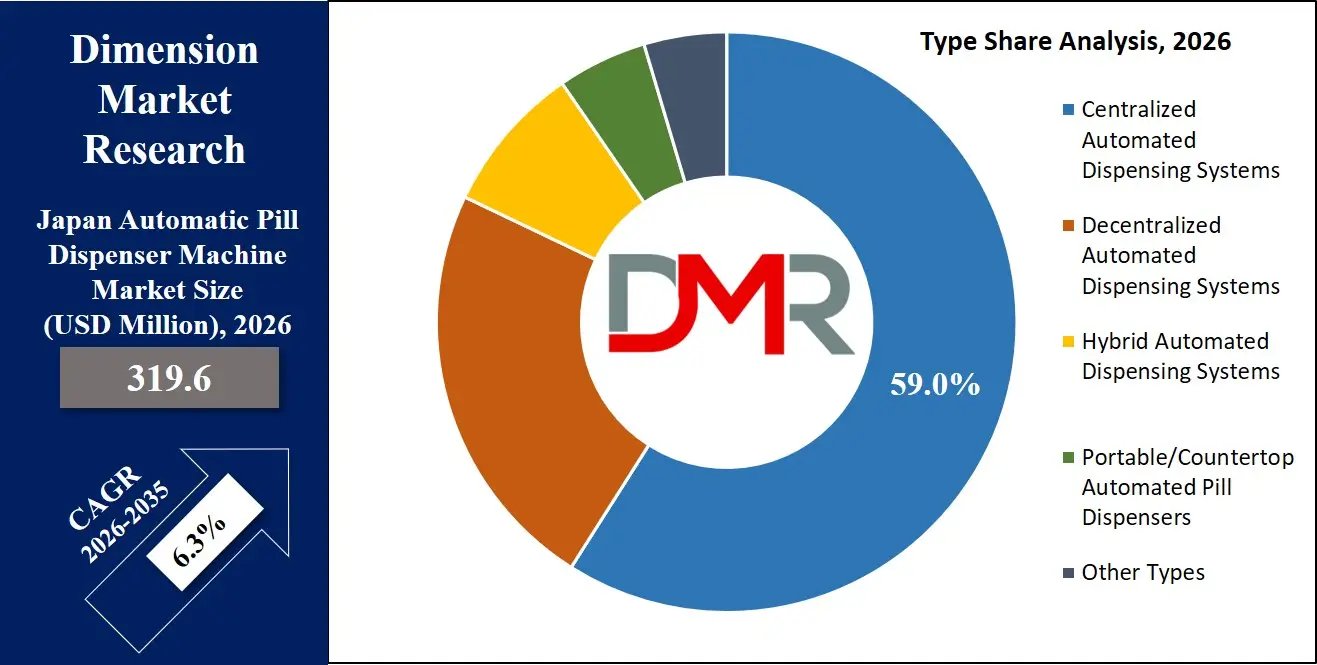
- By Type Segment Analysis: Centralized automated dispensing systems, with 56.5% in 2026, should take the lead in large part due to their key role in handling the high volume of prescription verification and pouch packaging processes typical of the Japanese separation of dispensing and prescribing (Bungyō) system.
- By Technology Segment Analysis: RFID based systems are making impressive inroads into the technology segment, fueled by regulatory favoring of tracking expensive biologics and narcotics, and the capacity of the technology to support contactless inventory management a feature that is greatly appreciated in the hygiene conscious Japanese healthcare setting.
- By Application Segment Analysis: The hospital pharmacy segment projected to has the highest share of 39.8% in 2026 because of the centralized nature of inpatient drug distribution and strict safety measures, but the home healthcare segment will experience the greatest dynamic growth as the Long-Term Care Insurance system (Kaigo Hoken) funds more assistive technology.
- Ministry of Health, Labour and Welfare (MHLW) / PMDA: The government actively advocates the adoption of robotic and automated systems to reduce the risk of dispensing errors in high-volume health insurance pharmacies, and in this regard, guidelines encourage the introduction of barcode verification and image recognition in the dispensing process.
- Japan Pharmaceutical Association / National Data: The problem of "leftover medications" has its estimated economic cost of billions of yen every year on the national health insurance system, and automated pill dispensers and medication compliance are increasingly regarded as a direct intervention in reducing the amount of pharmaceutical waste and enhancing therapeutic outcomes.
- Aging Society Research (Cabinet Office): Polypharmacy (taking 6 or more drugs at once), being a significant clinical issue, is a cornerstone of the Japanese demographic, with more than 29% of the population being 65 years and older, which has created a strong demand base in the environment due to multiple drug interactions and adverse drug reactions.
Impact of Iran Conflict on Japan Automatic Pill Dispenser Machine Market
The Iran conflict is exerting indirect but important pressures on the Japanese automatic pill dispenser machine industry through logistical and cost issues. Due to the country's reliance on the Middle East for its energy needs, the prices of gasoline and electricity have been increasing, causing higher costs of production for medical equipment.
Petrochemical shortages are also becoming common due to interruptions in the flow of naphtha, which is required for making plastics used in the production of medical equipment. There are also transportation issues within the global medtech supply chain that cause longer shipping periods and increased costs. Overall, although demand remains consistent due to the aging demographics of Japan, the industry will be facing some margin and price issues in the near term.
Japan Automatic Pill Dispenser Machine Market: Use Cases
- Community Pharmacy "Family Pharmacist" Use: Automated pouch packaging devices in community pharmacies allow one-dose packages to be created with the elderly patient, visually arranging the morning, noon, and evening doses to give the caregiver a significant break on complexity and the government's proposed continuity of care program "Family Pharmacist" program.
- Visiting Nursing Station Use: Portable automatic dispensers are installed in the homes of dementia or severely physically disabled patients and will allow the visiting nurses to load a week worth of medicine and be confident that the patient is taking only the right dose at the right time and will send remote alerts to the nursing station in case the patient misses a dose.
- Hospital Ward Dispensing Use: Decentralized automated dispensing cabinets are being designed in Japanese hospitals to support the specific and delicate unpackaging needs of Japanese pharmaceuticals, such as PTP (Press Through Pack) sheet management and injectable preparation, making them safer and decreasing the physical stress burden to hospital pharmacists.
Japan Automatic Pill Dispenser Machine Market: Market Dynamic
Market Trends in Japan Automatic Pill Dispenser Machine Market
Shift Toward Compact and Silent Automation for Urban Clinics
The severe space limitations and high property prices in the Japanese city centres such as Tokyo and Osaka have led to a strong trend towards ultra-compact, vertical automated dispensing systems, with maximum storage density per square meter. Moreover, the culture of Japan in the workplace highly values silent functioning and minimal disturbances. Manufacturers are developing robotic systems that have high noise-damping technology and smooth and silent actuator movements. This enables such units to be installed directly behind the counter in small local pharmacies without having to cause an industrial noise profile that could be detrimental to the quiet ambiance that is expected in a Japanese clinical environment.
Integration with Electronic Prescription and My Number Card Systems
Japan is actively implementing its national electronic prescription network, which is the substitute of paper prescriptions and physical medication notebooks with digital records formatted with the My Number national identification card. Automated dispensing systems are also being improved to easily integrate with this infrastructure. Once a patient shows his My Number card at the pharmacy, the dispenser software can immediately access the prescription information and verify the interaction with the existing medications in the digital notebook of the patient and create the automated packing process. This is one of the trends that the government has made the Digital Garden City Nation vision of streamlined government services.
Growth Drivers in Japan Automatic Pill Dispenser Machine Market
Unprecedented Demographic Aging and Labor Scarcity
Among developed countries, Japan has the most severe demographic crisis, as the number of working-age population has drastically reduced and cannot fit in the necessary positions in healthcare and nursing. The number of caregivers to the elderly is expected to deteriorate significantly. Automated pill dispensers are not just a convenience, but they are considered to be a vital part of the infrastructure to keep the long-term care insurance system functional. These machines can also allow the small number of pharmacists and nurses to concentrate on more valuable clinical evaluations and patient counseling, by removing the manual step of sorting and checking medications, which is now automated.
Government Subsidies for Nursing Care Robotics
In order to deal with the labor shortage, the Ministry of Economy, Trade and Industry (METI) and the Ministry of Health, Labour and Welfare (MHLW) in Japan have developed solid subsidy systems to enable the usage of the so-called nursing care robots, which clearly encompass automated medication management and dispensing systems. These subsidies, which are offered to nursing homes, group homes with dementia patients, and home-visit nursing providers, greatly reduce the financial entry barrier. This demand is policy based and produces a special and consistent growth environment that does not heavily depend on pure hospital capital budget cycles like other Western markets.
Growth Opportunities in Japan Automatic Pill Dispenser Machine Market
Export of Japanese Precision Engineering to Other Asian Super-Aged Societies
Manufacturers of Japan have perfected their automation technology to achieve very high domestic standards of reliability, compactness and precision when dealing with small delicate packaging. With other Asian countries such as South Korea, Taiwan, and Singapore rapidly trailing Japan in the demographic pattern into super-aged, the export of Japanese-made dispensing systems is tremendous. Using the international reputation Japan has in monozukuri (craftsmanship) and quality assurance, companies can market these neighboring markets with high-quality, high-precision automation devices tailored to Asian pharmaceutical packaging designs and space constraints.
Development of AI-Driven "Adherence Nudging" for Solo Elderly
Many Japanese citizens among the elderly live alone (kodokushi prevention is a social priority). Automated dispensers that have AI-based voice recognition in native Japanese are open to a big opportunity. These systems may be involved in subtle, culturally sensitive reminders and check-ins, in addition to basic alerts. The machine can also prompt the elderly patient to take his/her medicine without scaring him/her by using soft-spoken and polite Japanese language protocols. A combination of local community support centers and watch-over services will establish a comprehensive care ecosystem that considers not only medication compliance but also social isolation, which is a promising growth point of smart home health technology.
Market Restraints in Japan Automatic Pill Dispenser Machine Market
Complexity of Japanese Pharmaceutical Packaging (PTP Sheets)
Another distinctive technical and operational limitation in the Japanese market is the prevalence of PTP (Press Through Pack) sheet packaging of oral solid drugs, rather than the loose bulk bottles prevalent in the U.S. market. Centralized robotic filling of pouches or cassettes needs de-blistering machines that are automated to pick pills off these sheets. This creates a new, expensive and space-consuming procedure in the automation process. Manual deblistering is a time-consuming process and the absence of a single, effective deblistering standard to all sizes of Japanese PTP sheets forms a bottleneck, restricting the end-to-end efficiency of wholly automated pharmacies.
Stringent Bungyō Regulations and Pharmacist Oversight
Japanese medical and dispensing practices are strictly separated (Bungy) which requires intensive final visual inspection and counseling by a licensed pharmacist of every prescription dispensed. Automation can be used to perform counting and sorting, but the legal aspect of human pharmacist verification of final package contents cannot be automated. This control ceiling makes certain that complete "lights out" automation of pharmacies is not legal in Japan. The automation investment case is therefore limited by the fact that the savings in labor can only be seen in the back-end preparation, whereas the front-end counseling and final check will continue to be a labor-intensive, and pharmacist-driven process.
Japan Automatic Pill Dispenser Machine Market: Research Scope and Analysis
By Type Analysis
Centralized automated dispensing systems is projected to maintain a dominant footprint in Japan is dominated by this, which are indicative of the operational model of large hospital pharmacies and the high-throughput requirements of the "monzen" pharmacies located next to large medical centers.
ℹ
To learn more about this report –
Download Your Free Sample Report Here
Centralized equipment, especially automated pouch packing lines, is necessary to handle the detailed one-dose package (ippohoku-ka) service, which is a feature of Japanese patient-centered pharmaceutical care. The elderly patients and their caregivers also appreciate this service and the accuracy needed to prevent cross-contamination and to provide the right dosage at the right time is best suited to the centralized software-controlled robotic systems.
By Technology Analysis
The RFID-based systems are showing a strong growth pattern within the Japanese market, owing to their supportive nature to the national initiative of efficient inventory management and countering the effects of counterfeit drugs. This technology allows scanning whole shelves of narcotics or high-priced drugs quickly and contactlessly, which is a great benefit in Japanese pharmacies, where storage is small and tightly packed. Moreover, RFID capability to monitor the temperature of biologics within the cold chain is also becoming a more critical factor as Japan widens its application of costly antibody therapies and vaccines that demand stringent environmental regulations.
By Application Analysis
The largest end-user in the Japan automatic pill dispenser machines market is still the Hospital Pharmacy segment. The quality of care in the complex acute care setting necessitates error prevention because the volume of inpatient prescriptions is high, and the prevention of errors is an absolute need. Nevertheless, the Community Pharmacy application is of vital strategic significance because of the sheer quantity of dispensing pharmacies around the country. As the dispensing fees are reimbursed continuously under government scrutiny and pressure, pharmacies are automating their operations to enhance productivity in their operations and provide differentiated services in adherence to their patients and cement their market standing in an extremely competitive local market.
Japan Automatic Pill Dispenser Machine Market Report is segmented on the basis of the following:
By Type
- Centralized Automated Dispensing Systems
- Decentralized Automated Dispensing Systems
- Hybrid Automated Dispensing Systems
- Portable/Countertop Automated Pill Dispensers
- Other Types
By Technology
- RFID-Based Systems
- Barcode-Based Systems
By Application
- Hospital Pharmacy
- Retail Pharmacies
- Home Healthcare
Impact of Artificial Intelligence in Japan Automatic Pill Dispenser Machine Market
The introduction of Artificial Intelligence technology into automatic pill dispensers is already transformative in terms of tackling the unique demographic and linguistic issues of Japan. AI systems are being trained on large volumes of Japanese prescription patterns and patient histories to discover early signs of frailty or cognitive impairment using changes in medication adherence behaviour. This will enable early intervention, through visiting nurses or family members in facilitating long-term care prevention objectives of the government. Moreover, image recognition with AI is essential to ensure that PTP sheets have been de-blistered correctly, which is a large fraction of the pain in Japanese pharmacy automation processes.
In addition, remote monitoring of a great number of older adults living alone can be done more efficiently with the use of AI technology in home-based automatic pill dispensing machines. Voice-based AI assistants that speak natural and respectful Japanese can give vocal instructions, give mild encouragement and even have a small talk check-in about the timing of the meal in relation to medication. This technology fits the Japanese societal values of dignity and unobtrusive assistance, making the perceived stigma of being monitored less significant and making the users more willing to adopt home health technology.
Japan Automatic Pill Dispenser Machine Market: Competitive Landscape
The competitive environment within the Japan Automatic Pill Dispenser Machine Market is characterized by a strong domestic manufacturing base and high barriers to entry for foreign competitors unfamiliar with the nuances of Japanese pharmaceutical packaging and regulatory bureaucracy. Established domestic champions such as Yuyama Co., Ltd. and Tosho Inc. control a significant share of the hospital and community pharmacy automation market due to their deep integration with local healthcare IT ecosystems and extensive service networks.
ℹ
To learn more about this report –
Download Your Free Sample Report Here
Main competitive dynamics revolve around precision engineering, reliability under high-volume continuous use, and compliance with Japanese Industrial Standards (JIS). Foreign multinationals like Omnicell and BD participate through specialized segments, often relying on local distribution partnerships or subsidiaries to navigate the complex business culture. Innovation is focused on miniaturization, energy efficiency, and software compatibility with the national e-prescription infrastructure.
Some of the prominent players in Japan Automatic Pill Dispenser Machine Market are:
- Yuyama Co., Ltd.
- Omron Healthcare
- Panasonic Corporation
- Terumo Corporation
- Otsuka Pharmaceutical Co., Ltd.
- Nipro Corporation
- Daiichi Sankyo Company, Limited
- Fujifilm Corporation
- Takeda Pharmaceutical Company Limited
- Eisai Co., Ltd.
- Omnicell Inc.
- Becton, Dickinson and Company
- Capsa Healthcare
- Swisslog Healthcare
- McKesson Corporation
- ScriptPro LLC
- ARxIUM Inc.
- MedMinder Systems, Inc.
- Hero Health, Inc.
- Koninklijke Philips N.V.
- Other Key Players
Japan Automatic Pill Dispenser Machine Market: Recent Developments
- December 2025: Yuyama Co., Ltd. announced the integration of its fully automated dispensing line with the new national electronic prescription system operated by the MHLW, enabling a seamless digital flow from physician's tablet to Yuyama's robotic pouch packager without manual data re-entry in Japanese pharmacies.
- November 2025: Panasonic unveiled a prototype "Care Robot Dispenser" designed for home use, featuring a soft, rounded design aesthetic and a voice module utilizing synthetic speech that mimics the gentle tone of a traditional Japanese home helper to improve elderly user receptivity.
- October 2025: The Tokyo Metropolitan Government expanded its subsidy program for "ICT and Robot Utilization in Nursing Care," explicitly adding advanced pill dispensers with remote monitoring capabilities to the list of approved equipment for special nursing homes (Tokuyō) within the 23 wards.
- September 2025: Tosho Inc. introduced a new compact automated storage and retrieval carousel specifically engineered for the tight, narrow corridors of Japanese "monzen" pharmacies, increasing storage density by 30% compared to previous models while reducing power consumption to meet Top Runner Program efficiency standards.
Report Details
| Report Characteristics |
| Market Size (2026) |
USD 319.6 Mn |
| Forecast Value (2035) |
USD 555.5 Mn |
| CAGR (2026–2035) |
6.3% |
| Historical Data |
2021 – 2025 |
| Forecast Data |
2026 – 2035 |
| Base Year |
2025 |
| Estimate Year |
2026 |
| Report Coverage |
Market Revenue Estimation, Market Dynamics, Competitive Landscape, Growth Factors and etc. |
| Segments Covered |
By Type (Centralized Automated Dispensing Systems, Decentralized Automated Dispensing Systems, Hybrid Automated Dispensing Systems, Portable/Countertop Automated Pill Dispensers, and Other Types), By Technology (RFID-Based Systems, and Barcode-Based Systems), By Application (Hospital Pharmacy, Retail Pharmacies, and Home Healthcare) |
| Country Coverage |
Japan |
| Prominent Players |
Yuyama Co., Ltd., Omron Healthcare, Panasonic Corporation, Terumo Corporation, Otsuka Pharmaceutical Co., Ltd., Nipro Corporation, Daiichi Sankyo Company, Limited, Fujifilm Corporation, Takeda Pharmaceutical Company Limited, Eisai Co., Ltd., Omnicell Inc., Becton, Dickinson and Company, Capsa Healthcare, Swisslog Healthcare, McKesson Corporation, ScriptPro LLC, ARxIUM Inc., MedMinder Systems, Inc., Hero Health, Inc., Koninklijke Philips N.V., and Other Key Players |
| Purchase Options |
We have three licenses to opt for: Single User License (Limited to 1 user), Multi-User License (Up to 5 Users), and Corporate Use License (Unlimited User) along with free report customization equivalent to 0 analyst working days, 3 analysts working days, and 5 analysts working days respectively. |
Frequently Asked Questions
How big is the Japan Automatic Pill Dispenser Machine Market?
▾ The Japan Automatic Pill Dispenser Machine Market size is estimated to have a value of USD 319.6 million in 2026 and is expected to reach USD 555.5 million by the end of 2035.
Who are the key players in the Japan Automatic Pill Dispenser Machine Market?
▾ Some of the major key players in the Japan Automatic Pill Dispenser Machine Market are Panasonic Holdings Corporation, Tosho Inc., Takazono Corporation, Murata Machinery, Ltd., Sanyo Electric Co., Ltd., Yuyama Co., Ltd., Teraoka Seiko Co., Ltd., and many others.
What is the growth rate in the Japan Automatic Pill Dispenser Machine Market?
▾ The Market is growing at a CAGR of 6.3 percent over the forecasted period.