What is the Japan Automotive Adaptive Front Lighting System Market Size?
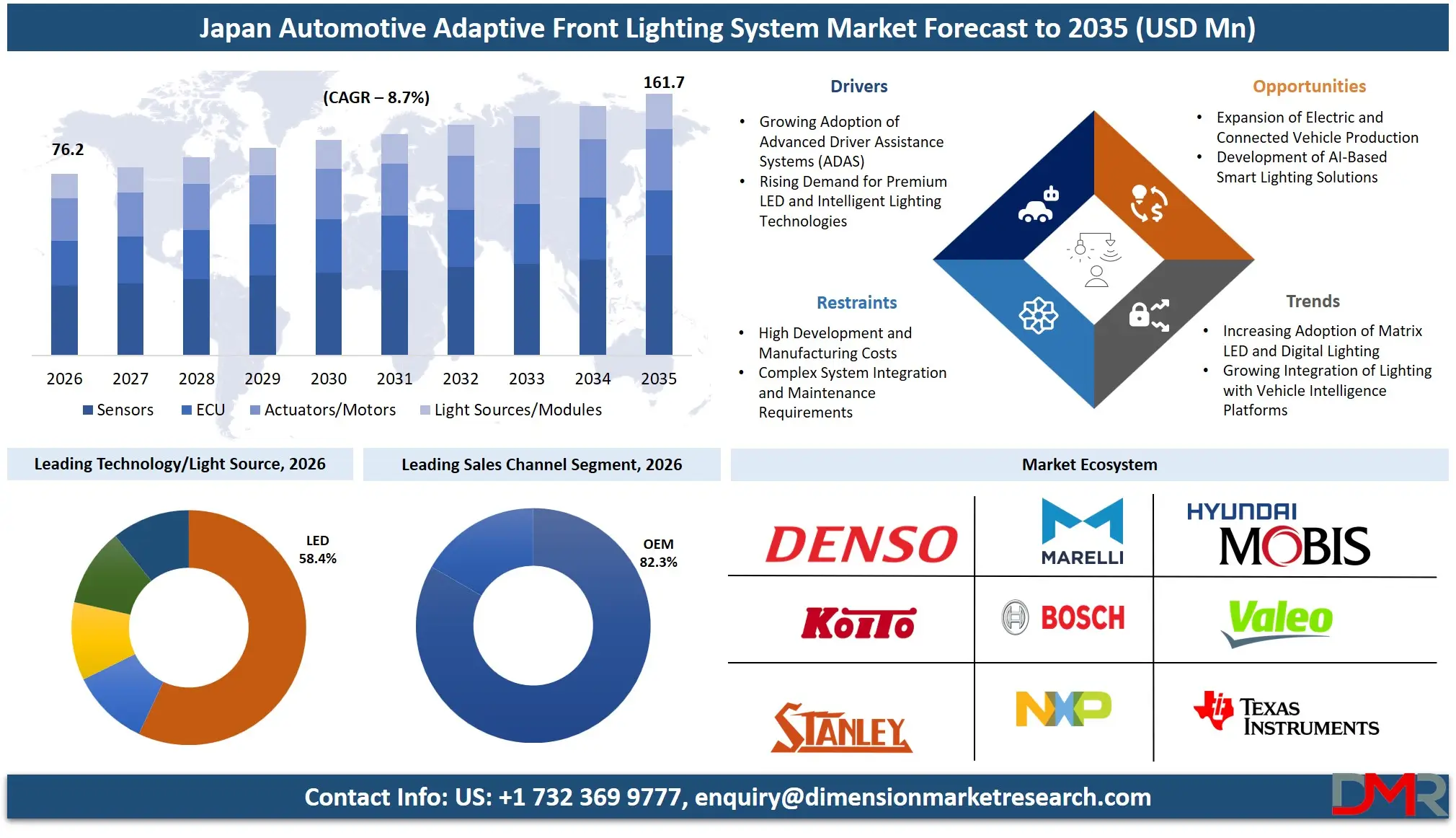
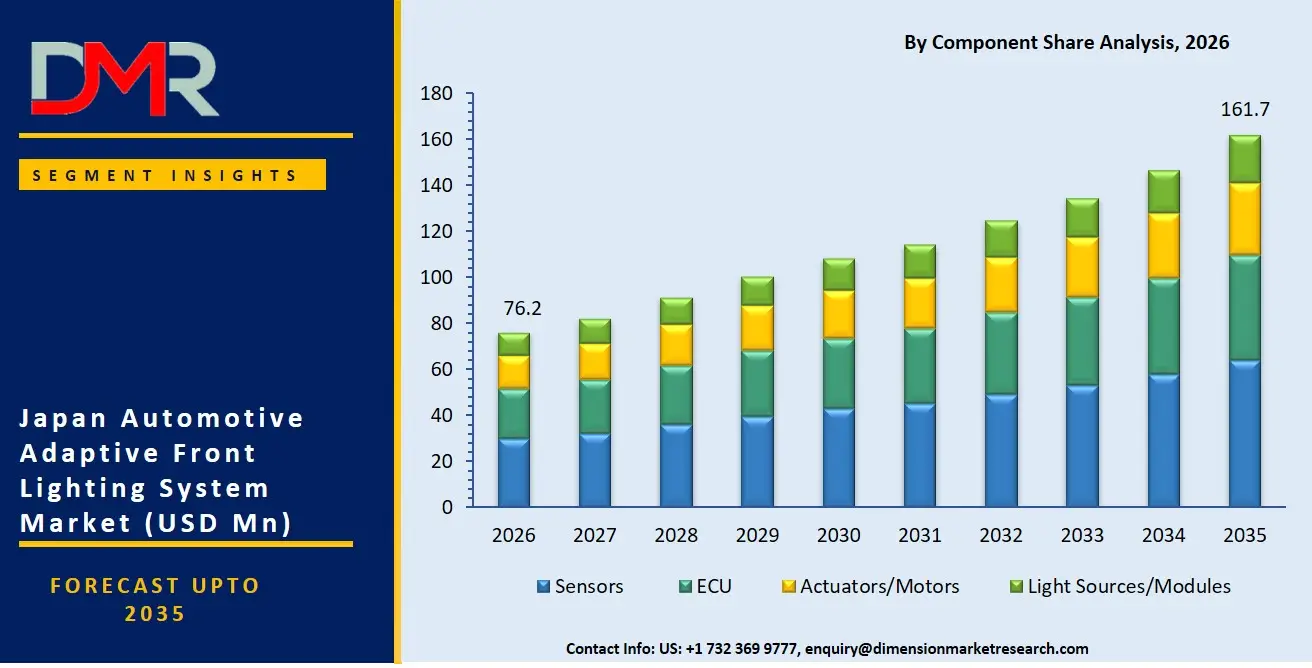
The Japan Automotive Adaptive Front Lighting System Market size is expected to be USD 76.2 million in 2026 and increase at a compound annual growth rate of 8.7% to USD 161.7 million in 2035 owing to growing adoption of advanced driver assistance systems (ADAS).
ℹ
To learn more about this report –
Download Your Free Sample Report Here
The Japan Automotive Adaptive Front Lighting System market comprises intelligent vehicle lighting technologies that automatically adjust beam direction, intensity, and distribution according to vehicle speed, steering angle, road conditions, weather, and surrounding traffic. The market includes electronic control units, sensors, actuators, adaptive light modules, and advanced LED, OLED, and laser lighting solutions supplied to OEMs and the aftermarket. Growing vehicle safety regulations, increasing adoption of advanced driver assistance systems (ADAS), rising penetration of premium and electric vehicles, and continuous innovations in intelligent lighting, matrix beam technology, and AI-enabled illumination are accelerating market expansion while enhancing driving visibility, road safety, and overall vehicle performance.
Key Takeaways
- Market Size & Forecast: The Japan Automotive Adaptive Front Lighting System Market size is projected to reach USD 76.2 million in 2026 and is anticipated to have a value of USD 161.7 million in 2035.
- Growth Rate & Outlook: The Japan Automotive Adaptive Front Lighting System Market size is set to grow at a compound annual growth rate of 8.7% during the forecast period of 2026 to 2035.
- Primary Growth Drivers: Some of the major growth drivers in the market are Growing Adoption of Advanced Driver Assistance Systems (ADAS), and more.
- Key Market Trends: Some of the major trends in the market are Increasing Adoption of Matrix LED and Digital Lighting and more.
- By Component Type: Sensors is expected to get the largest revenue share in 2026 in the Japan Automotive Adaptive Front Lighting System Market.
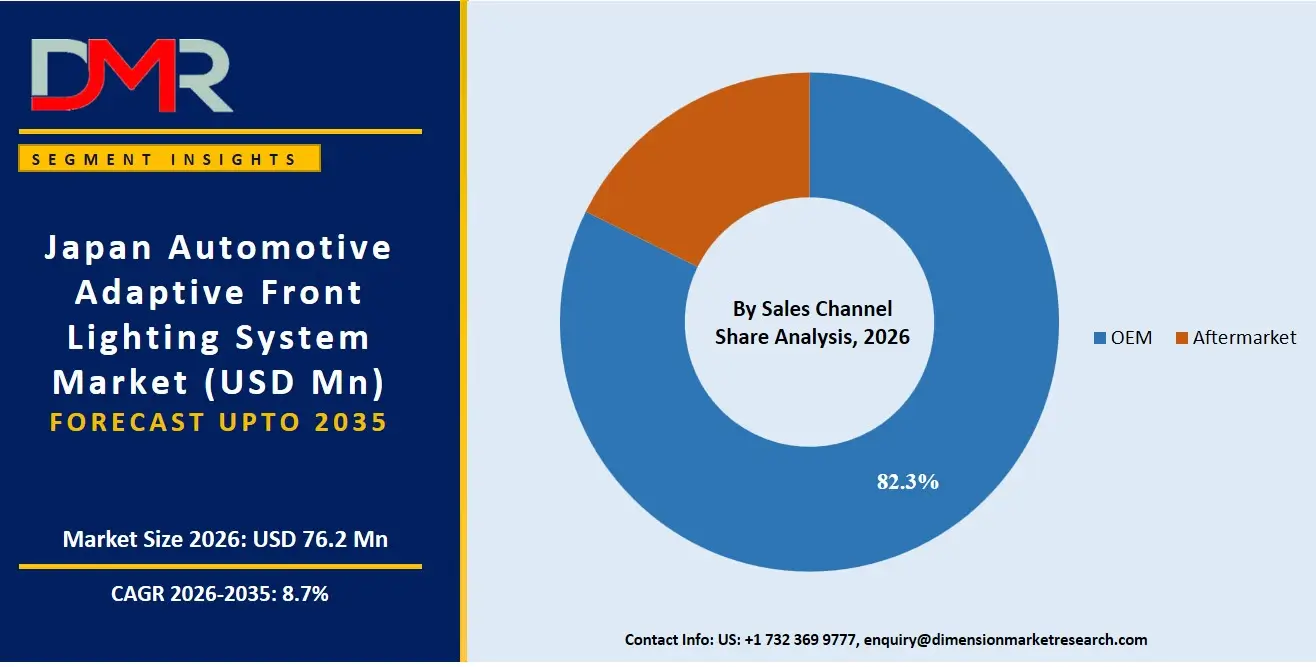
- By Sales Channel Type: OEM is expected to get the largest revenue share in 2026 in the Japan Automotive Adaptive Front Lighting System Market.
- By Technology/Light Source Type: LED segment is expected to get the largest revenue share in 2026 in the Japan Automotive Adaptive Front Lighting System Market.
What is the Japan Automotive Adaptive Front Lighting System?
An automotive adaptive front lighting system is an intelligent vehicle lighting solution that automatically adjusts the direction, range, intensity, and distribution of headlamp beams according to steering input, vehicle speed, road curvature, weather conditions, and surrounding traffic. It integrates sensors, electronic control units, actuators, and advanced lighting technologies to improve nighttime visibility, reduce glare for oncoming vehicles, enhance driver safety, and support advanced driving assistance functions.
Use Cases
- Enhanced Night-Time Highway Driving: Adaptive front lighting automatically extends illumination distance and optimizes beam patterns at higher vehicle speeds, allowing drivers to detect obstacles, pedestrians, and road signs earlier. This significantly improves visibility while minimizing glare for other road users.
- Urban and City Navigation: The system adjusts beam width and intensity in congested urban environments to improve side-road visibility, intersections, and pedestrian crossings. It enhances safety for drivers, cyclists, and pedestrians during low-speed driving.
- Adverse Weather Assistance: During rain, fog, or snowfall, adaptive lighting modifies beam distribution to reduce light reflection and improve road visibility. This helps drivers maintain clearer vision under challenging weather conditions while reducing accident risks.
- Integration with ADAS and Autonomous Functions: Adaptive lighting works alongside cameras, radar, navigation systems, and driver assistance technologies to dynamically illuminate curves, intersections, and potential hazards. This supports safer semi-autonomous driving and enhances overall vehicle intelligence.
How AI Is Transforming the Japan Automotive Adaptive Front Lighting System Market
Artificial intelligence is transforming adaptive front lighting by enabling real-time analysis of road conditions, traffic movement, pedestrian detection, weather patterns, and driving behavior. AI algorithms process sensor data from cameras, radar, and vehicle control systems to optimize beam direction and intensity while improving visibility and minimizing glare for surrounding vehicles.
AI also supports predictive lighting by integrating navigation data and vehicle intelligence to illuminate upcoming curves, intersections, and hazards before they become visible. Machine learning improves system performance through continuous optimization, enabling manufacturers to enhance energy efficiency, driving safety, product reliability, and overall customer experience while supporting future autonomous mobility applications.
Market Dynamic
Driving Factors in the Japan Automotive Adaptive Front Lighting System Market
Growing Adoption of Advanced Driver Assistance Systems (ADAS)
Increasing deployment of ADAS technologies in Japanese passenger and commercial vehicles is significantly driving demand for adaptive front lighting systems. Modern vehicles require intelligent lighting capable of interacting with cameras, radar, and vehicle control systems to improve safety and visibility. As automakers prioritize accident prevention and autonomous driving capabilities, adaptive lighting has become an essential component supporting safer nighttime and adverse-weather driving experiences.
Restraints in the Japan Automotive Adaptive Front Lighting System Market
High Development and Manufacturing Costs
Adaptive front lighting systems require sophisticated sensors, electronic controllers, precision actuators, and advanced lighting modules, resulting in higher manufacturing costs compared with conventional lighting systems. These increased costs limit adoption in entry-level vehicle segments, particularly where affordability remains a major purchasing criterion. Manufacturers must continuously balance performance improvements with cost optimization to expand market penetration.
Opportunities in the Japan Automotive Adaptive Front Lighting System Market
Expansion of Electric and Connected Vehicle Production
The rapid growth of electric and connected vehicles creates substantial opportunities for adaptive lighting manufacturers. EV platforms increasingly incorporate intelligent electronic architectures that simplify integration of digital lighting technologies. Growing investments in smart mobility, connected vehicle ecosystems, and software-defined vehicles are expected to accelerate demand for adaptive front lighting systems with advanced communication capabilities.
Trends in the Japan Automotive Adaptive Front Lighting System Market
Increasing Adoption of Matrix LED and Digital Lighting
Japanese automakers are rapidly incorporating matrix LED and digital lighting technologies that provide selective beam control without dazzling oncoming traffic. These systems independently control multiple light segments to optimize illumination while improving road safety. The transition toward software-controlled lighting is reshaping product development strategies across the automotive lighting industry.
Research Scope and Analysis
The research evaluates the Japan Automotive Adaptive Front Lighting System market across component, technology, product type, function, vehicle type, and sales channel segments. It analyzes market size, growth drivers, competitive dynamics, innovation trends, regulatory developments, demand patterns, and future opportunities influencing industry expansion and strategic decision-making through 2035.
ℹ
To learn more about this report –
Download Your Free Sample Report Here
By Component Analysis
Among components, Sensors are estimated to hold the largest market share of 39.6% in 2026 due to their essential role in collecting real-time vehicle and environmental information required for adaptive lighting operation. Cameras, radar, steering angle sensors, and speed sensors enable accurate beam adjustment under varying driving conditions.
ℹ
To learn more about this report –
Download Your Free Sample Report Here
Increasing integration of ADAS technologies further strengthens sensor demand across passenger and commercial vehicles. Meanwhile, Electronic Control Units represent the fastest-growing segment as advanced software algorithms, higher processing capability, and AI-enabled lighting management become increasingly important for supporting sophisticated adaptive illumination and future software-defined vehicle architectures.
By Technology / Light Source Analysis
LED (Light-Emitting Diode) technology is projected to account for 58.4% of the market in 2026, making it the dominant light source owing to superior energy efficiency, longer service life, compact design, and excellent compatibility with adaptive lighting functions. Japanese automakers continue replacing halogen and xenon systems with LED-based solutions across mainstream vehicle categories. Laser lighting is expected to register the fastest growth as premium vehicles increasingly adopt ultra-long-range illumination technologies that offer exceptional brightness, improved energy utilization, and enhanced support for intelligent lighting functions.
By Product Type Analysis
Adaptive Driving Beam (ADB) is expected to command 34.8% of the market in 2026, supported by rising demand for glare-free high-beam functionality and continuous visibility optimization during nighttime driving. ADB improves road safety by automatically adjusting beam distribution without requiring manual intervention from drivers. Matrix and pixel lighting systems represent the fastest-growing product segment because of their capability to independently control numerous lighting elements, providing precise illumination while supporting advanced digital lighting applications integrated with intelligent vehicle systems.
By Function Analysis
High Beam Assist / Glare-Free High Beam is anticipated to capture 31.5% market share in 2026 owing to increasing consumer preference for enhanced nighttime safety and driving convenience. Automatic beam management significantly improves visibility while preventing discomfort for oncoming traffic. Adverse Weather Lighting is forecast to experience the fastest growth as changing climate conditions and heightened safety awareness encourage manufacturers to introduce adaptive illumination capable of maintaining optimal visibility during fog, rainfall, and snow.
By Vehicle Analysis
Passenger Cars are projected to account for 67.9% of the market in 2026, supported by strong production volumes, widespread consumer demand for advanced safety technologies, and increasing installation of adaptive lighting across SUVs, luxury vehicles, sedans, and hatchbacks. Premium vehicle manufacturers continue introducing intelligent lighting as a standard safety feature. Electric Vehicles represent the fastest-growing segment as next-generation EV platforms increasingly integrate software-controlled lighting systems, digital electronics, and advanced driver assistance technologies that complement adaptive front lighting capabilities.
By Sales Channel Analysis
OEM (Original Equipment Manufacturer) is estimated to hold 82.3% of the market in 2026, reflecting the growing integration of adaptive front lighting during vehicle manufacturing rather than aftermarket installation. Factory-installed systems ensure better calibration, software compatibility, and compliance with evolving automotive safety standards. The aftermarket segment is expected to witness the fastest growth as vehicle owners seek premium lighting upgrades, replacement components, and advanced LED retrofit solutions to improve driving safety and vehicle aesthetics.
The Japan Automotive Adaptive Front Lighting System Market Report is segmented on the basis of the following:
By Component
- Electronic Control Unit (ECU)
- Sensors
- Camera
- Radar
- Steering Angle Sensor
- Speed Sensor
- Actuators / Motors
- Light Sources / Modules
By Technology / Light Source
- Halogen
- Xenon / HID (High-Intensity Discharge)
- LED (Light-Emitting Diode)
- OLED (Organic LED)
- Laser
By Product Type
- Static Adaptive Front Lighting
- Dynamic / Bending Light
- Matrix / Pixel Lighting
- Adaptive Driving Beam (ADB)
By Function
- Cornering / Curve Lighting
- High Beam Assist / Glare-Free High Beam
- Automatic Headlight Leveling
- Highway Lighting
- City Lighting
- Adverse Weather Lighting
By Vehicle Type
- Passenger Cars
- Hatchback
- Sedan
- SUV
- Luxury Vehicles
- Light Commercial Vehicles (LCV)
- Heavy Commercial Vehicles (HCV)
- Electric Vehicles (EVs)
By Sales Channel
- OEM (Original Equipment Manufacturer)
- Aftermarket
Competitive Landscape
The Japan Automotive Adaptive Front Lighting System market remains highly competitive, characterized by continuous investments in lighting innovation, semiconductor technologies, intelligent electronics, and software integration. Companies compete through product differentiation, long-term supply agreements with vehicle manufacturers, strategic research and development, manufacturing efficiency, and integration with ADAS platforms. High technological barriers, strict automotive quality standards, intellectual property portfolios, and extensive engineering expertise limit new entrants, while partnerships, digital lighting innovation, localization strategies, and next-generation AI-enabled lighting development continue strengthening competitive positioning across the industry.
Some of the prominent players in the Japan Automotive Adaptive Front Lighting System are:
- Koito Manufacturing Co., Ltd.
- Stanley Electric Co., Ltd.
- Marelli Holdings Co., Ltd.
- Denso Corporation
- Valeo
- Forvia Hella
- ams-OSRAM
- ZKW Group
- SL Corporation
- Hyundai Mobis
- Continental AG
- Bosch
- Renesas Electronics Corporation
- Infineon Technologies
- NXP Semiconductors
- Texas Instruments
- Analog Devices
- Lumileds
- Nichia Corporation
- ROHM Co., Ltd.
- Other Key Players
Recent Developments
- In October 2025, Marelli Holdings Co., Ltd. announced a strategic partnership focused on accelerating the development of intelligent automotive lighting technologies integrated with advanced driver assistance systems. The collaboration emphasizes digital lighting software, adaptive beam control, AI-assisted lighting algorithms, and enhanced vehicle connectivity. The partnership aims to develop scalable lighting platforms suitable for passenger cars and electric vehicles while improving system efficiency and reducing development timelines. The agreement supports growing industry demand for integrated safety technologies and strengthens Marelli's competitive position within intelligent automotive lighting solutions.
- In June 2025, Stanley Electric Co., Ltd. announced a major investment to expand production capacity for advanced automotive LED lighting components supporting adaptive front lighting systems. The investment includes manufacturing automation, digital quality inspection, semiconductor packaging improvements, and higher-capacity production lines. The expansion is intended to meet increasing demand from Japanese and international automakers developing electric vehicles and intelligent mobility platforms. The initiative also supports improved supply chain resilience, shorter production lead times, and greater manufacturing flexibility for next-generation automotive lighting products.
- In February 2025, Koito Manufacturing Co., Ltd. introduced an advanced intelligent automotive lighting platform designed to improve compatibility with next-generation ADAS and software-defined vehicles. The new solution incorporates enhanced matrix LED control, higher-resolution beam management, faster electronic processing, and improved energy efficiency. The platform enables more precise adaptive lighting performance under varying traffic and weather conditions while supporting future autonomous driving applications. The development strengthens Koito's position in advanced automotive lighting technology and expands its collaboration opportunities with domestic and global vehicle manufacturers.
Report Details
| Report Characteristics |
| Market Size (2026) |
USD 76.2 Mn |
| Forecast Value (2035) |
USD 161.7 Mn |
| CAGR (2026–2035) |
8.7% |
| Historical Period |
2021 – 2025 |
| Forecast Period |
2027 – 2035 |
| Base Year |
2025 |
| Estimate Year |
2026 |
| Segments Covered |
By Component, By Technology / Light Source, By Product Type, By Function, By Vehicle Type, By Sales Channel |
| Country Coverage |
Japan |
Frequently Asked Questions
How big is the Japan Automotive Adaptive Front Lighting System Market?
▾ The Japan Automotive Adaptive Front Lighting System Market size is expected to reach USD 76.2 million by 2026 and is projected to reach USD 161.7 million by the end of 2035.
What is the CAGR of the Japan Automotive Adaptive Front Lighting System Market from 2026 to 2035?
▾ The market is growing at a CAGR of 8.7 percent over the forecasted period.
What factors are driving the growth of the Japan Automotive Adaptive Front Lighting System Market?
▾ Growing Adoption of Advanced Driver Assistance Systems (ADAS), and more are the factors driving the growth of the Japan Automotive Adaptive Front Lighting System Market.
What are the major trends in the Japan Automotive Adaptive Front Lighting System Market?
▾ Increasing Adoption of Matrix LED and Digital Lighting, and more are some of the major trends in the market.
Who are the key players in the Japan Automotive Adaptive Front Lighting System Market?
▾ Some of the key players in the Japan Automotive Adaptive Front Lighting System Market include Valeo, NXP, Bosch, and more.
How is the Japan Automotive Adaptive Front Lighting System Market segmented?
▾ The Japan Automotive Adaptive Front Lighting System Market is segmented by component, technology / light source, product type, function, vehicle type, sales channel.