Japan Autonomous Maintenance Service Market Snapshot
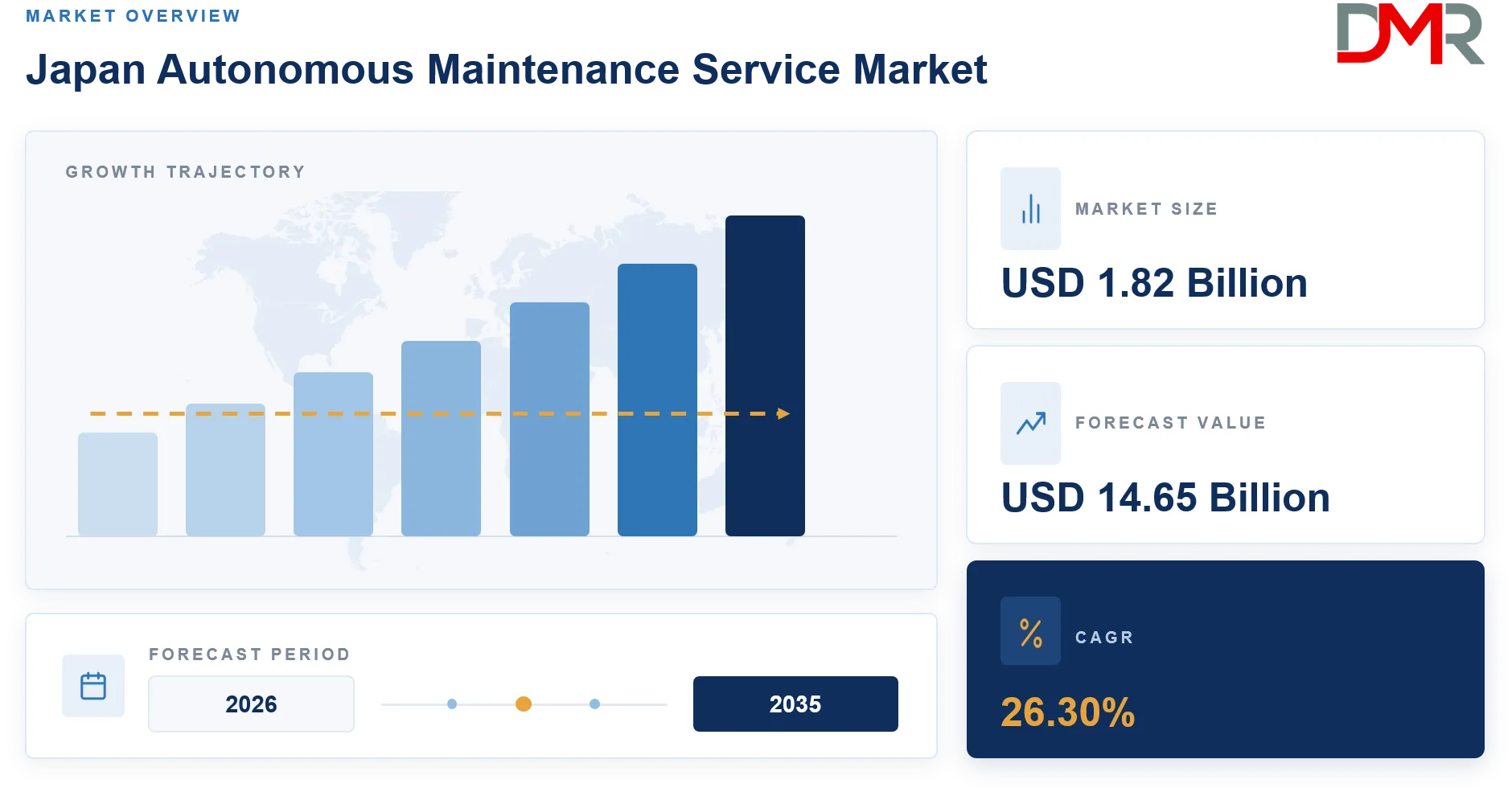
- Market Value: Japan Autonomous Maintenance Service Market is valued at USD 1.82 billion in 2026 and is expected to reach USD 14.65 billion by 2035.
- CAGR: Japan Autonomous Maintenance Service Market is expected to grow at a CAGR of 26.3% from 2026 to 2035.
- By Service Type Analysis: Predictive Maintenance Services led the service type segment with a 34.0% share in 2026.
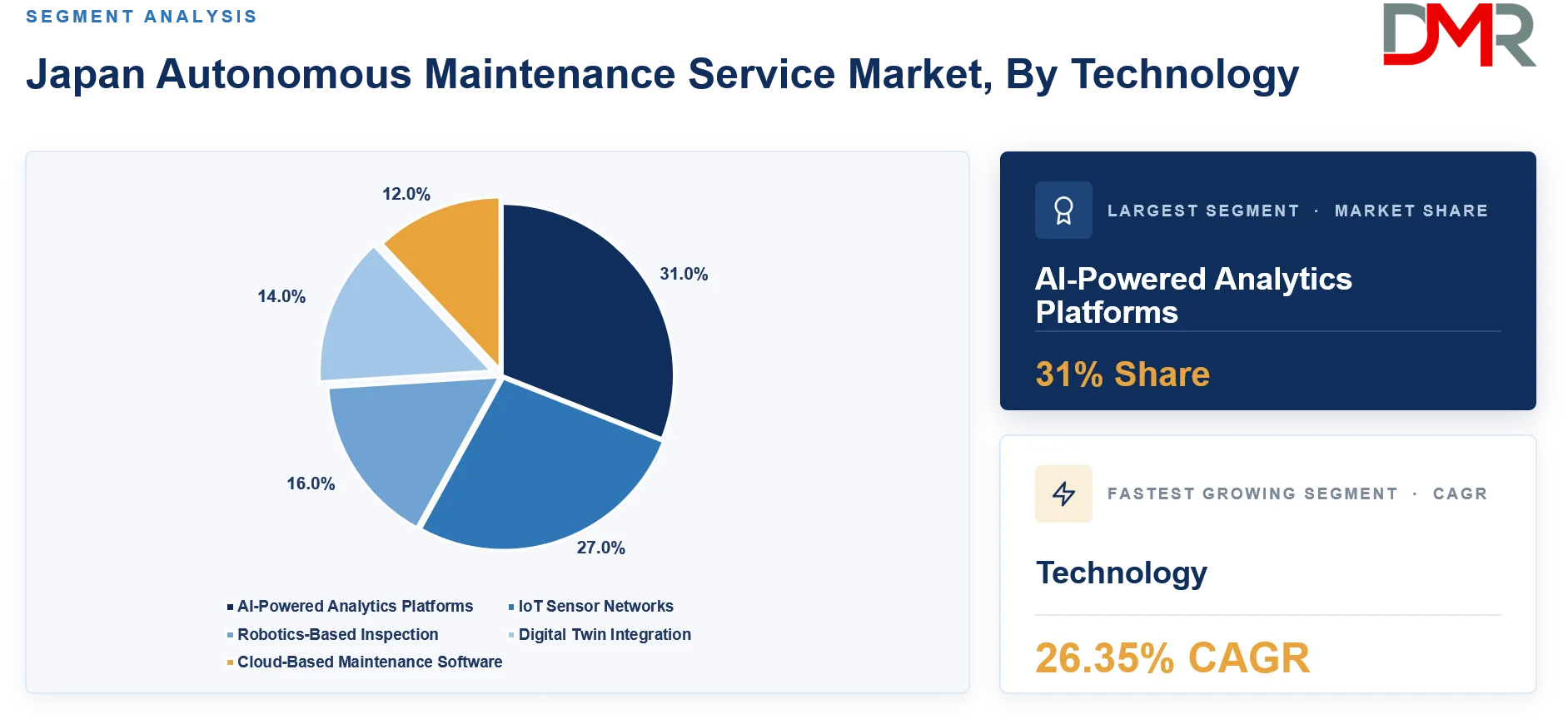
- By Technology Analysis: AI-Powered Analytics Platforms led the technology segment with a 31.0% share in 2026.
- By End-User Industry Analysis: Automotive Manufacturing held a 24.0% share in 2026.
- By Deployment Model Analysis: Hybrid Deployment Models accounted for a 42.0% share in 2026.
- Major Players: Sony AI, Toshiba Digital Solutions Corporation, Hitachi Vantara, NEC Corporation, and Others.
What is the Japan Autonomous Maintenance Service Market and its Market Size?
The Japan Autonomous Maintenance Service Market size is projected to be valued at USD 1.82 billion in 2026 and is projected to reach USD 14.65 billion by 2035, expanding at a CAGR of 26.3% during the forecast period. Autonomous maintenance services combine operator-led equipment care with predictive analytics, condition monitoring, industrial IoT, automated inspection, remote diagnostics, digital twins, and asset performance management. Japan has a strong foundation for adoption because autonomous maintenance originated as a central practice within Total Productive Maintenance, or TPM, developed by the Japan Institute of Plant Maintenance. The modern market extends this practice beyond routine cleaning, lubrication, and inspection by connecting machines, sensors, maintenance software, and industrial specialists in continuous equipment health management.
ℹ
To learn more about this report –
Download Your Free Sample Report Here
Demand is shifting from fixed maintenance schedules toward condition-based and predictive service models that identify deterioration before failure interrupts production. This shift is particularly relevant to automotive, semiconductor, industrial machinery, utilities, logistics, and food processing businesses where a single equipment interruption can affect production schedules, quality, energy consumption, and delivery commitments. Japan's mature manufacturing base, aging skilled workforce, high automation intensity, and focus on operational reliability are supporting autonomous maintenance service market growth.
Use Cases
- Predictive Equipment Health Monitoring: Manufacturers connect vibration, temperature, sound, current, pressure, and operating data to analytics platforms that detect abnormal behavior before breakdown. Maintenance teams can prioritize machines according to actual equipment condition instead of relying only on fixed service intervals, helping reduce emergency interventions and improve production availability.
- Autonomous Visual Inspection: Cameras, machine vision, mobile robots, and analytics software automate routine inspection of production assets, electrical equipment, pipes, gauges, and difficult-to-access areas. The approach supports factories with limited maintenance labor while creating repeatable inspection records that can be compared over time to detect leakage, wear, corrosion, thermal anomalies, or operating deviations.
- Remote Maintenance Operations: Industrial companies use secure connectivity, cloud platforms, and remote monitoring services to allow maintenance specialists to evaluate machines without being continuously present at each facility. This model is useful for distributed factories, warehouses, utilities, and infrastructure assets because engineering expertise can be shared across multiple locations while local teams receive faster diagnostic support.
- Automated Maintenance Scheduling: Equipment condition data can be connected with maintenance management systems to trigger work orders when predefined risk or deterioration thresholds are reached. Factories can coordinate maintenance with production schedules, spare-parts availability, technician capacity, and equipment criticality, reducing unnecessary service activities while improving planning for high-risk assets.
- Asset Lifecycle Optimization: Autonomous maintenance services combine operating history, failure records, inspection results, energy data, and component condition to support repair, overhaul, replacement, and capital investment decisions. Management teams gain better visibility into asset health and can compare the economic value of extending equipment life against replacing aging machinery with more efficient production assets.
How AI/Gen AI is Transforming the Japan Autonomous Maintenance Service Market?
AI is moving Japan's autonomous maintenance model from operator observation toward continuous machine-assisted diagnosis. Algorithms can process vibration, acoustic, electrical, temperature, image, and operating data to identify patterns that are difficult to detect through periodic inspection alone. Japanese manufacturers are increasingly applying these capabilities to machine tools, motors, production lines, semiconductor equipment, utilities, and automated material-handling systems. AI-powered analytics platforms accounted for 31.0% of the technology segment in 2026, equal to an estimated USD 564.2 million based on the total market value. Their leading position reflects demand for earlier fault detection, remaining-life estimation, anomaly classification, and maintenance prioritization.
Generative AI adds another layer by making technical knowledge easier to access across plant operations. Maintenance personnel can use natural-language interfaces to retrieve manuals, interpret alarms, summarize inspection records, compare historical incidents, and generate service instructions based on approved enterprise information. Combined with digital twins and IoT sensor networks, these systems can provide engineers with contextual recommendations instead of isolated equipment alerts. The strongest enterprise use cases are likely to remain human-supervised because safety, production quality, warranty requirements, and equipment-specific engineering rules require validation before a maintenance action is executed.
Key Drivers in the Japan Autonomous Maintenance Service Market
Shortage of Skilled Maintenance Personnel
Japan's shrinking working-age population is increasing pressure on manufacturers to preserve technical knowledge while operating highly automated production assets. Equipment diagnosis has traditionally depended on experienced technicians who recognize abnormal sound, vibration, heat, or product behavior. Autonomous monitoring platforms help convert this knowledge into measurable rules and data models. Remote diagnostics, automated inspection, and condition-based alerts allow smaller maintenance teams to supervise more equipment and concentrate specialist labor on faults that require engineering intervention.
Transition from Time-Based to Predictive Maintenance
Industrial operators increasingly want to service equipment when its actual condition indicates deterioration rather than replacing components only at fixed intervals. Predictive maintenance services represented 34.0% of the Japan market in 2026, corresponding to about USD 618.8 million. Sensors and analytics can identify abnormal vibration, temperature, acoustic behavior, current consumption, or process performance before a critical failure occurs. This helps automotive, machinery, electronics, and utility operators protect throughput while reducing unnecessary inspections and premature component replacement.
Restraints in the Japan Autonomous Maintenance Service Market
Integration with Legacy Industrial Equipment
Many Japanese production sites operate equipment installed across different investment cycles, resulting in mixed communication protocols, proprietary controllers, analog instruments, and machines with limited sensor interfaces. Connecting these assets to modern maintenance platforms can require gateways, additional sensors, edge computers, custom engineering, and historical data preparation. Integration costs can weaken the business case at smaller facilities, particularly when equipment failure patterns are rare or production assets have limited remaining service life.
Cybersecurity and Industrial Data Governance
Remote monitoring expands the flow of operational technology data between production assets, edge devices, corporate networks, cloud platforms, and external service providers. Manufacturers must protect equipment controls, process recipes, production information, and maintenance credentials from unauthorized access. Companies in critical infrastructure and high-value manufacturing may therefore restrict external connectivity or require private and hybrid architectures. These requirements lengthen deployment cycles and increase demand for secure access controls, network segmentation, audit trails, and locally managed data environments.
Growth Opportunities in the Japan Autonomous Maintenance Service Market
Brownfield Factory Modernization
Japan offers a significant opportunity for maintenance providers that can modernize existing machinery without forcing customers to replace complete production systems. Wireless sensors, edge analytics, machine vision, and retrofit monitoring devices can add condition intelligence to motors, pumps, machine tools, compressors, conveyors, and production cells. Service providers that combine hardware installation, data engineering, fault-model development, remote monitoring, and maintenance consulting can address factories that need measurable reliability improvements while preserving established equipment investments.
Digital Twin and Lifecycle Service Expansion
Digital twin integration creates opportunities to move autonomous maintenance from fault detection into lifecycle optimization. A digital representation of equipment can combine engineering specifications with operating conditions, inspection history, maintenance records, and predicted deterioration. Providers can use these models to support service intervals, replacement planning, production simulations, energy optimization, and spare-parts decisions. The approach creates recurring service revenue because models must be maintained as operating conditions, components, production processes, and asset configurations change.
Trends in the Japan Autonomous Maintenance Service Market
Growth of Edge-Based Equipment Intelligence
Industrial maintenance systems are moving more analytics closer to machines so abnormalities can be detected without sending every high-frequency data stream to a remote cloud. Edge processing is well suited to vibration, acoustic, vision, and machine-cycle analysis where fast response and large data volumes are important. It can also support factories with strict data-control requirements. Japan's automation suppliers are integrating analytics with controllers, sensors, gateways, and machine-level systems, creating a more distributed architecture for predictive maintenance and equipment health monitoring.
Convergence of Operator-Led TPM and Digital Maintenance
Autonomous maintenance in Japan is evolving rather than replacing its TPM foundation. Operators continue to play an important role in cleaning, lubrication, inspection, abnormality detection, and workplace improvement, while digital tools provide additional evidence about equipment condition. Connected checklists, mobile inspection records, sensor alerts, machine vision, and analytics make abnormalities easier to document and escalate. This convergence creates a practical model in which automated systems continuously screen assets while operators and specialists validate conditions and perform corrective work.
Research Scope and Analysis
The Japan Autonomous Maintenance Service Market is segmented based on service type, technology, deployment model, enterprise size, end-user industry, application, and other relevant categories. The study evaluates adoption patterns, service demand, technology integration, operating models, equipment reliability requirements, industry applications, and the contribution of individual segments to overall market growth.
ℹ
To learn more about this report –
Download Your Free Sample Report Here
By Service Type
Predictive Maintenance Services dominated the service type segment with a 34.0% share in 2026, representing approximately USD 618.8 million of the USD 1.82 billion market. The segment benefits from Japan's large installed base of automated manufacturing equipment and the high operational cost associated with unexpected production stoppages. Predictive services combine sensor data, condition monitoring, anomaly detection, equipment history, and failure models to identify developing faults before functional failure. Automotive plants, electronics factories, machinery producers, utilities, and processing facilities are key users because their production assets operate in interconnected processes where one machine can restrict an entire line. Adoption is also creating demand for continuous monitoring contracts and specialist diagnostic services.
By Technology
AI-Powered Analytics Platforms held the largest technology share at 31.0% in 2026, equivalent to around USD 564.2 million. The platforms analyze high-volume equipment signals and convert them into anomaly scores, failure indications, health indexes, and maintenance recommendations. Their position is supported by increasing use of vibration monitoring, acoustic analysis, image recognition, controller data, and industrial IoT connectivity. AI platforms are becoming more valuable as manufacturers move from isolated proof-of-concept projects to multi-asset monitoring. Integration with digital twins, cloud software, edge computing, and enterprise maintenance systems allows users to connect equipment condition with work orders, spare parts, production schedules, and lifecycle planning.
By Deployment Model
Hybrid Deployment Models accounted for 42.0% of the market in 2026, representing approximately USD 764.4 million. Hybrid architecture fits Japan's industrial environment because factories can keep sensitive production data, machine control functions, and low-latency analytics on-site while using cloud services for fleet-level analysis, reporting, model updates, and remote specialist access. The model is particularly relevant to large manufacturers operating several plants with different generations of equipment. Hybrid deployments also give enterprises greater flexibility when cybersecurity policies limit direct cloud connectivity from operational technology networks.
By End-User Industry
Automotive Manufacturing captured 24.0% of the market in 2026, equivalent to approximately USD 436.8 million. Automotive plants operate tightly synchronized welding, machining, painting, assembly, material-handling, and quality-control equipment where unplanned downtime can affect multiple downstream processes. Autonomous maintenance services help monitor motors, robots, bearings, pumps, machine tools, conveyors, and production utilities. Japan's automotive ecosystem also has a long history of TPM, kaizen, equipment ownership, and continuous improvement, which creates a strong organizational foundation for combining operator-led maintenance with sensor-based diagnostics and automated condition monitoring.
The Japan Autonomous Maintenance Service Market Report is Segmented on the Basis of the Following:
By Service Type
- Predictive Maintenance Services
- Preventive Maintenance Services
- Corrective Maintenance Services
- Remote Monitoring Services
- Autonomous Inspection Services
By Technology
- AI-Powered Analytics Platforms
- IoT Sensor Networks
- Robotics-Based Inspection
- Digital Twin Integration
- Cloud-Based Maintenance Software
By Deployment Model
- Cloud-Deployed Solutions
- On-Premises Systems
- Hybrid Deployment Models
By Enterprise Size
- Large Industrial Enterprises
- Medium-Sized Manufacturers
- Small Business Operators
By End-User Industry
- Automotive Manufacturing
- Electronics & Semiconductor
- Industrial Machinery
- Energy & Utilities
- Healthcare Facilities
- Logistics & Warehousing
- Food & Beverage Processing
By Application
- Equipment Health Monitoring
- Fault Detection Systems
- Automated Scheduling Tools
- Asset Performance Management
- Condition-Based Maintenance
- Lifecycle Optimization Services
- Safety Compliance Monitoring
Competitive Landscape
The Japan Autonomous Maintenance Service Market has a diverse competitive landscape that includes industrial automation manufacturers, enterprise IT companies, engineering service providers, AI developers, remote connectivity specialists, equipment-monitoring companies, and maintenance organizations. Mitsubishi Electric, Omron, Yokogawa Electric, Toshiba Digital Solutions, NEC, Fujitsu, Hitachi Vantara, NTT Data, Panasonic, and Sony AI bring combinations of industrial systems, analytics, connectivity, software, and enterprise technology. Engineering-oriented participants such as Asahi Kasei Engineering and Chiyoda add plant-level implementation capabilities, while specialist providers address condition monitoring, secure remote access, inspection, and maintenance operations.
Competitive differentiation increasingly depends on the ability to connect legacy equipment, analyze multiple sensor types, deploy models securely at the edge, integrate with existing maintenance workflows, and demonstrate measurable improvements in equipment availability. Providers that combine technology with domain expertise and long-term monitoring services are better positioned to capture recurring revenue as industrial customers scale deployments from individual machines to plant-wide asset portfolios.
Some of the prominent players in the Japan Autonomous Maintenance Service Industry are:
- Sony AI
- Toshiba Digital Solutions Corporation
- Hitachi Vantara
- NEC Corporation
- Mitsubishi Electric Corporation
- Fujitsu Limited
- Omron Corporation
- Yokogawa Electric Corporation
- NTT Data
- Panasonic Corporation
- Chiyoda Corp
- Mitsui Knowledge Industry
- ITOKI Corporation
- Secomea
- ONYX Insight
- Asahi Kasei Engineering
- SANKI SERVICE CORP.
- BPM株式会社
- Toyo Denki Seizo K.K.
- Japan Institute of Plant Maintenance
- Others
Technology Analysis
Japan's autonomous maintenance service market is moving toward integrated technology stacks that combine AI-powered analytics, IoT sensor networks, edge computing, machine vision, digital twins, and cloud-based maintenance software. AI-Powered Analytics Platforms led the technology segment with a 31.0% share in 2026, equal to about USD 564.2 million of the total market. Their lead reflects demand for anomaly detection, failure prediction, remaining-useful-life estimation, and automated maintenance prioritization across automotive, electronics, machinery, utilities, and logistics operations. IoT sensors provide the continuous vibration, temperature, acoustic, pressure, and electrical data needed to support these models, while edge devices reduce latency and help plants retain sensitive operational data on-site. Robotics-based inspection and digital twin integration are expanding where assets are difficult to access or require continuous condition visibility. Hybrid architectures are gaining importance because they allow manufacturers to combine local processing and control with cloud-scale analytics, remote support, and multi-site asset benchmarking.
Investment and White Space Analysis
Investment in Japan's autonomous maintenance service market is concentrating on brownfield modernization, predictive analytics, secure industrial connectivity, and service models that reduce dependence on scarce maintenance specialists. The largest white-space opportunity lies among medium-sized manufacturers and multi-site industrial operators that have valuable legacy equipment but limited internal resources to build AI, IoT, and condition-monitoring systems from scratch. Providers can create recurring revenue through sensor retrofits, managed monitoring, remote diagnostics, model maintenance, and outcome-based service contracts rather than one-time software deployments. Investment potential also exists in automotive suppliers, semiconductor facilities, logistics hubs, utilities, and food processing plants where uptime and compliance are operational priorities. Vendors that integrate heterogeneous PLCs, machines, sensors, and maintenance records without forcing major equipment replacement are well positioned. Partnerships among automation firms, IT integrators, engineering companies, and maintenance specialists can address cybersecurity, implementation, and workforce training gaps.
Recent Developments
- May 2026: Chiyoda Corporation entered a strategic partnership with Novity to deploy an integrated AI predictive-maintenance and plant-operations platform in Japan, targeting LNG, refinery, chemical, power and infrastructure facilities.
- January 2026: ITOKI Corporation launched ITOKI Advanced Maintenance, combining AI anomaly detection with remote support for automated warehouses, enabling earlier fault detection, planned servicing and reduced shutdown risk.
- December 2025: Hitachi Industrial Equipment Systems launched a generative-AI maintenance agent using FitLive equipment data, manuals and engineer expertise to give operators real-time troubleshooting guidance for connected industrial equipment.
Report Details
| Report Characteristics |
| Market Size (2026) |
USD 1.82 Bn |
| Forecast Value (2035) |
USD 14.65 Bn |
| CAGR (2026-2035) |
26.3% |
| Historical Data |
2021 - 2025 |
| Forecast Data |
2027 - 2035 |
| Base Year |
2025 |
| Estimate Year |
2026 |
| Segments Covered |
By Service Type (Predictive Maintenance Services, Preventive Maintenance Services, Corrective Maintenance Services, Remote Monitoring Services, and Autonomous Inspection Services), By Technology (AI-Powered Analytics Platforms, IoT Sensor Networks, Robotics-Based Inspection, Digital Twin Integration, and Cloud-Based Maintenance Software), By Deployment Model (Cloud-Deployed Solutions, On-Premises Systems, and Hybrid Deployment Models), By Enterprise Size (Large Industrial Enterprises, Medium-Sized Manufacturers, and Small Business Operators), By End-User Industry (Automotive Manufacturing, Electronics & Semiconductor, Industrial Machinery, Energy & Utilities, Healthcare Facilities, Logistics & Warehousing, and Food & Beverage Processing), By Application (Equipment Health Monitoring, Fault Detection Systems, Automated Scheduling Tools, Asset Performance Management, Condition-Based Maintenance, Lifecycle Optimization Services, and Safety Compliance Monitoring) |
| Regional Coverage |
Japan |
Frequently Asked Questions
What is the current size of the Japan Autonomous Maintenance Service Market?
▾ The Japan Autonomous Maintenance Service Market size is USD 1.82 billion in 2026, reaching USD 14.65 billion by 2035.
What is the growth rate of the Japan Autonomous Maintenance Service Market during?
▾ The Japan Autonomous Maintenance Service Market is projected to grow at a 26.3% CAGR from 2026 through 2035.
What factors are driving the growth of the Japan Autonomous Maintenance Service Market?
▾ Japan Autonomous Maintenance Service Market growth is driven by labor shortages, IoT adoption, and predictive tools.
What are the major challenges restraining the Japan Autonomous Maintenance Service Market?
▾ High integration costs, legacy equipment, cybersecurity risks, and skills gaps restrain Japan market expansion.
Which segment holds the largest share of the Japan Autonomous Maintenance Service Market?
▾ Predictive Maintenance Services lead the Japan Autonomous Maintenance Service Market with a 34.0% share in 2026.
Who are the leading companies in the global Japan Autonomous Maintenance Service Market?
▾ Sony AI, Toshiba Digital Solutions Corporation, Hitachi Vantara, NEC Corporation, Mitsubishi Electric Corporation, Fujitsu Limited, Omron Corporation, Yokogawa Electric Corporation, NTT Data, Panasonic Corporation, Chiyoda Corp, Mitsui Knowledge Industry, ITOKI Corporation, Secomea, ONYX Insight, Asahi Kasei Engineering, SANKI SERVICE CORP., BPM????, Toyo Denki Seizo K.K., and Japan Institute of Plant Maintenance are leading participants in the Japan Autonomous Maintenance Service Market.
How is AI influencing the Japan Autonomous Maintenance Service Market?
▾ AI is advancing Japan Autonomous Maintenance Service Market through anomaly detection and predictive diagnostics.
What are the future opportunities and trends in the Japan Autonomous Maintenance Service Market?
▾ Digital twins, edge analytics, brownfield upgrades, and remote monitoring offer strong Japan market opportunities.