What is the Japan Backpack Market Size ?
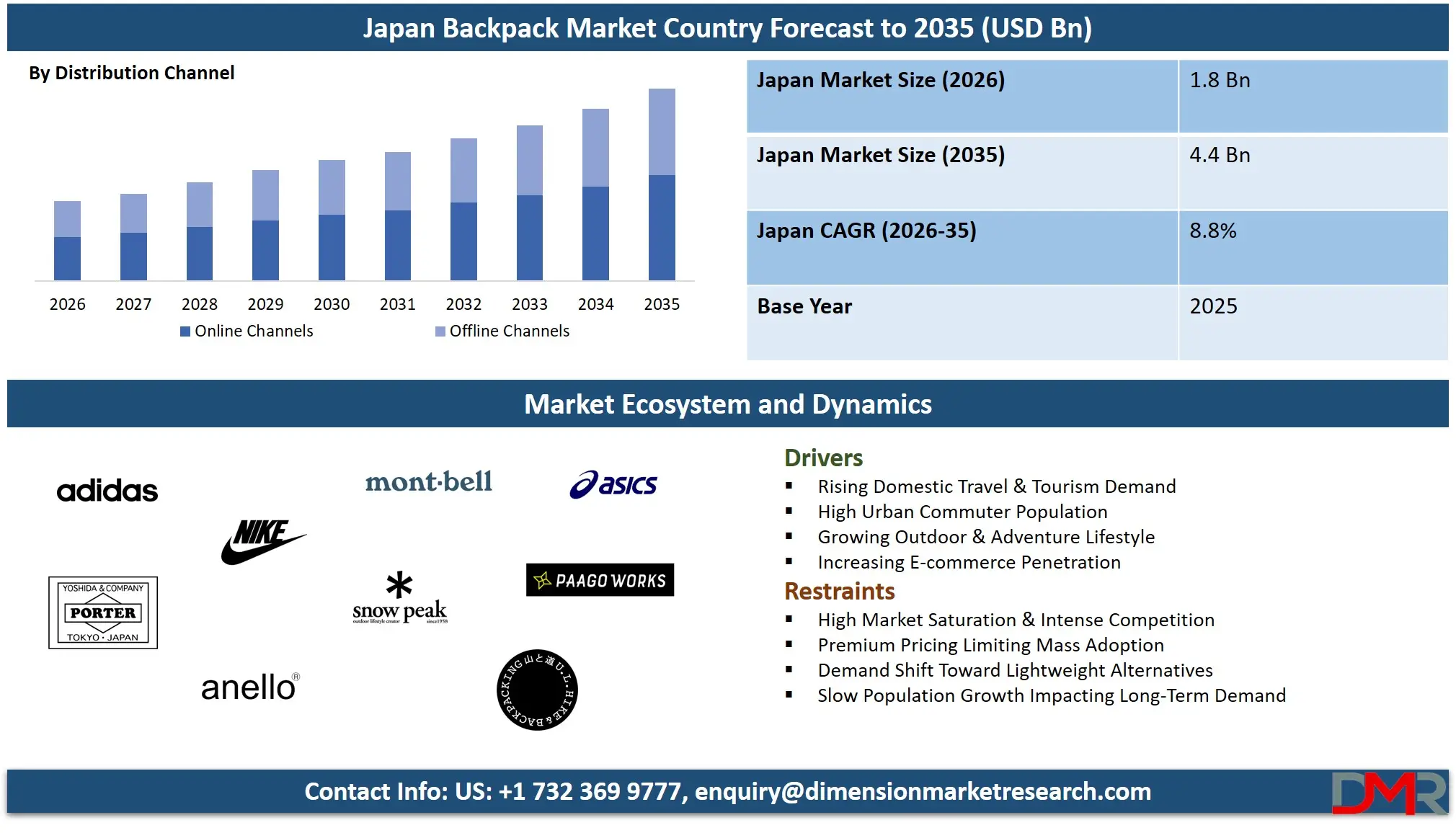
The Japan Backpack Market size is projected to reach USD 1.8 billion in 2026 and grow at a compound annual growth rate of 8.8%, reaching USD 4.4 billion by 2035, driven by rising demand for travel, commuter, and outdoor backpacks, growing e-commerce sales, and strong preference for durable nylon and lightweight backpacks.
ℹ
To learn more about this report –
Download Your Free Sample Report Here
Japan Backpack Market can be defined as the industry dealing with the manufacturing and selling of backpacks for travel, office use, educational purposes, sports, and outdoor activities in Japan. Such backpacks may include travel backpacks, office backpacks, and sports backpacks.
This industry is fueled by the significant number of urban commuters and increased demand for reliable and quality products. The growing interest in outdoor and travel activities has been fueling the demand. Moreover, this market receives support owing to its extensive e-commerce market and the availability of local and international brands of backpacks.
ℹ
To learn more about this report –
Download Your Free Sample Report Here
Key Takeaways
- Market Size: - The Japan Backpack Market is expected to be valued at USD 1.8 billion in 2026 and is projected to reach USD 4.4 billion by 2035, supported by steady demand across travel, commuter, and outdoor segments.
- Growth Rate and Outlook: - The market is expected to grow at a CAGR of 8.8% (2026–2035), driven by rising urban mobility, travel activities, and increasing preference for functional and durable backpacks.
- Primary Growth Drivers: - Growth is fueled by rising domestic and international travel demand, a large urban commuter population, and increasing adoption of lightweight and ergonomic backpack designs. Expansion of e-commerce channels and growing outdoor lifestyle trends further support market growth.
- By Product Type Analysis: - Travel bags dominate the market with around 35% share in 2026, driven by strong tourism activity and demand for spacious, durable backpacks suitable for both short and long-distance travel.
- By Material Analysis: - Nylon leads the material segment with about 40% share in 2026, due to its durability, lightweight nature, and water-resistant properties, making it ideal for travel, outdoor, and commuter backpacks.
- By End-Use Analysis: - The individual segment dominates with nearly 69% share in 2026, supported by high usage among students, commuters, and travelers requiring backpacks for daily personal and mobility needs.
What is the Backpack?
Backpack is a bag that can be worn with the help of two shoulder straps and which allows its wearer to move around easily with the bag. The use of the bag varies greatly; some use backpacks to carry their books, some their computers, clothes and some even use them for traveling purposes. In today's world, backpacks are available in different forms, like backpacks meant for schools, travel backpacks, backpacks meant for hiking, and even backpacks meant to carry laptops. The material used to make a backpack is usually nylon, polyester, leather, and many others, depending upon the purpose of the bag.
Use Cases
- Education & School Use: Backpacks in Japan are widely used by students for carrying books, laptops, and daily essentials. Demand for school backpacks is driven by a strong education system and preference for lightweight, durable designs.
- Corporate & Commuter Use: Work backpacks are commonly used by professionals in Japan for laptops, documents, and gadgets. Growing urban commuting boosts demand for slim, functional commuter bags with ergonomic features.
- Travel & Tourism Use: Travel backpacks are popular due to rising domestic and international travel in Japan. Consumers prefer lightweight, durable, and spacious designs for convenience during short trips and business travel.
- Outdoor & Recreational Use: Outdoor backpacks are used for hiking, camping, and sports activities. Increasing interest in adventure and fitness lifestyles drives demand for durable, water-resistant, and high-capacity backpacks.
How AI is Transforming the Japan Backpack Market
AI is changing the Japan Backpack Market because it is facilitating innovative and functional backpack designs. The AI technology is being used by manufacturers for developing backpacks that can be considered ergonomic and light. The forecasting of demand and management of inventory have become more accurate due to AI technology.
AI is helping companies to provide personalized services by offering users the backpack of their preference. In the area of retail, AI applications in e-commerce have facilitated improved recommendations for customers.
Market Dynamics
Key Drivers in the Japan Backpack Market
Rising Travel & Tourism Demand
Strong tourism activity and frequent intra-European travel are boosting demand for travel backpacks in Europe. Consumers prefer lightweight and durable backpacks for short trips, weekend travel, and cross-border mobility.
Hybrid Work Culture
The increase in hybrid working culture has increased the need for commuter backpacks in Europe. Workers want comfortable and functional backpacks that can fit laptops while carrying them.
Restraints in the Japan Backpack Market
High Market Saturation
The Europe backpack market is highly competitive with the presence of global and regional brands, leading to limited product differentiation and pressure on pricing and margins.
Price Sensitivity in Key Markets
In several European countries, consumers show strong price sensitivity, restricting the adoption of premium nylon backpacks and high-end travel backpacks despite growing demand.
Growth Opportunities in the Japan Backpack Market
Growth of E-commerce Channels
Rising online backpack sales in Europe are creating strong opportunities as consumers increasingly prefer digital platforms for convenient product comparison, variety, and doorstep delivery.
Demand for Sustainable Products
Increasing preference for eco-friendly backpacks made from recycled and sustainable materials is encouraging brands to innovate and expand green product portfolios in the European backpack market.
Trends in the Japan Backpack Market
Smart and Technology-Enabled Back Packs
The increasing popularity of intelligent back packs in Europe due to technologies such as the ability to charge via USB ports, an anti-theft system, and GPS tracking is now becoming a lifestyle trend amongst young people.
Rising Demand for Lightweight Outdoor Gear
Increasing interest in hiking, trekking, and adventure tourism is driving demand for lightweight and durable outdoor backpacks with enhanced comfort and storage efficiency.
Product Type Analysis
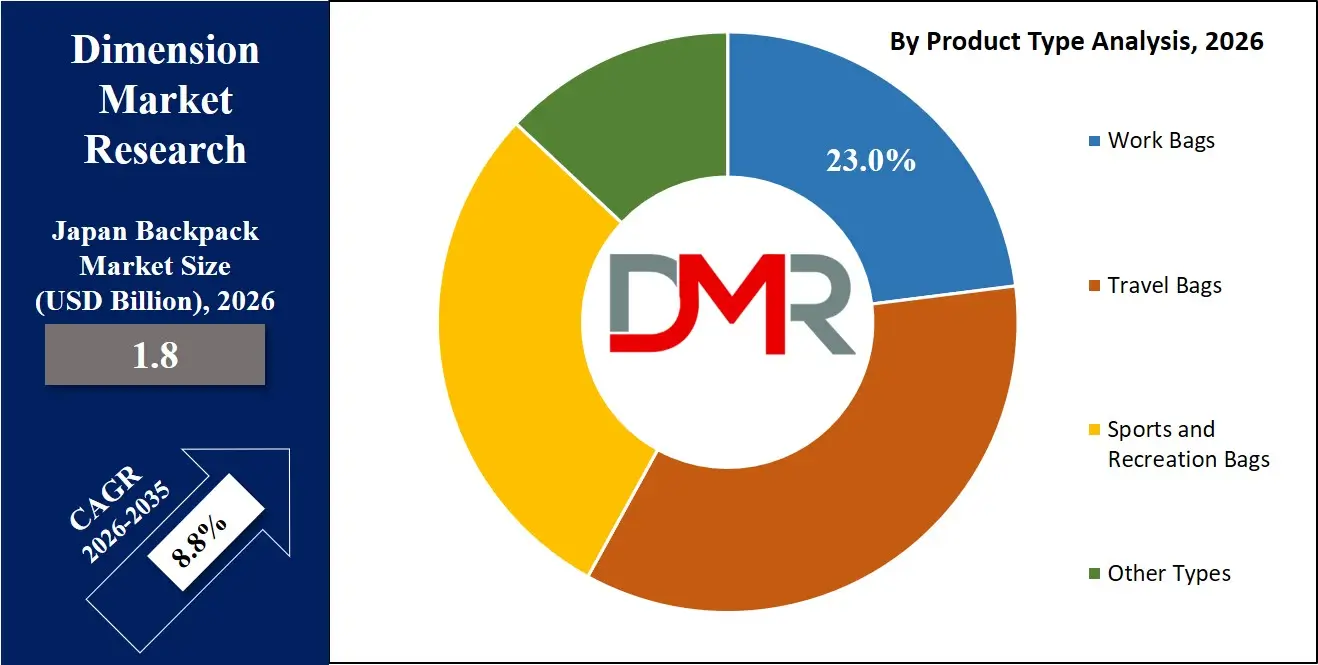
The travel bag is anticipated to dominate the Japan backpack market, contributing around 35.0% to the overall market share in 2026. This will be attributable to robust demand from the tourism industry and increasing travel needs. Travel bags are increasingly preferred due to their capacity to meet various requirements for short and long trips.
ℹ
To learn more about this report –
Download Your Free Sample Report Here
Additionally, there will be high demand for work bags. Factors such as increased employment rates in cities and increased use of laptop computers and other digital devices at work have been identified as major reasons driving the growth of the work bag segment.
Material Analysis
It is projected that nylon will have the largest market share in the materials category in the Japan backpack market at 40.0% in 2026, owing to its excellent durability, low weight, and water-resistant and wear-resistant characteristics. It is widely used in travel backpacks, outdoor backpacks, and commuter backpacks because of its long-term usability and flexibility. The polyester category will be another major player in the Japan backpack market, backed by its economy and availability in the mass-market backpack range. It is popular in school backpacks, casual backpacks, and regular backpacks since economy and durability are important considerations for them.
Distribution Channel Analysis
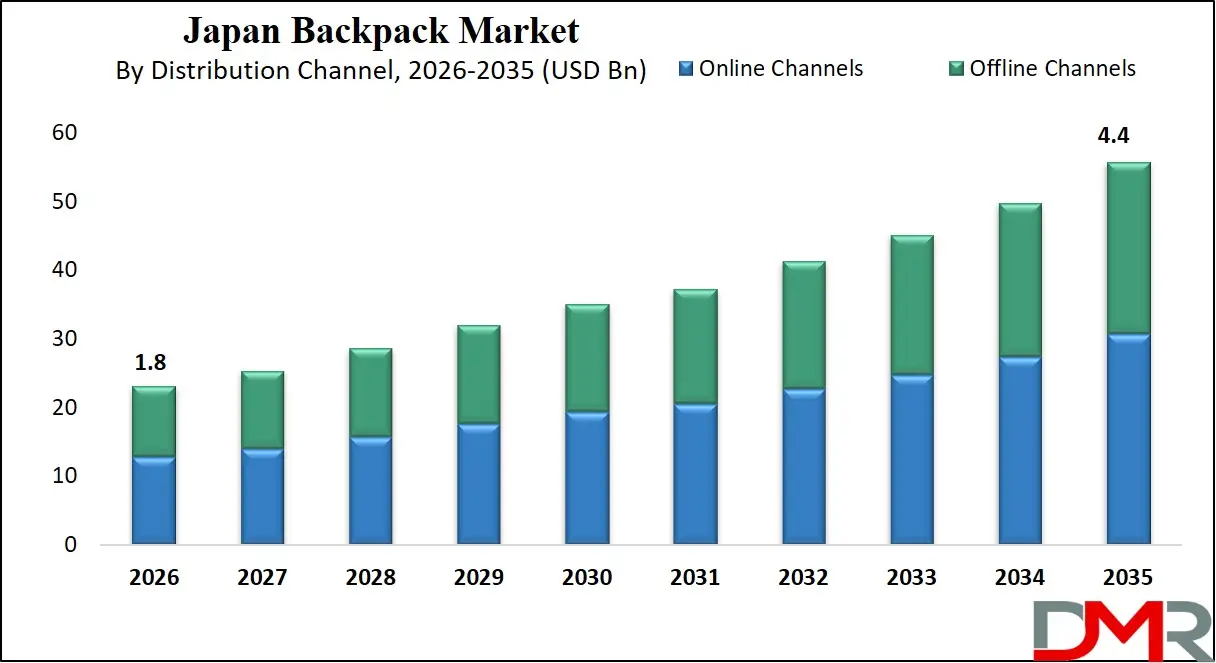
The online channel is expected to lead the distribution channel sector in the Japan backpack industry by accounting for almost 55.0% of the market share by 2026. This will be fueled by the fast expansion of the online platforms, increased product availability, and the convenience of home deliveries. People will opt for buying online because they can compare prices easily and avail discounts and a variety of brands from various backpack makers. The offline distribution channels will not lag behind, as physical shops, specialty shops, and departmental stores will help consumers judge the product quality and fitting before making any purchases.
End-Use Analysis
The individual segment will emerge as a leader among the end-use segments in the backpack market, contributing nearly 69.0% to the total market share in 2026, driven by increased adoption of backpacks by students, travelers, commuters, and people engaged in outdoor activities. This trend will be encouraged by increased adoption of backpacks by individuals in their personal lives for commuting, studying, and traveling purposes. The commercial segment will also register a decent market share, due to rising demand for backpacks by organizations such as schools, companies, and organizations to be distributed among their students and employees.
The Japan Backpack Market Report is segmented on the basis of the following:
By Product Type
- Work Bags
- Laptop Backpacks
- Messenger Bags
- Briefcases
- Professional Backpacks
- Travel Bags
- Carry-On Backpacks
- Travel Daypacks
- Wheeled Backpacks
- Backpacking Packs
- Sports and Recreation Bags
- Hiking Backpacks
- Camping Backpacks
- Gym Bags
- Fishing Backpacks
- Cycling Backpacks
- Other Types
By Material
- Nylon
- Polyester
- Cotton
- Leather
- Other Material
By Distribution Channel
- Online Channels
- E-commerce platforms
- Brand-owned websites
- Offline Channels
- Supermarkets / Hypermarkets
- Specialty Stores
- Department Stores
- Convenience Stores
- Other Retail Outlets
By End-Use
- Individual
- Commercial
- Other End-Uses
Competitive Landscape
Competitiveness in the backpack industry is very high due to the presence of numerous domestic and international manufacturers competing based on the designs and prices of their products. The main strategies that have been adopted by firms include product innovation, using lightweight material, and incorporating ergonomics. The increasing consumer preference for high-quality and multifunctional backpacks has increased rivalry within the industry.
ℹ
To learn more about this report –
Download Your Free Sample Report Here
Some of the prominent players in the Japan Backpack Market are:
- Yoshida & Co. (PORTER)
- anello
- master-piece
- Montbell
- Snow Peak
- ASICS
- Paago Works
- Yamatomichi
- Makavelic
- F/CE
- Gregory Mountain Products
- The North Face
- Osprey Packs
- Samsonite
- Nike
- Adidas
- Deuter Sports
- Kelty
- Mountain Hardwear
- WENGER
- Other Key Players
Recent Developments
- March 2026: Samsonite expanded its smart luggage and backpack portfolio with new travel backpacks featuring lightweight ergonomic designs and enhanced storage compartments targeting frequent travelers.
- January 2026: VF Corporation (owner of brands like The North Face) introduced a sustainable backpack line made from recycled nylon and polyester to meet rising eco-friendly demand.
- October 2025: Adidas acquired a small outdoor gear startup to strengthen its presence in the performance and sports backpack segment across global markets.
Report Details
| Report Characteristics |
| Market Size (2026) |
USD 1.4 Bn |
| Forecast Value (2035) |
USD 4.4 Bn |
| CAGR (2026–2035) |
8.8% |
| Historical Data |
2021 – 2025 |
| Forecast Data |
2027 – 2035 |
| Base Year |
2025 |
| Estimate Year |
2026 |
| Segments Covered |
By Product Type (Work Bags, Travel Bags, Sports and Recreation Bags, Other Types), By Material (Nylon, Polyester, Cotton, Leather, Other Material), By Distribution Channel (Online Channels, Offline Channels), By End-Use (Individual, Commercial, Other End-Uses) |
| Country Coverage |
Japan |
Frequently Asked Questions
How big is the Japan Backpack Market?
▾ The Japan Backpack Market is valued at USD 1.8 billion in 2026 and is projected to reach USD 4.4 billion by 2035, driven by strong demand from travel, commuter, school, and outdoor backpack segments supported by evolving lifestyle needs and urban mobility trends.
What is the CAGR of the Japan Backpack Market from 2026 to 2035?
▾ The market is projected to grow at a CAGR of 8.8% from 2026 to 2035, reaching USD 4.4 billion by 2035, driven by rising demand for functional, durable, and lightweight backpacks.
What factors are driving the growth of the Japan Backpack Market?
▾ Growth is driven by increasing domestic travel, a large urban commuter population, and strong demand for ergonomic and durable backpacks. Rising popularity of outdoor and recreational activities, along with expanding e-commerce channels, is further boosting market adoption. Innovation in lightweight materials and premium product designs is also supporting demand.
What are the major trends in the Japan Backpack Market?
▾ Key trends include rising demand for smart backpacks with tech features like USB charging and anti-theft systems, increasing preference for eco-friendly backpacks made from recycled materials, and strong growth in lightweight and multifunctional designs. Fashion-oriented and premium lifestyle backpacks are also gaining traction.
Who are the key players in the Japan Backpack Market?
▾ Yoshida & Co. (PORTER), anello, master-piece, Montbell, Snow Peak, ASICS, Paago Works, Yamatomichi, Makavelic, F/CE, Gregory Mountain Products, The North Face, Osprey Packs, Samsonite, Nike, Adidas, Deuter Sports, Kelty, Mountain Hardwear, and WENGER are the key players in the Japan Backpack Market.
How is the Japan Backpack Market segmented?
▾ The market is segmented by Product Type, Material, Distribution Channel, and End-Use.