Market Snapshot
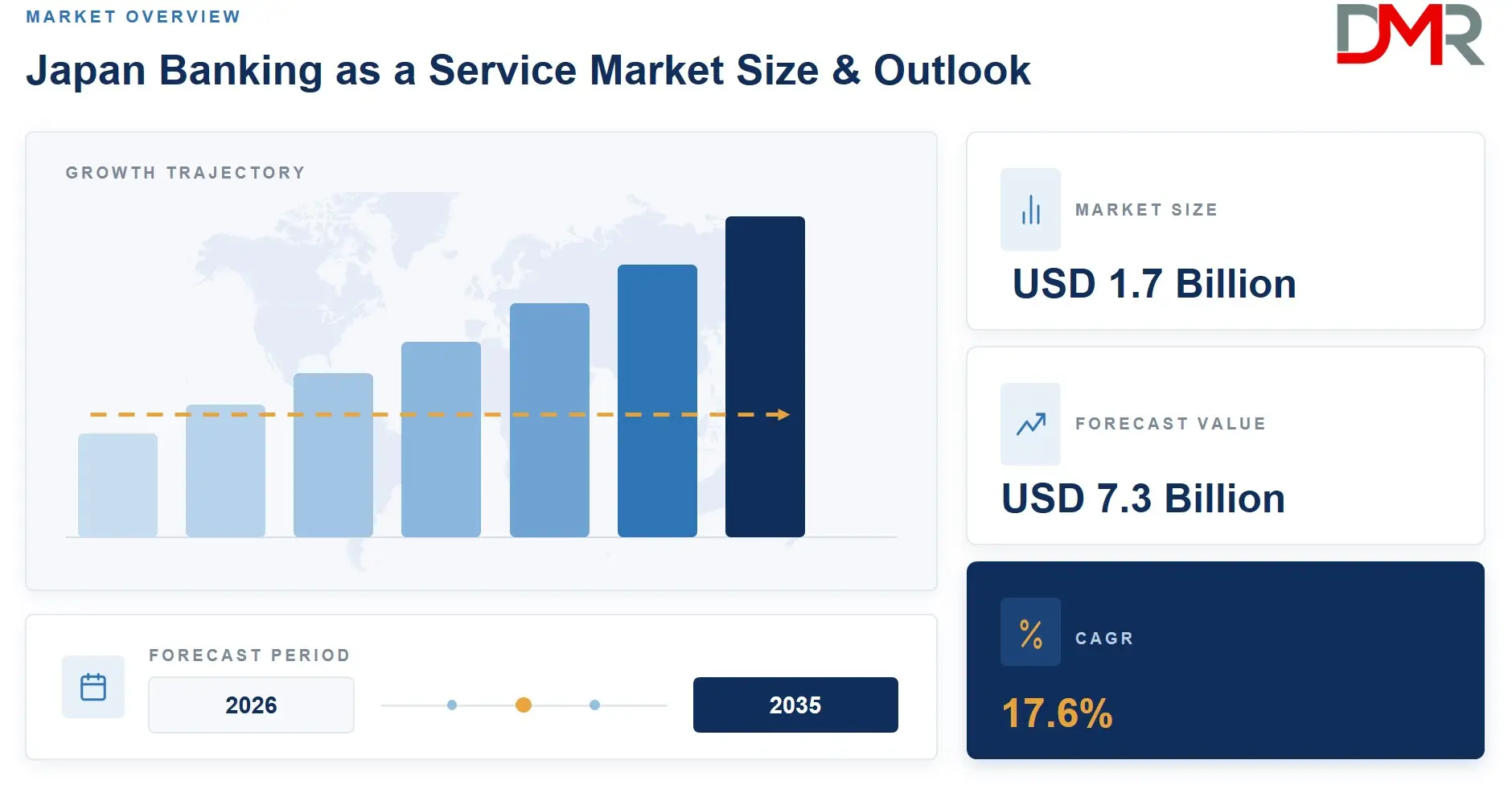
- Market Size (2026): USD 1.7 Bn
- Forecast Value (2035): USD 7.3 Bn
- CAGR (2026-2035): 17.6%
- Leading Component (2026): Platform, around 41%
- Leading Service Type (2026): Payment Processing & Card Issuing, close to 33%
- Key Players: Docomo SMTB Net Bank, GMO Aozora Net Bank, NTT DATA and others
What is Japan Banking as a Service Market and its Market Size?
The Japan Banking as a Service Market size is estimated to reach USD 1.7 Bn in 2026 and is further anticipated to reach USD 7.3 Bn by 2035, at a CAGR of 17.6%. Banking as a service describes the arrangement under which a licensed institution exposes account opening, deposit holding, payment execution, card issuance and credit origination through APIs, so that a retailer, carrier, brokerage or software vendor can put those functions inside its own product without applying for a banking licence.
ℹ
To learn more about this report –
Download Your Free Sample Report Here
Figures in this study cover revenue earned on banking capability consumed inside Japan. They do not capture the overseas revenue of Japanese institutions or the worldwide turnover of vendors headquartered in the country. Counted revenue includes platform subscription and setup fees, per-transaction infrastructure charges, licensing of core banking and middleware, managed operations, and the provider share of interchange and lending economics. Net interest income the sponsoring bank books against deposits sits outside the boundary, since it belongs to the bank's own balance sheet rather than to the service arrangement.
Two buyer groups drive spending. Distribution brands, chiefly carriers, retail chains, airlines, accounting software vendors and mobility operators, buy the capability to keep a customer inside their app when money moves. Financial institutions buy it too, as core banking abstraction and API management, because a mainframe built for branch operations cannot answer a partner request in real time. Corporate accounts have become the sharper contest.
Structurally, three changes matter. Amendments to the Banking Act created an intermediary category that lets non-banks distribute banking products under a lighter permission. Carrier and retail groups have bought or consolidated banking assets to anchor points economies. Regulatory sandbox activity has moved embedded lending and digital identity from pilot to production, shortening the path from concept to a live programme.
Use Cases
- Accounting Software Banking: Vendors serving small firms embed balance enquiry, transfers and automated journal matching inside bookkeeping software, so an owner never opens a separate banking portal. Reconciliation runs in the background, and the vendor earns fees tied to transaction volume.
- Airline and Travel Loyalty Accounts: Carriers open branded deposit and debit products that turn everyday spending into mileage, extending customer visibility well beyond flight bookings. Retention improves because the account keeps earning between trips, monetising a member base that previously paid only at purchase.
- Regional Bank Digital Spin-Offs: Prefectural institutions launch smartphone-only banks on a third party's account system rather than extending their own core, reaching younger customers outside the branch network. Build timelines fall from years to months, and the parent avoids a core replacement it cannot fund.
- Utility and Telecom Billing Wallets: Carriers and energy retailers fold prepaid balances, autopay and instalment options into the billing app, cutting collection costs on recurring invoices. Late payment falls where balances top up automatically, and the operator captures interchange on spending that previously left through a third-party card.
Key Takeaways
- Market Size & Share: Revenue expands at a CAGR of 17.6% between 2026 and 2035, well ahead of underlying banking fee income, because growth comes from new distribution rather than repricing.
- Component Analysis: Platform is projected to hold nearly 41% of 2026 revenue, while API gateway and middleware expands fastest at a CAGR of 22.8%.
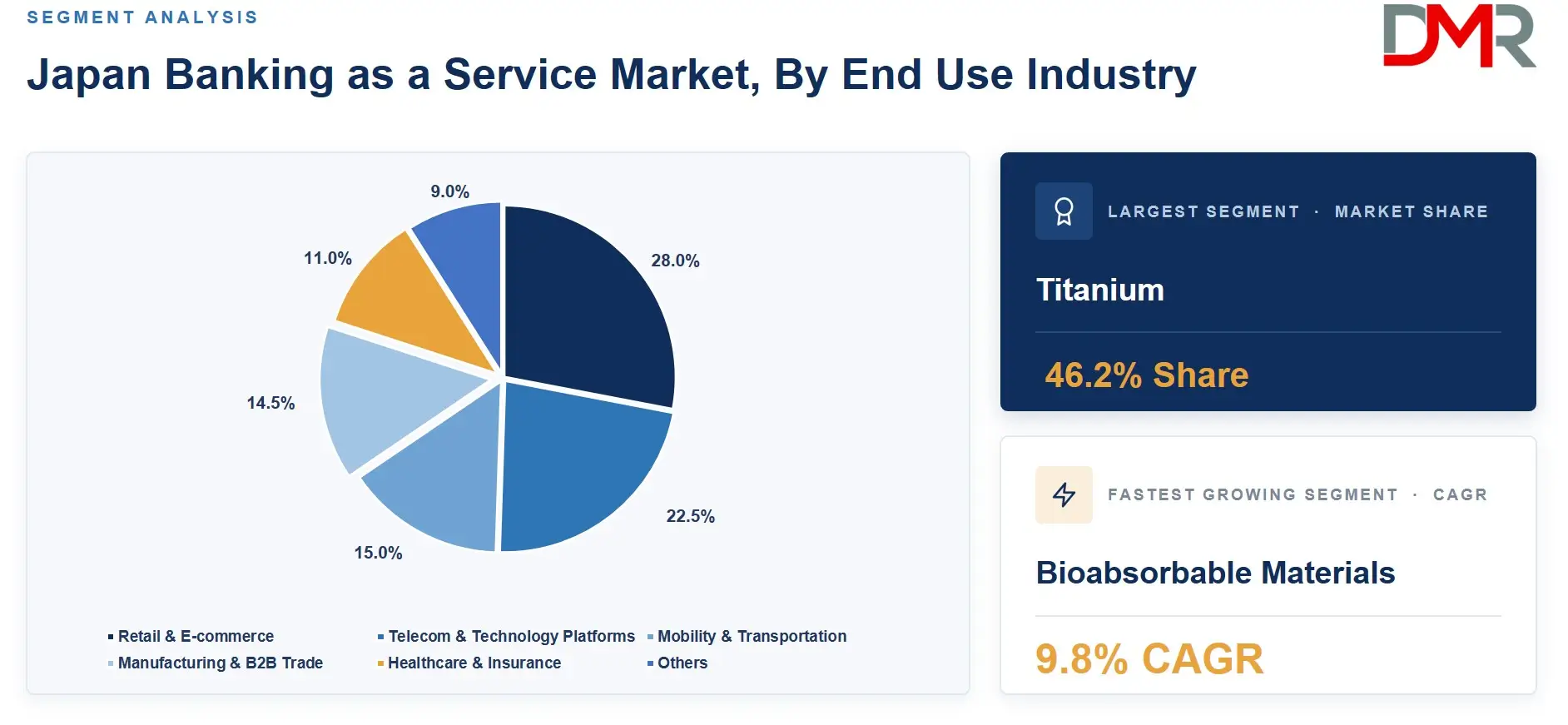
- Demand Concentration: Retail and e-commerce is set to represent approximately 28% of 2026 revenue, reflecting where large consumer audiences and points economies already sit.
- Provider Structure: Licensed banks are expected to account for roughly 44% of 2026 revenue, since the permission itself remains the scarce asset.
- Cloud Posture: Public cloud deployment is projected to carry just over 46% of 2026 revenue, led by net banks that never operated a mainframe.
- Growth Frontier: Embedded lending and credit records the steepest trajectory of any service type, at a CAGR of 23.9% through 2035, as transaction data replaces financial statements in underwriting.
How AI/Gen AI is Transforming the Japan Banking as a Service Market?
Artificial intelligence shows up in this market as an operating cost lever rather than as a product feature. Onboarding, monitoring and partner supervision are the three functions that consume compliance headcount, and each responds well to automation. Machine learning models score transaction anomalies against behavioural baselines instead of static thresholds, which reduces the alert volume a second-line team must clear before a programme can scale its account count.
Generative tooling has moved into system delivery. Core banking vendors and their bank customers apply code assistants to specification drafting, test generation and interface mapping, with delivery cycle targets set around a fifth faster than manual work. Providers are also deploying agent-based interfaces for corporate clients covering cash flow projection and document preparation. One limit binds: models trained on thin partner histories underperform.
- Identity Verification: Computer vision compares document images against selfie capture for electronic KYC, clearing standard applicants without manual review.
- Transaction Monitoring: Supervised and unsupervised models rank suspicious activity, cutting the false positive load that limits partner programme growth.
- Regulatory Documentation: Language models assemble partner due diligence packs and supervisory reporting drafts from structured source data.
- Credit Decisioning: Gradient-boosted models read settlement and invoicing data to underwrite small firms with no credit file.
Key Drivers in the Japan Banking as a Service Market
Demand rests on two forces that operate independently: settlement volume migrating onto digital rails, and banks searching for fee income after years of compressed lending spreads.
- Cashless Settlement Volume and Card Programme Economics: Each point of household spending that shifts from cash to digital instruments moves authorisation, ledger and dispute handling onto infrastructure that consumer brands cannot build alone. A retail chain launching a branded card needs BIN sponsorship, a settlement account structure and chargeback processing before it can accept a single transaction. Buying those as a bundle is faster than assembling them, which is why payment processing and card issuing is expected to hold close to 33% of 2026 revenue. Volume growth then compounds provider income on largely fixed servicing cost.
- Fee Income Substitution at Deposit-Rich Institutions: Years of thin interest margins left Japanese banks with large funding bases and limited spread to earn on them. Opening licensed capability to third-party brands converts an existing regulatory permission and an under-used balance sheet into recurring platform revenue that carries no credit risk. Marginal cost is low once the first partner programme is live, so each additional brand improves the return on the same core investment. Licensed banks are projected to hold roughly 44% of 2026 revenue by provider type, and the leaders in this group now report banking as a service as a separate profit line.
Restraints in the Japan Banking as a Service Market
Adoption trails the addressable opportunity, and the brakes are supervisory and technical rather than commercial.
- Sponsor Liability Under Supervisory Scrutiny: Regulatory accountability stays with the licensed institution even when the brand owns the interface and the customer relationship. That asymmetry slows onboarding: partner due diligence, product approval and continuous monitoring run through the bank's risk function, and a failure at any distribution partner lands on the bank's own supervisory record. Programmes commonly take nine to eighteen months from term sheet to launch. Banks respond by capping partner counts and favouring large, well-capitalised brands, which suppresses the long tail of smaller programmes that generates volume in other markets.
- Core Migration Cost and Security Guideline Compliance: Much of the country's account infrastructure runs on systems designed for branch processing, where batch settlement and overnight posting were acceptable. Exposing those systems through APIs requires a middleware layer, and financial system security guidelines set control expectations for cloud hosting, data residency and third-party access that lengthen design and audit cycles. Full core replacement costs a mid-sized institution tens of billions of yen and takes several years. Most providers therefore ship partial abstraction, so API coverage stays narrower than partner roadmaps assume and feature velocity suffers.
Growth Opportunities in the Japan Banking as a Service Market
White space sits where financial workflow is still manual and where distribution already exists but banking does not.
- Embedded Working Capital in Business-to-Business Trade: Manufacturers and wholesalers have historically settled through paper promissory notes, a practice being retired in favour of electronic instruments. That transition strips out a familiar credit mechanism and leaves suppliers looking for short-dated funding tied to confirmed invoices. Providers that sit inside procurement or accounting software can underwrite against settlement history rather than filed accounts, which is why manufacturing and business-to-business trade is set to expand at a CAGR of 24.6% through 2035. The buyer here is a finance director, not a consumer marketer, and the sales motion differs accordingly.
- The Regional Institution Channel: Roughly a hundred regional banks and a larger population of shinkin cooperatives face shrinking deposit bases and cannot fund independent digital builds. Renting an account system to launch a smartphone-only brand costs a fraction of a core replacement and reaches customers the branch network has lost. Early examples show a prefectural holding company standing up a digital bank on a third party's platform within about a year. Scaling that pattern across mid-tier institutions represents a durable annuity for infrastructure providers, and it broadens the market beyond consumer brands.
Trends in the Japan Banking as a Service Market
Buying behaviour and technical architecture are both shifting, in ways that redistribute margin across the stack.
- Unbundling of the Service Stack: Early programmes bought everything from one sponsor bank. Sophisticated buyers now procure the ledger, card processing, identity verification and orchestration separately, then assemble them behind a single interface. That preference favours specialists with deep coverage of one layer over generalists with shallow coverage of all of them, and it is the reason API gateway and middleware expands at a CAGR of 22.8% between 2026 and 2035. Sponsor banks retain the licence and the economics attached to it, but lose the automatic claim on the software layers above.
- Consolidation Around Carrier and Retail Ecosystems: Ownership of banking assets has been moving toward groups that already control a points currency and a large membership base. A carrier acquiring a net bank gains distribution the bank could not buy, while the bank supplies the licence and the account infrastructure. The effect on pricing is direct: platform fees compress for programmes inside the acquiring group and hold firm for outside brands. Independent providers are responding by specialising in corporate and small-business accounts, where points economies matter far less.
Research Scope and Analysis
Performance is assessed across five axes: component, service type, deployment model, end use industry and provider type. Each axis identifies the sub-segment holding the largest share of 2026 revenue and the one expanding fastest through 2035, with the reason behind both positions.
ℹ
To learn more about this report –
Download Your Free Sample Report Here
By Component
Platform is projected to hold the largest component share in 2026, accounting for nearly 41% of revenue, because every programme pays for the account ledger, product configuration and settlement engine before anything else. Contracts typically run multi-year with a committed minimum, so the base is sticky once a partner goes live. The steeper trajectory sits with API gateway and middleware, expanding at a CAGR of 22.8% between 2026 and 2035. Buyers increasingly want an abstraction layer that can front more than one sponsor bank, both to negotiate on price and to avoid a single point of failure. Legacy core estates require that layer before they can serve real-time partner calls.
By Service Type
Payment processing and card issuing is expected to represent close to 33% of 2026 revenue, the largest service category, since card and wallet programmes are usually the first product a brand launches and they generate per-transaction income immediately. Interchange sharing gives providers a line that scales with spending rather than headcount. Growth, however, concentrates in embedded lending and credit, advancing at a CAGR of 23.9% through 2035. Alternative underwriting inputs, particularly settlement flow and invoicing data available inside the host platform, allow decisions on small firms and sole proprietors that statement-based scoring declines. Origination margins also exceed payment economics.
By Deployment Model
Public cloud is set to carry just over 46% of 2026 revenue, the largest deployment share, driven by net banks and fintech infrastructure vendors that built on managed services from the outset and never carried a data centre. Their unit economics depend on elastic capacity during settlement peaks. Hybrid cloud grows faster, at a CAGR of 21.2% between 2026 and 2035, as established institutions move partner-facing workloads off premises while keeping the system of record inside their own environment. Security guideline expectations around data residency and third-party access make a full migration difficult to justify, so the split architecture becomes the practical compromise for banks with an installed mainframe estate.
By End Use Industry
Retail and e-commerce is projected to account for approximately 28% of 2026 revenue, ahead of every other vertical, because chains and marketplaces already own high-frequency customer contact and a points currency that a banking product can extend. Convenience and general merchandise operators run some of the largest branded programmes in the country. The faster mover is manufacturing and business-to-business trade, expanding at a CAGR of 24.6% through 2035. Retirement of paper settlement instruments has forced suppliers and buyers to rebuild trade finance around electronic records, and providers embedded in procurement or accounting software are positioned to fund those flows directly.
By Provider Type
Licensed banks are expected to hold roughly 44% of 2026 revenue by provider type, the leading position, because the banking permission cannot be substituted and the sponsor captures both platform fees and a share of programme economics. Deposit-funded institutions with modern cores enjoy the widest margin here. Fintech infrastructure providers grow more quickly, at a CAGR of 22.3% between 2026 and 2035, as brands separate the orchestration and experience layers from the regulated ledger. Their advantage lies in release cadence and developer tooling rather than in balance sheet, and partnership structures increasingly pair one such provider with two or more sponsoring banks.
The Japan Banking as a Service Market Report is Segmented Based on the Following
By Component
- Platform
- API Gateway & Middleware
- Professional Services
- Managed & Support Services
- Others
By Service Type
- Payment Processing & Card Issuing
- Deposit & Account Services
- Embedded Lending & Credit
- Identity, KYC & Compliance Services
- Others
By Deployment Model
- Public Cloud
- Hybrid Cloud
- Private Cloud & On-Premise
- Others
By End Use Industry
- Retail & E-commerce
- Telecom & Technology Platforms
- Mobility & Transportation
- Manufacturing & B2B Trade
- Healthcare & Insurance
- Others
By Provider Type
- Licensed Banks
- Fintech Infrastructure Providers
- Core Banking Software Vendors
- Others
Competitive Landscape
Concentration is moderate at the sponsor layer and fragmented above it. A small group of net banks holds most live partner programmes, since each additional brand reuses infrastructure the bank has already certified, and reference customers matter more than price in a first procurement. Systems integrators control the core banking and middleware layer supplied to incumbent institutions, competing on delivery record rather than product features. Competition turns on three variables: time from contract to launch, breadth of API coverage, and how programme economics are split between sponsor and distributor. Carrier and retail groups acquiring banking assets have added a fourth dynamic, favouring in-group programmes on pricing. Independent providers counter by specialising in corporate and small-business accounts.
Some of the Prominent Players in the Japan Banking as a Service Market Are
- Docomo SMTB Net Bank, Inc.
- GMO Aozora Net Bank, Ltd.
- Seven Bank, Ltd.
- Rakuten Bank, Ltd.
- Sony Bank Incorporated
- Minna Bank, Ltd.
- au Jibun Bank Corporation
- Aeon Bank, Ltd.
- PayPay Bank Corporation
- Japan Post Bank Co., Ltd.
- Mitsubishi UFJ Financial Group, Inc.
- Sumitomo Mitsui Banking Corporation
- Mizuho Financial Group, Inc.
- NTT DATA Group Corporation
- Nomura Research Institute, Ltd.
- Fujitsu Limited
- NEC Corporation
- Hitachi, Ltd.
- TIS Inc.
- BIPROGY Inc.
- Money Forward, Inc.
- Finatext Holdings Ltd.
- Infcurion, Inc.
- Kyash Inc.
- Simplex Holdings, Inc.
- JCB Co., Ltd.
- Credit Saison Co., Ltd.
- ORIX Corporation
- Toyota Finance Corporation
- DG Financial Technology, Inc.
- TRUSTDOCK, Inc.
- Netstars Co., Ltd.
- Visa Inc.
- Mastercard Incorporated
- Fiserv, Inc.
- Fidelity National Information Services, Inc.
- Temenos AG
- Finastra
- Adyen N.V.
- Accenture plc
- Other Key Players
Recent Developments
- In August 2026, SBI Sumishin Net Bank adopted the trade name Docomo SMTB Net Bank and moved its consumer app to a new retail brand, keeping the NEOBANK name on corporate partnerships. The split lets the carrier push retail accounts without unsettling partner programmes.
- In April 2026, Yayoi and GMO Aozora Net Bank launched an embedded banking service placing balance enquiry, transfers and automated journal entry inside Yayoi's accounting software for small firms. The bank becomes background infrastructure, with fee income tied to software usage.
- In March 2026, Daiwa Connect Securities and GMO Aozora Net Bank began a phased initiative pairing corporate bank accounts with workplace investing products for sole proprietors and executives. Each side reaches a base its own channels could not serve economically.
- In October 2025, SBI Sumishin Net Bank became a consolidated subsidiary of NTT DOCOMO and rebranded its retail service under the carrier's identity, linking a licensed platform to one of the largest points ecosystems in the country.
- In July 2025, 01Bank, a wholly owned digital banking unit of Senshu Ikeda Holdings, went live on account system functions supplied by GMO Aozora Net Bank, reaching a digital-only customer base without replacing its own core estate.
| Report Characteristics |
| Market Size (2026) |
USD 1.7 Bn |
| Forecast Value (2035) |
USD 7.3 Bn |
| CAGR (2026-2035) |
17.6% |
| Historical Data |
2021 - 2025 |
| Forecast Data |
2026 - 2035 |
| Base Year |
2025 |
| Segments Covered |
By Component, By Service Type, By Deployment Model, By End Use Industry, and By Provider Type |
| Regional Coverage |
Japan |
Frequently Asked Questions
How big is the Japan Banking as a Service Market?
▾ Market size is estimated to reach USD 1.7 Bn in 2026, measured as revenue earned on banking capability consumed inside the country. That covers platform and licensing fees, per-transaction infrastructure charges, managed operations and the provider share of interchange. Deposit interest booked by sponsoring institutions sits outside the boundary.
What is the growth rate of the Japan Banking as a Service Market?
▾ Revenue is projected to compound at a CAGR of 17.6% between 2026 and 2035, lifting the market to USD 7.3 Bn by the end of the forecast period. Growth comes from new partner programmes and new verticals rather than price increases, since competition at the sponsor layer keeps platform fees flat.
What is driving demand in the Japan Banking as a Service Market?
▾ Two forces dominate. Settlement volume keeps shifting from cash to digital instruments, moving authorisation and ledger work onto infrastructure that brands buy rather than build. Separately, banks holding large deposit bases and thin lending spreads are converting existing regulatory permissions into recurring platform fees that carry no credit exposure.
Who are the key players in the Japan Banking as a Service Market?
▾ Notable participants include Docomo SMTB Net Bank, GMO Aozora Net Bank, Minna Bank, Seven Bank, NTT DATA Group Corporation, Nomura Research Institute and Money Forward. Licensed net banks supply the regulated layer, systems integrators handle core abstraction, and specialist software firms compete on orchestration, identity and developer tooling.
Which component segment leads the Japan Banking as a Service Market?
▾ Platform is projected to hold nearly 41% of 2026 revenue, since the account ledger, product configuration and settlement engine are unavoidable purchases for any live programme and usually sit under multi-year committed contracts. API gateway and middleware grows faster, at a CAGR of 22.8%, as buyers separate orchestration from the ledger.